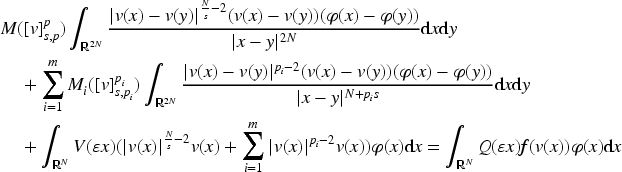
In this article, we study the existence of solutions to a non-autonomous anisotropic fractional equation
where is a positive parameter, , , and Further, the nonlinear function exhibits critical as well as supercritical exponential growth, while absorption potential and reaction potential are bounded continuous functions, and are Kirchhoff functions. By applying variational methods, we prove the existence of a nontrivial nonnegative solution to the given equation when is small enough.
The Kirchhoff problem, originally introduced by Kirchhoff, arises from the description of nonlinear vibrations in an elastic string. One can find recent development on fractional Kirchhoff models in Fiscella and Valdinoci (2014). These models account for the nonlocal tension stemming from fractional length measurements of the string. Anisotropic partial differential equations (PDEs) are motivated by phenomena or processes depending on direction. In case of image processing, such equations account for reducing noise while preserving edges by diffusing along, not across, the gradients. In material science, anisotropic PDEs can model the behavior of materials (e.g., crystals, elastic media) whose characteristics vary with orientation. In physical/biological systems, such equations describe the directional transport, growth, or pattern formation in diverse fields like fluid dynamics and biology. Combining the fractional Kirchhoff-type problem and anisotropic PDEs, it is expected that the resulting models can describe many phenomena in image processing, physical, biological, and material sciences, and inter-relationship among these areas.
In this article, we first consider an anisotropic Kirchhoff–Schrödinger equation involving a fractional -Laplace operator given by
where is a small positive parameter, , , absorption potential and reaction potential are bounded continuous functions, Kirchhoff functions are and , and the nonlinearity has an exponential critical growth. In addition, for and denotes the fractional -Laplace operator (up to a normalization constant) defined by
where is a sufficiently smooth function and
In order to study the problem (1.1), we assume that is a bounded continuous function satisfying
Using the penalized method and Ljusternik–Schnirelmann category, Nguyen and Rădulescu (2024) showed the existence of multiplicity and concentration of solutions to the problem (1.2). In the double phase case, Alves et al. (2019), Ambrosio and Rădulescu (2020) investigated the multiple and concentration of solutions to fractional equation
where is a parameter, and nonlinear reaction has the subcritical growth verifying certain conditions. When the equation (1.3) takes the form
where In 2021, Ambrosio and Repovs (2021) studied the multiplicity and concentration of solutions to equation (1.4) when , the potential function satisfies the global Rabinowitz condition and has a subcritical growth. In 2022, Nguyen Thin (2022) studied the problem (1.3) when has an exponential growth and satisfies the Rabinowitz condition. Based on Ljusternik–Schnirelmann category theory, suitable variational arguments and Nehari manifold, Nguyen showed that the existence of multiple solutions and their concentration on the set, where the potential attains its global minimum. Motivated by the forementioned work, Wang et al. (2023) studied the concentration of solutions to -Laplacian equation with Trudinger–Moser nonlinearity as follows:
where is a positive potential and is with subcritical growth in the sense of Trudinger–Moser, instead of assuming the Ambrosetti and Rabinowitz condition on the nonlinear function Using Nehari manifold, Pohozaev identity and penalized method, they constructed the solution of (1.5) that concentrates around any given isolated local minimum point of However, they did not obtain multiple solutions for the given problem. In 2023, Ambrosio and Radulescu (2024) studied the multiplicity of concentrating solutions to a -Schrödinger equation
where is small parameter, and The potential function is continuous and there exists a bounded open set such that They used the penalized method, Ljusternik–Schnirelmann category theory and Nehari manifold to get the multiple solutions of (1.6). In 2022, Zhang et al. (2022) discussed the double phase problem with competing potentials
where the nonlinearity is continuous function, the potentials and satisfy the conditions due to Ding and Liu (2013). Using the topological and variational tools from Nehari manifold analysis due to Szulkin and Weth (2010), and Ljusternik–Schnirelmann category theory, they showed the existence of positive ground state solutions and the relationship between the number of solutions and the topology set, where attained its global minimum and achieved its global maximum. In Zhang and Zhang (2022), Zhang-Zhang extended the results obtained in Zhang et al. (2022) to a nonlocal double phase problem
where the nonlinear function is continuous, is an absorption potential and is reaction potential satisfying the conditions due to Ding and Liu (2013). In 2016, Li et al. (2016) studied the problem
in the limit as under some suitable assumptions on the potential functions and , and the nonlinear function In 2020, Shiwata et al. (2021) studied the blow-up in finite time or global time of the solution to the Cauchy problem
where and for some and has an exponential growth in the sense of Trudinger–Moser. For initial data with energies below or equal to the ground sate level, they have shown that the dichotomy between finite time blow-up and global existence can be determined by means of a potential argument. In 2021, Majdoub and Tayachi (2021) studied the Cauchy problem
where and has an exponential growth and Using Banach’s fixed point theorem, they obtained the existence of a global solution to problem (1.10). Such problems are useful to find the standing wave solutions to equation (1.9) with In 2020, Fiscella and Pucci (2020) proved the existence of a weak solution to a Kirchhoff system involving fractional -Laplacian. For more results on Kirchhoff problem involving fractional -Laplacian, we refer the reader to Miyagaki and Pucci (2019), Xiang, Radulescu, and Zhang (2019), and Xiang, Zhang, and Repovs (2019). For a double phase equation, Isernia and Repovs (2020) discussed the existence of nodal solutions to a Kirchhoff problem involving fractional -Laplacian. The authors in Isernia (2020) also studied the fractional double phase equation. One can find more results on Kirchhoff problems involving nonlocal operators in the articles (Lai et al., 2025; Ledesma et al., 2024; Sun et al., 2024; Tripathi, 2025). In 2025, Li et al. (2025) studied the existence, concentration and multiplicity of solutions for -Laplacian equations with convolution term by using Pohozaev manifold, variational methods and Morse theory. In Deng et al. (2025), Deng, Luo, and Ledesma investigated the existence of a nonnegative weak solution to a nonlocal variational inequality.
As far as we know, there is only one article (Ambrosio, 2022) dealing with the equation (1.1) for , on when has a subcritical growth. The existence of weak solutions to (1.1) with Trudinger–Moser nonlinearity is yet to be studied. The aim of this work is to give the first result in this direction.
Let us first define some spaces related to our work. We denote by the fractional Sobolev space defined by
where is the seminorm Gagliardo given by
As argued in Pucci et al. (2015), is a uniformly convex Banach space with norm
For any let Setting we introduce a norm different from the one in (1.11) as
Notice that the two norms and are equivalent to Denote by equipped with the norm
Hence, is a uniformly Banach space. For each we consider the Banach space with norm
As argued in Pucci et al. (2015, Lemma 10), is uniformly convex Banach space and it is indeed a reflexive space. In addition, the embedding into is continuous for any via the condition and Theorem 6.9 (Nezza et al., 2012). Similarly, we can define the space We define endowed with the norm
Using the arguments employed in Pucci et al. (2015, Lemma 10), for any is uniformly convex Banach space and the sequences of embedding
are continuous. Then there exists a best constant for all satisfying
which can alternatively be written as
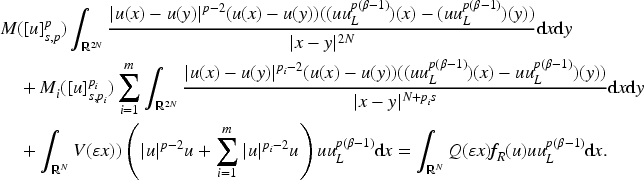
The function is said to be a weak solution to the problem (1.1) if
for any
Our main result in this article is given in the following theorem.
Let and hold. Then, there exists such that problem (1.1) has at least one nontrivial nonnegative weak solutions for any
The rest of the article is arranged as follows. In Section 2, we study an autonomous problem associated with (1.1). Using a variational method, the Lion-type lemma, a characteristic of the mountain pass level (Proposition 1), we show the existence of a ground state solution to problem (2.1). Section 3 studies the compactness of the Palaise–Smale sequence for the energy function associated with problem (1.1). In Section 4, we prove the existence of a weak solution to the problem (1.1). In the last section, we investigate the problem (1.1) when has a supercritical exponent growth. We use a suitable truncated function and study the modified problem. To obtain the solution for the original problem, we give an -estimate for the solution of the modified problem, and by the definition of the modified function, we derive the solution of the original problem. In the present work, we tackle the situation when equation (1.1) contains Kirchhoff functions. Precisely, we face difficulty in establishing the weak limit for the Palais–Smale sequence, which is a solution to the autonomous problem, and the compact property of the Palais–Smale sequence.
Autonomous Problem
In this section, we discuss the existence of a weak solution to a limit problem associated with (1.1) given by
where are constants. For problem (2.1), we use the energy function which has form
where and From the condition for any there exists a suitable constant satisfying
for all
[Zhang, 2019] Let and then the following inequality holds
Since is a density subspace of therefore, it follows by Lemma 1 that is well defined on Furthermore, is continuously embedded into and is well defined and belongs for all
If the conditions and hold, then there exist so that for all with
where and near and Furthermore, we assume that holds and If there is so that then
Let be a Nehari manifold associated with the autonomous problem and min–max level is defined by
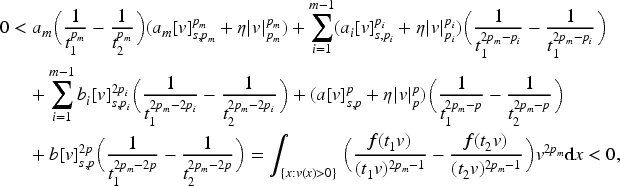
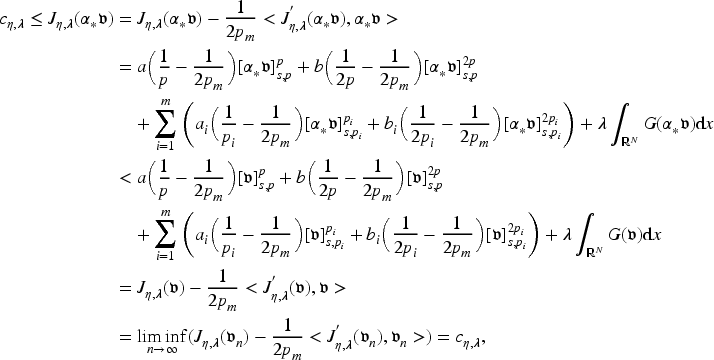
For each we show that there is a unique such that Denote by By Lemmas 2 and 3, we have that for all sufficiently small and for all sufficiently large. Then, admits at a point Using Fermat’s theorem, we deduce that and We consider the case The case can be proved in a similar manner and we omit the details for this case. Notice that if
By we know that is increasing on Let there exist for each so that Then, we get
which is impossible. Then, is unique. Setting and we get
and which implies that Furthermore, for sufficiently large and a fixed we deduce that . Thus, for all when is large enough. For any we consider , where is defined by Therefore, we get Hence, we have
We next claim that To get that inequality, we need to show that every path intersects with Indeed, if for any we have then or Note that
Using Trudinger–Moser inequality, as is small enough, we have Then, on which cannot hold. Now, we show that is also not true for . Indeed, by the condition we have
Clearly, and for all and and
Thus, for any it holds that
By definition of and continuity of on we obtain when and near Hence, (2.15) provides a contradiction when is near . Thus, and
If the conditions hold, then problem (2.1) admits a nontrivial nonnegative ground state solution.
Using Lemmas 2 and 3 and a version of Mountain Pass Theorem without the Palais–Smale condition (Rabinowitz, 1986; Willem, 1996), we show that there is a sequence such that
where is defined by
By Proposition 1, we have
where is Nehari manifold for Since is a sequence in therefore,
as Next, we prove that is bounded sequence in From (2.16) we get
where is given in Note that
Then, we obtain
due to From (2.17) and (2.18), the following inequality holds
Since
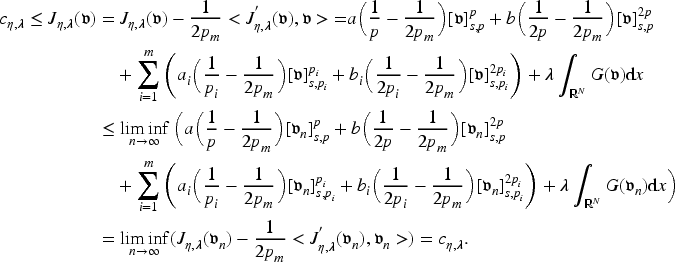
where , therefore, the sequence must be bounded in via (2.19). Then, we have
as In consequence, we have
and
for all Thus, we obtain
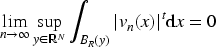
Now, it will be shown that there exist and satisfies
for some Combining (2.13) and (2.22), as is sufficiently large, we obtain
By Lemma 6, it follows that as Then
as Therefore, strongly in Thus, we deduce that
as which contradicts that Therefore, (2.23) holds. Denoting we obtain by using (2.23) that
Since and are invariant translation, therefore, we have
From the property we deduce that is a bounded sequence in and there is such that weakly in in and in outside a set with measure zero. Observe that by (2.24), and hence we obtain We now prove that By employing the arguments used in Thin (2022), we have
and
for all and Furthermore, we have
Upto a subsequence, we can assume that for all By Fatou’s lemma, we have for all We assume that for some Without loss of generality, we may assume that Combining (2.25) to (2.28), we obtain
for all From (2.29), we get Using Trudinger–Moser inequality, it holds that as and near zero. Then, there exists so that By the condition is an increasing function on Hence, we have
which is a contradiction. Then, for all and we get In addition, by the assumption on we deduce that By Fatou’s lemma, we have
Hence, is a ground state solution to the problem (2.1).
The Auxiliary Problem
The energy functional for equation (1.1) is given by
Observe that the energy functional is well defined on by the condition , via and and the weak solutions of the problem (1.1) are critical points of Associated with the Nehari manifold of (1.1), denoted by , is defined as
for some and all so that is sufficiently small. If (3.1) is not true, then there exists so that We see that (3.6) is true when we substitute as is sufficiently large. Therefore, we obtain
Note that we may assume when is large enough, then when is large enough and
Dividing both sides of the above inequality by and taking the limit we get a contradiction when is small enough. Thus, there exists such that for all
The following lemma is said to be geometric condition in Mountain Pass Theorem of energy function We omit the proofs.
The energy functional has the properties:
There are real numbers so that for all with
There is a function so that and
From Lemma 7 and the version of Mountain Pass Theorem (Rabinowitz, 1986), there exists a sequence that is,
where
and
As argued in Proposition 1, we can get the following result.
By using the arguments employed in Thin (2022, Lemma 9), we can formulate the following result.
Let be a sequence for so that weakly in and
where is a suitable constant and Then one of two following statements hold:
in or
there exist a sequence and constants so that
Assume that is a sequence which weakly converges to and
where is a constant and it is chosen to be near If in then where
Denote by a sequence satisfying
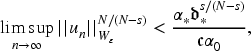
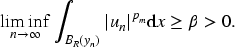
Claim 1.The sequence is such that Conversely, we assume that there is a number and up to a subsequence so that
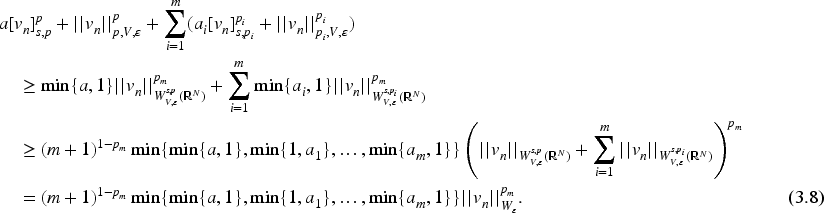
From and the boundedness of in we have It means that
Furthermore, recalling that we have
if and
if We only solve the case as the case can be proved in a similar manner. From (3.11) and (3.13), we deduce that
For any there is a positive real so that
via the conditions and From (3.14) and (3.15), we have
For any we have in Using (3.9), Hölder inequality and Trudinger–Moser inequality, we get and there exists so that
Then, we have
for sufficiently enough, where Due to the boundedness of sequence in and the continuous embedding from into there exists a suitable constant so that and From in and is a continuous function, and (3.15), there is so that
and
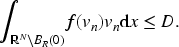
We denote As argued in Thin (2022), there is an element so that weakly in and , and there is a bounded set and so that and for all and , when is large enough. From (3.14) and (3.18), we obtain
for an arbitrary where Using the condition , Fatou’s lemma, (3.10), (3.20) and for all we get
for an arbitrary when is large enough. It is not possible and thus, Claim 1 is proved.
Now, we investigate the following two cases.
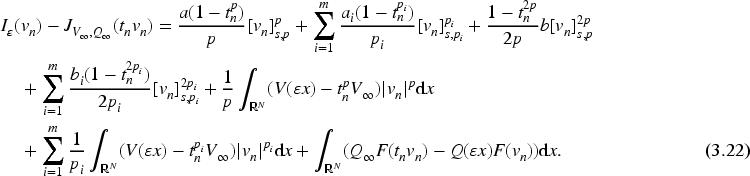
Case 1. Choose a subsequence if necessary and suppose that Since and therefore, we have
Observe that
From (3.15), in . Hence, by the condition , we obtain
for some suitable constant Similarly, we can get
By the boundedness of sequence in we have
From the condition using Trudinger–Moser inequality, it follows that
Like Lemma 11 in Thin (2022), we can formulate the following result.
Let be a for satisfying
where is a suitable constant and If then has a convergent subsequence in
From the condition and by the arguments used in Proposition 2, we deduce that is a bounded sequence in Choosing a subsequence if necessary, we assume that
As done in Proposition 2, we can get Let by the Brezis–Lieb lemma, as we obtain
for any Indeed, through the arguments employed in Thin (2022), we have
and
as for all Since is a bounded sequence in we deduce that
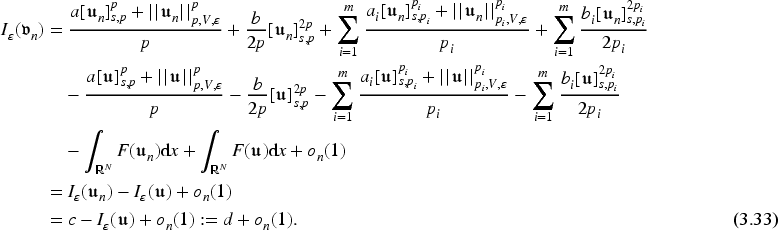
as , for all Then, it follows from (3.35) and (3.36) that (3.34) holds true. Since therefore, we have
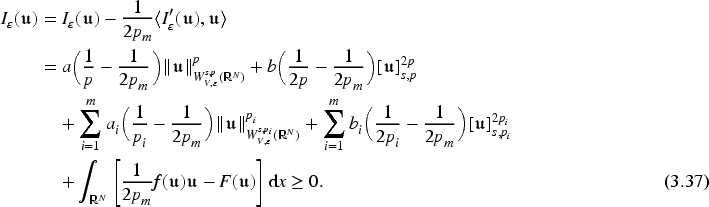
Combining (3.33), (3.34) and (3.37), we obtain that is a sequence with level Thus, we have in (see Lemma 9) and hence, we deduce that and in
Proof of Theorem 2
Let the energy function associated with the problem be defined by
Note that is the minimax level related to and is the Nehari manifold associated to which is given by
Proof of Theorem 2.
We show that there is a positive real number such that for any As it follows from Lemma 10 that satisfies the condition and has a critical point at level by Lemma 7. From the condition we have and Assume that is a function defined by
For each let where is a ground state solution of the problem due to Proposition 2. For each there is a real number so that and
For an arbitrary function we have
Since therefore, we get
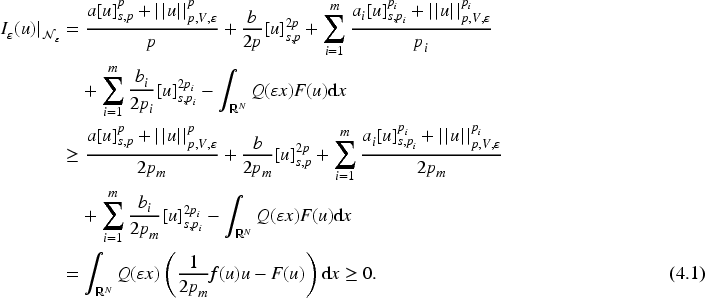
From (4.1), is a bounded sequence as for each Indeed, if for a fixed then we have
via condition which contradicts (4.1). Thus, we may assume that as As the support of is compact, we deduce by Vitali’s theorem that
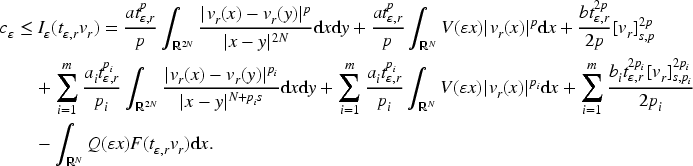
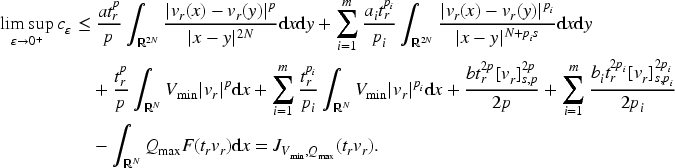
Note that and in as (see Lemma 2.3 Alves et al., 2019) and using condition we can show that as Then, we get
From Lemma 4, we get
with and where
with all large enough. For any sequence of by the arguments used in Proposition 2, we obtain
for all large enough. Now, the conclusion of this theorem follows from Lemma 10, that is, there exists such that
Supercritical Exponential Growth
In this section, we consider in equation (1.1), where , and is a continuous function satisfying the conditions:
for all and
There exists such that for all where
There exists and such that for all
The function is increasing on
There exists a constant large enough such that for all
Then, from the condition and (5.1), for any , it follows by employing the arguments used in Alves and Shen (2024, Lemma 3.2) and Shen and Radulescu (2024b, Lemma 2.2) that there exist constants such that
for all and all where is given in the condition By the arguments used in Alves and Shen (2024, Lemma 3.1), we obtain
From , , (5.2) and (5.3), we observe that satisfies the conditions Next, we consider the modified problem given by
Now, we give an estimate for the solution of equation (5.4).
Suppose that the conditions and hold. Furthermore, there exists so that If is a nontrivial nonnegative solution of the equation
then there exists such that
We consider the energy function associated with (5.5) as
Here, the solution of (5.5) can be obtained as in Theorem 2. Then, by the arguments employed in Proposition 1, we have
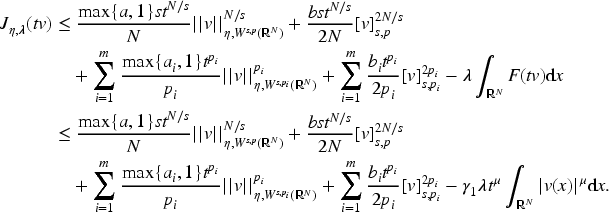
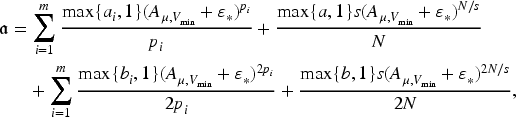
where is the Nehari manifold associated with By the condition and the arguments used to derive (4.2)–(4.4), we have that satisfies the inequality
for some where
and
for small enough and all Furthermore, we have Employing the arguments used to derive (2.20)–(2.22), we get
Let us fix Then, by the conditions and and the arguments used in Shen and Radulescu (2024b, Lemma 2.2), for any and we can find independent of such that
Clearly, Then, for any there exists independent of such that
for all By the arguments as used in Alves et al. (2019, Lemma 6.1), we have
for all Since for all therefore, it follows from the foregoing inequality and (5.13) that
Since and the continuous embedding , therefore, there exists satisfying
From (5.11), by the Trudinger–Moser inequality in with and satisfying the conditions near we can find a constant such that
Letting in the above inequality, we obtain
Fixing we find that and (5.17) still holds when we replace by It will lead to
For any positive integer we apply (5.18) up to times to get
which, on taking the limit yields
where
As an application of Theorem 2, we present the following result.
Let and hold. Furthermore, there exists so that Then, there exists a positive real number such that equation (5.4) has at least one weak solution for all
If we choose in (5.1), then by the definition of Hence, the solution obtained by Theorem 3 is a solution of equation (1.1) and we have the following result.
Assume that the conditions and hold. Furthermore, there exists such that Then, for a positive real number , the problem (1.1) with has at least one weak solution for all
Footnotes
Acknowledgments
The authors thank the reviewer for his/her useful comments on their work.
Funding
The author disclosed receipt of the following financial support for the research, authorship, and/or publication of this article: The research results of Nguyen Van Thin are supported by Thang Long University under grant number: DTV-2025-01.
Declaration of Conflicting Interests
The authors declared no potential conflicts of interest with respect to the research, authorship, and/or publication of this article.
ORCID iDs
Bashir Ahmad
Nemat Nyamoradi
Nguyen Van Thin
References
1.
AlvesC. O.AmbrosioV.IserniaT. (2019). Existence, multiplicity and concentration for a class of fractional -Laplacian problems in . Communications on Pure and Applied Analysis, 18(4), 2009–2045.
2.
AlvesC. O.ShenL. (2024). On existence of solutions for some classes of elliptic problems with supercritical exponential growth. Mathematische Zeitschrift, 306, 29.
3.
AmbrosioV. (2022). Kirchhoff type equation in involving the fractional (p,q)-Laplacian. The Journal of Geometric Analysis, 32, 135.
4.
AmbrosioV.RădulescuV. D. (2020). Fractional double-phase patterns: Concentration and multiplicity of solutions. Journal de Mathematiques Pures et Appliquees, 142, 101–145.
5.
AmbrosioV.RadulescuV. D. (2024). Multiplicity of concentrating solutions for -Schrödinger equations with lack of compactness. Israel Journal of Mathematics, 262, 399–447.
6.
AmbrosioV.RepovsD. (2021). Multiplicity and concentration results for a -Laplacian problem in . Zeitschrift für Angewandte Mathematik und Physik, 72, Article number: 33.
7.
BisciG. M.ThinN. V.VilasiL. (2022). On a class of nonlocal Schrödinger equations with exponential growth. Advances in Differential Equations, 27(9-10), 571–610.
8.
DengS. B.LuoW. S.LedesmaC. E. T. (2025). Combined effects for a class of fractional variational inequalities. Opuscula Mathematica, 45(2), 119–143.
9.
DingY. H.LiuX. Y. (2013). Simiclassical solutions of Schrödinger equations with magnetic fields and critical nonlinearities. Manuscripta Mathematica, 140, 51–82.
10.
FiscellaA.PucciP. (2020). Degenerate Kirchhoff -Fractional systems with critical nonlinearities. Fractional Calculus & Applied Analysis, 23(3), 723–752.
11.
FiscellaA.ValdinociE. (2014). A critical Kirchhoff type problem involving a nonlocal operator. Nonlinear Analysis: Theory, Methods & Applications, 94, 156–170.
12.
IserniaT. (2020). Fractional -Laplacian problems with potentials vanishing at infinity. Opuscula Mathematica, 40(1), 93–110.
13.
IserniaT.RepovsD. (2020). Nodal solutions for double phase Kirchhoff problems with vanishing potentials. Asymptotic Analysis1–26. https://doi.org/10.3233/ASY-201648
14.
LaiL. Z.QinD. D.HuD.ZhangJ. (2025). Existence of ground state solution for critical N-Laplacian Kirchhoff-type problem with convolution nonlinearity. Bulletin of Mathematical Sciences2550013.
15.
LedesmaC. E. T.GutierrezH. C.RodriguezJ. A.BonillaM. M. (2024). Properties of the least action level and the existence of ground state solution to fractional elliptic equation with harmonic potential. Opuscula Mathematica, 44(5), 749–765.
16.
LiY. Q.NguyenT. V.ZhangB. L. (2025). Existence, concentration and multiplicity of solutions for (p, N)-Laplacian equations with convolution term. Bulletin of Mathematical Sciences, 15(1), 2450009.
17.
LiS. J.SantosC. A.YangM. (2016). Existence of semiclassical states for a quasilinear Schrödinger equation on with exponential critical growth. Acta Mathematica Sinica, 32(11), 1279–1296.
18.
LiaQ.YangZ. (2016). Multiple solutions for a class of fractional quasi-linear equations with critical exponential growth in . Complex Variables and Elliptic Equations, 61, 969–983.
19.
MajdoubM.TayachiS. (2021). Global existence and decay estimates for the heat equation with exponential nonlinearity. Funkcialaj Ekvacioj, 64(2), 237–259.
20.
MiyagakiO. H.PucciP. (2019). Nonlocal Kirchhoff problems with Trudinger–Moser critical nonlinearities. NoDEA Nonlinear Differential Equations and Applications, 26(4), 27.
21.
NezzaE. D.PalatucciG.ValdinociE. (2012). Hitchhiker’s guide to the fractional Sobolev spaces. Bulletin des sciences mathématiques, 136, 521–573.
22.
NguyenT. V.RădulescuV. D. (2024). Multiplicity and concentration of solutions to fractional anisotropic Schrödinger equations with exponential growth. Manuscripta Mathematica, 173, 499–554.
23.
PariniE.RufB. (2018). On the Moser–Trudinger inequality in fractional Sobolev–Slobodeckij spaces. Atti della Accademia Nazionale dei Lincei. Rendiconti Lincei. Matematica e Applicazioni, 29, 315–319.
24.
PucciP.XiangM.ZhangB. (2015). Multiple solutions for nonhomogeneous Schrödinger–Kirchhoff type equations involving the fractional -Laplacian in . Calculus of Variations and Partial Differential Equations, 54, 2785–2806.
25.
RabinowitzP. (1986). Minimax methods in critical point theory with applications to differential equations. AMS CBMS Regional Conference Series in Mathematics. American Mathematical Society.
26.
RabinowitzP. (1992). On a class of nonlinear Schrödinger equations. Zeitschrift für Angewandte Mathematik und Physik, 43(2), 270–291.
27.
ShenL.RadulescuV. D. (2024a). Concentration of ground state solutions for suppercritical zero-mass -equations of Choquard reaction. Mathematische Zeitschrift, 308, 66.
28.
ShenL.RadulescuV. D. (2024b). Zero mass -Laplace equations with Stein–Weiss convolution: Supercritical exponential case. Preprint.
29.
ShiwataM.RufB.SaniF.TerraneoE. (2021). Asymptotics for a parabolic equation with critical exponential nonlinearity. Journal of Evolution Equations, 21, 1677–1716.
30.
SunX. Q.FuY. Q.LiangS. H. (2024). Multiplicity and concentration of solutions for Kirchhoff equations with exponential growth. Bulletin of Mathematical Sciences, 14(3), 2450004.
31.
SzulkinA.WethT. (2010). The method of Nehari manifold. D. Y. Gao & D. Motreanu (Eds.), Handbook of Nonconvex Analysis and Applications (pp. 597–632). International Press.
32.
ThinN. V. (2022a). Multiplicity and concentration of solutions to a fractional -Laplace problem with exponential growth. Annales Fennici Mathematici, 47(2), 603–639.
33.
ThinN. V. (2022b). Multiplicity and concentration of solutions to a fractional -Laplace problem with exponential growth. Journal of Mathematical Analysis and Applications, 506(2). Article number 125667.
34.
TripathiV. M. (2025). Multiplicity result for mixed local and nonlocal Kirchhoff problems involving critical growth. Opuscula Mathematica, 45(4), 523–542.
35.
WangL.WangJ.ZhangB. (2023). Concentration of solutions for an -Laplacian equation with Trudinger–Moser nonlinearity. Electronic Journal of Qualitative Theory of Differential Equations, 14, 1–32.
36.
WillemM. (1996). Minimax theorems. Birkhäuser.
37.
XiangM.RadulescuV. D.ZhangB. (2019). Fractional Kirchhoff problems with critical Trudinger–Moser nonlinearity. Calculus of Variations and Partial Differential Equations, 58, 57.
38.
XiangM.ZhangB.RepovsD. (2019). Existence and multiplicity of solutions for fractional Schrödinger–Kirchhoff equations with Trudinger–Moser nonlinearity. Nonlinear Analysis, 186, 74–98.
39.
ZhangC. (2019). Trudinger–Moser inequalities in fractional Sobolev–Slobodeckij spaces and multiplicity of weak solutions to the fractional-Laplacian equation. Advanced Nonlinear Studies, 19, 197–217.
40.
ZhangW.ZhangJ. (2022). Muliplicity and concentration of positive solutions for fractional unbalanced double phase problems. The Journal of Geometric Analysis, 32, Article number 235.
41.
ZhangJ.ZhangW.RadulescuV. D. (2022). Double phase problems with competing potentials: Concentration and multiplication of ground states. Mathematische Zeitschrift, 301, 4037–4078.