In this paper, we investigate the existence/non-existence, exact asymptotic behavior at the boundary and uniqueness of solutions to infinite boundary-value problems of the -Laplace equation with lower-order nonlinear gradient terms in bounded open subsets of . The main tool is a recently obtained comparison principle, that captures the subtlety that arises due to the presence of the nonlinear gradient term. To the best of our knowledge, the results contained herein are comprehensive and cover topics that have not been addressed in the literature, except for very special cases.
Introduction
Let be a bounded open set, and a fixed constant. Consider a continuous function , where . A function is said to be a subsolution (respectively, supersolution) of
in if and only if , and
We say is a solution of (1.1) provided is a subsolution (written ) of (1.1) and is a supersolution (written ) of (1.1) in . In other words, is a solution of (1.1) if and only if
We remark that if , then a simple density argument shows that we can take as a test function in the above definitions.
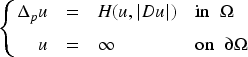
Our primary objective in this paper is the investigation of the following infinite boundary-value problem for given continuous functions , and given parameters and .
Here, by a solution to () we mean a function that solves (1.1) in , with , and satisfies as . Such solutions are known in the literature as large solutions or boundary blow-up solutions. We will use a similar definition of the boundary blow-up solution when the right-hand side term of the PDE in is replaced by any general term .
Infinite boundary-value problems have their roots in mathematical physics and Riemannian geometry (see Bieberbach 1916; Rademacher 1943). In fact, the first such application goes all the way back to 1916 when Bieberbach in Bieberbach (1916) sought to find a large solution of in a bounded smooth planar domain in order for to define a complete Riemannian metric on with Gaussian curvature . Several decades later, and motivated by a problem in mathematical physics, Rademacher studied in Rademacher (1943) a similar problem in a bounded smooth domain . It was not until the works of J.B. Keller in Keller (1957) and R. Osserman in Osserman (1957) that interest in infinite boundary-value problems garnered widespread interest. In 1957, these authors independently studied large solutions of in bounded smooth domains . They provided necessary and sufficient conditions on in order for the aforementioned equation to have a large solution in . To wit, let be a non-decreasing continuous function such that and for . Keller and Osserman showed that admits a solution in if and only if
where is the antiderivative of that vanishes at zero. For instance, when the problem admits a solution in a if and only if .
The literature on boundary blow-up problems is extensive, and it is impossible to give an exhaustive list. In this paper, we will only mention works that are closely aligned with our work and that served as motivation to our investigation in this paper.
Problem has been studied widely when . Let us mention a few works in this regard. In the paper Díaz and Letelier (1993), G. Diaz and R. Letelier, among many other results, show the existence of solutions to () when for and . Similarly, J. Matero in Matero (1996) and F. Gladiali and G. Porru in Gladiali and Porru (1998) show that Problem (), with , has a solution for a nonlinearity where is a non-decreasing continuous function provided that (i) of (2.1), given below, holds.
In sharp contrast to the type of problems mentioned above, Problem () with is vastly different and involves some subtleties. The nonlinear lower gradient term in Problem () introduces additional complexities that require careful analysis. In the case , such problems appear in stochastic control theory and were studied by Lasry and Lions (1989), with , but with in place of . Here is a constant, and . In Bandle and Giarrusso (1996), C. Bandle and E. Giarrusso investigated existence and asymptotic boundary behavior to Problem () with and . See also Bandle and Essen (1994).
The recent paper (Lair & Mohammed, 2023) investigates the existence and non-existence of solutions to Problem () for the case. We refer to the works (Zhang, 2006, 2014) of Z. Zhang for discussion on existence and asymptotic boundary behavior of large solutions to Problem for the case . In fact, Zhang (2014) studies large solutions of , when and are Hölder continuous on , positive in , but are allowed to vanish on the boundary. In the papers Cîrstea and Rădulescu (2006, 2007), Cîrstea and Rădulescu pioneered the use of Karamata theory to study sharp boundary asymptotic behavior of solutions for equations of the form () for the case in the absence of gradient terms.
The work on Problem () for the -Laplacian case is sparse, at least to the best of our knowledge. The lack of a comprehensive study in the literature of Problem for general can perhaps be explained by the fact that suitable comparison principle that can be used in analyzing the problem has been missing. Recently, A. Vitolo and one of the authors of the paper have studied in Mohammed and Vitolo (2024a, 2024b) comparison principles for solutions to the PDE in , and with the aid of these newly availed tools, we are now able to make complete investigation into Problem .
As already noted in the works of Bandle and Giarrusso (1996) for the case , the boundary blow-up problem for the equation exhibits a drastically different behavior and new type of growth conditions on and are needed. This will the subject of a forthcoming work.
Basic Assumptions
For easy reference, in this section we collect all the basic assumptions used in this paper. Unless specified differently, will always denote a bounded open subset of with boundary for some . Let us mention from the outset that throughout, are always assumed to be continuous. Also in this paper, we will say is non-decreasing (respectively, increasing) on a non-empty subset to mean that (respectively, ) whenever and . A similar definition is used for non-increasing or decreasing.
The following conditions on and , stated vis-à-vis the relative ranges of , will allow us to use comparison principles to investigate Problem ().
Let be non-decreasing, and furthermore assume one of the following is true.
is increasing when , and when .
is increasing when , is increasing when , and when .
Note that in (i) of (A-1), we only demand that and are non-decreasing (and of course, continuous as well) when , and .
Next, we consider conditions on and that are needed to study Problem when .
The following Keller–Osserman type condition on and , non-negative on , will play a crucial role in the investigation of .
Here, and are the antiderivatives of and , respectively, that vanish at zero.
It is clear that when , holds if either of the following is true.
It is convenient to refer to (i) of (2.1) as the -Keller–Osserman condition, and (ii) of (2.1) as the -Keller–Osserman condition. We wish to point out that if is non-decreasing, for some , and , then the -Keller–Osserman condition, and hence , holds.
We will use the following condition to show existence of solution to when .
.
Obviously, holds when the -Keller–Osserman condition holds. It also holds provided that and are non-decreasing and for all . See the discussion at the end of Section 4.
It will be convenient to adopt the following convention. We will simply say holds when holds for , and when holds for .
The uniform local boundedness of solutions to (1.1) is a crucial result in the proof the existence of a solution to Problem . However, to achieve this we will need the following limits:
See (4.2) in Section 4 for the notations and . The limit in (i) follows from condition when . However is not sufficient for the limit (i), when or for the limit (ii), when . Therefore, we need the following additional condition when to ensure that these limits hold.
We would like to emphasize that whenever condition (L-I) is invoked, we always assume that .
We refer to the paper Bhattacharya and Mohammed (2021, Appendix B) to see that (L-I) and together imply the limit in (i). Later in Section 4 we will verify that (L-I) and are sufficient for the limit in (ii).
In our investigation of boundary asymptotic estimates for solutions of for the case , the class of rapidly varying functions, which we now recall, will play a crucial role. We will say that a function is regularly varying (at infinity) of index , written , if is a positive measurable function on for some and if
We will also use the following conditions to study uniqueness of solutions to .
, and are non-decreasing in .
If for some , then (i) of (2.1) holds. Similarly if for some , then (ii) of (2.1) holds. See Appendix B for proof of these assertions. In such cases, we will use and to denote the functions determined by the following relations for all .
Note that and as . We also remark that, when the condition (N-D) is strictly weaker than requiring to be non-decreasing. Of course, when , the condition merely states that is non-decreasing.
When , and assuming that condition holds, we will define by the relationship:
Main Results
In this section, we collect the main results of the paper. Our first result gives a necessary and sufficient condition for the existence of solutions to Problem for the case . At this point, we would like to draw the reader’s attention to the convention we have adopted in Remark 2.1.
Existence
Assume that (A-1) and (L-I) hold, for , and . If holds, then Problem admits a solution in .
Our first non-existence result as follows.
Non-existence for the case
Assume that condition (A-1) holds. Then Problem has no non-negative solution in under either of the following conditions.
for , , and fails.
, and is non-decreasing. When , we assume that is increasing.
Assume that the assumptions of Theorem 3.2 hold. Then Problem has no non-negative solution in . If such a solution were to exist, then Lieberman (1991, Theorem 1.7) would imply that , which is not possible by Theorem 3.2.
The next result shows that Problem has no non-negative solution if .
Non-existence for the case
Let be a bounded open set with an interior ball condition. Suppose that and satisfy condition (A-1), with for and . If, in addition, as , and , then Problem has no non-negative solution in .
The following gives us the asymptotic boundary behavior of solutions of for a wide class of functions and , and when . In its statement, we use the notation for the distance of to the boundary .
Boundary Asymptotic Estimates for the case
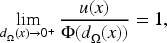
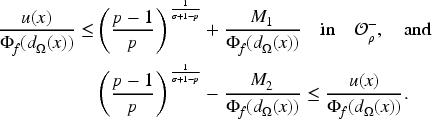
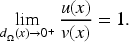
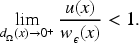
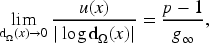
Let be a bounded domain with boundary , and let . Assume that condition (A-1) holds for and . Moreover, suppose that for some , and for some . Then for any solution of we have
When , the following theorem gives the asymptotic boundary behavior of solutions to Problem .
Boundary Asymptotic Estimate for the case
Let be a bounded domain with boundary , and . Suppose that and satisfy condition (A-1), and that holds. Furthermore, assume that , and for some Then, for any solution of , we have
As consequences of Theorem 3.5, and Theorem 3.6 we obtain our main result on uniqueness of non-negative solutions to Problem .
Uniqueness
Let be a bounded domain with boundary . Let satisfy conditions (A-1), and (N-D)1. For , we assume that , with , and , with . If , then Problem admits at most one non-negative solution in the class . On the other hand, for , we assume that holds, that and for some Then Problem admits at most one non-negative solution in the class .
Preliminaries and Auxiliary Results
A crucial tool we need in studying Problem () is the comparison principle. Since a significant portion of this work focuses on Problem (), let us highlight a comparison principle from Mohammed and Vitolo (2024a, Theorem 1.3, Theorem 1.4) and Mohammed and Vitolo (2024b, Theorem 1.3, Theorem 1.4) that is strictly relevant for our purpose in this paper.
Comparison Principle
Let be a bounded open set, and let satisfy condition (A-1). Suppose such that
Our investigation of Problem () is intimately related to an initial-value problem (IVP) of the following kind, where is any given constant.
Concerning existence of a solution to () we require that is a continuous function that satisfies the following.
is non-decreasing in for each .
for .
Under the assumptions (H-1) and (H-2) on given above, Problem () admits a solution , for some . We assume that is the maximal interval of existence of . Moreover, we also have and in . Since we couldn’t find a suitable reference for () that meets our needs, and to ensure thoroughness, we’ve opted to incorporate a comprehensive discussion of the IVP () in Appendix A.
While may not exist at , the differential equation in () holds, in the classical sense, in the open interval . Therefore satisfies the equation:
Suppose that is a solution of Problem (). Given the function
For the rest of this section we focus on the IVP () for a given , where we take with non-decreasing, continuous functions such that , and for . Notice that in this case satisfies both conditions (H-1) and (H-2). For , Problem () has recently been investigated in the papers (Lair & Mohammed, 2023; Zhang, 2014).
Let us now focus on the IVP () and assume that is a solution of Problem () on a maximal interval of existence , where . Hereafter, it will be convenient to use the following notations.
We multiply both sides by and integrate on for any . We find
We first suppose that .
Letting in (4.4), and recalling that and are non-negative on , we find for
where, in the last inequality we have used Young’s inequality for any constant . We choose , and rearrange to write
for some positive constant , depending on and . In the sequel, we will use to denote a positive constant that we allow to change from line to line, but will always depend on at most and . Taking the root in (4.5) we find
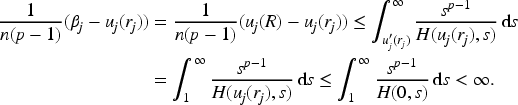
Integrating this on for we find
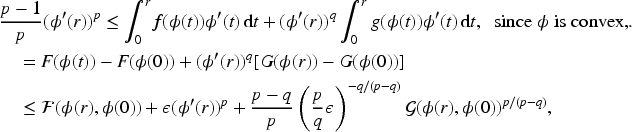
Next we estimate the integral in (4.7) from below. We begin by integrating the equation in () on for . Exploiting the convexity of in we get
Upon using this last inequality in (4.1) we obtain
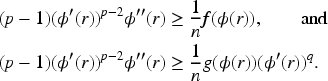
That is
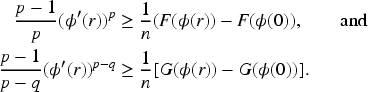
As a consequence of (4.8), the following two inequalities hold for all .
Multiplying both sides of each inequality by and then integrating leads to
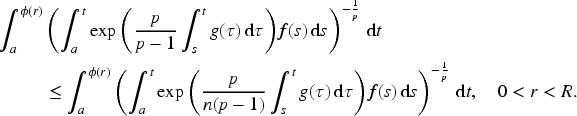
Notice that the above two inequalities hold for . Thus we obtain
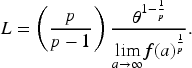
In fact, here the constant in (4.9) can be given explicitly as
Let us now assume that satisfy condition (A-1) and also the -Laplacian version of the Keller–Osserman condition for . Let be the maximal interval of existence of . On letting in (4.10), it follows that
where is the maximal interval of existence of in the IVP (), when .
Finally, under condition (L-I), and (KO), let us show that as where is defined by (4.20). Let us first compute (where we will momentarily use for the positive constant ) the following.
Therefore, for fixed , and an integer we have (using and in (4.22) for the first and the last two integrals below, respectively)
Let be the limit of the right-hand side of the inequality in (4.23), as . Let us first assume that as . Then, since , we see that
We then let to get the desired conclusion. Suppose now as . Then we obviously find from (4.23) that . This concludes the proof that as under the assumptions (L-I) and .
Problem
We begin with a lemma which will provide us, under suitable assumptions on and , with uniform bound on non-negative solutions of
In the following lemma, we will give a uniform local bound for solutions of (5.1). In the lemma, in addition to , we will also assume that condition (L-I) when . Recall that is defined by (4.12) in case , and is given by (4.20), when . As a consequence of the assumptions and (L-I), we recall that as , and hence we have
Suppose that and satisfy (A-1). Furthermore, assume that and that conditions and (L-I) hold. Then there is a non-increasing function such that for any subsolution of (5.1) we have
As a consequence of condition , and (L-I) we see that is a well-defined decreasing function. Here is as given in (4.12) when , while is as given in (4.20), when . As noted in (4.11), and (4.21), we recall for any . We extend the definition of the inverse function to the interval by setting . Let be any subsolution to (5.1), and fix . First we assume that , and take any . Let be a solution to (), with as the maximal interval of existence so that as . Then, we note that , and consequently we have the strict inclusion . We claim that . To see this, let , for . Then is a solution of in , and on . This implies, by the comparison principle, Theorem A, that in . This would, in particular, imply that as asserted. Therefore, in this case we have shown that for any . In other words, we find . Suppose now . Then for any . Thus for any . Arguing as in the above it would follow that for all so that .
Thus, in either case we have shown that for , where
If , then the strict monotonicity assumption on in Lemma 5.1 can be dropped. The strict monotonicity of was needed to apply the Comparison principle, Theorem A, in the presence of the gradient term.
Proof of Theorem 3.1. Let us first suppose that holds. For each positive integer , consider the Dirichlet Problem
Note that is a subsolution and is a supersolution of (5.2). Therefore, according to Véron (2017, Corollary 1.4.5), Problem (5.2) admits a solution such that in . According to Lieberman (1988, Theorem 1), we observe that belongs to for some .
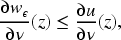
We invoke Lemma 5.1 to conclude that for and some non-increasing function on , independent of , and hence is locally uniformly bounded on . The Comparison Principle, Theorem A, shows that in for all . Let for . Since is locally uniformly bounded in , we use Lieberman (1991, Theorem 1.7), and apply the Cantor diagonal argument to extract a subsequence of , which we will continue to denote by the same, such that and uniformly on compact subsets of for some . In fact, it can be easily seen that in the weak sense, and that . We also note that , and hence on . So it remains to show that is a solution of the PDE in Problem . It is clear that belongs to . So, let and suppose that . The uniform convergence of and the continuity of on show that
Similarly, the uniform convergence of and shows that
Therefore we conclude that
Proof of Theorem 3.2. By way of contradiction, suppose that has a solution . Fix and . Let us first suppose that (i) holds. Let be a solution to (), where is the maximal interval of existence. Since condition fails, we see from (4.14) that . Then is a solution of (5.1) in , and thus on . By the comparison principle we conclude that in . In particular, , a contradiction. On the other hand, if (ii) holds, then is a solution of (5.1), and by comparison principle, see Leonori et al. (2017, Corollary 3.1), we conclude that in , which again leads to a contradiction.
Let satisfy (A-1), , , and for .
Assume that one of the following is true:
,
and (L-I) holds.
If satisfies the -Keller–Osserman condition, then Problem has a non-negative solution in .
Assume that one of the following is true.
as , and for some ,
, for and (L-I) holds.
Then Problem has a non-negative solution in .
Suppose is bounded, for some , and .
If satisfies the -Keller–Osserman condition and (L-I) holds, then Problem admits a non-negative solution in .
If does not satisfy the -Keller–Osserman condition, then Problem has no non-negative solution in .
(I)-(a): Under the given assumptions, we see that and (L-I) hold. Therefore, Theorem 3.1 implies that Problem has a non-negative solution in .
(I)-(b): Let . Since for some and , then (ii) of (2.1) holds. Therefore and (L-I) are satisfied. Therefore, Theorem 3.1 applies to show that Problem has a non-negative solution in . If , then holds. Hence, the claim of existence follows from Theorem 3.1.
(II): The hypotheses show that for some constants , we have
As a consequence, the desired conclusion follows from Theorems 3.1 and 3.2.
Assume condition (A-1). Suppose that holds for , and that , where is as defined in (4.14) for , and is given as in (4.19) when . Then any solution in of , if it exists, must be positive in .
Let be a solution of , and let us assume, if possible, that there is such that . Let be a solution to () with as its maximal interval of existence, and where is chosen such that . This is possible, since (4.14) and (4.19) show that as as a result of the assumption . Now, we recall is a solution of (5.1) and . Therefore, on . But, then by the Comparison Principle, Theorem A, we conclude that in . In particular, we see that , which is a clear contradiction.
Problem
In this section we show that Problem has no non-negative solution in if . In fact, we will show that the following problem
does not admit any non-negative solution under some suitable assumptions on the Hamiltonian . In addition to conditions (H-1) and (H-2) we already considered on the continuous function , we will also make the following assumptions.
is non-decreasing in each variable.
.
and as .
We will also need for the PDE in to enjoy a comparison principle. We direct the reader to the recent paper (Mohammed & Vitolo, 2024a, 2024b) for structure conditions on so that the following comparison principle holds as a special case.
Let such that
If on , then in .
As noted earlier, it is our objective in this section to show that Problem has no non-negative solution when satisfies (H-2)(H-5), and (H-c). In preparation for this, let us first consider a radial solution of in a ball , where we assume that is a continuous function that satisfies conditions (H-2), and (H-3). We begin by observing that , where , and is the center of , is a solution of
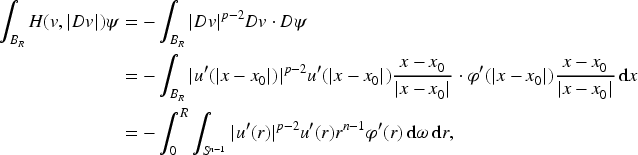
To see this, let us show first that the ODE in (6.1) holds in the distributional sense. Let , and set so that , and vanishes in for some sufficiently small . Note that
By definition of solution we have
where we have used to denote the unit sphere in . Thus, we have
In other words,
showing that (6.1) holds in the sense of distributions.
Since is continuous on , (6.1) shows that is in (see Hörmander, 1983, Corollary 3.1.5). This concludes the verification that (6.1) holds in in the classical sense. Integrating (6.1) on for any we find
Therefore for . In other words,
It is easily noted from (6.2) that is differentiable in . Since, by condition (H-2) we have for , arguing as in the proof of Lemma A.1 we see that and in . Differentiating (6.2), with in place of , we find (4.1).
Using condition (H-3), that is the fact that is non-decreasing in each variable, we find from (6.2) that the following holds for any .
Using this in equation (4.1), with in place of , we find that
Let us fix . Multiplying the inequality (6.3) by and integrating on , we find
Now that we have set the necessary framework, we can prove the following.
Suppose is a continuous function that satisfies conditions (H-2)(H-5). Given a ball , there is a sufficiently large positive constant depending on only, such that the Dirichlet problem
has no non-negative solution in for any constant .
Let . Assuming the contrary, suppose that there is an increasing sequence with such that each problem with has a non-negative solution . Since Problem (6.5) is rotation invariant we note that any solution is radial. Then where satisfies (6.1). We claim that is bounded. For the sake of contradiction, let us suppose that is unbounded. Then, a subsequence still denoted by , converges to infinity. Using in the inequality (6.3), and then integrating on we find
Using this, condition (H-2) and the Dominated Convergence Theorem (due to conditions (H-4), (H-5)), and the assumption that , we note that the right-hand side converges to zero, which is an obvious contradiction. Therefore, the sequence must be bounded, as claimed. Recalling that each is convex, there is4 a sequence of points in such that in and for all . Thus,
Therefore is bounded. Proceeding as in the steps leading up to (6.4), we find that
This is a contradiction.
Suppose satisfies (H-2)(H-5), and (H-c). If is a bounded open set with the interior ball condition, then Problem () has no non-negative solution in .
For the sake of contradiction, let us suppose that Problem () admits a non-negative solution . Since satisfies the interior ball condition, we pick such that . Let , where is the outward unit normal to at . Observe that for sufficiently small. Let and . Note that as . Moreover, we have
where for and for . On noting that is a subsolution, and is a supersolution, we can find a solution of Problem (6.6) such that in , see Véron (2017, Corollary 1.4.5). Thus, we see that for some . This follows from Lieberman (1988, Theorem 1).
Observe that . By the standard comparison principle for the homogeneous -Laplace equation we see that in . Therefore, we conclude that for some constant (see Lieberman 1988, Theorem 1). Since for , we use condition (H-3) to note that is a supersolution of in . Moreover, on the boundary . From this, and the comparison principle, that is, assumption (H-c), we find in . Note that for some . Therefore
where is the outer unit normal at . We observe that is radial and convex. Therefore, setting where we see that
In other words in , and consequently is a solution of (6.5) in , with . On taking sufficiently small, we see that (6.5) has a non-negative solution in the ball of radius , for arbitrarily large . But this contradicts Lemma 6.1, and as a consequence we conclude that Problem () cannot have a solution in .
Proof of Theorem 3.4. The theorem follows from Theorem 6.2 once it is shown that satisfies all the conditions (H-2)(H-5), and (H-c). Obviously, (H-c) holds by Theorem A. Since , it is also obvious that (H-4) holds. One can also verify that (H-2), (H-3), and (H-5) hold. This finishes the proof of Theorem 3.4.
Asymptotic Boundary Estimates and Uniqueness
In this section, we suppose that , and assume that are continuous and non-decreasing functions.
Let us also record the following simple but useful fact. Suppose that with , and is a function on an open interval that contains the image , and that in . Direct computation shows that belongs to , and satisfies
Let be a bounded domain, and let denote the distance of to the boundary . Then, there is such that , where
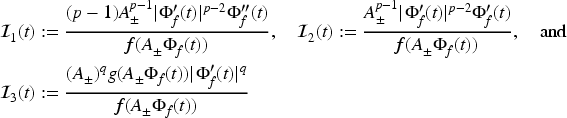
Proof of Theorem 3.5. Let us first consider (3.1). Since with , we see that satisfies (i) of (2.1). Therefore, as given in (I) of (2.2), is well-defined. With we set
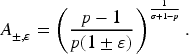
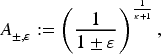
For brevity, we will write for . Let , and let us consider the functions in where
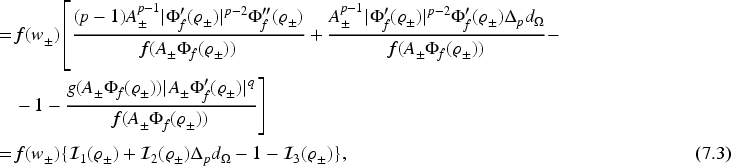
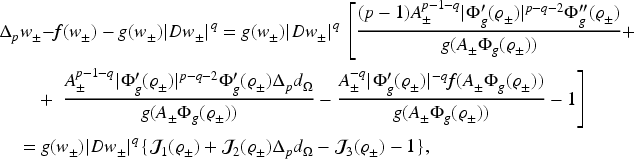
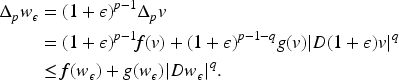
For convenience we will write for . Using (7.1) we compute
where
Let us first make note of the following (see Appendix B).
Again, using the fact that we get
Also, since is bounded on , we have .
Furthermore, we write
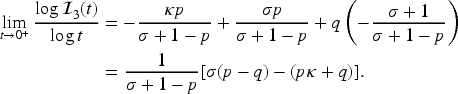
Recalling that for , and for we find from (7.4), see Appendix B, the following:
Since we assume that
then we find that
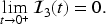
Recalling our choice of , we see that
As a consequence of (7.5), we observe from equation (7.3) that, for sufficiently small , we have the following inequalities.
Let and . Then
Since and are non-decreasing we see that and are supersolutions of (5.1) in and , respectively. Note that and . Therefore, by the comparison principle, Theorem A we conclude that
In other words we have
Letting followed by taking the limit as we find the following in .
Finally, taking the limit as we get the desired conclusion in (3.1).
Next, we take up (3.2). The method is essentially the same as the (3.1) case, and thus we will be brief. Since for we should note that satisfies (ii) of (2.1). Therefore, the function in (II) of (2.2) is well-defined. For , let
Using the assumptions that for and for , we obtain the limit
Recall that . In this case if we require
then The rest of the proof proceeds as in case (3.1).
Proof of Theorem 3.6. Let , and be as in the proof of Theorem 3.5. Recalling that condition (KO) holds, we note that , as given in (2.3), is well-defined. Upon differentiating the expression (2.3), we find
On differentiating both sides of (7.6), we find that
We employ the same notations used in the proof of Theorem 3.5 for our functions and sets , but with defined by (2.3). In other words, we set
where We now compute as in the proof of Theorem 3.5, to obtain
The rest of the argument proceeds as in the proof of Theorem 3.5.
Finally, we turn to uniqueness of solutions to Problem . We need the following simple lemma on comparison principle.
Let , and . Suppose that satisfy condition (A-1). Let such that
If then in .
Suppose to the contrary, at some point in . Consider the open set . By assumption we have and on . Therefore, by the comparison principle, Theorem A, we have in , which is a clear contradiction.
We are now ready to prove our uniqueness result for solutions to .
Proof of Theorem 3.7. Let be two non-negative solutions of . Then it follows from Theorem 3.5, and Theorem 3.6 that
Let for . Then clearly
Moreover, using assumption (N-D), we obtain
Therefore, by Lemma 7.1 we conclude that in . Since is arbitrary we find that in . A similar argument shows that in , thereby proving uniqueness.
A Few Examples
I. Let be a bounded open set, and consider the problem
Let . Then Problem (E-1) admits a non-negative solution in for any (per (I) of Corollary 5.3). If has boundary, , and , then the solution is unique in . When , then the solution is unique in for any (cf. Bandle and Giarrusso 1996 when ).
Now, let . Then Problem (E-1) has a non-negative solution in when (see (I) of Corollary 5.3), but no non-negative solution in if , as fails in this case.
II. Now we look at the problem
where is a bounded open set with boundary. Suppose and meet the assumptions of Theorem 3.1, and Theorem 3.6, and assume that (N-D) holds as well. If is integrable over , then the unique non-negative solution of Problem (E-2) satisfies
where . This follows from Theorem 3.6, and the limit (see Appendix C)
This work was supported by ISP (International Science Program) of Uppsala University, Sweden.
Funding
The authors received no financial support for the research, authorship and/or publication of this article.
Conflicting Interests
The authors declared no potential conflicts of interest with respect to the research, authorship, and/or publication of this article.
Notes
Appendix A. Existence of Solutions to Initial-Value Problems
While the content of this appendix is probably not new, we were unable to find sources that present the results in the form used in the paper. Therefore, we have decided to include a complete and comprehensive discussion.
In the first part of this appendix, we study solutions to the IVP () for any given . In fact, it is helpful to consider the following more general IVP with given constants and , where we assume if .
under the assumption that is a continuous function that satisfies (H-1), together with the following condition:
.
We prove the following.
Proof. Since , we use the continuity of to fix such that for all . Here, we are using the standard notation . Let us set
Clearly and , where we use L’Hospital’s Rule when .
If we select sufficiently small, it follows from estimates (A.8) and (A.9) that
On recalling that and , we conclude that .
We now proceed to show that is continuous on . Let be a sequence in that converges to . Therefore and uniformly on . Let us consider the continuous function . Note that and are uniformly continuous on and where , respectively. Hence
uniformly on , and therefore
uniformly on Consequently,
uniformly on . In other words, converges to in the Banach space .
Finally, let us show that
is relatively compact in . Since is a bounded subset of , and , we see that is a bounded set. Since is uniformly bounded on , it is obvious that is equicontinuous on . That is equicontinuous on follows from (A.7).
Hence, by the Schauder fixed-point theorem, there is such that , that is,
Thus we have shown that Problem () has a solution in some interval , and differentiating (A.10) we have
Let be the maximal interval of existence of . We claim that in . To see this, let . Condition (H-2) shows that is non-empty (as can be seen from (A.11)), and that where . We assume that , for otherwise there is nothing to show.
Let us set
so that
From (A.12), it can clearly be seen that is positive and differentiable on . Furthermore, note that
Thus we see that in fact, is differentiable on , and invoking condition (H-2) and (A.13) we conclude that . In fact, if we suppose that , then for a fixed we have for all sufficiently small .
Next we use the differentiability of on to show that is differentiable in . Let . We take any . Then, by the Mean–Value theorem applied to on the interval , we have
for some between and . Since on , we note that in . Therefore
Note that is continuous on and we recall that is between and . Hence, as we see that . Thus we see that
Taking the limit of both sides we see that
Hence exists for all . If , and , we note that is also differentiable at , and therefore in this case we have . Moreover, if we see that is not differentiable at . On the other, if we see that is differentiable at . In fact, in this case we have . Thus, in general, any solution of Problem () in belongs to
Using (A.12) we differentiate on to get the following for .
As noted before, recall that , and that if , then for sufficiently small . In any case, under the assumption that we now proceed to show that in .
To this end, suppose that in is not the case. Then there is such that . Since is continuous on it attains its maximum on at some . Since we see that . That is, . Consequently, we can find with , close enough to such that , and . Let . Since is continuous, and we see that is non-empty. Let . Since is a closed set we see that . Furthermore, . If this is not the case, and , then there is such that . Since , we can find such that . But, this contradicts the minimality of .
This obvious contradiction shows that in . As a consequence of (A.14), and recalling that in , we conclude that in .
Finally we remark that in and in , together with (A.16), imply that in . In fact, from (A.16) we have
Finally, we note that (A.17) together with (A.11) shows that . But the continuity of in , along with the assumption that leads to the contradiction of the definition of as . Therefore we must have , as claimed so that in , the maximal interval of existence of .
Furthermore the inequality (A.17) allows us to prove the following. Let be non-decreasing continuous functions such that for , , and for . Suppose is a solution to () on a maximal interval of existence with . Recall that and in . We claim that as . If this is not the case, say as , then (4.6) implies that as . Let be a solution to the IVP IVP(;,) on an interval . According to (A.17) we note that . By (H-1) and (H-2) we see that and and . In light of this, and (4.1), we can juxtapose to to extend to a solution of () in the larger interval . This would contradict the maximality of the interval .
Appendix B. On Properties of Regularly Varying Functions
To ensure completeness, in this appendix we will provide proofs of the main properties of regularly varying functions that were used in the paper.
If is continuous on and , then (see Mohammed 2007 for instance). Now suppose is non-decreasing and continuous on . If is the antiderivative of that vanishes at zero, and if , then it follows from the definition that . Since we see that
Suppose is continuous and for some . If is the antiderivative of that vanishes at zero, then
Proof. This follows from the computation
Suppose that is continuous on and suppose, for some ,
where is the antiderivative of that vanishes at zero. Suppose is defined by
Note that as , and that for some . Moreover, on we have
If we suppose that is non-decreasing, it follows from (B.2) that
If, furthermore, for some , then
Proof.
Direct computation shows that
Note that
To prove the limit in (B.4), let us first note from the limits in (B.1) and (B.5) that
Note that is a continuous function such that as . Therefore by integrating (B.6) on for and rearranging we see that
Differentiating this leads to
As a consequence of this last relation, we find that
Suppose such that If on , then .
Proof. We proceed as follows. Let
Clearly is continuous on and as . Moreover we see that satisfies the equation
That is
Thus we find
It follows from this that .
Appendix C. The Limit in ( )
Using the assumption that is integrable on , we compute
In both (C.1), and (C.2), we have used L’Hospital’s Rule.
References
1.
AlarcónS.QuaasA. (2013). Large viscosity solutions for some fully nonlinear equations. Nonlinear Differential Equations and Applications, 20, 1453–1472.
2.
BandleC.EssénM. (1994). On the solutions of quasilinear elliptic problems with boundary blow-up, partial differential equations of elliptic type (Cortona, 1992). Symposium Mathematics, XXXV, Cambridge University Press, Cambridge, 93–111.
3.
BandleC.GiarrussoE. (1996). Boundary blowup for semilinear elliptic equations with nonlinear gradient terms. Advances in Differential Equations, 1, 133–150.
4.
BhattacharyaT.MohammedA. (2021). Maximum principles for -Hessian equations with lower order terms on unbounded domains. Journal of Geometric Analysis, 31(4), 3820–3862.
5.
BieberbachL. (1916). und die automorphen funktionen. Mathematische Annalen, 77, 173–212.
6.
ChenH.FelmerP.QuaasA. (2015). Large solutions to elliptic equations involving fractional Laplacian. Annales de l’Institut Henri Poincaré C — Analyse Non Linéaire, 32(6), 1199–1228.
7.
CîrsteaF.-C.RădulescuV. (2006). Nonlinear problems with boundary blow-up: A Karamata regular variation theory approach. Asymptotic Analysis, 46(3-4), 275–298.
8.
CîrsteaF.-C.RădulescuV. (2007). Boundary blow-up in nonlinear elliptic equations of Bieberbach–Rademacher type. Transactions of the American Mathematical Society, 359(7), 3275–3286.
9.
DíazG.LetelierR. (1993). Explosive solutions of quasilinear elliptic equations: Existence and uniqueness. Nonlinear Analysis, 20(2), 97–125.
10.
DuY. (2003). Boundary blow-up solutions and their applications(pp. 89–97). World Scientific Publishing Co., Inc. ISBN: 981-238-262-3.
11.
DuY. (2004). Asymptotic behavior and uniqueness results for boundary blow-up solutions. Differential Integral Equations, 17(7–8), 819–834.
12.
DuY.GuoZ. (2003). Boundary blow-up solutions and their applications in quasilinear elliptic equations. Journal d’Analyse Mathématique, 89, 277–302.
13.
GherguM.RadulescuV. (1997). Large solutions of quasilinear elliptic equations: Existence and qualitative properties. Bollettino dell’Unione Matematica Italiana B (7), 11, 227–252.
14.
GilbargD.TrudingerN. S. (1983). Elliptic partial differential equations of second order (2nd ed.). Springer.
15.
GladialiF.PorruG. (1998). Estimates for explosive solutions to -Laplace equations, Progress in Partial Differential Equations, Vol I (Pont-à-Mousson, 1997), (PP. 177–127). Pitman Re. Notes Math. Ser. 383, Longman, Harlow.
16.
HörmanderL. (1983). The Analysis of Partial differential operators I. Springer, Berlin, ix+391 pp.
17.
KarlsM.MohammedA. (2016). Ahmed solutions of -Laplace equations with infinite boundary values: The case of non-autonomous and non-monotone nonlinearities. Proceedings of the Edinburgh Mathematical Society, 59(4), 959–987.
18.
KellerJ. B. (1957). On solutions of . Communications on Pure and Applied Mathematics, 10, 503–510.
19.
LairA. V.MohammedA. (2023). Necessary and sufficient conditions for the existence of large solutions to semilinear elliptic equations with gradient terms. Journal of Differential Equations, 374, 593–631.
20.
LasryJ. M.LionsP. L. (1989). Nonlinear elliptic equations with singular boundary conditions and stochastic control with state constraints. Mathematische Annalen, 283, 583–630.
21.
LeonoriT.PorrettaA. (2016). Large solutions and gradient bounds for quasilinear elliptic equations. Communications in Partial Differential Equations, 41, 952–998.
22.
LeonoriT.PorrettaA.RieyG. (2017). Comparison principles for p-Laplace equations with lower order terms. Annali di Matematica Pura ed Applicata, 196(3), 877–903.
23.
LiebermanG. (1988). Boundary regularity for solutions of degenerate elliptic equations. Nonlinear Analysis, 12, 1203–1219.
24.
LiebermanG. (1991). The natural generalization of the natural conditions of Ladyzhenskaya and Ural’tseva for elliptic equations. Communications in Partial Differential Equations, 16, 311–361.
25.
LiebermanG. (2011). Asymptotic behavior and uniqueness of blow-up solution of quasilinear elliptic equation. Journal d’Analyse Mathématique, 115, 213–249.
MohammedA. (2007). Boundary asymptotic and uniqueness of solutions to the -Laplacian with infinite boundary values. Journal of Mathematical Analysis and Applications, 325(1), 480–489.
28.
MohammedA. (2010). Existence and uniqueness of nonnegative solutions for boundary blow-up problem. Journal of Mathematical Analysis and Applications, 371, 534–545.
29.
MohammedA.RădulescuV.VitoloA. (2020). Blow-up solutions for fully nonlinear equations: Existence, asymptotic estimates and uniqueness. Advances in Nonlinear Analysis, 9(1), 39–64.
30.
MohammedA.VitoloA. (2019). Large solutions of fully nonlinear equations: Existence and uniqueness. NoDEA Nonlinear Differential Equations Application, 26(6), Article number 42.
31.
MohammedA.VitoloA. (2024a). The effects of nonlinear perturbation terms on comparison principles for the -Laplacian. Bulletin of Mathematical Sciences, 14(2), 2450005.
32.
MohammedA.VitoloA. (2024b). Remarks on comparison principles for p-Laplacian with extension to (p, q)-Laplacian. Bulletin of Mathematical Sciences, 14(3), 2450011.
33.
OssermanR. (1957). On the inequality . Pacific Journal of Mathematics, 7, 1641–1647.
34.
PorrettaA. (2004). Local estimates and large solutions for some elliptic equations with absorption. Advances in Differential Equations, 9(3-4), 329–351.
35.
RademacherH. (1943). Einige besondere probleme partieller Differentialgleichungen. In Die differential und integralgleichungen der mechnik und physik, I (2nd ed., pp. 838–845). Rosenberg.
36.
VéronL. (2017). Local and global aspects of quasilinear degenerate equations: Quasilinear singular elliptic problems. World Scientific.
37.
ZhangZ. (2006). Existence of large solutions for a semilinear elliptic problem via explosive sub-supersolutions. Electronic Journal of Differential Equations, 2006(2), 1–8.
38.
ZhangZ. (2014). The existence and boundary behavior of large solutions to semilinear elliptic equations with nonlinear gradient terms. Advances in Nonlinear Analysis, 3(3), 165–185.
39.
ZhangZ. (2017). Boundary behavior of large solutions to -Laplacian elliptic equations. Nonlinear Analysis Real World Applications, 33, 40–57.
40.
ZhangX.DuY. (2018). Sharp conditions for the existence of boundary blow-up solutions to the Monge–Ampére equation. Calculus of Variations and Partial Differential Equations, 57(2), article number 30.
41.
ZhangX.FengM. (2019). The existence and asymptotic behavior of boundary blow-up solutions to the -Hessian equation. Journal of Differential Equations, 267(8), 4626–4672.
42.
ZhangX.KanS. (2023). Sufficient and necessary conditions on the existence and estimates of boundary blow-up solutions for singular -Laplacian equations. Acta Mathematica Scientia (Series B) (Engl. Ed.), 43(3), 1175–1194.