Mukherjee A. & Tiwari S. (2025). A critical nonlocal double phase problem in the heisenberg group with a modified hardy potential. Asymptotic Analysis. 0(0). https://doi.org/10.1177/09217134251386204
In the published version of the article, the section labelled “The Heisenberg Group ℍN and the Space HWs,℘(ℍN)” was incomplete until the next section “Lemma 2.1.”. Below is the corrected version of the section:
The Heisenberg Group and the Space
In this section, we first present a few basic properties of the Heisenberg group . For more details we refer to Garofalo and Lanconelli (1990) and Garofalo and Nhieu (1996).
Let be the Heisenberg group of topological dimension , which is a nilpotent Lie group having as a background manifold equipped with a non-Abelian group law
for
Throughout the article, we will denote as the natural origin of . The left-invariant vector fields on given by
for form a basis for the real Lie algebra of of left-invariant vector fields. These bases satisfy the following canonical commutator relations
for all . Since the commutators of length more than two vanish, is a nilpotent graded stratified group of step two. A left-invariant vector field belonging to is called horizontal. For each real , the dilation defined by
It is easily verified that Jacobian of dilatations has constant determinant and equals , hence is the homogeneous dimension of . The Korányi norm of any is defined by
for and being the Euclidean norm in of . The Korányi norm of is
for all . The corresponding distance in , called Korányi distance, is
Throughout the article, we denote by
the Korányi open ball of radius centered at . For simplicity we put . The Lebesgue measure on is invariant under left translations of . Since Haar measures on Lie groups are unique up to constant multipliers, we denote by the Haar measure on with -dimensional Lebesgue measure, i.e. on and denotes the same of any measurable . Furthermore
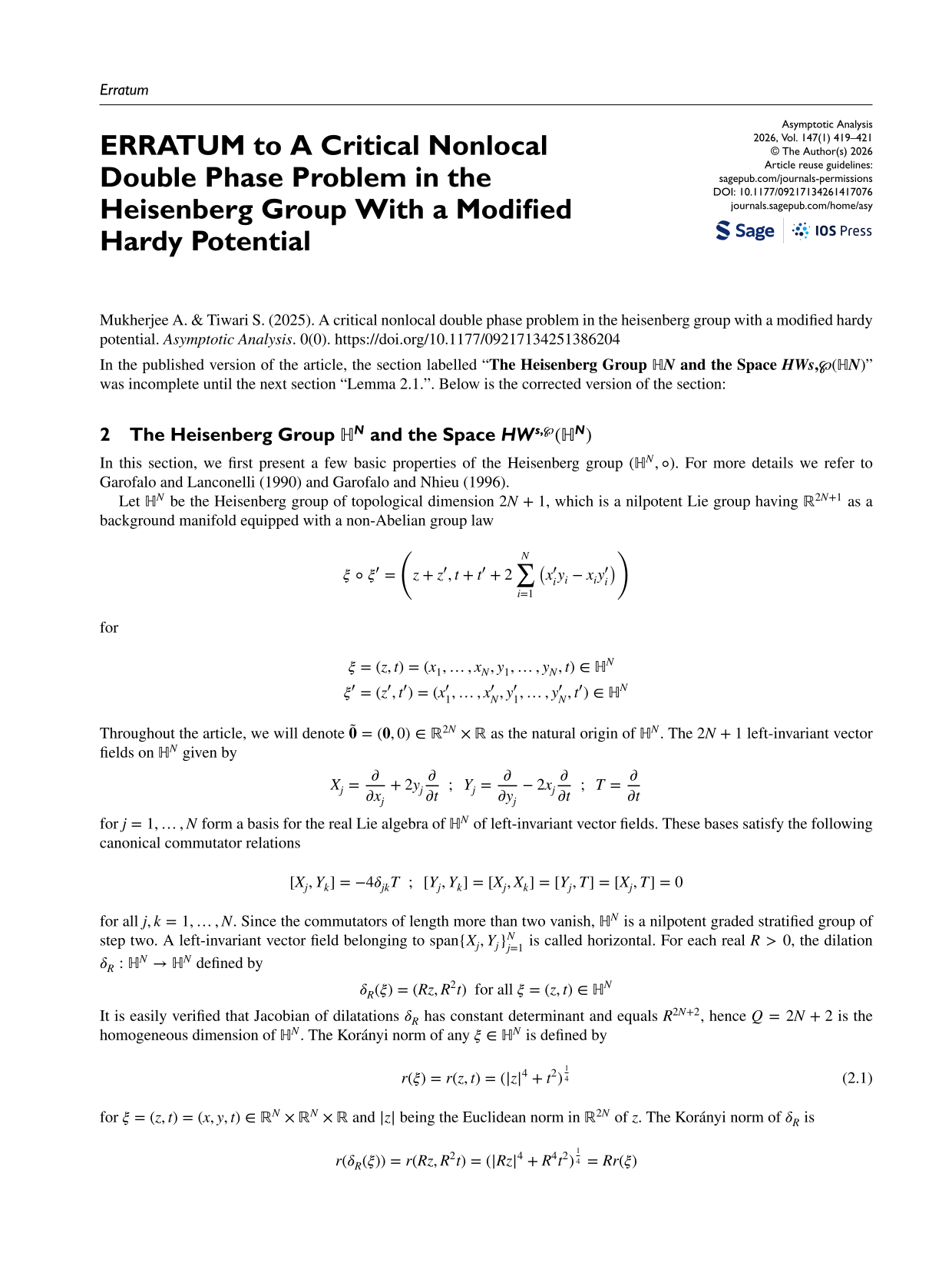
We define the horizontal gradient of some as
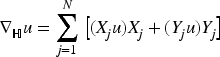
We consider the natural inner product
for vector fields and , here repeated indices follow Einstein summation convention. Then the Hilbertian norm induced by the above inner product is
for any horizontal vector field . The horizontal divergence of is then defined by
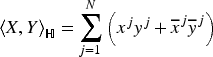
We then have the Kohn–Spencer Laplacian as
and the generalized horizontal -Laplacian for is defined by
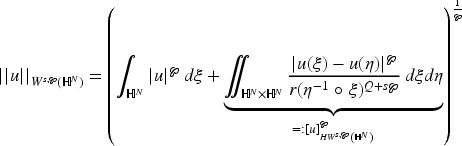
for all . We now define the horizontal fractional Sobolev spaces . Interested readers may follow Adimurthi and Mallick (2018), Ghosh et al. (2024), Zhou et al. (2022) for more details. Let and . Let be a Haar-measurable function. Then one defines
endowed with the natural norm
for . In a similar fashion, given some domain , one defines as the closure of in . We note . The fractional -horizontal gradient of any is denoted by
There are some classical embeddings in case of as seen in . We state a few of them. The following embedding is Theorem from Kassymov and Suragan (2020b), see also Theorem in Ghosh et al. (2024).