This paper aims to derive the time decay estimates for both weak and strong solutions to the incompressible magnetic Bénard system in a half-space. To address the technical challenges posed by the boundary effects in unbounded domains, we primarily employ estimates, together with properties of the Stokes operator and a suitable decomposition of the nonlinear terms. We establish the -estimates of weak solutions and obtain the -estimates of strong solutions and their first three derivatives. In addition, if the given initial data belongs to a suitable weighted space, more optimal decay effects are established.
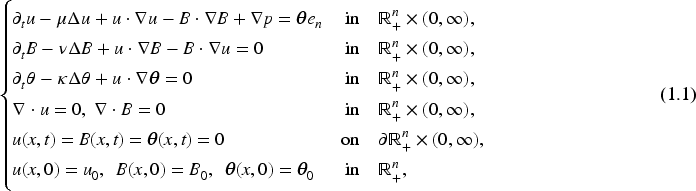
We consider the time decay estimates of solutions to the viscous incompressible magnetic Bénard system in a half-space
where , and is the upper half-space of . The unknown functions , , and denote the velocity, the magnetic field, and the temperature, respectively, is the pressure and is the unit vector. The constants and are the coefficients of dissipation and magnetic diffusion, and characterizes the strength of heat conduction.
The magnetic Bénard system is widely used to model thermal convection dynamics under the influence of a magnetic field (see Fan et al., 2019; Rionero, 1998), which is derived from the magnetohydrodynamic (MHD) equations by introducing the Boussinesq approximation. This simplified model confines and restricts the effects arising from density variations to the buoyancy term, thus preserving the interplay between gravitational and magnetic forces.
In the absence of magnetic field and temperature effects, the equations in (1.1) reduce to the incompressible Navier–Stokes equations. There is a great literature to date on the existence and time decay estimates of solutions to the incompressible Navier–Stokes equations. Leray (1934) first established the existence of global weak solutions to the three-dimensional Navier–Stokes equations in the whole space, though without addressing the decay and regularity properties of these weak solutions. Based on the strong -solution theory, Kato (1984) proved that for , the -norm of weak solutions vanishes as time tends to infinity, pioneering research into decay rates. To determine the decay rate of weak solutions in a three-dimensional space, Schonbek (1992, 1995) introduced the Fourier-splitting method and extended the results to higher-order norms decay (Schonbek & Wiegner, 1996). Notably, the whole-space Fourier-transform techniques are inapplicable to half-spaces. Using the Stokes operator fractional power estimates, Borchers and Miyakawa (1988) first derived -decay of solutions to Navier–Stokes flow in the half-space. Later, Bae and Choe (2001) refined the precision of the time decay rate through the Stokes solution formula. It is also well known that in higher space dimensions, the existence of regular solutions can only be proved when the initial data satisfies the smallness assumption within a specific function space (Lemarié, 2002). There are relatively few results on () estimates for solutions to the Navier–Stokes equations in the half-space and general unbounded domains. Han (2010, 2011, 2012) investigated the solutions of the incompressible Stokes equations and Navier–Stokes equations in half-spaces, along with the decay properties of their spatial derivatives of all orders, deriving specific decay rate estimates in the space. Liu (2020) studied the decay of weak solutions to three-dimensional Navier–Stokes equations in general unbounded domains and derived explicit -decay rates as . Han (2024) has recently achieved significant progress in this field, establishing the -decay behavior of higher-order norms for solutions to the Navier–Stokes equations in the upper half-space, which provides a crucial reference for analyzing higher-order decay behavior in .
As far as we know, relatively few mathematical results exist regarding time decay estimates for solutions of the magnetic Bénard system in the half-space and general unbounded domains. Inspired by the estimates developed by Han (2022), Han and Schonbek (2014), and Han (2024) for the Navier–Stokes equations and Boussinesq system in the half-space, as well as the spectral analysis and energy estimate methods employed by Liu (2019), Liu and Yu (2015), and Liu and Han (2024) for MHD flows in general domains, the main aim of this paper is to systematically explore the time decay estimates of weak and strong solutions to problem (1.1).
Without loss of generality, we assume . Our main results are stated as follows. The first result establishes the -decay for weak solutions of the magnetic Bénard system in the half-space.
Let and , . Then, problem (1.1) admits a weak solution satisfying for
and
If there exists depending on , such that
holds, then the weak solution satisfies
and
Further, if , then for any small and , it holds that
The estimates of solutions to the Navier–Stokes equations have been obtained (see, e.g., Fujigaki & Miyakawa, 2001; Han, 2010, 2011), but establishing the -decay estimates of solutions to problem (1.1) is typically more challenging and less common. The following Theorems 1.2 and 1.3 focus on the -decay estimates of solutions to problem (1.1) under the assumption on the small initial data condition and the weighted initial data, respectively.
Let , and , . There exists sufficiently small such that if , then problem (1.1) admits a strong solution satisfying for . Moreover, the solution satisfies that
Let , and , . Assume (1.4) holds. Let be the strong solution to problem (1.1) obtained in Theorem 1.2. Then, for , it holds that
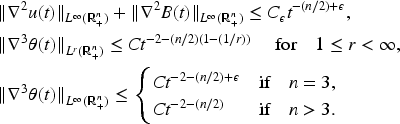
Building on the foundational research of Schonbek and Wiegner (1996) for the Navier–Stokes equations in the whole space, and Han and Schonbek (2014) for the Boussinesq system in the half-space, the following theorem establishes decay estimates of the second-order derivatives of the strong solution to problem (1.1). The decay estimates of the third-order derivatives of the temperature are also established under additional conditions.
Let , and , . Assume (1.4) holds. Let be the strong solution to problem (1.1) obtained in Theorem 1.2. Then, for
provided that , and
Further, if , and , then for any sufficiently small number and , it holds that
The structure of this paper is organized as follows: In Section 1, the required background and main findings are introduced. Section 2 discusses some inequalities. In Section 3, we present the decay behaviors of weak and strong solutions to problem (1.1). Finally, Section 4 focuses on establishing the estimates of the second-order derivatives of the strong solution and the third-order derivatives of the temperature field to problem (1.1).
Preliminaries
In this section, we list some notations and several inequalities that are frequently employed in this work.
Notation. We denote the usual spaces by
The norm is given by And we denote by the set of all divergence-free vector fields with compact support in The space is the closure of with respect to , namely
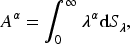
Then, we recall some facts about the Stokes operator . The Stokes operator is defined by be the Stokes operator for , is the Helmholtz projection operator. Let is self-adjoint and dense defined on . By the spectral theorem, there exists a uniquely determined spectral resolution in . The operator , for , is then defined as follows:
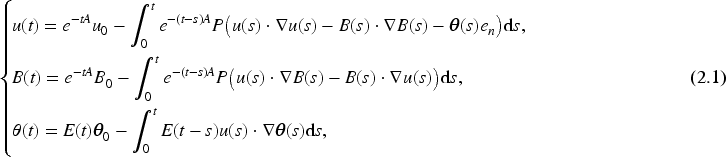
We intend to establish the algebraic decay estimates of the weak and strong solutions. To solve this problem, we usually invoke the projector P, transform problem (1.1) into the following integral forms by Duhamel’s formula:
A weak solution is called a strong solution if . Further, it can be demonstrated that a strong solution is in fact classical by combining the regularity criteria for the Navier–Stokes equations with standard regularity theory for parabolic equations. This implies that it not only satisfies the weak integral form but also possesses sufficient smoothness.
This section is devoted to prove investigating the decay behaviors of weak and strong solutions to problem (1.1). First, we establish the existence and basic decay properties of weak solutions, we then construct strong solutions with small initial data, and finally, further investigate the decay behavior of strong solutions when no small initial conditions are applied.
-Decay of Weak Solutions
In this subsection, our primary goal is to analyze the decay behavior of weak solutions to problem (1.1) within the space.
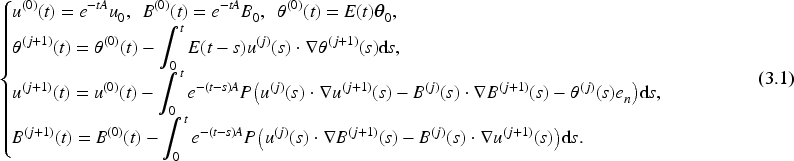
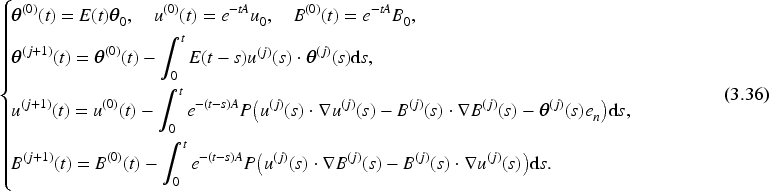
Proof of Theorem 1.1 Let , and , we analyze the iterative approximation for ,
The operator is defined for as follows
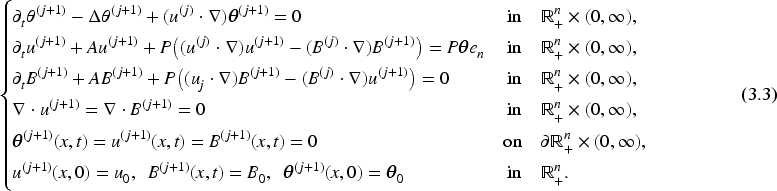
and is the Gauss kernel. It can be concluded that problem (3.1) admits a unique strong solution (see Borchers & Miyakawa, 1988). We have a simple calculation:
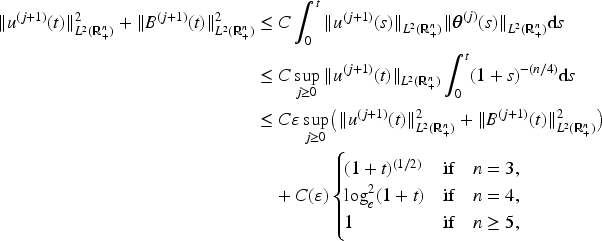
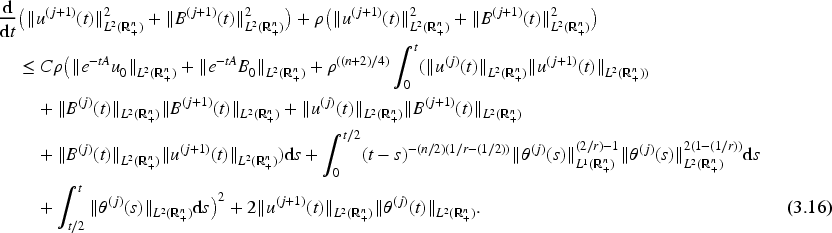
Multiplying the second and third equations of (3.3) by and , then integrating over and adding the two results together to obtain
Multiply the first equation of (3.3) by and also integrate the result over , then we have for and
By Lemma 2.6, we get . In addition, based on the operator , we infer for
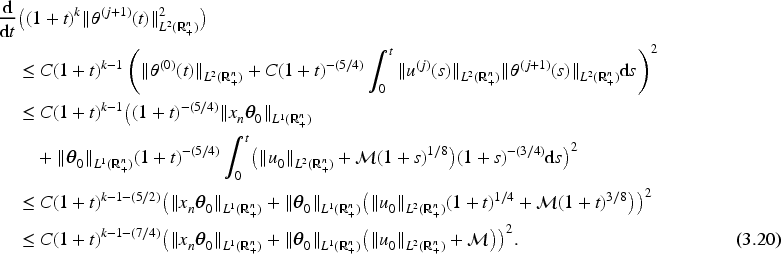
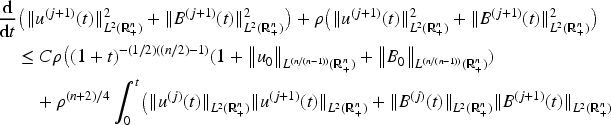
Set multiplying (3.17) by , we combine the resulting expression with (3.7), (3.18), and (3.19) for
Let be taken sufficiently large in (3.20), we infer for
Note that , by choosing suitably small with . From the above derivation process, it can be obtained
By integrating (3.19) and (3.22), using the procedure from (3.21), yields for all
Thus, it follows that for suitably large and . Combining (3.19) and still repeat the proof process of (3.21), we have
from which, . This inequality combined with (3.8) gives
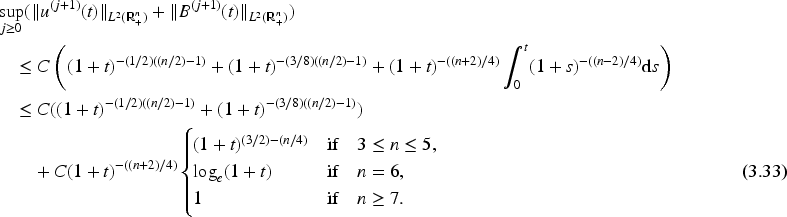
Thus, by employing the new bounds on and , following the procedure used to obtain (3.21), we get for
which implies that
We finish the proof when . □
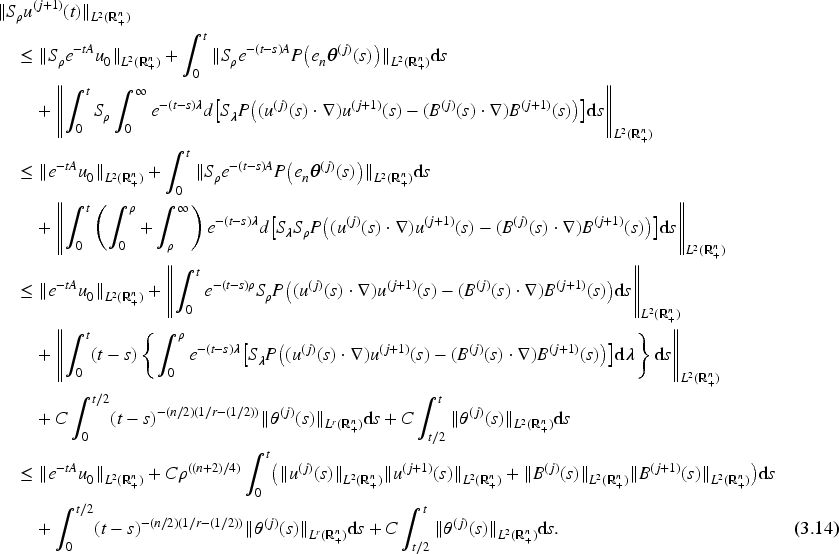
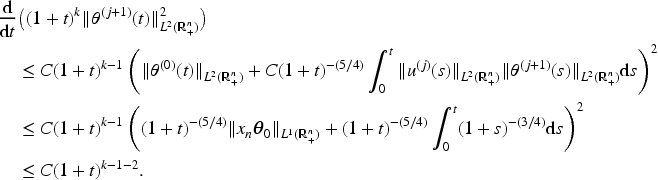
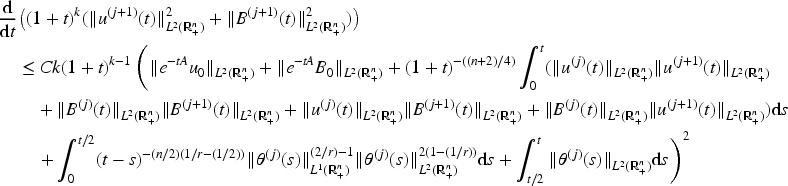
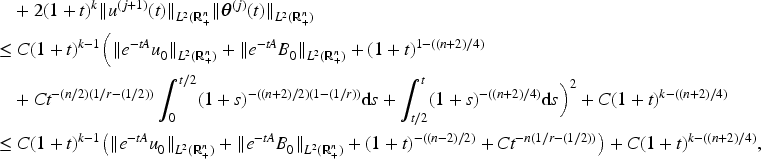
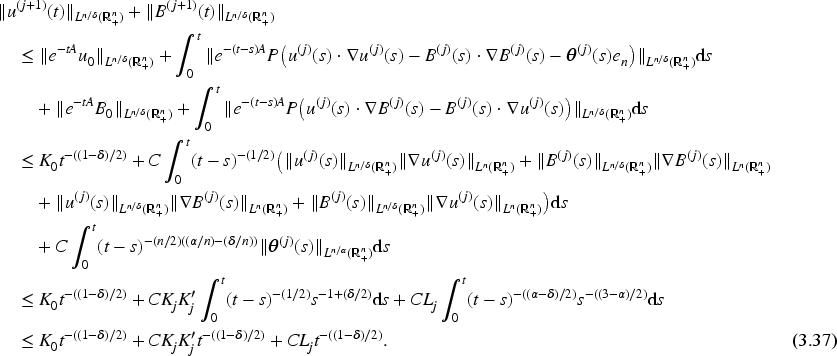
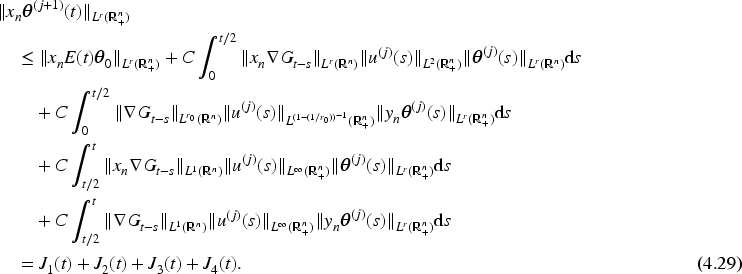
Case. Setting where is a sufficiently large positive integer, we multiply both sides of (3.14) by , together with (3.18) and (3.20), yields any
which implies for any
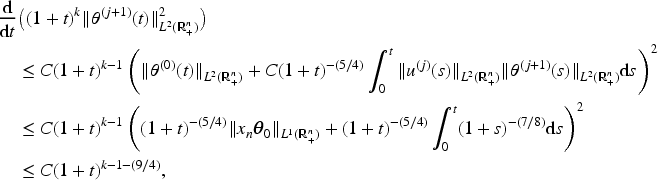
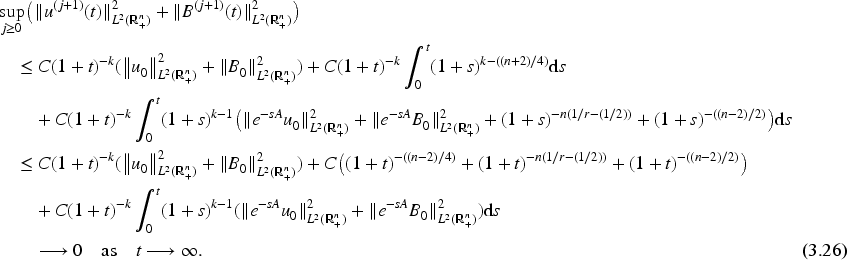
Repeating the process above, the new estimate implies that for and
from which, we deduce that
This shows the case .
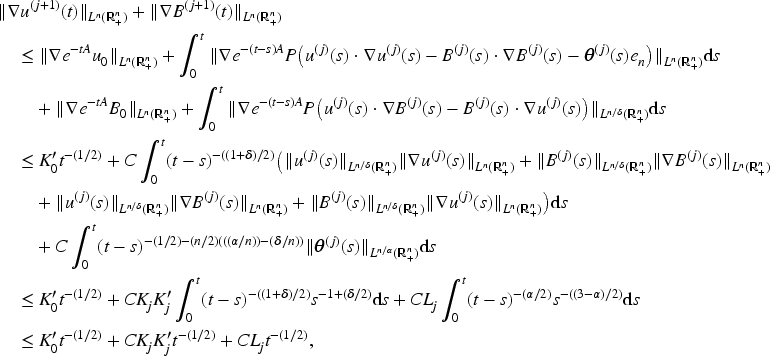
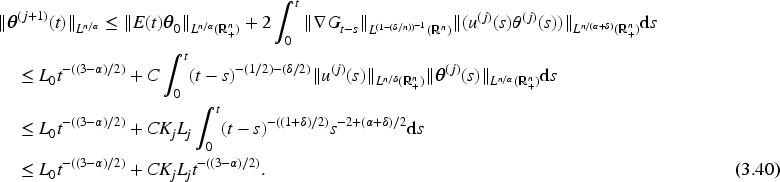
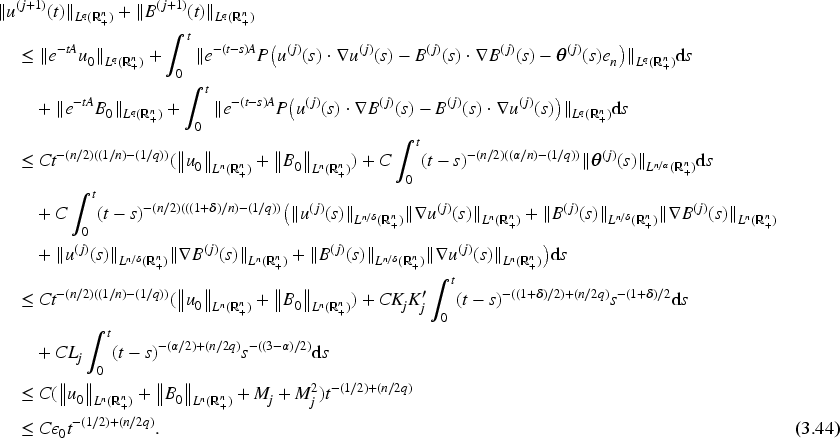
Case. In this case, by repeating the proof process for the case and using (3.10), it can be verified that (3.23) and (3.24) still hold true. Based on the above arguments, we have established that for ,
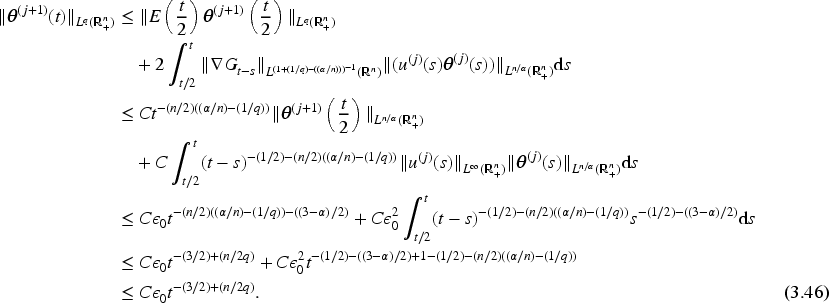
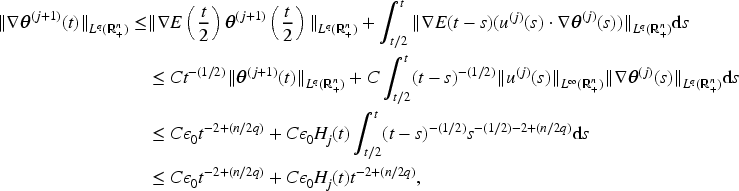
From (3.44), (3.46), and Lemma 2.4, we obtain for any and
where . Therefore, by choosing , we can easily obtain
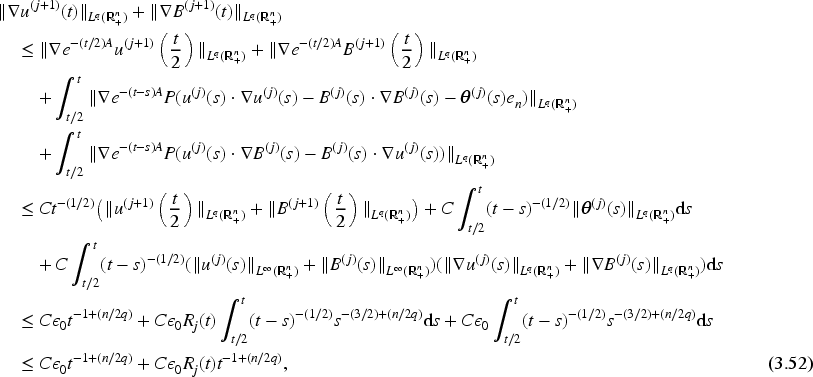
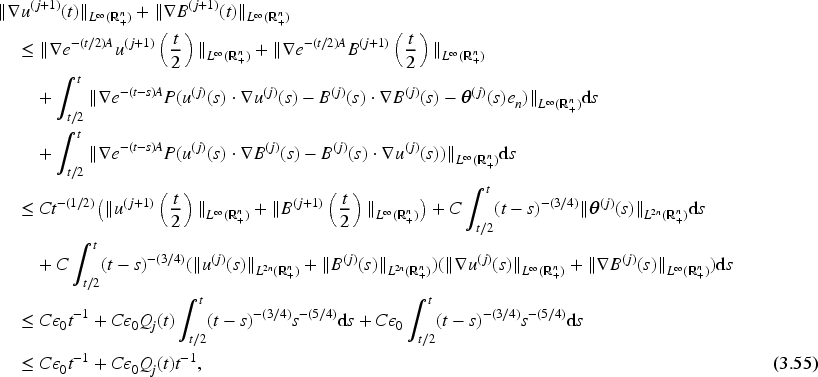
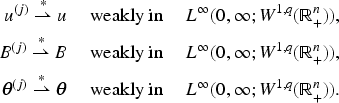
From (3.44), (3.46), (3.48), (3.49), (3.54), (3.56), by using the weak convergence properties, we can find a subsequence of as
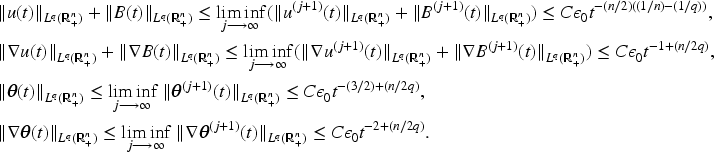
Moreover, we can derive for and by applying the limit under the weak convergence norm
In conclusion, we can easily establish that is a strong solution to problem (1.1) by combining parabolic regularity and the Serrin criteria. Additionally, satisfies the estimates stated in Theorem 1.2.
-Decay of Strong Solutions Without Smallness Conditions
This section is devoted to investigating the -decay properties of strong solutions without smallness conditions. Based on Theorem 1.2, we relax the initial conditions and refine the required function spaces, thereby providing a basis for the subsequent derivation of Theorem 1.4. First, we introduce an auxiliary proposition to assist in completing the proof of the theorem.
Let and , and is the strong solution to problem (1.1) obtained in Theorem 1.2. Assume (1.4) holds, then for , and ,
Proof. We first establish the -norm estimates of , which is crucial for proving the proposition. Then, we give an auxiliary estimate as follows:
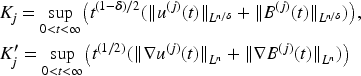
Auxiliary estimates: Set
Let . Then
By Lemma 2.4, it follows that
From Theorem 1.1, we know that . By combining (3.59) and Theorem 1.2, we obtain
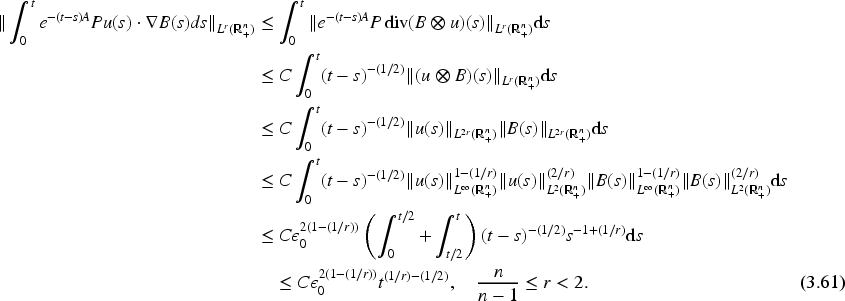
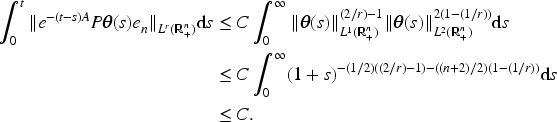
estimates of Obviously, we have for
Using Theorem 1.1, Lemma 2.4, and (3.61), we get for
which implies that
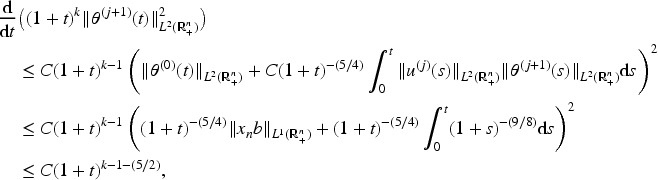
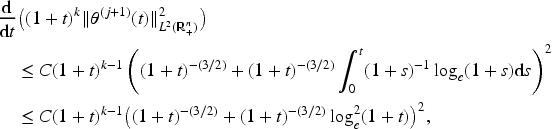
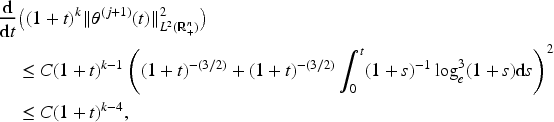
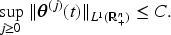
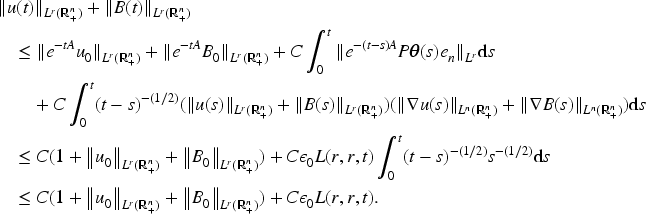
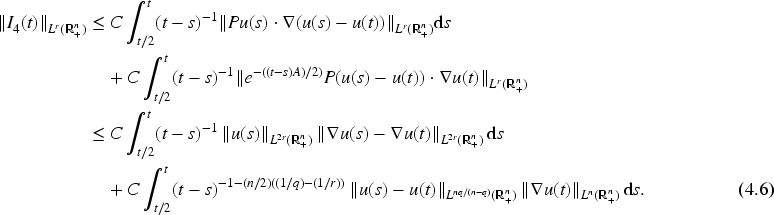
It is noted that , which implies the occurrence of a blow-up phenomenon. Although we have shown that the -norms of and are bounded in finite time, their uniform boundedness estimates have not yet been established. Next, we will accomplish this task. Let , it implies that , we also obtain . Combining Lemma 2.4 and Theorem 1.1, we have for
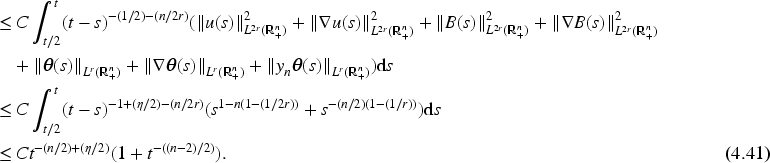
Then, we establish the -norm estimate of . We first derive the estimation of . Let , by Theorem 1.2, we conclude that
from which
where
Let , we have
Decay of, . From the interpolation inequality, we have
Decay of, , . By (3.67), we have the auxiliary estimates for and any
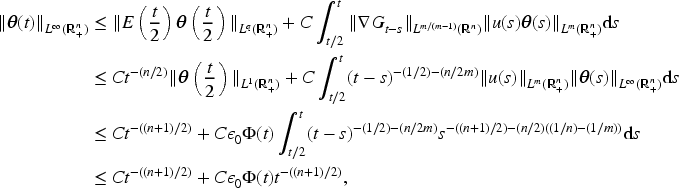
From Lemma 2.4, Theorem 1.2, (3.64), and (3.68), we get for , and
Let , we obtain by combining the decay estimate for in Theorem 1.2
from which
By choosing , we obtain
Let , we arrive at
The proof of Proposition 3.1 is complete. □
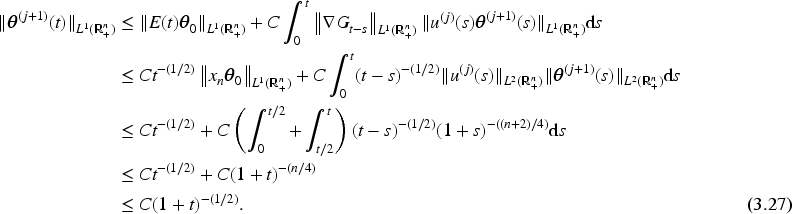
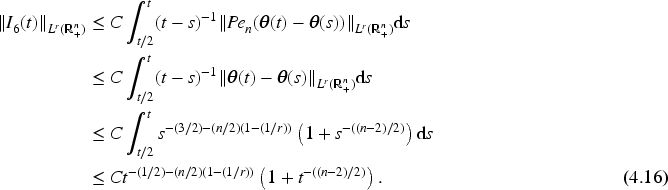
Proof of Theorem 1.3. The estimation of has been accomplished in the preceding text; our next core work is to complete the estimate of . Theorem 1.2 and (3.3) yield for and any .
In this section, our main aim is to estimate the decay of the second spatial order derivatives and the decay of the third derivative of for . Specifically, for the first part of Theorem 1.4, we prove it by means of an auxiliary lemma.
Let and , , be the strong solution to problem (1.1) obtained in Theorem 1.2. Then, for
Combining the above-derived estimates, we finish the proof of Lemma 4.1. □
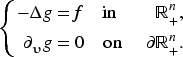
Now, we prove the rest of Theorem 1.4. Let be the solution to the Neumann problem
where is the unit outward normal vector of .
and we define the operator as
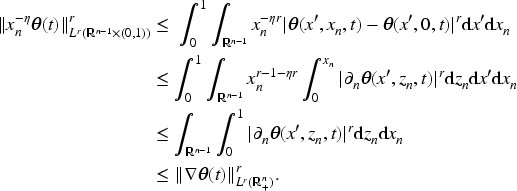
In addition, for and , it holds that
and
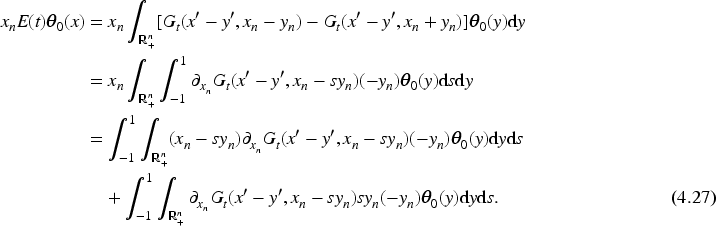
Proof of Theorem 1.4. We now establish the decay of and .
Let be the solution to problem (1.1), and assume . Then, for
Similarly, it holds that
Liu and Yu (2015) contain the proof of (4.25). For readers’ convenience, we briefly provide the proof of (4.26). Note that for ,
In order to estimate , Lemma 2.8 and an estimate for , with , are required. Nevertheless, as the bound of remains unobtained, we proof it by inductive hypothesis.
If , it follows for and that
Assume there exists , such that
where . Let , , we have
Using Theorems 1.2 and 1.3, we obtain
and
Now, we estimate . Let . Choosing , we have for and
where . Note that
Thus, there exists such that
Let , then
If ,
Then, for any , we have
Therefore, we obtain
Thus, we obtain
Take suitably small such that , we have for any and
From the estimates derived above, it follows that
Using the weak convergence procedure, we obtain for and any
Combining Lemmas 2.4 and 2.5, we have
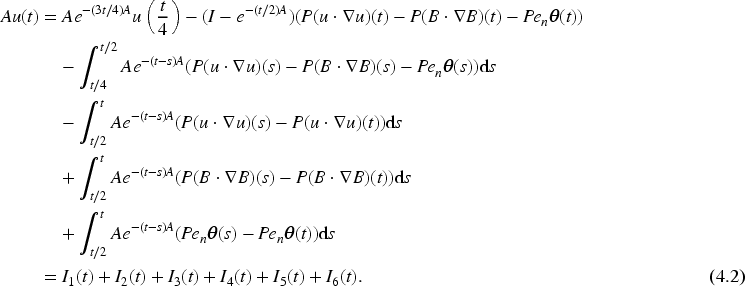
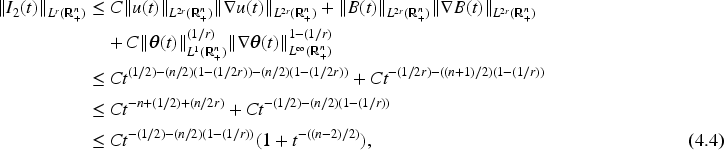
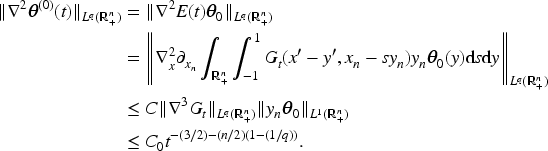
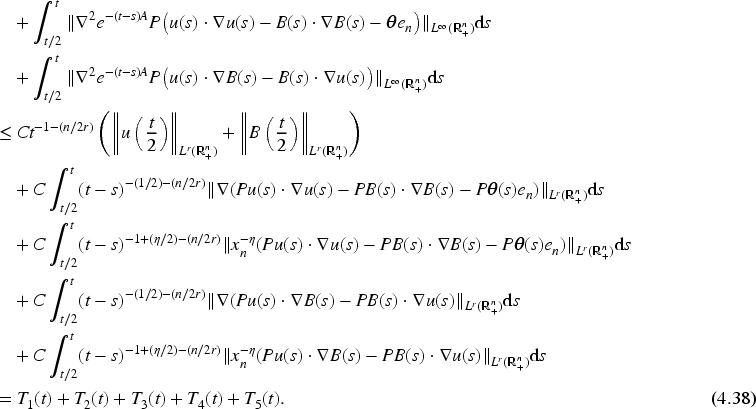
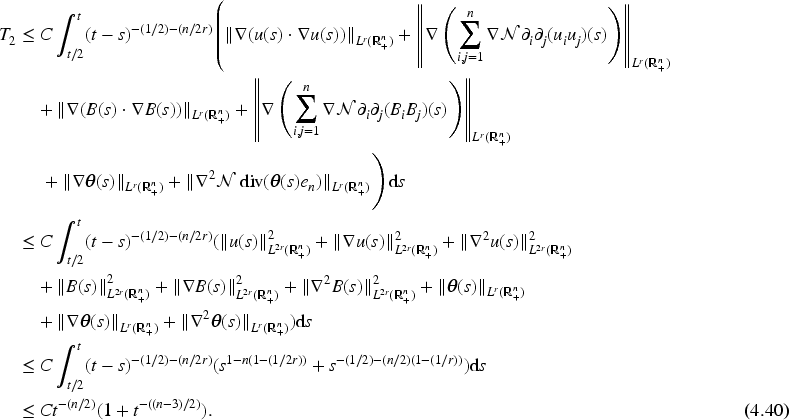
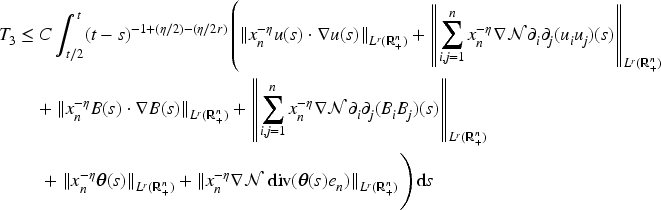
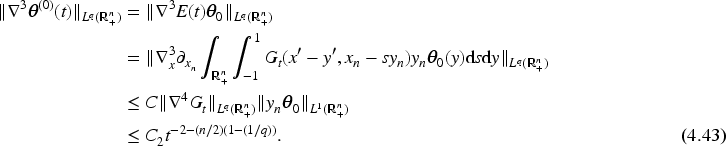
Now, we turn to estimate . By Lemmas 2.8, 2.9, 4.1, Theorem 1.3 and (4.37), we obtain for any and
Moreover, for
Similarly, we have
and
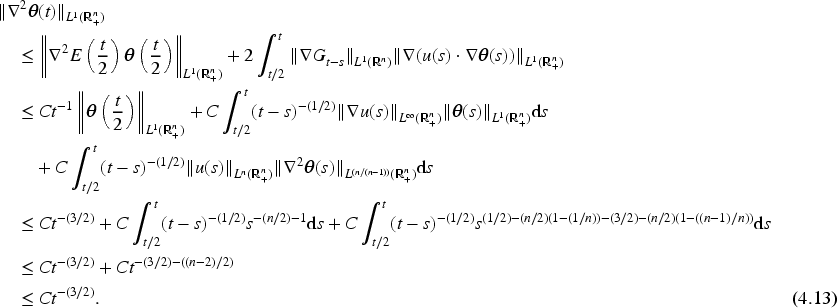
From the estimates derived above, we have for
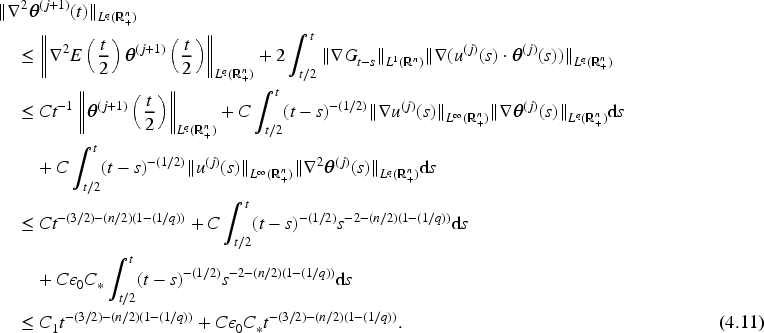
Now, we establish the decay of by induction as before. We can easily verify that for and
Assume that
To continue our analysis, we conclude some fundamental properties of :
As recalled earlier, for any and , then
holds.
Let , using (3.44)–(3.48) and Theorems 1.2 and 1.3, we obtain for any
Following a standard weak convergence argument, we get for and
Based on the estimates above, the proof of Theorem 1.4 is completed. □
Footnotes
ORCID iD
Yuzhu Wang
Funding
The authors disclosed receipt of the following financial support for the research, authorship, and/or publication of this article: This work is supported by the Program for Innovative Research Team (in Science and Technology) in the University of Henan Province (Grant No. 25IRTSTHN013).
Declaration of Conflicting Interests
The authors declared no potential conflicts of interest with respect to the research, authorship, and/or publication of this article.
Data Availability Statement
Data sharing is not applicable to this article as no data sets were generated or analyzed during the current study.
References
1.
AbidiH.GuiG. L.ZhangP. (2011). On the decay and stability of global solutions to the 3D inhomogeneous Navier–Stokes equations. Communications on Pure and Applied Mathematics, 64, 832–881. 10.1002/cpa.20351
2.
AbidiH.HmidiT.KeraaniS. (2011). On the global regularity of axisymmetric Navier–Stokes–Boussinesq system. Discrete and Continuous Dynamical Systems, 29, 737–756. 10.3934/dcds.2011.29.737
3.
BaeH. O.ChoeH. J. (2001). Decay rate for the incompressible flows in half spaces. Mathematische Zeitschrift, 238, 799–816. 10.1007/s002090100276
4.
BorchersW.MiyakawaT. (1988). decay for the Navier–Stokes flow in half spaces. Mathematische Annalen, 282, 139–155. 10.1007/BF01457017
5.
BrandoleseL. (2004). Asymptotic behavior of the energy and pointwise estimates for solutions to the Navier–Stokes equations. Revista Matematica Iberoamericana, 20, 223–256. 10.4171/rmi/387
6.
BrandoleseL.SchonbekM. E. (2012). Large time decay and growth for solutions of a viscous Boussinesq system. Transactions of the American Mathematical Society, 364, 5057–5090. 10.1090/S0002-9947-2012-05432-8
7.
CannoneM.PlanchonF.SchonbekM. E. (2000). Strong solutions to the incompressible Navier–Stokes equations in the half-space. Communications in Partial Differential Equations, 25, 903–924. 10.1080/03605300008821536
8.
ChenH.WangY. (2024). The -asymptotic behavior of strong solutions to the incompressible magneto-hydrodynamic equations in half-spaces. Applied Mathematics Letters, 150, Article 108966. 10.1016/j.aml.2023.108966
9.
FanJ.SunJ. Z.TangT. (2019). Uniform global strong solutions of the 2D density-dependent incompressible magnetic Bénard problem in a bounded domain. Computers & Mathematics with Applications (Oxford, England), 77, 494–500. 10.1016/j.camwa.2018.09.052
10.
FujigakiY.MiyakawaT. (2001). Asymptotic profiles of non stationary incompressible Navier–Stokes flows in the half-space. Methods and Applications of Analysis, 8, 121–158. 10.4310/MAA.2001.v8.n1.a6
11.
HanP. (2010). Asymptotic behavior for the Stokes flow and Navier–Stokes equations in half spaces. Journal of Differential Equations, 249, 1817–1852. 10.1016/j.jde.2010.05.021
12.
HanP. (2011). Decay results of solutions to the incompressible Navier–Stokes flows in a half space. Journal of Differential Equations, 250, 3937–3959. 10.1016/j.jde.2010.11.018
13.
HanP. (2012). Weighted decay properties for the incompressible Stokes flow and Navier–Stokes equations in a half space. Journal of Differential Equations, 253, 1744–1778. 10.1016/j.jde.2012.06.007
14.
HanP. (2022). Decay properties for the incompressible Navier–Stokes flows in a half space. Proceedings of the Royal Society of Edinburgh Section A, 152, 1509–1532. 10.1017/prm.2021.63
15.
HanP. (2024). -decay of higher-order norms of solutions to the Navier–Stokes equations in the upper-half space. Mathematische Zeitschrift, 308, Article 23. 10.1007/s00209-024-03578-6
16.
HanP.SchonbekM. E. (2014). Large time decay properties of solutions to a viscous Boussinesq system in a half space. Advances in Differential Equations, 19, 87–132. 10.57262/ade/1384278133
17.
HeC.XinZ. (2005). On the regularity of weak solutions to the magnetohydrodynamic equations. Journal of Differential Equations, 213, 235–254. 10.1016/j.jde.2004.07.002
18.
HmidiT.RoussetF. (2010). Global well-posedness for the Navier–Stokes–Boussinesq system with axisymmetric data. Annales de l’Institut Henri Poincaré C, Analyse Non Linéaire, 27, 1227–1246. 10.1016/j.anihpc.2010.06.001
19.
HuangW. (2023). Stability and exponential decay of the magnetic Bénard system with horizontal dissipation. Journal of Mathematical Analysis and Applications, 519, Article 126767. 10.1016/j.jmaa.2022.126767
20.
KatoT. (1984). Strong -solutions of the Navier–Stokes equation in , with applications to weak solutions. Mathematische Zeitschrift, 187, 471–480. 10.1007/BF01174182
21.
KozonoH.OgawaT. (1992). Some estimate for the exterior Stokes flow and an application to the nonstationary Navier–Stokes equations. Indiana University Mathematics Journal, 41, 789–808. 10.1512/iumj.1992.41.41041
22.
LemariéP.-G. (2002). Recent developments in the Navier–Stokes problem. CRC Press.
23.
LerayJ. (1934). Sur le mouvement d’un liquide visqueux emplissant l’espace. Acta Mathematica, 63, 193–248. 10.1007/BF02547354
24.
LiS.WangJ. (2020). Uniform regularity estimates of solutions to three dimensional incompressible magnetic Bénard equations with Navier-slip type boundary conditions in half space. Nonlinear Analysis, 199, Article 111932. 10.1016/j.na.2020.111932
25.
LiX.TanZ.XuS. (2022). Global existence and decay estimates of solutions to the MHD–Boussinesq system with stratification effects. Nonlinearity, 35, 6067–6097. 10.1088/1361-6544/ac93e0
26.
LiY. (2024). Large time behavior of the solutions to 3D incompressible MHD system with horizontal dissipation or horizontal magnetic diffusion. Calculus of Variations and Partial Differential Equations, 63, Article 43. 10.1007/s00526-023-02647-8
27.
LiuZ. (2019). Asymptotic behavior of solutions to the nonstationary magneto-hydrodynamic equations. Nonlinear Analysis, 185, 29–48. 10.1016/j.na.2019.02.030
28.
LiuZ. (2020). Algebraic decay of weak solutions to 3D Navier–Stokes equations in general unbounded domains. Journal of Mathematical Analysis and Applications, 491, Article 124300. 10.1016/j.jmaa.2020.124300
29.
LiuZ.HanP. (2024). Long time behavior for the two-dimensional magnetohydrodynamic flows in a general domain. Journal of Mathematical Physics, 65, Article 111501. 10.1063/5.0223634
30.
LiuZ.YuX. (2015). Large time behavior for the incompressible magnetohydrodynamic equations in half-spaces. Mathematical Methods in the Applied Sciences, 38, 2376–2388. 10.1002/mma.3227
31.
LuoZ.DuL.SunC. (2025). Global solution of 3D MHD–Boussinesq system with mixed partial dissipation and thermal damping. Discrete and Continuous Dynamical Systems—Series B, 30, 1029–1049. 10.3934/dcdsb.2024118
32.
PanX. (2022). Global regularity of solutions for the 3D non-resistive and non-diffusive MHD–Boussinesq system with axisymmetric data. Acta Applicandae Mathematicae, 180, Article 6. 10.1007/s10440-022-00508-8
33.
RegmiD.SharmaR. (2019). Regularity criteria on the 2D anisotropic magnetic Bénard equations. Journal of Mathematical Study, 52, 60–74. 10.4208/jms.v52n1.19.06
34.
RioneroS. (1998). On the magnetic Bénard problem. Rendiconti del Circolo Matematico di Palermo, 1998(2 Suppl), 419–426.
35.
SchonbekM. E. (1992). Asymptotic behavior of solutions to the three-dimensional Navier–Stokes equations. Indiana University Mathematics Journal, 41, 809–823. 10.1512/iumj.1992.41.41042
36.
SchonbekM. E. (1995). The Fourier splitting method. In Advances in geometric analysis and continuum mechanics (pp. 269–274). International Press.
37.
SchonbekM. E.WiegnerM. (1996). On the decay of higher-order norms of the solutions of Navier–Stokes equations. Proceedings of the Royal Society of Edinburgh Section A, 126, 677–685. 10.1017/S0308210500022976