



Abstract
In this article, I argue that powerful modern chess tools—including neural network engines, cloud-based databases, and endgame tablebases—now enable a human player to play consistently “error-free” chess. I begin with a personal history of my correspondence chess career, which spans over 50 years. Then, I detail the specific tools that contribute to what I call the methodological solution to chess. These tools apply across the Opening, Middlegame, and Endgame. My conclusion is that the resources currently available are fully adequate to achieve accurate evaluations for virtually all remaining unanalyzed middlegame positions. The only possible counterargument is the existence of long, maneuvering positions that might still challenge today's neural networks. However, I have yet to find one that does not ultimately result in a draw. The methodological solution to chess has significant implications for the future of the game. The ability to analyze with confidence and understand optimal play will accelerate the learning process for players at all levels. Looking forward, the remaining challenge is to determine whether truly unique structural positions exist that remain beyond the reach of current neural networks.
The Evolution of the Game
I began playing correspondence chess in 1972 and have since witnessed dramatic technological shifts. Before 2000, the game was defined by the slow, inefficient process of sending moves through the mail. In the early 1980s, chess engines were rudimentary. Effective analysis required access to mainframe computers, making them largely irrelevant to competitive correspondence play. Personal computers could rarely exceed 20 plies of analysis, rendering them unreliable for critical decisions (Edwards, 1988).
During that period, I succeeded by playing structurally, relying on deep personal study rather than engines. I used early versions of ChessBase to search databases for similar positions and motifs, which provided a substantial competitive advantage. This taught me that chess evaluation involved more than running a computer. However, by the late 1990s, engines had become so powerful that disregarding them was no longer viable (Sanakoev, 1999). After a series of disappointing results in the World Championship cycle, I took a decade-long break from the game.
The evolution of correspondence chess (Baumbach et al., 2008) has mirrored broader technological changes. When I returned in 2010, I equipped myself with modern chess tools and re-entered the World Championship cycle, eventually winning the 32nd World Final. This experience led me to a definitive conclusion about the current technological state of chess.
The Methodological Solution
A methodological solution to chess refers to a state in which tools and techniques allow a human player to play at a near-perfect level, consistently avoiding suboptimal moves. This is distinct from strong, weak, or ultra-weak theoretical solutions:
These tools are now widely accessible, making methodological error-free play feasible.
My Personal Development
It is perhaps unsurprising that many Correspondence Chess World Champions have concluded that the game is near a solution (see Baumbach, 1990; Berliner, 1999; Purdy et al., 1983). What distinguishes this paper is the claim that the solution is not theoretical but methodological. Thanks to tools such as neural net engines and cloud-based databases, error-free play is no longer aspirational but achievable.
Having played since 1972, I have personally witnessed the profound impact of technological change. Until 2000, correspondence games were dictated by postal inefficiencies. Early engines, limited to personal computers or expensive mainframes, offered poor advice. Even those with opening books often had built-in flaws.
I competed seriously in the American Postal Chess Tournaments (APCT), winning the championship four times during the 1980s. Engine use was prohibited—but more importantly, irrelevant due to their inaccuracy. My friend Stephan Gerzadowicz's quip sums it up: “It's immoral, it's unethical, and I hope they do it.”
My success in APCT led to the 1993 US Championship (under the International Correspondence Chess Federation [ICCF]), where computers were permitted but unreliable. I used engines for verification, not for direction. A key breakthrough was using ChessBase's Motif, a then-advanced tool for searching structural similarities in positions. While now standard, it required custom programming at the time.
I often played structurally—using the Hedgehog, for instance—and studied databases to understand how positions had previously been handled. While opponents fretted over minor engine eval differences (e.g., Rac1 + 0.28 vs. Rad1 + 0.27), I benefited from context and deep structural understanding. My preparation gave me an edge, engines couldn’t yet replicate.
By the late 1990s, however, the gap had closed. Engines became stronger than most human preparations, and I suffered for my continued skepticism. Poor results led me to take a decade-long break from ICCF, during which I focused on my career and family.
A Harbinger and a Canary
Throughout, correspondence chess has been a metaphor for technological progress—both a harbinger and a canary in the coal mine. What happens here often predicts developments in other fields.
After retiring from my position in Information Technology at Princeton University in 2010, I returned to the game. I invested in a powerful server, acquired the latest tools, and resumed competing. I eventually advanced through the preliminary, semifinal, and Candidates stages to win the 32nd World Final.
Today, I operate multiple high-powered servers, earning the dubious distinction of having the highest residential electric bill in central New Jersey. This technical setup enables me to make meaningful claims about the current capabilities of chess technology.
ChessBase remains a staple, offering tools for storing games, navigating openings, and supporting endgame analysis. In the past 3–5 years, several complementary tools have emerged that make methodological perfection not just possible but practical.
Let us examine the game's phases: opening, middlegame, and endgame.
Opening
Thanks to neural networks and databases, opening play has become nearly bulletproof. Tools such as the Chinese neural-net opening database (https://chessdb.cn/queryc_en/) offer evaluations deep into the midgame (well beyond move 25). In figure 1 (Chess Cloud Database is shown). ICCF's own game archive remains the highest-quality correspondence database available.
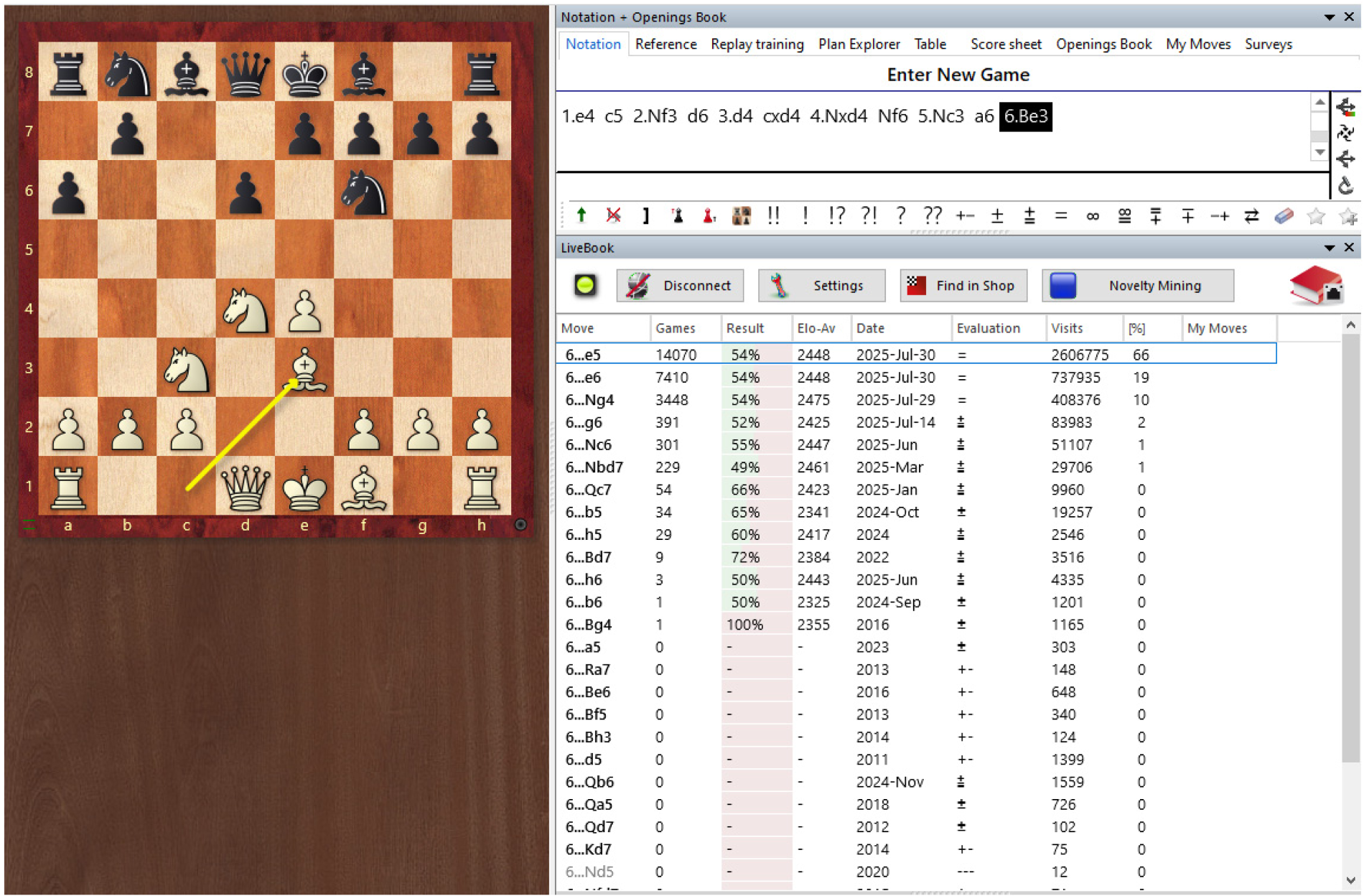
With these resources, it is increasingly rare for top players to make opening errors. Human intuition still plays a role, but engines and databases usually confirm the same optimal choices. This redundancy ensures reliability. Background information ICCF Archive Database is shown by using the more accurate Chess Base Interface in Figure 2. Finally in Figure 3 we see an up-to-date data version since there the game are stored in Chess Base's live Boch (see section 4.2).
Middlegame
In the middle game we see enormous progress, since players rely increasingly on neural networks. Databases such as LiveBook and Let's Check, integrated within ChessBase, offer access to the entire community's analysis. Players can instantly see engine evaluations and previous research for almost any position.
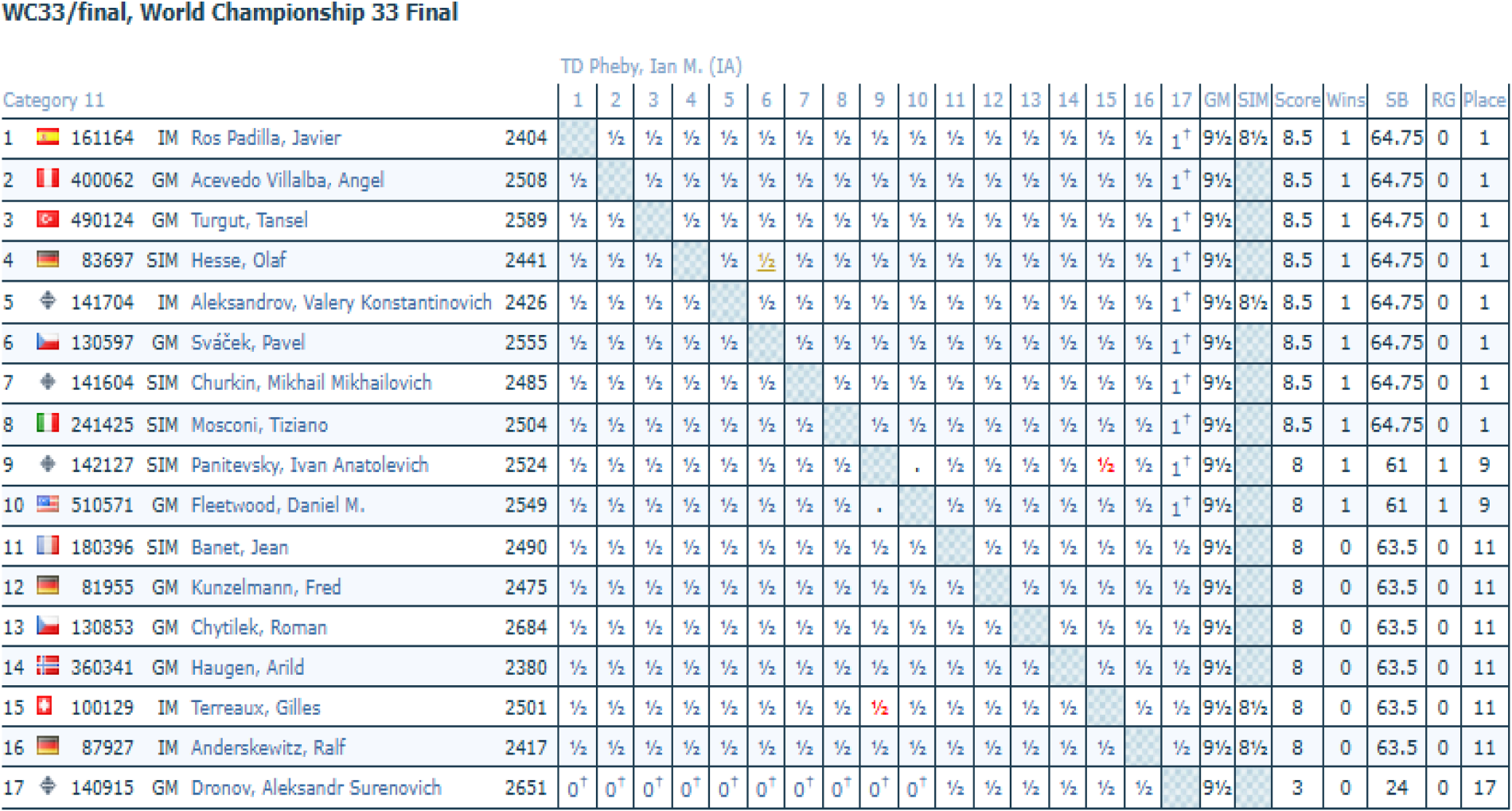
The Chess Cloud Database Query Interface. Information Available From the ICCF Game Archive Database Through the ChessBase Interface. Information Within the ChessBase Interface Available for all Games Stored Within ChessBase's LiveBook. The Cross Table of the Ongoing World Final 33.

Different engines excel in different types of positions—open, closed, or fortress-like. The strongest correspondence players test their engines against standard positions to select the best tool for each situation. For transparency, I’ll only say that Stockfish 17.1 is
What will be the result? Games between equally prepared players nearly always end in draws—unless a player suffers health issues or makes clerical errors. This is evident in World Final 33, where the only wins followed the unfortunate passing of Aleksandr Dronov (see Figure 4).
Endgame tablebases are the key to solving the game of chess. History tells us (Bellman 1965), proposed the concept, Strohlein 1970 did earlier Worhen Thompson developed the first widely known KQPR database and van Den Herik and Herschberg (1985) described the precise details (thanks to communication with Thompson) (for results see Thompson 1986). These original findings were later expanded to 6-piece and now 7-piece tablebases (https://syzygy-tables.info/), offering perfect knowledge of countless positions.
As endgame knowledge expanded, it effectively reduced the volume of middlegame positions that still require analysis. The question now is whether the remaining middlegame set is small enough for practical evaluation using modern tools. I argue it is (Edwards, 2014).
One possible exception: long, strategic maneuvering positions that stretch neural net evaluation to its limits. I have tried to reach such positions in my games by adapting my opening repertoire accordingly. However, over the past two years, all these games have still ended in draws.
Conclusion
Modern chess technology has ushered in a new era. At the highest levels, particularly in correspondence play, the game is no longer a contest of human intuition but of methodological mastery. Tools such as neural nets, comprehensive databases, and tablebases have virtually eliminated analytical mistakes.
While chess remains theoretically unsolved (strongly, weakly, or ultraweakly), it is, in practice, methodologically solved. The dominant result—draws—reflects this reality. Today, success comes not from brilliance, but from avoiding errors through robust preparation and methodical application.
Prospects
The methodological solution has clear implications. In elite correspondence play, draw rates will likely remain high, potentially challenging the format's viability. However, for amateur and club players, these same tools offer unprecedented opportunities for learning and improvement.
The final frontier may be the discovery of positional structures that lie beyond today's engine evaluations. Despite my efforts, I have yet to find one that doesn’t ultimately lead to a draw. Alternatively, the future of chess may lie in variants less vulnerable to current computational methods.
Solving chess, in this sense, is not the end—but a new beginning.
A Coda
The complexity of chess is estimated at 1043. The most complex game solved to date is
Footnotes
Acknowledgments
I would like to thank Michael Hartisch and Chu-Hsuan Hsueh, organizers of ACG 2025, for their assistance during the submission process. I am also grateful to Jaap van den Herik and Mark Winands for their help in finalizing this paper.
Funding
The author received no financial support for the research, authorship, and/or publication of this article.
Declaration of Conflicting Interests
The author declared no potential conflicts of interest with respect to the research, authorship, and/or publication of this article.
