



Abstract
Background
In the digital era, iGaming has become a rapidly expanding phenomenon that generates complex behavioral patterns and increases the risk of problematic gambling. The integration of technologies such as Artificial Intelligence of Things and the Internet of Behavior enables a shift from reactive to preventive approaches in public health protection.
Objective
This study combines clinical practice, AI, machine learning and the Internet of Behavior concept to analyze player behavior patterns and develop machine learning models for early detection of addiction risk through behavioral markers.
Methods
Behavioral data were collected from an online game supplier operating through 52 operators in Republika Srpska, Croatia, Romania, Brazil, Somalia, and Mali. Psychiatric expertise and clinical experience were applied to identify harmful behavioral markers, which served as inputs for training MLP neural networks. Models trained per country classified player behavior into recreational, risky, and problematic categories.
Results
The analysis included 109,418 players across three continents, aggregating 5,135,179,510 online slot game bets. Results revealed significant cross-country variation in risky and problematic gambling, shaped by socio-economic, cultural, and regulatory factors.
Conclusion
The integration of AI-driven behavioral analysis with psychiatric insight provides a robust framework for early risk detection and personalized interventions supporting responsible gaming.
Keywords
Introduction
In the era of the digital revolution, the phenomenon of iGaming (Internet Gaming) has become increasingly widespread, presenting complex behavioral patterns. These behavioral patterns, through the lens of psychiatric methods, advanced AI technologies, and the concept of the Internet of Behavior, raise new questions and challenges in understanding human behavior. iGaming has been accessible since the mid-1990s. For some players, gambling is a form of entertainment and a recreational activity, similar to going to the movies, while others view iGaming as a hobby. Unlike land-based gambling, online games can be accessed from any location, without fear of judgment, at any time of day or night, which leads players to spend more time gambling than those participating in live venues due to the enjoyable experiences provided.
Over time, online games have evolved from simple text-based games to graphic-rich virtual worlds that offer players a sense of community, allowing them to socialize and compete with each other. It is predicted that technologies like Augmented Reality (AR), Virtual Reality (VR), and other immersive technologies will further increase the demand for gaming across all player types. The growing popularity of iGaming highlights the need for behavioral tracking systems to fulfill the obligation of societal care. Globally, there is a trend to regulate iGaming, introducing laws and measures to protect players and transform gambling into an entertainment industry and recreational activity rather than an impulse-control disorder.
In most countries, iGaming is a socially acceptable and legal entertainment activity. While the majority of players engage in gambling recreationally without harmful consequences, for some, the habit escalates into an impulse-control disorder, negatively affecting both individuals and society. The accessibility of iGaming raises public health concerns due to its potential to foster addiction. In recent years, addiction has drawn increasing attention from clinicians and researchers alike. Hence, it is critical to identify high-risk players as early as possible. Behavioral markers and AI have significant potential to predict the development of gambling disorders or addiction.
Addiction typically involves exposure to a stimulus and is followed by behaviors that lead to repeating an experienced sensation. After a certain number of repetitions, addiction is established. The type and frequency of addiction may vary over time, occasionally interrupted by attempts to regain control. Problem gambling is a repetitive behavior where individuals cannot control how much money they spend. Regulators worldwide strive to ensure that iGaming remains an entertainment industry rather than a public health problem.
Pathological gambling, as a type of addiction, is the most prevalent and severe form of non-chemical addiction. It is a disorder characterized by an uncontrollable urge to gamble, far exceeding the boundaries of social or recreational activity, motivated by the willingness to risk a certain monetary value to gain a higher value. Historically, pathological gambling was regarded as an impulse-control disorder but has been reclassified as a behavioral addiction (non-chemical addiction) within DSM-5 and ICD-11, which place gambling disorder in the category of behavioral addictions.
One of the key ethical considerations in the gambling industry is promoting “responsible gambling” and protecting players. Player protection is a top concern for clinicians, researchers, and regulators. Many operators offer tools to help players understand and manage their gambling behavior. By analyzing player behavior during gaming sessions, AI algorithms can identify patterns and signs of problematic behavior, such as excessive spending, “chasing losses” (increasing bets to recover losses), or prolonged gaming sessions. Timely detection of problematic behavior enables interventions to support players whose risky gaming habits may escalate into gambling problems.
AI and large language models (LLMs), also known as Generative AI, hold significant promise in healthcare and mental health support. Based on medical histories, AI algorithms can suggest treatments and care plans. Similarly, AI offers vast opportunities for supporting mental health.
Machine learning and data science are highly relevant in helping regulators and operators protect players. Data science, combining various fields, overlaps significantly with AI, as it utilizes machine learning methods and classical programming to derive insights and predictions from existing data. Early identification of risky player behavior allows for targeted preventive interventions to mitigate the development of problematic gambling. Most previous research on gambling relies on data from a single operator or country and focuses on monetary and gaming intensity. The challenge with such models is the potential generalization of player behavior globally, without considering factors such as spending power, culture, mentality, and recreational habits.
This study describes iGaming behavioral patterns discovered through psychiatric techniques combined with machine learning, AI, and IoB. IoB refers to collecting data that provides essential insights into player behavior, interests, and preferences. From a behavioral psychology perspective, IoB aims to understand user data collected from online activities. The research aims to interpret data from an online slot game provider regarding player activities segmented by countries and continents, and to utilize this knowledge to develop and promote useful tools from the perspectives of human psychology, public health, and preventive healthcare, using machine learning and AI.
The data concerning individual players’ activities from each country are analyzed to determine whether a player is a recreational online slot player without addiction signs, exhibits risky behavior, or shows clear signs of gambling addiction. Using AI, early detection of addiction signs in individual players is possible, with high confidence in predicting risk and intervening to prevent future addiction development. After analysis, the next step involves leveraging modern technologies and AI to design personalized interventions for each risky player's behavioral profile through automated tools, tailored limits, personalized messages, and institutional support to prevent loss of control and help players return to the recreational player category.
This approach enables public health institutions to connect with a broad audience across different regions and promote “responsible gambling” by offering support to prevent the development of addictive behaviors. From a public health perspective, prevention is a more desirable solution than damage control. One of the goals of this study is to identify patterns in gambling behavior by tracking active players in multiple countries over 12 weeks of playing online slots. The study aims to uncover behavioral markers that can predict problematic gambling. The dataset, provided by an online slot game provider, includes a portfolio of over 200 different slot games offered by various operators in online environments across Republika Srpska, Croatia, Romania, Somalia, Mali, and Brazil. The data, protected under a non-disclosure agreement, cannot be shared or reported in a way that identifies individual players. Behavioral information is anonymized to ensure no identification of persons.
The dataset consists of millions of individual slot rounds grouped weekly for each player, with averages calculated for bets, winnings, round numbers, game variety, session duration, and more. One major challenge was identifying markers that distinguish players exhibiting risky behavior from those playing recreationally. Markers included player activity, betting patterns, time spent gaming, time of day, “chasing losses,” impulsivity reinforcement after significant wins, and betting frequency and intensity over weeks.
Earlier research struggled to identify risky players due to the lack of clinical verification of training samples, relying instead on players who self-reported problematic behavior. In this study, a sample of 1200 players was analyzed and segmented by a psychology and addiction psychiatry expert and his team. This sample was labeled as recreational, problematic, or addicted players. Machine learning was applied to this sample to train a neural network, specifically MLP, which was later tested on a control group of 109,418 players to identify player types across multiple countries. Group of players for training the MLP model and the control group of players make 110,618 players in total. When constructing the control sample for evaluation, we deliberately excluded the players already used for training the model to prevent overlap and ensure independence between training and testing data. As a result, the control sample consisted of 109,418 new players. The study reviews prior research, challenges in developing machine learning models for detecting problematic player behavior, and directions for advancing IoB systems. It also proposes a solution through the selection of relevant behavioral pattern markers and training machine learning models for each country. An MLP algorithm for supervised learning was implemented to detect risky player behavior across different countries, incorporating clinical practice experience in selecting harmful behavioral markers.
The focus of the study is not on comparing machine learning algorithms but on the results provided by the MLP algorithm across multiple countries. The findings, evaluated using data from 279 slot games and 109,418 players, offer a percentage breakdown of player types by country. Comparisons were made between countries with regulated and unregulated iGaming, varying income levels, and locations across continents.
This study represents a substantial extension of the author's previous research on the application of AI and behavioral analysis in online gambling environments. While the earlier study primarily focused on identifying behavioral indicators associated with problematic gambling behavior within a single country dataset, the current research introduces several significant methodological and analytical advancements, including the analysis of a substantially broader set of behavioral markers related to online gambling activity, player engagement, spending behavior, gameplay intensity, session dynamics, and potentially harmful behavioral patterns.
The present study incorporates clinically validated player segmentation performed by experts in psychology and addiction psychiatry, enabling the development of supervised machine learning models based on professionally classified behavioral profiles. In contrast to previous approaches relying primarily on self-reported gambling behavior, the current methodology applies expert-labeled training samples for improved reliability and interpretability of prediction results.
Additionally, the study expands the research scope from one country analysis to a large-scale multi-country evaluation involving 110,618 players and 279 online slot games across different regulatory and socio-economic environments. The research further contributes through the implementation and evaluation of an MLP neural network model for behavioral pattern recognition, comparative cross-country analysis, and discussion of responsible gambling applications supported by AI-driven behavioral interpretation.
These extensions significantly differentiate the current manuscript from the author's previous publication and provide a broader scientific and practical contribution to the field of AI assisted online gambling behavior analysis. A preliminary phase of this research was presented in the author's earlier publication, however, the current manuscript substantially extends the dataset, number of behavioral markers analyzed, number of input features for training neural network, methodological framework, analytical scope, and interpretation of results.
The analysis and discussion examine the evaluation results, prediction accuracy, and behavioral pattern identification, considering the impact of different socio-economic and regulatory factors. The study raises the question of how to work with players, not through coercive restrictions, but by offering education and raising awareness through tools that help players build a positive relationship with online slot gaming and empower them to make informed decisions based on the information provided.
Related work
The number of projects in the domain of AI and IoB is increasing year by year. However, only a portion of them is oriented towards public health and preventive healthcare for online slot players. The majority of research focuses on monitoring player activities, while only a fraction considers the broader picture and the impact of various factors that can be detected through the analysis of behavioral patterns defined using psychiatric methods. An additional challenge was how to connect new insights on gambling behavior from data science with knowledge from psychology and psychiatry, for example, how personality traits, gambling-related beliefs, financial capability in the country, national characteristics, and mental processes are linked with behavioral patterns of problematic gambling. It is generally accepted that online slot players have varying levels of risk for developing problematic gambling disorders, and therefore, more tools and resources are needed to mitigate the harmful impact of playing slots online. Previous works have emphasized concerns regarding the accuracy of machine learning algorithms, as it was necessary to balance between protection from the harmful effects of gambling and desires and rights to privacy while minimizing the use of sensitive data. All approaches consider broader frameworks that also look at the ethical use of AI in the iGaming industry. Research has mostly discussed voluntary self-exclusion programs and “responsible gambling,” which allowed players to disable themselves from playing various iGaming games with operators for some time, while new methods and approaches were not proposed. The data analyzed were usually limited to a small set of markers for analysis and tied to just one operator, most often only in Europe. There were no statistics on what percentage of recreational players, risk players, and problematic players there were when comparing data from game providers whose slots are played at multiple operators covering regulated and unregulated markets, countries with high and low average net earnings, or countries on different continents.
Previous research and relevant works are listed first by reviewing psychiatric studies, surveys, and research with statistical analyses. Then studies and research that used AI and machine learning for behavioral data analysis, classification, and prediction were covered. Reviews of papers that included dozens of studies using machine learning in behavioral data research, addiction diseases, and iGaming were then analyzed. Finally, the effectiveness of “responsible gambling” programs and tools for their implementation was discussed.
Pathological gambling has been renamed to gambling disorder and classified under behavioral addictions. 1 Addiction is often directly associated with impulsivity. Impulse control disorders and addiction diseases usually go together, both involving the reward system and activating the same parts of the brain. Pathological gambling is a very complex disease that is accompanied by neuropsychological deficits and impulsive behavior, characteristic both of addicts and people with impulse control disorders. There is a high degree of comorbidity between impulse control disorders and addiction diseases.
Behavioral addictions are most commonly associated with iGaming, internet use addiction, and playing online games addiction. Combining therapies and drugs, as well as interventions based on technologies, behavioral therapy appears promising, as stated in the publication. 2 Prevention strategies, awareness raising, education, early identification, etc., are of vital importance. Collaboration, awareness campaigns, and preventive measures targeting youth are crucial for addressing public and mental health challenges. In today's world, addiction diseases are not only related to substance use but also to internet, food, exercise, and shopping addictions. However, not all are included in prominent classification systems such as the International Classification of Diseases (ICD) 11 or the Diagnostic and Statistical Manual of Mental Disorders (DSM) 5. iGaming as a mental disorder is listed in ICD 10, and recently, addiction to playing internet games has been added as a new category. Many countries around the world have begun initiating plans aimed at curbing behavioral addictions. European countries have been working on solving the problem of behavioral addictions for some time. The disorder of playing games online has been recognized in several Southeast Asian countries, some of which, like South Korea, have opened centers for treating these addictions. India has also begun taking steps toward addressing behavioral addiction issues.
The COVID-19 pandemic had a significant impact on gambling in many jurisdictions around the world. The purpose of this review of papers on the topic of iGaming during the pandemic 3 is to systematically identify and describe the outcomes of surveys that examined the effects on gambling and gambling disorders during the pandemic. As access to casinos was reduced or disabled at the time, iGaming sites operated uninterrupted. Some media even reported that iGaming peaked during the pandemic. To prevent harmful gambling, some jurisdictions even limited iGaming advertising and daily money limits that a player could spend. In 17 publications reviewed, it was reported that with the closure of land casinos, the frequency of gambling and the money spent were reduced. Reasons cited in the papers related to the reduction of iGaming were financial (50%), then player statements that they did not want to gamble near family (15%), then impressions that they gambled too much (13%), and suggestions from someone that they should reduce gambling (13%). Young men were the group that increased the total share of iGaming during isolation. The percentages that testified to an increase in iGaming varied from 4–14%. After isolation, there were various results. For example, in Ontario, survey results indicated that the motives for increasing iGaming were related to job loss and other negative financial impacts. Players gambled more to earn a salary, while some claimed that iGaming helped when they were nervous or depressed because they had fewer working hours during the day. Unlike Ontario, it was estimated in the UK that during isolation, the intensity of gambling increased by 9%, and after isolation, 48% of those players increased the frequency of gambling or stayed at the same level. On the other hand, investigations in New Zealand showed that the intensity of gambling after isolation was reduced from 17% to 11%.
Nigeria has witnessed an unprecedented surge in gambling activities occurring daily, as described in study. 4 The most prevalent activities are iGaming, sports betting, racing, and slot games, with Nigeria leading Africa in the number of online gamblers. This study, which selected participants through a sampling technique, conducted a survey among players who bet on football matches online. Of the 390 participants, the majority were unmarried men between 18 and 39 years old. It was found that 1% were highly qualified, 39.7% had medium qualifications, and 15.6% were unemployed. About 75.4% were pathological gamblers, of which 89.5% were men and 10.5% were women. Men were more likely to be pathological gamblers, with a share of 77.4% compared to 22.6% for women. The frequency of gambling and the amount of money spent were significantly higher among the male population than among the female respondents. The authors suggest this discrepancy is due to the higher number of men in the study and the cultural and religious contexts that consider gambling primarily a male entertainment and strictly forbid it. The conclusion was that single men and younger populations are more susceptible to pathological iGaming, with most being of medium qualification.
Gambling is a very common and socially accepted activity in India. Recently, a significant change has been the increase in iGaming, which is quite different from live gambling. In study, 5 conducted on a sample of 31 patients undergoing hospital treatment, the prevalence rate of iGaming disorders was examined. The statistical design was formulated using collected data. Qualitative variables were analyzed using descriptive statistics with means and standard deviations, Pearson's correlation coefficient, and logistic regression. The prevalence rate of internet gambling disorder was 0.16%. Most respondents were under 35 years old, married, and unemployed. Twenty-one patients were hospitalized for mental issues and after detailed evaluation, were found to have an internet gambling disorder. Nine patients attended outpatient treatment due to this disorder. All were over 18 years old, and 90% were under 35. The study lasted six months. Approximately 32.25% had completed some degree of education, and 41.93% were students. About 64.51% were unemployed, and 54.83% were married. Around 70.96% came from urban areas, and 71% belonged to the middle economic class. According to the DSM-5 scale, 25% had a severe addiction, 48% moderate, and 25% mild. Nearly 50% of respondents had a personality disorder. Among all respondents with an internet gambling disorder, only 9% did not have another disorder. Alcohol use disorder (7), suicidality (5), and depression (3) were common psychiatric illnesses present in these patients. A strong correlation was found with antisocial, impulsive, and anxious personalities and internet gambling disorders.
The statistics shown in paper
6
state that iGaming has incurred significant additional costs to the health system in Germany. By surveying a sample of 15,023 German citizens between 14 and 64 years of age, researchers concluded that 2% of respondents showed symptoms of pathological gamblers, 55% of whom were female. Researchers estimated that the annual cost of treating gambling disorders was
The primary goal of the study conducted in Sweden 7 was to compare and analyze views and practices regarding problematic gambling and “responsible gambling” among licensed and unlicensed operators within Sweden. Fourteen casino managers were interviewed, and responses were explored on how gambling and problematic gambling are defined and how operators understand the relationship between problematic gambling and “responsible gambling”. Licensed companies perceive casino games as the most dangerous form of gambling. Both licensed and unlicensed companies agree that gambling should be entertainment and excitement, as well as an inseparable part of human history and culture. Furthermore, how licensed and unlicensed companies implement “responsible gambling” in practice and how the current industry stance on “responsible gambling” correlates with upcoming legislative changes were considered. Licensed and unlicensed companies have a long tradition of communicating with players and taking proactive measures. All agree that more intensive use of behavioral monitoring systems is necessary to fulfill the duty of care to players. Information about “responsible gambling” on online casino sites and the information they receive during play is essential prevention in the development of problematic gambling.
Due to the fundamental importance of identifying players at high risk of developing addiction diseases early, in this paper 8 a hypothesis was posited that behavioral markers such as gambling frequency, intensity, and tendencies to increase and decrease stakes during the first month of live game play can segment players who will later close their accounts due to problematic gambling. A sample of 48,114 sports betting players over two years was observed. Of these, 1758 players closed their accounts after one month of play. Of those, 530 (33%) confirmed they closed their accounts due to gambling problems, 19% were not satisfied with the service of the gambling organizers, while 48% said they were not interested in gambling. Of these, 92% were men, 8% were women, and men had higher stakes per day compared to women. The respondents were residents of Germany, Turkey, Poland, and Spain. Clustering using the k-means method was used to identify groups of players with similar behavior during the first month of play. Cluster 1 contained players who played frequently with large stakes. Cluster 2 included players who played very rarely. Cluster 3 grouped players who played frequently with a large number of bets but spent the same amount of money each day on betting. Cluster 4 comprised the most players, those who played rarely, with few bets and low stakes. Additionally, it was examined which groups of players had higher tendencies towards risky gambling than others. The high-risk group identified in the study included only 3% of those players who closed their accounts due to gambling problems.
Study 9 examines whether certain categories, i.e., types of iGaming games, are more associated with harmful behavioral markers than others. Data from one operator in the United Kingdom, from the year 2022, for 100,000 players over a six-month period were observed. Behavioral markers considered were: declined deposits, removal of “responsible gambling” limits, multiple deposits within one session, expectations of bonus credits, and playing at unusual hours. Researchers proposed several hypotheses about which products have a strong connection with harmful behavioral markers: those with shorter event frequencies, those allowing continuous betting, triggering impulsiveness and “chasing losses”, and are highly available so that they can be played at any time. All statistical analyses were conducted using Spearman's correlation to examine the relationship between the frequency of gambling based on the total number of active days for each product category and the frequency of harmful markers. Then, the relationship between product category and harmful markers was modeled using a series of negative binomial regression, after confirming that Poisson regression was not a suitable choice due to high dispersion in outcomes. Key measures in the model were the frequencies with which harmful indicators appeared over six months. The most popular products in terms of total participation were slots (50%), followed by individual stakes on races (42%), individual sports betting (31%), live event sports betting (19%), and combined sports betting (18%). 12% of players bet on less popular sports. Except for roulette (15.7%), participation in table games was very low. It was concluded that all markers except for the removal of “responsible gambling” limits varied together with the number of active playing days, which causes attachment to certain types of games, most often slots, and most forms of sports betting. It was also examined how accurately the number of active playing days in playing different types of iGaming games predicted harmful behavioral markers. These conclusions highlight the potential value of using measurement markers to differentiate risk and possible harm that can arise from different types of iGaming games.
“Responsible gambling” messages are used to inform players that they have choices and to encourage appropriate behavior during play. 10 They often inform players about the probability of winning and how outcomes are determined. Such messages are similar to warning messages found on tobacco and alcohol industry products, aimed at informing users about risks that may arise from excessive or inappropriate use. In the context of gambling, the use of informative and educational messages is based on the concept of problematic gambling as a result of irrational thinking and beliefs. Such messages need to be tailored and targeted for specific groups of players. The goal of this paper was to examine a focus group of Canadians consisting of younger (18–24 years old), older (over 60 years old), players who play frequently, i.e., on a weekly basis, and players who play skill-based games (poker and sports betting). Examinations were conducted on the focus group online in a similar form to when a moderator leads a discussion with a small group of participants, and additionally, the moderator could also privately communicate with individual participants. Participants were grouped into older players, younger players, players who like skill-based games, and those who play very frequently. The conclusion was that older players prefer messages about possible setting limits, while younger ones and those who play more frequently prefer messages related to their style of play and expertise. Players who play skill-based games respond to messages related to the probabilities of winning and outcomes over time. All groups agreed that a positive and non-judgmental tone, addressing in those messages, and the right choice of words are very important to reach players and reduce harm that can arise from risky gambling. Considering all groups, there was no difference in message preferences between male and female respondents.
Programs for self-exclusion as a player protection measure were discussed, and their actual usage in practice was examined. 11 Out of a total of 911 studies on this topic, 16 studies published in English or German from 1997 to 2017 were selected and analyzed. This review describes the sociodemographic characteristics, as well as the goals and motives for initiating self-exclusion in online and land-based casinos. It was found that individuals who opt for self-exclusion in online casinos are, on average, 10 years younger than those in land-based casinos. Self-exclusion was primarily motivated by financial problems, accompanied by a loss of control and issues in personal life with partners. This was more pronounced among land-based casino players, as described in 12 out of the 16 studies. Studies that analyzed self-exclusion in online casinos looked at players from Europe, while those focusing on land-based casinos included players from Germany, Austria, Switzerland, Australia, Missouri, Quebec, and Montreal. In land-based casinos, 45–72% of those who self-excluded were men, with an age range of 41 to 45 years. Between 42–67% had partners, and 73–90% were employed. In online casinos, 69–95% of those who self-excluded were men, with younger players, aged 31–36 years, showing a higher tendency towards self-exclusion. All player types complained about the complicated process of self-exclusion and the lack of clear explanations about what the process entails, its duration, etc. The conclusion was that besides simplifying the administrative part of the self-exclusion process, the use of professional care and addiction treatment services should be further promoted because only 1% of online players sought professional help, compared to about 10% in land-based casinos.
In one of the earlier studies, 12 data from a total of 22,500 players from England, who played at two operators, were analyzed. The role of gender as an input variable in algorithms for identifying problematic gambling and the accuracy of such algorithms was examined. Concerns were noted about the awareness of differences between men and women that could be relevant for predicting risky gambling. It was mentioned that testosterone levels could be linked to risk-taking and pathological gambling, and behavioral patterns in problematic gambling associated with gender were identified. A Random Forest machine learning algorithm was used to train a new model where gender was the main classification variable for prediction instead of self-exclusion, while the base model was optimized for predicting self-exclusion. An approach was proposed and evaluated that used gender data only for training the Random Forest model, constructing one model for each gender and combining trained models into a comprehensive model that does not require gender data as input variables.
BetBuddy applied a method called risk curve characteristics 13 for analyzing and protecting players who gamble online. The model searches for players whose behavior matches those who have chosen to stop playing, i.e., to self-exclude from the operator's site, formally requesting the operator to ban them from playing for 6 months or more. Players from the United Kingdom who play at bingo and slot operators online were observed. The system predicts whether players are at risk and recommends stopping play if their pattern of play matches those who have already requested self-exclusion. Parameters such as night-time play or declined deposits were considered. The dataset used for training the model contained variables that describe the way of playing, deposits, payouts, and setting various limits by players. The resulting variable is binary and represents whether a player is a serious candidate for self-exclusion or not. By analyzing the risk curves, it was concluded that increased night-time playing is not problematic up to a certain point if other playing parameters are stable. Beyond that point, consistency in night-time playing increases the risk of self-exclusion. Additionally, frequently initiating deposit rejections without other changes in playing habits and behavior does not necessarily lead to an increased risk of self-exclusion. A Random Forest machine learning model was applied and evaluated, which helps in reducing the harm from iGaming and shows that it can produce information relevant to the gambling industry. Based on this information, it would contribute to the development of safe playing guidelines and better communication with players through messages intended for timely intervention.
Using player tracking data from platforms of three operators across six countries (Austria, Germany, Sweden, Poland, Spain, and Slovenia), this study 14 investigated behavioral factors leading players to self-exclusion. A total of 25,720 online players were analyzed, of which 13% were female, and 1.61% of the total player base self-excluded in the near future. The authors compared five different machine learning models: AdaBoost, Decision Trees, Extremely Randomized Trees (extra-trees), Gradient Boosting, and Random Forest. The results indicated that players who had a higher number of limit changes in gambling and previous self-exclusions, as well as those with more diverse methods for making deposits, a high average number of deposits per session, and a large variety of games played regularly, were more likely to self-exclude. Additionally, a trend was observed where younger players, especially in Germany, were more prone to self-exclusion. In five out of the six countries, indicators related to the intensity of money spent did not significantly impact future self-exclusion. In Austria and Germany, a greater diversity of games played by players indicated a higher risk of self-exclusion. More deposits during a session increased the likelihood of self-exclusion in Spain and Poland. An increased number of payouts influenced the likelihood of self-exclusion in Slovenia, while canceled payouts were correlated with self-exclusion in Spain. Moreover, the study showed that with reasonable prediction performance, it is possible to predict future self-exclusions using identified behavioral variables in machine learning algorithms in countries not among the six analyzed. The study did not rely on the intensity of money spent, which varies from country to country.
In the past, the performance of machine learning and the Random Forest algorithm was tested in classifying iGaming players with and without records of previous self-exclusion. 15 A dataset from a Canadian operator was analyzed. The model was trained on a sample of 2157 players who had self-excluded, and predictions were made on a sample of 17,526 players. Behavioral parameters used for training the model reflected the frequency of playing, intensity, and variability. Psychological effects such as “chasing losses” or increased impulsivity after larger wins were not considered. The focus was on variability in stakes per session as an input parameter for behavioral markers. Of all input variables, variations in stakes per session had the greatest significance for prediction, accounting for 32% of the predictive signal. The dataset for analysis consisted of data from a year-long tracking of players who played online casino games. The predictive performance of machine learning in classifying self-excluding players was tested.
Although players are often reminded to play responsibly, they lack sufficient information to assess the risk associated with different formats of iGaming games, as is the case with alcoholic beverages where the alcohol percentage is clearly stated. In the work, 16 games involving certain skills, i.e., sports betting over eight seasons of the English Premier League, were examined. Gambling losses were positively correlated with the clear visibility of betting odds, indicating that the prominence of betting odds could be used to inform players about the risks involved. Significant variations in odds, or risks, are considered relevant in promoting “responsible gambling.” Machine learning using logistic regression was used to discover potential variations in outcomes in sports betting. The study explored how odds and risks in sports betting vary across a large set of previous betting odds and results available. The main innovation in the work was considering the overall impact of skill in sports betting by comparing the least skilled and most skilled strategies on a publicly available dataset for football match betting odds. The machine learning model, as a betting expert, learned the relationship between publicly available information about odds and match outcomes. The conclusion was that players’ losses increased when betting with high potential payouts, and this information was shown to the player. It was emphasized that any labeling of products associated with betting for warning purposes must first be empirically tested before being presented to the broader population to reduce the risk of any negative feedback effect on players’ behavior.
In the review, 17 progress in behavioral analyses of iGaming disorders was discussed. Challenges to be overcome in machine learning algorithms for risk prediction were considered. It was noted that indicators of problematic gambling such as self-exclusion or account closure are insufficient for training models, and that algorithms should consider other specific indicators. It was observed that most studies typically analyze data from only one operator. IGaming disorders are associated with a range of behavioral variables, as well as other predictors such as demographics, payment information, nighttime play, and customer support contact. It is necessary to monitor changes in stakes to consider “chasing losses” and increased impulsivity after large wins. Integrating new findings from data science with existing psychological knowledge on detailed characterization of threats and cognitive processes in gambling disorder is considered challenging, for example, whether impulsivity leads to predicting behavioral markers such as stake escalation or increased play intensity.
In the work, 18 a method was proposed for analyzing problematic gambling among adolescents using machine learning on a dataset of Korean adolescents aimed at preventing the development of addiction disorders in this target group. Adolescents were surveyed and to participate in the analysis had to answer questions such as their age when they first gambled, how much money they invested in the gambling activity they most frequently engaged in over the last three months, how much money they lost in the gambling activity they most frequently engaged in over the last three months, and their average monthly budget. The most significant characteristics for analysis were iGaming in the past three months, experience winning money or goods, and peer-to-peer betting. The questionnaire included questions related to demographics, gambling habits, awareness of gambling, monthly allowance, gender, age, and residence. Four models were trained: Random Forest, Support Vector Machine, Extra Trees, and Ridge Regression, with Random Forest showing the highest reliability in prediction. Algorithms trained on a sample of 5045 students provided moderate accuracy in predicting problematic gambling. Of the 5045 participants, 51.1% were male, 48.9% female, with an average age of about 15 years. The analysis identified significant predictors from complex human behavior, environmental factors, psychology, biological factors, laws, regulations, and family and friend relationships. Mental stress, which can have a significant impact on gambling behavior among adolescents, was not considered. Education on gambling prevention was proposed for both adolescents and their parents. Additionally, it was suggested that the trained machine learning model be installed on smartphones so that adolescents could determine their level of risky gambling behavior at any time based on filling out a questionnaire without any restrictions.
In the study, 19 of the 11,829 players from Norway, 4045 accessed information related to their gambling expenses. 69.1% were male, and 30.9% were female. The average age was 40.52, with approximately 25% of players under 30 years old and about 25% over 50 years old. Players were asked whether they thought the amount of money they spent was more than expected, as expected, or less than expected. During the month the analysis was conducted, players could access a six-month statistic of their expenses, which was also displayed graphically showing increases or decreases over a certain period. A hypothesis was posited that players who claimed the amount they spent was more than expected were more likely to experience cognitive dissonance and thus would try to reduce the amount of money they spent on gambling, unlike those players who believed the amount they lost was as expected. A Recursive Tree algorithm used for machine learning grouped players who responded that they spent more than the expected amount or the expected amount of money. The final results were contrary to the hypothesis because players without any cognitive dissonance reduced the amounts of money they spent on gambling more than players who felt cognitive dissonance. 63% of players responded that they spent as much on online games as they expected. 30% believed they spent more than expected, and 7% said they spent less than expected. Players who believed they had spent as much as they expected, after learning this information, reduced the amount of money they spent on gambling more than those who believed they had spent more than expected, while players who claimed they spent less than expected reduced the amount of money they spent on gambling the most. Finally, a more detailed analysis of specific playing patterns of six different types of players explained the ultimate paradoxical result using a decision tree algorithm of machine learning. The results demonstrated that players who receive personalized feedback on their gaming behavior spend significantly less time and money on gambling than those who receive no feedback.
The presented study 20 was the first to attempt to predict the self-imposed limits on the amount of money a player can spend, using data from a sample of 70,789 players who played at a Norwegian operator in the first half of 2017. The average age of participants was 41.04 years, with 28% being female. Of these 70,789 players, 6.7% changed their personal monthly loss limit at least once. 10% of players chose the maximum monthly spending limit, and 5% were classified as problem gamblers. Among players who received feedback that they had reached 80% of their loss limit, 18% changed their limit, most often increasing it, and only 0.7% decreased their limit. Consequently, increasing the limit led to increased money losses. Setting limits is a strategy presented to help players reduce their losses during gambling and thus help operators predict which players will activate a change in limits more frequently than others. The most important variables predicting limit modifications were the feedback players received about reaching 80% of their monthly spending limit, their betting amounts, their theoretical losses, and whether these players had previously raised their limit. The machine learning algorithms used were: Logistic Regression, Linear Discriminant Analysis, Random Forest, Gradient Boost Machine Learning, and Naive Bayes. The results demonstrated that it is possible to predict future limit setting based on player behavior and that the Gradient Boost machine learning algorithm was much better at predicting than other algorithms. Also, predictive analytics can greatly assist in identifying the right messages to send to players at the right time.
This review 21 covers 17 studies applying machine learning in addiction disease research. A good portion of the studies focused on predicting addiction disorders related to substances, cigarettes, alcohol, drugs, gambling, and online gaming. The studies included countries such as the USA, Canada, Australia, England, Ireland, Germany, France, and Italy. A wide range of machine learning methods, particularly supervised learning (ensemble methods, regression, classification), were demonstrated in studies aimed at assisting in medical decision-making. Sample sizes varied from study to study and depended on the machine learning methods used. The range was from 34 to 228,405 for supervised learning, from 395 to 5390 for unsupervised learning, and from 22 to 25 for reinforcement learning. Methodologically, supervised learning was more commonly applied than unsupervised learning. Studies on addictions that did not involve substance use were related to gambling and online gaming. Sports betting, live games, online casinos, and poker were subjects of the studies. Two risk groups were identified: players engaging in various gambling activities with large variations in casino investments and players engaging in various gambling activities with large variations in sports betting investments. Regarding online gaming, 3881 players from Korea were examined to predict patterns of problematic players. Player types were classified into those who spend a lot of money, those who play to socialize with other players, and those who prefer to play alone. The most important predictors were: how much money they spend, average playtime during the week, whether part of an internet community and attending their meetings, average playtime during weekends and holidays, marital status, and personal perception of internet gaming addiction. Limitations encountered include that the papers did not best display the potential application of machine learning in psychiatry of addiction diseases. Furthermore, many papers lacked details on input data and the evaluation of performance of trained models. The sample size in some studies was insufficient. The review highlights potential applications of similar methods in psychiatry and neurology.
The review 22 aimed to analyze behavioral data from players taken from operators over a period of 15 years. Online players can be grouped into clusters based on the frequency and intensity of gambling, variability in gambling, or frequent betting. Self-exclusion or account closures are also key behavioral indicators. The potential value of short-term interventions of “responsible gambling” tools, which include voluntary and mandatory limit settings, messages, and feedback sent to players about their behavior and manner of playing, was supported. Not enough attention was paid to comparisons of which type of games pose a higher risk of problematic gambling and the impact of “responsible gambling” tool interventions over the long term. The review provided an overview of general trends in research to identify which approach is most promising at the time. The risk that an individual poses, i.e., the description of a single player's behavior, rather than the risk of the product itself, was the focus of 78% of the 58 publications. Using various statistical analyses through clusters, Latent class, machine learning, and Decision-tree approaches, it is possible to identify a small percentage of players who are at high risk because their spending exceeds the limits of safe gambling. Several studies have addressed players identified as risky on the PGSI (Problem Gambling Severity Index) scale used to assess the level of gambling problems in individuals. Researchers have shown that there are significant changes over time that can be indicators of risky play such as patterns in investment, spending, “chasing losses,” and depositing funds. It is evident that decisions need to be made on how this information can be used to assist both operators and regulators. Much of the knowledge is based on academic research and is often retrospective based on statistical analyses or decision algorithms and not always available in real-time. Machine learning, on the other hand, differs from the academic approach and is more prediction-based, which is sometimes difficult to test and evaluate. The topic of discussion in this field is whether these two approaches are complementary or divergent. Analyses have shown that the top 10% of players on online platforms generate more than 50% of operator revenue. Also, players who play a variety of different game categories are most often high-risk players, and they tend to prefer fast and continuous games like slot games or live sports betting.
A total of 10,200 active online players of a Finnish operator participated in a study on their experience with “responsible gambling” tools. 23 They were invited to complete an online survey and rate their reactions, attitudes, how much the “responsible gambling” tools annoyed or upset them, and how many of them stopped gambling with a particular operator because they were overly exposed to these tools. Of these, 1223 agreed to be surveyed. Under the “responsible gambling” tools, they described setting limits on money spent or time spent playing, the ability to test players for symptoms of problematic gambling, and the option to freeze some or all gambling categories they participate in or to freeze their entire account. Comparisons between recreational players, risky players, and problematic players, i.e., their experiences in leaving operators and tendencies towards it, were done using a series of multiple linear regressions with gender, age, and whether they had experiences with “responsible gambling” tools as independent variables in the model. Of the total number of respondents, 38.5% were classified as medium-risk gamblers, then 26.8% as low-risk gamblers, 18.9% as recreational players, and 15.6% as problematic players. Recreational players had good experiences with “responsible gambling” tools. Riskier players had an even better reaction to the “responsible gambling” tools and were less annoyed compared to recreational players. Problematic players had the most negative attitude and felt that the “responsible gambling” tools irritated and upset them. While 25.9% of problematic players stopped playing with that operator due to exposure to “responsible gambling” tools, only 5.2% of recreational players stopped playing with that operator, showing that such players are not deterred by “responsible gambling” tools and do not pose a risk of stopping gambling if exposed to these tools.
Strategies for setting limits on money spent or time spent gambling online have been proposed as tools to reduce problematic gambling. This paper 24 provided a review of studies on how effective setting limit tools are in Norway. It included all studies that considered the effectiveness of setting limits in land-based or online casinos. Researchers also categorized studies based on whether limit setting was voluntary or mandatory. In mandatory limit setting, players cannot avoid setting limits or a limit is already set, while in voluntary limit setting, players have the option to decide whether to set a limit or not. The main outcomes summarized were: how many players chose to set a limit, how many found setting limits to be useful, and how much the ability to set limits helped in reducing the harm from risky behaviors during gambling such as spending money and financial losses. It was noted that in most studies, 1 to 3% of players voluntarily set limits, while only one study showed a result of 26%. After 6 to 12 months, the percentage of voluntary limit setting drops to almost 0%. The conclusion was that proposing voluntary limit setting has no effect, while mandatory limit setting helps reduce the damage that can result from uncontrolled gambling.
In this article, 25 the authors present a critique of the “responsible gambling” program, considering it not sufficiently effective in reducing harm from gambling. By focusing on individuals who gamble, “responsible gambling” programs often overlook the social, commercial, and environmental influences that make gambling unsafe. Reviewing articles describing “responsible gambling” programs, the authors approached these topics critically and described an alternative approach in the form of public health impacts. It was discussed that “responsible gambling” programs do not prevent people from suffering from the harmful effects of gambling. Undoubtedly, “responsible gambling” programs rely on individuals to keep gambling under control. Most gamblers gamble and never evolve into problematic players. For instance, in the Australian state of New South Wales, the success of “responsible gambling” programs is measured by maintaining the prevalence of problematic gamblers at less than 1% of the population. It should not be overlooked that people in poorer communities are most affected by the harmful impact of problematic gambling. The authors believe that a better result can be achieved through a public health approach, citing positive experiences from the tobacco industry and alcohol policy. They argue that the current focus on “responsible gambling” tools should be replaced by a focus that approaches players through a public health influence, thus protecting them from harmful gambling.
It's important to note that most previous research has been based solely on data from one operator in one country. Such data only provides a partial view of the behavioral patterns in playing online slot games, excluding other online operators. Moreover, the results should be generalized to other countries with great caution because other operators and countries have different regulations, advertising rules, and attract different demographic groups with varying purchasing power. What has also not been considered is that the global gambling industry, particularly the slot game sector, exhibits a wide range of regional preferences. This diversity highlights cultural nuances that affect entertainment choices. Different regions and cultures prefer different formats of slot games and exhibit different gambling habits. In the work, 14 where datasets on players from multiple countries were used, the focus was on predicting future self-exclusions based on patterns derived from the history of previous player self-exclusions. Previous works have not involved clinicians directly and have not taken into account the mentality and habits of a people when selecting harmful markers for training the machine learning algorithm. Several hypotheses were proposed on which types of iGaming games have a higher correlation with harmful behavioral markers than others and which have a higher potential to promote risky behavior with an increase in engagement level in the games. It was analyzed which behavioral markers lead to future self-exclusion and whether monetary characteristics of gambling among players further enhance prediction. Methodologically, supervised learning was used more frequently than unsupervised learning in the included addiction studies. Previous research used Random forest, Logistic regression, Linear discriminant, Naive Bayes, Gradient boosting machine, Tree + logistic regression, etc. Random forest had the highest accuracy during model training with over 90%, while testing accuracy was under 80%. Other models had significantly lower accuracy during training and testing, i.e., below 80%. Players who resorted to self-exclusion had a negative attitude towards the need for professional treatment as a potential solution to the problem, leaving open the question of how to approach players after detecting risky behavior.
In the author's previous research, 26 AI, ML and IoB concepts were applied to investigate behavioral patterns associated with problematic online gambling activity within a player sample from the Republika Srpska. The earlier study focused on the identification of risky gambling behavior through the analysis of behavioral indicators such as the number of different games played, total loss, total wager, average daily gaming time, average number of daily rounds, and temporal gambling activity patterns during morning, afternoon, and nighttime periods. Using clinically informed interpretation methods, an MLP neural network was trained on a sample of 200 players and evaluated on an additional dataset of 5000 players to identify behavioral patterns potentially associated with problematic online slot gambling behavior.
Although the previous study demonstrated the potential of combining AI techniques and psychiatric interpretation methods for early detection of risky gambling behavior, several limitations remained present. The earlier research was conducted within a single regional environment and relied on a narrower behavioral marker framework primarily focused on basic gambling intensity and temporal activity indicators. Furthermore, the scale of the analyzed dataset limited the ability to evaluate the generalizability of the obtained results across different countries, socio-economic conditions, and regulatory environments.
The current study substantially extends the previous research through the implementation of a significantly broader behavioral marker framework and large-scale cross-country analysis. In addition to the behavioral indicators used in the earlier research for training MLP neural network, the present study incorporates additional markers and input features related to session structure, average daily financial activity, total gameplay duration, total number of weekly rounds, total wins, average daily wins, and detailed session-based engagement characteristics. The expanded behavioral marker system enables a more comprehensive and accurate analysis of player engagement intensity, financial behavior, gameplay dynamics, and potentially harmful gambling patterns.
Another important advancement introduced in the current study is the use of clinically validated player segmentation performed by psychology and addiction psychiatry experts on a substantially larger training sample consisting of 1200 players, followed by model evaluation on a control group of 109,418 players across multiple countries, continents, socio-economic and regulatory environments. Evaluation of MLP models metrics was done for every country separately. These methodological and analytical extensions significantly improve the robustness, scalability, and practical applicability of AI assisted behavioral analysis models for responsible gambling and early risk detection systems.
By setting multiple hypotheses in this work, several goals were achieved, which will be described in the following chapters. IoB was used as a modern tool for prediction and impact on public health. Behavioral markers considered harmful in players who play slot games were selected because slot games have a shorter event frequency and have minimal breaks between two rounds, facilitating continuous betting opportunities, impulsive decision-making or “chasing losses”, and have high availability, i.e., they can be played at any time of the day or night. Using IoB and machine learning algorithms, data were interpreted and the acquired knowledge was used to reduce the negative impact on mental health and positively influence the general welfare by preventative impact on risky players. It was analyzed how much recreational players, risky, and problematic players spend by country in the Balkans. Of great importance for this work was the training of specialized models with tailored reference values for harmful behavioral markers for each country individually, taking into account the regulations in that country, as well as the habits and purchasing power of its residents. Models were trained and evaluated with data obtained from slot game providers, with a portfolio of 279 different slot games, played across various operators in an online environment in the Republika Srpska, Croatia, Romania, Somalia, Mali, and Brazil, with a database of 110,618 players.
It was shown what percentage of recreational players, risky, and problematic players are when comparing regulated and unregulated markets or countries with high and low average net earnings. Results from several countries across multiple continents were compared. Finally, it was suggested how to control potential harm from gambling among risky and problematic players as an addition to previous works that suggest self-exclusion of players in most cases.
Datasets and methods
Methods
Based on the parameters, or markers defined using psychiatric methods and clinical practice, the goal is to train a machine learning model using data from recreational players, those whose behavior is risky, and data indicating problematic gambling. The trained model would then find and group such players in the prediction dataset. A specialized neural network needs to be trained for each country. To accommodate the tastes of all generations, it is necessary to include as many games as possible in the analysis that match their preferences. Baby boomers prefer traditional casino games that are simple and can be found in land-based casinos. Generation X is attracted to more complex slot games, which, along with the traditional gameplay, also have elements of video games. Millennials seek innovations and interactivity. They lean toward slots offering an immersive experience, 3D graphics, social interaction, and a competitive element. Generation Z enjoys fast-paced games that can be played with the latest features in gaming technology, including VR and AR.
Dataset
The dataset was obtained from an online slot game provider with a portfolio of over two hundred different slot games. These slot games are available across multiple operators in the internet environment within the territories of the Republika Srpska, Croatia, Romania, Somalia, Mali, and Brazil. A total of 279 games and 110,618 players were processed. The data is provided under a Non-Disclosure Agreement that prohibits sharing the dataset or reporting data on individual players. Information on player behavior is presented in a way that does not identify individuals nor can it be used to identify anyone. The raw data contained every game and round played from January to April 2024. For training the model, and subsequently for prediction, randomly selected players who played during this period and had at least one session a week were considered. Millions of individual rounds were aggregated through sessions, days, and weeks for each player to extract relevant behavioral markers. A session is considered a continuous playing period where the player successively bets within a certain timeframe. The dataset, consisting of a total of 5,196,302,993 individual rounds played on slot games, is grouped by weeks for each player, for each country individually. The raw data was aggregated such that for each type in the dataset, 15 input variables, i.e., behavioral markers for neural network training, are formed, and the result is one output variable. Table 1 shows information about the dataset used for training the neural network to detect behavioral patterns of players for each country individually.
Datasets used for MLP model training by country.
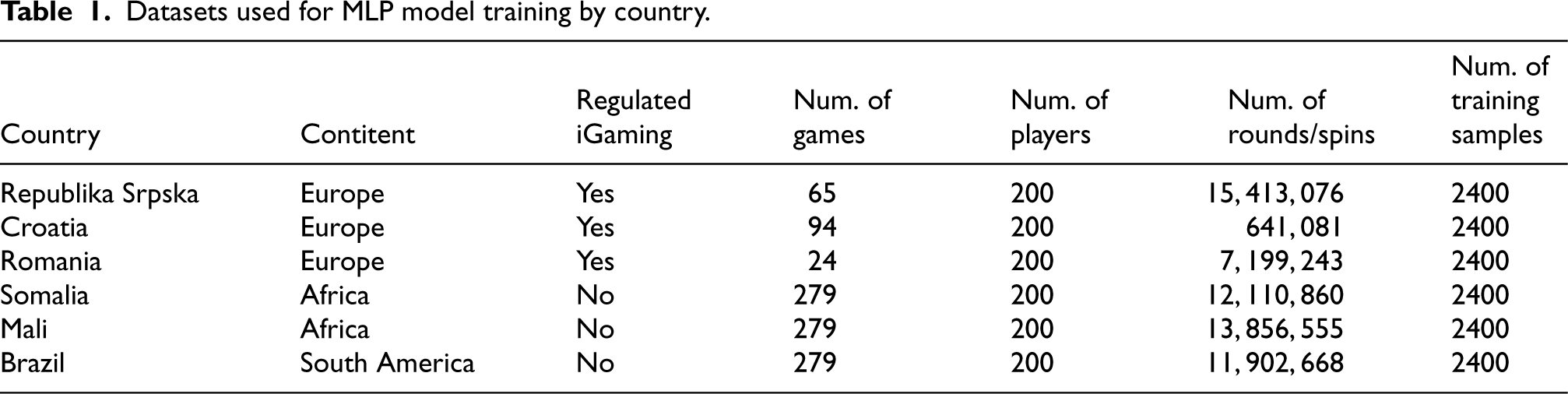
Datasets used for MLP model training by country.
Harmful behavioral markers are key in implementing “responsible gambling” techniques aimed at enabling personalized interventions towards players. Such personalized types of interventions are more likely to have a greater effect in raising awareness, reducing risky play and behavior, as well as preventing harmful outcomes. Certain characteristics can be grouped to observe specific activities or to monitor trends over time, or volatility over time. Examples include: the number of minutes a player spends playing daily, an increase in the average number of minutes played per day over a period, and variations in playing time throughout the day. Frequent nighttime playing as a marker suggests that a player is at higher risk of harm because most recreational players play in the evenings or weekends if they are employed, or during the day. Nighttime playing due to fatigue leads to irrational decision-making and negatively impacts work and personal life. The clinical definition of excessive gambling as an impulse control disorder is also consistent with frequent playing. Frequent playing, where the amount of money spent on betting does not vary on a daily basis, indicates that the player has more control over their behavior than a player who dramatically changes their stakes. In addition to all this, by observing the amount of money a player gambled, how much they won or lost during one week, characteristics related to frequency, intensity, session length, and variability are covered. Frequency refers to the number of sessions a player has during a certain period. Intensity is linked to the length of the player's session and their behavior during the session. Variability is a trend of how a player's behavior during gambling changes over time. Also, the phenomenon of playing multiple games simultaneously is considered under frequency, while playing in long sessions is a marker of intensity. Variability can also be interpreted as “chasing losses” or inconsistent playing. The trend in changes of these markers over time enables identification of changes in player behavior.
When selecting the range of variables, their values, and behavioral markers to train machine learning models for a specific country, several factors were considered. These include cultural preferences and traditions, purchasing power, as well as players’ habits related to gambling games, and also the regulations that exist in that country. Different variables can be included in machine learning models to achieve the best possible prediction. Behavioral markers can be grouped by whether they observe the level of a certain activity (number of minutes of play per day) or examine trends and changes over time (increase in the average number of minutes played per day in the previous month) and variations in time (variation in playing time during the day). Viewed through these frameworks, a diverse range of characteristics and types of variables is necessary to create models with the best performance. After extracting all markers, the challenge was to find the most relevant ones for grouping players and classifying degrees of risky behavior and playing. Proper selection of behavioral markers is essential for quick and correct training of machine learning models to make as precise predictions as possible. In the process of selecting behavioral markers, i.e., factors that can indicate a potential gambling disorder, based on clinical practice experience, the most significant 15 input variables were selected for training the machine learning models. All input variables were numerical, and the output was 0: recreational player, 1: risky gambling, and 2: problematic gambling. Using psychiatric methods and practice, players can be divided into three groups. The first group includes players who play infrequently, not too intensely, and with small variations in stakes. The second group are players who play more frequently and intensely, but with small variations in stakes on a weekly basis. The third group were those who play more frequently and intensely than the second group, and in addition, have larger variations in spending on a weekly basis. The first group would be classified as recreational players, i.e., those who play no more than two games simultaneously, have a low and unchanged betting pattern during the session, with a session lasting less than two hours. The time between two rounds, as well as the time between two sessions, is almost consistent. Bets revolve around an average bet that is always played and rarely deviates from the average. Among risky and problematic players would be those who have fewer rounds and shorter session durations. Individual stakes in a session are high, and in subsequent sessions even doubled. The time between two sessions is very short. Stakes would constantly rise, and volatility in betting patterns would increase. There is a lot of deviation from the average stake. The most significant difference between the second and third groups comes down to: higher bets, greater variations in betting, session duration, nighttime playing, and the time that passes between two sessions.
Table 2 shows the behavioral indicators which, based on experience from psychiatric practice, are considered the most relevant markers for predicting the degree of risky behavior in gambling.
Behavioral markers used in training sets.
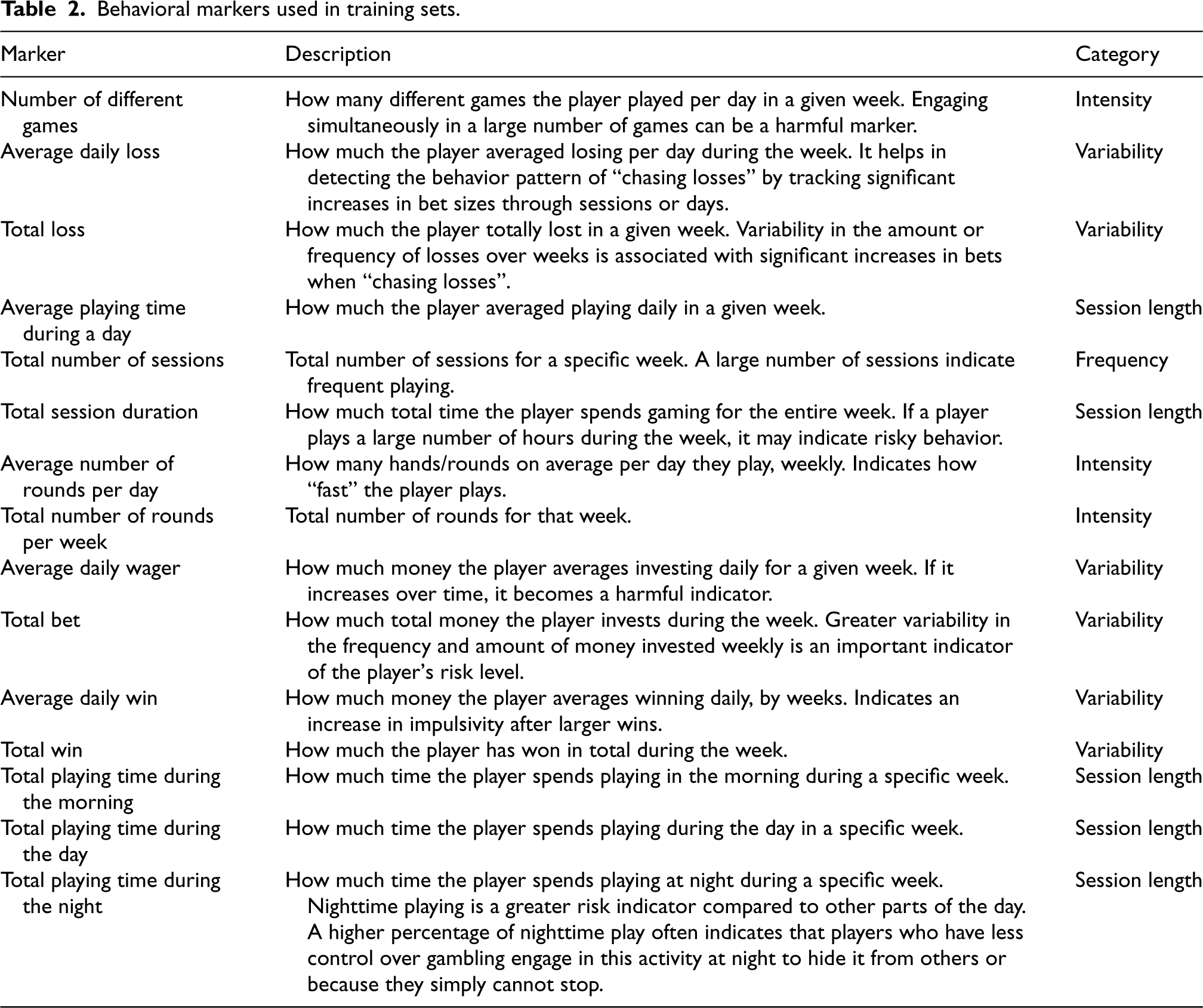
Behavioral markers used in training sets.
As previously mentioned, a separate dataset for each country was used for training and validating machine learning models because people's habits, culture, and purchasing power vary significantly. Behavior of randomly selected players was monitored. Each of these datasets, intended for training and validation of models, tracked 200 players over a period of 12 weeks, which is 2400 samples, each containing 15 input markers. Samples were labeled based on psychiatric methods and clinical practice, and grouped into non-risky, risky, and problematic behavior. The dataset was divided into a training set (80% of the samples) and a validation set (20% of the samples). The dataset was originally exported from database in a way that each sample corresponded to one player-week. It is important to note that two markers, player id and week number of the year, were excluded from the neural network inputs so that the same player and week couldn’t appear in both training and validation subsets. These variables serve only as identifiers and temporal references and therefore do not provide predictive value. As a result, the MLP was trained exclusively on 13 meaningful behavioral features. Consequently, the model could not exploit identifiers to memorize player-specific patterns, and the presence of multiple weeks from the same player across subsets does not introduce direct information leakage. To address cross-country comparability, we revised the preprocessing of monetary features. All financial values are kept in their original local currency to preserve contextual meaning. In addition, for the purpose of ensuring comparability across jurisdictions, each value was normalized into euros using official exchange rates valid for the study period. Labeling was conducted by a qualified psychiatrist, who also contributed as an author of this study, in collaboration with his team to ensure consistency and multiple professional perspectives. Table 3 presents demographic and statistical data by territories.
Demographic and statistical data by territories.
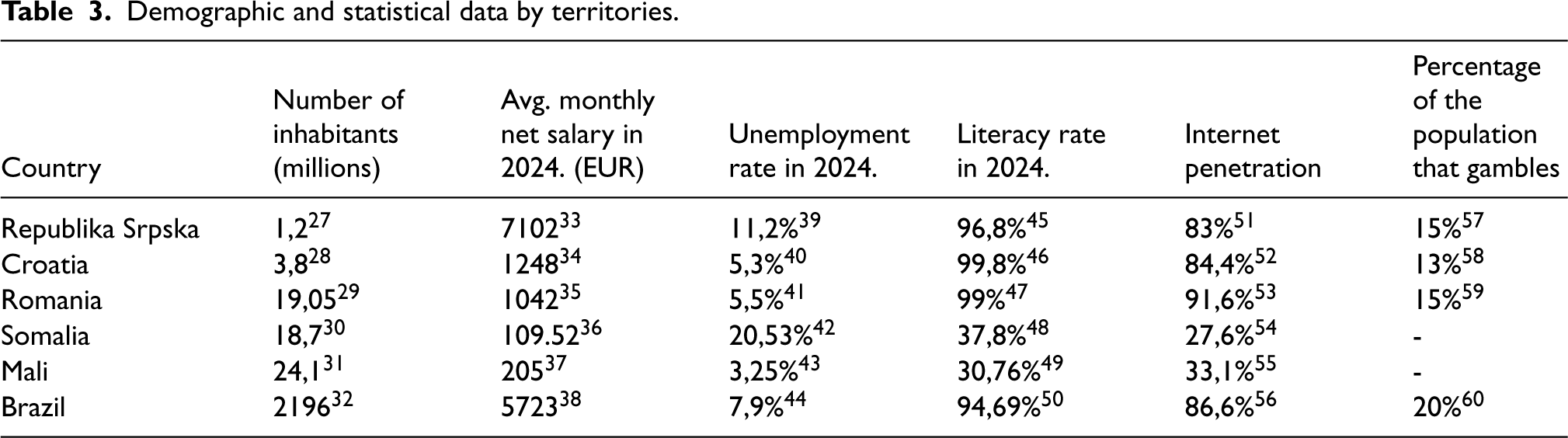
Demographic and statistical data by territories.
IGaming is regulated by law in the Republika Srpska. Since the organization of iGaming is regulated by law, players engage in games with licensed gambling operators.
61
There are no prescribed measures for implementing responsible gambling. According to available data,
62
the religious composition in the Republika Srpska is as follows:
Eastern Orthodoxy: 82%. Islam: 12.76%. Catholicism: 2.20%. Protestantism: 0.02%. Other Christian denominations: 0.21%. Other religions: 0.49%. Agnosticism: 0.10%. Atheism: 0.50%.
In Croatia, iGaming is also regulated by the gambling law. Operators must be licensed, and “responsible gambling” is largely enforced. A registered player can specify the maximum amount they can deposit in a certain period, or set a maximum loss amount they can incur in a certain period.
63
A player can request in writing to be excluded from playing for a certain period. According to data,
64
the religious composition in Croatia is as follows:
Roman Catholicism: 78.97%. Eastern Orthodoxy: 3.32%. Islam: 1.32%. Protestantism: 0.26%. Other Christian denominations: 4.84%. Non-religious/Agnostics/Atheists: 6.39%. Other religions: 0.96%. Not specified: 3.86%.
IGaming in Romania has been regulated since 2013. Operators must be licensed, and player protection is largely enforced by limiting the maximum bet per spin, maximum monthly deposits, self-exclusion, and support for addiction treatment.
65
According to data from 2024.
66
, the religious composition in Romania is:
Orthodox: 86%. Catholics: 5%. Protestants: 7%.
In Somalia, the religious composition is predominantly Islam, with 99.9% of the population practicing this religion. 67 Gambling of any kind is contrary to religion, considered immoral, and is not regulated in Somalia. There is no available data on what percentage of the population engages in gambling activities. There are no regulations, responsible gambling measures, or licensing systems. Players gamble with foreign operators. 68
IGaming is not mentioned anywhere in Mali's legislation. Foreign operators that accept players from Mali are registered in other countries, and Mali's laws apply only within the country's borders (within the so-called jurisdiction and do not apply to foreign operators). 69 Gambling of any kind is contrary to religion, so there is no data on what percentage of the population engages in gambling activities. According to data from 2024, the religious composition in Mali is predominantly Muslim, with approximately 92.5% of the population practicing Islam. 70 Additionally, about 3.2% of the population practices Christianity. There are also small groups practicing traditional African religions, making up 1.6% of the population.
In Brazil, iGaming is still unregulated. Regulations and laws are in the process of being drafted and published. The implementation of laws and regulations is expected to start in 2025.
71
Currently, Brazilian players gamble with foreign operators where measures for “responsible gambling” are not mandatory. As for the religious composition, the situation in Brazil is as follows
72
:
Roman Catholicism: 49.1%. Protestant Christianity: 31%. Assemblies of God: 6.46%. Other Pentecostals: 5.64%. Traditional Protestants: 4.03%. Other Christian denominations: 6.82%. Non-religious (including agnostics and atheists): 8.04%. Spiritism: 2.02%. Other religions (including Afro-Brazilian religions, Buddhism, Islam, Judaism): 1.04%.
The dataset of 200 players and 12 weeks per player aggregated a total of 15,413,076 rounds/spins for training the model for the territory of the Republika Srpska.
For those who are the most extreme cases, the average playing time during the night is about 3 h, and for 24 h the average is about 5.4 h per day.
The average number of different games that players played during the week is about 4. The average number of rounds during the day is 2868. They averaged losing about 229 BAM (117.09 EUR) daily. The average bet was about 2368 BAM (1210.79 EUR) daily.
For those considered risky, the average playing time during the night is approximately 40 min, and for 24 h the average is approximately 1.4 h.
The average number of different games that players played during the week is about 3. The average number of rounds during the day is about 534. They averaged losing approximately 6 BAM (3.07 EUR) daily. The average bet is close to 65 BAM (33.24 EUR) daily.
Considering the average net salary in the Republika Srpska, the culture, customs, and mentality of the people, as well as experiences from psychiatric practice, it is concluded that anything over 5 h of gambling during the day is risky behavior. Also, any bet greater than 60 BAM (30.68 EUR) daily exceeds the relaxation type of playing and enters the risky category. Continuous loss of money over 120 BAM (61.36 EUR) weekly combined with “chasing losses” and high bets is an indicator of problematic gambling. Playing four or more different games daily is considered extreme. More than two hours on average of nighttime playing indicates a high degree of risk of impulse control disorder. If all observed parameters grow or significantly vary over the 12 weeks, which is the period during which the player is observed, the player's behavior becomes risky. Any extreme variations in intensity, frequency, variability, or length of gambling sessions indicate a loss of player control.
These weekly behavior examples presented in local currency demonstrate how behavioral markers informed the assignment of labels (recreational, risky and problematic). For instance:
Recreational (Player 1): Played 2 games, average daily loss 0.42, total credit loss 2.97, average daily play time 0.75 min, 1 session with 5.25 total minutes, 11.57 average rounds per day (81 in total), average daily bet 1.32, total bet 9.27. Activity only at night (5.25 min). Risky (Player 2): Played 2 games, average daily loss 4.24, total credit loss 29.65, average daily play time 42.38 min, 4 sessions with 296.67 total minutes, 284.86 average rounds per day (1994 in total), average daily bet 28.86, total bet 202.05. Activity concentrated in morning (259.82 min) and night (36.85 min). Problematic (Player 3): Played 1 game, average daily loss 12.29, total credit loss 86.00, average daily play time 18.94 min, 7 sessions with 132.55 total minutes, 313.43 average rounds per day (2194 in total), average daily bet 722.00, total bet 5054.00. Activity distributed across morning (1.48 min), day (75.75 min), and night (55.32 min).
The unbalanced dataset for training the model for the Republika Srpska consisted of 31% recreational players, 41% risky players, and 28% problematic players, as determined after sample marking by experts with clinical practice in the field of psychology and psychiatry of addiction diseases.
Dataset for training the model for players from Croatia
The dataset of 200 players and 12 weeks per player aggregated a total of 9,805,399 rounds/spins for training the model for the territory of Croatia.
For those who are the most extreme cases, the average playing time during the night is about 4.5 h, and for 24 h the average is about 6 h daily.
The average number of different games that players played during the week is about 4. The average number of rounds during the day is 2494. They averaged losing about 46 EUR daily. The average stake was about 1062 EUR daily.
For those considered risky, the average playing time during the night is approximately 2.5 h, and for 24 h the average is approximately 68 min.
The average number of different games that players played during the week is about 3. The average number of rounds during the day is about 587. They averaged losing approximately 8.5 EUR daily. The average stake is close to 90 EUR daily.
Considering the average net salary in Croatia, the culture, customs, and mentality of the people, as well as experiences from psychiatric practice, it is concluded that anything over 5 h of gambling in one day or over 4 h of gambling during the night is risky behavior. Also, any stake greater than 80 EUR daily exceeds the relaxation type of playing and enters the risky category. Continuous loss of money over 150 EUR weekly combined with “chasing losses” and high stakes is an indicator of problematic gambling. Playing four or more different games daily is considered extreme. If all observed parameters grow or significantly vary over the 12 weeks, the player's behavior becomes risky.
These weekly behavior examples presented in local currency demonstrate how behavioral markers informed the assignment of labels (recreational, risky and problematic). For instance:
Recreational (Player 1): Played 4 games, average daily loss 9.16, total credit loss 64.15, average daily play time 2.7 min, 7 sessions with 18.87 total minutes, 67.29 average rounds per day (471 in total), average daily bet 28.31, total bet 198.2. Activity mainly at night (17.12 min). Risky (Player 2): Played 2 games, average daily loss 3.06, total credit loss 21.43, average daily play time 28.35 min, 8 sessions with 198.47 total minutes, 310 average rounds per day (2170 in total), average daily bet 46.18, total bet 323.23. Activity concentrated at night (198.47 min). Problematic (Player 3): Played 5 games, average daily loss 3.6, total credit loss 25.2, average daily play time 49.13 min, 22 sessions with 343.93 total minutes, 183 average rounds per day (1281 in total), average daily bet 60.46, total bet 423.2. Activity spread across morning (90.09 min), day (8.18 min), and night (245.66 min).
The unbalanced dataset for training the model for Croatia consisted of 58.75% recreational players, 21.25% risky players, and 20% problematic players, as determined after sample marking by experts with clinical practice in the field of psychology and psychiatry of addiction diseases.
Dataset for training the model for players from Romania
The dataset from 200 players over 12 weeks per player aggregated a total of 7,188,243 rounds/spins for training the neural network model for the territory of Romania.
For the most extreme cases, the average playing time during the night is about 3.5 h, and for 24 h, the average is about 2.5 h daily.
The average number of different games that players played during the week is about 3. The average number of rounds per day is 1356. They averaged losing about 362 RON (71.31 EUR) daily. The average stake was about 1354 RON (266.73 EUR) daily.
For those considered risky, the average playing time during the night is approximately 1.5 h, and for 24 h, the average is about 30 min.
The average number of different games that players played during the week is about 3. The average number of rounds per day is about 257. They averaged losing approximately 11 RON (2.17 EUR) daily. The average stake is close to 110 RON (21.67 EUR) daily.
Considering the average net salary in Romania, culture, religion, and regulations, as well as experiences from psychiatric practice, it is concluded that anything over 2 h of gambling in one day or over 3 h of gambling during the night is risky behavior. Also, any stake greater than 300 RON (59.1 EUR) daily exceeds the relaxation type of playing and enters into problematic gambling. Continuous loss of money over 750 RON (147.75 EUR) weekly combined with “chasing losses” and high stakes is an indicator of problematic gambling. Playing three or more different games daily is considered extreme. If all observed parameters grow or significantly vary over the 12 weeks, the player's behavior becomes risky.
These weekly behavior examples presented in local currency demonstrate how behavioral markers informed the assignment of labels (recreational, risky and problematic). For instance:
Recreational (Player 1): Played 1 game, average daily loss 4.56, total credit loss 31.89, average daily play time 7.02 min, 11 sessions with 49.15 total minutes, 111.57 average rounds per day (781 in total), average daily bet 14.4, total bet 100.8. Activity mainly at night (37.2 min). Risky (Player 2): Played 1 game, average daily loss 17.59, total credit loss 123.1, average daily play time 10.28 min, 16 sessions with 71.99 total minutes, 219.29 average rounds per day (1535 in total), average daily bet 244.8, total bet 1713.6. Activity distributed across morning (4.3 min), day (16.73 min), and night (50.96 min). Problematic (Player 3): Played 2 games, average daily loss 51.37, total credit loss 359.6, average daily play time 8.1 min, 14 sessions with 56.69 total minutes, 195.14 average rounds per day (1366 in total), average daily bet 308.63, total bet 2160.4. Activity spread across morning (5.97 min), day (8.28 min), and night (42.44 min).
The unbalanced dataset for training the model for Romania consisted of 53.5% recreational players, 20% risky players, and 26.5% problematic players, as determined after sample marking by experts with clinical practice in the field of psychology and psychiatry of addiction diseases.
Dataset for training the model for players from Somalia
The dataset from 200 players over 12 weeks per player aggregated a total of 12,110,860 rounds/spins for training the MLP model for the territory of Somalia.
For the most extreme cases, the average playing time during the night is about 2 h, and for 24 h, the average is about 4 h daily.
The average number of different games that players played during the week is about 3. The average number of rounds per day is 2676. They averaged losing about 2 USD (1.71 EUR) daily. The average stake was about 171 USD (146.12 EUR) daily.
For those considered risky, the average playing time during the night is approximately 1.5 h, and for 24 h, the average is about 2.5 h.
The average number of different games that players played during the week is about 2. The average number of rounds per day is about 413. They averaged losing approximately 1.5 USD (1.28 EUR) daily. The average stake is close to 16 USD (13.67 EUR) daily.
One gigabyte of mobile internet in Somalia cost, on average, 0.5 USD in 2023. 73 From 25 tariffs measured in Somalia, the lowest price recorded was 0.19 USD for 1GB for a 30-day plan. In the most expensive tariff, 1GB cost 1.67 USD. Mobile internet, as the only option, is still expensive considering the average net salary in Somalia. For this reason, residents of Somalia cannot spend much time on the internet, as residents of European countries can. Considering the average net salary in Somalia, culture, religion, and mentality of the people, as well as experiences from psychiatric practice, it is concluded that anything over 3 h of gambling in one day or over 2 h of gambling during the night is risky behavior. Also, any stake greater than 15 USD (12.82 EUR) daily exceeds the relaxation type of playing and enters into problematic gambling. Continuous loss of money over 35 USD (29.91 EUR) weekly combined with “chasing losses” and high stakes is an indicator of problematic gambling. Playing three or more different games daily is considered extreme. If all observed parameters grow or significantly vary over the 12 weeks, the player's behavior becomes risky.
These weekly behavior examples presented in local currency demonstrate how behavioral markers informed the assignment of labels (recreational, risky and problematic). For instance:
Recreational (Player 1): Played 1 game, average daily loss −0.53 (net win), total credit loss −3.74, average daily play time 19.74 min, 1 session lasting 138.18 min, 59.14 average rounds per day (414 in total), average daily bet 1.92, total bet 13.46. Activity only during the day (138.18 min). Risky (Player 2): Played 2 games, average daily loss 0.52, total credit loss 3.64, average daily play time 53.98 min, 3 sessions totaling 377.88 min, 318.14 average rounds per day (2227 in total), average daily bet 18.16, total bet 127.09. Activity concentrated in the morning (377.88 min). Problematic (Player 3): Played 2 games, average daily loss 3.74, total credit loss 26.21, average daily play time 234.01 min, 11 sessions with 1638.1 total minutes, 1054.43 average rounds per day (7381 in total), average daily bet 39.28, total bet 274.96. Activity spread across day (254.1 min) and night (138 min).
The unbalanced dataset for training the model for Somalia consisted of 54.73% recreational players, 28.26% risky players, and 17.01% problematic players, as determined after sample marking by experts with clinical practice in the field of psychology and psychiatry of addiction diseases.
Dataset for training the model for players from Mali
The dataset from 200 players over 12 weeks per player aggregated a total of 14,345,894 rounds/spins for training the model for the territory of Mali.
For the most extreme cases, the average playing time during the night is about 4.5 h, and for 24 h, the average is about 6 h daily.
The average number of different games that players played during the week is about 4. The average number of rounds per day is 1876. They averaged losing about 1865 XOF (2.84 EUR) daily. The average stake was about 197756 XOF (301.38 EUR) daily.
For those considered risky, the average playing time during the night is approximately 1.5 h, and for 24 h, the average is about 2.5 h.
The average number of different games that players played during the week is about 3. The average number of rounds per day is about 212. They averaged losing approximately 707 XOF (1.08 EUR) daily. The average stake is close to 8167 XOF (12.45 EUR) daily.
One gigabyte of mobile internet in Mali cost, on average, 2.76 USD in 2023. From 24 tariffs measured in Mali, the lowest price recorded was 0.57 USD for 1GB for a 30-day plan. In the most expensive tariff, 1GB cost 38.27 USD. 74 Similarly to Somalia, mobile internet is still expensive considering the average net salary in Mali. Considering the average net salary in Mali, culture, religion, and mentality of the people, as well as experiences from psychiatric practice, it is concluded that anything over 2 h of gambling in one day or over 2 h of gambling during the night is risky behavior. Also, any stake greater than 7000 XOF (10.67 EUR) daily exceeds the relaxation type of playing and enters into problematic gambling. Playing three or more different games daily is considered extreme. If all observed parameters grow or significantly vary over the 12 weeks, the player's behavior becomes risky.
These weekly behavior examples presented in local currency demonstrate how behavioral markers informed the assignment of labels (recreational, risky and problematic). For instance:
Recreational (Player 1): Played 1 game, average daily loss 71.43, total credit loss 500, average daily play time 18.94 min, 1 session lasting 132.57 min, 19.57 average rounds per day (137 in total), average daily bet 489.29, total bet 3425. Activity exclusively at night (132.57 min). Risky (Player 2): Played 2 games, average daily loss 2178.57, total credit loss 15,250, average daily play time 150.93 min, 9 sessions totaling 1056.48 min, 539 average rounds per day (3773 in total), average daily bet 15,939.29, total bet 111,575. Activity mainly in the morning (137.68 min) and at night (918.8 min). Problematic (Player 3): Played 3 games, average daily loss 9857.14, total credit loss 69,000, average daily play time 75.41 min, 4 sessions with 527.89 total minutes, 167.29 average rounds per day (1171 in total), average daily bet 33,457.14, total bet 234,200. Activity spread across morning (404.09 min) and night (123.8 min).
The unbalanced dataset for training the model for Mali consisted of 51.30% recreational players, 42.83% risky players, and 5.87% problematic players, as determined after sample marking by experts with clinical practice in the field of psychology and psychiatry of addiction diseases.
Dataset for training the model for players from Brazil
The dataset from 200 players over 12 weeks per player aggregated a total of 11,902,668 rounds/spins for training the MLP model for the territory of Brazil.
For the most extreme cases, the average playing time during the night is about 1 h, and for 24 h, the average is about 5.5 h daily.
The average number of different games that players played during the week is about 5. The average number of rounds per day is 18,326. They averaged losing about 7 BRL daily (1.12 EUR). The average bet was about 3035 BRL (485.30 EUR) daily.
For those considered risky, the average playing time during the night is approximately 2.5 h, and for 24 h, the average is about 4 h.
The average number of different games that players played during the week is about 2. The average number of rounds per day is about 2740. They averaged losing approximately 16 BRL (12.15 EUR) daily. The average bet is close to 231 BRL (36.94 EUR) daily.
Considering the average net salary in Brazil, culture, religion, and the mentality of the people, as well as experiences from psychiatric practice, it is concluded that anything over 4 h of gambling in one day or over 1 h of gambling during the night is risky behavior. Also, any bet greater than 200 BRL (31.98 EUR) daily exceeds the relaxation type of playing and enters into problematic gambling. Playing four or more different games daily is considered extreme. If all observed parameters grow or significantly vary over the 12 weeks, the player's behavior becomes risky.
These weekly behavior examples presented in local currency demonstrate how behavioral markers informed the assignment of labels (recreational, risky and problematic). For instance:
Recreational (Player 1): Played 1 game, average daily loss 2.86, total credit loss 20, average daily play time 17.62 min, 1 session lasting 123.32 min, 9 average rounds per day (63 in total), average daily bet 4.5, total bet 31.5. Activity exclusively at night (123.32 min). Risky (Player 2): Played 12 games, average daily loss 20.89, total credit loss 146.2, average daily play time 17.59 h, 1 session lasting 123.15 min, 106.57 average rounds per day (746 in total), average daily bet 224.33, total bet 1570.3. Activity exclusively at night (123.15 min). Problematic (Player 3): Played 10 games, average daily loss 10.26, total credit loss 71.84, average daily play time 53.63 min, 3 sessions totaling 375.41 min, 203.29 average rounds per day (1423 in total), average daily bet 483.39, total bet 3383.7. Activity concentrated in the morning (251.14 min) and during the day (124.27 min).
The unbalanced dataset for training the model for Brazil consisted of 64.81% recreational players, 17.24% risky players, and 17.95% problematic players, as determined after sample marking by experts with clinical practice in the field of psychology and psychiatry of addiction diseases.
Analysis of samples for training the MLP model
Figure 1 shows the segmentation of players in the datasets for training the model for each country individually, categorized by a professional from the field of psychology and psychiatry of addiction diseases.
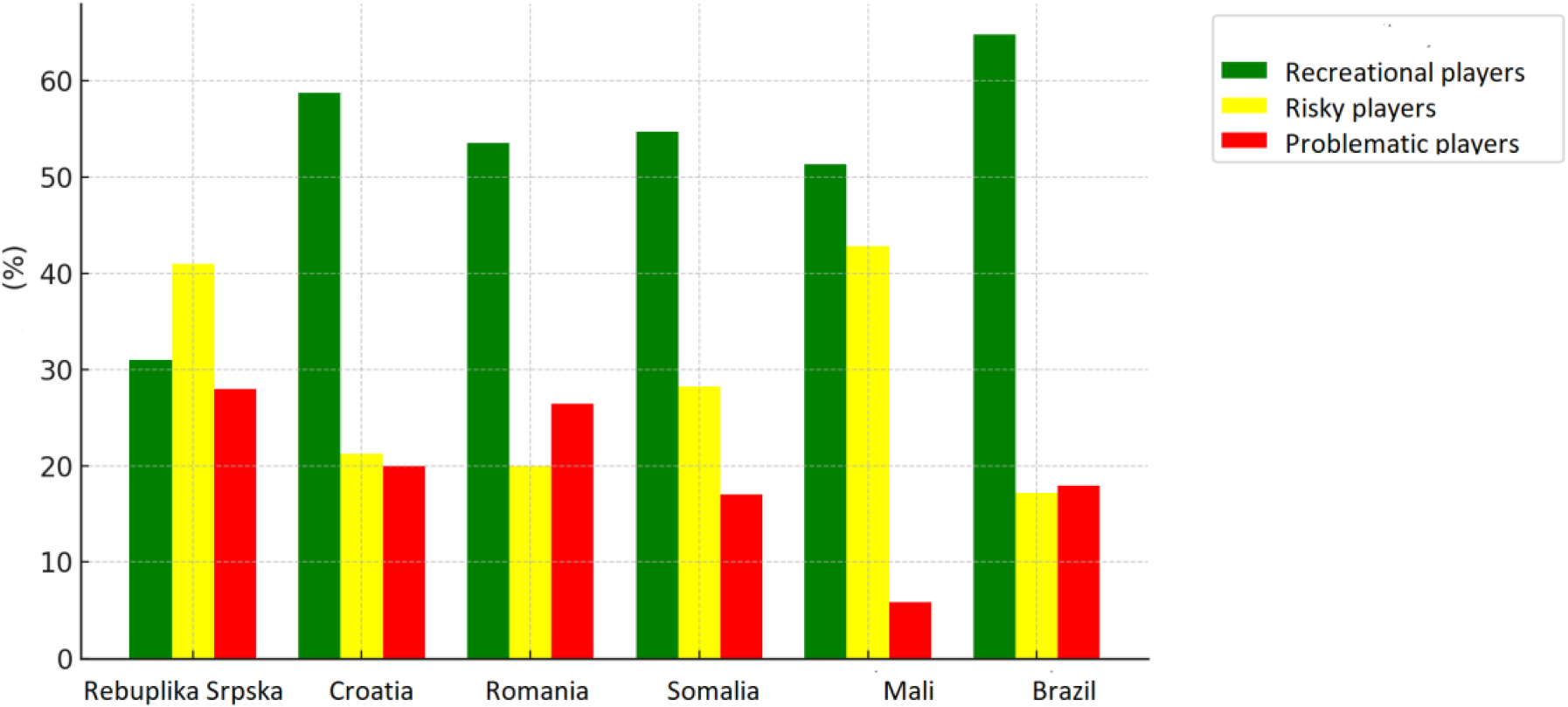
Player segmentation from the dataset for training the MLP model by countries.
The following is an analysis of randomly selected samples of data for model training by countries.
Recreational players in the model training sample:
Brazil has the highest percentage of recreational players, indicating a dominant group that plays occasionally without significant problems. The Republika Srpska has the lowest percentage of recreational players, suggesting that this group is less represented in the sample set for model training compared to other countries. Other countries have a relatively similar share of recreational players, between 51% and 58%. Risky players in the model training sample:
Mali has the highest percentage of risky players, indicating a high level of risk in player behavior. Brazil has the lowest percentage of risky players, showing a lesser tendency to transition into problematic patterns. Republika Srpska and Somalia also have a significant share of this group. Problematic players in the model training sample:
Republika Srpska has the highest percentage of problematic players, suggesting potential challenges with pathological behavior. Mali has the lowest percentage of problematic players in the model training sample. Other countries, including Croatia, Romania, Somalia, and Brazil, have moderate percentages (between 17% and 26%).
In the model training sample, Brazil has a predominantly recreational player share, with a low percentage of risky and problematic players, which may indicate an awareness of the harms of gambling or the influence of cultural and religious factors. The highest risk is shown by the Republika Srpska and Mali, as they have high levels of risky and problematic players, which may indicate a need for better prevention measures and education. Croatia, Romania, and Somalia show a moderate distribution among all three categories, where no group is extremely dominant.
The best way to keep iGaming safe for the masses is through a well-regulated entertainment industry that puts the player at the center of activities. Safe gambling in recent years has focused on restrictive play, i.e., when a problem is detected, the player receives restrictions on playing or their play is completely stopped and then they are referred to customer support. This affects a small percentage of players. The question arises, what proactive steps can be taken to create positive gambling habits? For example, how can we work with players instead of forcing them to do something, how can we provide education and tools that raise awareness and build a positive relationship with gambling, how can we encourage them to make decisions based on the information they have, etc.
AI has been part of the system for protecting players from the harmful effects of gambling for some time, and its role has been rapidly increasing over the past year. The use of machine learning models for prediction and segmentation of players comes with many platforms offering a standardized approach. The development of Generative AI will enable player protection systems to create content personalized for that player. In the coming years, it is believed that the application of machine learning will evolve driven by a better understanding of the issues revolving around players along with legislation around the use of AI in sensitive areas such as gambling. The idea that AI algorithms cannot be considered universal for all types of players in all territories is also one of the topics of this paper.
The larger the data volume for analysis, the more personalized it becomes. The more data there is about player behavior, the richer the profile of that player becomes, allowing actions in real-time to prevent their gambling from becoming risky. The ultimate goal is for two people who have the same problem to receive different approaches and experiences with prevention from harmful gambling based on their behavioral markers that are analyzed. This way, enormous potential would be created in terms of aiding health institutions using AI and behavioral analysis in detecting which players are at the highest risk of harmful gambling impacts. This analysis provides essential information that can help in identifying potential risky players at early stages of problematic gambling. Public health workers can use these results to develop early interventions that target high-risk players to affect them preventively.
In earlier research, the main obstacle in identifying players with risky behavior was the external verification in the absence of clinical identification of patterns for training models, so they relied on players who voluntarily stopped playing, declaring their behavior problematic, and their behavioral markers were used for training machine learning models. In this research, a sample of 1200 players from the territories of the Republika Srpska, Croatia, Romania, Somalia, Mali, and Brazil and their behavior over a period of 12 weeks was analyzed and marked by an expert in the field of psychology and psychiatry of addiction diseases, i.e., the behavior of players every week was marked as non-risky, risky, or problematic. This sample of 200 players for each of the states was used for training each individual machine learning model, also specialized by countries. Considering the average net salary in the countries that were the subject of the research, as well as the culture, customs, and mentality of the people, and experiences from psychiatric practice, several factors were taken into account when marking the behavior of players by weeks.
There are several dimensions described in the definition of addiction to playing games over the internet and they are: preoccupation, excessive use, social isolation, conflicts with people, and withdrawal. The most striking characteristics of risky players are the following: frequent and intense gambling combined with large variations in bets and increasing bets during the first months of gambling. The American Psychiatric Association identified the need for players to increase bets to experience the desired excitement that was previously achieved at lower stakes. Also, the need for a player to try to recover lost money is one of the indicators of pathological gambling. Variability in stakes can distinguish risky players from those who are not because uniform and consistent patterns in playing characterize most recreational, i.e., non-risky players. An important marker is also how often a player gambles during the night, whether more frequently during the week or on weekends. The logic behind this is that players who have less control over gambling often play at night to hide their activities from others.
Architecture of the MLP machine learning model
Machine learning models come in various levels of complexity. Innovations in machine learning research often focus on new techniques for processing large amounts of data. The intention of this paper was not to innovate and create new machine learning techniques in terms of improved predictions, but rather to apply existing predictive models to the theme of predictions and risk assessments in player behavior, aiming to implement “responsible gambling.” Unlike most previous works that used Random Forest, this paper chose a neural network approach, namely MLP classification. MLP models, specialized for each country individually, were trained on an unbalanced set of randomly selected data.
Data preparation for neural network training models
The dataset was divided into training, validation, and test sets. The training set was used to train the model, and the validation set was used to monitor the model's performance. The test set ultimately evaluated the final performance of the model on previously unseen data.
To develop and train the model in the most appropriate way, it is necessary to gather expert knowledge from multiple fields in one place. In this work, the data for training were prepared and the machine learning models were trained and tested using experts in the fields of software engineering and the domain of psychiatry of addiction diseases.
To have the data in a suitable format for training, it was necessary to aggregate and process them, and some were converted to the required data type (e.g., categorical to numerical). In the database, every round played by each player was stored. By aggregating such raw data, i.e., every round a player played during a specific week, a set of input variables is obtained that describe the player's behavior, frequency, intensity of playing, and the time spent playing during that week. Repeating the process for each player over a period of 12 weeks, a set of input variables for training, validating, and testing the MLP model is obtained. The output variable was mapped to values 0, 1, and 2 if the player's behavior that week is categorized as recreational, risky, and problematic playing, respectively. The set of input variables resulting from the aggregation and processing of individual rounds, described in Table 2, are: player ID, the ordinal number of the week being observed, the number of different games, average daily loss, total loss, average daily playing time, total number of sessions, total duration of sessions, average number of rounds played daily, total number of rounds, average daily bet, total bet, average daily winnings, total winnings, total morning playing time, total daytime playing time, and total nighttime playing time. Morning, daytime, and nighttime playing are categorized within the range of 6:00 AM to 12:00 PM, 12:00 PM to 7:00 PM, and 7:00 PM to 6:00 AM, respectively. Data was separately prepared and processed for each individual model, which was specialized for players from the Republika Srpska, Croatia, Romania, Somalia, Mali, and Brazil. For training and validation, each of the models aggregated 2400 data samples, i.e., 200 randomly selected players with behavioral data about their playing over a period of 12 weeks. Each week, for each individual player, was marked by an expert with domain knowledge from clinical practice and psychiatric methods in recognizing addiction diseases. The playing of a specific player was labeled with the output variable values of 0, 1, or 2 for recreational, risky, and problematic playing in a given week. From this unbalanced dataset, 80% of the data was used for training and 20% for validation. The test set for each individual model, i.e., a control group of players, consists of previously unseen samples of behavioral data, representing the behavior of thousands of players per week over a period of 12 weeks. In total, this amounts to 1,313,016 samples across all models from all territories, representing the behavior of a total of 109,418 players per week, over 12 weeks in total.
Designing the architecture of the MLP model
The Artificial Neural Network (ANN), i.e., the MLP model in this work, is designed to have an input layer, two hidden layers, and an output layer. Experimental methods were used to find the most appropriate design of the model architecture that would achieve the highest degree of accuracy. The best results were obtained with the number and arrangement of neurons across the layers as shown in Figure 2 and Figure 3. The dataset used in this study initially contained 15 input markers. However, not all of these markers are suitable for training the neural network. Specifically, playerId and week number of the year were excluded from the input layer because they do not provide predictive value regarding player behavior. PlayerId serves solely as an identifier, while the week number functions as a temporal reference without direct impact on the behavioral classification task. Consequently, the final set of relevant predictors used for training the MLP consisted of 13 input neurons. This approach ensured that only meaningful variables contributed to the learning process. The input layer consists of 13 neurons, the first hidden layer has 22 neurons, and the second hidden layer has 11 neurons. The output is one neuron with three possible values (recreational behavior, risky behavior, and problematic behavior). Parameters of the formed artificial neural network are shown in Table 4.
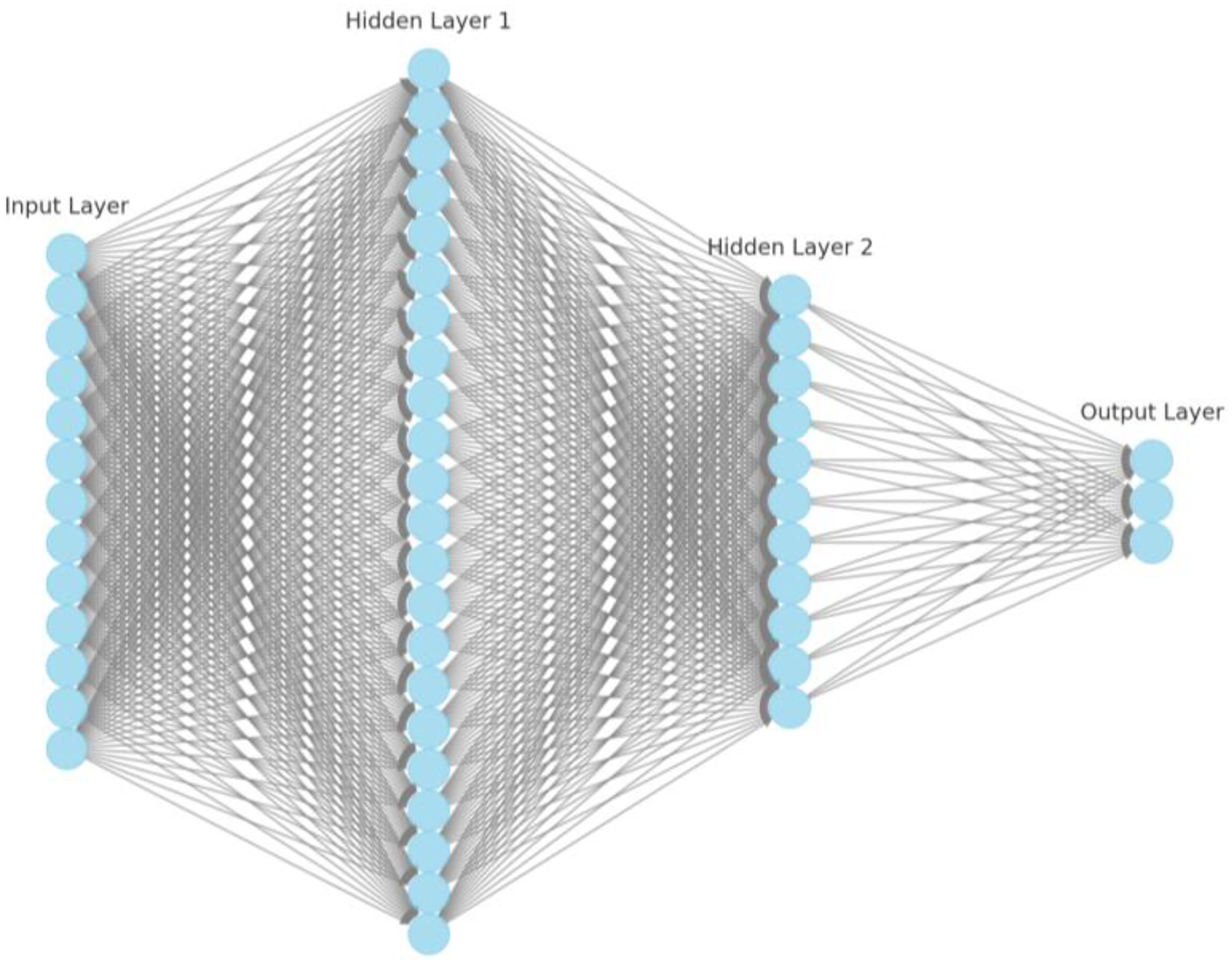
MLP model architecture used in research.
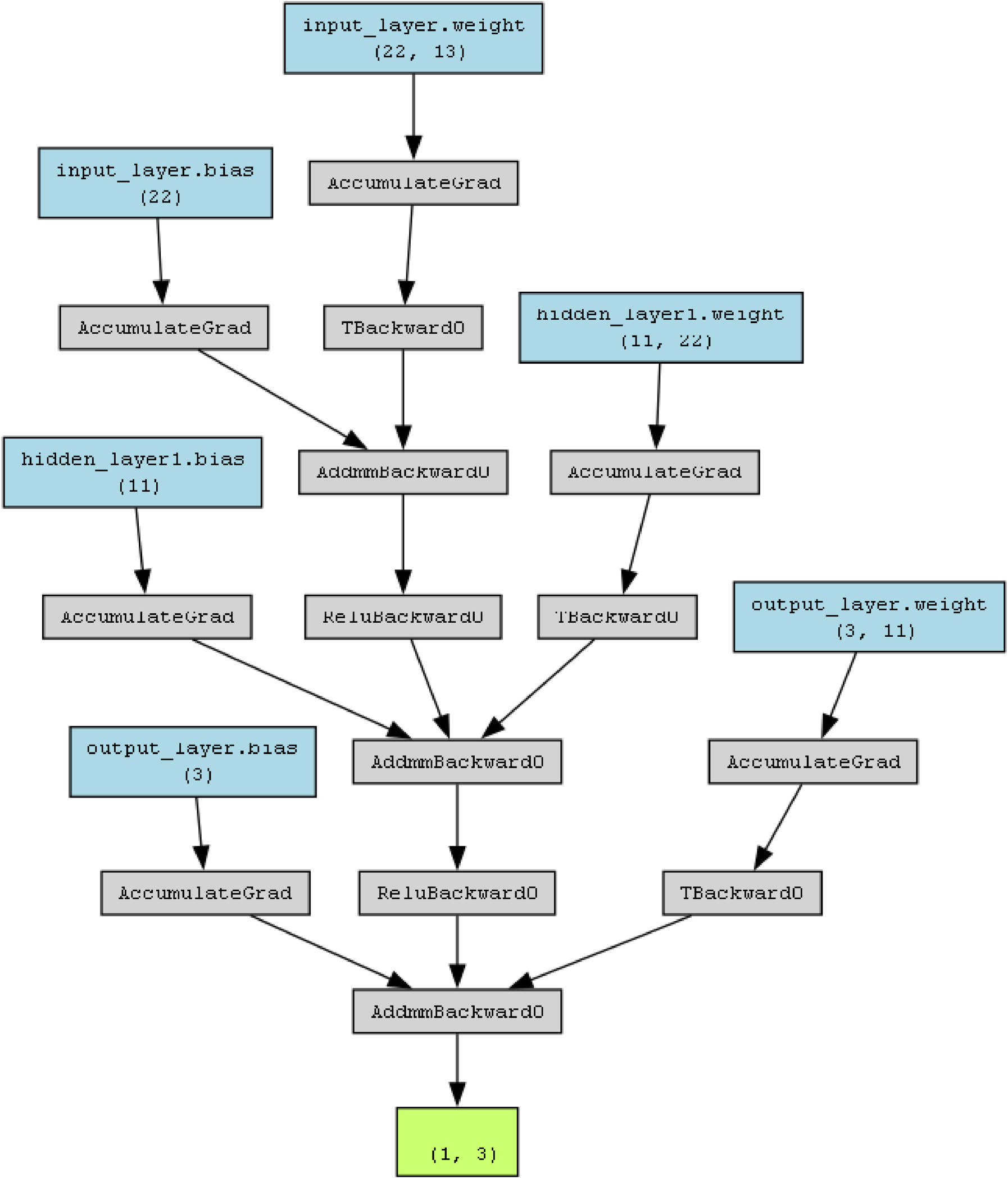
Visual representation of the neural network graph generated using the torchviz library.
Parameters of the formed artificial neural network.
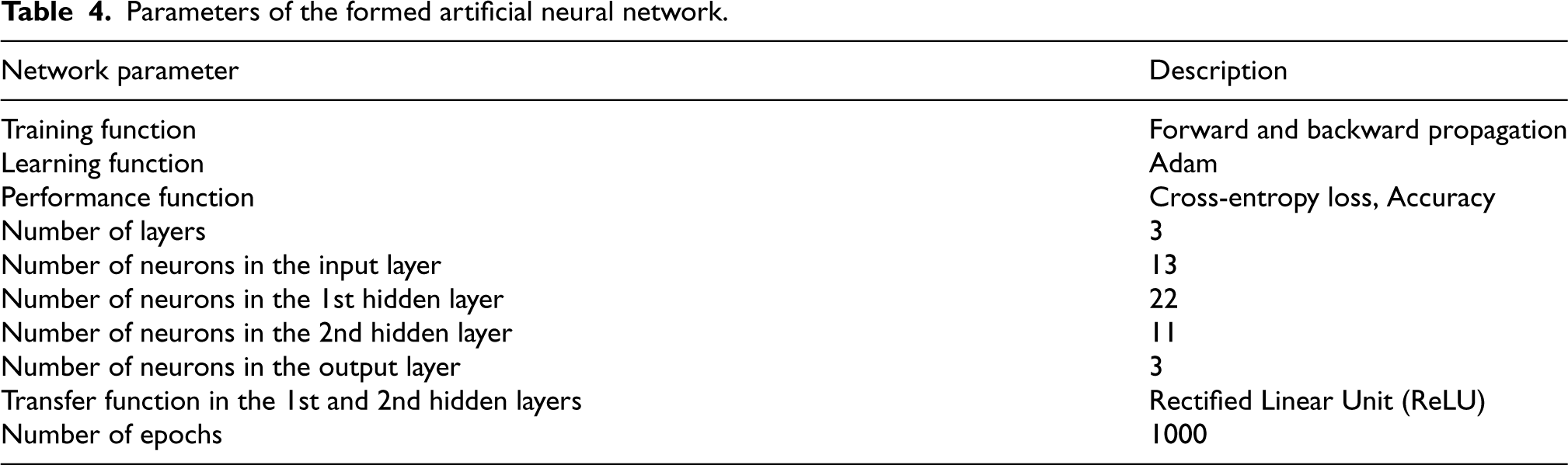
To find the most optimal settings for training, experiments were also conducted with the number of training epochs, i.e., iterations for training the model. Each epoch consists of a complete set of data that is processed by the algorithm. To optimize learning, the dataset “passes” through the algorithm multiple times to update weights at different steps.
After each epoch during learning, the error on the training set and the validation set is monitored. To determine the epoch at which the neural network converges, it is necessary to find the point where the losses during training and testing stabilize or do not significantly decrease. From the results, it can be concluded that the losses during training and testing stabilize between 300–400 epochs when the accuracy during testing reaches its peak, suggesting that the neural network converges around these epochs and the model's performance ceases to significantly improve.
The trained MLP model results in a training accuracy of 99.446% and a testing accuracy of 95.928%.
Between epochs 50–200, testing losses and accuracy remained relatively stable, with testing accuracy around 96.83%. This suggested that the model had already achieved a reliable level of generalization early in the training process. From epochs 250–400, testing accuracy improved slightly, reaching 97.29%, which marked the peak performance phase.
After this interval, however, performance began to deteriorate. From epochs 500–700, testing losses increased and testing accuracy declined, indicating the onset of overfitting. Between epochs 800–1000, this trend intensified, as testing losses continued to increase and testing accuracy fluctuated between 95.48% and 95.93%. Despite improvements on the training data, the model lost the ability to generalize effectively, confirming pronounced overfitting beginning around epochs 600–700.
Dropout (p = 0.3) in hidden layers and weight decay (5e-4) in the optimizer introduced L2 regularization. Additionally, early stopping was applied based on validation loss with a patience of 25 epochs. Although the maximum training duration was set to 1000 epochs, training was terminated at epoch 380, which corresponded to the lowest validation loss and stable testing accuracy (97.29%). This ensured that the final model was chosen at its optimal point, before stronger overfitting effects became evident in later epochs.
It is concluded that the model performs very well for classes 0 and 2, while it makes some errors in class 1 and struggles to differentiate class 1 from classes 0 and 2. The model more easily recognizes recreational and problematic players, while risky players are the hardest to identify.
Classes 0 and 2 have an AUC (area under the receiver operating characteristic curve—ROC) close to 1, indicating excellent performance. Class 1 has a slightly lower AUC. The PR (Precision–Recall) analysis indicates that the model performs exceptionally well on classes 0 and 2. Both classes show high levels of precision and recall across different thresholds, suggesting strong generalization and reliable discrimination. In contrast, class 1 demonstrates weaker performance. The calibration plot shows that class 1 is relatively well calibrated, while classes 0 and 2 exhibit larger fluctuations in the mid-probability range but align more closely with the ideal line at higher confidence levels. This indicates that the model is more reliable when making high-confidence predictions. Table 5 provides an overview of confusion matrix metrics for the trained model applied to players from Republika Srpska. Macro F1 is 93.29%.
Overview of confusion matrix metrics for the trained model for players from the Republika Srpska.

Overview of confusion matrix metrics for the trained model for players from the Republika Srpska.
Based on the results obtained, it can be concluded that the losses during training and testing stabilize at 500 epochs when the accuracy during testing reaches its peak, suggesting that the neural network converges around these epochs and the model's performance ceases to significantly improve.
The trained MLP model results in a training accuracy of 99.248% and a testing accuracy of 94.271%.
Between epochs 50–200, testing losses and accuracy remained relatively stable, with testing accuracy ranging between 94.27% and 94.79%. This indicated that the model had already achieved a solid level of generalization, as both metrics were approaching stabilization. From epochs 250–500, testing accuracy slightly improved, peaking at 95.31% at epoch 500, which represented the optimal performance interval. However, after epoch 250, testing losses began to increase slightly, while training losses continued to decrease, marking the first signs of overfitting.
Between epochs 500–700, overfitting became more evident: testing losses increased from 0.1758 to 0.2065, while testing accuracy decreased and fluctuated between 93.23% and 95.31%. Although training metrics continued to improve, test performance deteriorated. From epochs 800–1000, this trend persisted, with testing losses further rising (0.2132 to 0.2415) and testing accuracy fluctuating between 93.23% and 94.79%. This confirmed pronounced overfitting, where the model no longer extracted useful patterns but memorized training data instead, leading to degradation on unseen data.
Dropout (p = 0.3) in hidden layers, along with weight decay (5e-4) in the optimizer to introduce L2 regularization were used. Although the training limit was set to 1000 epochs, the process was terminated at epoch 480, which corresponded to the lowest validation loss and stable testing accuracy (95.31%) and ensured that the model was selected at its optimal point, prior to the stronger overfitting effects that emerged in later epochs.
As with the model trained for the Republika Srpska, it is concluded that the model performs very well for classes 0 and 2, while making some errors in class 1 and struggling to differentiate class 1 from classes 0 and 2. The model more easily recognizes recreational and problematic players, while risky players are the hardest to identify.
Classes 0 and 2 show outstanding performance, with AUC values close to 1, indicating nearly perfect classification. Class 1 has a slightly lower AUC of 0.97, reflecting a trade-off between TPR (True Positive Rate) and FPR (False Positive Rate). Although the model generally performs well, there is room for improvement in recognizing instances of class 1. The PR curve analysis shows that the model performs almost perfectly on classes 0 and 2, with very high average precision values. Both classes exhibit consistently high precision and recall across thresholds, indicating strong generalization. However, class 1 achieves lower average precision with a fluctuating PR curve, reflecting instability and a clear trade-off between precision and recall. This suggests that while the model is highly effective for the dominant classes, it struggles with the minority class, highlighting the need for targeted improvements such as dataset balancing. Table 6 presents an overview of confusion matrix metrics for the trained model applied to players from Croatia. Macro F1 is 86.64%.
Overview of confusion matrix metrics for the trained model for players from Croatia.

Overview of confusion matrix metrics for the trained model for players from Croatia.
The results show that losses during training and testing significantly decrease around epoch 200, where testing losses reach 0.0474 and accuracy hits 100%. After this, there are minimal improvements in losses and accuracy. From epoch 400 onwards, losses and accuracy become more stable, without significant changes. The neural network converges around epoch 200, as losses stabilize and accuracy reaches maximum values.
The trained MLP model results in a training accuracy of 98.426% and a testing accuracy of 97.917%.
Between epochs 50–200, testing losses dropped significantly from 0.3453 to 0.0474, while testing accuracy increased from 82.92% to 100%. This period represented active learning, where the model effectively generalized to the test data, reaching perfect accuracy and substantially reducing errors. From epochs 250–500, testing accuracy slightly improved, remaining between 99.17% and 99.58%. Testing losses reached their minimum of 0.0391 at epoch 550, while training losses also stabilized. This indicated that the model was approaching peak performance, though early signs of mild overfitting appeared, as training losses continued to decrease while testing losses remained stable or slightly increased.
Between epochs 550–700, testing losses began to rise gradually (from 0.0391 to 0.0374), while testing accuracy fluctuated between 98.75% and 99.17%. Although the losses remained relatively low, these changes indicated mild overfitting, with improvements limited to the training data and no significant gains on test accuracy. From epochs 750–1000, testing losses increased further from 0.0414 at epoch 750 to 0.0578 at epoch 1000, while testing accuracy declined from 99.17% to 97.92%. Training accuracy remained consistently high, showing that the model was overtrained, memorizing the training set and losing generalization capability. This phase reflected pronounced overfitting, as test losses rose steadily and accuracy decreased.
Dropout (p = 0.3) in hidden layers and weight decay (5e-4) in the optimizer were employed to introduce L2 regularization. Although the maximum training length was set to 1000 epochs, the process was terminated at epoch 560, corresponding to the lowest validation loss and stable testing accuracy (99.58%).
It is concluded that the model performs exceptionally well for classes 0 and 2, while showing minimal errors in class 1. The model has difficulty differentiating class 1 from classes 0 and 2, indicating greater confusion in recognizing this category. In this case, the model more easily recognizes classes that are well-defined (classes 0 and 2), while class 1 (risky players) presents a challenge for accurate classification. The PR curve analysis demonstrates that the model performs exceptionally well across all classes. The curves remain close to the ideal region, indicating both high precision and recall at nearly all thresholds. These results suggest that the model is highly reliable and generalizes consistently across all classes, with only minimal performance degradation observed for class 1 compared to the dominant classes. The calibration curves indicate that class 1 is the most reliable, as its predicted probabilities closely follow the ideal diagonal across a wide range of thresholds. Class 2 shows reasonable calibration but with some deviations and oscillations in the mid-probability range, while class 0 exhibits stronger underconfidence at intermediate probabilities before aligning with the diagonal at high-confidence predictions. An overview of confusion matrix metrics for the trained model applied to players from Romania is shown in Table 7. Macro F1 is 96.4%.
Overview of confusion matrix metrics for the trained model for players from Romania.

Overview of confusion matrix metrics for the trained model for players from Romania.
The results indicate that training and testing losses significantly decrease around epoch 200. After this point, testing losses stabilize at low values, while training losses become even smaller. Around epoch 200, the network reaches a phase of stability, with minimal improvements in losses. From epoch 400 onward, losses become more stable, with no significant changes. Based on this, it can be said that the neural network converges around epoch 200, as losses stabilize and further improvements are negligible.
The trained MLP model results in a training accuracy of 99.398% and a testing accuracy of 97.917%.
Between epochs 50–200, testing losses significantly drop from 0.2160 to 0.0767, while testing accuracy increases from 91.67% to 98.33%. This shows that the model is effectively learning and generalizing on the test data during this phase, achieving high accuracy and minimizing errors. The model is in an active learning phase and gradually improving performance. From epochs 250–400, there is a slight improvement in testing accuracy, which remains between 97.92% and 98.33%. Testing losses reach their minimum at epoch 350 with 0.0653, while training losses also stabilize. This suggests that the model is achieving peak performance but shows early signs of mild overfitting, as training losses continue to decrease while testing losses remain stable or slightly increase. Between epochs 450–700, it is noticeable that testing losses begin to oscillate and slightly increase, from 0.0759 at epoch 450 to 0.0878 at epoch 700, while testing accuracy fluctuates between 97.50% and 97.92%. Although losses remain relatively low, these signs indicate the onset of mild overfitting, as the model continues to improve performance on the training set, but testing accuracy does not show significant improvements. From epochs 750–1000, testing losses show a slight increase from 0.0859 at epoch 750 to 0.0884 at epoch 1000, while testing accuracy remains stable at 97.92%. Training accuracy remains high, indicating that the model has achieved stability in terms of training performance but without additional improvements on the test data. This period indicates pronounced overfitting, where testing losses do not significantly decrease, and accuracy remains stable. The model achieves peak performance between epochs 200–350, after which it begins to show increasing signs of overfitting, as training losses continue to decrease while test losses remain stable or slightly increase.
Between epochs 50–200, testing losses dropped significantly from 0.2160 to 0.0767, while testing accuracy increased from 91.67% to 98.33%. This phase represented active learning, where the model effectively generalized to the test data, achieving high accuracy and reducing errors. From epochs 250–400, testing accuracy showed slight improvements, stabilizing between 97.92% and 98.33%. Testing losses reached their minimum at epoch 350 (0.0653), while training losses also stabilized. This indicated that the model had reached its peak performance, though early signs of mild overfitting appeared, as training losses continued to decrease while testing losses remained stable or slightly increased.
Between epochs 450–700, testing losses began to oscillate and slightly increase, from 0.0759 at epoch 450 to 0.0878 at epoch 700, while testing accuracy fluctuated between 97.50% and 97.92%. Although losses were still relatively low, these patterns indicated the onset of mild overfitting, as improvements were observed only on the training set without further gains on test accuracy. From epochs 750–1000, testing losses further increased slightly from 0.0859 to 0.0884, with testing accuracy stabilizing at 97.92%. Training accuracy remained consistently high, confirming training stability but with no additional improvements on unseen data. This stage demonstrated pronounced overfitting, as test performance plateaued while training continued to improve.
Dropout with p = 0.3 in hidden layers, as well as weight decay (5e-4) in the optimizer introduced L2 regularization. Although the maximum training limit was set to 1000 epochs, the process was terminated at epoch 360, which corresponded to the lowest validation loss and stable testing accuracy (98.33%).
All three classes demonstrate perfect performance, with AUC values of 1, meaning the model flawlessly recognizes instances of all classes and makes no errors in distinguishing between them. The model exhibits high accuracy in classification and virtually no false positives. The PR curve analysis shows excellent performance for classes 0 and 2, with very high average precision, indicating strong precision and recall across thresholds. Class 1, however, performs weaker, with a fluctuating curve that reflects a trade-off between recall and precision. This suggests that the model is highly effective for the dominant classes but less reliable for class 1, where additional improvements such as class rebalancing may be needed. The calibration analysis shows that class 1 is the most consistent, with predicted probabilities closely following the diagonal and reflecting reliable confidence estimates. Class 2 demonstrates reasonable calibration but includes oscillations in the mid-probability range, while class 0 shows notable underconfidence at lower and mid thresholds before aligning with the diagonal at high probabilities. These results indicate that although the model achieves strong classification accuracy, its probability outputs are unevenly calibrated across classes. An overview of confusion matrix metrics for the trained model applied to players from Somalia is presented in Table 8. Macro F1 is 94.32%.
Overview of confusion matrix metrics for the trained model for players from Somalia.

Overview of confusion matrix metrics for the trained model for players from Somalia.
The results show a significant reduction in training and testing losses around epoch 200. At this stage, losses stabilize at low values, with testing losses at 0.0639 and training losses slightly lower at 0.0587. After epoch 200, the network enters a more stable phase with diminishing improvements in losses. Around epoch 400, losses stabilize further, with testing losses at 0.0255 and training losses at 0.0172. After this point, the network achieves a high level of stability, with no significant changes in losses up to epoch 1000. Based on this, it can be concluded that the neural network converges around epoch 200, as losses become more stable and further performance improvements are negligible.
The trained MLP model results in a training accuracy of 100% and a testing accuracy of 99.267%.
Between epochs 50–200, testing losses decreased significantly from 0.1947 to 0.0639, while testing accuracy increased from 92.91% to 97.80%. This period reflected the active learning phase, where the model effectively generalized on test data, reducing errors and achieving substantial improvements in accuracy. From epochs 250–400, testing accuracy slightly improved, stabilizing between 98.78% and 99.51%. Testing losses reached their minimum of 0.0255 at epoch 400, while training losses also stabilized. This indicated that the model had reached its peak performance, although early signs of mild overfitting appeared, as training losses continued to decrease while testing losses remained relatively stable.
Between epochs 450–700, testing losses oscillated and slightly decreased, from 0.0228 at epoch 450 to 0.0151 at epoch 700, while testing accuracy remained between 99.02% and 99.51%. Although testing losses were relatively low, this stage suggested mild overfitting, as improvements occurred primarily on the training data without significant gains in test accuracy. From epochs 750–1000, testing losses exhibited slight oscillations between 0.0145 and 0.0139, with testing accuracy stabilizing at 99.27%. Training accuracy remained high, confirming that the model had reached stability in training performance, but without further improvements in generalization. This period demonstrated pronounced overfitting, as testing performance plateaued while training performance continued to optimize.
Dropout with p = 0.3 in hidden layers, and weight decay (5e-4) within the optimizer were introduced. Additionally, early stopping was applied based on validation loss with a patience of 25 epochs. Although the training process was allowed up to 1000 epochs, it was terminated at epoch 410, which corresponded to the lowest validation loss and stable testing accuracy (99.51%).
This confusion matrix shows that the model is very accurate for class 0, with minimal errors for classes 1 and 2. Classes 0, 1, and 2 show perfect performance, with AUC values of 1. This means that the model flawlessly recognizes instances of all classes, without any errors in distinguishing between them. The model demonstrates high accuracy in classification, with virtually no false positive results. The PR curve analysis shows that the model achieves excellent performance for classes 0 and 2, with very high average precision values. Class 1 performs lower, with unstable PR curve that highlights difficulties in balancing precision and recall. These results indicate that while the model is highly reliable for the dominant classes, it struggles significantly with the minority class. The calibration curves for Mali indicate substantial deviations from the ideal diagonal across all classes. Class 1 shows severe underconfidence with predicted probabilities far from actual frequencies, while classes 0 and 2 display strong oscillations, particularly at mid-range probabilities, before aligning more closely with the diagonal at higher thresholds. Table 9 displays the performance metrics derived from the confusion matrix for the trained model on the Mali players dataset. Macro F1 is 95.37%.
Overview of confusion matrix metrics for the trained model for players from Mali.

Overview of confusion matrix metrics for the trained model for players from Mali.
At the beginning of training, around epoch 50, the model had relatively high losses, with training losses of 0.2879 and testing losses of 0.2372. However, by epoch 200, there is a significant reduction in losses, with training losses dropping to 0.0340 and testing losses to 0.0377, indicating efficient model learning and a significant decrease in errors. Between epochs 200 and 400, the losses become more stable, with minor changes. Around epoch 400, testing losses stabilize at 0.0278, while training losses drop to 0.0094. This stabilization suggests that the model begins to converge and becomes increasingly accurate. After epoch 400, the network enters a phase of high stability. From epoch 500 to 1000, training losses become negligible (from 0.0063 at epoch 500 to 0.0015 at epoch 1000), while testing losses oscillate between 0.0212 and 0.0257, with minimal variations, indicating a high degree of accuracy. From these results, it can be concluded that the network converges around epoch 200, as losses stabilize and further improvements are negligible.
The trained MLP model results in a training accuracy of 99.95% and a testing accuracy of 99.17%.
Between epochs 50–200, testing losses decreased substantially from 0.2372 at epoch 50 to 0.0377 at epoch 200, while testing accuracy increased from 93.78% to 98.76%. This phase represented active learning, where the model effectively generalized to the test data, achieving high accuracy and minimizing errors. From epochs 250–400, testing accuracy stabilized between 97.93% and 98.76%, while testing losses reached their minimum of 0.0278 at epoch 400. Training losses also stabilized during this phase, suggesting that the model was approaching peak performance. Early signs of mild overfitting appeared, as training losses continued to decrease while testing losses remained stable or only slightly decreased.
Between epochs 450–700, testing losses oscillated and slightly decreased, from 0.0233 at epoch 450 to 0.0227 at epoch 700, while testing accuracy remained between 99.17% and 99.59%. Although test losses were low, this stage suggested mild overfitting, since training performance continued to improve without corresponding gains in test accuracy. From epochs 750–1000, testing losses showed slight oscillations between 0.0241 and 0.0245, while testing accuracy remained stable at 99.17%. Training accuracy remained consistently high, indicating that the model had stabilized on training data but was no longer improving on unseen data. This period reflected pronounced overfitting, as training performance still optimized marginally while testing performance plateaued.
Dropout (p = 0.3) in the hidden layers and weight decay (5e-4) in the optimizer for L2 regularization were applied. Although the training limit was set to 1000 epochs, the process was terminated at epoch 420, corresponding to the lowest validation loss and stable testing accuracy (99.59%). This ensured that the final model was selected at its most optimal point.
Analysis shows a high level of accuracy in classification for all classes, with minimal errors specific to each class, indicating good model performance in separating different classes.
All three classes demonstrate perfect performance with AUC values of 1. This means the model flawlessly recognizes instances of all classes without errors in distinguishing between them. The model shows exceptionally high accuracy and classification capability, with practically zero false positives for all classes. The PR curve analysis showed that the model performed almost perfectly on classes 0 and 2, while class 1 lagged behind. The calibration analysis revealed that the model tends to be overconfident, particularly for class 0 and, to a lesser extent, class 1, where predicted probabilities systematically exceed the true frequencies. While class 2 is generally better calibrated, oscillations remain at intermediate probability ranges. Table 10 presents performance metrics derived from the confusion matrix for the trained model evaluated on players from Brazil. Macro F1 is 95.63%.
Overview of confusion matrix metrics for the trained model for players from Brazil.

Overview of confusion matrix metrics for the trained model for players from Brazil.
In everyday life, negative activities and behaviors lead to poor psychophysical states and lifestyles that can cause frequent modern-age diseases such as depression, heart problems, and addiction diseases. Early detection of initial symptoms is the best prevention in avoiding the onset of acute and chronic behavioral addictions.
Unlike many behavioral gambling studies, this paper considers players who use their own resources to play games of their choice. Problematic gambling among such players is reflected through multiple behavioral markers, including both monetary and non-monetary ones. However, one limitation is that not all data related to a single player are processed, but only a specific set. In this paper, the gender of the tested players is not known, which would be a significant improvement for future research. Therefore, it is necessary for future research to identify additional markers that can classify larger segments of players at risk of developing gambling disorders. A challenge in the work was how to integrate results from data science with existing knowledge from clinical practice about the detailed characterization of behavior and cognitive processes in problematic gambling. One advantage of this work is that it does not rely on players who have resorted to self-exclusion, as it may be less effective in identifying the harmful impact of gambling among players, some of whom may exhibit elements of problematic gambling or be addicted to gambling, and would not consider self-exclusion as an option.
This work aimed to identify high-risk players through data resulting from monitoring player behavior over a 12-week period and relied on extensive data aggregation. Identifying problematic gambling is an important prerequisite for effective interventions that would be built on the identified risk status. Detailed analyses of behavior where each individual wager within a single game session was aggregated enabled the detection of a tendency to continue gambling or to increase the bet in an attempt to recover losses. This is one of the criteria for problematic gambling that can be detected based on behavioral patterns from player monitoring data.
The main goal of the work was to discover behavioral patterns associated with iGaming, which were identified using psychiatric methods in combination with AI and IoB. To achieve this goal, the implementation and evaluation of an algorithm for detecting the harmful impact of gambling in an online environment were necessary. The dataset consists of a total of 5,135,179,510 individual gaming rounds played on slot games, grouped by weeks for each individual player, for each country individually. Analyzing over 5 billion individual game rounds provides a uniquely robust foundation for behavioral modeling, enabling the identification of statistically significant patterns across diverse player populations. This unprecedented data volume enhances the reliability, generalizability, and depth of the study's findings, allowing for nuanced insights into iGaming behavior at scale. The study included samples, i.e., players from 6 countries and 52 operators. The test set for all models and all states, i.e., the control group of players, consists of a total of 1,313,016 previously unseen behavioral data samples. A total of 1,313,016 samples for all models across all territories represent behavior during a total of 109,418 players over a 12-week period.
A total of 14,400 samples and 1200 players were marked by experts with clinical practice in the domain of psychology and psychiatry of addiction diseases, which were used to train the MLP models. When observing a 12-week period, where player behavior for each week is marked as recreational playing (class 0), risky playing (class 1), or problematic playing behavior (class 2), the results are summed up and the player is labeled as a recreational player (class 0), risky player (class 1), or problematic player (class 2). If a player has not engaged in risky or problematic play for 6 or more weeks, but has predominantly shown elements of recreational gaming, the player can be considered a recreational type of player. A player is labeled as a risky player if they show signs of risky gaming most weeks, or more than half of the observed period shows indications of risky or less than 60% of the time shows elements of problematic gaming. In the case that more than 60% of the observed period showed signs of problematic gaming or almost the entire observed period involved risky or problematic gaming, the player can be labeled as problematic. After marking samples by experts with clinical practice in the domain of psychology and psychiatry of addiction diseases, machine learning models were trained for each country individually.
Comparison of model performance by countries in terms of F1 score is given in Figure 4.
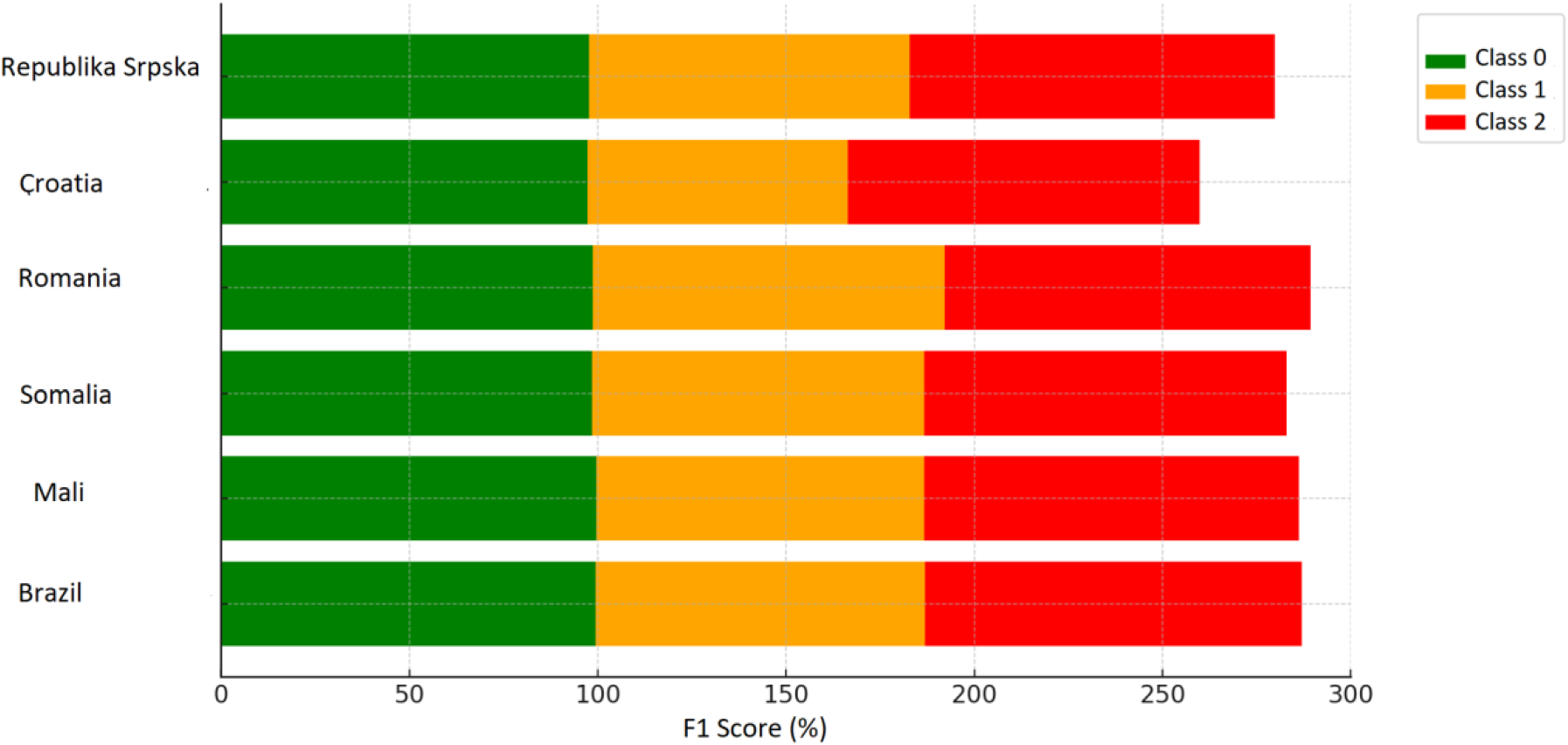
F1 Score by countries.
Low precision and detection probability for Class 1 in Croatia are 66.67% and 71.43%, respectively, which are significantly lower compared to other countries. This indicates that the models have issues with the specific characteristics of Class 1 data in Croatia or that Class 1 is less represented or uneven. Brazil and Mali show very high values for these metrics for Class 2, indicating that the models very effectively identify and classify examples from this class. The highest F1 scores are in Brazil and Mali for Class 2 (100%), reflecting a high balance between precision and detection probability. For Class 1, the lowest F1 score is in Croatia (68.97%), which again emphasizes the poorer performance in classifying this class in this country. Although the models generally show high performance, there are significant variations in their efficiency in classifying individual classes, especially in testing and in specific metrics such as precision and F1 score. In particular, the poorer performance of models for Class 1 in Croatia requires further research and possibly model adjustments or gathering more representative data for that class. Considering this, future research should conduct additional data analyses to identify potential causes of these differences and take steps to optimize the models.
Table 11 and Figure 5. show the performance of classification models by country based on ROC-AUC values and accuracy for training and testing models. All countries have exceptionally high ROC-AUC values for each class, indicating a high ability of the models to correctly classify different classes. All countries have ROC-AUC values of 0.99 or 1 for all classes. Since the ROC-AUC values are extremely high and uniform, there is no significant difference in model performance between different countries. This suggests that specialized models consistently perform well across different geographic locations. Mali and Brazil show the highest training accuracy at 100%, indicating that the model perfectly classifies data within the training set. Training accuracies range from 98.43% to 99.45%, which is also very high. The Republika Srpska has the highest testing accuracy at 95.93%, which may indicate that the model has better generalized on unseen data compared to other countries. Croatia shows somewhat lower testing accuracy at 94.27%, which may suggest a lesser ability of the model to generalize on data from Croatia. Models show very high performance in all countries for both training and testing, with particularly high ROC-AUC values. Although variations among training and testing accuracies are relatively small, countries like Mali and Brazil show slightly better results on test data, which may indicate better adaptability of the models in those environments.
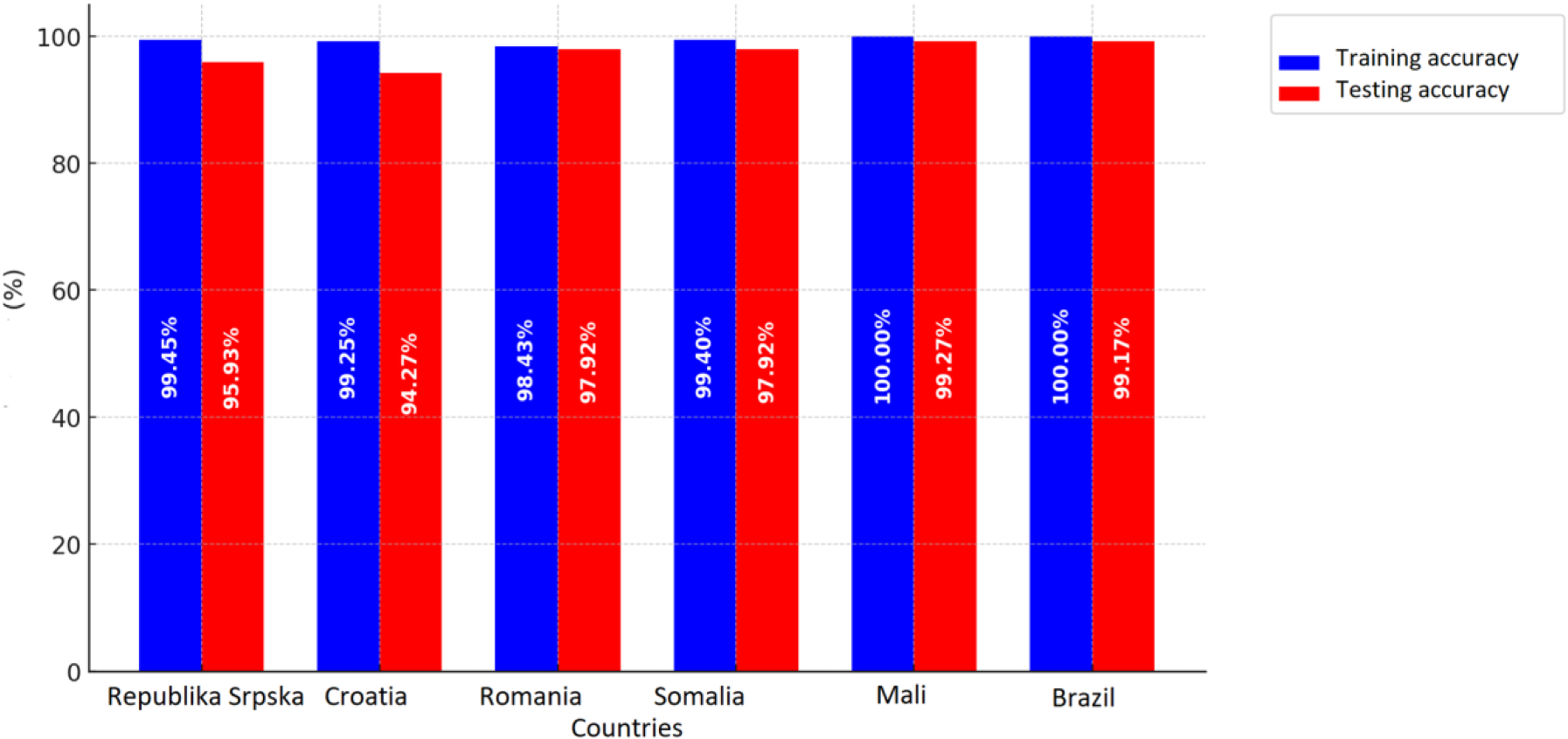
Model training and testing accuracy graph by countries.
ROC-AUC values and model accuracy by country.
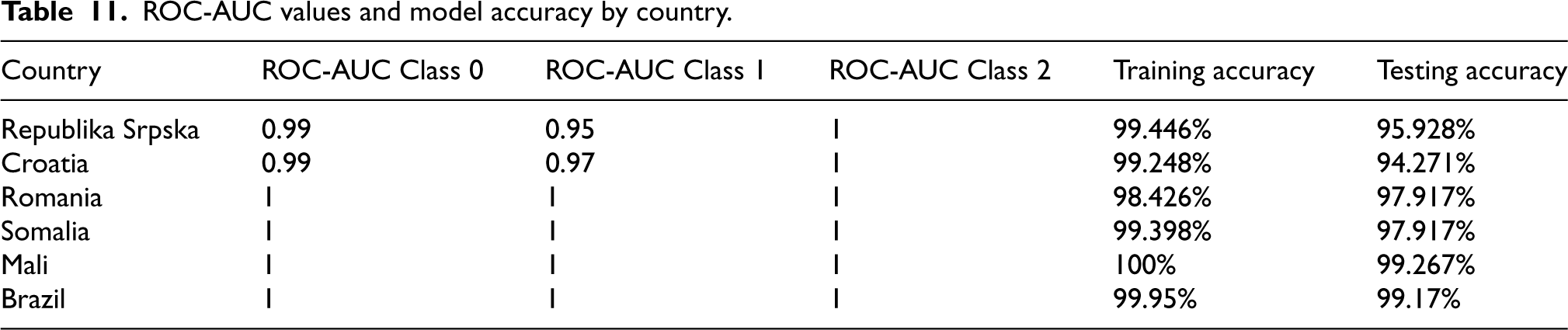
The evaluation of PR curves and calibration plots across different countries and datasets revealed a consistent pattern: while the classifiers achieved excellent performance for the dominant classes, minority classes showed results with lower average precision and poorer calibration. This imbalance suggests that although the models are capable of learning strong discriminative features for the majority classes, they struggle to generalize on underrepresented groups, leading to possible reduced reliability in practical applications. Furthermore, the calibration analysis demonstrated that predicted probabilities are in some casses misaligned with true outcome frequencies, indicating overconfidence at higher thresholds and oscillations in the mid-probability range. For future research these findings highlight the importance of applying corrective strategies, such as data balancing and diffrefent calibration techniques, to achieve not only high accuracy but also trustworthy probability estimates. In practical terms, this would improve the interpretability and robustness of the models, ensuring more reliable decision-making in real-world settings.
Observing the performance of the models and the results generated using behavioral input variables, a proof of concept for the development and practical implementation of applied machine learning algorithms for detecting problematic player behavior is presented. Trained models were deployed to classify players from a control group of previously unseen samples. The models were evaluated and their performances compared. After classifying player behavior by weeks, conclusions were drawn about which group all analyzed players belong to. The percentage distribution of each group (recreational, risky, and problematic players) was calculated by country and the results were compared considering various factors. Behavioral markers were examined with players from 6 different countries across Europe, Africa, and South America. There was a significant difference in terms of the percentages of risky and problematic players between the six different countries. The highest percentage of risky players was found in Mali, as can be seen in Table 12.
Dataset used for analysis and prediction with final results.
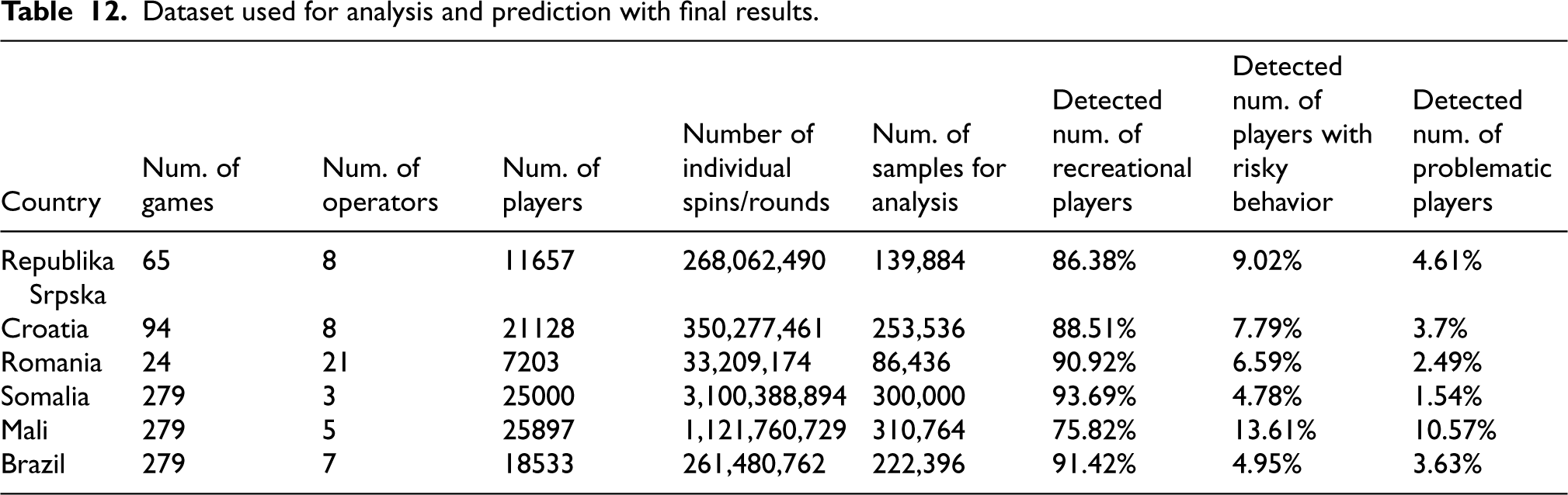
Somalia and Mali have the highest number of processed games (279 games), which is significantly more compared to other countries. Romania stands out with a considerably larger number of operators (21) compared to others. In terms of the number of players, Mali and Somalia have the largest number, indicating a greater popularity and availability of iGaming in these countries. The relatively small number of operators in Somalia and Mali suggests that the market is unregulated and that few operators are available to players. A large number of players in Croatia and Somalia correlates with a large number of games and operators, suggesting the popularity of online gaming. Somalia and Mali have a similar number of players, while Somalia has 2.7 times more rounds played for a similar number of players, indicating a high intensity of play. Distribution of player types by country is visualy presented in Figure 6. Compared to previous research, this paper has processed the largest dataset in terms of the number of spins, number of players, and diversity of countries in terms of religious and national affiliations.
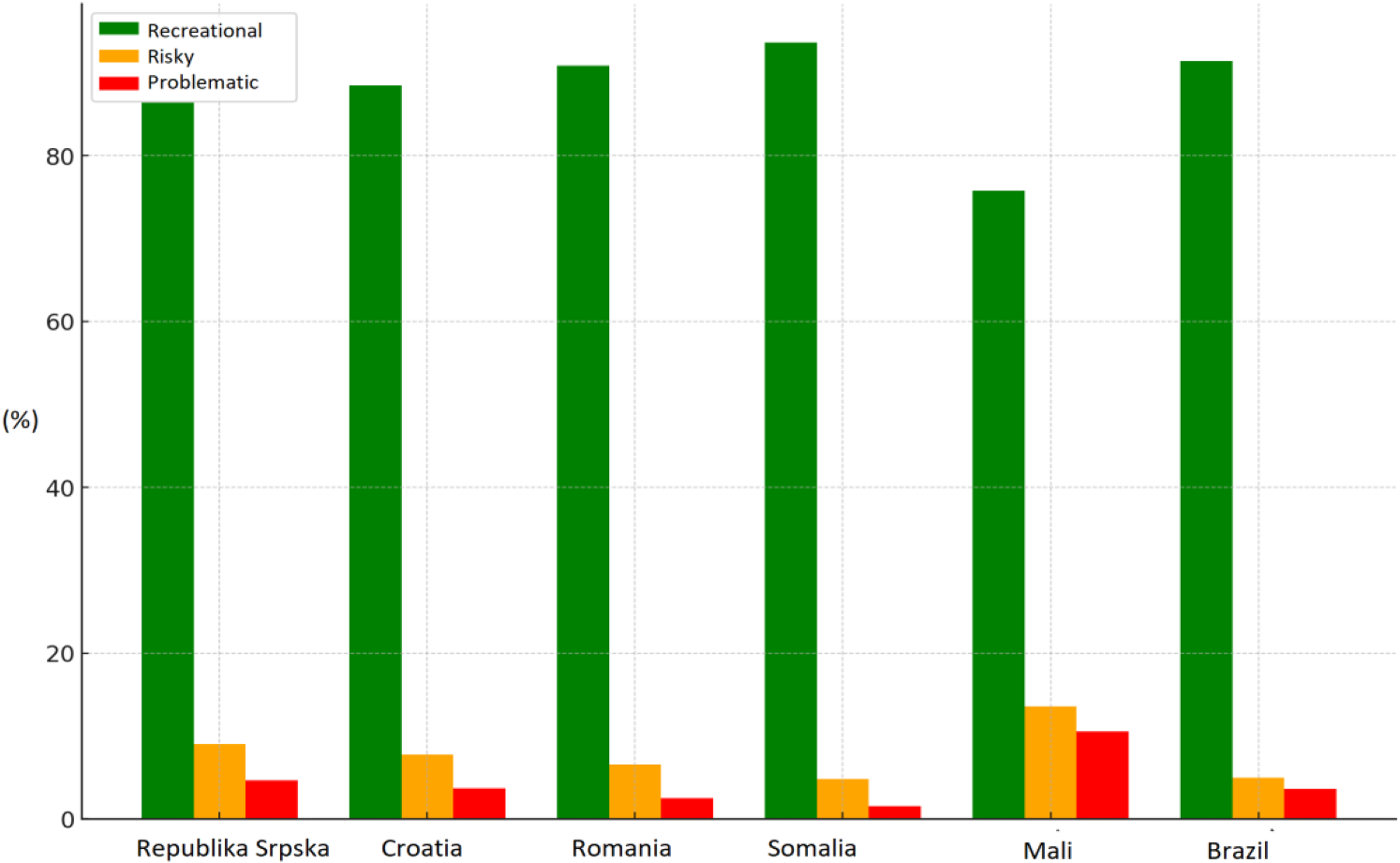
Distribution of player types by country.
Analyzing the results, several key points about the distribution of player types by country can be observed. All countries have a high percentage of recreational players, visually represented by dominant green bars for each country. For example, Somalia has the highest percentage at approximately 93.69%, while Mali has the lowest, but still significant, percentage at 75.82%. This suggests that the majority of the population engaged in gaming in these regions participates recreationally, which is considered healthy or low-risk gaming.
The percentage of risky players, i.e., those who might be at risk of developing gambling problems but are not yet problematic, varies more significantly. Mali has the highest share of risky players at 13.61%, which could indicate a potential problem if these players transition to problematic gambling. In contrast, Brazil and Somalia have the lowest percentages, around 4.95% and 4.78%, respectively.
Red bars, which denote problematic players, are the smallest in all countries, which is generally positive as it shows that fewer individuals have serious gambling-related issues. However, Mali stands out with a relatively high percentage of 10.57%, suggesting a greater prevalence of gambling issues that might require targeted interventions.
Although regionally different, countries like Romania, Somalia, and Brazil, despite differences in socio-economic contexts, show lower percentages of risky and problematic players compared to Mali. These results reflect differences in regulatory environments, cultural attitudes towards gambling, and the availability of gambling opportunities. In countries with stricter regulations and higher purchasing power (Romania and Croatia), a smaller percentage of problematic players is noticed, while in countries with weaker regulation, economy, and literacy, like Mali, there are more risky and problematic players.
Republika Srpska is predominantly Orthodox, and gambling is regulated by law. The gambling culture is relatively accepted but with caution due to possible negative consequences. There is social stigma associated with problematic gambling, but recreational gambling is often part of social gatherings as confirmed by the results. Croatia, predominantly Catholic, has a similar culture to the Republika Srpska in terms of gambling and regulations. Romania is a predominantly Orthodox country with traditional values that sometimes can conflict with gambling. Besides, gambling is regulated by law in Romania. Brazil is a predominantly Catholic country but with a wide diversity in religious and cultural practices. The gambling culture is diverse, with regions that are more open to gambling than others. Gambling is more socially accepted compared to African countries although it is not regulated by law. In countries with stricter religious norms, such as Somalia and Mali, gambling is forbidden, while in more secular or religiously diverse countries, such as Brazil, Croatia, and Romania, there is greater tolerance and integration of gambling into social life. Despite this, the percentage of risky and problematic players in Mali is quite high compared to the European countries that were part of the study. These factors directly affect the prevalence and acceptance of different types of gambling behavior. What is common in the results among European countries is that the Republika Srpska, Croatia, and Romania have a high percentage of risky players. The Republika Srpska has a higher percentage of both risky and problematic players compared to Croatia and Romania. Globally, the Republika Srpska is right after Mali when comparing percentages of risky and problematic players. Brazil and Somalia show lower percentages in the category of risky players, while Mali significantly leads compared to all other countries. Somalia and Mali, although from the same continent and with similar religious and cultural attitudes, do not show similarities in categorizations. Brazil is closest to Somalia in terms of the percentage of risky players and to Croatia in terms of the percentage of problematic players. Globally, Somalia has the smallest percentage of risky and problematic players.
The cross-country analysis additionally indicates that gambling behavior patterns may be influenced by socio-economic and regulatory factors, including differences between regulated and less regulated gambling environments, player protection mechanisms, and cultural attitudes toward gambling. The inclusion of a broader set of behavioral markers in comparison to previous studies enabled a more comprehensive understanding of player behavior dynamics. In addition to financial indicators such as total loss, average daily loss, total bet, and average wager, the analysis incorporated gameplay intensity, session structure, temporal gambling behavior, total playing time, and engagement frequency indicators. The findings suggest that potentially harmful gambling behavior cannot be explained through a single metric alone, but rather through the interaction of multiple behavioral characteristics observed over longer gameplay periods. These findings support the importance of developing adaptable AI assisted responsible gambling systems capable of operating across different jurisdictions and player populations. From a practical perspective, the proposed framework demonstrates the potential of integrating AI, behavioral science, and clinically informed interpretation methods into early risk detection systems focused on player awareness, personalized intervention strategies, and public health protection rather than exclusively relying on restrictive gambling control mechanisms.
The variability among countries suggests the need for tailored public health protection strategies and regulations. For operators and game providers to properly care for players, it is necessary to intervene timely when detecting problematic gaming or potential addiction. Countries with higher percentages of risky and problematic players could benefit from more robust prevention programs, increased public awareness, and stricter regulations to protect players. The differences in percentages obtained in the results are the result of various factors, including local gambling laws, cultural acceptance of gambling, availability of gambling opportunities, purchasing power, and the effectiveness of public health protection strategies related to preventing problematic gambling.
Balancing regulatory requirements, player protection, and commercial goals of gambling organizers is essential to ensure that the gambling industry is safe, sustainable, and enjoyable. For health care purposes, medical devices and wearable devices that collect and monitor health data in real-time are commonplace. The mobile phone can be such a device that would monitor player behavior and alert them to potential risks. Technology and AI have teamed up to provide opportunities for better management of health information and integration of technology in medicine. Suggestion systems and Chatbot assistants aimed at public health protection are key topics in machine learning in a dynamic environment. A huge potential for the prevention of behavioral addictions is also provided by AIoT. AIoT is a combination of AI technologies with IoT infrastructure to achieve more efficient IoT operations, improve human-machine interaction, and enhance data management and analytics. When in function, IoT devices create and collect data, which AI then analyzes to provide insights and improve efficiency and productivity. With the integration of AI, IoT creates a much smarter system. The goal is for these systems to make accurate decisions without the need for human intervention, which would greatly help in protecting public health. A major advantage of AIoT is personalization. While IoT devices can collect information about a player's preferences and behavior, AI can use this information to further customize the user experience. By combining IoT with AI, data collected from distributed databases can be used applying AI techniques such as machine learning and deep learning. As a result, the possibilities of machine learning move closer to the data source. This concept allows for greater scalability, robustness, and efficiency. In other words, with the integration of AI into IoT systems, their operation is not limited to collecting and transmitting information, but to understanding and analyzing data. Thus, a player's behavior can be analyzed in real-time, data can be collected from multiple sources including the player's health record, and ultimately personalized interventions can be created depending on the degree of risk and current health status of the player.
The popularity of online gaming is not accidental and is deeply rooted in behavioral science. High engagement relies on reward systems in the human brain, utilizing concepts such as goal setting, competition, and social validation to create an addictive desire for engagement. Each win, rise in ranking, or unlocked achievement triggers the release of dopamine, strengthening the desire to continue playing. Additionally, the social aspect satisfies a fundamental human need for connection. A major focus is placed on the social and community aspects in an industry that aims to become a hub for entertainment and connecting people. In this way, in addition to the competitive spirit, players feel part of a group and enjoy a shared activity with other people who share similar interests. The concept of multiplayer gaming is further enhanced by virtual worlds and augmented reality. Efforts are being made to develop games in metaverses where players will enter using VR glasses and interact with each other in virtual rooms. Besides creating a sense of belonging to a virtual community, there is a risk of creating even stronger addiction among players, indicating the need for AI algorithms to detect problematic gaming and player behavior to be a part of everyday life in the near future.
One of the goals of this research was to identify a set of behavioral variables in different countries that could cause problematic gambling in the future, which have also been associated with problematic gambling in previous works. As part of primary healthcare, health institutions and AI tools could then target potential high-risk players and apply “responsible gambling” measures as early as possible. Given the scale of the problem, personalized healthcare systems that include innovative strategies for preventative action are crucial. All previous works suggest that recent developments in machine learning enable the adoption of analytical approaches in addiction research. These advantages can revolutionize medical practice in preventive action and preventing certain diseases. The quality of prevention and care can be drastically improved for people who can better understand their health condition and potential dangers in collaboration with healthcare professionals.
Unlike most previous works, this paper did not focus on identifying problematic gambling in an online environment through the lens of predicting self-exclusion. The identification of problematic gambling in players is a prerequisite for the next step, i.e., for an intervention that could be built on such identified risk status in the player's behavior. Possible interventions include communicating about the risky status, feedback on recent gaming expenses, or pop-up windows indicating time spent playing. Future refinement of algorithms for detecting problematic gambling behavior may be directed towards the ability to predict the risk of disrupted gambling with a high degree of accuracy in real-time or at least with low latency. Since risky environments for the development of addiction disorders are being observed, one of the directions of future research is also to examine the impact of information on probability, i.e., with the resulting label that classifies player behavior into recreational, risky, and problematic adding information on the probability that the player can be classified into one of these three categories. One possibility is also that if game providers together with operators share more data about the actual behavior of players, it would enable further research on “responsible gambling” and further refinement of algorithms for detecting problematic behavior. Then, for example, the deposits of players, their age, and how often they contact customer support would also be considered. In addition, this work did not include sports betting, which is a very popular form of gambling in many countries. Data on player behavior tracking are specific to a particular operator, while the scope of player engagement with other operators or outside the online environment in land-based casinos is unknown. Unlike many other studies in the field of gambling research, this research was conducted with real players and is one of the few studies that covered so many different territories and such a large sample.
By combining psychiatric techniques and modern technologies such as AI and machine learning, it is possible to identify behavioral patterns of online players and predict the risk of problematic gambling. The application of these techniques enables early detection of risky behavior and personalized interventions that promote “responsible play,” thus contributing to public health protection and the prevention of addiction development. The key contribution of this research lies in the development of models based on clinically validated behavioral markers, enabling precise categorization of players and the implementation of automated tools for their education and support. The results were evaluated on large samples of players from different countries, showing potential for wider application, especially in the context of regulation and “responsible gambling” on a global level. The performance of the models and the final results obtained by categorizing players from all the countries that were the subject of the research were compared. The paper emphasizes the importance of prevention over damage control, using IoB as a tool for understanding and directing player behavior. Further, it suggests moving from restrictive to educational and supportive approaches, allowing players to make more responsible decisions through a better understanding of their habits.
When it comes to using AI in healthcare, historical gambling data used in machine learning models to identify potentially problematic gambling behavior is crucial. This research included many behavioral metrics related to gambling to reflect bets and player behavior during sessions. Many harmful markers were derived from identified behavioral variables that do not rely on the monetary intensity of gambling, which varies from country to country. Although this research had a large sample and contained data on player behavior monitoring from 52 online operators in 6 different countries, it is not without limitations. It is evident that problematic gambling in players is expressed through multiple behavioral markers, including monetary and non-monetary variables, as well as variables reflecting frequency, intensity, and variability. It is necessary to devise a proper way to integrate new insights from data science with existing psychological knowledge about the characterization of traits and cognitive processes in problematic gambling.
Generative AI and LLM models are already being applied in various aspects of healthcare. They can also find their purpose in detecting or preventing the development of addiction diseases. Thanks to their versatility and language understanding capabilities, LLM models can transform various aspects of healthcare, from improving patient care and communication to enabling precise medical analytics. Additionally, such models can participate in automating appointment scheduling and communication with patients as part of “responsible gambling” measures. LLM models can respond to patient questions, translate medical jargon into simple language, and generate personalized information about their condition or reminders. These models are also effective in tasks such as analyzing unstructured clinical texts and can extract significant insights and provide real-time analytics. Furthermore, models assess patients’ conditions based on medical history and other criteria during clinical treatment. It is almost certain that AIaaS (AI as a Service) will play a crucial role in the future, using virtual assistants for diagnosis and treatment, as well as through specially made machine learning models connected with a centralized database of electronic patient records and additional components for diagnosis and proposed treatment such as clinics, psychologists, psychiatrists, etc.
It is essential to popularize machine learning applications in addiction research to see the potential in applying methods that rely on machine learning generally in addiction psychiatry. In any case, it is predictable that data scientists will play an important role in assisting psychiatrists and neuroscientists in identifying and profiling groups with addictive behavior. More precise behavior predictions and tests of greater specificity for a particular population, together with traditional statistical methods, will provide a foundation and supplement to machine learning methods in making medical decisions, which will help in obtaining earlier clinical diagnoses and treatments. Machine learning and neural networks are ideal for distinguishing behavior patterns in those with problematic gambling from recreational players. Health institutions can offer tools for interventions as part of “responsible gambling” measures to all users or can direct such interventions to a subset of users.
Footnotes
Acknowledgements
Not applicable.
Ethical considerations
Not Applicable. This article does not contain any studies with human or animal participants. There are no human participants in this article and informed consent is not required.
Consent to participate
Not Applicable.
Consent for publication
Not Applicable.
Contributorship
EM and BP were engaged in data analysis, proposing solution, solution architecture engineering, machine learning model training, and results evaluation. STG and MC were involved in discovering behavioral patterns and labeling samples for training neural networks, by using psychiatric approach and experience from clinical practice.
Funding
The authors received no financial support for the research, authorship, and/or publication of this article.
Declaration of conflicting interests
The authors declared no potential conflicts of interest with respect to the research, authorship, and/or publication of this article.
Data availability
Not Applicable.
Institution where work was done
Faculty of Electronic Engineering, University of Niš, Serbia.
