



Abstract
In this article an examination is made of the association between unemployment and public demand for government intervention in the economy. The main hypothesis is drawn from the theory of issue ownership: public opinion is likely to shift to the left in times of high unemployment combined with a leftist government. Research on issue ownership has typically focused on case studies of particular countries. We extend the discussion to a much larger setting. Relying on data from the International Social Survey Programme from 23 OECD countries in the time period 1985–2007 we find a combined effect of issue ownership and agenda setting. An increase in unemployment leads the public to hold more leftist economic opinions when the government belongs to the left. However, ownership of an issue cannot be guaranteed to last if a party fails to deliver outcomes that are promised and expected from its historical legacy.
Introduction
‘“What am I going to do about a job?” is a question which gives more concern to each of us – at one or another time of our lives – than any other that is ever asked’ (Viteles, 1934: 271). This was written in the wake of the Wall Street crash of 1929. Even so, this question is of timeless relevance. On 15 September 2008, Lehman Brothers, one of the world’s leading financial services firms, filed for bankruptcy protection. This represented the peak of the 2007–9 financial crisis. The effect of the crisis was felt worldwide. Production rates fell and unemployment rose. It was the worst recession since the Great Depression of the 1930s. Subprime lending combined with increasing oil prices ended a period of economic growth and replaced it with a period of crisis and renewed fear of unemployment. The response of US voters was to elect a president who campaigned for more government intervention in the economy. Similar public sentiment was felt in Europe where people seemed to support government intervention in the economy, and the period saw great liquidity injections into the world’s financial markets. Both the USA and Europe experienced a series of company bailouts. It is recognized that some of the reasons for President Obama’s victory in the presidential election of 2008 were due to issue ownership over economic crisis policy. Issue ownership can be described as the perception of a political party’s ability to manage certain civic issues. Frequently, the leftist parties have a better reputation than their political counterparts for handling unemployment. The main focus of this article is the effect of issue ownership on people’s economic left–right opinions.
In the wake of the financial crisis the world has also seen a renaissance of Keynesian 1 economic thinking. We live in an era where more government intervention in the economy is considered one way out of financial and economic difficulties. Yet not everyone seems to agree that the Keynesian route is the right one to follow in order to escape the crisis. Strong forces in US politics and the media question government influence over business, since it is perceived to contradict American core values.
There is some controversy in the literature regarding the effect of unemployment on the economic left–right opinions of the public. On one side of the table we find Durr (1993) who argues that economic hardship gives rise to a more rightist population, and on the other side stands Blekesaune (2007) who states that when economies contract, people will want their governments to take more responsibility in economic matters. Also, leftist parties, with a historical reputation of fighting unemployment, may escape some of the negative sentiments that develop during a period of increasing unemployment. Such historically accumulated legacies are, of course, not waterproof as leftist parties may lose their issue advantage if they are not able to meet citizens’ expectations on reducing the unemployment problem. For example, in the Swedish general election of 2006 the Social Democratic Party was not able to benefit from its reputation during a period of increasing unemployment. The UK Labour government was defeated in the 2010 general election in similar circumstances. This can be viewed as real life critique of the issue ownership argument.
The recent financial crisis should stimulate research about the relationship between unemployment and public opinion. In this article, we test whether there is a connection between the level of national unemployment and aggregated public opinion towards government intervention in the economy. In addition to the country level analysis, we investigate individual level attitudes to test whether the ideology of a leftist government is penalized if unemployment is high. With this article we address a gap in the literature as previous studies of issue ownership have based their conclusions on single country studies. Our contribution is to expand on this by systematically investigating data from several countries over a period of time. More specifically, we use a quantitative approach, focusing on individual attitudes in 23 OECD countries over a period of more than two decades. We are looking at the two decades preceding the 2007–9 financial crisis. Our data are taken from the International Social Survey Programme (ISSP) ‘Role of Government’ studies and the Key Indicators of the Labour Market database. This article focuses on individuals’ opinions rather than their voting behaviour. Three questions pertaining to people’s attitudes towards government involvement in the economy and government spending on unemployment benefits are investigated.
At the individual level we find the expected support for interventionist attitudes by social and political categories. The political sociology of an active state follows a traditional pattern with strongest support among those who are most dependent on government: women, individuals with low education and the unemployed. At the country level the results show that an increase in unemployment strengthens leftist attitudes within the population if the government comes from the left. This finding is explained by the rationale of the clientele hypothesis and issue ownership theory. We argue that issue ownership combined with political agenda setting contributes to the shaping of public opinion. In more general terms, we observe that the negative social and economic effects of unemployment translate into politics in a somewhat more complex way than just assuming that unemployment always leads to the punishment of incumbent parties. A model with issue ownership produces a differentiated view of holding power in tough economic times.
In the next section we discuss the consequences of unemployment, followed by a review of the literature and theory on economic hardship and public opinion from which the first hypothesis is deducted. We then proceed with a presentation of issue ownership theory on which our second hypothesis is based. This is followed by a presentation of the data before the hypotheses are tested by means of multilevel modelling.
Unemployment: a grave social risk
Employment has a central position in western societies, and unemployment is one of the most serious problems that can affect an individual during the life course. Those employed experience better health and less risk of early death than those who are unemployed or outside the labour market. High levels of unemployment can generate ill health that leads to a vicious cycle of irregular employment and early exit from the labour market (Bellaby and Bellaby, 1999), as well as reduced mental well-being (Strandh, 2000). Ill health can be caused both by personal unemployment and indirectly through increased job pressure when the national unemployment rate is high. Also, lack of employment can lead to social, economic and political marginalization. A jobless person is often disappointed with the authorities and tends to be dissatisfied with how democracy works (Bay and Blekesaune, 2002).
In the extant literature unemployment is largely analysed from a sociological and economic perspective. Using extensive comparative and longitudinal data several scholars have exposed the problems and burdens of unemployment. Gallie et al. (2003) have emphasized how unemployment leads to poverty, which can, just as with ill health, in turn result in an unfortunate cycle of exclusion. Immigrants have been shown to be especially exposed to unemployment in many European countries; especially exposed are immigrants from Islamic countries (Fleischmann and Dronkers, 2010). Indeed, such a gap between immigrants and natives is likely to increase over time (Brekke and Mastekaasa, 2008). Youth unemployment is a major problem in many countries although there is considerable variation throughout Europe, and in respect of individual characteristics and family background (Russell and O’Connell, 2001). Bay and Blekesaune (2002) discovered a radicalization when it comes to the political opinions of unemployed youth, that is, that they more frequently support revolutionary political ideas. Another alarming finding is that they also show a lack of political trust.
The above discussion shows that unemployment, and especially long-term unemployment, is a grave social risk. From this it follows that unemployment, in its many varieties, should trigger a political response from political parties and governments and also move public opinion on the issue. We commence with an overview of how scholars view the link between unemployment and left–right policy attitudes.
Economic hardship and left–right attitudes
Several studies exist on how micro (individual level) and macro (state level) factors can influence left–right economic attitudes. Among others, Rehm (2009) found that the risk of losing one’s job leads to a stronger preference for redistributive policies. Much research has focused on factors like self-interest as an explanation for attitudes towards welfare state policies (e.g. Hasenfeld and Rafferty, 1989; Kumlin, 2007). However, macro factors can also play a part. For instance, policy-makers can be seen as moulders of public opinion (Papadakis, 1992). In an explanation of why residents in free market regimes are reluctant to support welfare policies, characteristics of the regime have been found to influence public opinion on welfare policies. Individuals living under social democratic welfare regimes are generally supportive of welfare policies (Larsen, 2008). Other scholars, however, have found mixed results of the proposed effect of welfare regimes on individual opinion (Jæger, 2006).
Can unemployment be a decisive factor of public attitudes towards welfare state policies? There is an academic debate regarding this question. Some studies have found a positive link between unemployment and public support for welfare policies (Blekesaune, 2007; Blekesaune and Quadagno, 2003), while others have listed more tentative results or reported that there is no significant relation (e.g. Fraile and Ferrer, 2005; Kam and Nam, 2008). Durr (1993) claims that economic hardship gives rise to a more rightist population. Shifts in citizens’ political sentiments along a liberal–conservative axis can be explained by changing economic expectations. If the public expects a declining economy with a rise in unemployment, this will push the mood of the people to the right. The logic behind this is taken from the self-interest argument whereby people turn right politically because they discover that their tax money is being spent on others than themselves. Even so, the argument that citizens will always want greater wealth for themselves holds less true if goods are abundant. Liberals, or the left in US politics, promote a policy of an active federal government. Such efforts, Durr argues, can only be put into action if the population enjoys the benefits of a healthy economy. If one already has financial security, it is easier to support a liberal political agenda. On the other hand, in times of financial hardship, people will favour a rightist or conservative economic policy (Durr, 1993).
However, Durr’s contention can be argued to be USA-specific, and thus not apply to other advanced economies. In contrast to Durr’s argument is the study by Blekesaune and Quadagno (2003) where public attitudes towards welfare policies such as support for the sick and the elderly as well as for the unemployed are investigated. After introducing unemployment at both the individual and national level, they found that this exerted significant explanatory power on attitudes towards welfare state support for the unemployed at both levels. An increase in unemployment at the national level leads to an increase in support for the welfare of the unemployed among the respondents. A related study by Blekesaune (2007) confirms the earlier findings of Blekesaune and Quadagno (2003). Here the governmental protection hypothesis is presented which states that in times of economic decline people tend to believe that governments should take more responsibility, whereas when employment rates are high and the economy is booming people tend to have more confidence in the individual and the market. The logic underlying the government protection argument is that high unemployment increases public awareness of the risk of becoming unemployed and also triggers sympathy for those already unemployed. This hypothesis had previously been used by Lipset (1968) to explain prosperity and stability in post-war Europe. Blekesaune (2007: 399) found that an increase in unemployment was associated with increased support for welfare state policies measured as governmental responsibility for economic provision and redistribution.
We test whether there is actually a macro–micro link between times of economic hardship and peoples’ wish for government intervention in the economy. Based on the government protection argument, we advance the following hypothesis:
H1) When unemployment is high, people will demand more government intervention in the economy than in periods with low unemployment.
We test this hypothesis by employing a model which includes macro indicators of unemployment as well as individual factors which we expect will influence demand for government intervention in the economy. Unemployment is measured at the level of both the country and the individual. In both cases we expect that unemployment will be positively associated with support for government intervention in the economy.
Does the political orientation of the government matter?
In this section we address the issue ownership argument. A premise for this is that political parties pursue different goals with regard to macroeconomic policies. In the USA, Democrat governments have been found to favour policies for reducing unemployment while Republican governments are more concerned with suppressing inflation (Alesina, 1987; Budge and Farlie, 2003; Petrocik et al., 2003). If the public were rational, then the different parties’ fields of expertise would be taken into account, when voting and forming their own political opinion. This is because the ideological predisposition of the political parties, which is analogous to public opinion, has a great impact on whether the government pursues the goal of reducing inflation or decides to cope with unemployment.
According to the theory of economic voting, parties in government will be penalized for bad economic conditions. But the degree of negative effects might be dependent on the political ideology of the parties in government (Anderson and Singer, 2008). Even in times of economic hardship, a leftist government might be perceived as having greater competence in solving economic problems than their rightist or centrist counterparts. According to the clientele hypothesis, a leftist incumbent government could go relatively unpunished despite rising unemployment (Martinsson, 2009). If the election campaign is fought over issues where a particular party has issue ownership, then uncommitted voters will tend to support this party (Bélanger and Meguid, 2008; Budge and Farlie, 2003). This reasoning was elaborated further by Petrocik (1996). Some parties are perceived as being better at handling and/or are more committed to certain issues than other parties. The majority of voters are described as pragmatic where the main concern is finding that party which can solve those problems that are on the agenda. One assumes differences in the capability of the different parties of ‘fixing’ sundry issues (Petrocik et al., 2003). Issue ownership or perceived competence is argued to matter more when there is a large degree of party convergence (Green and Hobolt, 2008). According to issue ownership theory, in times of high unemployment political parties with ownership over a certain issue would gain from this issue getting increased salience (Martinsson, 2009). Thus, this theory is applicable to our study of public opinion. If a person’s vote can be influenced by the salience of an issue, this will also affect their economic left–right attitudes.
The second hypothesis tests whether issue ownership plays a greater role when the government comes from the left. To a large extent, issue ownership is determined in the electorate’s mind by the record of the incumbent. The causal direction implied would be that an increase in unemployment leads the public to want more government intervention. If the incumbent government is leftist, it would be perceived as the most competent at handling unemployment, and people’s attitudes would still favour its policies. In addition, a leftist government would put societal problems on top of the agenda, and we could thus be expected to see an additional effect of unemployment if the government is liberal (USA) or socialist (Europe). The incumbent may perform a form of selective influence over people’s opinion. Elites set the agenda, and incumbents are in the best position of the elites to influence it (Andrade and Young, 1996; Kingdon, 1995). The lion’s share of public knowledge about policies is mediated rather than being direct understanding of political information (Iyengar and Kinder, 1987; Nelson et al., 1997). By selecting the presentation of information, the incumbent government emphasizes political issues where they hold the strongest cards, that is, where they have issue ownership. According to Lindblom (1977), authority structures can be used as instruments of social coordination. This is in line with Zaller (1992) who argues that the public establishes its views based on political information. In other words, a leftist government will have the power to influence the public, given that the prevalent issues are considered ‘their turf’. This combination of issue ownership and agenda setting will, if the government is socialist or liberal, lead the public to be more positive towards government intervention in the economy. We thus present our own version of the clientele hypothesis:
H2) Public opinion will shift to the left in times of high unemployment combined with a leftist government.
If issue ownership combined with incumbent agenda setting is the decisive factor, we would expect our second hypothesis to be confirmed. There are cases where the socialist side has lost ownership over the issue of unemployment (Martinsson, 2009). Recent examples include elections in Sweden and Britain. Bad times can give the upper hand to the opposition, so if a leftist government over time is not able to solve the problem of unemployment, issue ownership on this matter could be handed to parties on the other side of the political spectrum. However, the 2009 election in Norway was an example of increasing support for a left-wing government in times of rising unemployment, indicating support for the issue ownership argument. All in all, we assume the general rule to be that the left owns the unemployment issue.
Data and variables
To test for a relationship between unemployment and public opinion, we combined survey data with national statistics on unemployment. Individual level data are from the ISSP study ‘Role of Government’. 2 This dataset has been employed by several scholars (e.g. Blekesaune and Quadagno, 2003; Brooks and Manza, 2006). We use data from four time-periods (1985, 1990, 1996 and 2006) and 23 countries. 3 For some countries the survey was conducted in the following year. We investigate three questions about government intervention in the economy. Two of the questions used are taken from the battery: Here are some things the government might do for the economy: Government financing of projects to create new jobs; Support for declining industries to protect jobs. The last question used is: Listed below are various areas of government spending. Please show whether you would like to see more or less spending in each area; Unemployment benefits. All questions have five response categories, the first two ranging from Strongly in favour to Strongly against. For the third question, the response categories range from Spend much more to Spend much less. A principal component analysis of the data demonstrates that the three variables have a single underlying construct or factor. Yet, when testing the reliability of an aggregated measure composed of the three variables, this proved to be too low to justify its inclusion in a regression model. For simplicity, we have constructed a scale (1 to 13) where high values indicate leftist attitudes as shown in Figure 2. However, in the regression models we investigate the three questions separately.
The macro level measure employed here, UNEMPLOYMENT, is the share of the labour force that is without work but seeking employment (given in percentages of the total workforce). The data are taken from the Key Indicators of the Labour Market (ILO, 2009) database. We present two figures giving us a descriptive statistic of the unemployment rate and aggregated public opinion on these three questions. In addition, we also present two multilevel models. In order to avoid spurious findings we have included gender, age, unemployment (at the micro level) and trade union membership as controls in these models. Women can be expected to be more in favour of government intervention and spending than men. This expectation can be attributed to their acquired ethic of caring which makes women predisposed to think more socially and have less focus on individual gain (Jelen et al., 1994). Middle-aged persons can be expected to hold more rightist views than the young and the old due to factors like job stability and financial security. The same reasoning is applicable with regard to education. Both personal unemployment and trade union membership are expected to lead to leftist economic opinions.
There are both theoretical and statistical reasons for using a multilevel quantitative approach. From a theoretical point of view the intention is to test if issue ownership theory can assist in explaining the link between macro factors and individual level opinion. By including country-year variables in the regression equation one allows for factors at the society level to be accounted for.
Results
The first step of the analysis is to present descriptive statistics and see if any trends can be seen with regard to attitudes on government intervention in the economy. Figures 1 and 2 show countries which have participated in at least three of the survey rounds. In Figure 1 the total unemployment for the five countries in question can be seen for the period 1984–2007. The trend is that unemployment has decreased over the last two decades (before rising again due to the 2007–9 financial crisis). When Figure 1 is juxtaposed with Figure 2, which shows the aggregated public opinion towards government intervention (country means), it is difficult to see any strong correlation between unemployment and attitudes towards government intervention. Even so, one can see that the UK and Italy seemingly have attitude trends that fall in line with our first hypothesis.
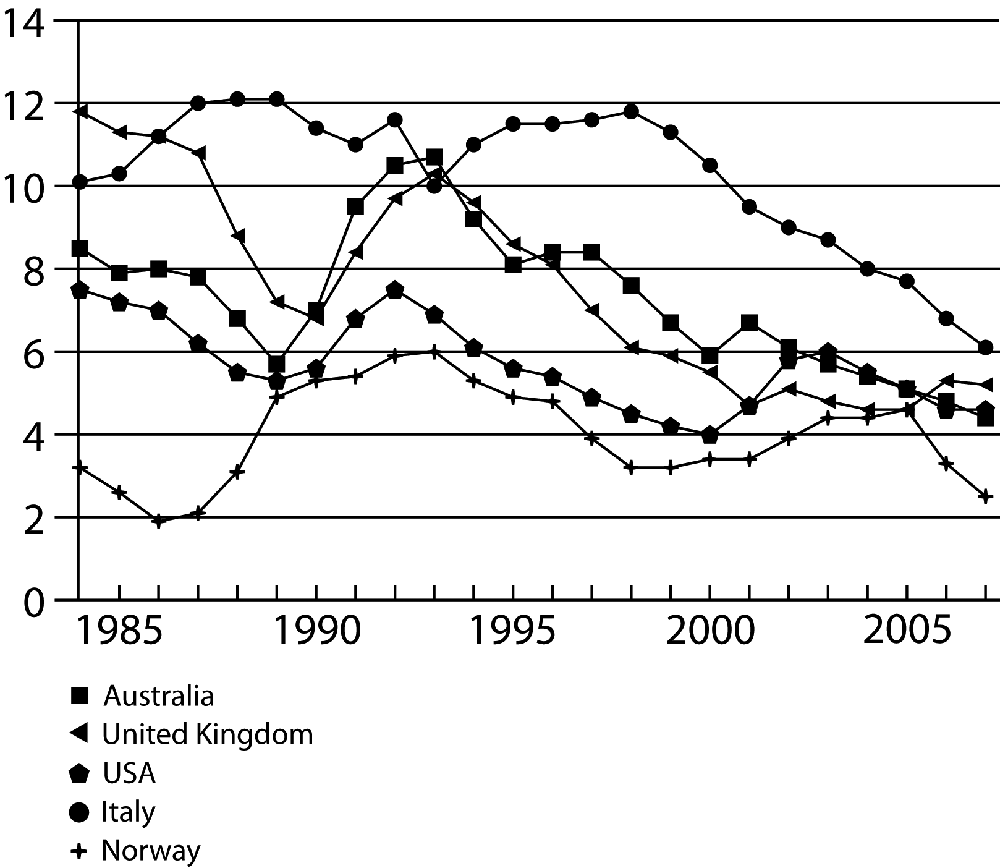
Unemployment (% of labour force) in the period 1984–2007
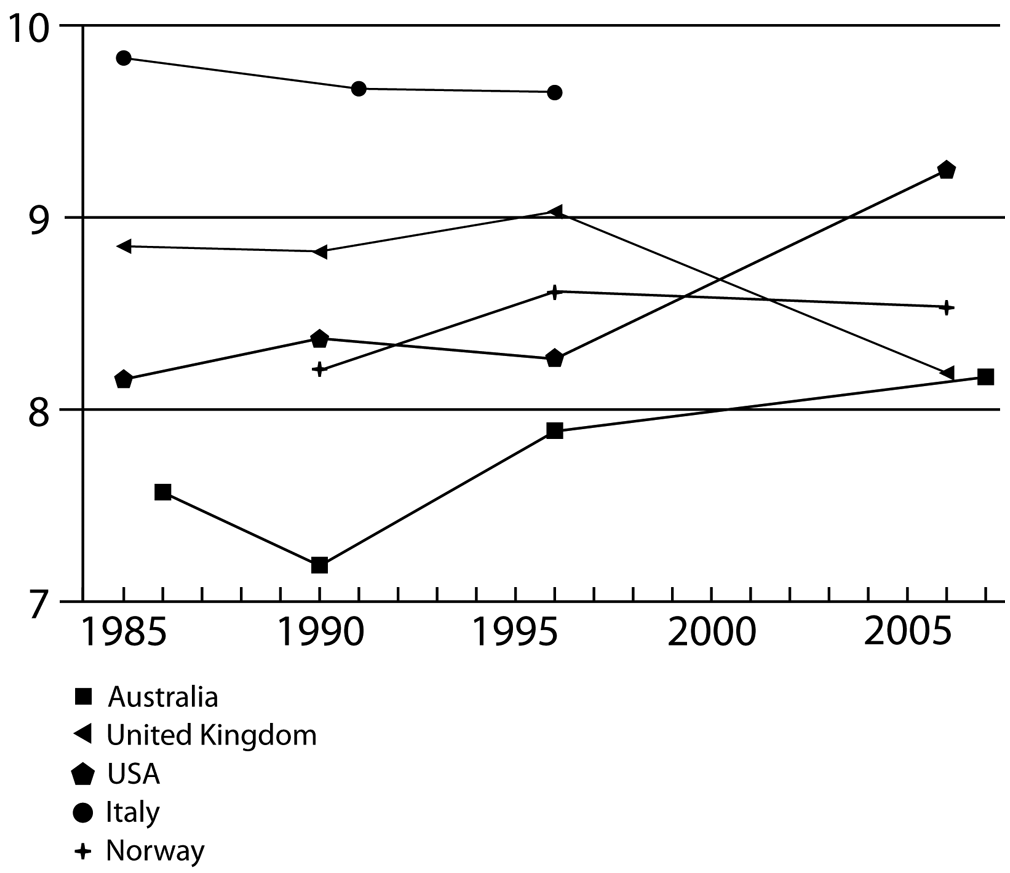
Attitudes (1–13) towards government intervention at four points in time
It is first and foremost those who are actually unemployed who should be expected to favour government intervention in the economy. Therefore it is vital to control for micro level explanatory factors such as whether or not the respondent is currently employed. Investigating micro level attitudes and allowing controls for other factors will better enable us to test both our hypotheses. In order to examine the link between unemployment and public opinion more closely we present six multilevel regression models (two for each of the three dependent variables) in Tables 1 and 2. Multilevel modelling enables us to investigate data structures that are hierarchical where the sample data can be viewed as a multistage sample from this hierarchical population (Hox, 2002). We thus claim that there are effects of the social context on individual opinion. There are three nested levels in the data: individuals, country-years and countries. The dependent variables are ordinal questions, and we thus run three-level ordered logit models. For the first three models we use Equation (1) where two country-year level variables are included, namely percentage of unemployment in the country in the year previous to that of the survey β6, and whether or not the government was leftist in the same period β7; 4 y ijk tells us the value on the dependent for an individual i from specific country-year j and country k (for example Australia-1996 and Australia); τ m represents the four intercepts or cut-points (one for each answer category of y minus the baseline group), while e ijk , u0jk and v0k are the level-1, level-2 and level-3 residuals.
Three-level ordered logit models on government intervention and spending, 1985–2007
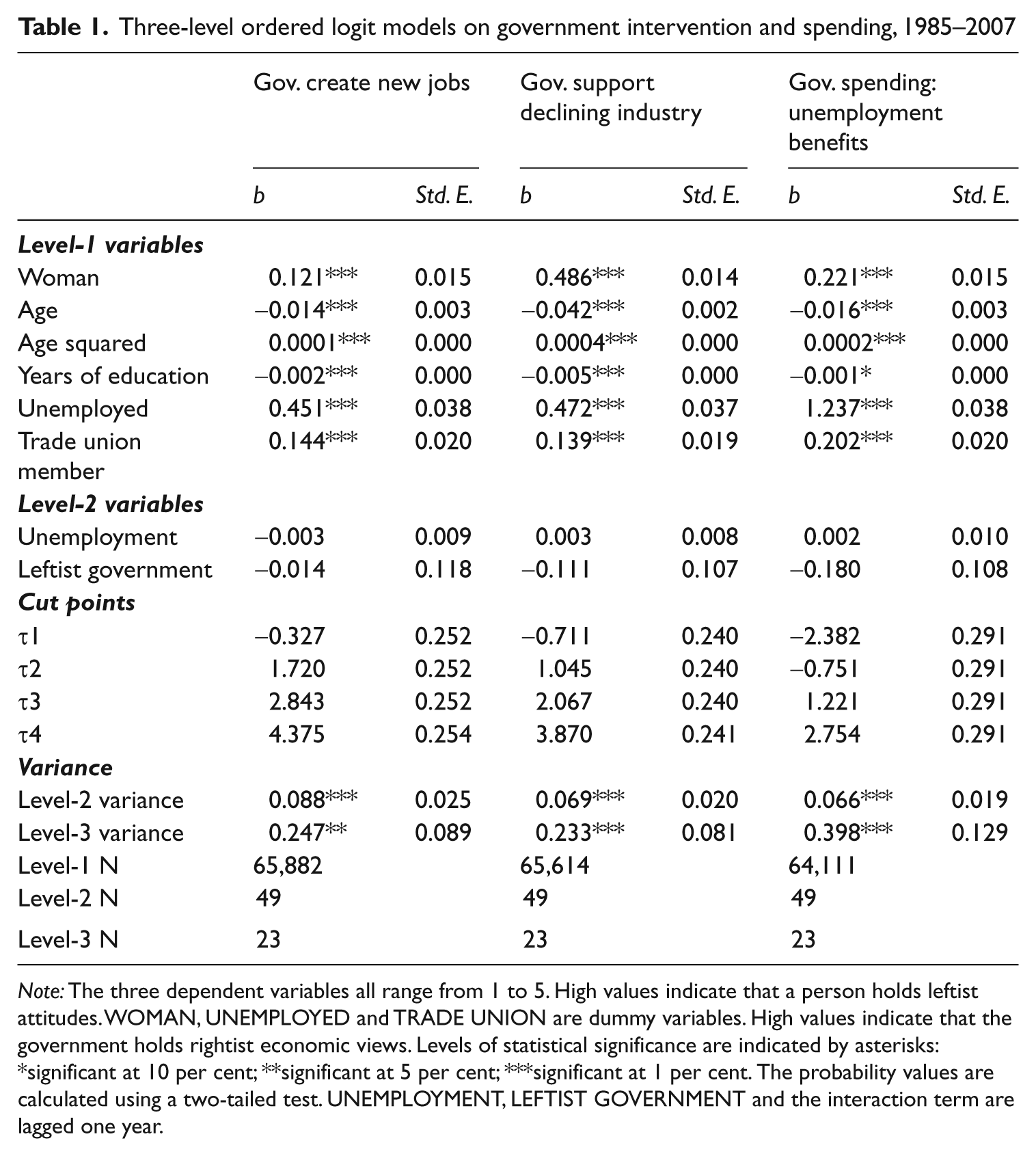
Note: The three dependent variables all range from 1 to 5. High values indicate that a person holds leftist attitudes. WOMAN, UNEMPLOYED and TRADE UNION are dummy variables. High values indicate that the government holds rightist economic views. Levels of statistical significance are indicated by asterisks: *significant at 10 per cent; **significant at 5 per cent; ***significant at 1 per cent. The probability values are calculated using a two-tailed test. UNEMPLOYMENT, LEFTIST GOVERNMENT and the interaction term are lagged one year.
Three-level ordered logit models on government intervention and spending 1985–2007, including interaction term
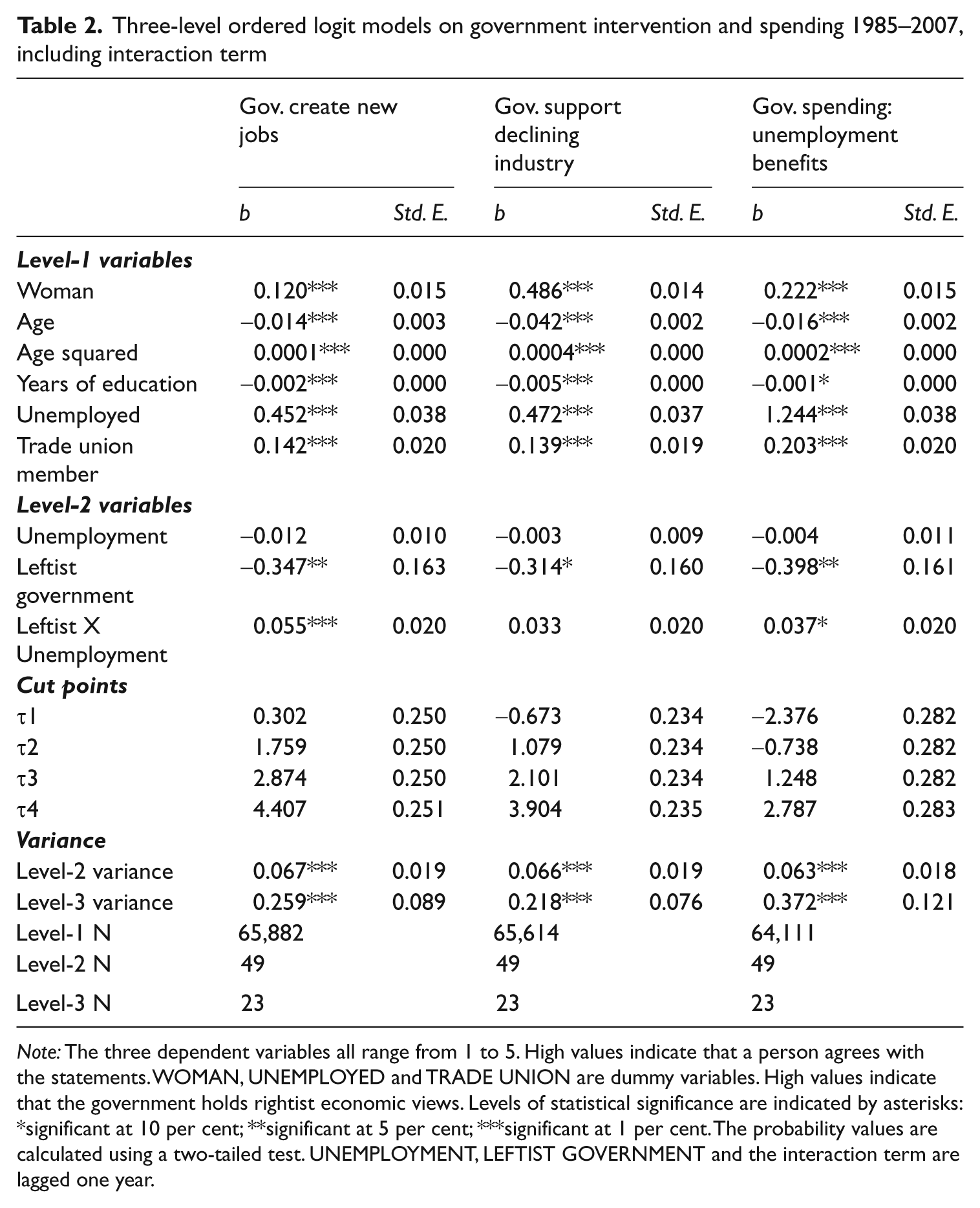
Note: The three dependent variables all range from 1 to 5. High values indicate that a person agrees with the statements. WOMAN, UNEMPLOYED and TRADE UNION are dummy variables. High values indicate that the government holds rightist economic views. Levels of statistical significance are indicated by asterisks: *significant at 10 per cent; **significant at 5 per cent; ***significant at 1 per cent. The probability values are calculated using a two-tailed test. UNEMPLOYMENT, LEFTIST GOVERNMENT and the interaction term are lagged one year.

Equation 2 is similar to the first equation. Here, however, we have included an interaction term composed of the two country-year level measures:

When calculating the coefficient of an interaction term, we must include the effects of the explanatory variables that make up that interaction in our interpretation of the results. Account must also be taken of the low level-2 N (which is only 49) when interpreting the statistical significance of level-2 variables. Only fairly large effects can be expected to reach a p<0.05. It is therefore appropriate to discuss effects that are significant at p<0.10 (which are denoted with one star in our tables).
Tables 1 and 2 present results for our models of the hierarchically ordered data, predicting opinions towards government intervention in 23 countries at four different points in time, giving us a total of 49 country-years. 5 The models presented in Table 2 include an interaction term composed of the two macro level variables. The highest value on the dependent is used as the reference category. This implies that one would have to reverse the signs of the coefficients to obtain the natural interpretation; or alternatively give high values on the dependent of the opposite meaning. We have chosen the latter option such that the coefficients can be interpreted as if high values on the dependent mean leftist opinion. 6 We are now in a position to examine the variations in attitudes towards government intervention in the economy and spending on unemployment benefits that can be attributed to variance at the country level.
In all models, data show that the sociological micro level variables are important predictors. Women have significantly more leftist attitudes than men. There is a curvilinear effect of age: middle-aged persons tend to be more rightist than the young and old. As expected, the variable denoting whether or not the respondent is currently unemployed is also positive and significant, and this is the strongest effect in four of the six models. This is in accordance with the self-interest and economic voting argument: persons who are unemployed are likely to hold positive attitudes towards government intervention in the economy. Our finding is consistent with previous research, for example, Blekesaune (2007). Trade union members also hold more leftist opinions than those who are not organized, supporting the conventional view that unions favour active labour market policies. Our first macro predictor shows that there is no significant direct effect of unemployment on the individual’s left-right economic opinions (see Table 1). The first hypothesis is thus not supported.
In Table 2 we include the interaction effect between UNEMPLOYMENT and LEFTIST GOVERNMENT. This does not affect the direction of the signs or the significance level of the level-1 control variables. We see that the coefficient estimate on the LEFTIST GOVERNMENT variable is negative and statistically significant which implies that public opinion tends to be rightist if one has a leftist government combined with low unemployment. This seemingly odd pattern can partly be explained by the thermostatic quality of public opinion. Citizens typically want less of whatever the current government is providing and more of what the government is not providing (Soroka and Wlezien, 2010). The introduction of the interaction term enables us to test our second hypothesis: that public opinion is more positive to government intervention in times of high unemployment combined with a leftist government. This hypothesis is supported in two of the models where the interaction term is positive and significant, implying that there is an effect of macro level unemployment if the government is leftist. To see the effect of unemployment under a liberal/socialist government we simply add the effect of the interaction term (which is positive and large) to the effect of UNEMPLOYMENT (which is negative but very small). In the ‘Government support declining industry’ model the p-value of the interaction term is just above the 0.10 threshold. All in all, our models show results that are in line with our second hypothesis.
Conclusion
Employment is an important source of social belonging and integration. The fundament of economic and social security is created at the workplace. If a person is unemployed, he or she misses out on the socialization and the network building that takes place there. Also, unemployment can lead to a vicious cycle of exclusion, poverty and ill health. Questions about unemployment and government intervention in the economy have received renewed interest since 2007. Generally speaking, citizens and governments have become more favourably disposed to state intervention in the economy as the financial crisis has led to an increase in unemployment. Unemployment and inflation are issues which citizens agree upon. Even so, people and politicians sometimes disagree on what is the best solution to solve economic problems. This article introduced the theory of issue ownership to assess the role of public opinion on government intervention in the economy. By moving beyond previous single country research, our study contributes to knowledge on the link between unemployment and demand for government intervention in the economy.
Political parties of the left normally have ownership of the unemployment issue. This, in combination with a leftist government, will promote unemployment to the top of the political agenda and strengthen public support for interventionist policies. We analysed macro data and survey data from 23 OECD nations over a period of more than 20 years. Public support for government intervention in the economy and spending on unemployment benefits was positively related to the experience of personal unemployment. The effect of aggregate unemployment in the country as a whole was not significant, and we thus have to reject our first hypothesis. However, we found that the effect of unemployment was conditioned by parties in government. According to economic voting theory, the incumbent government will be punished by the electorate if unemployment is high. This stands in contrast to the issue ownership argument which states that a leftist government still could receive support for their policies even in a period of high unemployment. If issue ownership was to have a spillover effect on public opinion, the public sentiments associated with the left could gain ground. Thus, the ideological profile of the governing party affects the attitudes of society as a whole and could actually work to the advantage of a leftist ideology. The multilevel models presented here show that an increase in unemployment leads the public to hold more leftist economic opinions, given that the government is from the left.
In conclusion, the findings suggest that there is an issue ownership effect. If unemployment is high, public opinion will be framed around this issue. We have tested this theory using three-level ordered logit models, combining survey data with data at the country-year level. The key conclusion of our analysis is that a combination of issue ownership and agenda setting has an influence on individual level attitudes towards government intervention in the economy. It is an implication of this research that individual experiences of unemployment lead to citizens’ support of policy positions that actively attempt to increase employment, but also that political macro responses are important. The theory of issue ownership argues that parties with a reputation of actively fighting unemployment will have an advantage in moving opinion in a pro-interventionist direction. Although the statistical results from a large number of countries support this interpretation, ownership of an issue cannot be guaranteed for the future if a party fails to deliver outcomes that have been promised and expected according to the historical legacy of the party. Based on our analysis we conclude that the theory of issue ownership is useful but not universal. A caveat with our models must be mentioned. Personal income was not included, the reason being lack of comparable data for the countries in our study. Our attention has been focused on the link between macro-factors and micro level opinion. However, we recommend that future studies also focus on individual characteristics like income and personal employment and their effects on opinions, security and social capital.
Footnotes
Appendix: coding of leftist government
The following parties were members of governments coded as leftist: the Australian Labour Party; the Social Democratic Party in Austria; the Liberal Party in Canada: the Czech Social Democratic Party; the Hungarian Socialist Party; the Socialist Party (Partito Socialista Italiano), the Italian Democratic Socialist Party, the Democrats of the Left (Democratici di Sinistra) and the Democratic Party (Partito Democratico) in Italy; the Social Democratic Party in Japan; the New Zealand Labour Party; the Norwegian Labour Party (Det Norske Arbeiderparti); the Democratic Left Alliance in Poland; the Spanish Socialist Workers’ Party; the Swedish Social Democratic Party; the Socialist Party in Portugal; the Labour Party in the UK; the Democratic Party in the USA.
Acknowledgements
We would like to thank Jon SE Jakobsen and John G Taylor for graphical assistance and proofreading, and the anonymous referees and the editors for valuable comments.
Notes
Tor Georg Jakobsen, born in 1980 in Bodø, Norway, is a Post Doctoral Research Fellow in Political Science at NTNU and Associate Professor at Trondheim Business School. His research interests include political behaviour, peace research and sociology of race and ethnicity. Jakobsen has authored and co-authored articles in, among others, European Sociological Review, Strategic Analysis and Civil Wars. He is the editor of the book War: An Introduction to Theories and Research on Collective Violence (Nova Publishers, 2011).
Ola Listhaug, born in 1949 in Ørskog, Norway, is Professor of Political Science at the Norwegian University of Science and Technology, Trondheim. He is also a research group leader at the Centre for the Study of Civil War, PRIO. He has published articles on political trust, electoral behaviour, political participation, ethnicity and conflict and other topics in political behaviour and public opinion. Books and edited volumes include (with Christopher J Anderson et al.) Losers’ Consent: Elections and Democratic Legitimacy (Oxford University Press, 2005) and (with Dragana Dulić and Sabrina P. Ramet, eds) Civic and Uncivic Values in Serbia: The Post-Milošević Era (Central European University Press, 2011).