



Abstract
In the French-speaking province of Québec in Canada, entrepreneurship was officially introduced into the Québec Education Program (QEP) in 2001. Entrepreneurship is viewed there as a learning tool associated with the conduct of entrepreneurial projects; that is, student-led action projects that respond to a community need by creating a good, offering a service or organizing an event. The purpose of this article is to report on an investigation conducted into a school shop at primary school level to document what it means to learn to be enterprising in school. The results show that, to learn to be enterprising (i.e. to learn to plan and implement an action project), pupils have to be fully engaged in the creation of the shop and in the inquiry processes to be conducted. Thus they need to be able to identify problems arising, analyse the environment, devise solutions and implement them. Moreover, learning to be enterprising entails learning through being enterprising. Two main learning points were enabled by the inquiry processes based on the school shop experience: (1) the integration of multiple disciplinary contents from the QEP, and (2) critical reflection on society.
Keywords
Since the 1980s the development of entrepreneurship has been a major political concern in the French-speaking province of Québec in Canada. 1 Historically, Québec’s economy has developed thanks to foreign capital and large foreign companies, mainly active in the primary sector related to natural resources. The progressive relocations of large companies abroad and the shift to a more service-based economy have strongly affected the different regions of Québec, most of which were highly dependent on employment through large companies, causing massive rural exoduses and high unemployment rates. As in other parts of the world, small and medium-sized enterprises (SMEs) were progressively seen as a means of tackling the problem of unemployment and diversifying Québec’s regional economies (Julien, 2000). Bélanger and Fournier (1987) showed that in the late 1980s SMEs, rather than large companies, were already providing the majority of new jobs in the province. Entrepreneurship thus emerged as a first-hand solution to tackle socio-economic problems and has since received constant political attention. More specifically, the desire was to favour endogenous economic development; that is, local economic development led by local economic actors more attentive and responsive to local needs, specificities and dynamics. There was a rapid strategic alignment in the discourses concerning the promotion of endogenous economic development and the role of education in nurturing youth engagement in the socio-economic development of local communities, through specific projects tailored to local needs (Higher Council of Education, 1989). As early as 1989, Québec’s Higher Council of Education recommended that schools should develop a regional sense of belonging, a spirit of enterprise, empowerment, and civic, social and economic literacy.
Since then, entrepreneurship in K-12 education 2 has been subject to constant development in the province of Québec, 3 – as well as in post-secondary education which is not the focus of this article. In 1997, the Ministry of Education created the Québec Entrepreneurship Contest. 4 This contest targets and rewards especially young people in schools (from elementary school to university) who have carried out projects that demonstrate their entrepreneurial skills during the school year. In 2001, entrepreneurship was officially introduced into the Québec Education Program (QEP), following a K-12 education reform. 5 In 2004, the Youth Secretariat launched the Youth Entrepreneurship Challenge, a 3-year action plan to develop an entrepreneurial culture in Québec so that young people could consider becoming entrepreneurs as a career option. This challenge was extended from time to time by the Youth Action Strategy (2006–2009, 2009–2014) and was included in the Québec Youth Policy 2030. Since the late 1990s, practical models of entrepreneurial schools, targeting primary and secondary school levels, were developed locally – for example, the Québec Network of Entrepreneurial and Environmental Schools and IDEA Entrepreneurial Education, the latter implementing the Conscious Entrepreneurial Community School concept in Canada and internationally. International programmes like Junior Achievement were also established in the Québec school system. Pedagogical guides, furthermore, were made freely available for primary and secondary school teachers (Duchaine, 2006; Morin, 2008; Pelletier, 2005). The latest available data from the Québec Entrepreneurship Contest, which is a good indicator of entrepreneurial dynamism in education, show that 1992 entrepreneurial projects led by nearly 40,000 students, most of whom were from primary and secondary schools, were submitted to its 2016–2017 edition.
To summarize, entrepreneurship discourses and initiatives targeted towards young people in general, and students as early as primary school more particularly, have been developing for more than 20 years in the province of Québec. This is in line with the strong incentive discourse that has been developed internationally for several decades, and especially since the work of Ball (1989) for the Organization for Economic Cooperation and Development, to promote entrepreneurship at all stages of schooling (European Commission/EACEA/Eurydice, 2016). The purpose of this article is to report on a 1-year single-case investigation conducted into a school shop at primary school level to document what it means to learn to be enterprising in school. As will be seen, entrepreneurship in schools in Québec is mostly implemented through entrepreneurial projects – in the form of student-led action projects that respond to a community need or problem. The general conclusion of the investigation is that, if an entrepreneurial project is indeed a preferred way to support being enterprising, ‘learning to be enterprising’, which also entails ‘learning through being enterprising’, calls for an inquiry-based pedagogy (Pepin, 2015).
General context: Entrepreneurship in the QEP
As briefly mentioned above, entrepreneurship was officially introduced in the QEP in 2001, justifying and at the same time guiding the pedagogical practices that claim to be based on what has been recently named, in Québec, ‘educational entrepreneurship’ (Samson, 2013). Entrepreneurship, along with vocational education, was introduced in the QEP as a ‘broad area of learning’ called ‘Personal and Career Planning’ (orientation et entrepreneuriat in French). The four other broad areas of learning are ‘Health and Well-Being’, ‘Citizenship and Community Life’, ‘Media Literacy’ and ‘Environmental Awareness and Consumer Rights and Responsibilities’. These five broad areas of learning are one part of the cross-sectional content of the curriculum that refers to contemporary societal issues. As such, they represent potential interdisciplinary contexts that can create a favourable ground for linking academic learning content to life outside school. Indeed, broad areas of learning are not defined in terms of content to be taught to students, but rather in terms of broader objectives. Regarding the broad area of learning ‘Personal and Career Planning’, its educational aim is ‘to enable students to undertake and complete projects that develop their potential and help them integrate into society’ (Ministère de l’éducation du Québec, 2001: 45). It focuses on three aspects of development: (1) self-knowledge and awareness of one’s own potential and how to fulfil it; (2) adoption of strategies related to a plan or project; and (3) familiarity with the world of work, social roles and trades and occupations.
To fully understand the way entrepreneurship was introduced in the QEP, it is worth mentioning the three educational aims related to the introduction of entrepreneurship in education (see Figure 1) that are distinguished in the international literature (Gibb, 1987, 1993; Hytti and O’Gorman, 2004): Acquiring knowledge in entrepreneurship in order to better understand the phenomenon (knowledge). Entrepreneurship is here viewed as a type of learning content to be taught. Johnson (1988) talks about ‘education about enterprise’; others about ‘entrepreneurship education’ (Breen, 2004). From this first perspective, implementing entrepreneurship in school would mean teaching students learning contents related to entrepreneurship. Developing specific entrepreneurial skills in order to become an entrepreneur (know-how). Entrepreneurship is here thought of as an occupational activity to which students are given an introduction. Johnson talks about ‘education for enterprise’; others about ‘small business education’. From this second perspective, implementing entrepreneurship in school would mean developing in students business creation and management skills. Developing so-called personal ‘entrepreneurial’ characteristics, such as leadership or sense of initiative, in order to become more entrepreneurial/enterprising in life in general (soft skills). Entrepreneurship is here regarded as a process through which to learn. Johnson talks about ‘education through enterprise’; others about ‘enterprise’ or ‘entrepreneurial’ or even ‘enterprising’ education. As will be further seen, there is, however, no consensus of what would entail implementing entrepreneurship in school from this third perspective (Lackéus, 2017).
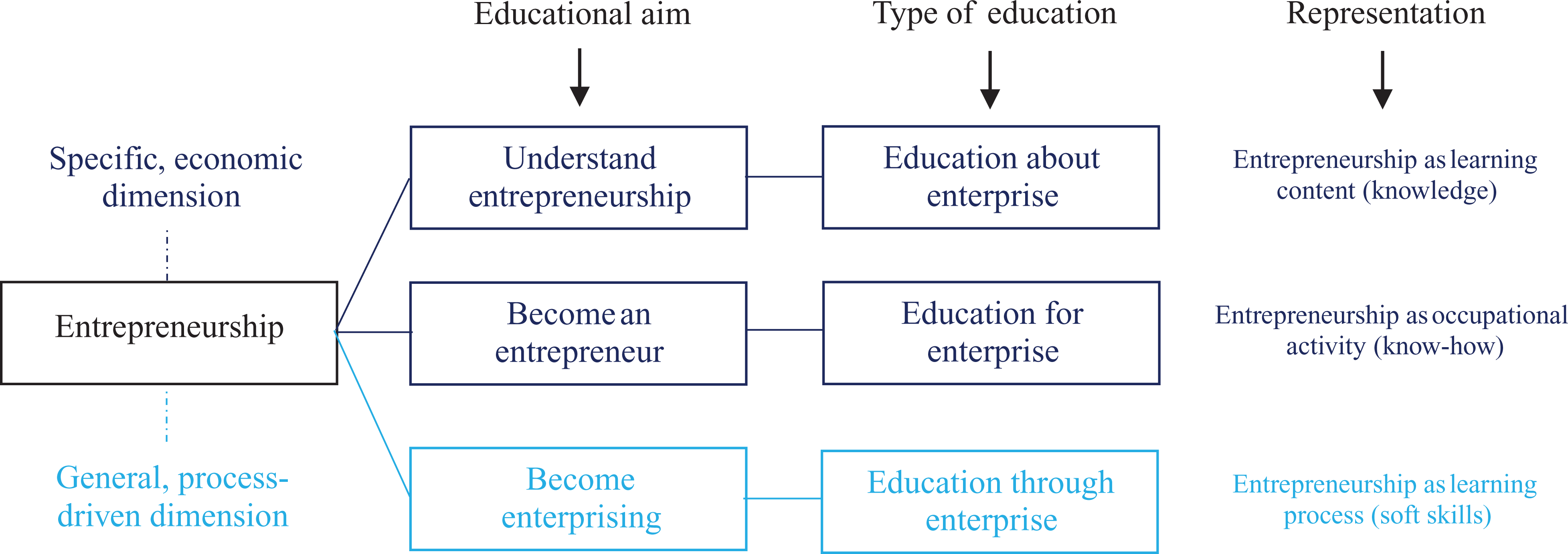
Overview of the field of entrepreneurship in education.
The first two aims or perspectives are often looked at together and are associated with a specific (or narrow), economic view of entrepreneurship, while the third is associated with a general (or broad) view (Deuchar, 2007). At early stages of schooling – lower secondary, primary or even preschool (Axelsson et al., 2015) – a broad view of entrepreneurship is usually favoured (Cummins and Dallat, 2004; Lackéus, 2015; Leffler, 2009; Surlemont, 2007). In this regard, the way entrepreneurship was introduced in the QEP can be associated with the broad view of entrepreneurship. Indeed, entrepreneurship in the QEP is viewed as a learning tool (Pepin, 2011); that is, a learning process associated with the conduct of projects, all with a view to help students learn to be more enterprising in life in general. However, this statement creates a new problem of a theoretical nature, as no one knows what being enterprising or entrepreneurial really means. The general research question of this investigation was thus: what does it mean to learn to be enterprising in school?
Theoretical framework: Towards a process-driven model of learning to be enterprising
Being enterprising as being project-oriented
A critical problem with the broad view of entrepreneurship is that there is no consensus on what it means to be enterprising or entrepreneurial in life in general and what should consequently be developed in students. As early as 1990, Caird (1990a) raised this difficult question in an article entitled ‘What does it mean to be enterprising?’ – an issue that is still being debated today (Cummins and Dallat, 2004; Lackéus, 2015, 2017; Leffler, 2009). Put differently, her question might be phrased in terms of an underlying problem: if we do not want to teach entrepreneurship and/or to train future entrepreneurs through enterprise education, then what do we want to do? Most authors have tried to answer that question by referring to concepts from the field of entrepreneurship research, and more particularly from studies of a psychological nature aimed at defining what an entrepreneur is by producing lists of so-called entrepreneurial traits or attributes. For many authors, being enterprising thus relates to the idea of being a leader, having a high sense of responsibility, showing initiative, a willingness to take risks, an openness to accept and learn from failure and so on (Pilsh and Shimshon, 2007; Young, 2014). One problem with those lists of ‘entrepreneurial’ characteristics is that no two lists are alike (Caird, 1991; Coffield, 1990). Furthermore, being too general, much of the personal characteristics included in them could apply to many teaching approaches. In addition, from an educational point of view, having such lists in hand does not mean that we know how to develop the characteristics in students. For Caird (1990b), and in line with the important call of Gartner (1989) to study what entrepreneurs do instead of who they are, being enterprising simply refers to the idea of being project-oriented in any kind of human activity. Her point of view opens the way to a more process-driven definition of being enterprising.
Model of learning to be enterprising
In Québec, entrepreneurship in the early stages of schooling is being developed mainly through entrepreneurial projects 6 ; that is, student-led action projects that respond to a community need by creating a good, offering a service or organizing an event (Pelletier, 2005). This experiential way of implementing entrepreneurship is in line with the way entrepreneurship was introduced in the QEP. Following the proposition of Jones and Iredale (2010), an entrepreneurial project, as one means among others of implementing enterprise education in schools, can be considered a pedagogical practice in and of itself – that is, as a process oriented towards action through which to teach and to learn. To further conceptualize this vision, John Dewey’s philosophy of experience (1916, 1938a), famous for his maxim of ‘learning by doing’, is of particular interest. A link can be made between his concept of ‘occupation’ and entrepreneurial projects in schools. For Dewey, an ‘occupation’ is a basic social activity brought into the classroom for the purpose of learning (DeFalco, 2010). For instance, in the Dewey school (Mayhew and Edwards, 1965), gardening will lead to learning biology. Entrepreneurial projects in school and ‘occupations’ are alike in being oriented towards something to do and in being centred on society. In these contexts, learning takes place through what is to be done and will vary depending on how the project – or occupation – will evolve. This is indeed a pragmatic way, in the philosophical sense of the term, to consider learning. To illustrate, the entrepreneurial project investigated in this research was a school shop in which students were selling school supplies and healthy snacks to the other students during recess. As will be seen, the school shop experience – a reproduction of a social practice that is basically a store – facilitated the teaching of academic content, such as measurements to build the shop.
On this basis, I have proposed a model of what it means to learn to be enterprising (see Figure 2). Relying on Dewey, being enterprising is defined as the idea of determining purposes for action and subjecting them to the test of experience in a given context (Pepin, 2012). Instead of referring to personal psychological characteristics, this process-driven definition refers to two distinctive phases: charting a guiding direction for the action to be undertaken (planning) and putting the plan of action to the test of experience (implementing). In simple terms, being enterprising thus refers to the idea of planning and implementing an action project. In order for an experience to be educative, reflexivity at all phases of this process should be deemed important (Cope and Watts, 2000; Dewey, 1916). Based on the above, as shown in Figure 2, learning to be enterprising, which entails both acting and reflecting, can be theoretically described as follows: From Dewey’s perspective, being enterprising always starts from an initial impulse: something happens that pushes somebody – or a group – to take action. Instead of acting directly, Dewey invites us to reflect on the initial impulse. The pre-action reflection, which supports planning, must then serve two goals: (1) the formulation of a purpose – an end-in-view in Deweyan terms – which will give direction to the action to be undertaken, and (2) an action plan to achieve it. This refers to Dewey’s idea of experience being teleological (Garrison, 2001). As being enterprising is closely tied to action, the action plan must then be implemented. Here, Dewey shows that obstacles, problems and opportunities will emerge, and thus uncertain situations will necessarily occur, no matter how conscientious the planning. Instead of acting directly, Dewey invites us once again to reflect on those uncertain situations. Reflection-in-action, which supports implementing, will thus serve, through inquiry processes as will be seen, to overcome uncertain situations arising and will also serve as the ‘springboard for learning’ throughout the process. Indeed, various lessons will have to be learned to overcome situations that first appear uncertain. This refers to Dewey’s idea of experience being experimental. In Dewey’s view, there is no end to this process: reaching the purpose of action already constitutes an occasion for planning new purposes – this refers to Dewey’s idea of the continuity of experience. However, in a school setting, the process has to come to an end at some point. The model thus entails a third phase, which consists in taking a look back in order to draw more general conclusions on the entire process. The post-action reflection, of a more metacognitive nature, supports distance-taking.

Model of learning to be enterprising.
To put it clearly, ‘being enterprising’ refers to planning and implementing an action project, whereas ‘learning to be enterprising’ entails reflecting at all phases of the process (Pepin, 2012). The specific objective of this research was thus to document how systematizing reflection in an entrepreneurial project could foster learning to be enterprising in a school setting.
Method: A single-case study
Three different tools to document the case
To document the proposed vision of learning to be enterprising, a group of 19 second-grade primary students (7–8 years old) and their teacher were followed in their project of creating and managing a shop of school supplies in their school. Following Dewey’s recommendation on reflexivity, and to implement his democratic view of educational processes (Dewey, 1916), a pupil council was added to the school shop project. From a collaborative research standpoint (Pepin and Desgagné, 2017), the council was led by the teacher and the researcher, and was designed to manage the project with the group and to increase occasions of reflexivity for the students on the experience to be lived. The school shop experience was followed as closely as possible during an entire school year (from September to June). Three complementary sources of data collection were used to achieve this goal, each allowing the researcher to document a specific dimension of the shop (Meyer, 2001; Yin, 1984), for a total of 62 research events, with a 49-min average (Pepin, 2017): Twenty-two open-ended interviews with the teacher were held and audio-recorded. These interviews allowed the researcher to document the decisions taken by the teacher to ensure the gradual deployment of the school shop and successfully engage her students by determining either what was to be discussed with the group in the pupil council or the learning activities that should be planned to equip students to overcome a particular problem (e.g. how to engage the students in the choice of the shape to give the shop, knowing that they would need a place to sell their school supplies and that no site was permanently available in the school). Twenty-five pupil councils were held and video-recorded on a quasi-weekly basis. The pupil council, in which all the students were engaged, allowed the researcher to document how the teacher was working to frame the group’s reflections – that is, how the group highlighted specific problems likely to arise and/or found solutions to the problems to be solved in order to create and then to manage the shop (e.g. the question raised by a student during a pupil council: would customers, i.e. the other students of the school, be authorized to bring money to school to shop in the store?). Fifteen learning activities in the classroom related to the school shop were observed and video-recorded. These learning activities served to equip the pupils to implement the chosen solutions for the problems encountered (e.g. teaching students how to read a clock, knowing that they would have to install their shop in the school atrium every day a few minutes prior to recess).
A first description of the school shop project
The desire to document the case as closely as possible, and over a long period, led to the need to process a considerable amount of qualitative data in this investigation. As Eisenhardt (1989: 540) points out, in case-study research ‘there is an ever-present danger of “death by data asphyxiation”’. In one way or another, one has to find a way to organize the data so that it can be further analysed. To organize the primary data, a research journal was written during data collection. This journal allowed the researcher to summarize noteworthy elements of each research event; that is, what topics were discussed with the teacher alone or with the group in the pupil council and what type of learning activities were organized in class. On this basis, full transcripts of the interviews with the teacher were further analysed. As those interviews were focused, on one hand, on what was done with the group during the last week and, on the other hand, on what was consequently to be done during the coming week, they allowed the researcher to document the gradual deployment of the school shop project and served as a guideline to analyse the other sources of data. The second way to organize the data was thus to write a description of the case as a whole – of how the school shop project had evolved during the entire school year. In this respect, the data show that the initial impulse for the project was a lack of school supplies in the classroom. The teacher was basically always lending erasers, rulers or notebooks to her students − a very common problem in a classroom. For 1 month, the teacher merely emphasized that problem in class. By the end of September, she had invited the researcher into the classroom and introduced him to the students as an expert who could help them to tackle their problem of school supplies. The pupil council was thus established for that purpose.
During the first pupil council, the lack of school supplies was discussed with the group. Students had several ideas on how to tackle the problem, among which a little school shop was chosen by a show of hands. That solution did seem the best fit with the students’ analysis in that it would create a long-term solution and would also serve the other students in the school (as it emerged from discussions that other classes faced the same problem). For an entire month the school shop remained an idea that was further discussed in the pupil council. Students, with the teacher’s and researcher’s help, explored what they would have to do to actually create the shop. These initial discussions, which essentially concerned planning, brought out some problems that would need to be tackled if the shop were to be created. The data show, in this context, that the school shop evolved as a succession of problems – or uncertain situations in Deweyan terms – to be solved. Eight problem-solving processes were thoroughly described as they allowed the researcher to cover the entire deployment of the school shop project. These problem-solving processes were organized around eight topics that emerged inductively from the data: authorization to bring money to school; the construction of the shop in the school; advertising the shop in the school; the integration of managers in the shop; the addition of healthy snacks to the shop’s products; schedule management in the shop; consumption in the shop; and profit from sales.
Figure 3 shows the gradual deployment of the school shop as a succession of problem-solving processes. Three stages of that deployment can be emphasized. In the first stage, called ‘action plan’, the majority of the problem-solving processes emerged from discussions. Note that, in Figure 3, the eight problem-solving processes are named in terms of questions to be answered rather than simply as topics. In the second stage, the group implements the action plan and multiple problems are tackled simultaneously, but separately, sometimes over a long period. This stage already involves action and leads to the creation of the shop in the school. In the third stage, the shop is opened in the school and products are sold to other students. This stage concerns the daily management of the shop during recess. Note that, on the first timeline (at the top of Figure 3), the upper dates represent the research events with the whole class (pupil councils or learning activities), while the lower dates represent interviews with the teacher. Regarding the research objective, it can already be said that learning to be enterprising takes place mainly during the first two stages – that is, before the school shop has actually opened. Furthermore, as we already understand that the problem-solving processes support learning through being enterprising, as will be further seen, the first two stages are of particular interest. The third stage, which concerns managing the shop, is also important to give meaning to what has been previously experienced, but is essentially of a more routine nature as the action is then oriented towards solving urgent problems to ensure sales in the shop. To put it clearly, in the third stage, action is more oriented towards running the project than towards teaching through it.
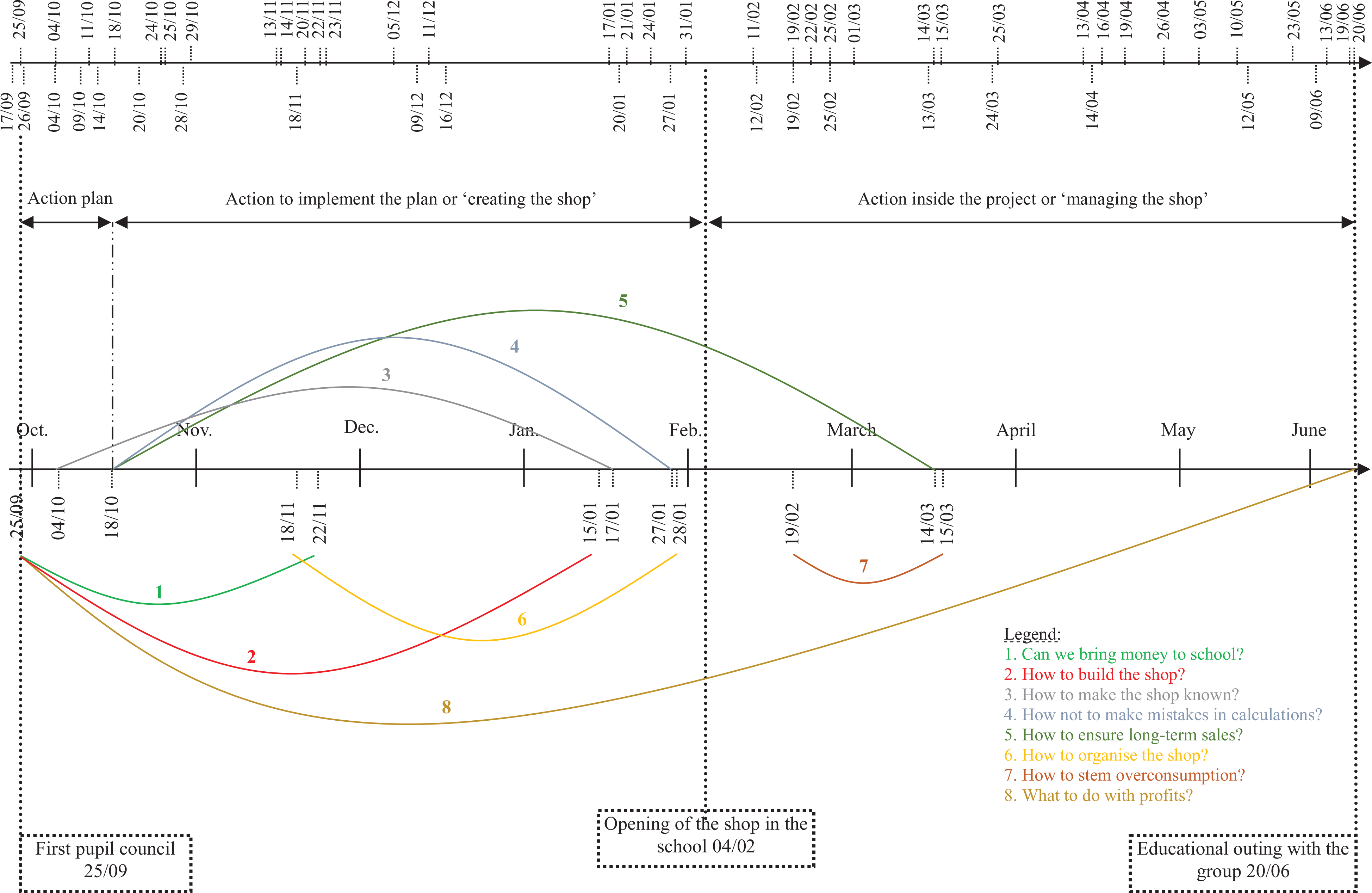
The school shop deployment as problem-solving process or inquiry.
Dewey’s theory of inquiry as an analytical tool
Dewey’s theory of inquiry (Dewey, 1938b) was used as a theoretical tool to analyse the data. For Dewey, an inquiry, which is basically a problem-solving process, is the cornerstone of his conception of the act of learning. An inquiry begins with the recognition of an indeterminate or uncertain situation that could prevent the project from moving towards the goal set as the end of the action undertaken. An inquiry process entails problematizing the situation, devising a solution and implementing it. Problematizing is here very important. A situation is never entirely uncertain, and so one has to judge which aspects of the situation can be ignored and which must be taken into account to define a specific problem to work on. This is crucial in order to conceive a solution that will actually solve the problem that has been defined. The chosen solution must then be separated into practical operations in order to be implemented into action. The function of inquiry is to overcome the uncertain situation; that is, to re-establish experiential continuity in relation to the subsequent action to be undertaken to move towards the goal that has been set. In other words, an inquiry process starts from a practical problematic situation encountered in action, uses reflection to devise a solution through analysis, and must be reinvested into action. Theoretically speaking, each problem-solving process was thought of as an inquiry process in itself. This is, incidentally, why each problem-solving process, or inquiry, is represented as a curve in Figure 3: each problem-solving process starts from the school shop experience and finishes in it, the central timeline representing the temporal deployment of the project. On this basis, it can be said that the school shop project – an occupation in Deweyan terms – has developed as a succession of uncertain situations, calling for inquiries to be carried out by the group. Methodologically speaking, the eight inquiry processes were thought of as mini-cases inside the case (Stake, 2008). As such, they were analysed separately, but from the same analytical standpoint: (a) what could be learned from each inquiry process to document learning to be enterprising, and (b) what could be learned from each inquiry process to document learning through being enterprising? The remainder of the text will highlight transversal lessons from this analytical exercise.
Results: Learning through the school shop experience
Learning to be enterprising through the inquiry processes
The first inquiry process is the most representative of learning to be enterprising. This inquiry starts at the very beginning of the school shop project. From the moment the shop was chosen from the various ideas of how to tackle the lack of school supplies in the classroom, or rather in the entire school, the question of whether the supplies would be given free or sold was discussed. Obviously, supplies are sold in a ‘real’ shop, out of school, but the students were not sure they could bring money to school (problem). Although not forbidden, bringing money to school was not encouraged. Yet their ‘clients’, the other students, would have to bring money to school to buy their supplies in the shop if the decision was to sell them. At the same time, to sell supplies, the students would have to buy them in a ‘real’ shop and, even if profit had not yet been discussed, they understood that they could not incur losses. The teacher had not planned this question and had no one-size-fits-all solution to suggest to her students. From experience, because she had run the same project for 6 years with older students in another school, she knew that this was not really a problem. Nonetheless, she chose to discuss it with her students in the pupil council. Once they realized that they sometimes brought money to school, notably to pay for outings, the group agreed on asking the Director, the ‘rule-keeper’ of the school, if bringing money to school was allowed (solution). From the ideas put forward on how to contact the Director, the group decided to write him a letter to explain the school shop project and invite him to the pupil council (implementation of the solution). This, moreover, enabled the teacher to impart to her students the formal rules of writing a letter, which is a learning objective of the curriculum. While in the pupil council, the Director showed that nothing in the school rules strictly prohibited students from bringing money to school and allowed the group to proceed with the shop project (resolution of the problem). At the same time, he asked the students to find a way to ensure that bringing money to school would not create new problems, like loss, theft or intimidation. This would be taken into account by students later in the project, when drawing up the school shop rules.
From the theory of inquiry perspective, in order to learn to be enterprising (i.e. to learn to plan and implement an action project) students had to be fully engaged in the creation of the school shop and, in the inquiry processes to be carried out, to be able to identify problems arising, analyse the environment, devise solutions and implement them. The role of the pupil council, which was basically a democratic and reflexive structure, was crucial here in order to give a voice to students so that they could fulfil those requirements. The role of the teacher is also important in helping students in the process. Beyond the example given above, the teacher sometimes had to help them to analyse situations, whether to show them neglected aspects of their analysis, to suggest a solution to a particular problem or to explain a way to implement a preferred solution. For Dewey (1938a), the role of the teacher, who is more experienced and has better analytical skills than the students, is to facilitate their educational experiences. The teacher must further ensure that the project keeps running in order to support being enterprising. As a result, she sometimes ‘smoothed’ its deployment by raising problems that had not at first been identified by the students so that a particular situation did not become too problematic. For instance, in the fourth inquiry process, it was the teacher who raised the problem of possible mistakes in calculations during the sales − which led to the inclusion of older students, called managers, in the shop. These managers were chosen by the students to help them. Also, in the sixth inquiry process, it was the teacher who raised the problem of time management – which led to the creation of schedules. Moreover, if the teacher sometimes suggested a solution to a problem or a way to implement it, it was because she knew that this specific way of doing it would allow her to integrate some disciplinary content into the school shop experience. More generally, in order to help students to learn to be enterprising, the pedagogical leadership of the teacher has to be balanced between leaving the students on their own, which presents the risk that they will not be enterprising, and doing everything for them, which could lead to the same result.
Learning through being enterprising through the inquiry processes
As stated above, inquiry is the cornerstone of Dewey’s conception of the act of learning. Indeed, if a situation appears uncertain, it means that the individual or group lacks resources to directly take control of it. To overcome an uncertain situation, it is necessary to learn through the inquiry process – through problematizing and devising solutions to implement. In Deweyan pragmatism, the end of inquiry is learning. In other words, each inquiry not only represents an occasion for reflexivity but is also an opportunity for learning for the group. In the context of this research, it can be said that learning to be enterprising entails learning through being enterprising. Among all that students learned through the school shop experience, disciplinary and critical learning appear to be the most important.
Disciplinary learning
The inquiry processes carried out based on the school shop experience have allowed the teacher to integrate multiple disciplinary learning content from the QEP. As noted earlier, the formal rules for writing a letter were taught through the first inquiry process. To further illustrate, the second inquiry process is representative. This inquiry process also started with the initial discussions about the idea of creating a shop. The students quickly realized that they would need a place to sell their school supplies (problem). After some discussions during a pupil council, a student proposed building the shop as a trolley (solution). This idea would meet the criteria raised by the students’ analysis: the shop would have to be moved frequently from the classroom (where it would be stored during class time) to the atrium (to guarantee sales during recess). Having a rolling device would thus be helpful. The teacher agreed with the students but did not want to build a trolley herself and thought her students were too young to do it. To take the students’ proposition into account, she therefore asked them to draw their ideal plan of the upper face of the trolley – the flat surface on which the supplies would be displayed for sale (implementation of the solution). This provided an opportunity to teach measurement and how to use measuring tools to the students. After multiple learning activities for this purpose, the students were placed in groups of four to draw plans of the trolley surface. At the end of the exercise, the entire group chose the best plan, the one that was large enough to carry all the supplies and narrow enough to go through the door as the trolley would have to be moved frequently from the classroom. The chosen plan was finally given to the school carpenter, who built the trolley – in effect the physical shop – for the group (resolution of the problem). Other teaching opportunities arose, for example, when students needed some artistic concepts to draw posters to advertise the shop in the school (third inquiry process) and knowledge of nutrition when the decision was to integrate healthy snacks into the shop’s products (fifth inquiry process).
The school shop, indeed, appears to constitute a complete learning context in itself. It calls for learning needs, through the uncertain situations that arise, and is also the context in which learning will have to be reinvested. For instance, students learned measurement not only because it was a learning objective of the curriculum, but also because they needed to know how to measure to go forward with their project. Moreover, problems to be solved in the school shop were authentic, as opposed to the artificial problems that are usually presented to students in the classroom, and that authenticity gave more meaning to what was learned. In addition, it must be understood that, in Dewey’s terms (1938b), the inquiries emerging from the school shop were of a practical nature. As such, there was not just one single way to conduct them and, most importantly, they did not call for any specific disciplinary integration. The role of the teacher was crucial here to translate the uncertain situations that arose (such as how to build the shop) into educational inquiry processes (draw a plan with exact measurements of the upper surface of the trolley) – that is, processes that would lead the students to learn. It is interesting to note that in this case the curriculum was used by the teacher as a tool to overcome specific problems, contrary to the usual practice in which teachers look at the curriculum and then plan a lesson or a problem-solving task. In other words, the curriculum is used here as a resource to integrate multiple disciplinary contents into the overall experience of developing and running the school shop, which therefore makes it an interdisciplinary learning context.
Critical learning
The inquiry processes, interestingly, facilitated another type of learning in that they developed in students a critical perspective on society. In this regard, the seventh inquiry process is the most representative. The shop had now been open for 2 weeks. During a pupil council, now led by the students who had to report on what had been going on in the shop during the past week, a student raised the problem of some clients coming to the shop when they obviously did not need anything and increasing the waiting time in the queue (problem). The student’s remark fits the researcher’s observations. The researcher had observed some clients coming to the shop without knowing what they were going to buy and others who bought something and then asked what else they could buy with the change (and so were buying things they did not need). For the teacher, this problem was far more important than simply increasing the waiting time in the queue: it was a problem of overconsumption. From her point of view the purpose of the shop was to offer school supplies at low prices, since the school is in a disadvantaged area, and so she did not want to encourage overconsumption. Nonetheless, most of her students were not immediately able to understand the overconsumption aspect of the problem. In order to help them, the teacher therefore decided to formally discuss the difference between desires and needs, which is a suggested topic of the broad curriculum area of learning ‘Environment and Consumer Rights and Responsibilities’. After the discussion, the students, who were then better equipped to understand the root of the problem, agreed on the idea of occasionally ‘moralizing’ those clients who came to the shop when they did not need anything (solution). Thus when they encountered those clients at the shop, they told them to keep their money so they could buy something later that they really needed or to put it in their savings account (implementation of the solution), and this strategy proved to be sufficient to stop overconsumption (resolution of the problem). In a ‘real’ shop, outside the school, overconsumption would not have been seen as a problem, but rather would have been encouraged to maximize sales and profits. The school shop, however, has different values and so overconsumption was treated as a problem calling for the teacher’s intervention to educate the students. For Dewey (1916), the end of education is not to reproduce society but rather to change it. Introducing a social practice into the classroom through an occupation such as running a shop does not therefore mean reproducing the imperfections of the social practice that serves as a reference. In other words, the experience of the project should also provide a starting point for students to learn to look critically at the society in which they are engaged. It must be said, however, that this type of learning was less evident for the teacher. If she was prompted to integrate multiple disciplinary contents into the inquiry processes, developing a critical look at society was a less obvious aspect, especially since the students were so young. Nonetheless, the school shop, or more generally an entrepreneurial project, because it reproduces a social practice and therefore creates a direct link between school and society, can facilitate this type of critical learning.
Conclusion
This article contributes to a better understanding of what might be the impact of the introduction of entrepreneurship in the early stages of schooling from the perspective of educational research. As we have seen, entrepreneurial projects, such as the one investigated in this article, are identified in Québec as the preferred way to implement entrepreneurship teaching at primary school level. It is true that there is still no clear conceptual distinction between an entrepreneurial project and the more investigated concept of the mini-enterprise. It is also true that the school shop described in this article involved money and the students made limited profits from the sales – which were used to organize an educational outing with the group to a bookshop, where they each bought a book. Nevertheless, the school shop was not used primarily to teach students how to run a business, but rather to teach them how to be enterprising – that is, how to plan and implement an action project – and, moreover, to enable them to learn disciplinary and critical content through this experience. In this way, this research offers a different, theoretically consistent way to conceive the introduction of entrepreneurship in education. Based on Dewey’s philosophy of experience (Dewey, 1916; 1938a), an entrepreneurial project was theorized as an occupation; that is, as a social practice introduced in the classroom for the purpose of learning. To be educative, such an experience requires a reflexive structure, like the pupil council in this investigation, to systematize students’ constant reflection on action. The results show that learning in this context takes place through inquiry processes (Dewey, 1938b), which are basically problem-solving processes. Through inquiries, students learned to problematize, to analyse their environment, to devise solutions and to implement them. It was seen that, to engage students in inquiries, the role of the teacher has to be balanced between leaving them on their own and doing everything for them. Through inquiries, furthermore, the students learned multiple disciplinary content and developed a critical perspective on society. Once again, the role of the teacher was crucial in translating the instrumental, uncertain situations that arose in the school shop into educational inquiry processes. Finally, if the problems illustrated in this article are specific to the documented case, the very principle of facing problems and to overcome them through inquiry processes can be generalized. As such, from this research perspective, if an entrepreneurial project is indeed an effective means of encouraging students to be enterprising, learning to be enterprising and learning through being enterprising ultimately call for an inquiry-based pedagogy in order to take advantage of the educational potential of action.
This research has limitations. The conclusions are drawn from a single case and the generalizability of the conclusions needs to be tested in other contexts and at other levels of schooling. Subsequently, the interdisciplinary nature of an entrepreneurial project could be the subject of further research. Indeed, at the primary school level, the teacher is a generalist who teaches more than one subject, as opposed to teachers at more advanced levels of schooling who are oriented towards one discipline. Could the interdisciplinary nature of an entrepreneurial project be exploited at other school levels and how? Would it entail increasing collaboration between disciplinary teachers and how would it work? This specific research question has been explored, notably by Leffler (2014) and her team in a Swedish context, but our common understanding as a research community still needs to be deepened. Moreover, the role of the teacher in developing enterprising students and in teaching through entrepreneurial projects could be further researched. What skills need to be developed in teachers in order to help students to become more enterprising? What is the right degree of teachers’ involvement in an entrepreneurial project? How can students’ reflections be properly supported? Although the role of the teacher is highlighted in this article, the study offers no formal characterization of the skills or support needed from the teacher to make an entrepreneurial project educational. This specific issue has begun to be studied (Hietanen and Järvi, 2015; Peltonen, 2015), but it needs further exploration.
To conclude, the research field of enterprise education is moving from the exploration of teachers’, future teachers’, school directors’ and other stakeholders’ opinions or perceptions on enterprise education towards a better understanding of what is actually done in schools and in classrooms (Hörnqvist and Leffler, 2014; Ruskovaara et al., 2016; Ruskovaara and Pihkala, 2013, 2015; Seikkula Leino et al., 2015). This article is a contribution to this global research effort.
Footnotes
Declaration of conflicting interests
The author(s) declared no potential conflicts of interest with respect to the research, authorship and/or publication of this article.
Funding
The author(s) disclosed receipt of the following financial support for the research, authorship, and/or publication of this article: This research was funded by a doctoral grant (2010-2013) from the Social Sciences and Humanities Research Council of Canada (SSHRC).