



Abstract
The barriers to higher education–industry cooperation (HIC) have been studied extensively. However, it is not yet clear which barriers affect which partner firms, which barriers may prevent cooperation altogether or which drivers help to overcome which specific barriers. To answer these questions, the authors conducted an original survey (a novel sample that included micro firms and small and medium-sized enterprises) and looked at HIC barriers in relation to firm characteristics and cooperation drivers. More than half of the survey sample had engaged in HIC. The results suggest that small export-oriented firms may not find suitable competences in higher education institutions and are therefore less likely to engage in HIC. Larger companies do engage in cooperation, but find strategic differences (goals, stances, time allocated) to be significant issues in cooperation. From the viewpoint of firms, possible solutions (drivers) include easy access to more information on HIC opportunities as well as support and training for student mobility.
Keywords
Knowledge – and the innovation it can lead to – are key drivers for the world economy (Carayannis and Campbell, 2012; OECD, 2014). Universities and other higher education institutions (HEIs) are traditionally among the largest producers of knowledge in society (Brennenraedts et al., 2006). It is therefore natural for industry to want to tap into their potential and gain access to knowledge produced within HEIs – in the form of higher education–industry cooperation (HIC) (Ankrah and AL-Tabbaa, 2015; Bekkers and Bodas Freitas, 2008). It is widely accepted that HIC does not take place in a vacuum – rather it happens in an intertwined net of cooperation connections described by the Triple Helix framework (Etzkowitz and Leydesdorff, 2000). It is also widely noted that there is a variety of forms of cooperation – from formal channels such as patents, licences, contract research (Bekkers and Bodas Freitas, 2008; Di Gregorio and Shane, 2003) to informal channels such as meetings, consultation, internships (Cohen et al., 2002; Roolaht et al., 2015) and more – and a variety of firms (small, large, etc.) may use these channels to engage in HIC.
However, as with any cooperation, it is not without its difficulties. A list of cooperation barriers have been identified (e.g. Bruneel et al., 2010; Di Gregorio and Shane, 2003; Ranga et al., 2008), varying from high-level strategic differences (Roolaht et al., 2015) to lack of operational resources and capabilities (Laursen and Salter, 2004; Tether, 2002). While many barriers have been identified, however, it is not clear which barriers are relevant to which cooperation partner firms, especially considering that the many types of engagement may include firms of any kind. This is a problem, since Triple Helix parties (governments and HEIs) try and take measures to encourage and improve HIC; however, if it is not clear which barriers are relevant to which cooperation partners, they cannot be properly addressed.
Several papers study the characteristics of firms cooperating with universities and detail the profiles of firms that cooperate (see e.g. Carboni, 2013; Eom and Lee, 2010; Fernández López et al., 2015; and Guimón and Salazar-Elena, 2015, for an overview of various empirical papers). But cooperation barriers have not been studied in the context of firm characteristics. Nor have they been studied in terms of which barriers may cause issues during cooperation and which may prevent cooperation altogether. Moreover, while a list of drivers has also long been identified (see e.g. Barnes et al., 2002; Miller et al., 2016; Nielsen and Cappelen, 2014), there is a lack of knowledge about specifically which drivers would be the most appropriate to overcome which barriers. In addition, it is important to note that, while several studies acknowledge and therefore investigate or include the cooperation behaviour of small and medium-sized enterprises (SMEs) (Chun and Mun, 2012; Fontana et al., 2006; Levy et al., 2006), widely available data sets do not always necessarily include SMEs or micro firms with under 10 employees (such as the Community Innovation Survey – Eurostat 2019). Given the variety of possible cooperation channels, the sheer quantity of SMEs in economies and the scalability potential of small spin-offs or start-ups, this is an oversight.
Considering the above research gaps, the aim of this article is to identify the relevance of different barriers for different firms. There are several novelties involved in this approach. Firstly, we conduct an original survey to gain a data set that better reflects the firm profiles related to each barrier. Our sample of firms consists of a large quantity of SMEs and micro firms, which provides a more realistic overview of the state of HIC as well as the barriers hindering cooperation. Secondly, we identify the profiles of firms across different cooperation barriers. Thirdly, we identify what kinds of HIC barriers occur for (1) firms that have cooperated with universities or other HEIs (henceforth ‘coop’ for short); and (2) firms that have not cooperated with universities or other HEIs (henceforth ‘no coop’ for short). Lastly, we also look at which drivers help overcome which barriers.
The article is structured as follows. Firstly, we give an overview of the HIC framework and its barrier-driver background. Secondly, we describe the results of the original survey we conducted to better look into the research questions and the analytical method. Thirdly, we present the results of the study and discuss their implications.
Theoretical overview
HEI–industry cooperation process
HIC is widely viewed within the framework of the Triple Helix concept (Etzkowitz and Leydesdorff, 2000), which combines governmental, HEI and firm participation into the cooperation logic. The Triple Helix emphasizes the intertwined impacts of the parties in HIC and the consequent outcomes. Although the actual cooperation takes place between HEIs and industry, governmental incentives and support measures are crucial for sustainable cooperative relationships and long-term outcomes (Henrekson and Rosenberg, 2001; Rajalo and Vadi, 2017; Ramos-Vielba et al., 2010). Moreover, the Triple Helix will work ideally in a balanced configuration, in which academia, the state and industry form trilateral networks and hybrid organizations (Ranga and Etzkowitz, 2013). Carayannis et al. (2018) even propose a Co-opetitive Spatial and Sectoral Fractal Innovation and Entrepreneurial Ecosystem model, which integrates the Quadruple Helix (including civil society) and the Quintuple Helix (including the environment) into the integrated multilateral cooperation logic. In essence, these integrated cooperation models provide a multilateral view and suggest that cooperation can occur in a variety of ways, with a variety of partners. While cooperation in specific formats (such as patents, licences, contract research) may be more easily measured and packaged as outcomes (Bekkers and Bodas Freitas, 2008; Cohen et al., 2002; Schartinger et al., 2002), the Helix models suggest that cooperation exists in a wide spectrum of forms and should therefore be included in HIC research (e.g. short-term projects, consultation, informal cooperation methods, etc.) (Caniëls and Van den Bosch, 2011; Ranga et al., 2008; Roolaht et al., 2015). The authors of the current article agree with this view.
Before looking further into cooperation channels, however, it is important to consider the steps that comprise a cooperation process. Davey et al. (2011) 1 propose a five-step model: (1) activity (including stakeholders, strategies and frameworks), (2) factor level (factors such as barriers and drivers), (3) result level (in a variety of cooperation forms), (4) outcomes and (5) impact. Ankrah and AL-Tabbaa (2015), based on a thorough literature review, propose four steps: (1) Formation Phase (where the need is identified and the first steps taken); (2) Choosing an Organizational Form (whether informal, targeted agreement or other); (3) Operational phase (which entails project work, meetings etc.) – this phase is also impacted most by facilitating or impeding factors (commonly termed drivers and barriers); (4) Outcomes (benefits and drawbacks). While the approach of Davey et al. takes into account a variety of cooperation forms and separates outcomes and impact, that of Ankrah and AL-Tabbaa includes a more thorough engagement process. Therefore, we have combined these views into one process, with the main steps as follows: motivation, choosing cooperation form, engagement, outputs and impact (Figure 1).
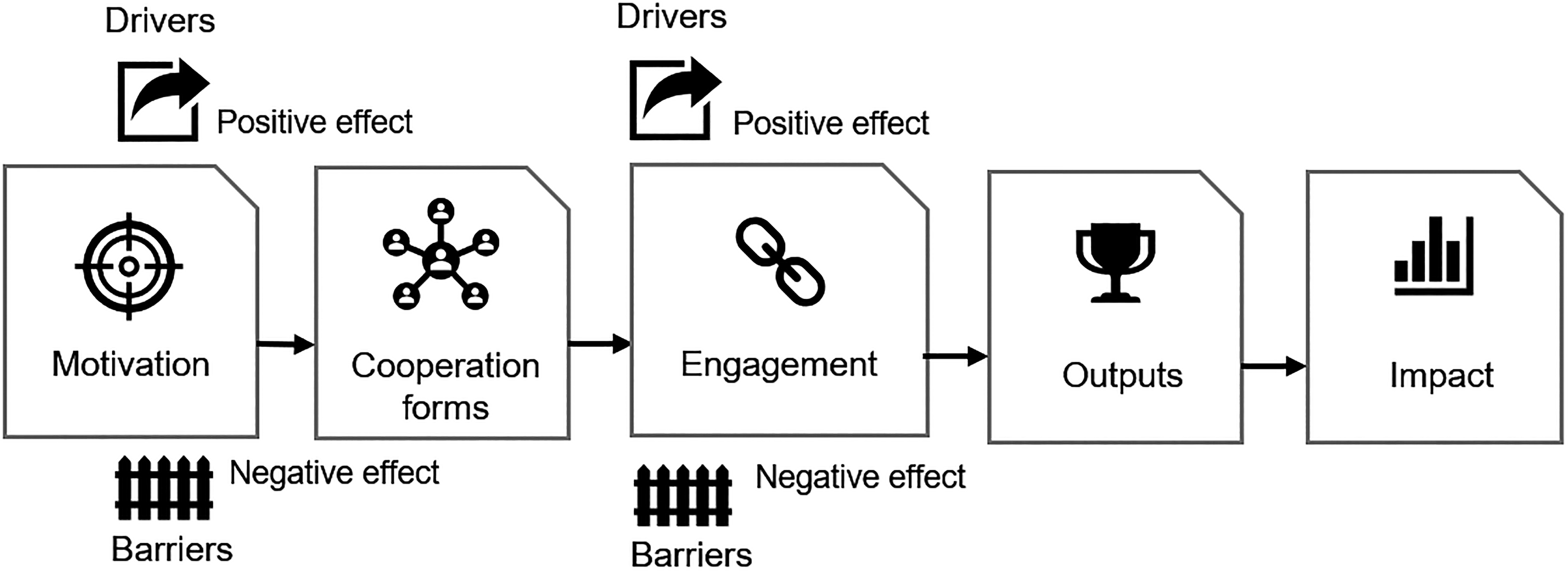
Overview of the HIC process. Source: Composed by the authors based on Dekackere and Veugelers (2005), Bekkers and Freitas (2008), Wissema (2009), Davey et al. (2011), Martin-de Castro (2015) and Miller et al. (2016). HIC: higher education–industry cooperation.
The motivation step includes the reasons and incentive for the parties to engage in HIC. Choosing the cooperation form includes setting joint goals and selecting suitable partners and cooperation forms. Engagement may be viewed as a traditional project process, including project and resource management, and so on. Barriers may occur at several points in the process, but so may drivers that help to overcome them. While the output may turn out to be in accordance with the agreement, this does not necessarily determine the impact the result has in practice on firm innovation or some other aspect. We look into several of these steps more thoroughly below.
Motivation for HIC
The motivation to engage in HIC may arise from various factors, depending on the party in question. The motivations for government are seen in the literature as rather straightforward – economic growth and the development of a knowledge-intensive economy (OECD, 2014), the enhancement of innovation and economic competitiveness at various institutional levels (Henrekson and Rosenberg, 2001; Laursen and Salter, 2006; Perkmann et al., 2013) and other similar goals. To achieve these goals, the government may invest in a variety of support measures and incentives (Albors-Garrigos and Barrera, 2011; Galán-Muros and Plewa, 2016), innovation and cooperation centres or have public-sector institutions engage in cooperation. For HEIs, motivations relate both to resources and to meeting expectations. There is a growing societal pressure on HEIs to act as engines for economic growth (Philbin, 2008; Wissema, 2009) in addition to their more traditional role as providers of education and science. But HEIs may also wish to secure private-sector funding which supplements the (often lacking) governmental support (Ankrah and AL-Tabbaa, 2015), to gain opportunities for scientists to use their research results in practice (Debackere and Veugelers, 2005), to obtain employment or internship opportunities for graduates (Bozeman and Boardman, 2013; van der Sijde, 2012; Williams and Fenton, 2013) and more. The motivations of government and HEIs are thus seen as a premise for cooperation (i.e. they are willing to cooperate).
The current article, however, focuses on the firm’s perspective. To understand firms’ motives, it is important to note that knowledge can be viewed as a resource (the resource-based view) (Amit and Schoemaker, 1993; Penrose, 1959) which the firm needs to develop its capabilities (Amit and Schoemaker, 1993; Christensen and Overdorf, 2000), generate innovative solutions and gain competitive advantage (Barney, 1991; Knockaert et al., 2011). This is visualized in Figure 2.

Firms’ resources, capabilities and competitive advantage. Source: Composed by the authors based on Barney (1991), Amit and Schoemaker (1993), Christensen and Overdorf (2000) and Knockaert et al. (2011).
Several resources (tangible and intangible), including knowledge, combine inside a firm and form different capabilities that are unique to that firm (Amit and Schoemaker, 1993; Penrose, 1959). Capabilities may be technological (like the ability to operate machinery, use specific software), experience-based (internationalization, efficiency of operations), organizational (culture of learning) and so on. Capabilities in turn may combine into competitive advantages (Knockaert et al., 2011) – for example, the use of new technologies that lead to efficiency gains, the ability to achieve economies of scale and the ability to provide innovative user solutions for customers.
Since knowledge can be viewed as a resource, it follows that, like other resources, knowledge can be increased. It can either be developed internally or acquired from outside sources (Amit and Schoemaker, 1993; Chesbrough, 2003). Knowledge developed internally is often tacit, embedded in the firm’s processes and is very valuable since it is hidden within the firm and hard for competitors to copy (Brennenraedts et al., 2006; Debackere and Veugelers, 2005; Lauto et al., 2013). However, it is not efficient to develop everything internally because of the demands on resources (including time); therefore, it is reasonable for firms to seek out external knowledge.
External knowledge can be internalized via knowledge transfer, but to achieve this the firm needs first the resources (finances, time, human resources) to find it (Laursen and Salter, 2006) and second appropriate capabilities to incorporate it – widely known as absorptive capacity (Cohen and Levinthal, 1990). As for external knowledge sources – although HEIs are traditionally one of the largest producers of knowledge in society (Brennenraedts et al., 2006), they are also just one of the potential sources for knowledge transfer (Laursen and Salter, 2004). There are various potential partners to which a firm may turn – including customers, competitors, partners, suppliers, governmental support agencies and so on (Varblane et al., 2008). It is therefore obvious that, in many cases, it may not be resource-efficient for firms to turn to HEIs since the appropriate knowledge may be located elsewhere.
In some cases, on the other hand, it may be a misperception that turning to HEIs is not resource-efficient – it may prove, on the contrary, to be the most resource-efficient solution. Firstly, there may be specific expertise or new technology in HEIs (Debackere and Veugelers, 2005) which can provide solutions the firms’ customers are pressuring for (Miller et al., 2016) – for example, machine learning solutions, new materials and so on. There may also be pre-existing personal social bonds or previous experience of cooperation (Galán-Muros and Plewa, 2016; Rajalo and Vadi, 2017) which may ease the transfer of knowledge (see in addition ‘Drivers’ section below). It has also been noted that HEIs may prove an important source of knowledge especially for smaller firms (or SMEs), because the outcome is often public and can be a substitute for expensive internal research and development (R&D) projects (Ranga et al., 2008). It is likely that misperceptions concerning the expense of cooperating with HEIS emerge from organizational culture or perspectives (Ranga et al., 2008; Roolaht et al., 2015) or from the popular discourse, since traditional views of HIC tend to focus on very formal channels of cooperation (patents, licences, contract research) and those may indeed prove expensive. The fact that these forms of cooperation are also easier to measure than less formal channels (joint management, entrepreneurship) (Davey et al., 2011) can also contribute to such perceptions. The literature therefore hints that there may be some perceptions that function as barriers and therefore prevent or reduce the likelihood that different parties will cooperate even before opportunities for cooperation arise.
That is why in the next section we look further into forms of HIC and then, in the subsequent section, into what barriers have been identified for HIC and which may function as a deterrent before cooperation.
Forms of HIC
Cooperation between HEIs and firms can occur in several forms or channels (we use these terms interchangeably). Cooperation channels may be formal, such as contract research, patents, licences and spin-offs (Bekkers and Bodas Freitas, 2008; Di Gregorio and Shane, 2003), or, as has recently been more often agreed, through less formal channels like curriculum development and delivery, lifelong learning (Davey et al., 2016), the mobility of academics and students (Davey et al., 2016; van der Sijde, 2012), consultancy and training (Roolaht et al., 2015). Ankrah and AL-Tabbaa (2015) categorize these into six main topics: (1) personal informal relationships (e.g. individual consultancy, joint lectures), (2) personal formal relationships (e.g. student internships), (3) third party (e.g. institutional consultancy), (4) formal targeted agreements (e.g. contract research), (5) formal non-targeted agreements (e.g. industrially sponsored R&D) and (6) focused structures (e.g. innovation/incubation centres).
While some are noted as specific cooperation channels and others are marked by their level of formality, none of these seems to address the matter of commitment. An important factor when choosing a cooperation channel is likely to be the commitment required (commitment of finances, time, personnel, etc.) (Mora-Valentin et al., 2004; Okamuro and Nishimura, 2013). Therefore, we propose a combined view (Table 1). This type of commitment-based view helps identify which forms of cooperation may be undertaken more easily due to their lower commitment requirement. In addition, some channels may serve as gateways to others (Perkmann et al., 2011) since having a former relationship can encourage future cooperation (Delfmann and Koster, 2012). For example, an HEI’s training session for a firm may lead to good social connections – social connections play a crucial role since cooperation happens first and foremost between human beings (Galán-Muros and Plewa, 2016; Rajalo and Vadi, 2017) – and result in a joint R&D contract in the future.
Combined view of cooperation channels based on commitment required.

R&D: research and development; HEI: higher education institution.
Source: Composed by the authors based on Di Gregorio and Shane (2003), Mora-Valentin et al., (2004), Okamuro and Nishimura (2013), Davey et al. (2016) and Ankrah and AL-Tabbaa (2015).
The authors will adopt the cooperation channels listed in Table 1 as a basis for the rest of the article. We will now look further into the barriers that might affect cooperation negatively.
HIC barriers
As mentioned above, in the section on motivation, there are factors that may greatly prevent or disrupt the potential knowledge transfer – commonly referred to as ‘barriers’. Barriers have been studied fairly extensively in the literature. They are related to several dimensions. Firstly, there are strategic differences (Davey et al., 2011; Roolaht et al., 2015) or orientation-related differences between firms and HEIs (Bruneel et al., 2010). This is often illustrated by the fact that firms need research results that can be applied to specific problems or for product development, whereas academics may prioritize research that is regarded as important in the scientific world (Bruneel et al., 2010). This difference could impact joint projects either by leading to results which are too theoretical for firms to use or by leaving the academics involved under-motivated. Secondly, the level of bureaucracy in public-sector institutions may complicate transactions between firms and HEIs (Di Gregorio and Shane, 2003; Ranga et al., 2008). In addition, intellectual property ownership (IPO) issues are noted as a hindrance (Bruneel et al., 2010) which may be significant in the more formal cooperation channels.
The level of existing capabilities and resources may also serve as a barrier. The economic success of a firm (e.g. number of employees, turnover) (Fritsch and Lukas, 2001; Laursen and Salter, 2004; Tether, 2002), technological capabilities (Martín-de Castro, 2015), strategic and leadership capabilities (Ranga et al., 2008) and general existing knowledge (Quintane et al., 2011; Subramaniam and Youndt, 2005) can all be factors that may cause a firm to experience problems in cooperation. Relationship barriers may also play a significant role (Davey et al., 2011) – as the name implies, this type of barrier concerns interpersonal issues, conflicting social stances and organizational cultures (Galán-Muros and Plewa, 2016; Roolaht et al., 2015). Pre-existing relationships – or the lack thereof – may therefore play an important part in the success or failure of HIC.
Finally, human and financial resources have often been noted as a key reason why firms do not cooperate with HEIs (Galán-Muros and Plewa, 2016; Iqbal et al., 2011; Tether, 2002). It is often observed that SMEs in particular may struggle with the more complex HIC channels (e.g. R&D projects and joint spin-offs) because of limited resources and internal knowledge (Cohen and Levinthal, 1990; Laursen and Salter, 2004) and a lower absorptive capacity (Chun and Mun, 2012). It is important to note, however, that recent research suggests otherwise. No direct linkage between size and cooperation was found by Fernández López et al. (2015) and Rõigas et al. (2018), but other factors, such as in-house R&D, were significant, which may be a sign of a firm’s specific capabilities (such as absorptive capacity). We therefore propose that having fewer resources does not necessarily prevent smaller firms from cooperating – but merely means that they may choose cooperation channels more suited to their available resources.
Although there has been substantial coverage of barriers in the literature, it remains unclear when specific barriers may prove to be most significant. As pointed out in the section above on motivation, certain perceptions and stances may hinder cooperation just as much as more tangible constraints, such as a lack of resources. Based on the existing literature, it can be said that the majority of barriers may occur at any point of the cooperation process (e.g. lack of resources, cultural differences); however, some barriers (such as perceptions or lack of contacts) may deter firms from cooperating with HEIs in the first place. We thus distinguish between the two periods during which barriers may come into play: (a) before the decision to cooperate and (b) during engagement in cooperation (see Figure 1).
Therefore, the following questions arise. Have firms that have engaged in cooperation with HEIs (‘coop’) experienced different barriers to HIC from firms that have not cooperated with HEIs (‘no coop’)? What kinds of barriers may be significant enough to prevent cooperation? To test this, we propose the question: Q1: What kinds of barrier are significant for ‘coop’ firms and for ‘no coop’ firms?
Furthermore, how does the firm’s profile (its resources, capabilities) affect cooperation, especially considering the variety of cooperation channels and of partner firms? Is there a difference in the barriers that are most significant to different firm profiles? To test this, we therefore also pose the question: Q2: What barriers are significant for what kinds of firms?
Understanding the barriers and their significance to firms is relevant to both governmental support measures, which might be better targeted, and HEI strategies and communication for HIC. These supportive or enabling measures, commonly referred to as drivers, will be discussed in the next section.
HIC drivers
When discussing barriers, the necessary second part of the conversation is overcoming them. Various beneficial and supportive measures, or drivers, aim to do just that. Drivers may simply ease the general process of HIC or may also provide incentives for cooperation to take place. Following the Triple Helix logic, we consider drivers from the HEI and government sides, respectively.
From the HEI side, drivers can be a clear cooperation system, through which projects are well managed, results are well defined and benefits are shared in a balanced way (Barnes et al., 2002; Davey et al., 2011) – for example, in the case of mobility, the benefits for HEIs and students should not greatly outweigh benefits for the firm. A clear knowledge transfer system (Ramos-Vielba and Fernandez-Esquinas, 2012) – for example, decentralized management in an HEI, makes it easier for firms to connect with HEI workers (Debackere and Veugelers, 2005). There are several more HEI-side drivers, including a clear motivation system for HEI staff (Ramos-Vielba and Fernandez-Esquinas, 2012) and reduced bureaucracy (Di Gregorio and Shane, 2003).
From the governmental perspective (including third parties such as entrepreneurship support organizations, etc.), there are also a variety of drivers. A specialized knowledge transfer centre, for instance, capable of managing HIC efficiently (Miller et al., 2016) and acting as a mediator in managing the project (Bekkers and Bodas Freitas, 2008), may help connect partners and achieve better results. A relationship development system could act as a driver: information on HEIs’ cooperation options and the introduction of HEI staff and research help to create social relationships between current and potential partners and to overcome interpersonal issues (Galán-Muros and Plewa, 2016; Nielsen and Cappelen, 2014). Such a system could function as a driver in several respects since, as noted earlier, prolonged relationships may help HIC develop from less committed forms to more commitment-intensive forms.
As with barriers, the greatest drivers are related to resources. The availability of public resources for cooperation is known to boost HIC (Albors-Garrigos and Barrera, 2011; Galán-Muros and Plewa, 2016) – these may take the form of tax reductions (Fernández López et al., 2015), grants (Bozeman and Gaughan, 2007), support measures or government spending (Bozeman and Gaughan, 2007), help with accessing investors (Albors-Garrigos and Barrera, 2011) among other things. Public resources could also be directed at student-related activities, such as mobility and internships (Davey et al., 2011).
As previous literature has shown, different drivers help to overcome different issues. Whereas it may seem obvious that relationship-related barriers can be overcome with relationship-related drivers, the reality may not be so straightforward. For example, if a firm assesses that it has no resources for cooperation, is it because it actually has no resources or because it feels that cooperation is not a priority? Perhaps there are high alternative costs or deeply rooted prejudices against cooperation with HEIs? This raises a third question in connection with barriers: Q3: What drivers do firms find important for overcoming which barriers?
Method and data
Barriers and drivers in relation to HIC have been studied extensively in the literature, as discussed above. However, previous studies have not addressed the issue highlighted in the previous section – that some barriers may prevent cooperation while others just make it harder. To our knowledge, barriers have not been examined in the context of comparing groups of firms that have cooperated and firms that have not. Previous work also has not identified which specific drivers can help overcome which specific barriers. Therefore, we chose to combine the barriers and drivers used in previous research in the study we conducted.
In preparing our survey, we also took into account the fact that previous studies have identified the importance of using a variety of cooperation channels (see e.g. Ankrah and AL-Tabbaa, 2015; Bekkers and Bodas Freitas, 2008; Davey et al., 2016; Di Gregorio and Shane, 2003). Therefore, the cooperation channels listed in Table 1 were all included in the study as possible means of cooperation. As for the target group, it is often noted in the literature that a firm’s size (number of employees or revenue) can indicate a higher likelihood of cooperation (see e.g. Cassiman and Veugelers, 2006; Cohen et al., 2002; Fritsch and Lukas, 2001; Tether S, 2002). However, these studies focus on the more formal cooperation channels like patents, licenses and contract research. Other studies have shown that factors such as in-house R&D (Rõigas et al., 2018) or previous experience of cooperation with HEIs (Fontana et al., 2006) may be more important in terms of future cooperation. Also taking into account the variety of cooperation channels (Ankrah and AL-Tabbaa, 2015; Perkmann et al., 2011), we concluded that a variety of firm sizes ought to be included in the study.
Therefore, we compiled an original survey which asked firms to assess statements regarding barriers and drivers on a Likert scale. We also conducted eight structured interviews and three focus groups. Since the survey was directed at firms, we consulted with working professionals at different firm development organizations. They provided invaluable help with factors that had to be taken into consideration – the length and wording of the questionnaire, as well as the general motivation for firms to engage at all. For the content of the questionnaire, firms were asked whether or not they had cooperated via a cooperation channel 2 (as listed in Table 1). Patents and licences were combined into IPO issues due to the low number of engagements in that form.
With regard to the study’s limitations, it is important to note that not all barrier statements could be assessed by all firms. That is, those who had not cooperated with HEIs at all might have had indirect experience at best with some barriers (e.g. the difference between HEIs’ and firms’ goals), whereas those who had already cooperated could not assess statements like ‘HEIs seem too distant and big’, as they had evidently gone past that point. Therefore, some statements concerning barriers were excluded from either group. This can be viewed as a limitation of the survey, since some potential barriers were omitted for one or the other group. Although this was done in accordance with advice to increase the likelihood of receiving responses, the results could be verified in future with a modified version of the survey including all barrier-related statements. All statements were included for all firms concerning drivers. In this article, we look only at third-party (government) provided drivers. 3
Data
Estonia was chosen due to its relative comparability with other EU regions (Hollanders and Es-Sadki, 2018), especially outside large cities (London, Paris, etc.) (Ashyrov et al., 2019). It has a fairly stable ranking in the Global Innovation Index (Cornell University et al., 2018). Of the country’s total R&D expenditure, 53.7% is financed by firms, which is a little above the EU average (48.2%) (Hollanders and Es-Sadki, 2018). The percentage of innovators among the total number of firms (24.4%) and of SME innovators (23.5%) is a little below the EU average (28.3% and 28.7%, respectively) (Hollanders and Es-Sadki, 2018). Estonia also provides a variety of supportive measures (advice, financial support) for entrepreneurship (e.g. via Enterprise Estonia), science parks, HIC centres at universities, as well as a national-level central system named ‘Adapter’ for firms to connect to HEIs – these may also serve as basis for comparison.
The survey was first piloted in 2014 via two focus groups with 10 firm representatives in each and two structured interviews with firm representatives. The main study was launched at the beginning of 2015 through Enterprise Estonia regional centres, technology development centres, HEI knowledge transfer centres, city governments and other similar institutions. These networks contained between 4000 and 5000 firms representing a wide range of sectors and profiles. The distribution partners warned there might be low response rate from their networks due to the high volume of information flowing in the lists. Nevertheless, 182 replies were submitted and after data cleansing 168 remained. A general overview of respondent firms is given in Appendix 1. The responses came from various industries, including telecommunications, energy and retail, as well as a number of manufacturing firms.
We should note a further limitation here. Future studies would benefit from a larger number of observations – ideally, observations from different countries and regions. However, this preliminary study can serve as an indication of the relative significance of HIC barriers for different firms which can later be replicated on a larger sample.
To compare firms and their assessments of HIC barriers, we also bound the responses to the following economic indicators (taken from the Estonian Firm Registry): number of employees, turnover, export and value-added (calculated by adding firm profit, employee costs and depreciation of fixed assets) and all of their logarithmic values. All the indicators are an arithmetic average of 3 years (years 2010, 2011 and 2012) to counter radical fluctuations (years chosen by availability in 2014). To simplify discussion, we will refer to these indicators in three groups: (1) size – number of employees, turnover, turnover per employee; (2) export orientation – export, export per employee; (3) performance – value-added, value-added per employee.
We analysed the data in a number of ways. First, to look at the differences, we grouped answers in ‘coop’ and ‘no coop’ groups. Second, to ascertain the importance of barriers to firms, we divided answers about barriers into groups: not important (rated 1 or 2) or important (rated 4 or 5) – option 3 was left out to create two differing groups. The same was done for drivers. Due to the great variations in firms’ economic indicators (some very small, some very large), differences between the comparison groups were tested with the Mann–Whitney test. We shall now discuss the results.
Results and discussion
First, it is worth mentioning that, in the sample of 168 firms, 55% had engaged in HIC. Such a finding is quite rare in previous empirical work (e.g. Chun and Mun 2012; Tether 2002), in which around 5–10% of firms typically cooperate with HEIs. 4 This result is probably due to the inclusion of SMEs and a variety of cooperation channels. Still, in a broader sense it is rather novel. A practical implication is that governments normally focus their efforts on a very small portion of firms which engage in R&D projects with HEIs. But if, in reality, many different types of firms engage in HIC of some kind, then more effort may be needed to determine which channels are most used and what kinds of support is required to help progress through these channels.
Importance of barriers to ‘no coop’ firms
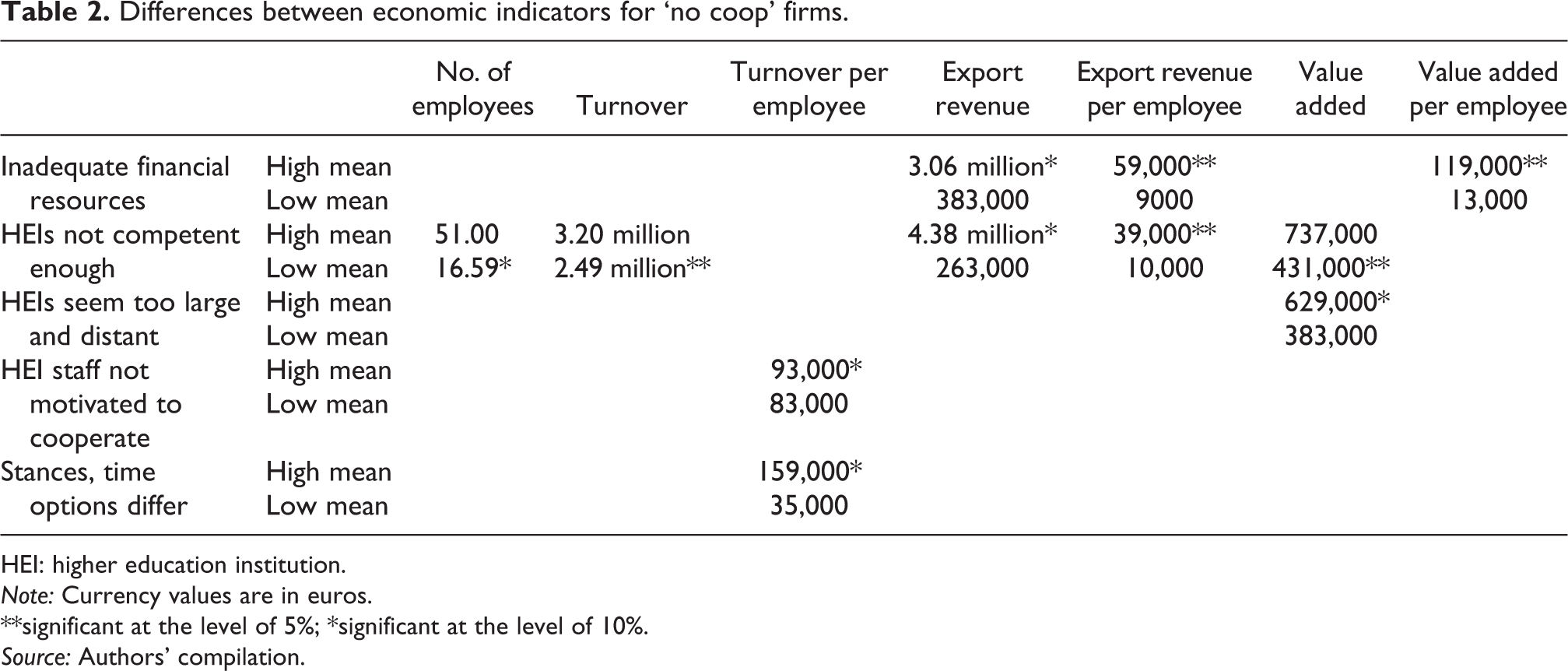
With regard to research questions Q1 and Q2, for ‘no coop’ firms the more important barriers were a lack of financial resources and difficulty in finding partners in HEIs (Appendix 2). Surprisingly, when we looked at their economic profiles (Table 2), those who rated lack of financial resources as an important barrier also had higher indicators of export, export per employee and value-added per employee (compared to those who did not find the barrier important). They could be characterized by our indicator categories as small, export-oriented and well-performing. While smallness and a limited availability of resources have been highlighted as important factors in firms’ perceptions of barriers to HIC by previous authors, such as Tether (2002), Iqbal et al. (2011) and Galán-Muros and Plewa (2016), the fact that these may be well-performing export firms has not previously been detected.
Differences between economic indicators for ‘no coop’ firms.
HEI: higher education institution.
Note: Currency values are in euros.
**significant at the level of 5%; *significant at the level of 10%.
Source: Authors’ compilation.
The lowest-rated barrier was the perception that HEIs were not competent enough for cooperation. However, firms that did find this barrier important had fewer employees, lower turnover and value-added indicators, but higher export indicators (compared to those who did not find it important). It is possible that small export-oriented firms require very specific knowledge and so HEIs might not in fact be the best partners for them. This was also suggested by the interviewees and focus groups, but a larger sample to test the results is still required.
Firms that rated as important the perceived barriers ‘HEI workers are not motivated to cooperate’ and ‘Stances and time options between HEI and industry differ’ had higher turnover per employee indicators. However, since these results were scarce in the ‘no coop’ group and at the same time also appeared in the ‘coop’ group, we will look at them in the next section.
Importance of barriers to ‘coop’ firms
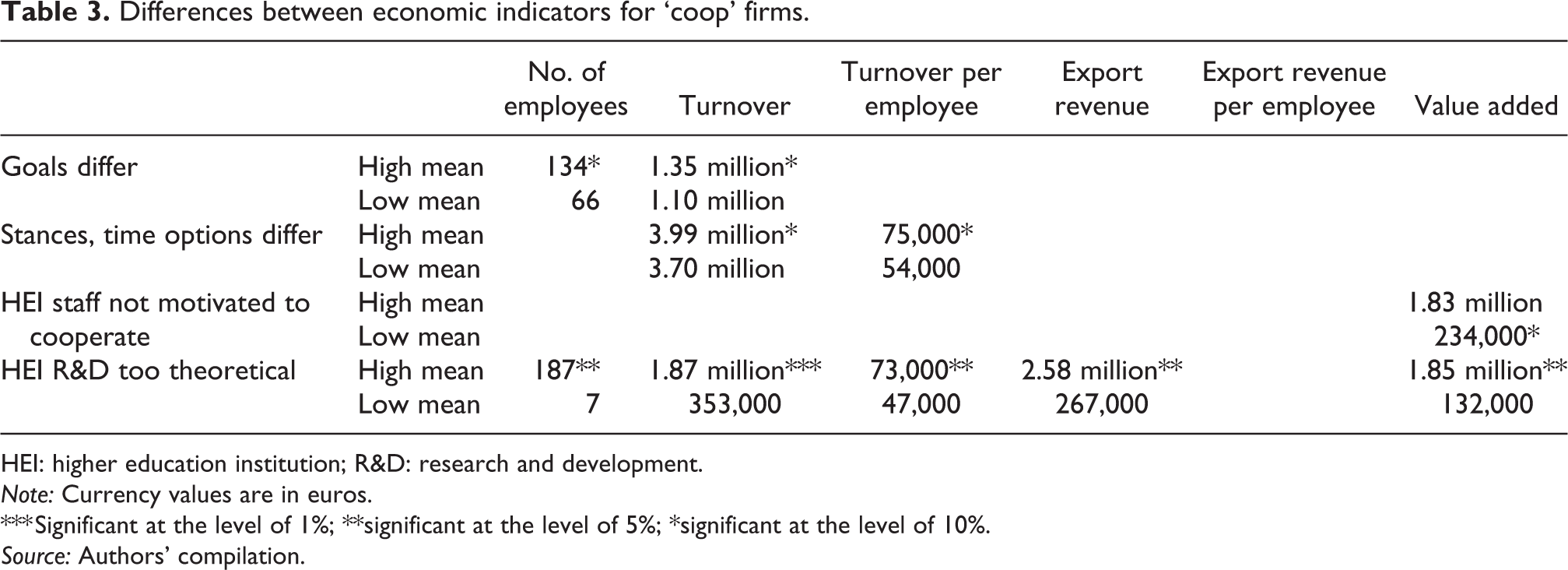
With regard to research questions Q1 and Q2, for the ‘coop’ group, the difference in goals between HEIs and firms was the most important barrier (Appendix 3). Firms that rated this as an important barrier had a higher number of employees and higher turnover than those who did not find it important (Table 3). We could categorize these firms as large. Previous research has confirmed that larger firms put more emphasis on strategy (compared to SMEs) (Davey et al., 2011; Galán-Muros and Plewa, 2016). Therefore, they are also more likely to see strategic differences with HEIs as barriers. The findings reported in this article support this argument (Davey et al., 2011; Galán-Muros and Plewa, 2016).
Differences between economic indicators for ‘coop’ firms.
HEI: higher education institution; R&D: research and development.
Note: Currency values are in euros.
*** Significant at the level of 1%; **significant at the level of 5%; *significant at the level of 10%.
Source: Authors’ compilation.
Firms that rated differences in stances and time options as an important barrier also had higher total turnover and turnover per employee. Firms that thought HEI staff were not motivated to cooperate had lower value-added indicators. These results coincide with the barriers mentioned in the previous paragraph, where larger firms were more adept at grasping strategic differences. Similar to previous findings (Davey et al., 2011; Roolaht et al., 2015), these results could be related to strategic and organizational culture – and also to poor motivational systems for HEI staff (Lauto et al., 2013).
Firms that thought HEI research was too theoretical had a higher number of employees, higher total turnover, higher turnover per employee and higher exports and value-added. One of the most recurrent comments from the interviews on this barrier was that, with regard to cooperation, academics were more interested in obtaining detailed and publishable results, while the firm needed a practical and working solution which was shielded from competitors. This could be a direct result of the different goals of the parties (one oriented towards science, the other towards profit) (Davey et al., 2011; Miller et al., 2016; Nielsen and Cappelen, 2014), or it might reflect a lack of incentives for academics to cooperate (Ramos-Vielba and Fernandez-Esquinas, 2012). All of the above results, of course, need further confirmation, but in the interviews that were carried out this barrier was deemed as among the most demotivating factors. Although HEIs often push for more cooperation, this divergence of interests quite obviously remains an issue.
Comparison of ‘coop’ and ‘no coop’ groups
Next, we compared the ‘coop’ (55% of observations) and ‘no coop’ (45% of observations) groups (research question Q1). No significant differences were found among the economic indicators listed above; that is, no specific firm profiles could be linked to either group. This is consistent with the results of Lopez et al. (2014) and Rõigas et al. (2018), where no direct linkage between size and cooperation was found. The reason here is likely due to the increased heterogeneity of the sample. The finding also suggests that the established notion that smaller firms have a much lower probability of cooperating with HEIs (Cohen et al., 2002; Laursen and Salter, 2004; Tether, 2002) might not hold quite as true as previously thought. Perhaps, it is harder for smaller firms to engage in resource-extensive cooperation channels, but they can easily engage in other types of HIC. Considering the numbers of SMEs in economies, there may therefore be great potential for increasing knowledge economy and innovation. When comparing the ‘no coop’ and ‘coop’ groups, the low motivation of HEI staff and differences in organisational culture remain important problems.
Drivers for ‘coop’ and ‘no coop’ groups
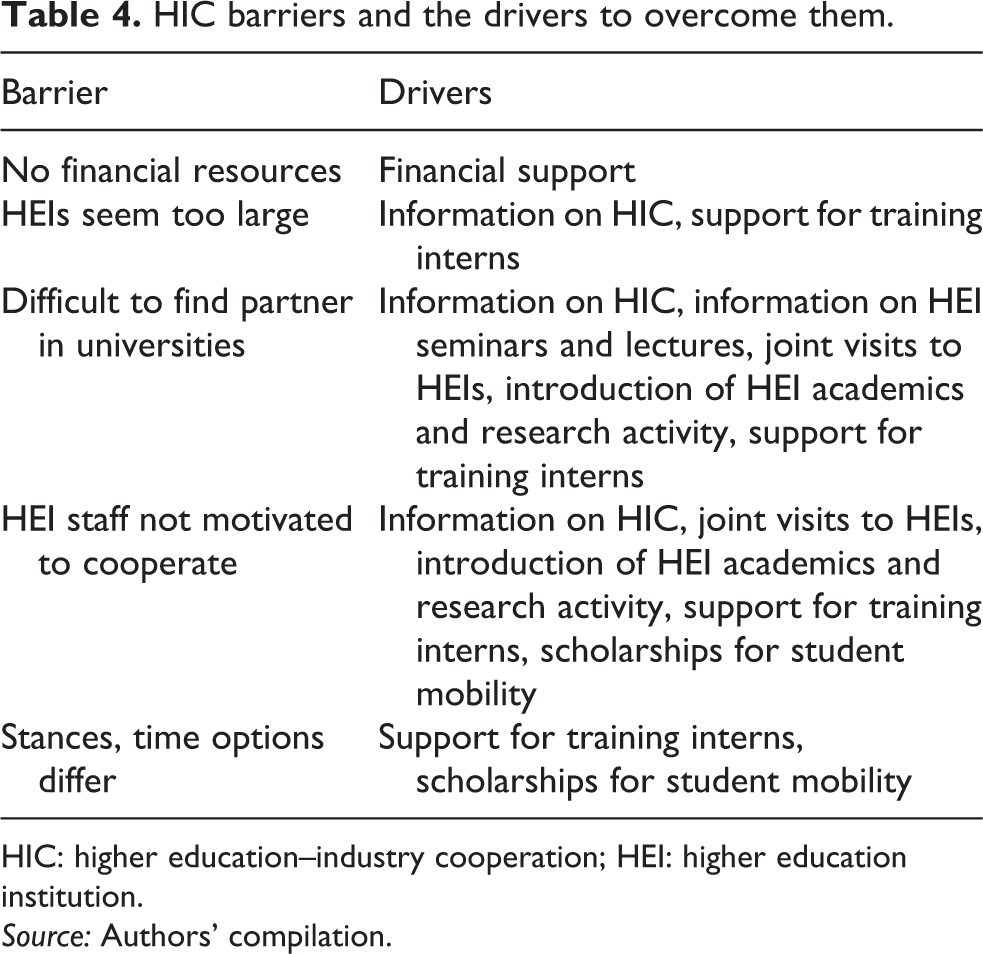
For drivers (see Appendix 4 for a summary of the results,) we also ran a correlation of both groups and compiled a list of barriers with the relevant drivers for overcoming them (research question Q3) – see Table 4. First, firms that rated financial resources as an important barrier also rated government financial support as an important driver for cooperation. It also emerged in the interviews that, in addition to direct financial support, indirect financial support (e.g. free project management) would be helpful. This finding is consistent with previous studies by Debackere and Veugelers (2005) , Miller et al. (2016) and, especially, Galán-Muros and Plewa (2016) who showed that financial support was important for a variety of cooperation channels.
HIC barriers and the drivers to overcome them.
HIC: higher education–industry cooperation; HEI: higher education institution.
Source: Authors’ compilation.
Second, those firms that rated it difficult to find a partner also considered it important that public organizations should share information about HEI cooperation opportunities, seminars and training, organize joint visits, introduce HEI staff to personnel in firms and support firms by organizing internships. These activities, with the addition of establishing scholarships for student mobility, were also considered important by firms that thought HEI workers were not motivated to cooperate. These results again are similar to the findings of previous studies, including those by Albors-Garrigos and Barrera (2011) , Bozeman and Gaughan (2007) and Ranga et al. (2008), who also noted that helping to connect parties and providing information about HIC were among the simplest and most effective options for supporting HIC.
Third, those firms that regarded HEIs as too large and distant also thought that third-party information and support for training interns was important. Third-party information support has been previously noted as a necessary driver (Ranga et al., 2008). The idea that internship could be an important driver for cooperation has been less discussed, although it is considered by Caniëls and Van den Bosch (2011) and Davey et al. (2016) and is sometimes treated more as a motivator for HEIs to improve students’ skills (van der Sijde, 2012; Williams and Fenton, 2013). One interviewee, however, specified that internship allows for very personal contact with the intern as well as their HEI-provided supervisor. This echoes the idea that students can function as knowledge carriers themselves while an internship can also lead to further personal contacts at and cooperation with the HEI (Delfmann and Koster, 2012).
Finally, similarly to the previous finding, firms that rated different stances and time options as a barrier thought support for internships and temporary scholarships would be helpful. This may stem from the idea of short-term mobility and the benefits for the firm of integrating someone with university background (Caniëls and Van den Bosch, 2011; Davey et al., 2016; Williams and Fenton, 2013).
It is interesting to note that, next to direct financial support, scholarships for student mobility and internship support were seen as key drivers. While the contention that different financial support measures can help overcome HIC barriers coincides with previous research (Davey et al., 2016; Galán-Muros and Plewa, 2016; Miller et al., 2016), it is a rather novel notion that firms also view student scholarships and internships as important drivers for cooperation with HEIs. Firms may intuitively realize that building social relations eases the HIC process.
Conclusion
The overall finding of this article is that cooperation between firms and HEIs is more widespread than has been indicated in previous studies – 55% of the firms in our original sample had already collaborated with HEIs. This considerably larger proportion than in similar studies could be explained by our sample design and methodology, as we included small and micro firms and a variety of cooperation channels, which are often omitted. In terms of economic indicators (size, export orientation, performance), no specific firm profile could be linked with the ‘had cooperated’ and ‘had not cooperated’ groups – implying that in principle any firm could cooperate. Thus, the frequently expressed view that smaller firms have a much lower probability with respect to HIC (Cohen et al., 2002; Laursen and Salter, 2004; Tether, 2002) may not hold as true as has been thought.
With regard to the research questions Q1 and Q2, we found that small export-oriented firms in the ‘no coop’ group faced barriers related to financial resources and university competences, whereas for firms in the ‘coop’ group (larger, well-performing firms) the main barriers were strategic differences and the over-theoretical nature of the R&D. For both groups, differences in organisational culture remained a barrier, as did to some extent the low motivation of university staff to cooperate. We also found (Q3) that the most important drivers for overcoming barriers such as difficulty in finding partners in HEIs or academics not being motivated to cooperate were information about HIC, the research scientists were engaged with and support for training interns.
These results prompt two main practical implications. First, there is a need for a progression path for firms to collaborate with HEIs – from less complex to more complex cooperation channels – including an ongoing relationship management system. Realizing this can help HEIs to forge a step-by-step HIC system, through which long-term cooperation can be built up over time with a variety of partners. The approach provides options for smaller firms to find suitable channels for cooperation and for larger firms to gain more trust and better relationships for further cooperation. In addition, it may help smaller export-oriented and well-performing firms to engage in HIC. Such a system would help to generate trust and make it easier for both sides to acquire the necessary knowledge and capabilities for cooperation. It would also provide the information required for cooperation that was seen as an important factor in overcoming barriers.
Governments could facilitate this process by having appropriate institutions document and develop effective HIC systems and progression paths, which would help HEIs to determine which cooperation channels should be included in their particular systems. In addition, governments could offer supportive measures for different stages of cooperation (like information on research activities in HEIs or internship support measures, both of which were identified as important in our study). Such support may prompt more firms to try different types of cooperation and so tap into the vast knowledge available in HEIs. In addition, governments could explore more options for support measures directed towards education-related HIC. Granting student mobility scholarships, for example, might provide an important link between HEI and firm representatives that could subsequently lead to long-term cooperation.
Second, since the motivation of HEI staff to cooperate was perceived as an important barrier, as were the differences in the goals of HEIs and firms, measures should be taken to address these problems. The dominance of publication-focused science in academia means that spending time on applied research is not as attractive as it might otherwise be. However, increased motivation in the HEI-based academic will have to be achieved by means other than the prospect of scientific publications – perhaps simply by financial reward or also by means of associating HIC activity with prestige and status. This would be a reasonable addition to the already suggested step-by-step HIC progression path. Governments could help this process by providing specific support measures (either financial, such as grants, or HIC engagement rewards) as well as recommendations or good practice guidelines with regard to how HEIs can establish an appropriate motivation system for their academic staff.
Limitations and future research
As mentioned in the section above on methodology, the survey was limited in sample size and by the fact that some barriers were omitted for one or the other group, which was necessary for the design of current study. These limitations could be removed by repeating the study with a larger sample over a variety of countries and adjusting the barrier list. However, and given that the results were quite informative, further research is needed on both the ‘coop’ and ‘no coop’ groups, barriers related to economic indicators, drivers and, perhaps most of all, HEI–industry cooperation channels. Which channels serve mainly which firms and what does their progression path look like? An important area for future research is HEIs’ current systems of cooperation, what channels they use and what types of firm they encounter through those channels. This would provide a clearer and more detailed understanding of how HIC systems work as well as of which problems affect those systems and which drivers could help to overcome them.
Footnotes
Declaration of conflicting interests
The author(s) declared no potential conflicts of interest with respect to the research, authorship, and/or publication of this article.
Funding
The author(s) received no financial support for the research, authorship, and/or publication of this article.

Notes
General description of respondent firms.
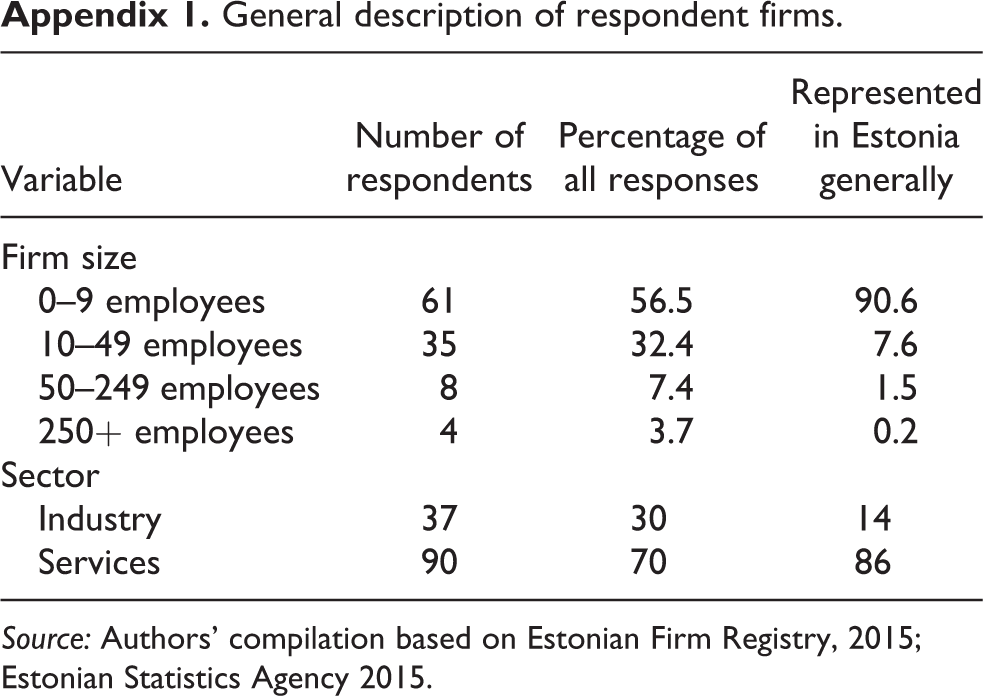
| Variable | Number of respondents | Percentage of all responses | Represented in Estonia generally |
|---|---|---|---|
| Firm size | |||
| 0–9 employees | 61 | 56.5 | 90.6 |
| 10–49 employees | 35 | 32.4 | 7.6 |
| 50–249 employees | 8 | 7.4 | 1.5 |
| 250+ employees | 4 | 3.7 | 0.2 |
| Sector | |||
| Industry | 37 | 30 | 14 |
| Services | 90 | 70 | 86 |
Source: Authors’ compilation based on Estonian Firm Registry, 2015; Estonian Statistics Agency 2015.