




Abstract
The capstone course serves to integrate accumulated knowledge with a culminating experience or project and is a common component in undergraduate and graduate programs. The research on capstones courses shows that many capstone experiences or projects involve students working with outside clients, such as local businesses and organizations, to solve problems or develop new projects or campaigns. Such capstone experiences or projects seek to offer students real-world, career-building experience, while the clients seek to benefit from the learned academic knowledge of the students. Where the literature is scarce on client-based capstone projects is when the client is the student’s employer or career-related organization. A graduate program in administration at a public Midwestern university in the USA offers a different approach to the student–client model by requiring a degree-culminating capstone project that challenges adult students to apply their learned knowledge to solve administrative problems not for an outside client but at their place of employment or career-related organization. The researchers surveyed 66 alumni and interviewed 6 on how the capstone project had benefited their work-related learning and its impact on their employer or career-related organization. Students perceived an improvement in their ability to define and analyze administrative problems in their workplace, while the employers or organizations which implemented the project recommendations experienced positive organizational change. This case study contributes to the literature on capstone courses by examining the relevance of a work- or career-related capstone project to students and their workplace.
Keywords
Central Michigan University (CMU) began offering a Master’s in Administration degree in 1974, and in 1989 it added a degree-culminating capstone course to the curriculum. Capstone Course A required students to complete a research project on a managerial or administrative issue within an organization and recommend solutions to the organization’s decision-makers. According to the program’s student manual (CMU, 2016), the project’s learning objectives include: to provide an opportunity to bring together the concepts, information and methodologies learned in the earlier courses; to challenge students to apply learned knowledge, skills and abilities to their profession; and to demonstrate an understanding of the related literature, a knowledge of the subject area studied and an ability to apply that knowledge both analytically and practically.
Capstone Course A is offered face-to-face, online or as a hybrid. Students enrolled in the course are strongly encouraged to propose projects that are directly related to their employment or career. Those who are unemployed, serve in the military or are unable to conduct research in their workplace can propose projects with other organizations, such as volunteer organizations, schools and churches. Students must identify an administrative issue or problem existing in the organization, conduct applied, problem-solving research, and present their final project recommendations to decision-makers in the organization. All projects are subject to approval by either the university’s Institutional Review Board or the program’s department to meet federal requirements involving human subjects and research. As part of the approval process, students are required to obtain written permission from their organization to conduct the project and to collect necessary data in the organization, whether the collection method is surveys, interviews, observations or organizational records. The recommendations students offer in their project must evidence an ability to define a problem, to conduct applied research using appropriate methodologies, to evaluate findings and to communicate conclusions in a professional manner (CMU, 2016).
The Capstone Course A project is designed not only to lead to the learning goals for the student, but also to benefit the organization at which the administrative problem was investigated. This case study extends the literature on the academic merits of a graduate capstone course by investigating the benefits of a culminating project conducted in the students’ workplace or career-based organization. We look specifically at the perceived impact of the project on student learning relevant to the student’s workplace or organization and its ability to influence organizational change.
Literature review
Development of capstone courses
A capstone is defined as a building’s topmost stone serving to prevent mortar erosion or the crowning achievement of a series of actions (Brown and Benson, 2005). Similarly, the educational capstone, as defined by Durel (1993), is “a crowning course or experience coming at the end of a sequence of courses with the specific objective of integrating a body of relatively fragmented knowledge into a unified whole” (p. 223). Starr-Glass (2010) likewise described the capstone experience in education as providing a “holistic perspective” to a course of study (p. 340). Thus, the capstone course is the topmost course of an educational program that provides students the opportunity to integrate their accumulated knowledge into a final project or experience.
The concept of the capstone course began in the mid-1980s in response to a perceived lack of in-depth learning at undergraduate level (Brown and Benson, 2005), specifically regarding teacher education and preparation (Starr-Glass, 2010). In 1990, a taskforce created by the American Sociological Association (ASA) recommended a “terminal student experience” (Starr-Glass, 2010: 330) that incorporated students’ knowledge and prepared them for a professional career. Starr-Glass further explained that the ASA capstone recommendation included two primary objectives, “…one focused on a consolidation and integration of what had been learned; the other providing an opportunity for students to bridge the gap between their prior academic learning and future professional engagement” (p. 330). In 1998, the Boyer Commission released a wide-ranging report on undergraduate education and recommended that “to ensure that the educational experience is drawn together, the student needs a course at the end of the curriculum that corresponds to the capstone of a building or the keystone of an arch” (as cited by Starr-Glass, 2010: 331). The capstone experience has since “become ubiquitous in undergraduate education” (Starr-Glass, 2010: 329).
Purpose of capstone courses
The synthesis purpose of a capstone, or integrating knowledge, is widely recognized as integral to the capstone experience. Carlson and Peterson (1993) noted that an undergraduate capstone course “should give students a sense of the coherence of their program of study in a discipline and should deepen their appreciation of the discipline as an approach to specific problems” (p. 239). Reinicke and Janicki (2011) described the capstone course as compelling students to integrate what they have learned throughout their program, and Van Acker and Bailey (2011) explained that the capstone experience allows students to reflect back on what they have learned. According to Starr-Glass (2010) the ability of the capstone course to help students integrate prior learning was influential in the inclusion of an undergraduate capstone course in the curricula of over 700 academic programs. Brown and Benson (2005), Maleki (2009), and Wickam (2018) further attested to the importance of the capstone course in synthesizing learned knowledge. Research by Lee and Loton (2019) identified 28 purposes of the capstone course from a review of scholarly articles and later surveyed 216 educators involved in capstone design and delivery to rate the importance of the capstone purposes. Their results showed that the top four rated purposes of capstone courses were communication (verbal and written), thinking (e.g., critical decision-making), application to practice and synthesis of prior learning.
Even though capstone courses are designed to synthesize what students have learned throughout the program, the introduction of new content during the course is supported. Mowbray (2015) reported that instructors might need to introduce new theoretical material to achieve or enhance the objectives of a capstone course, and Van Acker and Bailey (2011) supported the concept of introducing new content into the capstone experience, provided the new content is focused. The learning objectives for Capstone Course A do not include the introduction of new content; however, instructors can introduce students to new content if earlier course material was not adequately covered or well understood or the new content is deemed to be crucial to an effective capstone experience.
Postgraduate capstone courses
While the capstone course developed in response to a perceived need in undergraduate education, academic programs have also incorporated them at graduate level. Brown and Benson (2005) described several advantages of the graduate capstone course, including the provision of a “meaningful avenue that encouraged students to apply skills and theories acquired in a relevant way” (p. 685). Though both undergraduate and graduate capstone courses seek to offer an experience that integrates and bridges, Mowbray (2015) noted that a key distinction between the undergraduate and graduate capstone experience is that graduate students, unlike undergraduates, “are generally already established in their careers and are undertaking postgraduate study either to progress their existing careers or to enable them to change direction” (p. 44). This distinction characterizes most students enrolled in Capstone Course A.
The literature on the capstone experience at graduate level offers relatively few examples of projects with specific application to the student’s employment or career field, as is the case with the Capstone Course A. Several studies (Adkins and Tu, 2019; Hagan, 2012; Maleki, 2009; Reinicke and Janicki, 2011; Wawrzynski and Jessup-Anger, 2014) have reported on partnerships between academic programs and external clients to provide students with a real-world experience of tackling a project of interest to the client, while other academic programs have designed team-based capstone experiences in which the real-world element is simulated (McSweeney et al., 2017; Tappert and Stix, 2012). Contrastingly, the Capstone Course A project is an individual experience in which students must focus their projects on an administrative issue, policy or process they identify in their workplace or career-based organization. Blanford et al. (2020) detailed the capstone project of an online graduate program for working professionals which required students to work independently and in which 44% of them selected a project related to their workplace. Unlike the Capstone Course A project, however, the students who selected a work-related project were not asked to submit their completed projects to their employer or organization. The two capstone projects studied by Devine et al. (2020) were the most similar to the Capstone Course A project that we were able to identify. Graduate students in an instructional design program “identify an actual learning need that exists in their professional workplace or a local community organization” (p. 609), and the students work independently on the project. There is no indication, however, that the final project is presented to their workplace or chosen organization. Devine et al. (2020) also described a capstone project for a Master’s program in teacher leadership which requires students to “identify a problem of practice” (p. 611) in their school or district, and through which the students “live and breathe the experience since their projects yield real change in their classrooms, schools, and districts” (p. 611). While students can choose to present their final projects to decision-makers, the project is a collaborative effort between students and their colleagues.
Methodology
A survey was designed to investigate students’ perception of the impact of the Capstone Course A project, and responses were measured using Likert Scales. The survey was made available in March 2018 via SurveyMonkey, and 1,047 program graduates from 2016 and 2017 were invited to complete it. All graduates with email addresses provided by the university’s Alumni Office received a survey invitation. Graduates from 2016 and 2017 were selected as the target population because they had had enough time to assess the impact of their capstone project recommendations on their organization. The mean age of students enrolled in the program in 2016 and 2017 was 37 (CMU, 2020). All survey respondents were provided with the opportunity to participate in a voluntary interview with the researchers to offer additional information regarding their capstone experience. The university’s Institutional Review Board (IRB) approved the survey and interview questions. During a 4-week period in March and April 2018, 66 respondents completed the survey, a 6.3% response rate. In addition, 14 of the 66 survey respondents volunteered to be interviewed later.
Due to scheduling issues, time-zone differences and interviewees who were unable or chose not to call in at their scheduled time, only six interviews were conducted. The interviews were conducted online using the WebEx video conferencing application provided through the authors’ institution. The interviews were scheduled for 30 minutes and ranged in duration from 15 to 38 minutes. Each interview was recorded with the permission of the interviewee and was later transcribed using the Happy Scribe transcription service. The interview questions were largely open-ended and were designed to elicit detailed responses (see Appendix). The interviews were conducted in as informal and friendly a manner as possible to provide an environment in which the interviewees would be willing to provide detailed and reliable information (Zikmund et al., 2010). The transcriptions provided a rich body of information and, while content analysis was not performed, patterns and trends were sought for the qualitative study. The researchers recognize the subjectivity of qualitative data analysis and acknowledge the influence that expectations and biases can have on their understanding.
Findings
Our research sought to examine the impact of a work- or career-related graduate capstone project on student learning and the organization in which the research was conducted. As noted above, all 66 survey respondents completed their capstone requirement for their degree in 2016 or 2017. One of the survey questions asked, “What was your job at the time you completed your capstone?” The jobs reported varied widely and included responses such as human resources director, electrician, administrative assistant, army lawyer, factory worker, public school teacher, village manager, accountant and project manager. Sixty-two of the 66 respondents indicated that they were in employment—in private industry, government, education, or health care—and 7 were in the military. The other four were either full-time students or retired. Of the 66 respondents, 45 (68%) indicated that their project was directly related to their employment. Examples of work-related capstone projects included: “program evaluation of the new Army Officer Evaluation Reports (OERs)”; “effects of my employer’s tuition reimbursement plan on job satisfaction”; “I wrote a new safety program”; “analyzed the delays and wait list problems encountered by veterans and dependents in the VA system”; “reasons and solutions for nursing shortage and turnover”; and “I looked at the correlation between mental illness and physical health at a mental health facility.”
One interviewee explained he was “…able to get a really good topic that my employer was ready for as well. It was a topic directly related to my job that I really enjoyed, which involved coordinating new communication technologies such as WebEx” (personal communication, 27 March 2018). Twenty-one respondents (32%) reported that their projects were not work- or career-related, and, instead, examined administrative issues in approved organizations, such as churches and military reserve units. Other respondents focused their research on organizations in which a friend or relative was employed. Asked if they submitted their final project to someone in their organization, 30 (45%) of the 66 respondents answered affirmatively. Of the 45 who answered that their project was related to their employment, 30 (66%) submitted it to a decision-maker in the organization. While students were encouraged to submit their projects to someone in their organization, it was not a requirement of the course. Figure 1 provides clarification on why 36 of the 66 survey respondents did not submit their final project to someone in their organization.

Reasons for not submitting.
Fifty-two percent of those 36 respondents indicated that they did not submit their project to their organization because the recommendations included in the report were no longer relevant to management, while 38% cited managerial changes in their organization.
Seventy-two percent of the respondents (see Figure 2) indicated interest from management in the recommendations contained in their project. Twenty-seven percent of managers had “Little interest” or “No interest at all” in the students’ findings. Comments from respondents ranged from, “They would not even take time to read it. They did not care at all,” to “The program I developed was put in place and management was very supportive and open to the opportunity.” However, the extent of implementation of the recommendations made in the projects was less than the extent of interest expressed by management (see Figure 3).
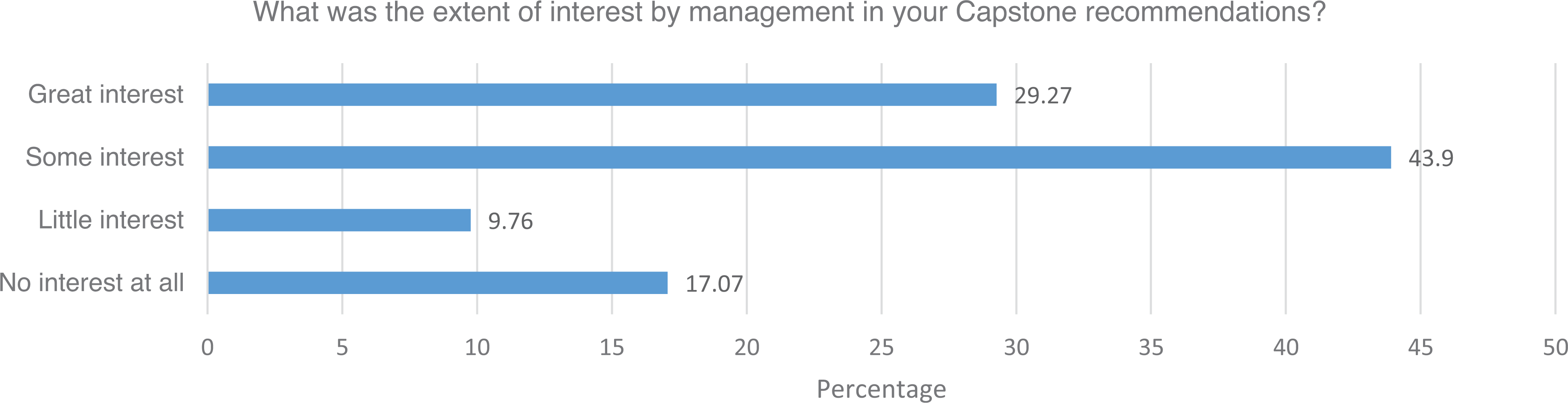
Extent of interest.
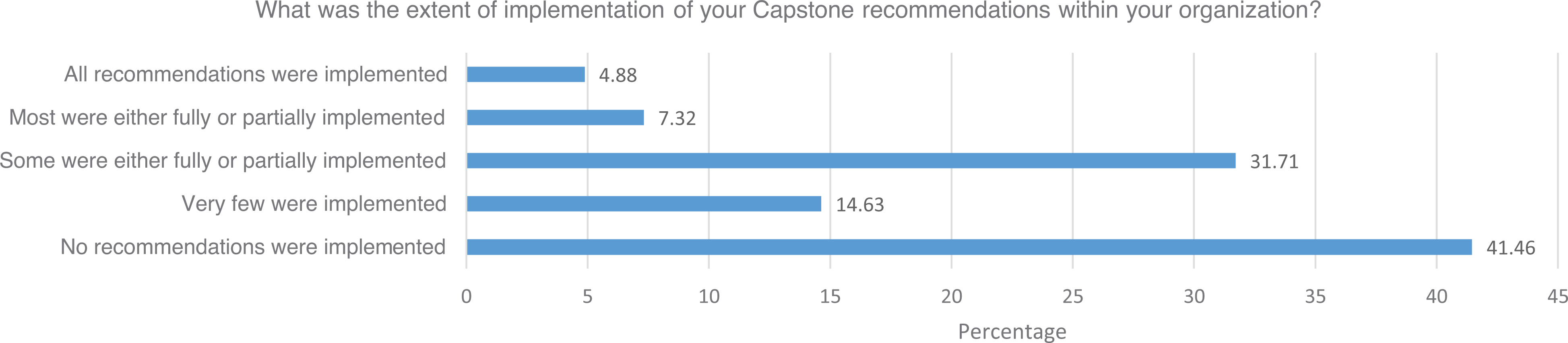
Recommendations implemented.
The 72% level of interest expressed by management in Figure 2 translated to 44% implementation of recommendations. Fifty-six percent of respondents indicated that very few or no recommendations were implemented in their organizations. Comments regarding the degree to which respondents’ recommendations were implemented included “lower priority for management” and “due to budget limitations, everything could not be implemented.” Other respondents indicated a more positive response to the implementation of their recommendations; for example, one commented, “I was given green light to start working on a few of the recommendations…,” while another noted that “the program was fully implemented.”
As shown in Figure 4, over half of the respondents indicated workplace improvements resulting from the implementation of their project recommendations, whereas 46% saw no improvements. Comments from survey respondents regarding observed changes or improvements included: “Too little time has elapsed to see definitive changes.” “I noted great improvements at the time with the feedback received from new hires regarding their feelings on the program and how prepared they felt to begin their role at the organization.”
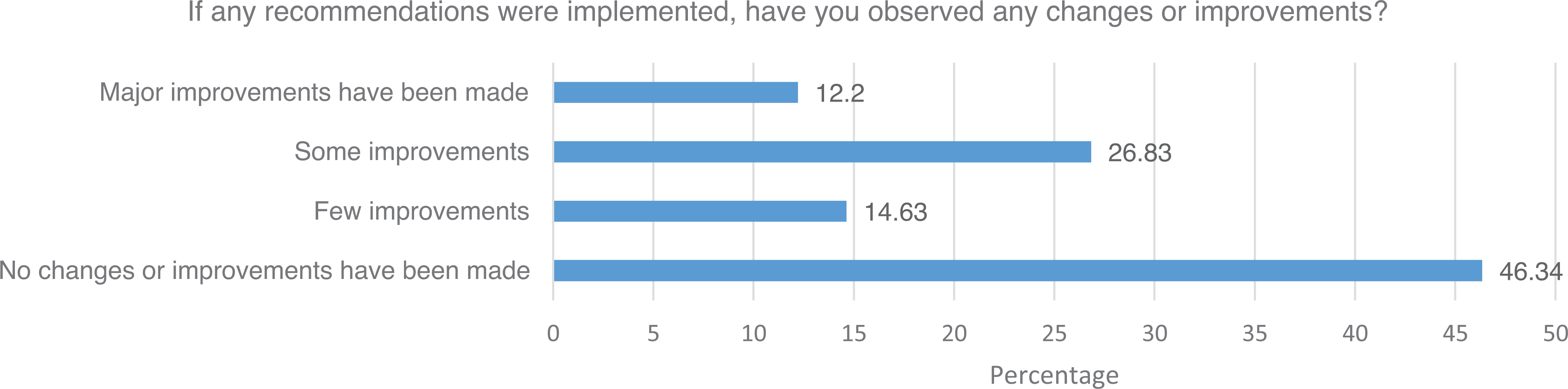
Observed changes or improvements.
An interviewee explained that 2 years after completing the project, “…we are still following those recommendations and still promoting them heavily” (personal communication, 21 March 2018).
As stated previously, one goal of the Capstone Course A project is to “Challenge students to apply learned knowledge, skills, and abilities to their profession” (CMU, 2016: 6). Survey respondents were asked to assess the impact of the project on their administrative abilities in the workplace. Approximately 85% indicated some degree of agreement that they are better at defining administrative problems and opportunities because of the project (see Figure 5). Fifteen percent were undecided or did not agree. Two respondents commented, “I had this skill prior to the capstone” and “I already understood methods of preparing good analysis.”
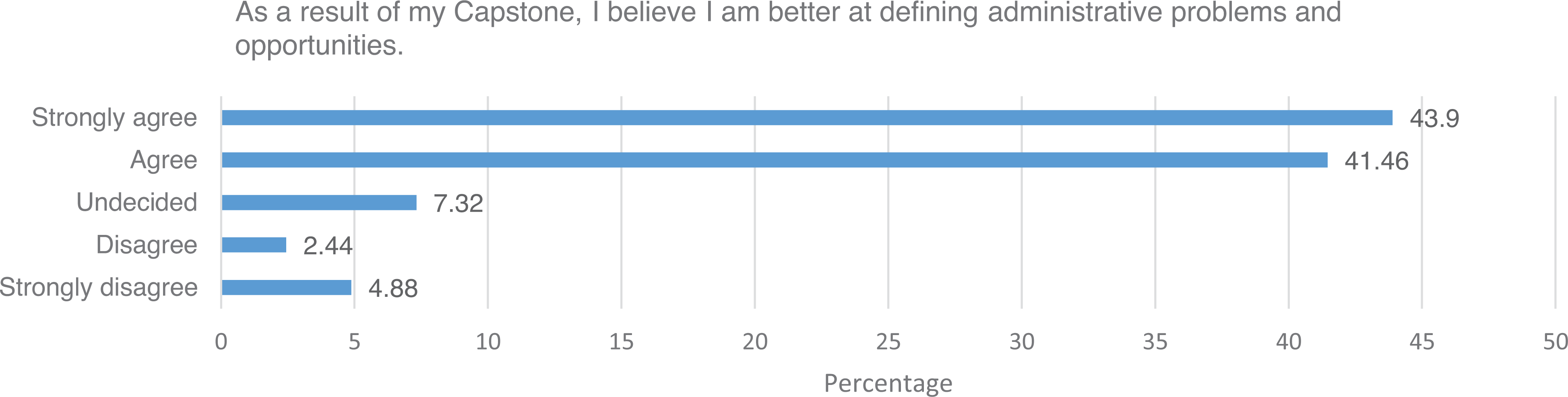
Defining administrative problems and opportunities.
In addition to defining problems, respondents were asked about their abilities in analyzing administrative problems and opportunities in the workplace (see Figure 6). Approximately 80% perceived that, because of the project, they had become more thorough and systematic in analyzing administrative problems and opportunities. Twenty percent were undecided or did not agree. One interviewee discussed the learning acquired from the project: “…the final project had a lot to do with critical thinking and taking something and really analyzing it to the full extent, which is what has helped me in my career” (personal communication, 22 March 2018). An interviewee who was enrolled in a PhD program at the time of the interview commented on how the project had influenced her analytical skills outside the workplace as well: “…the capstone project definitely prepared me for my PhD program. I think I am quite ahead of many students in my program. I know what to expect in the dissertation…like full data collection and analysis” (personal communication, 20 March 2018).
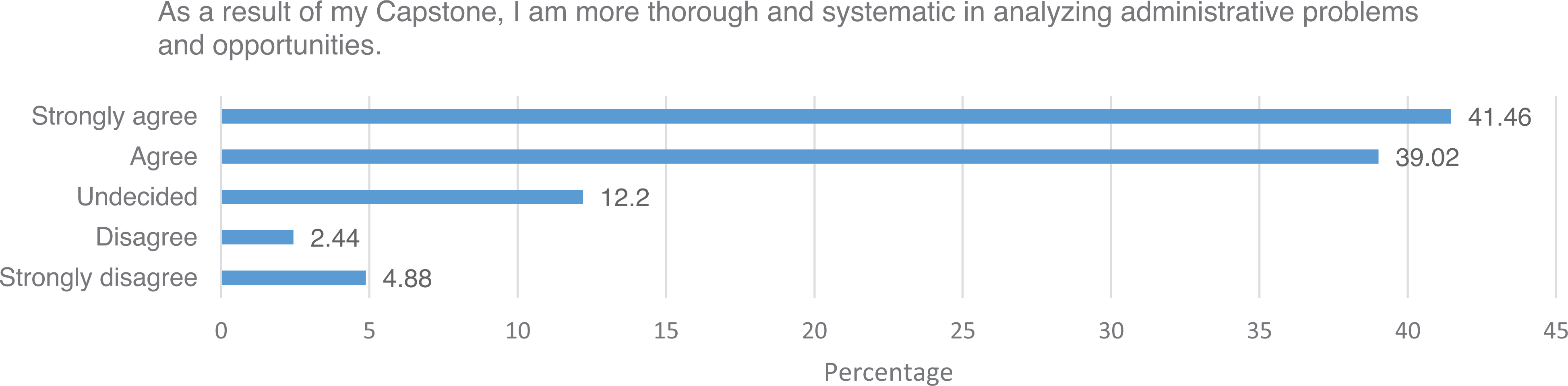
Analyzing administrative problems and opportunities.
The survey asked respondents whether the project had had any impact on their visibility in their organization (see Figure 7). Approximately 61% agreed that they had greater visibility with management in their organization because of their work-related project. Twenty-two percent were undecided, and 17% disagreed that their capstone project had given them greater visibility with management. An interviewee commented that the capstone “…definitely gave me more exposure…and afforded me the opportunity to get in front of some audiences that I might not otherwise have that exposure to” (personal communication, 28 March 2018).
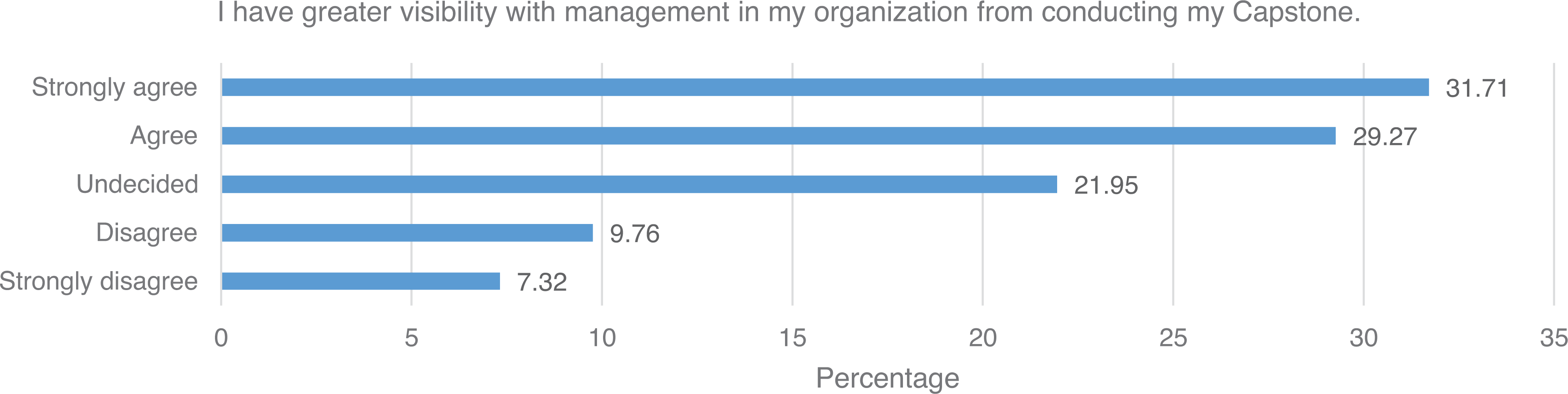
Increased visibility within organization.
Similarly, the survey asked about the impact of the project on career development opportunities in the respondent’s organization (see Figure 8). Forty-nine percent, or 20 of the 41 graduates who responded, agreed that they had greater career development opportunities because of their project. Fifty-one percent were undecided or disagreed about the impact of their project having a positive effect on their career development opportunities.
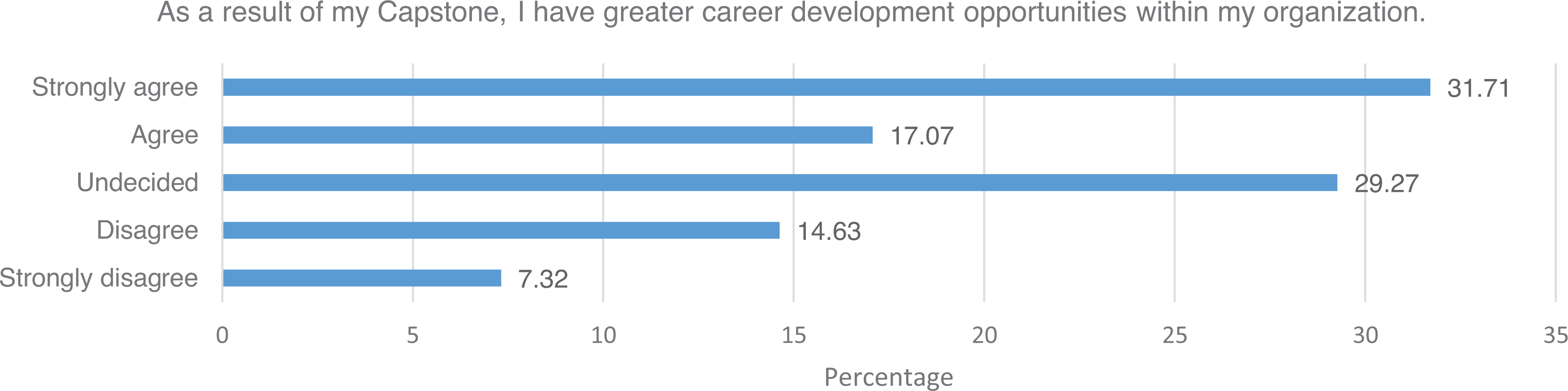
Greater career opportunities.
In summary, most students pursued Capstone Course A projects related to their workplace or career and, while decision-makers in their organizations overwhelmingly expressed interest in the project’s recommendations, respondents reported that conflicting administrative priorities and budget constraints had hindered or derailed implementation of their recommendations. Where recommendations were implemented, however, respondents observed improvements in the workplace. Despite encouragement from the academic program, many respondents reported that they had not submitted their project recommendations to anyone in their organization. Respondents largely credited the Capstone Course A project with improving their ability to define and analyze administrative problems in the workplace. Most also felt that the project had increased their visibility with management and half of the respondents perceived improvement in their career development opportunities.
Discussion
Our study sought to examine both the impact of the Capstone Course A project on students’ ability to identify, define and analyze administrative problems in the workplace, and the project’s impact on the organizations in which it was conducted. The survey results and the interviews indicate that students overwhelmingly perceived the project as helpful in developing their ability to identify, define and analyze administrative problems. This finding is significant, as it demonstrates that the project’s learning objectives were achieved. The connection of the project to the student’s work- or career-related organization speaks to the positive impact on student learning when the processes and analytical techniques acquired through coursework are applied in realistic settings (Carter and Stickney, 2019).
Our sample of Capstone Course A students reported a high level of interest expressed by management in the recommendations contained in their projects. However, despite strong encouragement by the program to do so, almost half of the respondents reported that they had not submitted their project to their organization. Respondents cited changes in the organization’s management from the time the project was approved to its completion as the major reason for non-submission. Considering that the Capstone Course A project was also intended to benefit the organization, we were disappointed by this finding. It is possible that the length of time taken to complete the capstone project, roughly 4 months, is no longer compatible with organizational decision-making requiring a shorter timeline. For the project to remain relevant to the organizations in which they are conducted, the program may need to revise the Capstone Course A project to align better with the pace of change in the today’s workplace.
Of particular concern to the researchers is the variance between the high interest expressed by management in the project and the reported lack of implementation of some or all of a project’s recommendations. Budget constraints were cited by some respondents as one reason why their project recommendations were not implemented, and costly project recommendations would reasonably be delayed or rejected by an organization unable to afford to implement them. However, the apparent lack of interest by management in implementing some or all the recommendations is concerning. It is conceivable that the apparent lack of interest was a subjective assessment by respondents whose expectations regarding how their project would be received by their organization had not been met. Besides, management may have found that the recommendations simply could not be implemented. Nevertheless, project recommendations that are beyond an organization’s ability to implement, or that lack relevance, shed light on the efficacy of the Capstone Course A project and signal that there may be a need to revise it.
Notably, organizations which implemented all or some of the recommendations proposed in Capstone Course A projects experienced positive organizational change. One interviewee explained that recommendations from his project were still being followed and promoted in the organization after 2 years. Where respondents reported a lack of observable improvements from implemented recommendations, this may have been due in part to insufficient time for improvements to develop in the organization. Several respondents also noted that, because of the project, they had experienced an increase in visibility in their organization and more career development opportunities. For those respondents who had experienced greater career development opportunities, it is difficult to isolate the project’s specific role. Survey comments and interviews suggested that the capstone had played a part, but most credited the overall degree program.
Limitations
It is unknown how well the selected sample represented the target population of all students who completed Capstone Course A at the university in 2016 and 2017. Only graduates with email addresses on record with the Alumni Office were sent a survey and, while it can be assumed that most graduates continued to use email, email addresses can change, messages can end up in Junk folders, and they can be ignored or deleted. We also acknowledge that, while the survey questions were pre-tested, interview questions were not assessed prior to the interviews. Also, it is possible that there are differences in the survey respondents compared to non-respondents. For example, sample bias may occur: those who believed that their capstone recommendations had resulted in organizational change or that their capstone project had resulted in a positive learning experience may have been more motivated to respond to the survey and interview invitations. Another unknown but potentially important difference among survey recipients might have been their relative perceptions of the relevance or clarity of the questions. Furthermore, some respondents may misrepresent their perceptions by giving answers to appear intelligent, to avoid embarrassment or to say what they think is expected of them. Finally, the study did not survey students’ employers or organizations; instead, the value of the capstone to the organization and to the student’s learning was assessed through student perception only. Surveying the organizations that allow the Capstone Course A project to be conducted would afford a better understanding of the impact on the organization. It should be noted that the aim of this study was to pursue answers to research questions designed to enhance understanding of the impact of the Capstone Course A project rather than to generalize findings or test hypotheses.
Conclusion
Our research sought to examine the impact of a work- or career-related graduate capstone project on student learning and the organization in which the research was conducted. Echoing experiential learning theory, which places experience at the heart of the learning process (Kolb and Kolb, 2012), our research found that the Capstone Course A project promotes student learning by applying students’ acquired course knowledge and research skills to the solution of real problems in real-world environments. Like the capstone courses detailed in the literature, Capstone Course A offers its students a “culminating and cumulative” (Young et al., 2017, as cited in Devine et al., 2020: 606) project, but unlike most capstone courses we reviewed, the project is designed to be conducted in a work- or career-related organization. Evidence from the literature combined with our survey and interview findings supports the view that capstone projects conducted for and in real organizations promote student learning and allow students to apply learned knowledge to effect positive organizational change. To assess the impact of the Capstone Course A project more thoroughly, future research in this area should concentrate on the organizations that agree to allow students to evaluate their internal processes and policies.
However, we conclude from this case study that the learning by students from applying knowledge to solve real problems and the potential benefits to organizations speak to the importance and relevance of the Capstone Course A project, and indicate that it can serve as a model for other academic programs.
Footnotes
Acknowledgment
The authors would like to acknowledge the assistance and input provided by Kimberley Gribben, Assistant Director, Master of Science in Administration Program, Central Michigan University.
Declaration of conflicting interests
The author(s) declared no potential conflicts of interest with respect to the research, authorship, and/or publication of this article.
Funding
The author(s) received no financial support for the research, authorship, and/or publication of this article.
