



Abstract
This study assesses the impact of different psychological and contextual factors on entrepreneurial motivations and the role of entrepreneurial motivations in determining the entrepreneurial intention of students at Indian universities. The paper also explores whether gender acts as a moderator in the entrepreneurial motivation–intention relationship. Cross-sectional data were collected by administering a questionnaire to 329 students who had received entrepreneurship education during their course program. A confirmatory factor analysis model was run to ensure the model’s fitness, reliability, and validity, while structural equation modelling was used to test the hypotheses. The study validates the following key findings. First, the psychological factors of perceived cultural support and entrepreneurship education foster entrepreneurial motivations, which help determine students’ entrepreneurial intention, whereas fear of failure negatively affects students’ entrepreneurial motivations. Second, the contextual factors of government support policies and access to entrepreneurial finance do not influence entrepreneurial motivations. Third, entrepreneurial motivations significantly enhance the entrepreneurial intention of students. Fourth, gender negatively moderates the entrepreneurial motivation–intention relationship. The study contributes to the literature on the entrepreneurial motivation–intention relationship using psychological and contextual factors and also explores the interaction effect of gender on that relationship.
Keywords
Increased globalization, workforce diversity, and rapid changes in technology have led to the transformation of work environments and traditional organizational structures, resulting in a change in the narrative of how individuals perceive their careers (Sullivan and Baruch, 2009). This changing narrative has tended to favor entrepreneurship over other career options (Edelman et al., 2016). Hence, entrepreneurship has attracted the attention of the younger generation and has become one of the most discussed career options (Edelman et al., 2016). Governments and universities have increased their focus on supporting entrepreneurial activities (Agarwal et al., 2020; Fretschner and Weber, 2013). Researchers have also been exploring student entrepreneurship, often in terms of the formation of entrepreneurial intentions (Anwar et al., 2021a, 2021b; Criaco et al., 2017; Souitaris et al., 2007; Zellweger et al., 2011). However, studies like those by Goethner et al. (2012), Kautonen et al. (2015), Joensuu-Salo et al. (2015), and Rauch and Hulsink (2015) have found that only a few individuals are able to transform these intentions into actual behavior. Hence, there is a growing need to understand the factors that lead to entrepreneurial intentions and the potential of these factors in transforming intentions into behavior.
Entrepreneurs are regarded as enablers of economic and social change due to their dynamic and innovative approaches in addressing economic and social challenges (Shaw and Carter, 2007). They are also affected by the prevailing business environment in their country (Welter, 2011; Meoli et al., 2020). A country like India, which is facing colossal employability crises, is now encouraging its youth to become self-reliant and to promote an entrepreneurial culture by seeking a career in entrepreneurship. In this regard, India has recently launched a program called “Atamanirbar Bharat” with the slogan “vocal for local.” According to the GEM Report for 2019–2020, 33.3% of India’s adult population have developed the intention to undertake or have thought of undertaking an entrepreneurial activity (Bosma et al., 2020); however, only 15% were able to transform these intentions into actual behavior by undertaking an entrepreneurial activity (Bosma et al., 2020). Despite initiatives like Atmanirbhar Bharat and scoring well above the global average in all the GEM data parameters, India still lags behind in retaining its adult population’s confidence. Ajzen et al. (2009) found that intention and actual behavior are highly correlated with one another, as intention is the best predictor of actual behavior (Sheeran and Webb (2016). Therefore, the transformation of intentions into actual behavior depends on how strong and stable the intentions are (Liñán and Rodriguez-Cohard, 2015; Meoli et al., 2020), and these are affected by the underlying motivations while undertaking an entrepreneurial activity (Chen et al., 2017; Mahto and McDowell, 2018; Meoli et al., 2020; Solesvik, 2013). Other studies have found that the intention and behavior are highly correlated. Additionally, psychological and contextual factors play a pivotal role in fostering the motivations (Kah et al., 2021; Wu and Mao, 2020) that guide an individual toward an entrepreneurial activity (Hassan et al., 2021; Barba-Sánchez and Atienza-Sahuquillo, 2018).
Furthermore, researchers have noted that there is no particular agreed theory on entrepreneurship explaining the intention of an individual to undertake an entrepreneurial activity (Shook et al., 2003). The two main conceptual frameworks that have been predominantly used to model the precursors and predictors of entrepreneurial intention are the Entrepreneurial Event Model of Shapero and Sokol (1982) and the Theory of Planned Behavior” of Ajzen (1991). However, the results obtained from empirical studies have highlighted a gap between these models and the practicalities of entrepreneurship (Barba-Sánchez and Atienza-Sahuquillo, 2018) as various other psychological and contextual factors—including entrepreneurial motivations, fear of failure, perceived cultural support, perceived government support, access to entrepreneurial finance and entrepreneurship education—also play a key role in determining the entrepreneurial intentions of an individual (Sahoo and Panda, 2019; Shinnar et al., 2012; Tsai et al., 2016; Tung et al., 2020; Urban and Ratsimanetrimanana, 2019). Welter (2011, p. 165) also highlight the importance of context in entrepreneurship: “Context is important for understanding when, how, and why entrepreneurship happens and who becomes involved.” Therefore, we build on these factors as the precursors of entrepreneurial intention using individual-level data collected through questionnaires, and provide a theoretical framework that allows us to examine the strength of psychological and contextual factors in fostering entrepreneurial motivations and developing the intention to undertake an entrepreneurial activity.
The theoretical framework developed in this study considers broader psychological and contextual variables and explains their strength in forming entrepreneurial intentions among university students. We tested our framework using data collected through questionnaires from commerce and management background students who had received entrepreneurship education during their respective courses. The data were collected from three universities located in three different regions of India: the University of Kashmir, Srinagar (Northern region), Aligarh Muslim University, Aligarh (Central region) and Jamia Hamdard University Kannur campus (Southern region).
Researchers consider that entrepreneurial motivation is an underexplored area of the entrepreneurship field (Carsrud and Brännback, 2011)—in particular, the motivation–intention link (Solesvik, 2013). In this context, the current paper significantly contributes to the study of the entrepreneurial motivation–intention relationship. First, the study expands and enriches the focus on different psychological and contextual factors that foster entrepreneurial motivations among university students (Kah et al., 2021; Wu and Mao, 2020). Second, entrepreneurial motivations, which spark the intention to undertake an entrepreneurial activity, play a vital role in the venture creation process (Barba-Sánchez and Atienza-Sahuquillo, 2018; Hassan et al., 2021; Meoli et al., 2020). Therefore, the study allows us to explore the influence of psychological and contextual variables in shaping these motivations and leading to the subsequent formation of entrepreneurial intention among students. Third, by framing (see Figure 1) and testing our model moderated by gender as suggested by Arshad et al., (2020), the study provides a better insight into the gender bias that hinders a motivated university student from undertaking an entrepreneurial activity (Hassan et al., 2020). Accordingly, we explore the following three research questions: • RQ1: What is the relationship between entrepreneurship education, perceived cultural support, government support policies, entrepreneurial finance, fear of failure and the entrepreneurial motivations of university students? • RQ2: What is the relationship between the entrepreneurial motivations and the entrepreneurial intention of university students? • RQ3: What is the moderating role of gender in the entrepreneurial motivation–entrepreneurial intention relationship? Hypothesized model.

Theoretical background and hypotheses development
Theoretical background
Entrepreneurial intention can be defined as the proclaimed conviction of an individual to undertake an entrepreneurial activity (Biraglia and Kadile, 2017; Thompson, 2009). It has also been defined as the “the target behaviors of starting a business” Krueger et al. (2000, 420). Therefore, intention acts as a key factor in the venture creation process (Tomy and Pardede 2020), as entrepreneurial intention is recognized as the best predictor of individual entrepreneurial behavior (Armitage and Conner, 2001; Liñán and Chen, 2009). A study by Haynie et al. (2010) has recognized that the conviction behind an entrepreneurial activity originates from the individual’s entrepreneurial motivations, and these motivations act as the leveraging factor in the whole entrepreneurial process (Barba-Sánchez and Atienza-Sahuquillo, 2017). Entrepreneurial motivation can be defined as the drive or psychological reason behind undertaking an activity (Schacter et al., 2011). Researchers have recognized motivation as a fundamental factor in the venture creation process, having the adequate explanatory power of determining the intention of an individual to undertake an entrepreneurial activity (Chen et al., 2017; Mahto and McDowell, 2018). According to a study by Barba-Sánchez and Atienza-Sahuquillo (2017), the business creation decision is taken on two levels: the rational level and the motivational level. The rational level is based on the objective reasons for taking such a decision, originating in the environmental setting which either hinders or reinforces this behavior (Ajzen, 1991; Bandura, 1977). The motivational level relates to the subjective reasons emerging from the expectations of the decision-maker (i.e., their motivations) (Barba-Sánchez and Atienza-Sahuquillo, 2018).
Most of the literature on entrepreneurial intention is based on Shapero and Sokol’s Entrepreneurial Event model (1982) (Fitzsimmons and Douglas, 2011) or Ajzen’s Theory of Planned Behavior (1991) (Izquierdo and Buelens, 2011), or on a combination of both models (Krueger et al., 2000). However, the results of empirical studies have shown a gap between the reality of entrepreneurship in different contexts and these dominant theoretical models (Barba-Sánchez and Atienza-Sahuquillo, 2018). Researchers have suggested psychological–economic methods, which offer an alternative to the existing models for explaining the entrepreneurial phenomenon and the factors determining the intention of an individual to undertake an entrepreneurial activity (Athayade, 2009; Barba-Sánchez and Atienza-Sahuquillo, 2018; Lee et al., 2011). Hence, our study takes into consideration these suggestions by incorporating different psychological, contextual variables in the theoretical model and examining their strength in determining the entrepreneurial intention of students.
Hypothesis development
Entrepreneurial motivations and entrepreneurial intention: The psychological purpose or cause of an action has been defined as motivation (Schacter et al., 2011). Theories based on entrepreneurial motivation have been classified into two groups: incentive theories and drive theories (Carsrud and Brännback, 2011). The drive theories focus on the inner need of an individual (e.g., autonomy or need for achievement) that helps to reduce the tension by motivating the individual to undertake an entrepreneurial activity (Fayolle et al., 2014; Solesvik, 2013). The incentive-based theories on the other hand propose that external rewards (e.g., prestige, income, or flexibility) act as the motivator for an individual to undertake an activity) (Fayolle et al., 2014; Fayolle and Liñán, 2014). Shane et al. (2003) categorized these motivations into general (the need for achievement, vision, locus of control, passion, desire for independence and drive) and task-specific (goal setting and self-efficacy).
Previously, the economic motive was considered the reason behind the undertaking of an entrepreneurial activity (Carsrud and Brännback, 2009). However, recently the narrative has changed from economic to other socially driven motives, particularly with regard to social entrepreneurship (Fayolle et al., 2014), suggesting that these act as the primary motivators for social entrepreneurial activity (Fayolle et al., 2014).
When connecting the drive theories of motivation to entrepreneurship, it can be concluded that the internal tension of an individual instigates the higher intention of undertaking a new venture (Fayolle et al., 2014). This is the result of motivation affecting the psychological mindset of the individual with regard to undertaking an entrepreneurial activity (Solesvik, 2013). The intention has been defined as the initiative influenced by a group of motivations (Schlepphorst et al., 2020). Therefore, individual motivations act as the antecedent for the development of entrepreneurial intention (Barba-Sánchez and Atienza-Sahuquillo, 2018; Solesvik, 2013). Earlier studies have shown that entrepreneurial motivations significantly predict entrepreneurial intention (Antonioli et al., 2016; Barba-Sánchez and Atienza-Sahuquillo, 2017; Hassan et al., 2021; Lang and Liu, 2019; Solesvik, 2013; Nabi and Liñán, 2013). Based on the literature, we propose our hypothesis as follows:
Entrepreneurial motivations significantly enhance the entrepreneurial intention of an individual. Entrepreneurship education and entrepreneurial motivations: Entrepreneurship education can be defined as “any pedagogical program or a process of education for entrepreneurial attitudes and skills” (Fayolle et al., 2006) which helps an individual in identifying commercially suitable business opportunities and imparts the knowledge, awareness and self-efficacy to act on them (Jones and English, 2004). Entrepreneurship education plays a major role in developing students’ entrepreneurial ability and knowledge about entrepreneurship (Shi et al., 2012). An entrepreneur has been described as an individual who possesses attributes like a tolerance of ambiguity, a need for achievement, risk-taking and self-control (Green et al., 1996; Koh, 1996; McClelland, 1961). As noted above, these motivational attributes have been categorized into two groups by Shane et al. (2003): general (need for achievement, vision, locus of control, passion, desire for independence and drive) and task-specific (goal setting and self-efficacy). Entrepreneurship education helps to nurture these attributes, which enhance the likelihood of performing an entrepreneurial act (Lindberg et al., 2017). Solesvik (2013) has shown that individuals who have undergone a program of entrepreneurship training and education are likely to have higher motivation and are more likely to take up entrepreneurship as their career choice (Hassan et al., 2020; Anwar et al., 2020). However, researchers’ opinions vary regarding the entrepreneurship education–entrepreneurial motivations relationship. Studies such as those by Jakubiak and Buchta (2016), Farhangmehr et al. (2016), and Khalili et al. (2014) have found that entrepreneurship education shapes the entrepreneurial competencies of students and fosters their motivations to undertake an entrepreneurial activity. However, Athayde (2009) and Oosterbeek et al. (2010) have shown different results, confirming that entrepreneurship education does not influence entrepreneurial motivations significantly. Thus, the question arises as to whether or not entrepreneurship education can enhance the entrepreneurial motivations of an individual. Based on the literature, we formulate our hypothesis as follows:
Entrepreneurship education significantly enhances the entrepreneurial motivations of an individual. Perceived cultural support and entrepreneurial motivations: Culture has been defined as an integration of beliefs, expected behaviors and shared values (Hayton et al., 2002). In the context of entrepreneurship, it is related to taking responsibility, valuing entrepreneurial traits, seeking a business opportunity, entrepreneurial fear of risk aversion, and capability beliefs (Stephan, 2009). Culture can be more or less supportive to individual’s entrepreneurial activity and career in entrepreneurship (Kibler et al., 2014). In a supportive entrepreneurial culture, the entrepreneurial activity of an individual is considered to be desirable and appropriate (Liñán et al., 2020), which affects their entrepreneurial behavior (Thornton et al., 2011; Hayton and Cacciotti 2013). Cultural norms are society-driven values that formulate the degree to which society contemplates the desirability of entrepreneurial behaviors (Hechavarria and Reynolds, 2009). Cultural norms related to the valuing of entrepreneurship vary (Zanakis et al., 2012) and affect the cognition and behavior of graduate and undergraduate students (Yao et al., 2016). Culture can foster motivations by nurturing the personal attributes of an individual for the performance of a particular behavior (Mueller and Dato-on, 2013). Hofstede (1984) found that cultural factors play a vital role in guiding individual-level motives. Liñán and Santos (2007), Hechavarria and Reynolds (2009), Obschonka et al. (2012) and Wu and Mao (2020) also found that the social system can develop entrepreneurial motivations among urban students which encourage them to undertake an entrepreneurial activity. Numerous studies have explored the impact of cultural norms on entrepreneurial intention (Liñán et al., 2011; Solesvik et al., 2014; Shinnar et al., 2012), but very little literature is available that has explored the impact of cultural norms on entrepreneurial motivations (Valliere, 2014). Hence, this study will add to that scarce literature and we propose our hypothesis as follows:
Perceived cultural support positively influences the entrepreneurial motivations of an individual. Perceived government support and entrepreneurial motivations: Government support can be described as the preferential measures offered by a government to entrepreneurs, as in the facilitation of approval in business processes, entrepreneurial institutions optimization and preferential taxation (Garcia-Cabrera et al., 2018; Gnyawali and Fogel, 1994; Nam and Hwansoo, 2019). Government support (including government policies and procedures) inevitably plays a role in promoting a culture of entrepreneurship (Gnyawali and Fogel, 1994), especially in a developing country like India. Government support also affects the market mechanism and can help to ensure the smooth functioning of this mechanism by removing bottlenecks, hindrances and policy rigidities that may impede an individual while undertaking an entrepreneurial activity (Gnyawali and Fogel, 1994): rigid rules and procedural requirements may discourage individuals from entrepreneurial endeavors (Anwar and Saleem, 2019a, 2019b; Dana, 1990; Young and Welsch, 1993). Government support, as part of the socio-economic environment, also acts as an entrepreneurial motivation enhancer (Suzuki et al., 2002; Yao et al., 2016; Zhao et al., 2019). Zhao et al. (2019) found that government support which facilitates a favorable environment for entrepreneurship plays a significant role in enhancing entrepreneurial motivations among college students. Yao et al. (2016) and Garcia-Cabrera et al. (2018) produced similar results, showing that government policy support boosts the entrepreneurial motivation of individuals by offering them a sense of protection. However, other studies, like that by Wu and Mao (2020), have found inconsistent results, suggesting an insignificant impact of government support on the entrepreneurial motivations of students. Given this inconsistency in results, further investigation is needed to understand the relationship between government support and entrepreneurial motivations. Based on this proposition, we formulate our hypothesis as follows:
Perceived government support significantly enhances the entrepreneurial motivations of an individual. Access to entrepreneurial finance and entrepreneurial motivations: Access to entrepreneurial finance can be defined as the easy and adequate access to different funding options, which can be in the form of debt, equity or funds from private lenders and friends (Gimmon and Levie, 2010; Kristiansen and Indarti, 2004; Matshekga and Urban, 2013; Urban and Ratsimanetrimanana, 2019). Entrepreneurial finance can have multiple sources—venture capital funding, bank loans, personal resources, and seed funding (Farooq et al., 2018; Kristiansen and Indarti, 2004). Studies such as those by Sandhu et al. (2011), Covin and Lumpkin (2011) and Indarti et al. (2010) have shown that access to entrepreneurial finance fosters an individual’s motivation to undertake an entrepreneurial activity. In general, accessibility to entrepreneurial finance remains one of the main obstacles hindering individuals from choosing entrepreneurship as a career option ( Welter, 2011; Yao et al., 2016) and the inaccessibility of entrepreneurial finance has been found to discourage students from undertaking an entrepreneurial activity (Smith and Martin, 2011; Smith et al., 2020). Along the same lines, Garcia-Cabrera et al. (2018), Gathungu and Baariu (2018), and Wu and Mao (2020) found a significant positive impact of entrepreneurial finance on the entrepreneurial motivations of students. However, a study by Pruett (2012) in the USA found a non-significant relationship between access to entrepreneurial finance and entrepreneurial motivations. For a greater understanding of the relationship between the two, we further investigate this relationship and formulate our hypothesis as follows:
Access to entrepreneurial finance significantly enhances the entrepreneurial motivations of an individual. Fear of failure and entrepreneurial motivations: Fear of failure in entrepreneurship has been defined as the “negative affective reaction based in cognitive appraisals of the potential for failure in the uncertain and ambiguous performative context of entrepreneurship” (Cacciotti et al., 2020 p. 4). Previous researchers have mainly examined fear of failure as a psychological construct that acts as a constraint to undertaking an entrepreneurial activity (Asiedu and Nduro, 2015; Bosma et al., 2007; Chua and Bedford, 2015; Hatala, 2005; Henderson and Robertson, 1999). However, other studies (Mitchell, 1996; Mitchell and Shepherd, 2011; Morgan and Sisak, 2016; Ray, 1994) suggest that fear of failure can both inhibit and motivate individuals’ cognitive behavior. Fear of failure plays a considerable role in determining the entrepreneurial motivations of an individual (Cacciotti et al., 2016) as it affects the cognitive behavior of an individual (Shinnar et al., 2012). Some studies of fear of failure suggest negative effects on an individual’s motivation toward entrepreneurial behavior (Autio and Pathak, 2010; Brixi et al., 2012; Chua and Bedford, 2015; Hessels et al., 2011; Vaillant and Lafuente, 2007; Wennberg et al., 2013). Based on the role played by the construct fear of failure as a constraint to entrepreneurial motivation (Cacciotti et al., 2016; Wennberg et al., 2013), we propose our hypothesis as follows:
Fear of failure has a negative influence on the entrepreneurial motivations of an individual. Moderating role of gender: Gender differences in society have been much studied in entrepreneurship research (Arshad et al., 2020). Recent advances have explored gender as a moderator, examining its effect on the relationships of entrepreneurial intention with its precursors (Arshad et al., 2020; Hassan et al., 2020; Lerner and Malach-Pines, 2011). Gender appears to impact entrepreneurial intention, as motivations to start an enterprise and gender are indirectly associated (Cerqueti et al., 2020). Almobaireek and Manolova, (2013); Humbert and Drew, (2010) found a difference in entrepreneurial motivations between men and women, suggesting that men are driven mainly by financial motivations while women are mostly necessity-driven. Previous studies have shown that entrepreneurial intention varies according to gender (Phipps and Prieto, 2015; Santos et al., 2016), with men tending to show higher intention toward undertaking an entrepreneurial activity than women (Hassan et al., 2020; Anwar and Saleem, 2019). Thus, based on this notion of gender differences in entrepreneurial motivations (Almobaireek and Manolova, 2013) and entrepreneurial intention (Santos et al., 2016), we propose our hypothesis as follows:
Gender moderates the relationship between entrepreneurial motivations and entrepreneurial intention in such a way that the relationship is stronger for males than for females.
Research design and methods
In this study, the authors have endeavored to measure the influence of entrepreneurship education, perceived cultural support, government support policies, access to entrepreneurial finance and fear of failure on the entrepreneurial motivations of university students studying business and management courses and, in turn, they also measure the influence of entrepreneurial motivation on students’ entrepreneurial intention while moderating this relationship by gender. The study employs a cross-sectional design and uses a convenience sampling method for data collection. The data were collected from 329 university students from business and management backgrounds.
Participants and data collection
The data were collected from 329 students of three universities in different regions of India: the University of Kashmir, Srinagar (northern region), Aligarh Muslim University, Aligarh (central region) and Jamia Hamdard University Kannur Campus (southern region). The target population was students studying business and management courses at undergraduate and postgraduate levels. Students were asked to complete the survey online through Google Forms, and convenience sampling was employed to collect the data. Convenience sampling has been widely applied in entrepreneurial intention studies and has produced consistent and robust results (Anwar et al., 2021b; Anwar and Saleem, 2018; Bazan et al., 2020; Hassan et al., 2020; Martins and Perez, 2020; Roy et al., 2017). About 450 students were contacted (150 from each university) during February 2021, and 354 students completed the questionnaire. The data were subsequently screened and cleaned, leaving a final sample of 329 responses (Central University of Kashmir = 109, Aligarh Muslim University = 117, and Jamia Hamdard University Kannur campus = 103), consisting of 171 males and 158 females.
Survey instrument
For the development of the survey instrument, the authors borrowed published and validated scales from different sources. For measuring entrepreneurial intention and entrepreneurship education, the study borrows the scales developed by Linan and Chen (2009). For entrepreneurial motivations, it uses the scale from Solesvik (2013). The authors adopted the scale for government support policies from Gnyawali and Fogel (1994). Scales to measure perceived cultural norms and fear of failure were taken from Linan et al. (2020) and Cacciotti et al. (2020), while access to finance was measured with the scale developed by Matshekga and Urban (2013) and used by the GEM National Expert Survey (NES). The questionnaire was divided into two sections, with the second capturing demographic details (age, gender, entrepreneurial inclination, and parental occupation) and the first measuring seven variables comprising a total of 33 observed items.
Data screening
Before proceeding with any statistical analysis, the data were cleaned and screened for missing values, outliers and unengaged responses, and any potential common method bias. No missing values were found since the data were collected using an online platform, and all the questionnaire items were marked mandatory: therefore, no respondent could submit the survey while leaving any question unanswered. However, 13 respondents were found to have completed the survey without being engaged; hence, these responses were deleted from the dataset. In addition to removing unengaged responses, the authors also examined for outliers in the dataset using Cook’s distance method (Stevens, 2012). It was found that the Cook’s statistics were above the threshold of 1 for 12 responses, thus representing the outliers in the data, and these responses were also removed. As noted already, the study was left with a final sample size of 329 responses.
Common method bias
Total variance explained (Harman’s single factor test).
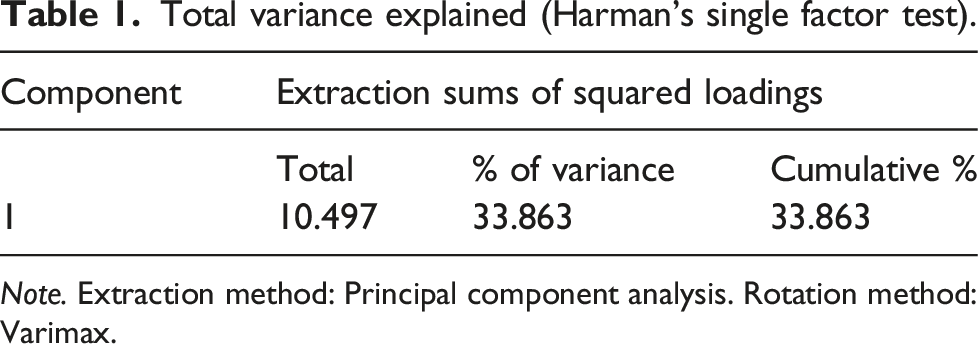
Note. Extraction method: Principal component analysis. Rotation method: Varimax.
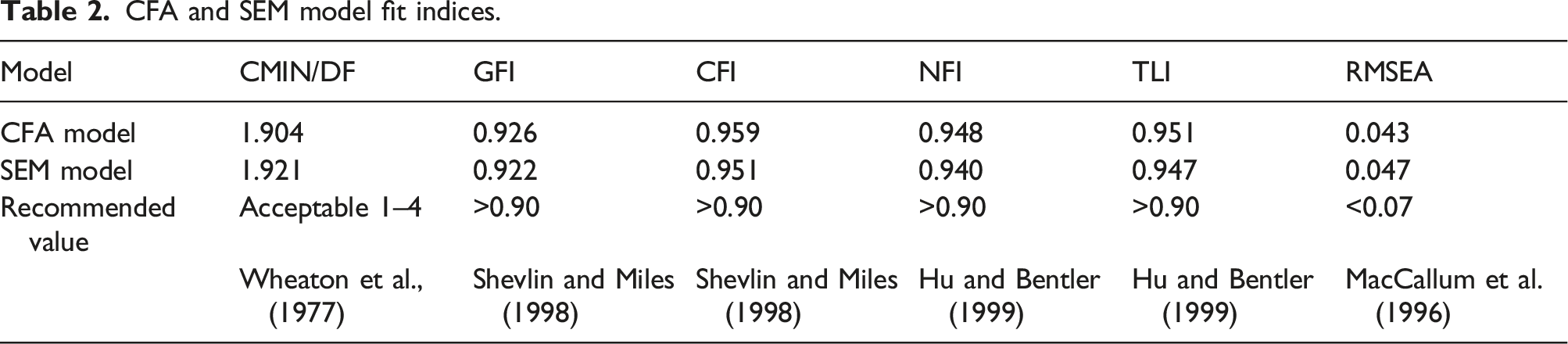
Subsequently, the study tested the model fitness, reliability and validity of the data; for this purpose, as noted in the next section, confirmatory factor analysis (CFA) was applied using AMOS (Anderson and Gerbing, 1988). Moreover, the hypotheses of the study were tested using structural equation modeling (SEM).
Results
Measurement model: Fit indices, reliability, and validity
CFA and SEM model fit indices.
CFA loadings, AVE, CR and Cronbach’s alpha.

Correlations, divergent validity, and descriptive statistics.
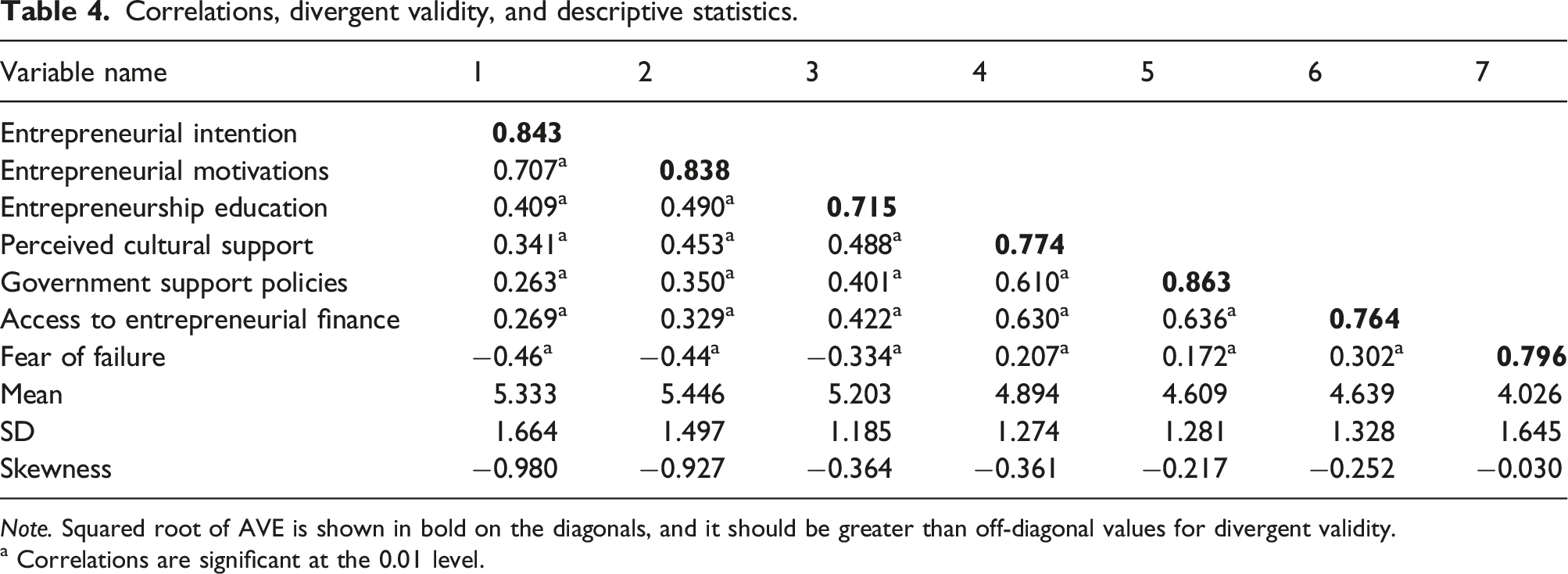
Note. Squared root of AVE is shown in bold on the diagonals, and it should be greater than off-diagonal values for divergent validity.
a Correlations are significant at the 0.01 level.
Hypothesis testing (direct effects)
Standardized direct effects and moderation effect.
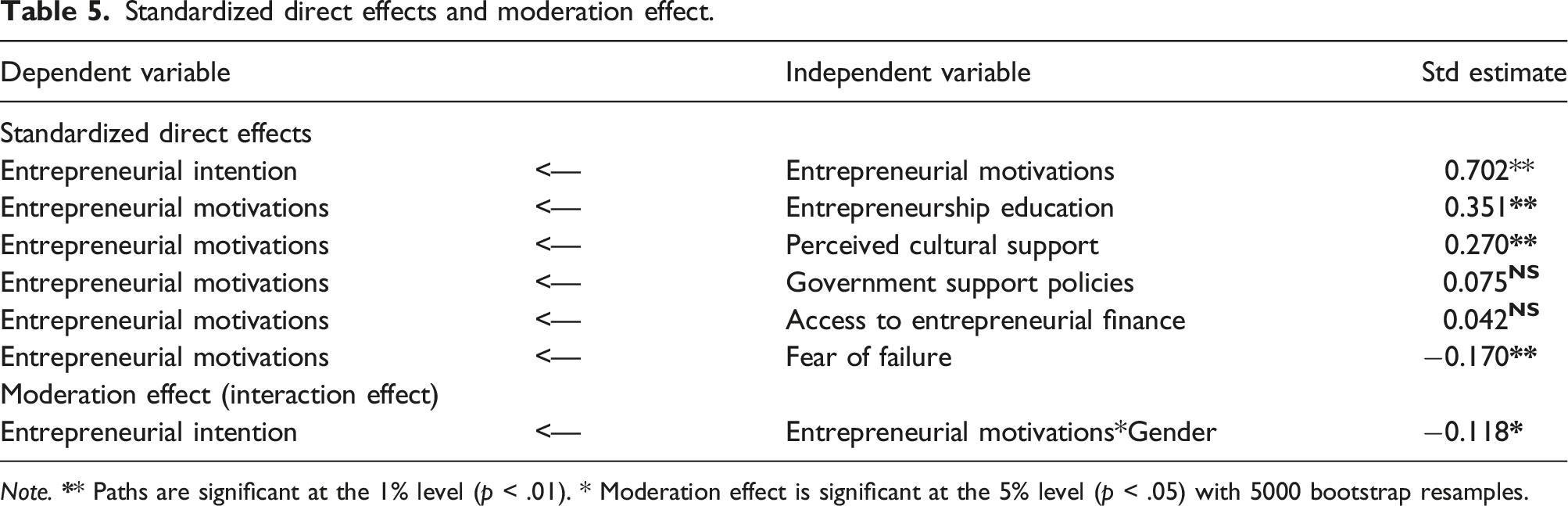
Note.
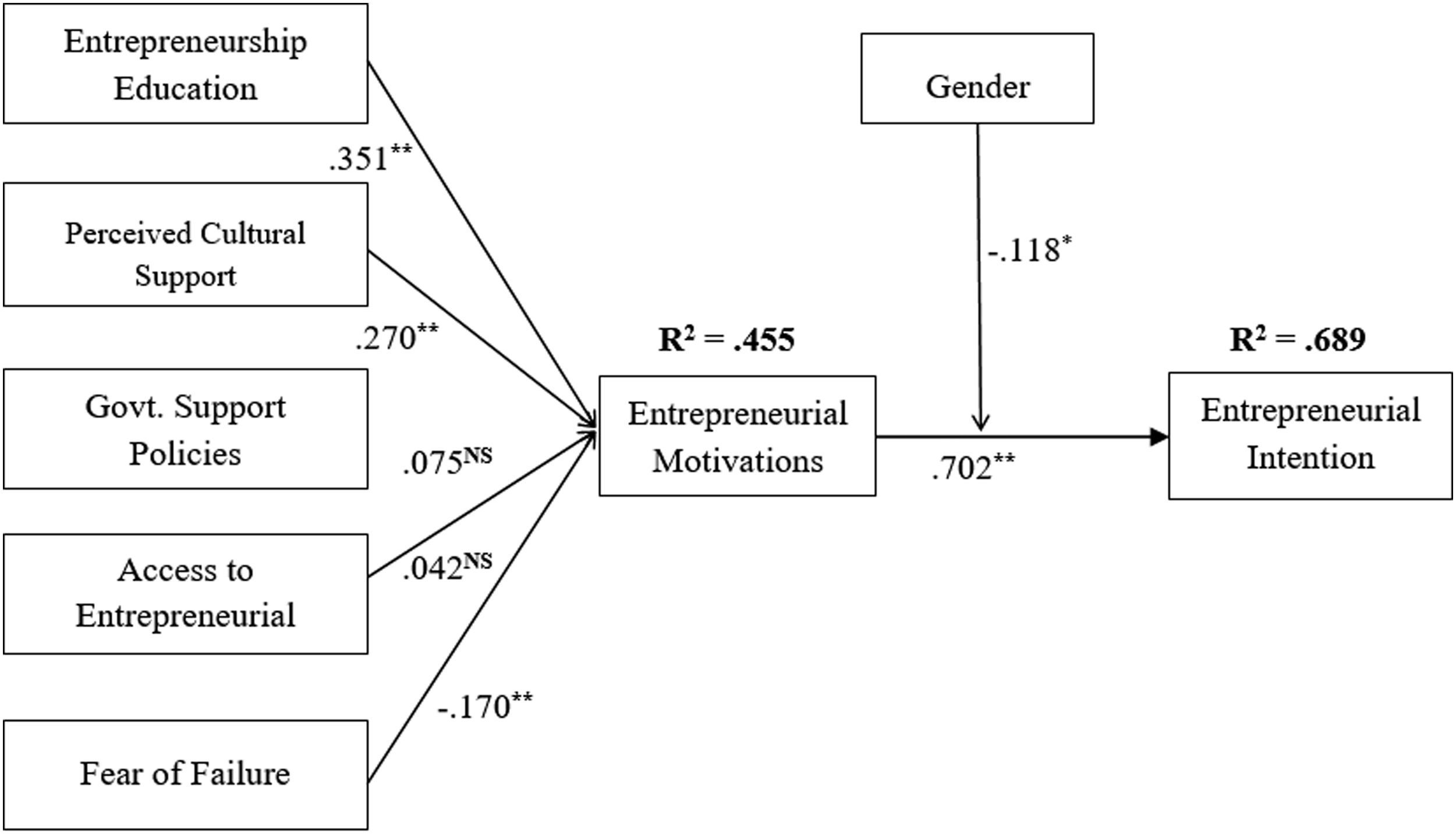
Tested model. Note: ** Paths significant at the 1% level (p < .01). * Paths significant at the 5% level (p < .05).
Moderation analysis (interaction effect)
The study also considered the moderating effect of gender on the entrepreneurial motivation–intention relationship in that males may exhibit a stronger association between their motivations and intention than females (hypothesis H7). The interaction effect was measured using model 1 in PROCESS Macro for SPSS v3.0 with 5000 bootstrap resamples and centered means (Hayes, 2017). The results in Table 5 indicate that gender negatively moderates the entrepreneurial motivation–intention relationship (with a standardized coefficient of −0.118) in such a way that it is stronger for males than for females, thus supporting H7.
Discussion
Our study shows how different psychological and contextual factors foster the entrepreneurial motivations of an individual, which in turn lead to the development of entrepreneurial intention. The findings indicate that in addition to the theoretical antecedents of dominant intention-based models like the Entrepreneurial Event Model (Shapero and Sokol, 1982) and the Theory of Planned Behavior (Ajzen, 1991), other psychological and contextual factors also play a vital part in determining entrepreneurial intention among students. This is consistent with the results of earlier studies (Al-Kwifi et al., 2020; Kristiansen and Indarti, 2004; Liñán et al., 2011; Zhang et al., 2019).
The results for the first hypothesis showed that entrepreneurship education plays a significant role in fostering the students’ entrepreneurial motivations, with a weight of 0.351. These results conform with those of earlier studies (Farhangmehr et al., 2016; Hassan et al., 2021; Jakubiak and Buchta 2016), denoting a strong correlation between the two and suggesting that the entrepreneurship education students are receiving in Indian universities can nurture their motivations to undertake an entrepreneurial activity. Therefore, it can be said that classroom-based entrepreneurship education (in the form of teaching theory-based entrepreneurial concepts, industry-based case studies and success stories of entrepreneurs) can enhance students’ entrepreneurial motivations and instigates them to pursue a career in entrepreneurship.
The second hypothesis, concerning the relation between perceived cultural support and entrepreneurial motivations, also shows a significant positive relationship with a weight of 0.270. The results for this hypothesis indicate that a supportive entrepreneurial culture acts as a motivation enhancer. This finding is consistent with existing studies such as those by Hofstede (1984) and Obschonka et al. (2012). Culture is predominant in influencing an individual’s behavior in choosing a particular career option. Thus, we can say that students in India perceive that favorable cultural support prevails in the country, and this support instigates their motivations to choose entrepreneurship as a career.
The third proposed relationship was between perceived government support policies and entrepreneurial motivations. The results showed an insignificant relationship, which is consistent with recent research results (Wu and Mao, 2020), but inconsistent with some earlier studies that find a significant positive impact on motivation enhancement (Garcia-Cabrera et al., 2018; Yao et al., 2016). This study’s finding suggests that students perceive very little support from the government, which is consequently a non-significant factor in driving their entrepreneurial motivations and the decision to undertake a new venture. Hence, the government should create support to help and encourage potential entrepreneurs and should inform universities about any relevant government schemes and policies regarding entrepreneurship.
In emerging economies like India, any individual who wants to pursue a venturing idea has to ask, “Where will I get the necessary funding?” and “Is there easy access to finance?” If there is easy availability of and access to finance, then individuals will be highly motivated (Garcia-Cabrera et al., 2018; Gathungu and Baariu, 2018; Kristiansen and Indarti, 2004; Welter, 2011) to pursue their ideas by undertaking an entrepreneurial activity (Farooq et al., 2018; Sandhu et al., 2011). However, the results for the fourth hypothesis showed a non-significant impact of access to entrepreneurial finance on students’ entrepreneurial motivations. This finding is inconsistent with the results of earlier studies (Eggers et al., 2013; Garcia-Cabrera et al., 2018; Wu and Mao, 2020; Yao et al., 2016) and indicates that access to entrepreneurial finance does not constitute any enhancement of an individual’s entrepreneurial motivations. One possible reason for this non-significant impact could be the unavailability of finance, or the difficulty of obtaining finance if it is available, for new graduates in developing countries like India.
Fear of failure showed a significant negative impact on individuals’ entrepreneurial motivations, which is consistent with the results of previous studies (Brixi et al., 2012; Cacciotti et al., 2016; Hessels et al., 2011; Wennberg et al., 2013). These results suggest that Indian university students have a fear of failure which could affect their entrepreneurial motivations and act as a constraint to undertaking a new venture. Thus, the less there is fear of failure among young people, the stronger will be their motivations to carry forward their ideas for venture creation.
The underlying motive behind undertaking an entrepreneurial activity glues an individual to the idea of venture creation and plays a significant role in determining entrepreneurial intention. In this study, the relationship between entrepreneurial motivations and entrepreneurial intention is found to be positively significant, with a strong weight of 0.609. This finding is consistent with earlier studies that show a significant positive relationship between the two (Barba-Sánchez and Atienza-Sahuquillo, 2017; Fayolle et al., 2014; Hassan et al., 2021; Schlepphorst et al., 2020; Solesvik, 2013), indicating that students with certain underlying motives, like independence, financial help and career desires, are more likely to start their own venture (Hassan et al., 2021). Hence, the government should reach out to university campuses and introduce awareness programs regarding their schemes and policies for individuals who want to choose entrepreneurship as a career. This will help to increase students’ confidence and will also create a favorable climate for entrepreneurs in the country, leading to the promotion of an entrepreneurial culture.
The finding for our final hypothesis, examining the moderating effect of gender on the entrepreneurial motivation–intention relationship, conforms with previous studies (Almobaireek and Manolova, 2013; Arshad et al., 2020; Humbert and Drew, 2010). This result indicates that the influence of entrepreneurial motivations on entrepreneurial intention is stronger for men, who are more likely to undertake an entrepreneurial activity. Women exhibit a weaker relationship between entrepreneurial motivations and intention, suggesting that they are less likely to start a venture than their male counterparts. One reason for this phenomenon could relate to a difference of approach between men and women: typically men are opportunity-driven while women are necessity-driven. If it is the case that there is a tendency in women to act only when necessary, they should be encouraged to reposition their entrepreneurial motivations through education that enhances their inducements for achievement (Cerqueti et al., 2020).
Implications
This study shows that entrepreneurship education and cultural support can act as vital antecedents in the venture creation process by enhancing entrepreneurial motivations. These findings have implications for Indian universities and the Indian government. The universities need to review the current curriculum by increasing student–entrepreneur interaction and focusing more on problem-solving and ideation processes rather than just imparting theoretical knowledge. The Indian government should also reach out to the universities by starting entrepreneurship awareness camps, diffusing information about the different funding avenues available for aspiring entrepreneurs and relevant government initiatives. This will foster the motivations of potential entrepreneurs, develop the entrepreneurial ecosystem, and help to create an entrepreneurial culture in the country. It is important that the government should spend more on educating young people by providing the necessary classroom entrepreneurship education and by creating awareness about its various schemes in support of entrepreneurship rather than simply creating them: the findings show that education can be an important tool to in motivating young people to embark on an entrepreneurial career.
Studies have also shown that fear of failure negatively impacts an individual’s motivation to become an entrepreneur. This is one of the main obstacles in the venture creation process. Indian universities need to focus on this aspect by providing clear insights for students into the venture creation process and by boosting their self-confidence through student–entrepreneur interaction and the sharing of entrepreneurial success stories. University-level entrepreneurship education can instill the confidence to overcome fear of failure by adopting real-life problem-solving methods (Hassan et al., 2021).
The findings of this study contradict the Global Entrepreneurship Monitor Report (GEM) 2020 (Bosma et al., 2020) with regard to various parameters. For example, the GEM India Entrepreneurial Framework conditions have shown that India scores well above the global average for parameters like government support policies and access to finance (Bosma et al., 2020). However, the findings of this study suggest otherwise. This contradiction could be because the GEM collects National Expert Survey (NES) data on these framework parameters from subject experts, policy-makers, etc., who are concerned with policy-making. In contrast, our study collected data from university students who are the potential beneficiaries of government policies and aspiring to become entrepreneurs. Hence, there is a need for policy-makers to focus on the ground-level situation and to ensure the appropriate implementation of policies and their accessibility to stakeholders.
Based on the suggestions of Humbert and Drew, (2010) and Arshad et al., (2020) to explore the entrepreneurial motivation–intention relationship from psychological, contextual and economic perspectives, with gender as a moderator, this study also adds to the literature on entrepreneurial motivation–intention relationship by considering the moderating effect of gender.
Limitations
The study has certain limitations. First, it is focused only on commerce and management students who have received entrepreneurship education. Future studies may focus on students from other disciplines to enable comparative analysis. Second, it examines students from Indian universities, making the findings mainly generalizable to other emerging economies. Further similar studies could be carried out in developed economies, which would help to validate the framework in similar economies. Third, only psychological and contextual variables have been used to predict entrepreneurial intention, which might not be sufficient. Future studies might add other cognitive, social and intellectual capital variables, which could strengthen the framework and help in better predicting entrepreneurial intention. Fourth, the study is based on a relatively small sample size of 329 respondents from only three universities, thus leaving scope for similar studies with a larger sample size from other universities and regions of the country. Finally, our study used cross-sectional data in predicting entrepreneurial motivations. The intention of students may not necessarily lead to actual behavior. Longitudinal empirical evidence would provide a better insight as the intention may change over time (Ephrem et al., 2019).
Conclusion
This study adds to the literature on the entrepreneurial motivation–entrepreneurial intention relationship. The results provide insights concerning the role of different psychological and contextual factors in fostering entrepreneurial motivations and their role in the entrepreneurial process. Entrepreneurship education influences entrepreneurial motivations positively, leading to the development of entrepreneurial intention. Perceived cultural support acts as a confidence builder by validating the underlying motives behind undertaking a new venture, paving the way for stronger entrepreneurial intention. Fear of failure hinders the entrepreneurial process by negatively influencing entrepreneurial motivations. Entrepreneurial motivations, highly correlated with entrepreneurial intention, are one of the significant precursors to entrepreneurial intention. The findings also show that gender negatively moderated the entrepreneurial motivation–entrepreneurial intention relationship. However, the influence of perceived government support and access to entrepreneurial finance were found insignificant in enhancing the entrepreneurial motivations of students, indicating that these factors do not play a significant role in determining the entrepreneurial intention of Indian university students.
Footnotes
Declaration of conflicting interests
The author(s) declared no potential conflicts of interest with respect to the research, authorship, and/or publication of this article.
Funding
The author(s) received no financial support for the research, authorship, and/or publication of this article.
