



Abstract
This study examines the relationship between the individual motivational characteristics of young scientists (i.e. PhD students and post-docs) and their entrepreneurial intention, exploring also the mediating role of their third mission orientation. For this purpose, the authors considered the knowledge spillover theory of entrepreneurship at the level of the individual and the Theory of Planned Behaviour. Having university scientists as the unit of analysis, they used structural equation modelling to survey a sample of 337 young scientists working in a major Italian university. The authors were able to empirically identify the importance of third mission orientation as a mediating variable between scientists’ motivational characteristics and their entrepreneurial intention. The entrepreneurial orientation is reinforced if scientists are also engaged in third mission activities. The findings offer valuable insights for policy makers and higher education managers to develop strategies that could enhance knowledge transfer activities and produce additional benefits for universities and societies.
Keywords
Universities play an important role in modern societies by delivering education to a significant portion of the population and by creating knowledge (Perkmann et al., 2013). Since the last decade of the 20th century, universities in Europe have moved from focussing only on research and teaching (traditionally the two core missions) to taking a more significant role in regional and economic development. This new role of the university, defined as the ‘third mission’, emphasizes knowledge transfer, innovation and commercialization (Lambert Review of Business-Industry Collaboration, 2003; Laredo, 2007; Zomer and Benneworth, 2011).
Research has proven that third mission activities such as university–industry collaborations are important for creating innovative spillovers (D'Este and Patel, 2007). Academics can also start new innovative businesses and create jobs. Roberts and Eesley (2011) conducted a survey on ‘Entrepreneurial impact: the role of MIT’. They found that the Massachusetts Institute of Technology had spawned 25,800 active companies by the end of 2006, offering jobs to 3.3 million people and annually generating 2 trillion dollars revenue around the world, an amount equal to the world’s 11th largest economy.
In a recent review of the literature on the engagement of academics in commercialization and university–industry collaborations, Perkmann et al. (2013) reported that 50% of such studies had been carried out in the USA, 14% in the UK and just 31% in all 28 European member states, with the rest of the world accounting for the remaining 5%. Thus, this topic must be further explored in the European region. Bercovitz and Feldman (2003) suggest the importance of focussing on the motivational characteristics of university scientists to increase their interactions with industry. We also need to learn which factors in academia increase these interactions and why. In addition, scientists’ entrepreneurial intention (SEI) is enhanced if they are engaged in knowledge transmission. This engagement allows academic entrepreneurs to better identify their own abilities and recognize new opportunities, making them more likely to decide to commercialize their ideas by creating new ventures (Qian and Acs, 2013).
A limited number of studies are available that investigate the university–industry relationship while considering university scientists as the unit of analysis (D’Este and Patel 2007; Landry et al., 2005; Bercovitz and Feldman 2003; Agrawal and Henderson, 2002; Louis et al., 2001). There are only a few studies that examine SEI (Guerrero and Urbano, 2014; Lee and Wong, 2004; Louis et al., 1989). Therefore, it is important to identify which characteristics of university scientists and their engagement in university–industry knowledge transfer significantly impact their decision to create a new venture.
In addition, prior studies of why academics become involved in entrepreneurship have emphasized university-level characteristics and ignored individual-level characteristics (Clarysse et al., 2011).
In this study we address two research questions: 1. Do university scientists’ motivational characteristics, such as their attitudes toward innovation, entrepreneurial culture, opportunity recognition and planning skills, enhance their entrepreneurial intention? 2. Does third mission orientation (TMO) mediate this relationship?
Therefore, a framework that considers knowledge transfer at the individual level is appropriate for measuring the phenomena of academic entrepreneurship and SEI (Bird and Schjoedt, 2009; Guerrero and Urbano, 2014; Krueger, 2000).
Accordingly, this research investigates how motivational characteristics impact the entrepreneurial intention of young scientists. We also examine the mediating role of scientists’ TMO between individual motivational characteristics and SEI, seeking to incorporate consideration of these mediation effects in our research model (Fayolle and Liñán, 2014). We build our research on SEI on a combined theoretical framework that includes the knowledge spillover theory of entrepreneurship (KSTE) and the Theory of Planned Behaviour (TPB). Integrating these two theories provides a strong theoretical basis on which to explain SEI, with the TPB explaining scientists’ perceived desirability and perceived feasibility and the KSTE supporting TMO in knowledge transfer.
This theoretical framework offers three research contributions. Firstly, our research contributes to the academic entrepreneurship literature, in which the exploration of the entrepreneurial intention of university scientists has been scarce (Guerrero and Urbano, 2014; Lee and Wong, 2004). Secondly, we examine scientists’ individual motivational characteristics that are correlated with their engagement with entrepreneurship. This relationship has received insufficient attention in the literature (Clarysse et al., 2011). Lastly, this study also contributes to the third mission literature. In particular, we have been able to empirically identify the importance of TMO as a mediating variable between scientists’ motivational characteristics and SEI.
The paper is organized as follows. Firstly, we discuss the importance of SEI, TMO and our research contributions. Secondly, we explore the background of TMO and build our research model grounded in the KSTE and TPB. After that, we present our research methodology and explain the findings of our empirically tested hypotheses. The last section contains a discussion of the results, their implications, the study’s limitations and future research directions.
Background and theoretical frameworks
Third mission orientation
In recent decades, policy makers have highlighted the importance of the third mission of universities. In response, various universities have initiated actions by fostering connections with industry and supporting technology transfer processes (Etzkowitz et al., 2000; Florida and Cohen, 1999; Gulbrandsen and Slipersaeter, 2007). The third mission is a concept that has been pursued for a considerable time, although in different forms. The notion of academic institutions engaging with industry and society is therefore not a new one.
The third core mission of the university emphasizes knowledge transfer, innovation and commercialization (Lambert Review of Business-Industry Collaboration, 2003; Laredo, 2007; Zomer and Benneworth, 2011), but there is no generally accepted definition (Secundo et al., 2017). However, it is important for scientists to know how their valuable research could be commercialized through patenting and new businesses (Carlsson et al., 2007).
Several studies have shown support for university–industry collaboration (Bishop, D’Este and Neely, 2011; Bierly et al., 2009; Etzkowitz and Leydesdorff 2000; Clark, 1998). For instance, Krabel and Mueller (2009) have shown that scientists with close ties to firms in the industrial sector have a strong entrepreneurial perspective, and scientists who have already cooperated with private firms in research projects are more alert to entrepreneurial opportunities. In another study, Shane (2002) posited that a good knowledge of the business environment contributes positively to the development of new discoveries and technological breakthroughs by academic scientists and leads to the identification of potential commercial opportunities. Previous research has shown that the interaction between scientists and firms gives the latter access to new knowledge that can complement their existing knowledge (Bercovitz and Feldman, 2006; March, 1991; Von Hippel, 1998). To successfully transfer the tacit component of this new knowledge, close reciprocal ties between scientists and firms are needed (Teece, 1985).
A substantial body of literature confirms a relationship between patenting and new venture creation (Jensen and Thursby, 2001; Landry et al., 2010; Shane, 2002; Siegel et al., 2003; Wright et al., 2007). Specifically, prior studies have investigated the relationship between patenting and the publication outputs of scientists. For example, when patenting and publishing complement and/or reinforce each other, patenting opens up new scientific opportunities, leads to new ideas and creates or contributes to maintaining scientific networks (Stephan et al., 2007). Although involvement in patenting and commercialization may not directly impact scientists’ academic careers, some scholars believe it can increase their prestige and reputation (Moutinho et al., 2007; Owen–Smith and Powell, 2001). There is, also, relative agreement that academic inventors publish more and better papers than their non-patenting colleagues (Agrawal and Henderson, 2002; Azoulay et al., 2007; Breschi et al., 2007). Patenting represents an initial step, indicating a willingness on the part of a scientist to exploit the research findings or invention.
However, prior invention experience, in terms of the time spent on inventing, developing patent applications and training, helps scientists to refine the routines in the invention process and increases their ability to navigate the steps involved in patent applications (Bercovitz and Feldman, 2008). Such experience also brings better knowledge of the risks associated with, and the complementary assets required for, the exploitation of opportunities through patenting and spin-off development (D'Este et al., 2012).
Theory of Planned Behaviour and scientists’ entrepreneurial intention
The model that has been widely used for predicting entrepreneurial intention and behaviour draws heavily on the TPB. Entrepreneurship models have typically been based on less robust, less predictive approaches using personality traits, demographics or attitudinal measures. According to Ajzen (1987, 1991), the TPB identifies three attitudinal antecedents of intention. The first two reflect an individual’s perception of the desirability of engaging in entrepreneurial behaviour. These are: (1) personal attitude toward the outcomes of the entrepreneurial behaviour and (2) the individual’s perception of social norms. The third antecedent of entrepreneurial intention is perceived behavioural control, which reflects the individual’s perception of the extent to which the entrepreneurial behaviour is personally controllable.
Knowledge spillover theory, third mission orientation and scientists’ entrepreneurial intention
The KSTE has been well discussed in the entrepreneurship literature. A literature review by Ghio et al. (2015) identified 52 articles using the KSTE that had been published in leading journals between 1999 and 2013. Guerrero and Urbano (2014) argue that three elements are required for the knowledge exchange process. The first is the ability to overcome existing barriers, such as bureaucratic administrative processes at the level of university government. The second is the scientists’ decision to convert their research findings into patents: their research findings can be commercialized through patent licensing to existing businesses or through the creation of a new venture. The third element is the contribution of knowledge transfer to economic development.
A review of the above literature suggests that universities involved in entrepreneurial processes need to pursue their three missions concurrently. Research commercialization through patent licensing and new businesses generates significant value for the economy (Guerrero and Urbano, 2012, 2014). Research has shown that some countries invest substantially in research and new knowledge transfer but experience relatively less economic development because they are engaged in fewer entrepreneurship-related activities (Audretsch et al., 2006; Audretsch and Keilbach, 2004).
Based on the above theoretical frameworks and literature we developed the research model shown in Figure 1. The model highlights the relationships between motivational characteristics, third mission orientation and entrepreneurial intention. Research model.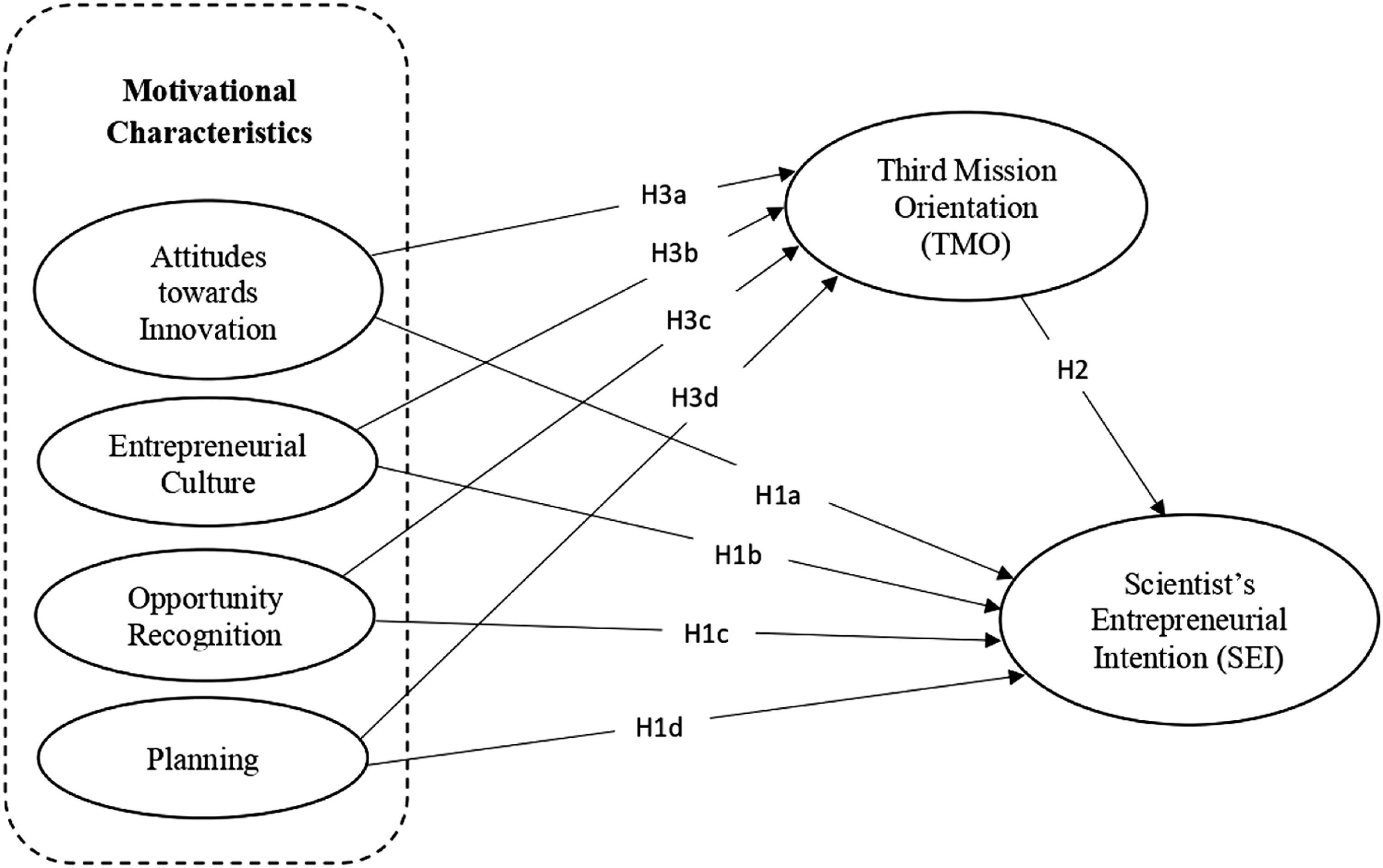
Relationship between scientists’ motivational characteristics and entrepreneurial intention
There are various models of entrepreneurial intention in the literature (Bird, 1988; Krueger and Brazeal, 1994; Krueger and Carsrud, 1993; Shapero and Sokol, 1982). According to some scholars, however, all of these models are based on Azjen’s TPB (Krueger et al., 2000; Peterman and Kennedy, 2003). The TPB considers three predictors of intention: attitude toward behaviour, subjective norms and control of the planned behaviour (Ajzen, 1987, 1991). We focus on the first predictor and examine how the attitude of university scientists toward innovation influences entrepreneurial intention. In this context, attitude toward innovative behaviour is a reflection of a scientist’s appraisal of innovative activities and can be placed along a continuum with favourable and unfavourable polar ends.
Additionally, skills and prior knowledge conceptualized as functions of scientists’ innovative abilities are also fundamental predictors of entrepreneurial intention. Several studies have demonstrated that the accumulation of a variety of skills, knowledge and experiences can influence entrepreneurial intention (Gupta and Govindarajan, 2000; Roberts and Fusfeld, 1981; Shane and Khurana, 2003). We included innovative attitudes in our model as we believe that these attitudes influence SEI. For innovative attitudes we formulated three statements referring to knowledge transfer, observation of products and product improvements.
In the 21st century, economies have witnessed the power of innovation and entrepreneurship in revolutionizing the business and economic landscape. However, it is noteworthy that there are significant differences in the entrepreneurial activities of economies. These differences can be partially attributed to entrepreneurial culture, which influences the entrepreneurial readiness or capability of entrepreneurs (Teece, 2009). Entrepreneurial culture can be divided into three components: (1) the cultural stock that comprises the entrepreneur’s personal qualities and educational background (Chell et al., 1991; Kirzner, 1979); (2) the behavioural characteristics that enhance the development of personal knowledge and the acquisition of abilities to exploit entrepreneurial opportunities (Minguzzi and Passaro, 2001) and (3) contextual factors such as natural culture and traditions, the legal framework, the political system and the economic environment (Berger, 1991). Scholars argue that a combination of these factors affects the emergence of researchers’ entrepreneurial intention (Kickul et al., 2009; Zhao et al., 2005). A supportive entrepreneurial culture enhances the recognition and exploitation of new ideas (Lee and Peterson, 2000), which in turn favours scientists’ attempts to embark on entrepreneurship. The presence of a supportive entrepreneurial culture is therefore crucial in unleashing the entrepreneurial capability of scientists.
Self-efficacy is a measure of what individuals believe they are able to accomplish using their own skills under certain conditions and situations (Snyder and Lopez, 2007). It is normal for individuals to choose to perform behaviours they think they will be able to control and master (e.g. starting a new venture). Self-efficacy has replaced perceived behavioural control in some studies (Kolvereid and Isaksen (2006); Krueger et al., 2000), and a meta-analysis conducted by Rauch and Frese (2007) found that it was strongly positively related to entrepreneurial success. Self-efficacy entrepreneurial theory posits that individuals with high entrepreneurial self-efficacy are more likely to engage in entrepreneurial activities (Van der Bijl and Shortridge–Bagget, 2002).
Researchers must strategically plan their activities in detail before embarking on entrepreneurship. However, most of the literature on academic entrepreneurship has focused more on factors such as patenting, the creation of spin-offs and the institutional context of universities rather than the individual strategies and plans adopted by scientists (Rolfo and Finardi, 2014). The more important the goals are, the greater is the need to plan thoroughly (Gollwitzer, 1996). Planning enhances the ability to attain the goals and increases resilience in the face of hurdles. We therefore propose the following hypothesis:
University scientists’ (a) attitudes toward innovation, (b) entrepreneurial culture, (c) self-efficacy in opportunity recognition and (d) self-efficacy in planning are positively related to their entrepreneurial intention.
Relationship between third mission orientation and scientists’ entrepreneurial intention
The TMO is meant to advance the way universities scientists engage with industry and society. Evidence from empirical literature suggests that the entrepreneurial activities of scientists depend heavily on their engagement with and personal ties to industry (Etzkowitz, 2003; Krabel and Mueller, 2009). One of the activities of the third mission is based on the interaction between scientists and industrial and societal audiences (Spaapen et al., 2007), and this interaction can enhance entrepreneurial commitment. Models developed by Shane (2004) and Vohora et al. (2004), which offered new perspectives on scientists’ entrepreneurship, have further explained the relationship between TMO and entrepreneurial activities. It is also evident that scientists should comply with societal norms when it comes to involvement with entrepreneurship activities (Bercovitz and Feldman, 2008).
Different theoretical viewpoints have been advanced to explain the activities of academics under the TMO. Firstly, from an agency theory perspective, there is an assumption that each party acts in its own self-interest, which gives rise to the agency problem (Siegel et al., 2003), in which the interests of scientists and the university may conflict, which may in turn affect SEI. Secondly, to understand entrepreneurship in an organized context, institutional theory could be helpful. The influence of the institutional context in researchers’ entrepreneurial activities is shown by the differences in the numbers of academic entrepreneurial ventures created by different universities (O’Shea et al., 2008). Thirdly, knowledge spillover theory is based on the assumption that the individual characteristics of scientists related to entrepreneurship are constant, while the context varies. In this perspective, entrepreneurship is seen as a mechanism to facilitate the spillover of knowledge (Audretsch et al., 2005). In the current work, our focus is on entrepreneurial opportunities based on new knowledge and ideas. We have selected knowledge spillover theory to examine the relationship between the TMO and the SEI.
Knowledge spillover theory views entrepreneurship as an endogenous response to investments in new knowledge made by organizations – in this case universities – combined with the difficulties in commercializing the knowledge. Hence, knowledge spillover theory shifts the decision making to embark on entrepreneurship from the university to individuals such as scientists. The TMO enhances the commercialization of new knowledge through scientists’ entrepreneurship. Since the third mission is considered to be a pathway to enhance SEI, we propose the following hypothesis:
The TMO of university scientists is positively related to their entrepreneurial intention.
Relationship between scientists’ motivational characteristics, third mission orientation and entrepreneurial intention
The increasing attention given to the production and transfer of knowledge and technology from universities to industry and society has provoked changes in the traditional structure of universities, establishing what is commonly referred to as the third mission (Gulbrandsen and Slipersaeter, 2007). Extensive research has explored universities’ adoption of this mission (Etzkowitz and Leydesdorff, 2000; Van Looy, Ranga, Callaert, Debackere and Zimmermann, 2004). In the beginning, the TMO at the individual level was facilitated by personal relationships between academics and industry, as there were few dedicated structures (Geuna and Muscio, 2009). Today, most universities have created such structures to effectively manage third mission processes. These entities are expected to encourage academics to consider exploiting entrepreneurial opportunities resulting from their research and to support them in doing so O'Gorman et al., 2008; Siegel et al., 2004). These processes, at the institutional level, are also intended to increase the TMO of scientists and thus their entrepreneurial intention.
Knowledge spillover theory holds individual motivational characteristics constant while varying the knowledge context. This can help in understanding how a person can maintain entrepreneurial intention while operating in different knowledge contexts (Audretsch et al., 2005). Entrepreneurial intention allows a potential academic entrepreneur to recognize opportunities in new knowledge and to decide to commercialize such knowledge by starting a new venture (Qian and Acs, 2013). Prior studies have highlighted that academic entrepreneurs are able to identify specific entrepreneurial opportunities and that this ability is based on knowledge, position and time (Holcombe, 2003). In the process of knowledge transformation, numerous filters control the conversion of academic knowledge into beneficial economic knowledge such as new products and organizations (Carlsson et al., 2007; Mueller, 2007).
The emergence of entrepreneurship in the TMO appears to be more dependent on motivational characteristics than on formal university structures – hence, the relationships among motivational characteristics, TMO and SEI have emerged as crucial. To consider the holistic manner in which the TMO influences these relationships, we posit the following hypothesis:
The TMO of university scientists acts as mediator of the relationship between SEI and (a) attitudes toward innovation, (b) entrepreneurial culture, (c) self-efficacy in opportunity recognition and (d) self-efficacy in planning.
Methodology
This research draws on an empirical analysis of a sample of 337 scientists (pre-doctoral, doctoral and postdoctoral researchers) at University of Padova in Italy. The authors designed an online questionnaire and tested it through a successful pilot. To consider the variability and representativeness of responses, respondents were selected from all the schools of the University of Padova. The questionnaire was sent to 2616 scientists by the university’s central administration. Two reminders were sent to those who had not responded. A total of 385 responses were received, 48 of which were discarded due to incomplete information, resulting in 337 complete questionnaires, or a response rate of 13%.
The average age of participants was 30.4 (range 24–54). These scientists were in a phase of their professional career that allowed them to make mature career choices. In terms of their research experience, 42% identified as postdoctoral, 36.7% were in doctoral programs and the remaining 21.3% were pre-doctoral. The highest response rate, 28.5%, was received from the School of Science, followed by the School of Engineering at 26%, the School of Agriculture and Veterinary Medicine at 12.7%, the School of Medicine at 9.2%, the School of Human and Social Sciences at 8.9%, the School of Economic and Political Science at 7.4% and, lastly, the School of Psychology at 7.1%. Moreover, 45% of respondents were female and 55% were male, which confirms a balance between genders.
To limit the common method bias, we tested the collected data by considering initial and delayed respondents to the questionnaire (Chen and Paulraj, 2004). By applying t-tests, we verified that no significant differences existed in our data sample and that method bias was not a significant concern. We also examined common method bias using Partial Least Square (PLS) Structural Equation Modelling (SEM). Adopting Kock’s (2015) approach, we examined the Variance Inflation Factor (VIF) value. This analysis assesses whether the full collinearity outcomes are equal to or lower than 3.3, indicating that there is no common method bias. We examined all study factors and none exceeded a VIF of 3.3. The outcomes of these examinations validated the sample for further statistical analysis and confirmed that common method bias was not a substantial problem in this sample.
To test our research hypothesis, we used PLS (Smart PLS 3.2), which is an SEM technique (Ringle et al., 2015). Two sub-models are associated with the single PLS model: (1) the measurement model, which scrutinizes each latent variable’s relationship with its block of constructs, and (2) the structural model, which deals with relationships of constructs. Since our study is predictive in nature, we considered PLS to be preferable to any other SEM technique (Hair et al., 2014).
Measurement variables
Results of confirmatory factor analysis (CFA).

To measure the TMO, we used three statements from the literature (D’Este et al., 2012; Zomer and Benneworth, 2011; Carlsson et al., 2007; Bishop et al., 2011; Landry et al., 2010; Wright et al., 2007), each with a 7-point Likert scale (from 1 = totally disagree to 7 = totally agree), which clearly represent the scientists’ ability to transfer knowledge and to secure innovative outcomes using patents. This process provided a Cronbach’s α of 0.605, which was below the threshold limit. To solve this problem, we followed Hair, Black, Babin, Anderson and Tatham’s (2006) suggestion that the CR value should be considered in conjunction with SEM to address the tendency of Cronbach’s α to underestimate the reliability. In this respect, Nunnally and Brenstein (1994) suggested that a CR of 0.70 or greater is satisfactory, and Hair et al. (2014) recommended an AVE score of 0.50 or higher as acceptable. Therefore, with a Cronbach’s α of 0.605, a CR of 0.779 and an AVE of 0.548, the construct provided a consistent scale for analysis.
Previous research was utilized, in particular belief-based measures, for personal attitudes (Kolvereid, 1996). To measure scientists’ attitudes toward innovation, we used three statements (see Table 1). Nunnally (1978) recommended multi-item scales as more appropriate than single-item scales. In this respect, we measured attitudes toward innovation using three items on a 7-point Likert scale (from 1 = totally disagree to 7 = totally agree). All three items validated the construct for analysis with a Cronbach’s α of 0.777, a CR of 0.870 and an AVE of 0.691.
In this study, we also consider entrepreneurial culture as one of the key variables that affect SEI. Entrepreneurial culture includes beliefs, opinions, rules, shared values and norms mutually held by founders when creating a new venture (Fletcher et al., 2012; Zahra et al., 2004). In addition, personal social networks constitute a knowledge creation and exploitation mechanism for academics (Autio et al., 2001; Krueger et al., 2000).
We measured entrepreneurial culture with three statements that closely represent the culture (see Table 1) using a 7-point Likert scale (from 1 = totally disagree to 7 = totally agree). All factor loadings were between 0.61 and 0.83, giving an unsatisfactory Cronbach’s α of 0.585. To solve this problem, following Hair et al.’s (2006) recommendation, we checked the CR and AVE values. A CR value of 0.770 and an AVE value of 0.530 provided evidence of a reliable construct.
Another important factor for our study is entrepreneurial self-efficacy. (Stevenson et al., 1985) proposed a ‘process model’ divided into four aspects of entrepreneurial self-efficacy: (1) searching, (2) planning, (3) marshalling and (4) implementing. This model has frequently been used in subsequent research (e.g. McGee et al., 2009). We used two elements of this self-efficacy construct: searching, as opportunity recognition, and planning. Both constructs were measured on a 7-point Likert scale (from 1 = very low to 7 = very high). Research has demonstrated a positive relationship between self-efficacy and entrepreneurial intention (e.g. Zhao et al., 2005). Following McGee et al. (2009), we used three statements for opportunity recognition (see Table 1) which represent the scientists’ level of confidence in their ability to identify an opportunity and develop an idea. The opportunity recognition construct was satisfactory, with a Cronbach’s α of 0.886, a CR of 0.929 and an AVE of 0.814. Another aspect of self-efficacy is planning, which describes how entrepreneurs transform an opportunity into an achievable business plan. We measured planning using four statements (see Table 1) that had been employed by McGee et al. (2009). For the planning construct, we obtained the following values: Cronbach’s α = 0.902, CR = 0.932 and AVE = 0.773. These values indicate good reliability for the analysis.
Results
Appraisal of measurement model
Correlation matrix.

Measurement model evaluation.
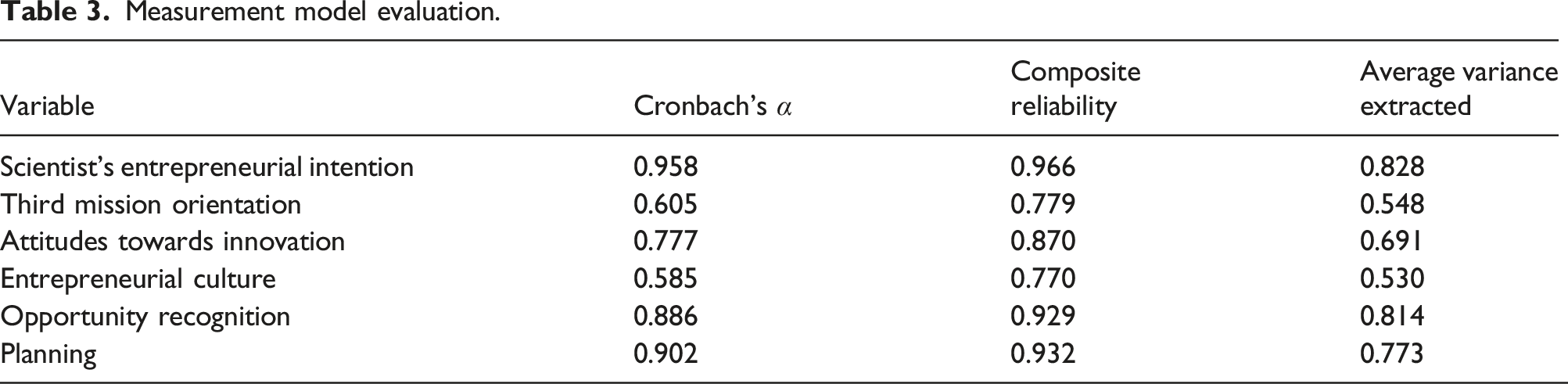
The convergent validity of constructs was investigated by ensuring that the score of 0.7 or more for Cronbach’s α and for CR was satisfactory (Nunnally and Bernstein, 1994). Moreover, research has suggested that an AVE value higher than 0.5 is adequate for a study (Chin, 2010; Hair et al., 2014). In addition, we assessed multicollinearity (the VIF) for all study variables. None of the VIF values exceeded the required level of 10.00. Bowerman and O’Connell (1990), indicating that multicollinearity was not a concern. Based on the above discussion and the explanation of the measurement model, we can say that the research results are reliable.
Appraisal of structural model
Results of structural model.
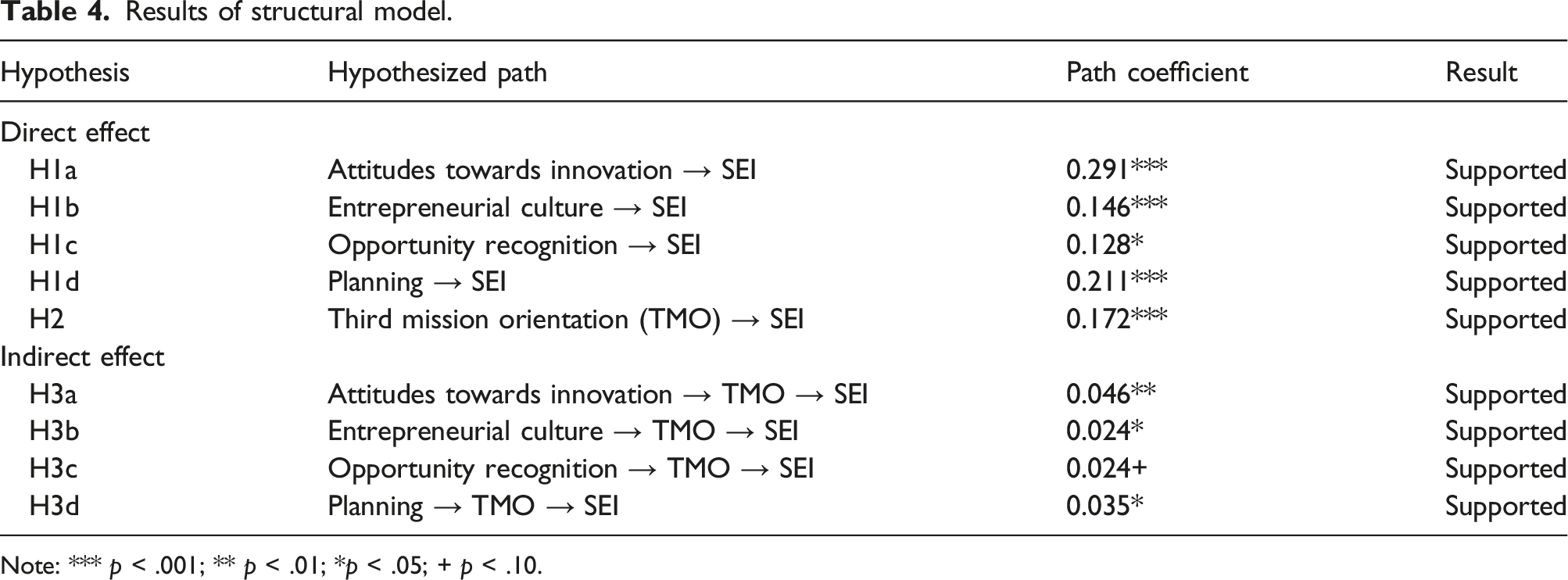
Note: *** p < .001; ** p < .01; *p < .05; + p < .10.
The f2 values offer an indication of the relative impact of each variable on the other variables in the model. Hair et al. (2014) highlighted that a value of f2 = 0.02 is associated with a small effect, f2 = 0.15 indicates a medium effect, and f2 = 0.35 shows a large effect. In our model, a small effect (0.02) was seen for the association between opportunity recognition and TMO, while a large effect (0.10) was seen for the association of attitudes and SEI.
In addition, to examine the predictive relevance of our proposed model, we performed Stone’s (1974) Q2 test to assess how efficiently the path model forecasted the originally observed values. The value of Q2 for the dependent variable in our study was greater than 0, and this is considered adequate (Hair et al., 2014). Moreover, we used the standardized root mean square residual (SRMR), which represents the standardized difference between the predicted correlation and the actual correlation. In our model, the SRMR value was below the limit of 0.08 which defines a satisfactory model fit (Henseler et al. 2016).
Figure 2 presents the results of our research model. All the hypothesized relations in the model were found to be significant. The results indicate a positive relationship between SEI and attitudes toward innovation (β = 0.291, p < .001), entrepreneurial culture (β = 0.150, p < .001), self-efficacy in opportunity recognition (β = 0.129, p < .05) and self-efficacy in planning (β = 0.213, p < 0.001). These findings support our hypotheses H1a, H1b, H1c and H1d, respectively. The mediator variable TMO was positively and significantly related to SEI (β = 0.172, p < .001), providing support for H2. We also explain the relationships between the mediator variable and independent variables, although these relationships are not part of our hypothesized relations. Our results show a positive relationship between TMO and attitudes toward innovation (β = 0.268, p < 0.001), entrepreneurial culture (β = 0.139, p < .01), self-efficacy in opportunity recognition (β = 0.138, p < .05) and self-efficacy in planning (β = 0.204, p < .001). Results of research model. Note: *** p < .001; ** p < .01; *p < .05; + p < .10.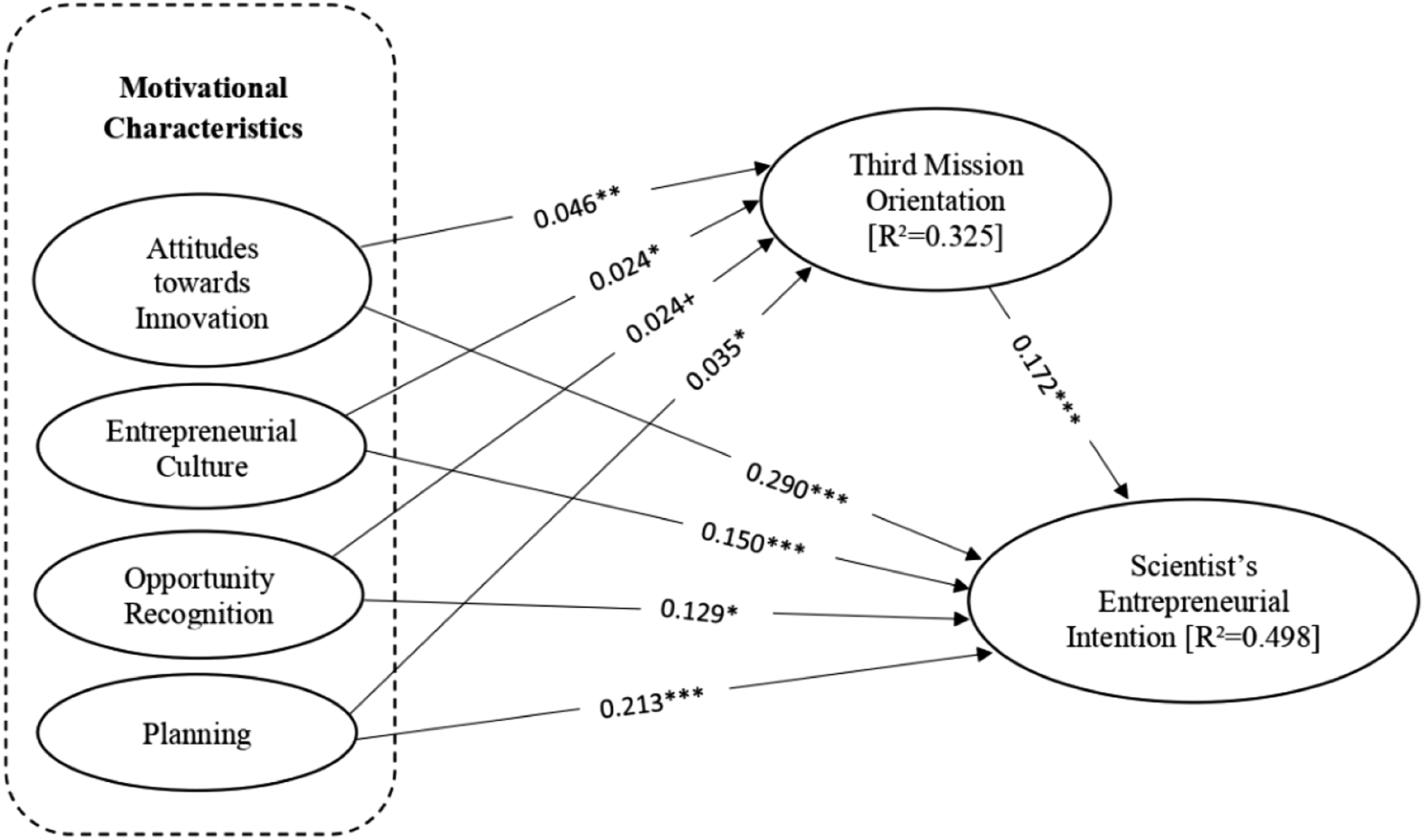
Hypotheses 3a–3d propose indirect effects of the independent variables on SEI through TMO. The outcomes of our model indicate that TMO does positively mediate the relationship between SEI and attitudes toward innovation (β = 0.046, p < .01), entrepreneurial culture (β = 0.024, p < .05), self-efficacy in opportunity recognition (β = 0.024, p < .10) and self-efficacy in planning (β = 0.035, p < .05). To further verify our mediation results, we followed Sobel’s (1982) suggestion. Sobel’s test of mediation confirms that the TMO of university scientists mediates the influence on SEI of individual motivational characteristics such as (1) attitudes toward innovation, (2) entrepreneurial culture, (3) opportunity recognition and (4) planning, providing partial support for hypotheses 3a, 3b, 3c and 3d.
Additional analysis
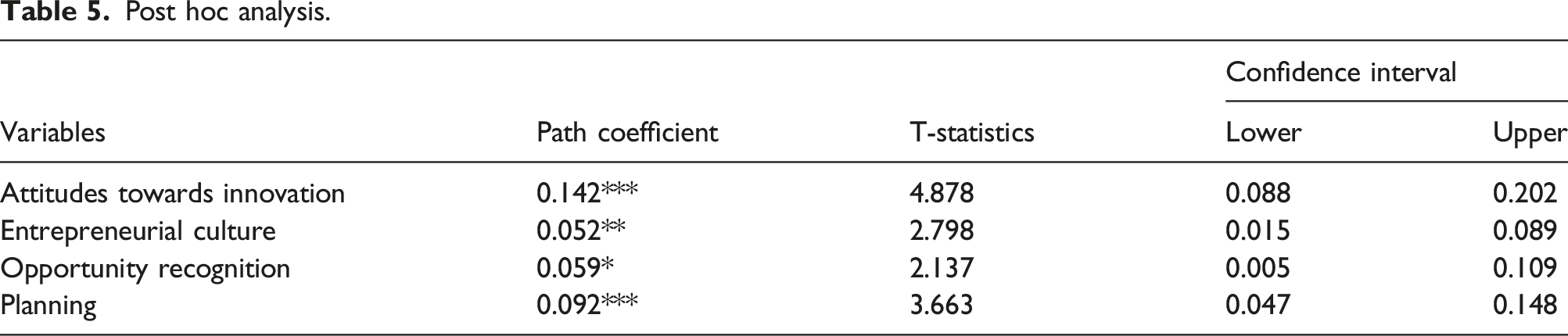
Post hoc analysis.
Discussion
In this study we addressed two research questions: 1. Do university scientists’ motivational characteristics, such as their attitudes toward innovation, entrepreneurial culture, opportunity recognition and planning skills, enhance their entrepreneurial intention? 2. Does third mission orientation (TMO) mediate this relationship?
Building on the KSTE and TPB frameworks and employing SEM, we proposed and tested nine hypotheses using survey results from a sample of 337 early career scientists in an Italian university. Our findings support our hypotheses. We also performed an additional analysis to verify the validity of our results; the post hoc analysis results were similar to those obtained from the main analysis.
Scholars have tended to focus much more on the entrepreneurial intentions of university students than on the entrepreneurial intentions of scientists. Moreover, while there has been extensive coverage of the various motivational characteristics of entrepreneurs. Douglas et al. (2021), most studies have collected their data from university students (e.g. Delanöe–Gueguen and Liñán, 2019; Liñán and Fayolle, 2015; Meoli et al., 2020; Shinnar et al., 2018), and the current research, to our knowledge, is the first to examine scientists’ motivational characteristics towards SEI and the role of TMO. Spaapen et al. (2007) suggest that interaction between scientists and industrial organizations can encourage entrepreneurial activities. In a more recent study, Huyghe et al. (2016) find that a scientist’s passion with regard to entrepreneurial activities increases their intentions and so the chances of a start-up, and that this relationship is mediated by the entrepreneurial self-efficacy.
Hypotheses 1a–1d claim that scientists’ motivational characteristics have positive effects on SEI. The findings supporting H1a show that attitudes toward innovation positively affect SEI. Attitudes toward innovation can be articulated through certain creative behaviours, and the innovative attitudes of scientists motivate them to create new businesses. Hypothesis H1b suggests a positive relationship between entrepreneurial culture and SEI. Organizational culture is an important factor that helps define human behaviour. Our hypotheses 1c and 1d, that opportunity recognition and planning are positively linked with SEI, were also supported. If university scientists can recognize promising opportunities and are able to develop a solid plan, they are more likely to initiate a new business. Thus, our findings support our theoretical concept and provide evidence that strong motivational characteristics in university scientists increase the chances that they will create a new venture.
Hypothesis 2 posits a positive relationship between TMO and SEI. If scientists are engaged in one or more third mission activities in addition to the two other core missions of universities (research and education), they may be more entrepreneurially oriented. Our results suggest that, if university scientists are engaged in industry collaboration, knowledge transfer activities and patenting their research results, they are more likely to be involved in venture creation. Hypothesis 3a indicates that the relationship between scientists’ attitudes toward innovation and SEI is mediated by their TMO. If scientists have a positive attitude toward innovation, defined as translating scientific knowledge into new products and services, they are also more entrepreneurially oriented. This entrepreneurial orientation is reinforced if they are also engaged in third mission activities. Results supporting Hypothesis 3b indicate that TMO mediates the relationship between scientists’ entrepreneurial culture and SEI. In other words, the TMO of university scientists reinforces the elements of individual entrepreneurial culture; in this way, TMO can also increase entrepreneurial intention. The results relating to Hypotheses 3c and 3d confirm that the relationships of SEI to opportunity recognition and to planning are also mediated by TMO. If scientists are more involved in third mission activities, they can strengthen their ability to recognize opportunity and improve their planning skills. In this way, they can increase their entrepreneurial intention. This research contributes to both the academic entrepreneurship literature and the university third mission literature. The study’s primary objective was to examine SEI (Guerrero and Urbano, 2014; Lee and Wong, 2004; Louis et al., 1989). We also assessed the role of TMO as an important factor that impacts the relationship between scientists’ motivational characteristics and their entrepreneurial intention.
Conclusions and implications
Our research offers some important policy implications. We analysed the TMO of scientists at the individual level, and this variable proved to be important in influencing entrepreneurial intention and thus new venture creation within a university. This has implications for university policies. If universities want to increase their performance in new venture creation, they must first improve their collaboration with industry – that is, their third mission-related activities. For universities, it is important to encourage third mission activities carried out by their scientists, and scientists should clearly perceive that third mission activities are important not only for themselves but also for their institution.
Since the first decade of the 21st century, universities have been rethinking their social and economic role. In particular, they have increasingly focused on their impact on economic development. This is manifest in the greater emphasis on third mission activities and academic entrepreneurship. For university governance, it is important to reinforce the economic value of entrepreneurial initiatives. This requires significant change in the overall strategies of universities traditionally focused on the first two core missions.
This study is not without its limitations. Despite its contribution to the area of academic entrepreneurship, the study’s evaluation of TMO and SEI has several limitations that suggest a future research agenda. First, the selection of appropriate elements for measuring TMO remains problematic, because no general definition for third mission is available (Secundo et al., 2017). Therefore, the challenge of defining and validating the elements of TMO persists. Second, we investigated interactions of motivational characteristics at the individual level, but scientists are also influenced by the university-level environment. For this reason, further studies researching entrepreneurial intention in academia should examine the influence of supervisors, departments and university-related elements. Supervisors may or may not encourage young scientists to have a positive attitude towards business creation and may or may not discourage any attempt to do so. Similarly, policies at the departmental and university levels may or may not convey the importance of enterprise creation.
Moreover, we need to extend the research to other universities in different regions to better understand university and regional environmental issues. The presence of a strong industrial context oriented towards technological innovation can improve the propensity of scientists to create new ventures, since the enterprises already present in a territory may provide strong support for younger companies.
It might be also interesting to investigate the role of motivational characteristics in different contexts, such as in research centres and companies, to understand whether scientists in these contexts are more interested in starting a new business than scientists in academia. A relevant aspect is the policy of the institution regarding enterprise creation. Among the criteria for measuring the performance of a research centre there might be not only the number and quality of publications but also an explicit policy for business creation. It should be kept in mind that publication and patenting are not compatible if they are not performed in a correct sequence; that is, first patenting and then publication. The institution must therefore explicitly encourage and support patenting, which is very often the basis for the creation of a new company.
Footnotes
Declaration of conflicting interests
The author(s) declared no potential conflicts of interest with respect to the research, authorship and/or publication of this article.
Funding
The author(s) received no financial support for the research, authorship and/or publication of this article.
