



Abstract
University–business collaboration in doctoral education has been promoted by governments and universities. In contexts where there is limited contact between the academic and business sectors, individuals and their social capital might play an important role in the formation and success of such partnerships, including the frequency of interaction and continuity of partnerships. Here, data from a survey of directors of doctoral programmes in Portugal were used to explore these aspects. The social capital of the directors seems to increase both the intensity and continuity of collaboration, especially in scientific fields considered to be more distant from companies and in which university–business collaboration is less common. Previous collaboration will create relational capital, resulting in mutual knowledge and trust which, in turn, lead to more intense and sustainable collaboration. Academic experience with companies—reflecting cognitive aspects of social capital—increases the diversity of university–business collaboration in doctoral programmes, while also reinforcing the possibility of long-term collaborations. The findings indicate that academics’ social capital is an important factor in determining the success of collaborative doctoral education, and should be taken into account when designing and supporting collaborative doctoral programmes.
Keywords
In recent decades, strengthening the links between universities and companies has become a major ambition in research and higher education policy. It is well-known that university–business relations are embodied in a range of varied forms depending on the features of disciplines (D’Esteand Patel, 2007), industry and company characteristics (BekkersandFreitas, 2008) and the experiences and skills of the actors themselves (Gulbrandsenand Thune, 2017). Forms of collaboration range from formal agreements over the transfer of intellectual property and large-scale research partnerships to informal networks of different types. Whereas most attention has been put on collaboration activities connected to research and technology transfer, recent research has also addressed collaboration related to the training, education and mobility of people and knowledge across sectoral boundaries (Perkmann et al., 2021).
One area of interest in recent research on university–business relationships has been collaboration in doctoral education. Although not a recent phenomenon, as programmes to support collaborative doctoral education have existed for decades, many initiatives and programmes have been set up by governments and universities more recently to support these connections on a larger scale (Cardoso et al., 2019; EUA, 2015). The ambitions of such programmes are to train future researchers in areas that are highly relevant to companies, to foster the mobility of people and ideas across boundaries, and to develop relevant professional skills among PhD graduates (AssbringandNuur, 2017).
Collaborative doctoral programmes were first developed in technology and engineering disciplines, such as the industry PhD schemes operating in several countries. More recently, programmes have broadened to encompass a wider set of fields, including health and biomedical sciences and the humanities and social sciences (EUA, 2015). The latter scientific fields may, however, have other interests and opportunities and may be more oriented towards collaboration with the public and non-profit sectors (Olmos-Penuelaet al., 2014).
There is a variety of models for collaborative doctoral education (Bao et al., 2018). Arrangements include formal models, such as the creation of joint doctoral programmes and internships for doctoral students, and informal models that include collaboration connected to data collection and the use of facilities, supervision and teaching, and collaboration connected to the communication and sharing of knowledge generated by doctoral students with companies (Santos et al., 2020).
In this paper, we emphasize that collaboration in doctoral programs consists of different forms of interaction. These include both formal and informal forms of collaboration between academic and business actors in the doctoral programs. Most prior studies have focused on formal collaborations, such as industry PhD programmes, with less emphasis on informal modes. This study broadens the scope to a wider set of collaboration models.
Moreover, we emphasize that different models of collaboration are not exclusive and are often combined (Santos et al., 2020). Collaborations also evolve over time, and informal connections tend to be stepping-stones towards more formal, long-term collaboration (Gustavsson et al., 2016; Thune, 2009). Studies have found that university–company collaboration frequently begins with personal initiatives and is often based on previous personal relationships (Malfroy, 2011; PaierandScherngell, 2011). Previous research has also found that individuals and personal connections play an important role in the establishment of collaborative doctoral education (Borrell-Damian, 2009; Butcher and Jeffrey, 2007; Thune, 2010). This also implies that it is important to understand the roles of individuals in university–business collaboration (Al-Tabbaa and Ankrah, 2018; Bercovitz and Feldman, 2008).
Drawing on research on university–business collaboration and social capital theory, this article addresses whether the ‘social capital’ (Bourdieu, 2006 [2000]) of individuals influences university–business collaboration in doctoral education. In particular, we are interested in understanding whether the social capital of individuals—in this case of academics—accrued from personal experience and past connections, influences collaboration intensity and partnership continuity in doctoral education.
The empirical context of the study is collaborative doctoral programmes in Portuguese universities. Portugal has a ‘developing scientific system’ in which university–business collaboration is at an early stage (Santos et al., 2016). The Portuguese economy is mainly composed of small and medium-sized companies, specializing in low or medium-low technology economic activities, with only 5.7% of doctorate holders working in the business sector (DGEEC, 2017). It is interesting to analyse whether the social capital of individuals is more important in empirical settings where university–business collaboration is less developed.
This article begins with a short review of the literature on social capital and collaboration in general and in university–business collaborations in particular, and based on this we formulate a set of hypotheses. Then, it presents empirical data on collaborations in doctoral programmes to shed light on the importance of social capital for the successful development of collaboration, particularly addressing collaboration intensity and continuity. The last part of the article discusses the findings in light of the existing research, and outlines our main contributions and the implications for future studies and public policies.
Theoretical framework
Social capital and collaboration
There is now a significant research tradition on social capital and collaboration (Kwon and Adler, 2014). Social capital is a concept with multiple intellectual roots and interpretations which has entered mainstream thinking in many research fields. The concept originally emerged within community studies (neighbourhoods, facilities, informal social networks, social clubs, etc.) and pointed to elements of the social structure that influence behaviours and actions of individuals without clear economic incentives or command-and-control mechanisms (Kwon and Adler, 2014). As such, it is often compared with market relations and hierarchical relations, with attention placed on the value that social ties facilitate in different respects.
A common distinction in the literature is between social capital understood in terms of its structural properties of social networks, and research that focuses on the resources that spring from social ties and the benefits these might have for actors (individuals or organizations) (Kwon and Adler, 2014). The assumption is that these resources can be appropriated (i.e. becoming a form of capital) and are convertible, in that they can be transferred into other forms of capital (Kwon and Adler, 2014). The latter has been an important point of study in management research, which tends to explore the economic value of network ties for companies (Nahapiet and Ghosal, 1998), but studies of individual benefits (human capital) have also addressed economic values of social ties (e.g. Granovetter, 1973; Coleman, 1990). Research has also entwined these two strands to consider how different network structures are carriers of different kinds of resources that are important for different kinds of outcomes (Inkpenand Tsang, 2005; Nooteboom, 2000). In both instances, social capital resides in relationships and is created through exchange between actors (Bourdieu, 2006[2000]). Hence, social capital develops in relationships, but is also a precondition for further exchanges in relationships.
As social capital is a broad concept, much thought has gone into the discussion of different dimensions of social capital—essentially discussion about the different resources comprising social capital. NahapietandGhosal (1998: 243) define social capital as ‘the sum of the actual and potential resources embedded within, available through, and derived from the network of relationships possessed by an individual or social unit’. They identify three dimensions of social capital that have frequently been used in empirical research: structural, relational and cognitive dimensions. Structural dimensions concern having access to, and a position within, a social network that may give participants access to information, resources and opportunities. Structural dimensions of social capital are preconditions for the formation of collaboration, and hence the precondition for the other two aspects of social capital—relational and cognitive resources.
Relational dimensions, on the other hand, stem from experiences in a specific set of social ties. Through repeated interactions in a specific social setting, individuals develop resources that are beneficial for collaboration, such as mutual trust, norms of reciprocity, obligations and expectations. Such resources are beneficial to collaboration because they achieve coordination, facilitate exchange of knowledge and restrict opportunistic behaviour (Coleman, 1990; Granovetter, 1973; Ring et al., 2005). They reduce potential friction in collaboration and make coordination more efficient (Nahapiet and Ghosal, 1998).
Social capital also has a cognitive dimension (Nahapiet and Ghosal, 1998), associated with development of knowledge, perspectives and understandings. An important aspect of this is a common language and common codes, and these in turn lead to the development of a common ‘system of meaning’ among social actors. Another concept for this is ‘cultural capital’ (Bourdieu, 1986). Cognitive resources may not only develop in specific relationships, but also through experience of collaboration with multiple others in a specific field—that is, cognitive resources are also related to the structural dimensions of social capital and are transferable across contexts. However, while ‘weak ties’ or more generic relationships in a network are good for the transfer of information and codified knowledge, research has found that closer relationships between specific partners that are characterized by repeated interaction are necessary for developing and sharing tacit knowledge (Inkpenand Tsang, 2005; Nooteboom, 2000). As such, the cognitive dimensions of social capital are also related to the relational dimensions (Nahapiet and Ghosal, 1998).
Social capital and university–business collaboration
Considerable research has been published on the topic of social capital and university–business relationships (Al-Tabbaa and Ankrah, 2016; Steinmo and Rasmussen, 2018; Thune, 2007). Many studies have addressed structural properties of university–business networks in the context of, for example, high-tech clusters (Walker et al., 1997). Social capital in a structural sense creates opportunities to connect, and as such has been found to be important for the formation of more formal types of university–business collaboration, such as joint projects, research centres, educational programmes, etc. (Al-Tabbaa and Ankrah, 2018; Balland, 2012; Gordon, 2016; Thune 2007).
Research has focused on how social capital reduces barriers to collaboration, and here the attention has been placed on the relational and cognitive dimensions of social capital. As universities and companies belong to different societal fields, and are seen to embody different institutional logics (Bjerregaard, 2010; Sauermannand Stephan, 2013), collaboration is seen as inherently difficult. Studies have shown that prior collaboration between academic and business actors leads to more successful partnerships (as perceived by the participants), as they develop routines, common knowledge resources and expectations that facilitate knowledge exchange and reduce possible friction (Butcher and Jeffrey, 2007; D’Este et al., 2013; Mora-Valentin et al., 2004; Steinmoand Rasmussen 2018). Prior collaboration experiences can lead to a greater convergence of understanding (cognitive resources), making it easier to reach a common perception of the different aspects of the process (Bruneel et al., 2010; Thune, 2009).
In these cases, social capital is hence seen as something that ‘lubricates’ such relationships and reduces barriers to collaboration (Nahapiet and Ghosal, 1998), particularly when focussing on participants’ perception of quality or success. It is less clear whether social capital is important for other measures of success, such as the intensity or frequency of interaction or the achieved results. MuscioandPozzali (2013), for instance, find that cognitive distance (limited social capital cognitive dimensions) between universities and companies does not prevent the establishment of collaboration, but hinders its intensity of interaction (measured in frequency). There are also interesting studies illustrating that relational and cognitive sources do not always have to work in tandem. Steinmoand Rasmussen (2018) found that companies that had been involved in repeated interactions with universities relied more on cognitive resources, whereas new collaborators stressed direct, personal interactions as important for successful collaboration.
Another issue that has been investigated is the relationship between social capital and the continuity of partnerships over time. Salimi et al. (2016) argue that continuity is more likely if joint projects are preceded by another collaboration, indicating that social capital also motivates the continuation of collaboration. Thus, the authors note evidence of ‘chains’ of collaborations indicative of long-term collaboration. They also state that a collaboration is more likely to be continued if the business partner funded the project, which is indicative of trust and commitment.
These findings illustrate that social capital is an antecedent to university–business relationships, but that it also influences collaboration intensity and duration. According to Ring et al. (2005), social capital and collaboration tend to develop in cyclical ways where different dimensions of social capital exist in dynamic relations. For instance, structural capital is important for the formation of a relationship; relational capital is crucial for experiencing successful and meaningful relationships; and relational resources are necessary for developing cognitive resources, which in turn are necessary for developing long-lasting relationships.
Hypotheses
In this study, we focus on the development of university–business collaborations, and not on the formation of such collaborations. As seen above, the relational and cognitive dimensions of social capital are both relevant to understanding the barriers to collaboration. However, we turn our attention to whether social capital resources are also relevant in explaining the success of these partnerships. We consider collaboration intensity (how frequently actors interact) and continuity (repeated interactions) as indicators of a positive development of partnerships, and investigate the effect of social capital on these dimensions of collaboration in particular.
The insights derived from the literature on social capital and collaboration are used to develop a set of propositions to guide the empirical research: •H1: The stronger the relational dimensions of the social capital of academics involved in the collaboration, the greater the collaboration intensity. •H2: The stronger the cognitive aspects of the social capital of academics involved in the collaboration, the greater the continuity of collaboration. •H3: The stronger the intensity of collaboration, the greater the possibility of continuity of collaboration.
Methods and data
To test these hypotheses, we draw on a survey of the directors of doctoral programmes in Portugal who were active in the academic year 2016–2017. The objective was to map university–business collaborations in doctoral education and discover trends and practices. The identification and definition of variables and indicators used in the survey were based on theoretical considerations drawn from analysing the literature on university–business collaborations, doctoral education and doctoral education in collaboration with companies.
The questionnaire used was applied to directors based on the consideration that they were in a privileged position regarding information about the doctoral programme, including collaboration processes with companies. However, we are aware of the limitations of using one source of data. Therefore, the questionnaire was tested with doctoral directors from different scientific fields and, based on the feedback, the instrument was improved in terms of perceived ambiguity, vague concepts and representative response options.
The final version of the survey was divided into eight sections with 51 questions in total: i) general characterization of the doctoral programme; ii) collaboration between doctoral programmes and companies; iii) characteristics of collaboration; iv) effects of collaboration; v) facilitating factors and obstacles in collaboration; vi) continuity of collaboration; vii) data on the company; viii) data on the doctoral programme director. The questions in sections i), ii), iii), v), vi) and viii) are analysed in this article.
The questionnaire was available online (Limesurvey) between November 2017 and January 2018. Each director was invited to participate by email. To minimize non-response situations, as Dillman (2000) suggests, two reminders were sent to non-respondents. All Portuguese universities were included in the sample, 1 in all scientific domains (a total of 592 doctoral programmes), covering fields not normally included in studies on university–business collaboration.
Population and sample.
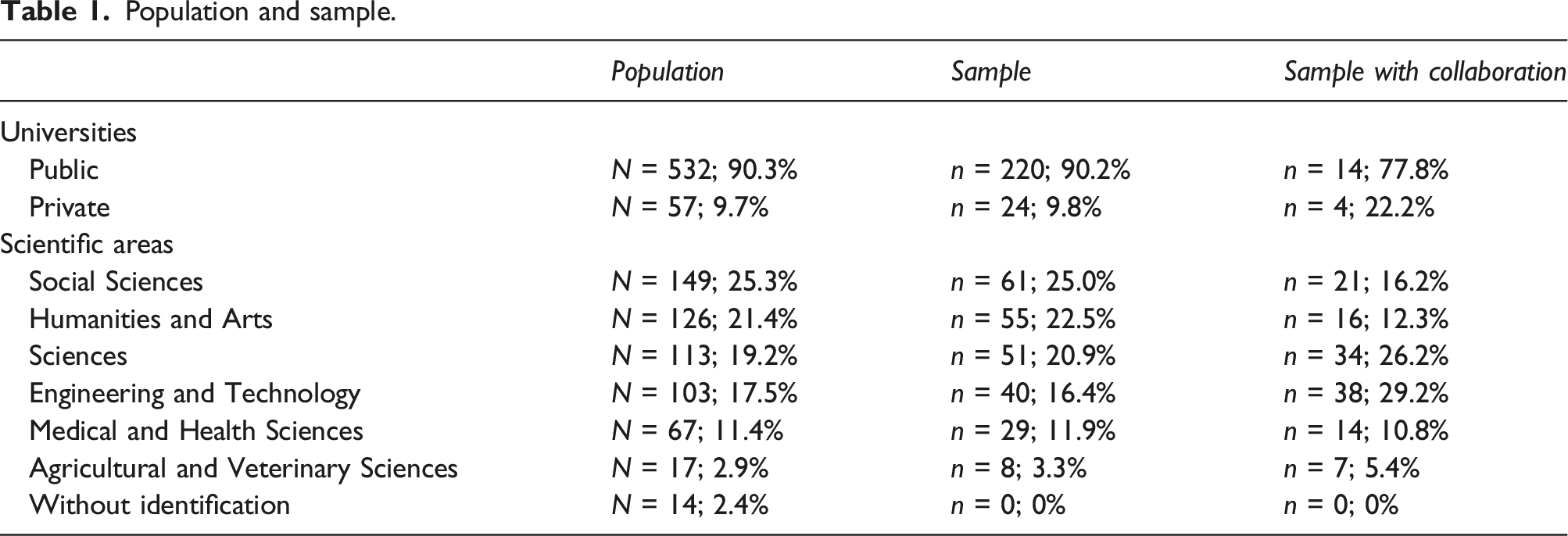
In this article, only the doctoral programs that integrated collaborative processes with companies were selected, which corresponds to 130 programs of the sample (53.3%). Its characterization by type of university and scientific domain is also found in Table 1.
Variables
There are two dependent variables in the study. The first—collaboration intensity—is used to test Hypotheses 1 and 3 and is adapted from the proposal of Bozeman andGaughan (2007). This variable was created from the response items to the following question in the questionnaire: “During the academic year 2016/2017, did any of the following collaboration activities with companies take place in the doctoral programme?” The question had a total of 18 items, adapted from the European Commission’s (2016) study Assessing the State of University–Business Collaboration, ranging from the ‘dissemination of R&D results produced by doctoral students in companies’ to ‘offer doctoral programme together with companies’. Based on the response items, an ‘intensity scale’ was developed to represent the frequency of involvement between universities and companies, with a minimum value of 1 (one collaborative activity) up to a maximum value of 18 (all collaborative activities). In order for the results to be clearer, we divided the scale into weak intensity (1 and 2 activities), low–moderate (3 and 4 activities), moderate–medium (5 and 6 activities), moderate–strong (7 and 8 activities) and strong (more than 9 activities).
The second dependent variable is collaboration continuity, used to test Hypothesis 2. This binary variable (yes/no) represents the expectations and plans for continuing the collaboration beyond the present time (at the time of the survey). It was created from the answers to the question, ‘Did the collaboration in the doctoral programme continue in the academic year 2017/2018 [the year after the survey was administered]?’ The construction of this variable was based on the study of Salimi et al. (2016), who used a similar question to measure continuation of collaboration.
The main explanatory variables are measures of the social capital dimensions described above. Relational capital is a binary variable (yes/no) based on answers to the following question: ‘Before this collaboration, did you collaborate with the company in other activities?’ The variable is meant to capture the specific experience that the programme director has from previous relationships with a specific company.
Cognitive capital is intended to measure general experience in collaboration with companies that provide the director with business knowledge. This variable was created from the items that make up the variable ‘previous experience of working with companies’ and result from the answer to the following question: ‘In what activities with companies were you involved in the academic year 2016/2017?’ This question had a total of 7 items, also adapted from the European Commission (2016) study: ‘research and development projects involving companies’, ‘research projects contracted by companies’, ‘registered patents’, ‘licencing contracts’, ‘spin-offs created’, ‘start-ups created’ and ‘working in a company (for example, sabbatical or internship)’. This scale represents the frequency of the director’s involvement with companies in general, assuming a minimum value of 0 (no collaborative activity) or 7 (all collaborative activities). Based on descriptive analysis, the scale was divided as follows: no capital (0 activities), minimum capital (1 activity), medium capital (2–4 activities) and maximum capital (more than 5 activities).
As there may be alternative explanations, we add two control variables to the analysis. The first is the field of science of the doctoral programme. Differences related to the scientific domain and, in particular, its importance with regard to university–business collaborations have been established in different studies (Belkhodjaand Landry, 2007; Borrell-Damian, 2009; Bozeman andGaughan, 2007; O'Shea et al., 2005). For simplicity, and following other studies, we compare responses from programme chairs in engineering and technology (1) to all other scientific domains (0).
The second control variable is the number of years the respondent has acted as the director of the programme, since prior research has indicated that it is more common for academics with more years of service to be involved in external collaboration (e.g. Gulbrandsen and Thune, 2017).
Dependent, independent and control variables.

Analysis
The analysis of the results is divided into three parts: i) the influence of social capital on the intensity of collaboration; ii) the influence of social capital on the continuity of the collaboration; and iii) the connections between relationship intensity and the continuity of the collaboration.
Influence of social capital on intensity of collaboration
The results show that the relational capital of the director of the doctoral programme is related to the intensity of collaboration, explaining 10.4% of the intensity (Eta = 0.322; Eta2 = 0.104). More specifically, a significant percentage of cases in which the director has no prior experience with the company are located in the ‘weak intensity’ category (46.7% of the cases); most of the cases in which this capital exists are ‘moderate intensity’ collaborations (69.5%) (Figure 1). Although few, there are also doctoral programmes whose directors have relational capital and have ‘strong intensity’ collaborations (6.1%), indicating that prior knowledge can be an important factor in promoting a greater diversity of collaborative activities within the doctoral programme. Relational capital and intensity of collaboration (%).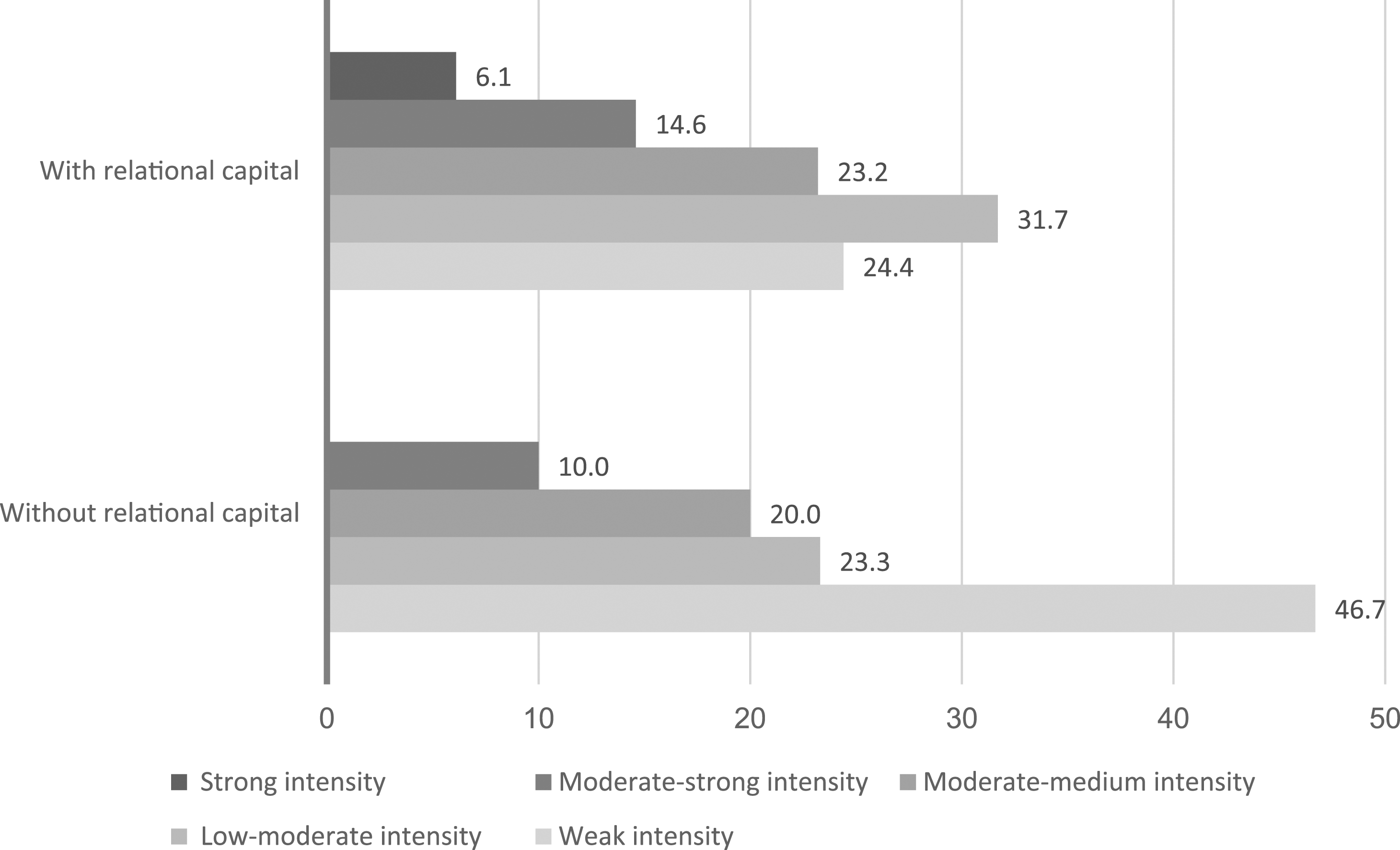
The director’s cognitive capital is also, and more strongly, related to the intensity of the collaboration (Pearson = 0.479, p< 0.001), implying that the greater the academic’s experience with companies, the greater the intensity of collaboration (Figure 2). 42.9% of the cases in which there is no cognitive capital are ‘weak intensity’. This means that collaboration processes are restricted to one or two activities. For cases in which the director has ‘minimum cognitive capital’ the collaboration is, above all, ‘moderate intensity’ and ‘weak intensity’, while 100% of the cases in which the director’s capital is maximum show ‘strong intensity’. Cognitive capital and intensity of collaboration (%).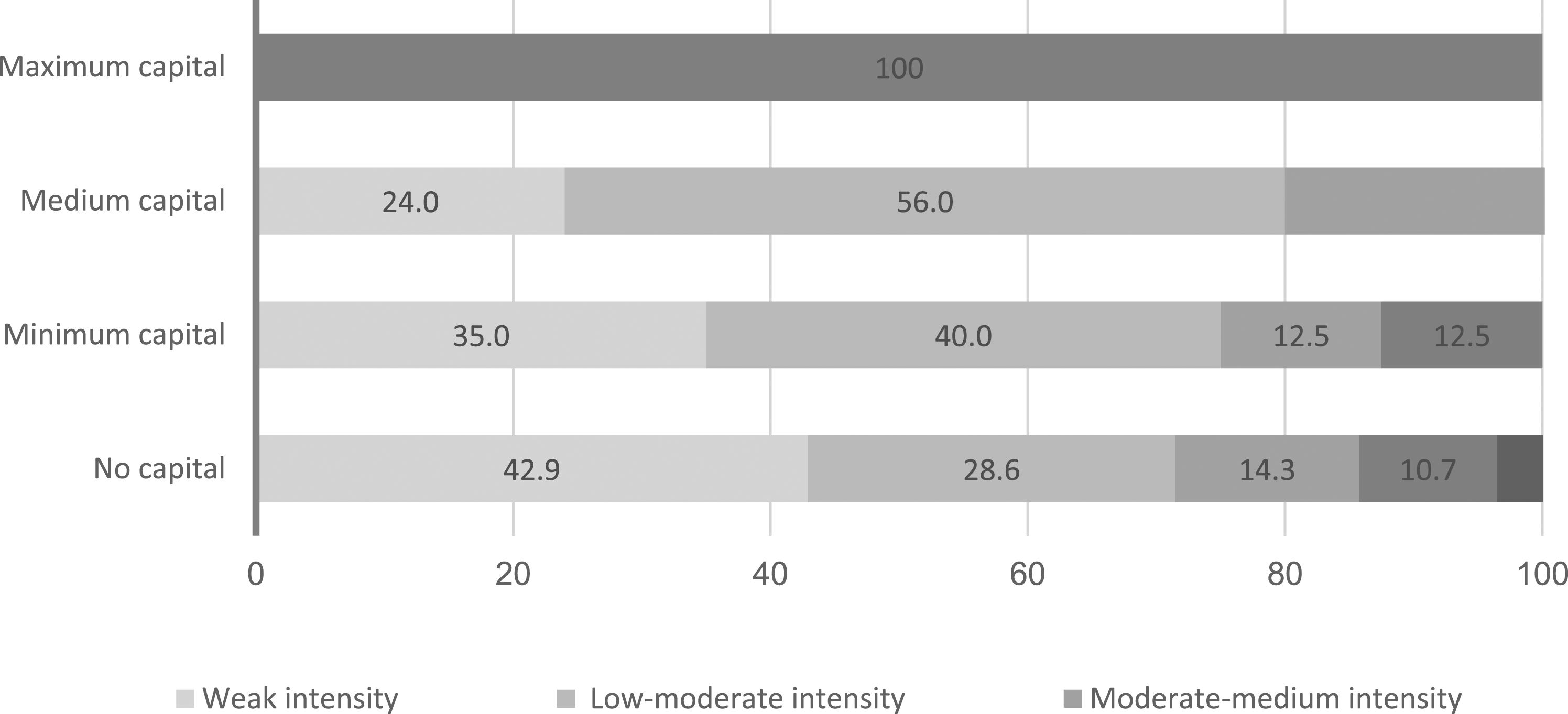
We can say that the experience with companies enables academics to have acquired important tools that help promote a more diverse collaboration. This can be a factor valued also by business actors. To support this idea, the results indicate that the more experience the directors have with companies the less ‘divergent communication and language modes between universities and companies’ is considered a barrier (Eta = 0.438); just as, to a lesser extent, ‘divergent motivations/values between universities and companies’ are considered barriers (Eta = 0.275).
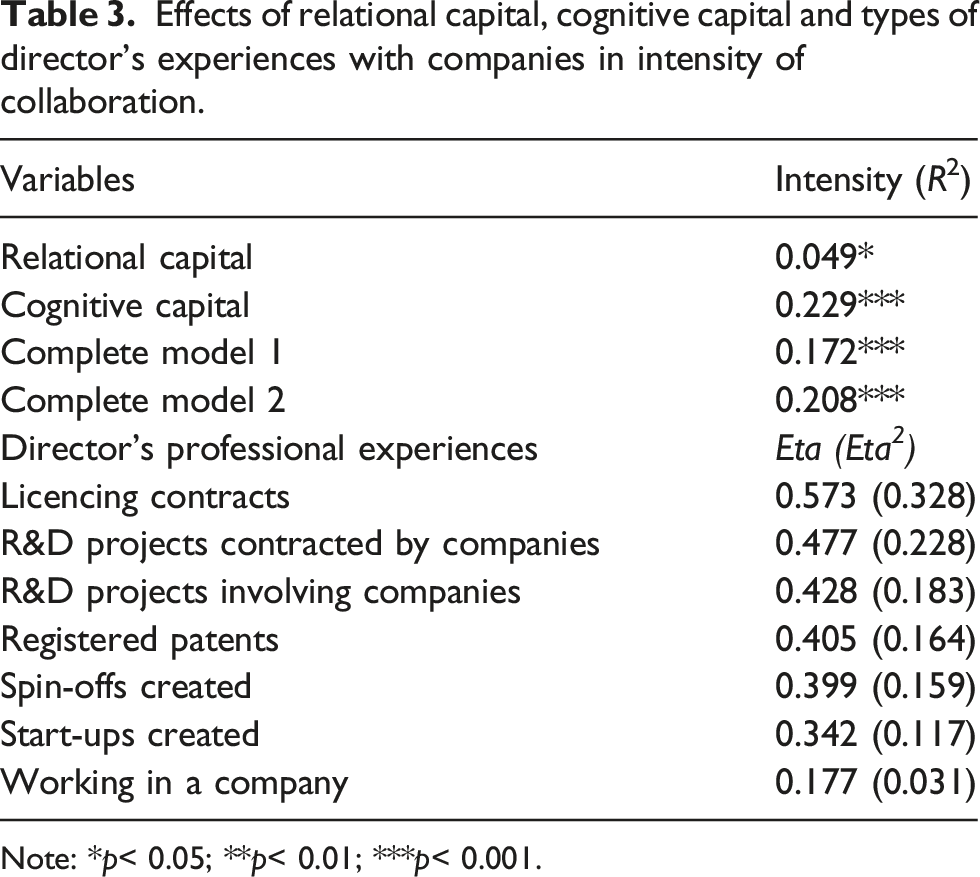
Effects of relational capital, cognitive capital and types of director’s experiences with companies in intensity of collaboration.
Note: *p< 0.05; **p< 0.01; ***p< 0.001.
The complete model with the control variables (model 2) is significant, and in this model the control variables—years of programme director and being a programme in the field of engineering and technology sciences—do not explain the intensity of the collaboration. Despite this, in bivariate analysis cognitive capital seems to influence the intensity of collaboration in almost all scientific domains (with Pearson’s coefficient varying from 0.894 to 0.378, p< 0.05), but less for the sciences, engineering and technology. This may indicate that close languages and cultures between academics and companies are a more important factor for the intensity of collaboration in the scientific domains that are more distant from business culture. The same does not happen with relational capital, the relevance of which does not seem to depend on cultural proximity between the scientific domain and companies.
It is also worth mentioning that the director’s professional experiences strongly related to the intensity of the collaboration are, in order of importance: licencing contracts, research projects contracted by companies, research and development projects involving companies and registered patents. Only 1.6% of the directors had been involved in licencing contracts and 4.1% were involved in the registration of patents, suggesting that cognitive capital acquired in less common activities in the Portuguese panorama of university–business collaboration can promote more intense collaboration.
Influence of social capital on continuity of collaboration
The director’s relational capital is weakly related to the continuity of the collaboration (Cramer’s V = 0.254, p< 0.05). In cases of prior collaboration between director and company, 88.2% of collaborations were maintained after the academic year, compared to 66.7% of the programmes whose directors had no prior collaboration with the companies. Those with prior collaboration were also more satisfied with the collaboration than those without prior collaboration (Cramer’s V = 0.366, p< 0.05).
Also, the director’s cognitive capital with companies is related to the continuity of the collaboration, explaining 10.2% of the dependent variable (Eta = 0.319, Eta2 = 0.102). In 47.1% of the cases in which the director has no experience with companies the collaboration does not continue, compared with 15.4% of collaborations that do not continue when the director has experience working with companies (Figure 3). If the analysis is done in terms of the different levels of cognitive capital, 83.3% of cases with continuity are in programmes whose directors have ‘minimal capital’ (43.6%) or ‘medium capital’ (39.7%); and when the director has the ‘maximum cognitive capital’ all collaborations continue. Cognitive capital and continuity of collaboration (%).
Effects of relational capital, cognitive capital and types of director’s experiences with companies on the continuity of collaboration.
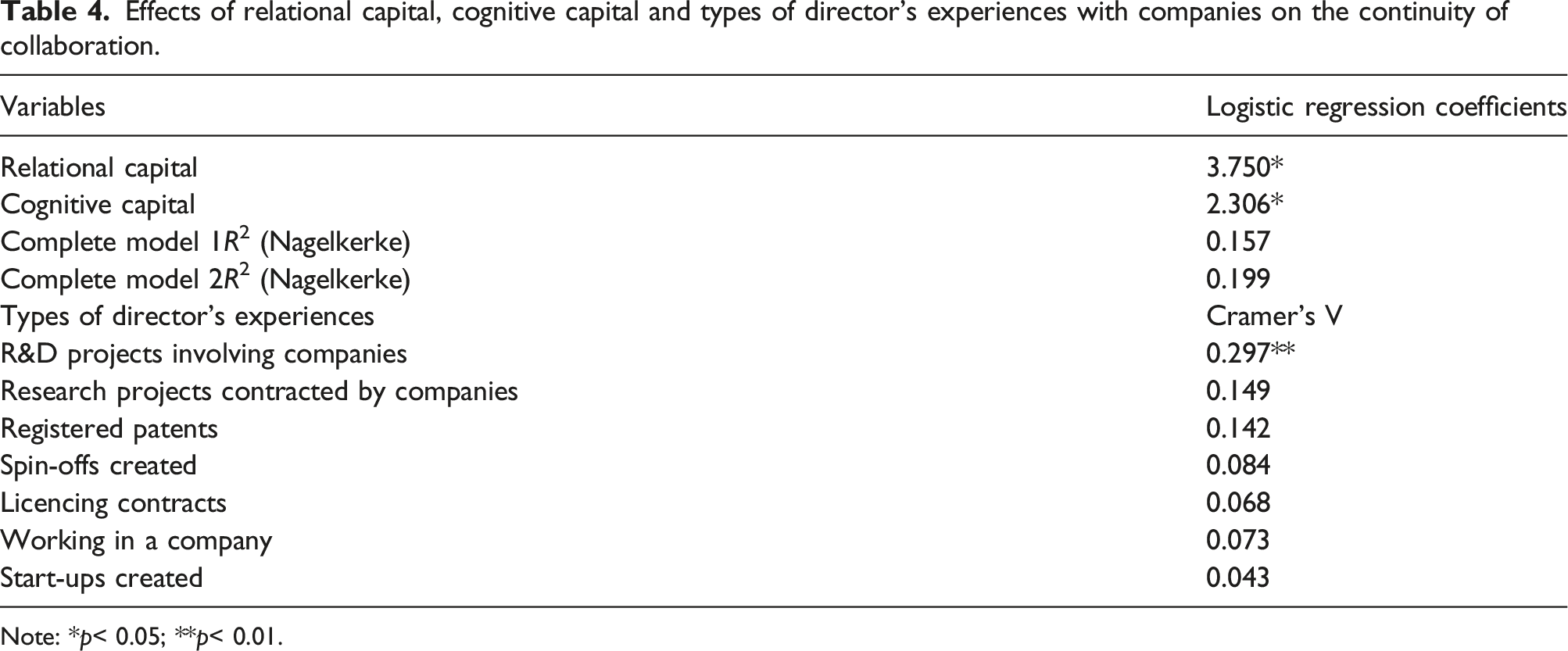
Note: *p< 0.05; **p< 0.01.
Relationship between intensity and continuity of collaboration
The intensity of the collaboration is related to its continuity, explaining 20.7% of continuity (Eta = 0.455; Eta2 = 0.207). The data also show that an increase in intensity means greater continuity. While the majority of ‘weak intensity’ cases lack continuity (56.3%), the ‘moderate intensity’ cases are, above all, characterized by collaboration continued into the following academic year (Figure 4). Intensity and continuity of collaboration (%).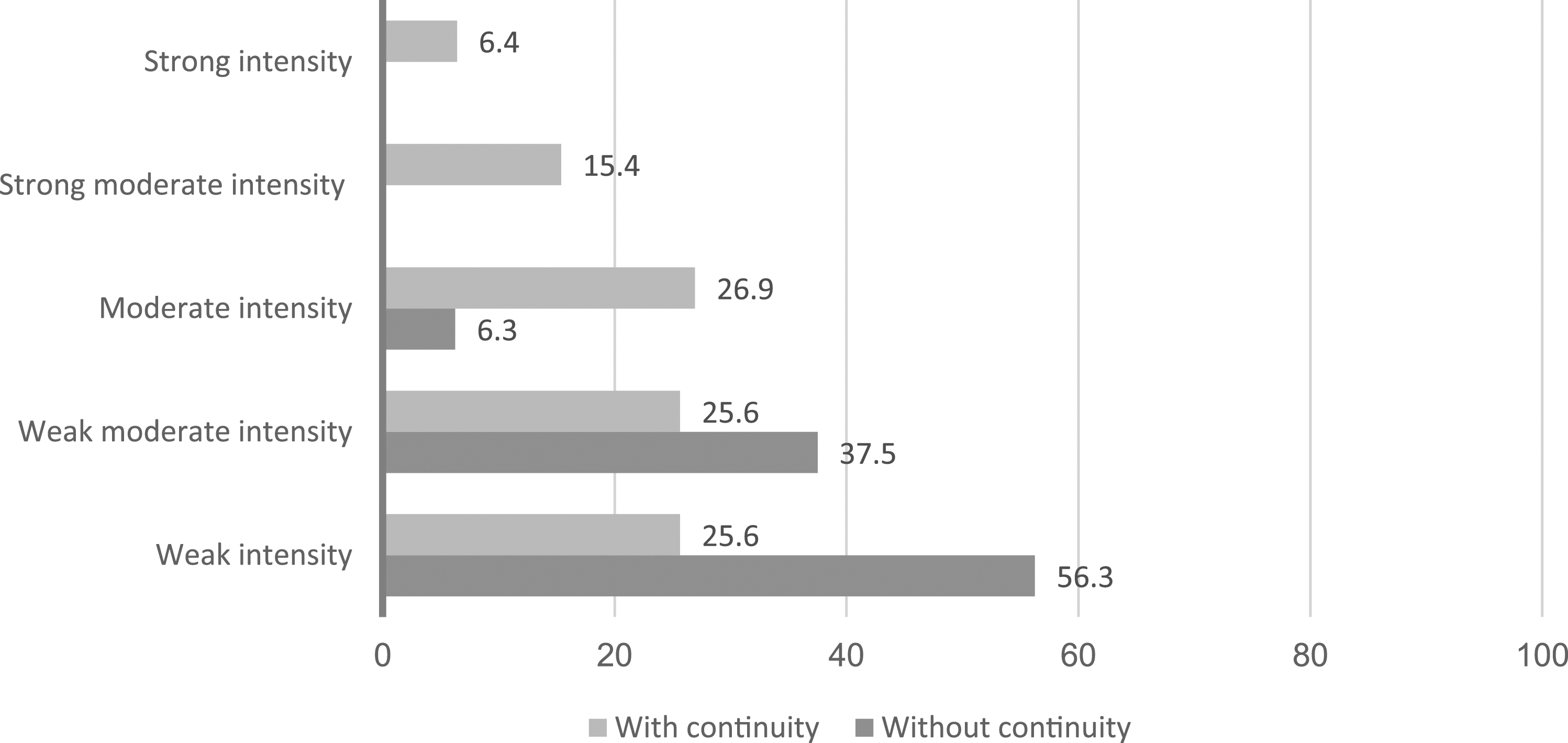
The linear regression model to confirm this result shows that the intensity of the collaboration has an effect on the continuity of the collaboration (R2 = 0.116, p< 0.001). This result remains significant after adding control variables that show the robustness of the model (R2 = 0.126, p< 0.01). The bivariate analysis shows that in all scientific domains the relationship is strong (Eta ranging between 0.999 for the social sciences and 0.769 for the natural sciences). However, the results show that the more culturally distant the scientific domains are from the companies, the more important is the intensity for the continuity of the collaboration. For programmes in the fields of sciences, engineering and technology and medical sciences and health, the association between intensity and continuity are strong, but less strong than in social sciences and humanities and arts. This result confirms that social capital is more important in scientific fields that are less connected to business and industry in general.
Discussion
The results show that collaboration with companies in doctoral programmes is often initiated by individuals—academics, business actors or the doctoral students themselves (72.3%). This underlines the importance of the individual in understanding the formation and development of university–industry collaboration. This paper focuses on the role of academics as program directors, and to what extent their experiences and resources (i.e. their social capital) are instrumental in the setting up and development of collaborative doctoral programs. The results confirm the three hypotheses, and indicate that academics play an important role in collaborative processes.
The social capital held by the directors, both the relationship-specific (relational capital) and the generic experience from university–industry collaboration (cognitive capital), is positively related to the intensity of the collaboration.
This finding supports prior research indicating that the existence of previous relationships (relational capital) between academic and business actors promote trust and confidence (Ring et al., 2005). In this case, social capital helps to diversify the range of collaborative activities and increase the frequency of interactions. This study also shows that, through repeated interactions, academic actors and business actors become engaged in activities that are stronger in terms of company commitment, such as providing company funding for programmes and doctoral students. This is also in line with previous studies which highlight that repeated interactions are helpful in building trust, joint understanding and commitment (Ring et al., 2005) and help to reduce friction (D’Este et al., 2013; Thune, 2009).
The results also show that academics with more diverse experience of working with companies (cognitive capital) are able to foster more frequent or more intense forms of collaboration in doctoral programmes. This result underscores the finding that prior collaboration experiences can lead to a greater convergence of understanding (cognitive resources), making it easier to reach a common perception of the different aspects of the process (Bruneel et al., 2010; Thune, 2009).
The continuity of collaboration is also an important, but less studied, topic in the literature on university–business collaboration. The results show that both the relational capital and cognitive capital of programme chairs matter for the continuation of partnerships over time (confirming Hypothesis 2). Previous involvement in collaboration seems to increase, although to a small extent, the possibility of continuity of the collaboration.
This result may be related to the conclusions of previous studies which show that prior collaboration between academic and business actors leads to greater identification between partners (Al-Tabbaa and Ankrah, 2018) and more satisfaction with the partnership (Bruneel et al., 2010; Thune, 2009). This may also have an effect on the motivation to continue collaboration with a particular company (Salimi et al. 2016).
However, in this study cognitive capital seems to be even more important in promoting continuity than relational capital. This indicates that cognitive capital reduces the friction resulting from organizational and cultural differences (as evidenced by Butcher and Jeffrey, 2007; Mora-Valentin et al., 2004; Salimi et al., 2016). It also resonates with the findings of Steinmoand Rasmussen (2018), who highlight that cognitive capital is more important for long-term collaborations, and relational resources are most important for the establishment of new partnerships. In our study we also see that cognitive resources are especially important in scientific fields that traditionally have had more limited connections to firms and industries. We see in our results that cognitive capital is particularly important for the intensity and continuity of collaboration in fields such as the social sciences, humanities and arts.
Finally, the intensity of the collaboration strengthens the possibility of continuing collaboration between the doctoral programme and the company in the following year (confirming Hypothesis 3). This leads to positive cycles of collaboration (Ring and Van de Ven 1994), especially in scientific fields that are traditionally more distant from companies and industries (Steimo and Rasmussen, 2018). The findings support the idea that there are ‘chains’ of collaborative processes in which proximity generates trust and commitment between actors, which in turn enable the development of a more intense model of collaboration. Networks established between academic and business actors can create a solid foundation for this type of collaboration, resulting in continued exchange of knowledge (as highlighted by Gustavsson et al., 2016).
Overall, the results confirm the general pattern established in previous studies on university–business collaborations, indicating that proximity in the form of relationships established between academic and business actors (relational capital) and more general experience from collaboration with the business sector (cognitive capital) are vital for the intensity and continuity of university–business collaboration.
In general, these results underscore the point that collaboration is a social process which requires careful consideration of the social actors involved (Comacchio et al., 2012), emphasizing in particular that particular academics who possess considerable social capital can be important promoters of stronger and more intense connection with the business sector. These academics are probably more valued as partners by companies because of their expertise and knowledge. It is also possible that they are more oriented towards the commercial value of scientific research. These actors are likely to be academics who assume a ‘dual life’ (Etzkowitz, 2008) or act as ‘boundary spanners’ (Parker andCrona, 2012). They gain experience and knowledge of both sectors, so reducing the difficulties in translating knowledge from one sector to the other, lessening friction and making different interests and demands more easily compatible. When academics also involve doctoral students in collaboration with industry and companies over time, this reinforces these networks and essentially trains a new generation of ‘boundary spanners’ (Kunttu et al., 2018; Nielsen et al., 2018).
Conclusions and implications
The study has two important limitations that must be considered in future research. The first is that it only takes into account the point of view of the academic programme directors. This could be a limitation as other actors in the programme may have been the promoters of collaborations and the director’s knowledge of these collaborations may be limited. Future research might opt for case studies including different actors in the analysis or even analyse the importance of the social capital of academics perceived by companies. On the other hand, directors may have had a need to ensure a more positive or successful image of the collaborations. However, we believe that this conflict of interest may have been minimized by ensuring the anonymity and confidentiality of the data.
Another area that needs further investigation concerns the operationalization of the dimensions of social capital, which may not capture all the factors that influence the development of social capital in the relationship between academic and business actors. It could be useful to add other variables, enriching the analysis, for example by including institutional differences.
Moreover, this paper addresses doctoral programs that collaborate with the business sector. Doctoral programs in the humanities and social sciences often have limited interest in or opportunities to collaborate with companies, but they interact with a diverse range of groups, including government agencies and non-profit organizations, promoting multidisciplinary and applied knowledge (Hall andTandon, 2014). In some countries, collaborative doctoral programs have been extended to formal arrangements with the non-business sector, such as in Norway where there is now a ‘public sector PhD programme’, in addition to industry PhD schemes. Whether or not the same dynamics that we observe in this paper for business–university collaborations apply in such programmes is, however, an open question. Such arrangements are relatively recent phenomena and warrant further research.
This study may also have useful implications for policies to promote university–business collaboration in doctoral education and for managers of such programmes. In contexts that are not characterized by high levels of collaboration between companies and universities, the results suggest the need to take into account the academics’ social capital, their ability to connect academia with the business world. The policy implication overall is that paying attention to individuals is important and that it is important to build on and strengthen existing relationships, especially in the scientific domains that are more distant from the business culture.
Universities or policy organizations that want to extend collaborations in doctoral education must take into account experiences of the academic actors involved. The mobility of academics, and potentially entrepreneurs, between universities and companies is an important vehicle for collaboration and one that is particularly useful for developing competencies and skills that are relevant in both the academic and company domains. Policy instruments that support the mobility of people across the university–business interface are therefore also useful for supporting collaborative doctoral programmes.
Finally, as this study highlights the dynamic nature of collaboration and emphasizes that actors over time develop resources that benefit doctoral programmes, policy should also support and reinforce established collaborations and through this support increase the continuity and degree of interaction. More ‘intense’ partnerships likely lead to more learning opportunities for doctoral students, and hence to better learning outcomes.
Footnotes
Declaration of conflicting interests
The author(s) declared no potential conflicts of interest with respect to the research, authorship, and/or publication of this article.
Funding
The author(s) disclosed receipt of the following financial support for the research, authorship, and/or publication of this article: This work was supported by the Fundaçãopara a Ciência e a Tecnologia through grant number SFRH/BD/102400/2014.The proofreading was provided by the Fundaçãopara a Ciência e a Tecnologia through the Financing of the R&D Unit UIDB/03126/2020.
