




Abstract
Collaboration between industry and universities is a driving force for scientific and technological advancements. Due to the role of AstraZeneca (AZ), a British–Swedish multinational pharmaceutical and biotechnology company, in combatting the COVID-19 pandemic, an analysis of the collaboration between the company and universities in the UK is of importance. Here, the collaboration of AZ with top UK universities, namely the University of Cambridge (UoC), the University of Oxford (UoO), Imperial College London (ICL) and University College London (UCL), is investigated. The investigation is based on two different measures: the well-developed Salton’s measure and the scientific impact of collaboration (SIC). The former considers the scientific articles published by each party as well as the joint articles published in the period 2010–2021. The SIC, which is introduced for the first time in this article, involves the number of joint articles and citations to them in the same period. An unprecedented increase in the value of the Salton’s measure for the collaboration between AZ and UoO is observed in 2021, and this is discussed with regard to the development of the Oxford–AstraZeneca COVID-19 vaccine. The findings support the argument that strategic alliances are more important than co-location in drug discovery and development.
Keywords
Knowledge is of great value in organizational development, and therefore its transfer into the organization is of critical importance since it can shape and drive the business activity and the competitive position of the organization (Mahura and Birollo, 2021; Sharma and Lenka, 2019). Among various types of knowledge, the knowledge sourced by academia and transferred to industry is considered an important driver of innovation and economic growth, as it eases the commercialization of new scientific knowledge in firms, promoting social and economic development (Atta-Owusua et al., 2021; Chen et al., 2020; Moghadam-Saman, 2019; Ying, 2021).
The literature highlights that successful collaboration between university and industry can activate the knowledge transfer process (Bercovitz and Feldman, 2006; Gretsch et al., 2019). Successful collaboration has often been measured in terms of immediate tangible outputs, including scientific publications (Perkmann et al., 2011), based on which research collaboration can be defined as ‘the working together of researchers to achieve the common goal of producing new scientific knowledge’ (Katz and Martin, 1997). This highlights the importance of scientific articles arising from such collaborations.
It should be considered, however, that scientific collaborations do not always lead to the publication of results, and that co-authorship of a publication does not necessarily indicate real collaboration (Katz and Martin, 1997; Melin and Persson, 1996). Nevertheless, co-authorship remains one of the most tangible outcomes, and the most efficient documented indicators of research collaboration (Subramanyam, 1983; Katz and Martin, 1997; Glänzel and Schubert, 2004). According to Subramanyam (1983), co-authorship is a valid indication of collaboration offering a series of advantages, such as being invariant, easily and inexpensively ascertainable, quantifiable and non-reactive (i.e., the process of ascertaining collaboration does not affect the process of collaboration itself – Glänzel and Schubert, 2004). These features highlight the fact that scientific collaboration between parties can be reliably tracked by analysing co-authorship networks using bibliometric methods.
In this study, the analysis of the scientific articles is used to evaluate the collaboration between AstraZeneca (AZ) and a group of top UK universities. AZ is a science-led British–Swedish multinational biopharmaceutical company operating in more than 100 countries, with headquarters at the Cambridge Biomedical Campus in England. At the beginning of the last decade, a major revision was made to AZ’s research and development strategy in order to improve its R&D productivity, leading to substantial investments in research, including the value of around $10.6 billion in 2018–2020 (AstraZeneca Annual Report & Form 20-F Information, 2020; Wikhamn and Styhre, 2019).
AZ has played an important role in combatting recent diseases, and particularly the SARS-CoV-2 infection (COVID-19). As of March 2021, COVID-19 had caused more than 219 million infections worldwide, with deaths totalling more than 4.5 million. Massive vaccination campaigns were initiated in many countries throughout the world using a variety of vaccines, including the Oxford–AstraZeneca one, contributing to the reduction of infection (Vallée et al., 2021). In the UK, the infection rate fell by 65% for people receiving the first dose of the Oxford–AstraZeneca vaccine (Lacobucci, 2021). Apart from its high efficiency, this vaccine (AZD1222) used less expensive technology and was cheaper than the developed alternatives, and thus had the potential for widespread application even in low- and middle-income countries (Sharun et al., 2021). Unlike many of the COVID-19 vaccines, which must be stored at very low temperatures, the Oxford–AstraZeneca vaccine can be kept in an ordinary fridge, lowering its costs to a few dollars per dose (Callaway and Mallapat, 2021). In addition to these advantages, what makes the Oxford–AstraZeneca vaccine remarkable is that the timescale of around 10 years which is often required to produce a new vaccine was compressed into around 10 months, which might be seen as little short of a miracle (Agut, 2021). These achievements highlight the role of science and the collaboration with academia in the remarkable performance of AZ. AZD1222 was developed at the University of Oxford (UoO) and then licensed to AZ for further development: the collaboration that led to the rapid development and subsequent extensive use of the vaccine is thus a valuable subject for study.
Zaheer and George (2004) investigated the collaborative behaviour of technology-intensive industries, including biotechnology, for the period 1985–98, and suggested that for such firms the formation of strategic research and development alliances was a considerably more important factor than being located in same geographical area. The current study investigates this hypothesis for the case of AZ in the period 2010–2021, before and during the pandemic. Here, we consider joint articles as a measure of such collaboration. To this end, the University of Oxford, the University of Cambridge, Imperial College London and University College London, which are the four top UK universities, with recent Quacquarelli Symonds (QS) world university rankings of 2, 3, 7 and 8, respectively (QS World University Rankings, 2022), were selected as the collaborating institutes. This article therefore investigates the collaboration between AZ and these four research universities. To this end, we employ two measures to evaluate the collaboration level between AZ and the universities, individually and in combination. The first is Salton’s measure, which compares the relative collaboration strength between parties. This measure has been used in the literature to analyse international scientific collaboration (H, 2009; Leydesdorff, 2008), indicating the strength of the bond between the parties (Haustein et al., 2011). We also introduce the scientific impact of collaboration (SIC) as an evaluation measure, based on the joint articles and their citations.
Methodology
Salton’s measure of collaboration
The calculation of Salton’s measure is based on the number of the joint articles normalized based on the total scientific articles published by the participating parties. This highlights the strength of the collaboration (He, 2009; Haustein et al., 2011; Leydesdorff, 2008). Salton’s measure for the collaboration between party X and party Y (SX-Y) is calculated with equation (1)

SIC measure of collaboration
SIC is defined, for the first time in this article, as a measure for evaluating the scientific impact of collaboration between two organizations, based on the number of joint articles published and the number of citations given to those joint articles, according to the equation (2) Details of the survey conducted to determine what academic value is most appropriate to be given to each citation of an article, if the article itself is given a value of 10: (a) academic positions of the survey respondents; (b) answers to the question.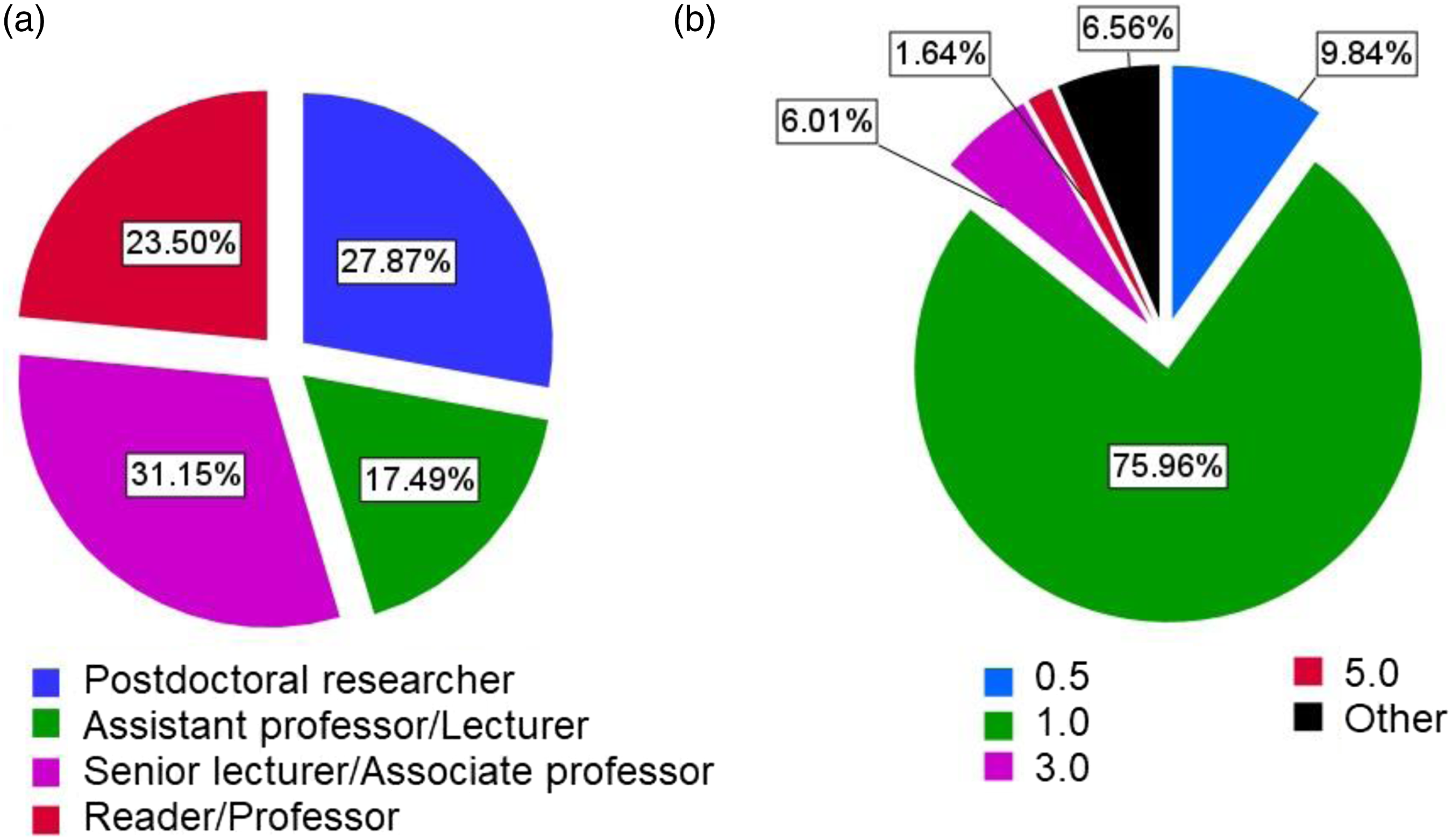


Sampling
In this study, the Web of Science (WoS) was used to gather the required data. For joint articles, those co-authored by at least one author from the firm and one author from the university, with a publication date between 2010 and 2021 were considered. The sampling covers the whole period until the end of September 2021, when it was terminated.
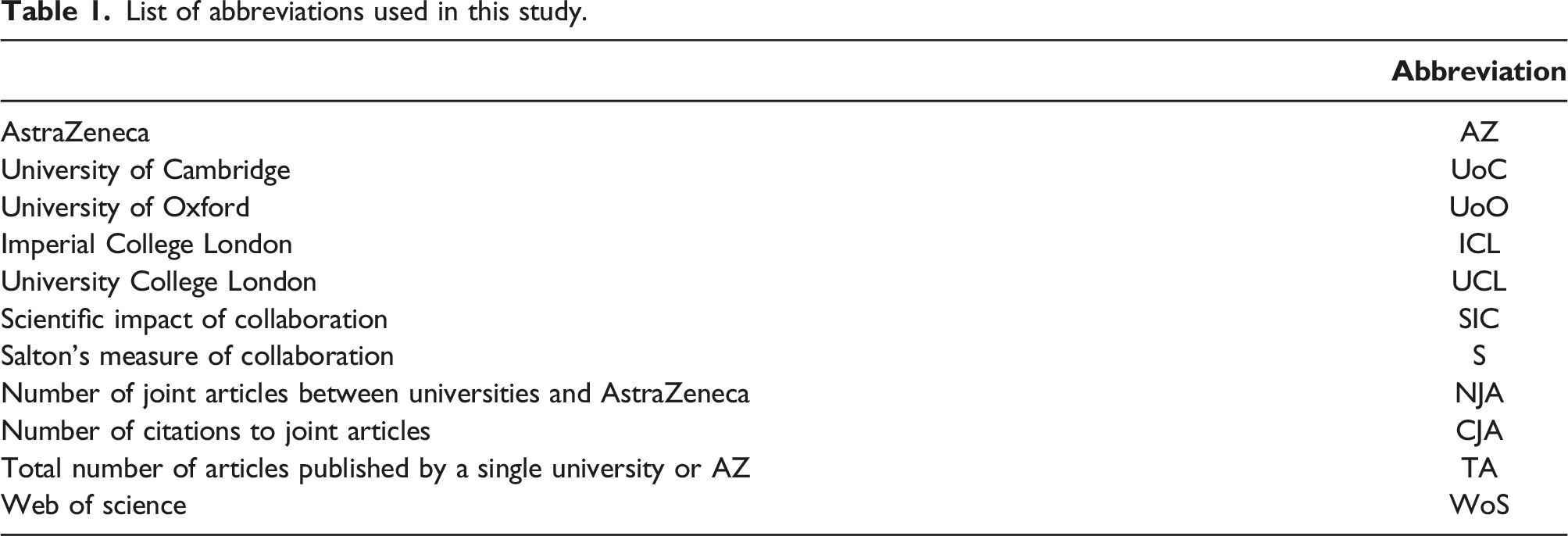
List of abbreviations used in this study.
Results and discussion
Number of articles published by various institutes, joint articles between universities and AZ, and the number of related citations in the timeframe 2010–21.a
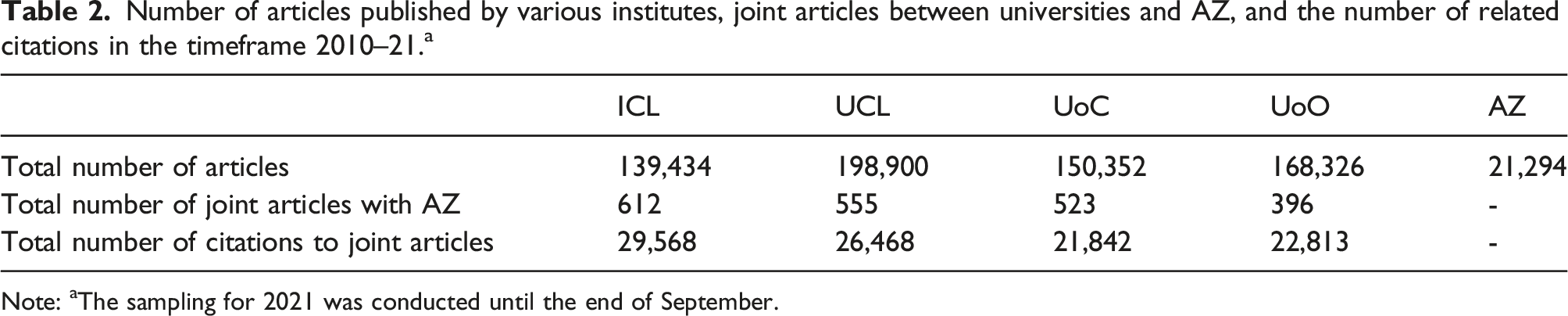
Note: aThe sampling for 2021 was conducted until the end of September.
Collaboration between the group of universities and AZ
The number of articles published by the group of the universities in the period between 2010 and 2021 (end of September) is shown in Figure 2(a). As can be seen, the combined articles published by universities increases gradually from 41,746 recorded in 2010 to 63,383 in 2017. Then the number of published articles increased slightly to 64,099 in 2018, followed by a sharper increase in 2019, with the highest number of 69,450 recorded. Thereafter, the number slightly decreases for the first time in the last decade to 68,174 in 2020, followed by a substantial decrease in 2021 to 35,745. The lower number of articles published in 2021 is partly related to the fact that only articles available online by the end of September 2021 (when the sampling was terminated) were considered. The extrapolation of this number to the end of 2021, however, leads to an estimate of 47,660 articles for the year, which is still substantially lower than the total for 2020. This significant reduction in the total number of published articles can be attributed to the outbreak of the pandemic, which disturbed research activities in many parts of the world. In the UK, the government-mandated social distancing measures and ‘lockdown’ were introduced in 2020 in order to restrict the transmission of COVID-19 (Laydon et al., 2021). This will have impacted research activities in UK universities, including the four institutions considered in this study. The collaboration between the four UK universities (UoC, UoO, ICL and UCL) and AZ in different years: (a) articles published by universities; (b) articles published by AZ; (c) articles published jointly by an individual university and AZ; (d) number of citations to joint articles; (e) Salton’s measure of collaboration between the universities (combined) and AZ; (f) scientific impact of collaboration (SIC) between universities (combined) and AZ. Note: The sampling for 2021 was conducted until end of September.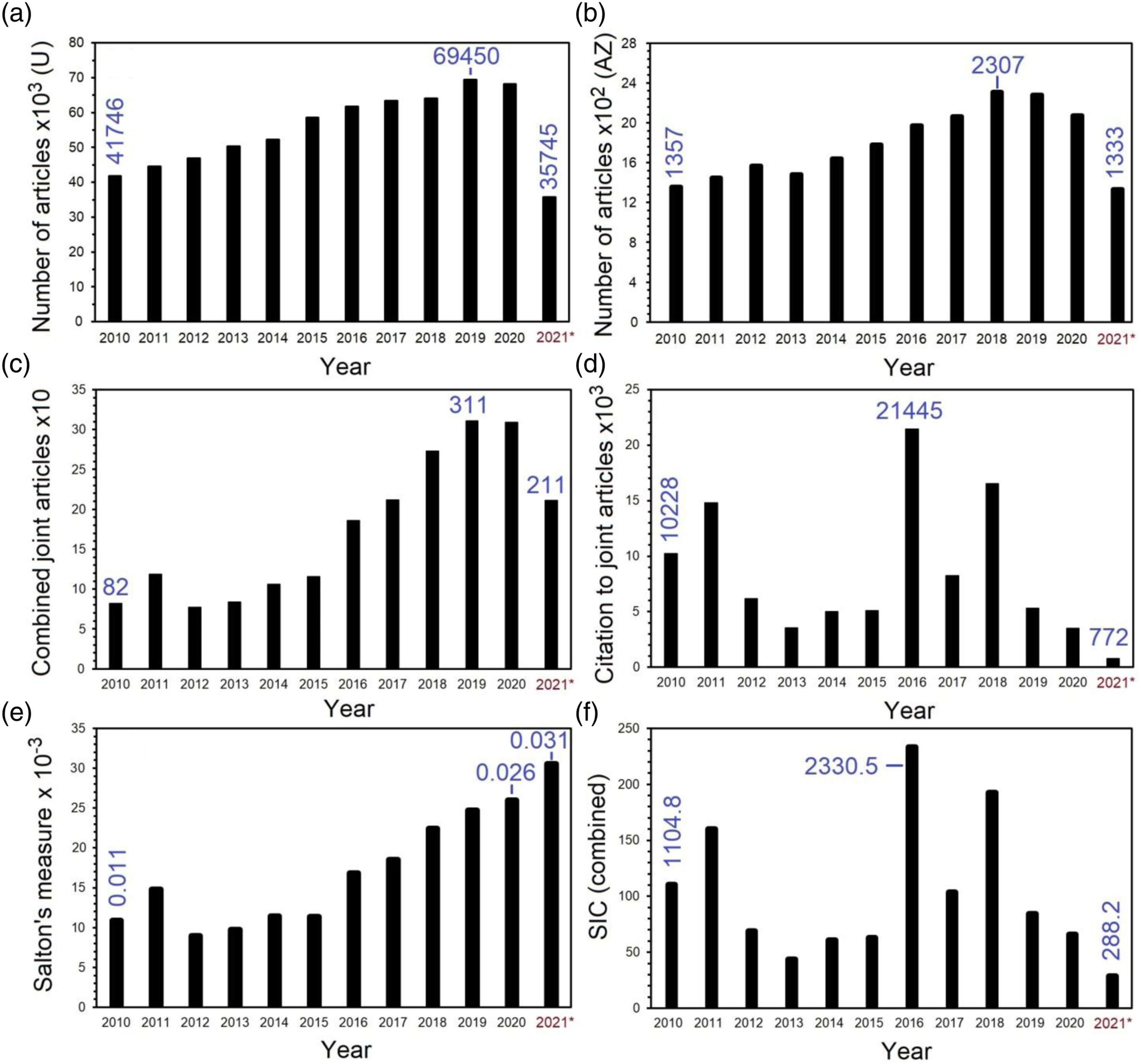
Figure 2(b) shows the number of articles published by AZ in the last decade until the end of September 2021. The overall trend is similar to that observable in Figure 2(a). Accordingly, the number of articles published by AZ ranges from 1357 to 1482 between 2010 and 2013. Then, a steady increase in the number of published articles is observed, from 1640 in 2014 to the highest total of 2307 in 2018. This value slightly decreases to 2,279, 2072 and 1333 in 2019, 2020 and 2021 (until end of September), respectively.
Figure 2(c) shows the number of joint articles by one of the universities and AZ. Overall, the same trend is observable as in Figures 2(a) and (b). The number of joint articles ranges from 82 to 116 in 2010–15. Then, the number increases from 186 recorded in 2016 to the highest total of 311 in 2019, and this remains about the same (309) in 2020. The number of joint articles in 2021 was determined to be 211, and the extrapolation to the end of 2021 leads to an estimate of around 280, which is slightly lower than the total for 2020. However, considering the influence of the national lockdown, this value may indicate an enhancement of collaboration between top UK universities and AZ amid the pandemic restrictions, as will be discussed later in this article.
Another important parameter that indicates the impact of the collaboration between the universities and AZ is the number of citations to the joint articles, as shown in Figure 2(d). As expected, the trend in Figure 2(d) does not necessarily follow that in Figure 2(c). The highest number of citations was recorded in 2016, with a total of 21,445, which is 2.7 times greater than the average number of citations from 2010 to 2020 (7847), excluding 2016. The large number of citations recorded for 2016 is related to the articles such as that by Klionsk et al. (2016), with citations totalling 3668 by authors from 2135 institutes (including AZ, UoC, UoO, ICL and UCL).
In this article, we use two measures to evaluate the collaboration performance between the group of universities and AZ, based on the information provided in Figures 2(a) to (d): Salton’s measure of collaboration and scientific impact of collaboration, based on equations (1) and (3), respectively. The values of the Salton’s measure are presented in Figure 2(e), in which interesting information about the collaboration bond between the universities and AZ can be observed. The overall feature of Salton’s measure over the period 2010–2015 is similar to that of Figure 2(c), fluctuating between the values of 0.009 and 0.015. Moreover, the Salton’s measure values during 2016–2020 can roughly be compared with those of Figure 2(c), since a gradual yet steady increase can be observed, from 0.017 in 2016 to 0.026 in 2020. However, interestingly, the Salton’s measure considerably increases in 2021, reaching its highest value of 0.031, in contrast to the fall in the number of joint articles observed in Figure 2(c) for the same period. Thus, although the total number of joint articles published in 2021 is considerably less than in the previous few years, the Salton’s measure of collaboration between AZ and the group of universities increases considerably. This indicates the influence of the COVID-19 pandemic in enhancing the scientific collaboration between the firm and the universities.
In contrast with Salton’s measure, which includes the total number of articles published by collaborators and the joint articles, the SIC concerns the number of joint articles and citations to those articles, based on equations (2) and (3). The SIC values are shown in Figure 2(f). The overall features of the SIC values are different from those of Salton’s measure, indicating the sharp influence from citations of the joint articles. In particular, the SIC in 2016 is recorded at its highest value of 2330.5, which is in agreement with the number of citations shown in Figure 2(d).
Collaboration between individual universities and AZ
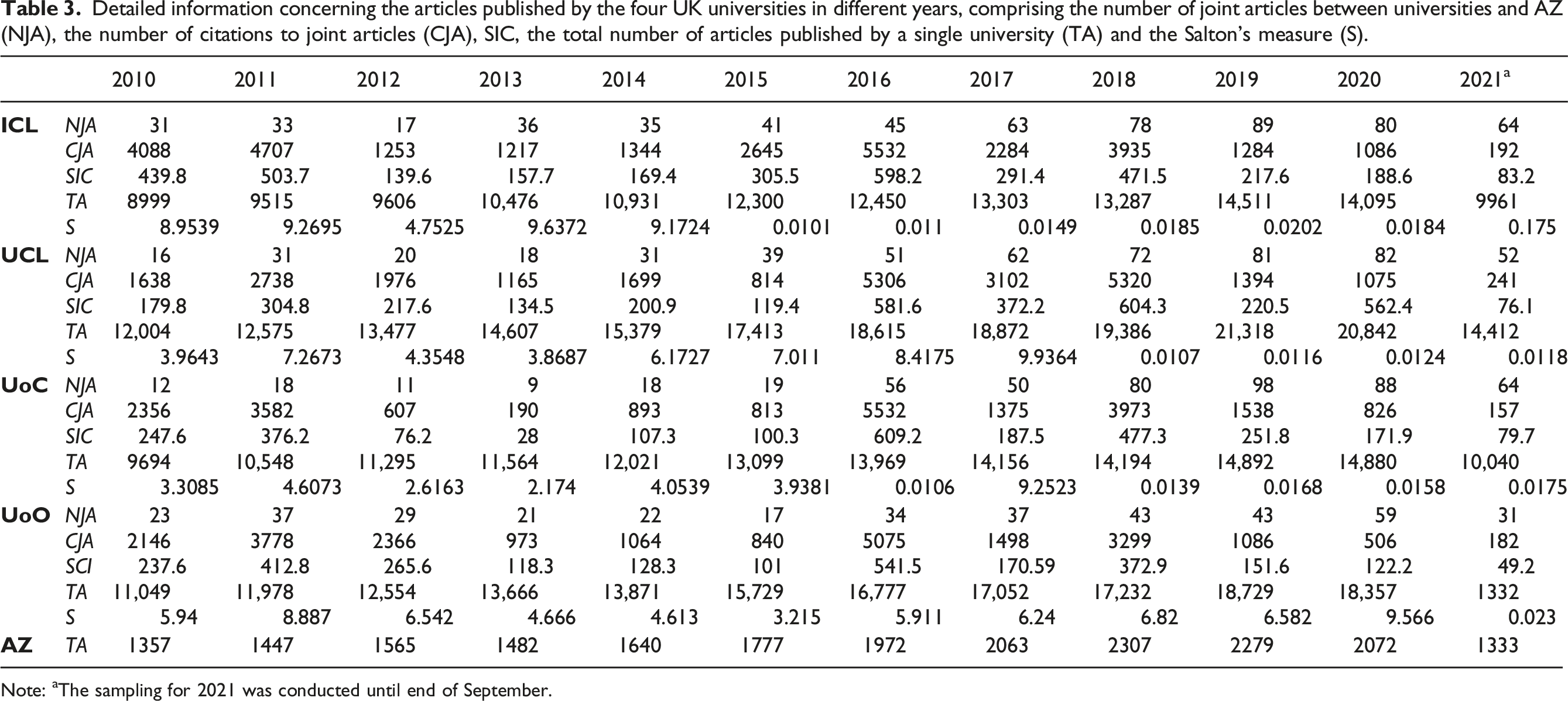
The overall collaboration between the four universities and AZ is considered in the previous section. In this section, the contributions of the individual universities to the overall collaboration are highlighted, as presented in Figure 3 and Table 3. Figure 3(a) shows the number of articles published by each institute in various years. Overall, the number of articles published by UCL is slightly more in all years than the number for the other universities, followed by UoO, UoC and ICL, respectively. It can be observed that the number of articles published by AZ is substantially lower than the numbers for the universities. The fall in the number of published articles in 2021 is also evident in Figure 3(a). Figure 3(b) compares the number of joint articles between each university and AZ. The highest number of joint articles was by UoC and AZ in 2019 (98). Interestingly, the number of joint articles by AZ and UoO is the lowest in all years after 2015, with, for example, 43 joint articles published in 2019. Even the development of the Oxford–AstraZeneca vaccine in 2020 did not change the overall trend, and the number of joint articles by UoO and AZ remained the lowest in 2020 and 2021. This indicates that the technological cooperation between UoO and AZ did not significantly influence the number of joint articles by the two organizations. Despite this observation, Salton’s measure of collaboration (Figure 3(c)) provides contrasting results. As observed, Salton’s measure of the collaboration between UoO and AZ has the lowest value between 2015 and 2020. For instance, the value for UoO–AZ is 0.007 in 2019, which is lower than those for UoC (0.017), UCL (0.012) and ICL (0.020). However, the situation is different in 2021, for which the Salton’s measure of collaboration records its highest value for UoO–AZ (0.023), in comparison with those for UoC (0.017), UCL (0.012) and ICL (0.018). It should be considered that the Salton’s measure value for UoO-AZ in 2021 is the highest observed in Figure 3(c) for all years. Thus, although the relative number of joint articles between UoO and AZ did not significantly change in 2021, the related Salton’s measure rose sharply. This indicates that the research collaboration with AZ formed a substantially higher proportion of the overall research in UoO in 2021, which can be atrributed to the development of the Oxford–AstraZeneca vaccine and the related funding. This can be understood from the relatively low number of publications published by UoO in 2021, in comparison with previous years. Contribution of single universities to overall collaboration between the four universities and AZ: (a) total number of articles published by each institute; (b) number of joint articles between each university and AZ; (c) Salton’s measure of collaboration between each university and AZ; (d) number of citations to the joint articles between each university and AZ; (e) scientific impact of collaboration between each university and AZ. Note: The sampling for 2021 was conducted until end of September. Detailed information concerning the articles published by the four UK universities in different years, comprising the number of joint articles between universities and AZ (NJA), the number of citations to joint articles (CJA), SIC, the total number of articles published by a single university (TA) and the Salton’s measure (S). Note: aThe sampling for 2021 was conducted until end of September.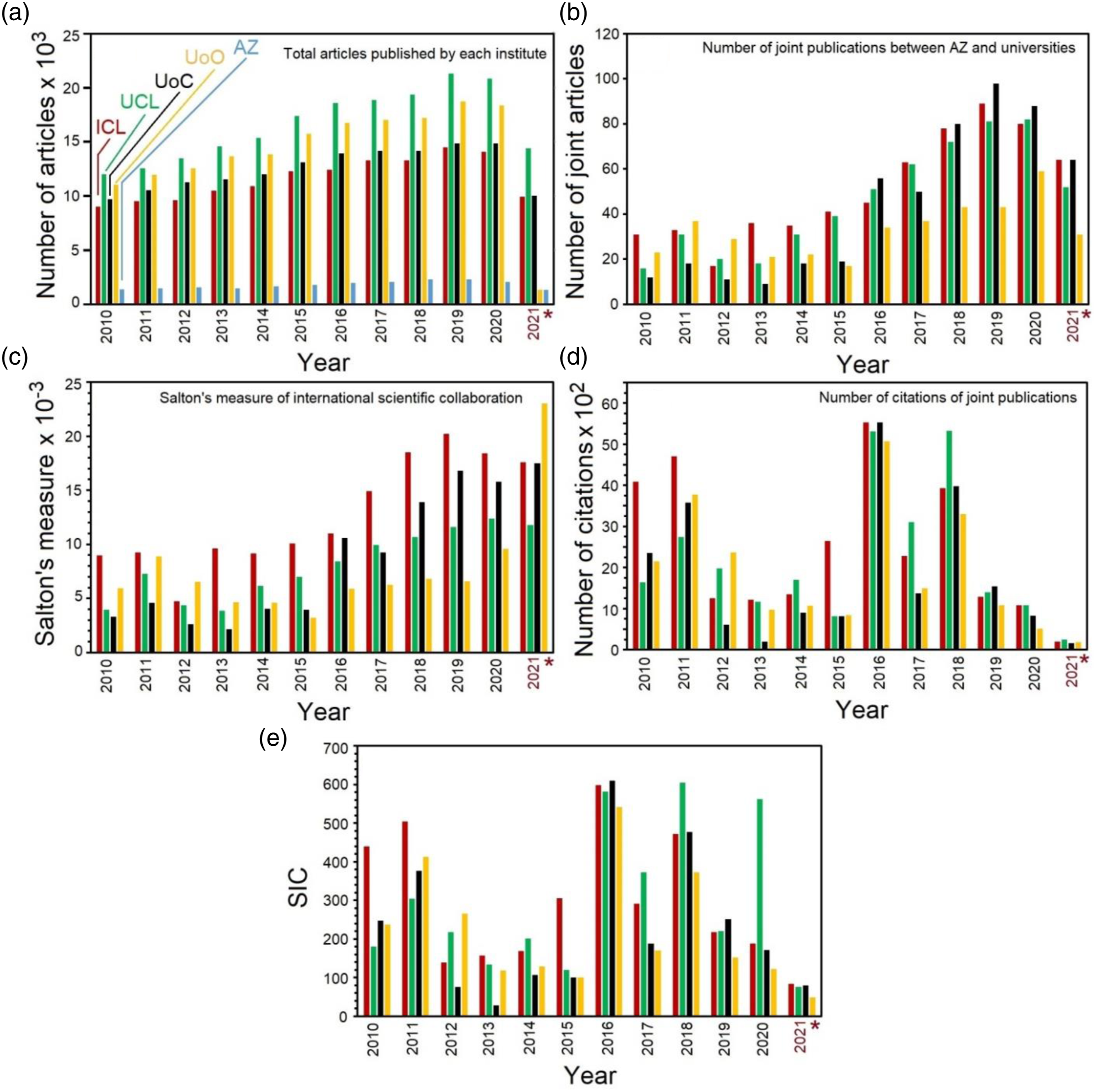
The numbers of citations to the joint articles published by AZ in cooperation with the individual universities are shown in Figure 3(d). As can be observed, the number of citations fluctuates. In particular, the number of citations is highest for all universities in 2016, which is related to the high-citation joint articles published in this year, as discussed before. The same observation can also be made about Figure 3(e), which shows the SIC values. The similar patterns observed in Figures 3(d) and (e) can be explained by the contribution of the number of citations to the SIC value (see equations (2) and (3)). By comparing Figures 3(c) and (e), it can be concluded that two different aspects of collaboration can be revealed by the calculation of Salton’s measure and SIC. The former reflects the strength of the bonds between the firm and university, which is not a time-dependent measure. The latter provides information about the scientific impact of such collaboration, which is a time-dependent measure and may change considerably over years.
The results obtained can be further discussed in the context of the UK drug discovery and development, which is being shaped through a complex interaction of research, policy and practice (Kelleher and Zecharia, 2021). In terms of research collaboration, there are two contradictory observations in the literature describing the way firms collaborate with research organisations. The first observation emphasises that co-location promotes collaboration, influenced by the culture that evolves around cooperative norms, trust and shared identity (Saxenian et al., 1994). In contrast, Zaheer and George (2004) suggest that efficient knowledge transfer is affected by forming alliances both within and beyond geographical clusters. According to these authors, being part of a geographical cluster is not a critical factor in determining the collaboration patterns of technology-intensive industries such as biotechnology. The current study investigated the behaviour of AZ with regard to collaboration with four major UK universities from 2010 to 2021, before and during the COVID-19 pandemic. Salton’s measure (Figure 3(c)) and the SIC (Figure 3(e)) underline, respectively, the strength and the scientific impact of that collaboration. AZ’s headquarters in the UK is in the same geographical location as UoC. The results obtained in this study, therefore, support the second hypothesis, that strategic alliances are more important than co-location in drug discovery and development. This finding also supports the current global approach towards the economic and sustainable preparation of new materials to combat emerging infections (Seifi and Kamali, 2021), for which the availability of appropriate equipment and expertise is more critical than the geographical proximity of firms, influencing their collaboration partners.
Conclusion
This study concerns the evaluation of collaboration between AZ and a group of four top UK universities, individually and in combination, using the Salton’s measure of collaboration and SIC. The results highlight that the number of joint articles involving AZ and UoO has always been lower than those between AZ and the other three universities after 2015. This trend is reflected in the Salton’s measure for 2015–20, during which the number of joint articles by UoO and AZ is lower than in all the other cases. However, the Salton’s measure for the UoO–AZ collaboration increases sharply in 2021, reaching the highest in all year/time categories with a value of 0.023, which is substantially higher than that for 2020 (0.009). This high Salton’s measure value for collaboration between AZ and UoO is related to the much lower number of published articles involving UoO in 2021, indicating a meaningful shift of research in UoO towards the collaboration with AZ, which can be associated with the development of the Oxford–AstraZeneca vaccine. Consistent with this, the Salton’s measure for the collaboration of the group of universities with AZ constantly increases from 2015, reaching its highest in 2021 with a value of 0.031. In contrast to Salton’s measure, SIC considers the number of citations to the joint articles. As such, the SIC values related to the collaboration between the group of universities and AZ is highest for 2016, due to the presence of highly cited joint articles in this year.
This article provides insights into the collaboration patterns between AZ and the selected universities, highlighting the different functions of the Salton’s measure and SIC in analysing such cases.
Footnotes
Declaration of conflicting interests
The author(s) declared no potential conflicts of interest with respect to the research, authorship, and/or publication of this article.
Funding
The author(s) disclosed receipt of the following financial support for the research, authorship, and/or publication of this article: This work was financially supported by Fundamental Research Funds for Central Universities, China (N2025001), and Cambridge Silicon Age Ltd, UK (CSA20203).
