



Abstract
This paper adopts a cross-disciplinary approach to opportunity recognition competence development. Prior research suggests that opportunity recognition is a relatively neglected area in enterprise and entrepreneurship education. Increasingly, there are calls to look to the creative disciplines for pedagogies that could enhance the creativity required to engage with entrepreneurship. Due to the creative nature of opportunity recognition, this research explores the potential for design education pedagogies to enhance opportunity recognition competence. Informed by the lived experience of design educators, the findings highlight that design education enables many of the attributes, behaviours and skills associated with opportunity recognition. The resultant opportunity recognition education framework suggests that, with the aid of four key enablers, opportunity recognition competence can be developed, moving students from dependence to independence over time.
Keywords
Historically, the Republic of Ireland has been heavily dependent on foreign direct investment for employment (Fenton and Barry, 2011). Due to prevailing and challenging global and national economic conditions, and corresponding employment uncertainty, encouraging greater levels of entrepreneurship is a particular priority in Ireland (Entrepreneurship Forum, 2014). As with most developed economies, it is generally accepted that future generations face uncertain work environments, increasing their need to be entrepreneurial (Gibb, 2007). Graduates require entrepreneurial competencies, such as the ability to generate fresh entrepreneurial ideas and recognise opportunities, both for themselves and for ventures of all kinds (Gibb, 2007; Higher Education and Training Awards Council, 2013). Educational institutions have a role to play in developing entrepreneurial graduates (Fenton and Barry, 2011), stimulating creativity and curiosity and allowing students to experience failure, from which innovation can emerge (Turner and Mulholland, 2017).
Enterprise and entrepreneurship (EE) education is recognised as playing a vital part in developing entrepreneurial competencies (Gibb, 2002, 2007) although not all entrepreneurial learning takes place within EE education (QAA, 2018). Stenholm et al. (2021) acknowledge that non-entrepreneurship educators enable some entrepreneurial competencies such as creativity, learning from experience and financial literacy. However, their findings suggest that other specialist competences, such as opportunity recognition (OR), do not receive attention from non-entrepreneurship educators and such ‘niche’ competences should be emphasised in EE education. OR is considered central to entrepreneurship (Shepherd, 2015). At European policy level, it is recognised as being an important feature of EE education, yet evidence suggests this is not the case in practice (Bacigalupo et al., 2016; European Commission, 2014). This problem is compounded by a lack of guidance for educators on appropriate teaching methods and on the skills needed to turn ideas into opportunities, resulting in calls to make practical guidelines or frameworks on OR available to EE educators (Balan and Metcalfe, 2012; Goldsby and Nelson, 2012).
There are growing expectations that EE education can enable student competence in OR. OR is recognised in the literature as a creative process (Hills et al., 1999) and it is argued that many of the associated skills can be developed from a creativity perspective. However, criticisms of EE education’s reliance on analytically focused pedagogies raise questions as to whether the creativity required for entrepreneurship can be both developed and assessed in this way (Penaluna et al., 2011, 2012).
Responding to calls from the art and design domain, some EE educators have embraced design thinking methodologies in their teaching (Carey and Matlay, 2010; Davey et al., 2016; Penaluna et al., 2013). Design thinking is believed to enable students of EE to explore creative ways to turn problems into opportunities (Neck and Greene, 2011; Nielsen and Storvang, 2014). It is argued that entrepreneurs and designers think in similar ways (Neck and Greene, 2011): the starting point for both is a dissatisfaction with the current state (Razzouk and Shute, 2012) and both need creative problem solving skills to succeed in domains with uncertain futures (Nielsen and Storvang, 2014). Laviolette et al. (2014) suggest that entrepreneurs see opportunities as ‘possibilities’ when looking at it from a design perspective. Therefore ‘entrepreneurs have to use their imagination in order to transform opportunities in firms’ (Laviolette et al., 2014: 4). Such is the growing popularity of design thinking that it is leading to increasing criticism from the design community that such methodologies have become diluted and meaningless (Badke-Schaub et al., 2010; Johansson-Skoldberg et al., 2013; Dorst, 2011). Indeed, Dorst (2011) suggests that the situation has reached ‘crisis point’. This paper responds to these issues by moving beyond design thinking to explore the potential of design education (DE) pedagogy to enable opportunity recognition competence development.
Literature review
The terms ‘enterprise education’ and ‘entrepreneurship education’ are frequently interchanged, but they are distinctive. The Quality Assurance Agency for Higher Education (QAA, 2018: 7) defines enterprise education as ‘the generation and application of ideas, which are set within practical situations during a project or undertaking’ and entrepreneurship education as the ‘application of enterprise behaviours, attributes and competencies into the creation of cultural, social or economic value’ (QAA, 2018: 7). Turner and Mulholland (2017) argue that being enterprising requires applying a broad range of enterprise skills to the challenges associated with new business start-up. However, the common foundation is the development of entrepreneurial attributes, behaviours and skills in students (Gibb, 2002, 2007) leading to the development of entrepreneurial competence (Bacigalupo et al., 2016).
Fayolle (2013) argues that EE education should place greater emphasis on the development of entrepreneurial competences, and soft skill competency in particular. Entrepreneurial competence is associated with the exercise of successful entrepreneurship (Mitchelmore and Rowley, 2010); however, until recently, what is meant by entrepreneurial competences has remained vague (Henry, 2020). Bacigalupo et al. (2016) introduced a framework of entrepreneurial competences, EntreComp, which identifies ‘Ideas and Opportunities’, ‘Resources’ and ‘Into Action’ as the three core entrepreneurial competence areas, along with 15 corresponding competences. Bacigalupo et al. (2016) emphasise that entrepreneurship as a competence is made up of a combination of these. The framework identifies different competence levels, reflecting the fact that competence develops progressively. Jones et al. (2014) suggest that this development can be assisted by EE educators shifting the emphasis from pedagogy through to andragogy and ultimately heutagogy over time. While creativity and OR are the two most commonly mentioned competences in EE education, researchers contend that there is little effort to develop them as such (Nixdorff and Solomon, 2007) and more detailed frameworks for enabling and building OR competence remain elusive.
The concept of OR is pivotal to entrepreneurship theory; as Scott and Venkataraman (2000: 220) state, ‘to have entrepreneurship, you must first have entrepreneurial opportunities’. OR is frequently seen as the first step in the entrepreneurship process. The literature suggests that for ‘push entrepreneurs’ OR can happen after the decision to set up an entrepreneurial venture, whereas ‘pull entrepreneurs’ tend to recognise the opportunity first (Chelly, 2011; Tegtmeier, 2011). It is argued that OR is not a once-off event and it is considered critically important for entrepreneurial ventures due to the ongoing nature of the process (Hills and Lumpkin, 1997). Regardless of when it occurs, OR has been linked to creativity due to the importance of idea generation in the OR process and in the processes involved in effectively exploiting opportunities (Dimov, 2011; Ardichvili et al., 2003).
There is little shared agreement on what is understood as OR, albeit commonalities in interpretations exist (Hansen et al., 2016). The term ‘opportunity development’ is frequently used to describe both the recognition of an opportunity and successfully identifying and acquiring the necessary resources to realise the opportunity (Pretorius et al., 2006; Vaghely and Julien, 2008). However, they are not the same and Baron (2006: 107) clearly distinguishes OR from opportunity development by defining it as the ‘cognitive process (or processes) through which individuals conclude that they have identified an opportunity’. Baron (2006) clearly sees OR as the initial step in a process which then continues with evaluation of the feasibility of the opportunity, assessing its value and taking active steps to realise it.
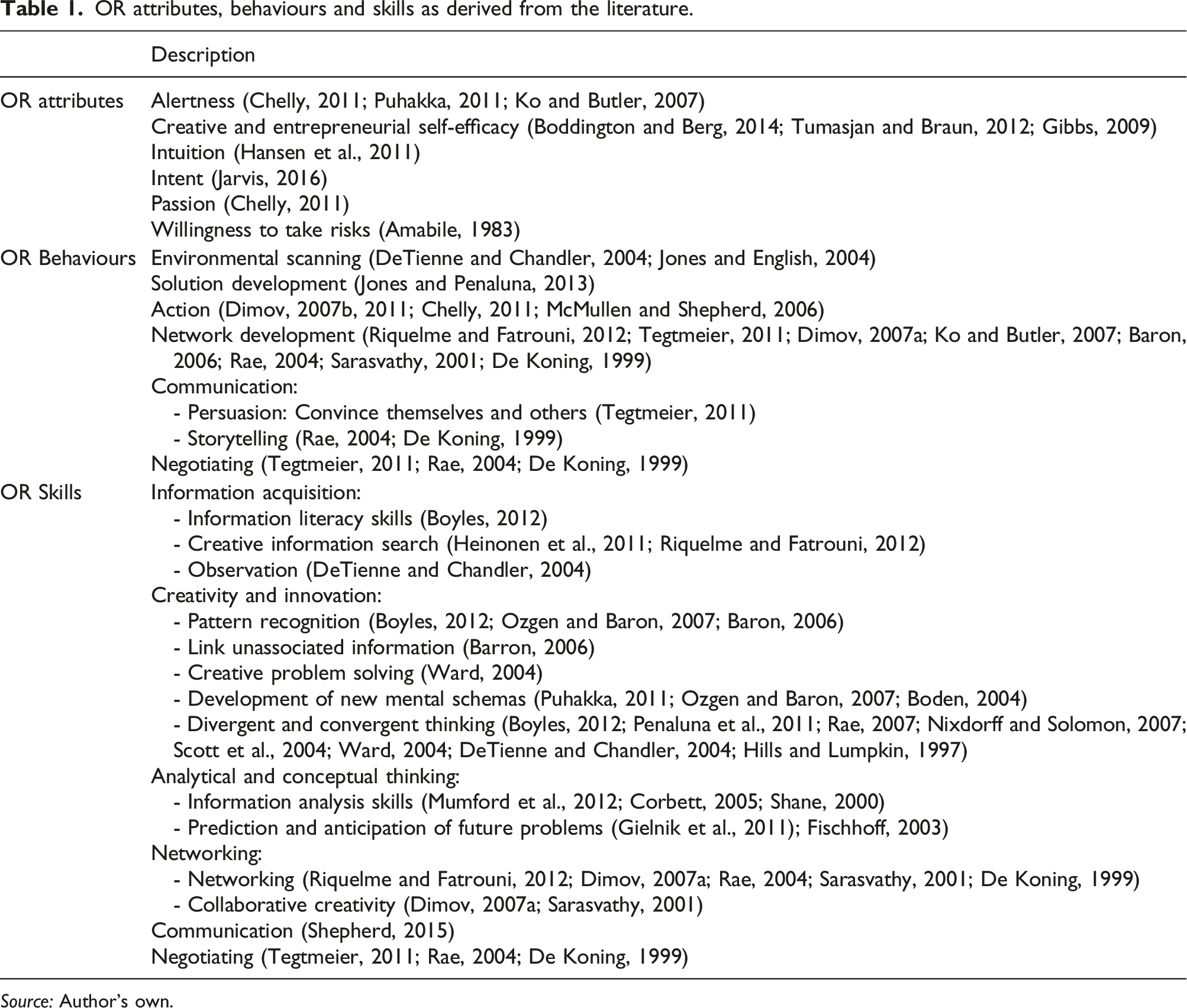
OR attributes, behaviours and skills as derived from the literature.
Source: Author’s own.
Opinion is mixed as to whether the creativity processes and skills associated with OR can be enabled in an educational context (Krueger, 2009). Chell (2013) contends that some, such as alertness, cannot be taught, while other researchers assert that the creative process leads to entrepreneurial alertness (Puhakka, 2011). Krueger and Dickson (1994) link self-efficacy with OR, but Gibbs (2009) argues that creative self-efficacy has a greater influence on OR than entrepreneurial self-efficacy. Krueger (2009) supports this view, suggesting that acquiring the necessary skills in OR may not be enough as it is a student’s belief in their ability to apply those skills that can influence their behaviour.
Edmondson et al. (2020:225) argue that a growing focus on ‘how to develop attributes in students that promote creativity and innovative thinking’ gives rise to a greater need to build engagement across disciplines, in particular with the humanities. This is supported by Penaluna and Penaluna (2021) who still question the ability of business schools in developing student competence in creativity and suggest benefits in looking at design education. Enabling student creativity is an area in which design educators have significant experience (Penaluna and Penaluna, 2021; Penaluna et al., 2013; Carey and Matlay, 2010). In the past decade, calls for the adoption of design approaches in both the teaching and assessment of EE education have increased (Carey and Matlay, 2010; Neck and Greene, 2011; Nielsen and Storvang, 2014; Penaluna and Penaluna, 2021; Penaluna et al., 2011, 2013). However, clarity regarding the exact nature of these approaches and when or how best they should be used is lacking. This puts the non-design educator in a challenging situation in which they must select what they think are the most suitable approaches in EE education.
Design is more typically associated with dealing with wicked problems, where the true nature of a problem is not immediately known but needs to be discovered through exploration (Nielsen and Storvang, 2014; Dorst, 2003, 2011; Lawson, 1990). Looking at design as a problem-solving approach has led to the development of phased models of design thinking (Dorst, 2003). In this respect Badke-Schaub et al. (2010) caution that design processes are not homogenous and should not be treated as such. Due to the complexity of design, they argue that the reality is not so simple because it consists of many dimensions on several levels. The Design Council’s Double Diamond model (Design Council, 2016), developed in 2004, is recognised for its simplicity and has been widely accepted in the industry (Design Council, 2022; Nessler, 2016). This model represents the different stages of divergent and convergent thinking involved in design. It identifies four distinct phases: discover insight into the problem (divergent), define the area to focus on (convergent), develop potential solutions (divergent) and deliver solutions that work (convergent) (Design Council, 2022). The model is considered iterative and not linear in nature, which supports claims that design processes are not straightforward. Design processes are considered to require successive iterations, shuttling between the problem and proposed solutions, which results in both problems and solutions becoming clearer as design processes evolve (Dorst, 2003; Lawson, 1990).
The literature suggests that design approaches can enable EE students to explore creative ways to turn wicked problems into opportunities, taking into account disparate stakeholder views (Neck and Greene, 2011; Nielsen and Storvang, 2014). While research indicates strong support for using ‘design thinking’ in EE education, not all are in agreement. The attractiveness of design thinking is that it is perceived as emerging, as it has a focus on what might be (Nielsen and Storvang, 2014). Neck et al. (2014) describe design thinking as a ‘toolkit’ for enabling empathy and the development of entrepreneurial behaviour. Indeed, Neck and Greene (2011: 64) suggest that a design thinking approach allows students to develop a broad range of skills such as ‘observation, synthesis, searching and generating alternatives, critical thinking, feedback, visual representation, creativity, problem-solving and value creation’. Davey et al. (2016) found that design thinking in EE education had a positive impact on students’ motivation and their satisfaction with their own performance.
However, the growth in popularity of design thinking is causing clear opposition from the design community (Badke-Schaub et al., 2010; Dorst, 2011; Johansson-Skoldberg et al., 2013) on the basis that the liberal application of design principles, coupled with a lack of understanding, leads to an oversimplification of design concepts (Dorst, 2011). Design thinking is often associated with problem solving, but Dorst (2003) contends that limiting design to simply problem solving leaves it ‘silent’ regarding how much more design can offer. In a review of 168 items of literature on design, emanating from both the design and non-design fields, Johansson-Skoldberg et al. (2013) distinguish between what they term ‘design thinking’ and ‘designerly thinking’. The latter is associated with a professional, reflexive way of reasoning to make sense of things which results in the creation of meaning, frequently communicated through artefacts.
There are calls for researchers to adopt a pluralistic perspective in relation to design in order to make an academic contribution and it is argued that such a perspective will signal maturity within the domain (Johansson-Skoldberg et al., 2013). In an attempt to extend the debate in this area, the author explores the design education domain, to identify whether it offers the potential to enhance OR competence development in EE education by enabling OR attributes, behaviours and skills.
What is design education?
Prior to the 1980s the emphasis in design education (DE) was on the end product of design, with the student working on their designs in the background. However, educators realised that ‘the end product of design was too important a commodity of the process to remain such a neglected, hit and miss affair’ (Lawson, 1990: 2). More recently, pedagogic approaches in design disciplines have tended to emphasise the process over the output (Penaluna et al., 2013).
Dorst (2003) describes DE as ‘design as learning’, in which design is a process of going through learning cycles (propose–experiment–learn) until the student has created a suitable solution to the existing design problem. Approaches used in DE, and other creative industry disciplines, are described as being peer-enabled, formative and discussion-led, with students having to present and defend their work in a public forum (Carey and Matlay, 2010; Penaluna and Penaluna, 2009). Collaboration with industry on design projects is common, positively impacting performance, engagement and design quality (Hurn, 2016).
DE delivery is considered to nurture creativity and promote critical thinking, reflection and innovation (KEA European Affairs, 2009). DE curricula are typically based around the belief that design should be learned and not taught, and design methods tend to be woven into design assignments in the early DE stages (Dorst, 2003). Design educators do not expect their students to ‘blindly go looking for new ideas, but train their students to employ a set of approaches that may lead to discovery’, enabling them to respond to problems and see them as opportunities (Penaluna and Penaluna, 2009: 729). Learning by doing, through a series of projects, is liberally accepted as it models the client/practitioner reality of design (Carey and Matlay, 2010; Carey and Naudin, 2006; Lyon, 2011). Learning by doing is considered to develop both thinking and technical skills, encourage experimentation and decisions based on intuition and develop student potential and learning based on reflection (Dorst, 2003; KEA European Affairs, 2009; Lyon, 2011). Reflection is considered a necessary component which facilitates depth of learning (Quayle and Paterson, 1989). Reflective thought is considered to centre around ‘informed reflection’ on previous actions, coupled with the constant encouragement of reflection throughout the process (Quayle and Paterson, 1989: 34).
Design students are required to take risks, as they can follow a route based on their intuition and incomplete information, yet get nowhere (Dorst, 2003). This drives students to use their creativity and experiment with different design options (Lyon, 2011). DE provides them with both the time and space to explore possibilities, respond to their emotions, experiment, take risks and express their own individuality (Lyon, 2011). Indeed, Penaluna and Penaluna (2009) argue for the importance of allowing sufficient time to facilitate creativity, contending that ‘if the first periods of divergent thinking and reflection are not given a sufficient time allocation, the source “material” from which to solve a problem will be limited to the students’ personal prior experiences’ (Penaluna and Penalua, 2009: 725). This supports the argument that those who come up with answers right away tend to come up with the worst answers (Dorst, 2003).
The role of the tutor is considered important as they give encouragement, feedback, propose alternative routes, find a student’s strength and build on it (KEA European Affairs, 2009; Penaluna et al., 2014). Frequently, the DE educator is a practitioner in the area, thereby injecting reality into the process (Carey and Matlay, 2010; Carey and Naudin, 2006; Penaluna, 2009). Dorst (2003) suggests that the tutor must also push the student to reach their potential by criticising the work when needed. Cardoso and Badke-Schaub (2016) draw attention to the importance of questioning in influencing the way designers think. Yet Quayle and Paterson (1989) advise caution regarding the frequency and veracity of questioning, suggesting that students can become overly self-conscious, potentially leading to an inability to perform.
Carey and Matlay (2010) contend that a suitable academic environment is necessary to allow students to articulate and develop their ideas. Lyon (2011) considers that the learning space should offer students an environment in which they can experience both formal and informal learning from educators and students alike. This link between creativity, the environment and risk is supported in the creativity literature. An encouraging, open, non-threatening environment enables experimentation and risk taking, creating an atmosphere of playful enquiry and encouraging self-directed learning (Hansen et al., 2012).
Assessment in the design domain is considered robust, emphasising objectivity where possible (Carey and Matlay, 2010). However, there is mixed debate as to how transferable the approach is (Carey and Matlay, 2010). Critiques of students’ work (referred to as ‘crits’) are frequently used for formative assessment and as a vehicle to provide feedback (Penaluna and Penaluna, 2009). During a crit, students present (and justify) their work to both educators and peers and are expected to ‘defend’ both their work and its rigour (Carey and Naudin, 2006; Carey and Matlay, 2010; Penaluna and Penaluna, 2008; Penaluna et al., 2013). The ability to communicate is considered pertinent to DE (Penaluna and Penaluna, 2009) and the role of the crit is recognised as helping students to understand and articulate their own work (Carey and Matlay, 2010; Lyon, 2011). Lyon (2011) highlights criticisms of the crit as a means by which students can demonstrate their learning and the degree to which it offers educational benefits to the students. However, Penaluna et al. (2011) argue that assessment processes used in design enable students to manage and cope with risk over time and that their skills of ‘intellectual enquiry [are] enhanced through the curiosity that the pedagogy develops’ (Penaluna et al., 2013: 6).
Methodology
This exploratory research served to gain insights into OR competency development using a design education lens. The literature demonstrates that OR competence is an area that is only partially understood and gaps have been identified in the knowledge relating to this area. Qualitative research, which is considered suitable when researchers need to gain a detailed understanding of a complex issue (Creswell, 2007), allowed the researcher to gain an in-depth understanding of the experiences from the individual design educator’s perspective (Bryman and Bell, 2007). Observation was used for crystallisation purposes (Ellingson, 2009), enabling information to be gathered immediately at the time that it occurred. Observation is frequently used in research on classroom interaction as it is considered a useful method to help understand what is going on in a situation by providing pointers and cues at a surface level (Silverman, 2011). However, when used in conjunction with other methods, such as interviewing, it is considered to add rigor to the research (Bryman and Bell, 2007).
Qualitative interviews and observation of design educators in the Republic of Ireland were used to gain an in-depth understanding of this complex phenomenon from the individual educator’s perspective. In total, ten semi-structured interviews were undertaken across nine (out of a total of 14) higher education institutions in Ireland. Interviewing provided the flexibility to explore interesting issues more deeply, to adapt the flow and use of questioning according to the specific context (Bryman and Bell, 2007; Saunders et al., 2012). Design educators, selected from the pool of interview participants, were observed on three occasions.
A purposeful sampling approach was used as the research warranted input from DE educators who had the necessary experience and expertise in their domain at the higher education level in Ireland. As not all design is the same (Dorst, 2003; Lawson, 1990), this research focused on sectors of design education which deal with: open design problems; problems that arise from the needs of others; strong commercial orientation guiding their design; and designs capable of repeated production (rather than one-off works). The sample included predominantly commercial, product and visual communications designers.
Following pilot testing, data were gathered in two phases over 6 months, allowing for initial data analysis and the adaptation of questions where necessary (Bryman and Bell, 2007; Saunders et al., 2012). Phase 1ran from October to mid-December 2015 and Phase 2 ran from January to April 2016. At the end of phase 1the data-gathering phase was paused to allow time to reflect on the data gathered and to allow further examination of insights in the subsequent round.
Interviews were face-to-face, allowing the opportunity to adapt questions as required. They ranged in duration from 41 to 81 min and were audio-recorded and manually transcribed and anonymised by the researcher (Saunders et al., 2012). Overt non-participant observations took place in their normal educational setting, lasting between 1 and 3 h. In all instances participant consent was secured. The observations revealed relevant information that had not emerged in the initial interviews as the respondents may not have perceived such information as relevant (Bryman and Bell, 2007). Detailed notes were taken during the observations and reflections on the experience were recorded in the researcher’s diary (Saunders et al., 2012).
A descriptive phenomenological approach was taken in analysing the data, supported by the qualitative data analysis software package QSR NVivo10. The advantages in organising, indexing, storing and coding the data proved useful (Silverman, 2011).
The process for data reduction and analysis, informed by Giorgi (2012), involved reading each transcript several times to become familiar with the data. The words of the participant and observation diary entries were coded into ‘meaning units’ and a broad category system was generated in an attempt to manage the initial volume of codes. Each meaning unit was examined more closely in the context of the research, which led to a fuller and deeper categorisation of the initial categories (Dey, 1993). A composite of the participants’ experiences resulted from reviewing all the nodes and then refining, grouping and merging nodes together in hierarchical node trees. A descriptive analysis of participants’ accounts was progressively developed to get a clearer picture of the shared experiences that emerged from the data (Dey, 1993). The data were interpreted at a macro-level, enabling linkages to be made between concepts (Dey, 1993; Miles and Huberman, 1994). Relationships between the nodes were considered and patterns and themes identified. Modelling was used to clarify linkages, providing a focus on the themes emerging from the data (Miles and Huberman, 1994).
Initial codes added to code book per interview.

Findings
Participant demographics.

Source: Author’s own.
Ways of thinking
DE was found to develop ‘ways of thinking’, enabling students to develop workable solutions to problems. Students engage in different types of thinking, such as abductive and deductive reasoning, which are developed over time rather than being explicitly ‘taught’. DE was described as a ‘journey’ that is undertaken over a number of years. This progression allows students to develop both thinking and technical skills which, educators suggested, students cannot move back from. ‘It’s maybe like you just have this eureka moment but it’s actually well no, there’s different types of thought processes going on …’ (DE3) ‘And these projects could run from anything from a week long to anything up to 15 weeks long, depending on where you are in the degree.’ (DE1)
Early stages of DE were found to be more structured, becoming more self-directed later on. Actively doing design and practice over time were considered important in DE, with students regularly undertaking short task-based projects which could be independent of each other. Repetition of design processes through projects enables students to understand what is required and to develop their skills and helps them to refine their own design processes.
Features of DE
The data revealed a number of themes, which were distinguishing features of DE: explore, challenge, risk and collaboration. ‘Explore’ was described as starting ‘wide’, taking things from an ‘holistic’ perspective and looking at all possibilities: ‘If you only pursue one area then your selection is going to be very limited and then your solution probably is going to be very limited.’ (DE7)
Observation revealed that educators knowingly intervened at this stage to prevent students from arriving at solutions too quickly. They explained that, by exploring, students discovered insights which led to design opportunities – this was considered important for areas that were unfamiliar to students. Insights were described as illusive constructs, difficult to precisely define yet clearly identifiable by both educators and students when they occurred. Terms such as ‘nuggets of information’ or ‘a creative thought that catches you unaware’ were used to describe an insight. Curiosity was identified as a driver for exploration and having the confidence to follow their curiosity was thought to develop students’ resourcefulness. This was an area in which design students were considered to excel: ‘Just kind of curiosity and just finding things out that they need to find out, and just kind of thinking on their feet, being resourceful.’ (DE2)
In this context, ‘challenge’ is understood as the act of calling students’ thinking into question. Descriptions revealed challenges on a number of levels: challenging the route to final conclusions, challenging students to figure things out, challenging the methods used or challenging the usefulness of the solution: ‘The educator questions the students’ reasoning and asks what is the “because” which is based on their insight from their learning’ (OB2DE). Challenge allowed educators to pull students back from following a path to which they may have become overly attached, helping them identify how their work could be improved or pushing them to justify their design decisions. Challenge was seen as enabling students to question, rather than accept things as they were: ‘I am prepared to be corrected in terms of if students can identify, go back to the brief, identify it, provide a clear rationale I’m willing to be swayed and to be brought in that direction but I need to be able to see the connection.’ (DE7)
Challenge was effected through formal critique or face-to-face feedback and was considered central to developing students’ ability to reflect. DE10 suggested that the skill lay in recognising the value of what was said, considering how this might impact what they did next and then being resilient enough to do it. Educators explained that the focus was not on what was right or wrong, but rather on students’ ability to reflect on what was done: ‘… it’s something that they have to do after, if they are not reflecting on what you said there is no point in having the tutorial you know...’ (DE10) ‘…that reflection in the process and that they can articulate, that reflection of their personal experience, through a crit, that as an educator you’re not, you are giving them critical feedback, you are not criticising them but you allow them to reflect.’ (DE9)
DE exposes students to risk in many ways. Engaging in creativity itself was considered risky: students can be afraid to openly express their ideas, as evidenced by procrastination, ‘curating’ their work, or not incorporating their ideas into work shared publicly with others. Attachment to an idea was also recognised as a risk, causing students to resist sharing their ideas with others, letting go of their ideas or exploring other alternatives. It was acknowledged that some students did not take advice, thereby increasing the risk, as they ultimately learned through failure. However, failing in this context was recognised as a valuable source of learning.
DE processes, by their nature, expose students to risk. ‘Explore’ requires students to engage with users early on, which some naturally resist. Explore requires them to find their own path, which can result in their following many leads which may not have potential: ‘Around this time there’s a lot of confusion, I’ve reasonably regular meetings with students coming into my office going “I don’t know what I want to do” and it’s quite a big thing because this project is generally their number one portfolio piece.’ (DE1)
Insight was described by DE8 as ‘the risk’ in design as there is no right or wrong answer and students must be able to defend any insight they propose: ‘Insight is, is the risk, is the creative, it’s like “oh that’s really interesting”, you know?’ (DE8)
Risk is inherent in such challenges as shortcomings in students’ current thinking may be revealed. This was clearly observed when a student sighed with relief following a review session as he declared ‘What a relief, I was sure you’d tell me I had gone off on a tangent’.
Finally, risk is intrinsic in the self-directed nature of DE, in which students take responsibility for their own work, develop their own ideas and acquire knowledge and skills they deem necessary for their projects. This risk was considered to intensify towards the latter stages of undergraduate education.
DE was found to encourage collaboration. Collaboration with industry was seen to expose students to role models and replicate real world experiences while interdisciplinary collaboration involved students from different programmes or schools working jointly together. Collaboration was considered necessary to help students develop the vocabulary, technical know-how and versatility to apply their design skills in a variety of different contexts: ‘On any given year we could have 20–25 different members from industry in speaking to the students. And they tend to speak to them across years.’ (DE1) ‘You don’t necessarily have to be able to produce all of the stuff yourself, because the skill set has changed, there’s people who specialise in kind of core areas but you should be able to work together with them to, to kind of, to arrive at the finished solution.’ (DE7)
An emphasis on peer-to-peer engagement also reflected this collaborative approach. Formal peer-to-peer engagement occurred in the context of group critiques and feedback sessions, while informal engagement was observed when students voluntarily helped each other and casually offered suggestions.
Enablers of designerly ways of thinking
Enablers of designerly ways of thinking.

Source: Author’s own.
The role of the DE educator has many aspects (Table 4). The relationship between students and educators was described as open, supportive and built on trust over time. Support was described as a form of ‘nurturing’, as students can feel ‘disillusioned’ or ‘disheartened’ at times. DE educators were found to knowingly intervene in creative processes by challenging students’ thinking to prevent them from identifying solutions too quickly. Having trust in oneself, trust in the process and trust in the student–educator relationship were considered important to enable student risk-taking: ‘I mean if people are terrified that they are going to get hammered for doing something wrong then they are not going to take a risk so you’ve got to encourage risk at the beginning.’ (DE2)
The delivery of DE was frequently workshop- and tutorial-driven, with workshops used to facilitate both theoretical and practical elements. Scaffolding was evident in the form of thinking and filtering frameworks that enabled students to make sense of information they had found. Educators described exposing students to examples of best practice to inform their design work: these were contemporary, seminal and industry-specific examples that could be applied to the work at hand.
The physical layout, visual aesthetic and the climate of the learning environment were found to encourage experimentation, creative freedom and openness between peers and tutors. The studio environment was described as being noisy, where some students thrived but others could find it challenging. A lot of simultaneous activity can take place in the studio, with teaching spaces in some areas while other activities take place in other parts of the studio. At times, student groups from different stages in their undergraduate education occupy sections of the same studio space, which allow students to freely move amongst each other and overhear discussions, workshops or other events taking place. Providing a supportive, nurturing and non-threatening environment that encourages risk taking and accepts failure as a natural part of the process were mentioned in this regard. Similarly, DE7 explained that, over time, students gradually lose their inhibitions as they grow used to the environment and the processes at play: ‘Safe places are very important […] for, for learners to explore.’ (DE9) ‘It’s kind of their space. Em, there’s a, it’s quite social really em sometimes there’s quite an industrious hum. So last week and the week before it was like, oh yeah, you could feel the working vibe going on.’ (DE3)
DE was found to prioritise assessment of the student’s performance in the process of design over the final deliverable produced by the student (Table 4): ‘explore’, ‘challenge’ and ‘reflect’ were mentioned as specific learning outcomes of some programmes. The focus of much formative assessment was on: the students’ ability to negotiate the process; to illustrate their thought processes throughout; to demonstrate their ability to consider solutions from a variety of angles; and to demonstrate their learning from their experience of the process. Educators described students keeping a record of the development of their work using blogs, logs, sketchbooks or diaries that were frequently consulted in discussions between students and tutors and as a form of formal assessment. The design process was assessed through student learning logs/diaries, in which the ‘explore’ stage was documented and reflected upon, and through interim presentations of their work. ‘So the crit is not necessarily an assessment, em, it’s used to give feedback on the project really more than anything.’ (DE6) ‘They generally in later years do a blog of their progress so they record all their design process and we want that to be a […] critical piece rather than necessarily a documentation of practice […] so we use that to assess a lot of their work.’ (DE1)
Discussion
This study reveals that DE develops ways of thinking in its students that enable them to solve problems and identify design opportunities. The findings show that these ways of thinking are developed progressively over time, using frameworks, scaffolded processes and constant repetition. During this time, students become more skilled and self-directed in managing their own design processes (DE3).
The findings highlight a number of distinctive features of DE that enable ‘designerly’ ways of thinking. ‘Explore’ requires students to take a holistic perspective, which was considered particularly important when students explored unfamiliar areas (DE7). The exploratory stage emerged as central to students’ ability to discover insights from which design opportunities could be generated. Curiosity was revealed as the driver of exploration, requiring students to be resourceful in their work (DE2). Interestingly, DE educators were found to actively intervene to prevent students from arriving at solutions too quickly, supporting claims by Penaluna et al. (2013) that rushing in and identifying problems or solutions too early can be avoided.
Challenge emerged as a distinctive feature of DE, and it was not just reserved for the crit (Carey and Matlay, 2010; Penaluna et al., 2011). Challenge permeated much of the interaction between students and educators, both formal and informal. Students were challenged on their thinking, methods, routes and the value of their designs throughout a project. Challenge was ultimately considered as a catalyst for reflection, thereby stimulating designerly ways of thinking and student resilience (DE10). These findings support those of Cardoso and Badke-Schaub (2016), who draw attention to the importance of questioning in influencing the way designers think.
DE is recognised for exposing students to risk (Dorst, 2003) and this study reveals a variety of ways in which this happens. The creative nature of design poses an immediate risk, with students required to share ideas, to let go of ‘pet’ ideas and to discover elusive ‘insights’ (DE8). Indeed, the pedagogy itself presents risk because students must find their own path, move outside their comfort zone to engage with external stakeholders and become increasingly self-directed in their approach (DE1).
Collaboration is woven into the fabric of DE design and delivery (Carey and Matlay, 2010; Lyon, 2011; Penaluna and Penaluna, 2009). This study shows that it occurred in the forms of collaboration with industry, interdisciplinary collaboration and peer-to-peer collaboration. These were considered necessary for students to develop the vocabulary and technical know-how needed to succeed in design (DE7). An emphasis on peer-to-peer collaboration was built through formal processes and it was observed in students voluntarily critiquing or contributing to each other’s work.
Four principal enablers were found to support DE processes: the educator, the forms of delivery, the learning environment and assessment. Similar to previous research, the participants all had previous experience as practitioners in their field which enabled them to access practitioner networks and bring real-world experience into the classroom (Carey and Matlay, 2010; Carey and Naudin, 2006; Penaluna, 2009). DE delivery encompassed a combination of technical workshops and individual and peer tutorials. Nurturing trust was found to be an important role of educators, enabling students to fully engage in design activities without risk of recrimination. In support of Carey and Matlay (2010), the physical environment and learning climate were considered important stimulators of creativity where experimentation was encouraged in a safe and nurturing setting. This environment exposed students to both formal and informal learning opportunities (Lyon, 2011).
These findings support claims that DE assesses the process over the final deliverable and student reflection was found to play an important part in assessment (Carey and Matlay, 2010; Penaluna et al., 2013). Assessment processes reflect the importance of challenge in DE. However, this study contrasts with prior research with regard to the centrality of the crit in DE assessment (Carey and Matlay, 2010; Penaluna et al., 2013; Penaluna and Penaluna, 2008), since the crit was found to be more a vehicle for feedback and did not always play a role in summative assessment, particularly in the early years of a student’s education. Alternative forms of assessment included blogs, diaries and reflective pieces, which enabled educators to examine the depth and breadth of exploration and trace the development of ideas over time.
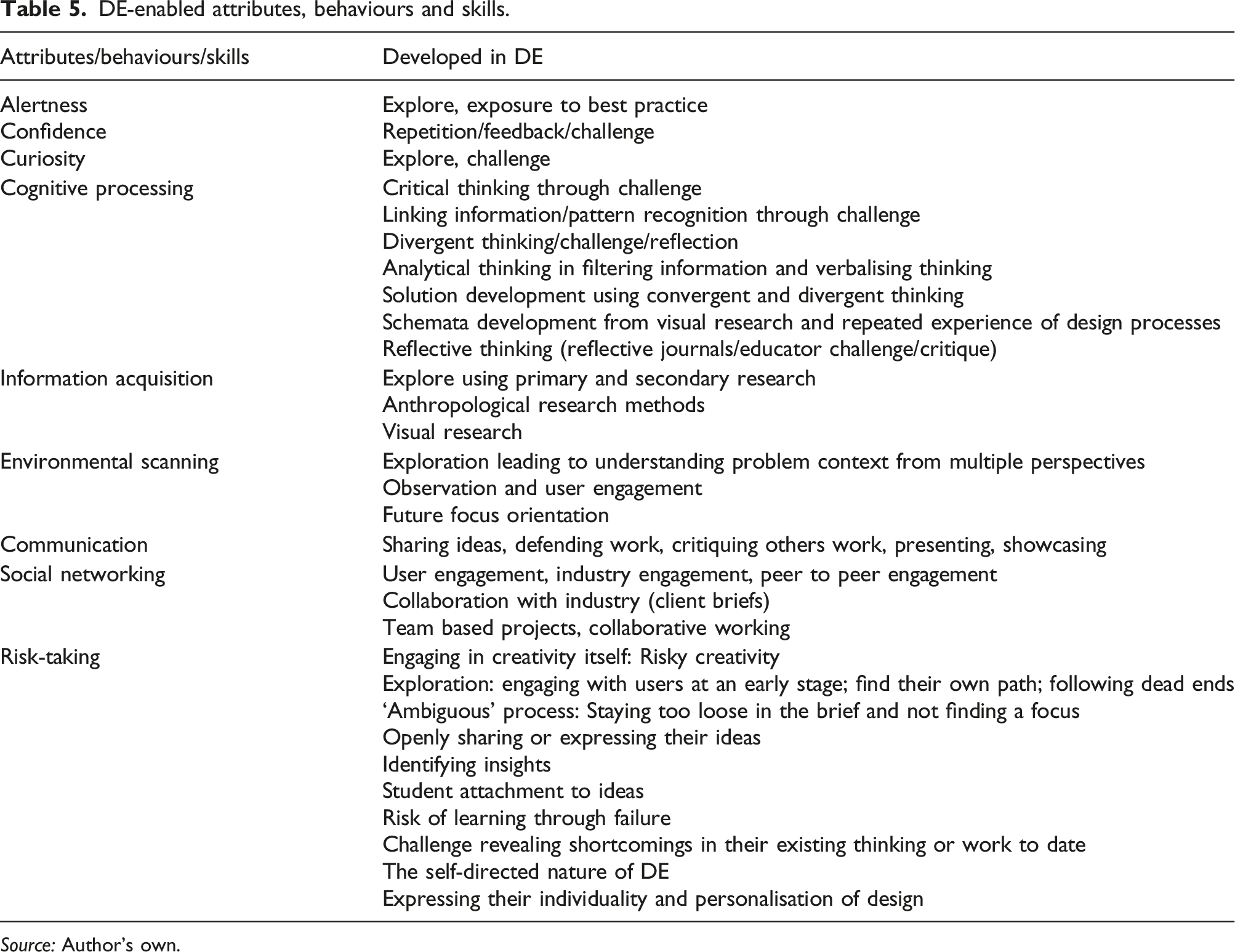
DE-enabled attributes, behaviours and skills.
Source: Author’s own.
`The author posits that DE pedagogies offer the potential to enhance OR competency development in EE. In response to research calls (Balan and Metcalfe, 2012; Goldsby and Nelson, 2012), an OR Education Framework is proposed (Figure 1). As exhibited in Figure 1, the repeated exposure of students to design-led OR processes should enable OR competency development over time. Engagement with OR processes should be enabled by the EE educator, in both the nature of delivery and the development of an appropriate learning environment. Successive cycles of exposure to design-led OR processes over time could enable the progressive development of OR attributes, behaviours and skills. The framework also highlights that OR competence can be determined through design-informed assessment of these processes. Opportunity Recognition Education Framework. Source: Author’s own.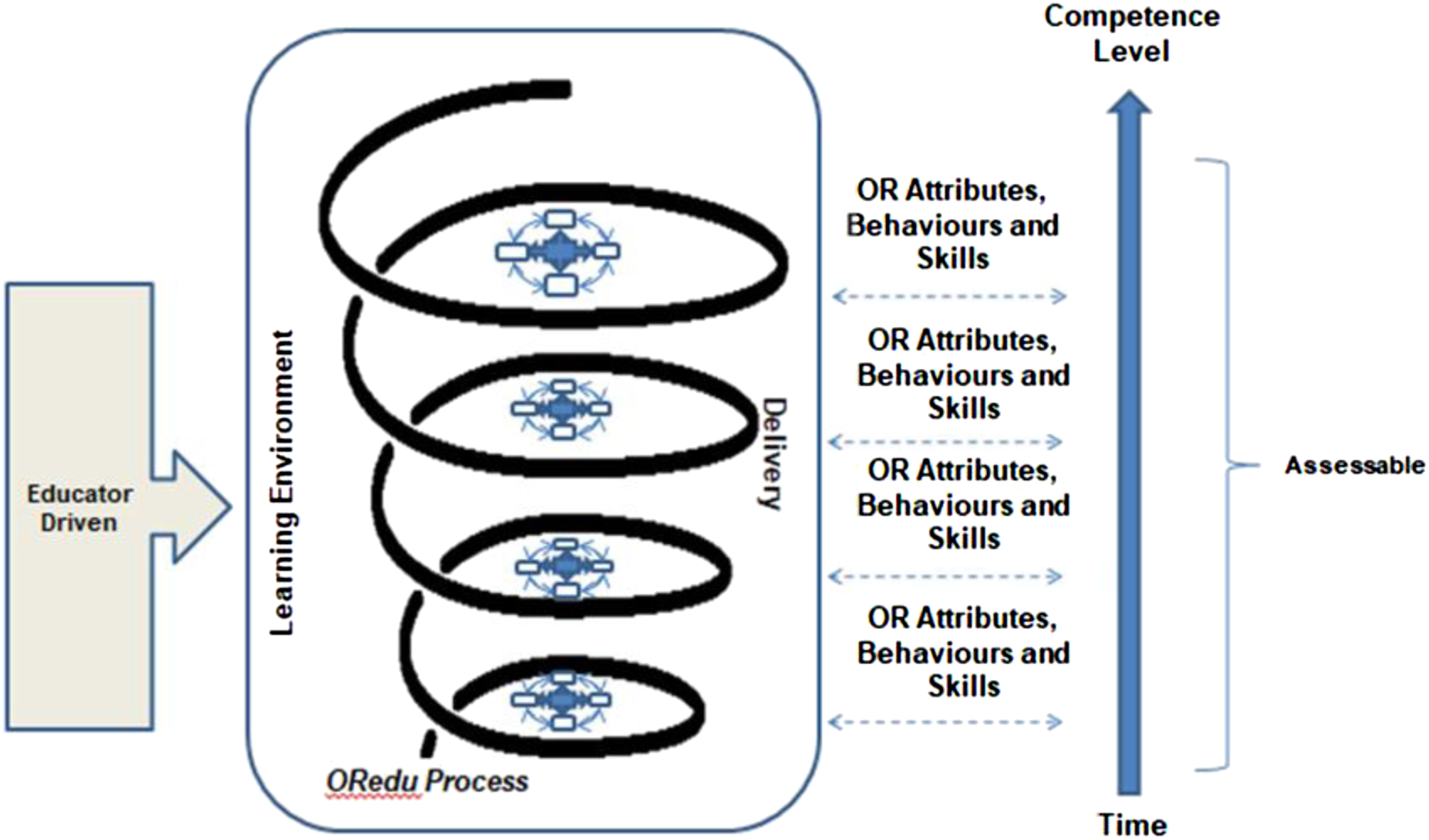
In support of the EntreComp framework (Bacigalupo et al., 2016), the proposed OR Education (ORedu) Framework could be applied to facilitate all levels of OR competency development. The foundation level would see a greater level of EE educator scaffolding and support available to students in acquiring the requisite attributes, behaviours and skills to successfully engage in OR. Scaffolding could include tailored OR project briefs, ‘explore’ frameworks and repeated divergent and convergent thinking exercises, facilitated peer-to-peer feedback and structured reflection. Regular EE educator and peer challenge could support initial skill acquisition.
Based on the research findings, OR education should be designed to become more student-led and self-directed as students become more experienced and skilled in design-led OR processes, when approaching advanced levels of undergraduate education. In keeping with the EntreComp framework (Bacigalupo et al., 2016), expert levels could encourage independent ownership of the OR process, incorporating more heutagogic (learner-determined) approaches, such as negotiated learning (Jones et al., 2014).
Conclusion
This article draws attention to the continuing lack of prominence of OR in current EE education (Hills and Lumpkin, 1997; Nixdorff and Solomon, 2007). Inspired by calls for EE educators to look to the creative disciplines for pedagogies used in art and design education (Carey and Matlay, 2010; Penaluna et al., 2013; Penaluna and Penaluna, 2009), it explores the potential cross-disciplinary contribution of design education methodologies to EE education, and OR competence development in particular. The findings suggest that exposure to DE pedagogies, which emphasise the process over the outcome, facilitates the development of attributes, behaviours and skills commonly associated with OR.
This research supports the argument that DE has much to offer the EE education domain (Carey and Matlay, 2010; Penaluna and Penaluna, 2009, 2021; Penaluna et al., 2013). It argues that EE educators should look beyond design thinking processes and embrace the potential offered by design education pedagogy, which can move students from dependency to independence over time. The proposed framework for OR education complements the EntreComp Framework developed by Bacigalupo et al. (2016) as it suggests that repetition of the design-informed OR process can lead to the progressive development of OR competence, enabled by the educator, the learning environment, delivery and assessment.
This paper unpicks what is understood by OR competence, providing greater clarity to the EE educator in terms of attributes, behaviours and skills associated with OR. The research contributes to practice: the framework (Figure 1) provides educators with a structured approach to OR competence development over time. As the role of the EE educator is central to the proposed framework, the author recommends that engagement with DE pedagogies should be coupled with educator training and design educator peer interaction. Such training would enhance educators’ capacity to guide students through design-led OR processes in the search for creative solutions to problems. Identification of OR attributes, behaviours and skills creates visibility, thereby providing the EE educator with opportunities for assessment of OR competence.
This research set out to establish the suitability of DE approaches to OR education in an EE education context. However, opportunities exist to explore both domains from the reverse perspective, looking at the suitability of approaches used in the broader EE education domain to enhance competency development in DE. Such research could serve to further strengthen links between design and EE education.
Footnotes
Acknowledgements
I thank Professor Jill Venus, University of Wales, Trinity Saint David, Carmarthen Campus, Carmarthen, and Professor Andy Penaluna, Professor Emeritus of the University of Wales, Trinity Saint David, Swansea, Wales, for their support and guidance in the conduct of this research. I would also like to thank the Waterford Institute of Technology for funding this research.
Declaration of conflicting interests
The author(s) declared no potential conflicts of interest with respect to the research, authorship, and/or publication of this article.
Funding
The author(s) received no financial support for the research, authorship, and/or publication of this article.
