



Abstract
How do politicians buy votes in secret ballot elections? I present a model of vote buying in which a broker sustains bribed voters’ compliance by conditioning future bribes on whether her candidate’s votes reach an optimally set threshold. Unlike previous explanations of compliance, the threshold mechanism does not require brokers to observe individual voters’ political preferences or even vote totals of the bribed voters. I show that when there is uncertainty about voters’ preferences, compliance can be sustained as long as electoral results of small groups are available. If preferences are observed however, vote buying is not deterred by higher aggregation of electoral results. I also find that vote buying is facilitated when voters care about the welfare of other voters. Using survey data from Nigeria, I provide evidence consistent with the model’s results.
1. Introduction
During the 1998 campaign for governor of Nueva Sparta in Venezuela, the COPEI candidate, Rafael ‘Fucho’ Tovar distributed between 5,000 and 15,000 Bolívares to people who waited in line to ‘talk’ to him every Friday. All indicated that the money was given to influence their voting choices. 1 Given that Fucho was running in a secret ballot election, the puzzle that this case presents is how Fucho was able to induce his visitors to vote for him. Even with the secret ballot, the distribution of cash, bags of rice, construction materials, whiskey bottles, farm animals, kitchen supplies, and many other items in exchange of votes is still widespread in elections across the world.
Previous explanations of bribed voters’ compliance assume either that the parties successfully develop ways to monitor their constituents’ actions or that they are able to accurately identify voters’ preferences. Stokes for example argues that individual monitoring is achieved through a deep insertion of the party in the voters’ social networks that allows brokers to target weak opponents and to infer their voting choices (Stokes, 2005). An alternative explanation is that brokers target unmobilized supporters, enforcing compliance by monitoring turnout (Nichter, 2008). While these explanations seem appropriate when parties know the voters’ political leanings and turnout prospects, they cannot account for the active market of votes that takes place in more limited information environments. Consider the case of Los Mapaches (the raccoons) in Mexico, a group of young activists who come from outside the communities to bribe voters around election time (Wang and Kurzman, 2007: 74). It is not clear how Los Mapaches, who go temporarily to a given region, are able to infer voters’ intended or actual votes. Similarly, brokerage frequently occurs in urban centers where the relative lack of tight social networks hinders the acquisition of voters information. Bosco illustrates the point when describing brokerage in Taiwan, ‘While rural thiāu-á-kha [vote brokers] can know with a fair degree of certainty for whom a voter is likely to vote, urban thiāu-á-kha often have to approach voters with almost no knowledge of their background and voting proclivities’ (1994: 46). The uncertainty faced by brokers is even more pervasive during violent campaigns in which voters have to cope with both intimidation and bribing attempts. Under these conditions, voters are forced to hide or misrepresent their political leanings to avoid being victims of attacks.
This paper studies a simple mechanism that sustains compliance when brokers do not know voters’ preferences, turnout prospects, or even bribed voters’ vote totals. In the model, the broker optimally sets a threshold of votes for her candidate. If the threshold is not reached in a particular polling station, those who were bribed are excluded from future payments for a fixed number of periods. Compliance under the threshold mechanism depends on two elements: voters’ fears of losing access to future benefits, and the uncertainty about other citizens’ preferences that both voters and the broker face. Whenever bribed voters perceive that failure to comply significantly increases the chances of triggering the punishment, they will vote for the broker’s candidate to avoid being excluded from future handouts.
Similar outcome-contingent mechanisms are in fact used by brokers to enforce vote buying transactions. An example that highlights the importance of monitoring aggregates for vote buying is given by a campaign staff member who worked during the 2011 local elections of Bogotá, Colombia: What these people do is to look up those that supposedly voted for the candidate on the web. They enter the bribed peoples’ information [name and national i.d. number] in the electoral commission web page. There, they can find the polling station where they voted, and with the E14 [official form used to publish results], they then check the votes that the candidate got in that polling station.
2
Clearly—as the interviewee acknowledged—the described monitoring process only gives a rough measure of compliance as not all voters in a polling station are bribed. This then motivates the question of under what conditions collective monitoring can be effectively applied. While it has been noted that collective monitoring can enforce vote buying transactions (Birch, 2011; Chandra, 2007; Kitschelt and Wilkinson, 2007; Schaffer and Schedler, 2007), there is not a clear understanding of the mechanisms used and under what circumstances they work, especially when brokers do not see bribed voters’ results or lack detailed knowledge about their political inclinations.
A separate aspect of vote buying captured by the model is that it suffers from a dual commitment problem. Not only do brokers have to hope that bribed voters will deliver their support, but voters also have to trust brokers to continue rewarding them in the future if electoral results are favorable to the party. The expectation of future interactions between voters and brokers has been recognized as an element that sustains these transactions (Stokes, 2005, 2007), and, here, that element is incorporated as a key component of the model. However, repeated interactions by themselves cannot solve the commitment problem faced by bribed voters when future benefits are determined by aggregate election results. A voter who receives the broker’s payment could vote for her preferred candidate while hoping that other bribed voters would comply with their part of the deal. In this case, the voters’ commitment problem is compounded by a collective action problem. All bribed voters who oppose the buyer’s candidate have incentives to free-ride on others’ compliance while voting for their preferred choices. A major difference with previous models that use repeated interactions to sustain vote buying, like the ones in Stokes (2005) and Gallego (2012), is that this paper’s model allows us to explore in detail the bribed voters’ collective action problem.
By studying the collective action problem of bribed voters in a repeated game framework, the model provides a theoretical basis for at least four patterns identified in the empirical literature: the negative impact of higher levels of aggregation of electoral results on vote buying (Birch, 2011; Chandra, 2007; Schaffer and Schedler, 2007), the positive relationship between expectations of others’ compliance and individual compliance (Bratton, 2008), the preference of parties to look for brokers with extensive local knowledge (e.g. Callahan and McCargo, 1996; Wang and Kurzman, 2007), and the tendency of brokers to target groups with strong social ties like extended families and clans (Arghiros, 2001; Blaydes, 2011). The paper also presents a quantitative case study that shows evidence consistent with new theoretical insights derived with the model. In particular, using survey data from Nigeria, I find that the strength of the negative relationship between electoral aggregates and vote buying depends on the uncertainty about voters’ preferences, and that people who are active members of groups in their communities are more likely to be offered bribes during the campaign. The case of the Nigerian 2007 elections is particularly well suited to study vote buying in an electoral environment that resembles the model’s setup: brokers faced high uncertainty about voters’ individual preferences in certain regions, and vote buying was widespread.
Exploring vote buying when brokers have imperfect local knowledge can also give insights on the question of how vote buying becomes entrenched in the first place. The introduction of multiparty politics with secret ballot elections is often accompanied by the emergence of a strong market for votes as the experience of many Sub-Saharan countries during the 1990s illustrates (Jensen and Justesen, 2014). This highlights the need to understand how brokerage works when there is no established electoral history guiding brokers when selecting their targets. While it could be argued that the persistence of traditional values of reciprocity and gift giving could account for vote buying in new democracies, others have challenged these views by noticing that the link between traditions, morality, loyalty and compliance is not robust (Arghiros, 2001; Brusco et al., 2004; van de Walle, 2007). The analysis that follows does not rely on reciprocity and can shed light on how vote buying takes place in new democracies, as well as in more established ones when brokers have limited information.
The paper proceeds as follows. In the next section, I briefly highlight the contribution of this paper to the formal literature of clientelism. In Section 3, I set up the basic model and in Section 4 I present the main results. Section 5 explores how vote buying is sustained under the threshold mechanism in alternative electoral settings. This is followed by the quantitative case study of the 2007 Nigerian elections. I conclude in Section 7.
2. Related literature
In addition to the articles already cited, this paper belongs to a small but growing formal literature on clientelism and vote buying. Models where individual voting choices are observed by the buyer have been used to study the capture of legislatures (Groseclose and Snyder, 1996) and control of workers’ political behavior through employment contracts (Baland and Robinson, 2008). A separate group of papers focus instead on elections where individuals’ votes are imperfectly observed, as occurs when parties can circumvent the secrecy of the ballot with an exogenous probability (Dunning and Stokes, 2008; Gans-Morse et al., 2009). 3 Other models that study different mechanisms to influence voting bodies relax the assumption of observable voting choices but do not explore our electoral environment of interest in which there is simultaneously a secret ballot, uncertainty about individual voters’ preferences and no buyer commitment to future payments (Dal Bó, 2007; Morgan and Vardy, 2011a). Robinson and Verdier (2013), on the other hand, focus their attention on how the vote buyer credibly promises to reward previous supporters. The main mechanism of their paper, however, is tied to the authors’ interest in explaining how offers of public sector employment are effectively used to increase electoral support and is not directly applicable to the exchange of material benefits for votes.
This paper is perhaps more closely related to the work of Smith and Bueno de Mesquita (2012) and Gingerich and Medina (2013). In Smith and Bueno de Mesquita (2012) the authors offer a different outcome-contingent mechanism to sustain vote buying that requires party operatives to have access to the vote totals of the bribed voters. This requirement however is not met in the transactions that are the focus of this paper. When in the streets of Bogotá, a broker hands out 50,000 pesos to 10 voters who vote in a polling station along with 50 others, how does she enforce compliance? In this case the broker would observe the vote totals of the group of 60 but usually she cannot tell how the bribed voters voted as a whole. The threshold strategy examined here accounts for clientelistic transactions in which bribed voters’ vote totals are not observed. Gingerich and Medina (2013) present an alternative mechanism for the link between election aggregates and vote buying. In their model, as electoral jurisdictions grow in size, so does the uncertainty about how voters would coordinate their voting choices. They find that in the presence of multiple equilibria in the voting subgame, a risk averse broker would stop buying votes in large jurisdictions. Building on these papers our model further explores how certain characteristics of the electoral environment influence the effectiveness of brokerage. Some of those characteristics that have not been previously examined in their models include the types of voters’ political preferences (instrumental vs. expressive), their stability over time and their visibility, unobserved costs of voting, and the presence of interrelated preferences among voters. By examining the role of these characteristics in vote buying, the paper offers new explanations for findings in the existing literature and new hypotheses on the factors that affect the negative relationship between election aggregates and the incidence of vote buying. These are examined using survey data from Nigeria.
3. The model
Consider the following infinite horizon game with N citizens and one vote buyer called the broker. 4 Time is discrete and indexed by t, and all players discount the future at a common rate β ∈ (0,1). In each period an election is held in which two candidates compete (one of them being the broker’s candidate). Before the election of each period, the broker chooses a number Bt ∈ {0,1,2,…, N} of voters who are selected to be given a payment m > 1 in exchange for their vote. When a voter is given a payment, she will be referred to as a bribed voter, as I assume that offers are not rejected. 5 All citizens must vote either for the broker’s candidate, or for the other candidate and their vote choices are not observed by others. Only aggregate results are publicly revealed.
At the beginning of every period t, voters’ preferences are randomly drawn from a Bernoulli distribution. Specifically, in each period a voter is a supporter of the broker’s candidate with probability 1 − r, and with probability r she prefers the other candidate, in which case the voter will be called an opponent. These preference draws are independent across time and across voters, and they are private information. A citizen that votes according to her preferences receives one unit of payoff. 6 Therefore, the instantaneous utility function of a voter i that prefers candidate ci,t when she votes for vi,t is

where 11{.} is the indicator function and bi,t takes the value of one if voter i receives a payment and zero otherwise. The values vi,t and ci,t can either be one or zero as well. The voting choice vi,t is one if i votes for the broker’s candidate, and the type ci,t is one when she prefers the broker’s candidate.
As for the broker’s utility, it increases with the number of votes her candidate receives, and with the money that was not spent buying votes. The total amount of resources the broker has at every election is R and her budget restriction is R ≥ Bt · e, where e is the price of the bribe. The broker’s ex-ante utility function is

where
Given the secrecy of the ballot, I examine strategies where the players condition their actions on past aggregate electoral results of the N voters. N should then be interpreted as the number of people voting in a polling station, or more generally, as the minimum number of voters for which there are aggregate results available. The class of strategies is given by the following: at t = 0 the broker selects B0 and randomly distributes those bribes. Then she sets
Formally, a broker’s strategy is a choice of
This setup describes an infinitely repeated Bayesian game with imperfect monitoring. The equilibrium concept used to solve the game is the perfect Bayesian equilibrium. An equilibrium of the baseline game is therefore a set of optimal strategies for each type of voter and the broker and a set of beliefs about the types of each voter held by all players after each history.
Note that since there is no serial dependence of individual preferences, aggregate results do not alter prior beliefs on voters’ types, which are determined by r. This greatly increases the tractability of the model. Examining the case where voters’ types exhibit some persistence while maintaining key features like infinite repeated interactions and imperfect observability of voting choices is not straightforward. Recent literature has found general results for similar games only when players’ actions are perfectly observed (Escobar and Toikka, 2013). The difficulty lies in the fact that when types are serially correlated, the voters can use signaling to alter beliefs about the population preferences creating a greater challenge for sustaining the type of cooperative equilibrium between the broker and the bribed voters that we are interested in modeling.
More important, however, is the fact that the setup closely resembles the typical environments of elections in poor developing or new democracies where vote buying is common. In those environments campaign promises lack credibility, and as a result voters perceive ex-ante that election outcomes do not directly influence their utilities. Also these elections are frequently highly personalized contests in which long-term loyalties to a party are rare because party brands are unstable over time or do not exist in the first place. Similar conditions apply to elections under one party rule, or more generally, under systems that encourage intra-party competition that forces several candidates with very similar ideological platforms to compete. 8 In those elections, the probability of a voter preferring the candidate for which the broker works is almost completely independent of the probability of that same voter liking the candidate for which the broker will work in the next election. The assumptions of expressive voting and the way preferences are determined over time are consistent with such electoral environments. Nevertheless, in variations of the baseline model, I examine other relevant scenarios where vote buying is observed by simultaneously relaxing i.i.d. and unobserved preferences, and separately relaxing expressive voting and complete turnout.
4. Results
To define the equilibrium strategies, consider the following plan of action for the players: in normal periods the broker hands out payments to B voters selected at the beginning of the game, bribed opponents vote for the broker’s candidate, and everyone else votes for their preferred choices. In punishment periods, the broker does not distribute payments, and all voters vote for their preferred choices. Applying the one shot deviation principle (for details see the Appendix) we can see that such a plan of action is part of an equilibrium if the following inequality holds:

In this expression
The compliance constraint intuitively states that a longer punishment spell, a larger value assigned to the bribe by the voters, a higher probability of reaching the threshold, and a higher probability of having a vote that determines whether the threshold is reached all help in sustaining compliance.
We can now state our first result for an equilibrium in which players follow the previously described strategies. All proofs as well as the formal statement of the strategies are in the appendix.
Given that payments are costly, if there is a very small chance of finding opponents in the population, the broker is better off by keeping the money and getting votes only from her candidate’s supporters. The broker does not want to distribute payments to voters who would vote for her candidate when there are no handouts. However, the observable implication of the model is not that we should only see opponents being targeted with bribes. The broker would want to do so, but she is prevented from targeting only opponents by her lack of knowledge of individual preferences.
The lemma also tells us that as α and e increase, the parameter space for r in which vote buying can occur shrinks. This suggests that we should not see vote buying either when the opponents demand expensive gifts to compensate them for not voting for their preferred choices, as happens when they have high incomes or strong political preferences, or when the value of being in office is small.
The next result completely characterizes an equilibrium that can sustain bribed opponents’ compliance.
In normal periods bribed opponents vote for the broker’s candidate if their compliance constraint holds and in punishment periods they vote according to their preferences.
All other voters vote in all periods for their preferred choice.
Before the first election the broker chooses
After the first election the broker continues distributing bribes to the same voters in normal periods and she does not distribute bribes during punishment ones.
One characteristic of the equilibrium is that punishment spells can occur along the path of play even though all bribed voters comply. This occurs whenever there is a shift in the preferences of the non-bribed voters that makes the threshold unreachable. Punishments occurring along the path is a feature of repeated games where players only observe noisy signals of past play. Here, the broker and the voters condition the punishment on low realizations of the signal (the votes of the broker’s candidate) to provide intertemporal incentives for a cooperative outcome. A related feature of the equilibrium is the fact that in punishment episodes both the bribed voters and the broker are hurt by the punishment. One could ask: why do the broker and the voters not agree to not enter the punishment episode when the threshold is not reached? Punishments are necessary since the voters would not be able to believe that once low results were realized and there were no subsequent consequences, things would be any different in the future. Although punishments are costly, they are credible, because without them it would not be possible to enforce mutual cooperation.
As stated by the proposition, every bribed opponent correctly believes that other bribed opponents are voting for the broker’s candidate. However, it can be of interest to examine alternative voters’ expectations about others’ actions. There is evidence that people tend not to comply when they think that others are doing the same. Using data from a pre-election Afrobarometer survey in 2007 in Nigeria, Bratton (2008) finds that the strongest predictor of defection for a bribed voter was the expectation of others defecting. The model is able to account for this finding when we examine what happens when a bribed opponent expects a defection by other bribed opponents.
Suppose that the broker sets the bribes and threshold as indicated by Proposition 4.2, but that a bribed opponent thinks that a fraction of other bribed opponents are not complying. Those expectations will most likely reduce her calculated probability of being pivotal since there are fewer expected votes for the broker, and no matter what she does, the threshold would be less likely to be reached if it was set optimally. 9 This gives the bribed opponent less incentive to comply.
Figure 1 presents both sides of the compliance constraint inequality as a function of the expected fraction of opponents complying. 10 The graph presents the expected positive relationship between the benefits of complying and the fraction of expected opponents complying. If 80% or more of the potential opponents among those that were bribed are expected to comply, then it is better for a particular bribed opponent to do so as well. This follows from the observation that for that range of beliefs, the left-hand side of the compliance constraint (solid line) is above the 1 − β line.

Compliance constraint and expectations of others’ compliance.
We now examine how changes in the size of the group for which there are available results affects the number of bribed voters. When N is large, for all combinations of thresholds and lengths of punishment, the chance of any bribed opponent triggering the punishment by not complying is so small that it is always better for them to vote for their preferred choice. Then higher levels of aggregation represent a big obstacle for vote buying as the next result shows.
This result is consistent with previous observations made in empirical studies (e.g. Birch, 2011; Chandra, 2007). Schaffer and Schedler, after explaining how aggregate monitoring is used to enforce compliance, note ‘Collective monitoring is made easier when votes are counted at the precinct level, as in India, Senegal and Thailand prior to the 1997 reforms’ (2007: 24). Similarly, Birch states, ‘Such techniques [collective reprisals] of course rely on the use of small units of vote aggregation that allow political patrons to ascertain how relatively small groups of people vote’ (2011: 98). What is not explained by these authors is how exactly small units of vote aggregation facilitate vote buying. The model gives a simple logic based on the collective action problem faced by the bribed voters. Gingerich and Medina (2013) offer an alternative explanation that highlights how uncertainty about electoral outcomes grows with the size of a jurisdiction, and how risk adverse brokers might prefer to avoid such uncertainty. What we find here is that risk neutral brokers can also prefer not to buy votes when they only have access to highly aggregated electoral results.
The result can also explain why we consistently observe that small and rural populations are more likely to experience clientelistic practices (Bratton, 2008; Nielson and Shugart, 1999; Stokes, 2005). Other authors have given explanations that emphasize the role of strong social networks present in small communities and how this allows parties to infer preferences and monitor voters’ actions (Magaloni, 2006; Stokes, 2005). The explanation supported by this model is that the threshold mechanism tends to collapse in large population centers because most polling stations in those areas serve large numbers of voters.
We can also show that if voters derive utility when their candidate wins, for a fixed N, and an increasing size of the electorate, bribed opponents’ compliance can always be sustained (see the proof in the Appendix). 11 This is because the benefit of cheating, which is given by the probability of making the preferred candidate win, becomes very small as the electorate size increases. On the other hand, the benefit of compliance for a fixed polling place size does not decrease towards zero as the electorate size grows. This result suggest that whenever voters expect a change in their utilities that is triggered by the outcome of the election we should not expect a negative relationship between levels of aggregation and incidence of vote buying. In most places where vote buying occurs though, the assumption of expressive voting appears to more closely capture how voters’ vote, as noted earlier.
5. Variations
The model makes assumptions that are consistent with a limited information environment in which brokers interact repeatedly with a group of voters whose utilities depend only on how they vote and on the bribes that they receive. In this section, the basic setup is changed to accommodate other electoral environments. The alternative assumptions that are examined are: visible and stable political preferences, elections in which abstention is allowed, and vote buying of voters that have interrelated preferences. 12
5.1. Brokerage with stable and visible preferences
How is vote buying with a secret ballot affected when preferences are observed and they do not change over time? It could be argued that whenever parties have an established history in the political arena voters preferences will not randomly fluctuate over time and will be more visible to party operatives. There is evidence that confirms that brokers can acquire knowledge of voter preferences under these conditions. Using a survey with party brokers and voters in Paraguay, Finan and Schechter (2015) found that local brokers are able to correctly predict a known villager’s political leanings more than 77% of the time. In this particular case, the brokers had been working for the traditional parties for an average duration of 18 years. After 18 years of close interaction with the same people, it is perhaps possible for brokers to gather enough information to infer precisely individual voters’ political leanings. In this section I study how the threshold scheme works where parties have very detailed information on voters’ political preferences.
I again restrict attention to an equilibrium in which players adopt the same strategies given in our baseline model. The next result shows that unlike the incomplete information case, the existence of an equilibrium that sustains payments along the path of play is guaranteed when voters sufficiently value the bribes.
in normal periods, bribed opponents vote for the broker’s candidate if their compliance constraint holds and in punishment periods they vote according to their preferences;
all other voters vote for their preferred candidate in every period;
before the first election the broker sets
after the first election the broker continues distributing bribes to the same voters in normal periods and she does not distribute bribes during punishment ones;
if and only if
Here, the threshold is set at the level that makes all bribed voters pivotal. If any bribed opponent votes for her preferred candidate when the threshold equals the number of supporters Nb plus the number of bribed opponents, this would automatically bring a punishment episode. This is similar to what happens when brokers can sometimes monitor individual votes as in Dunning and Stokes (2008), Gans-Morse et al. (2009) and Stokes (2005). In their models and in our complete information model, individual deviations can be identified (although in a different way), and punishments can be carried out immediately after the deviations occur. This means that under complete knowledge of preferences, voters are forced to act as if there were no secret ballot. Moreover, in the equilibrium of this version of the game, there are no costly punishments which gives an explanation for why parties invest heavily in finding brokers with extensive local knowledge.
A final consequence of adopting this informational setup is that more aggregated results no longer inhibit compliance. What this suggests is that when brokers have more local knowledge or when preferences are easily linked to observable characteristics of voters, we should not see a negative relationship between votes aggregation and vote buying.
5.2. Abstention and vote buying
The baseline model assumes that all voters show up to the polls in every election. This gives incentives to the broker to target only opponents whenever possible. This setup was used to focus the analysis on the incentives faced by the opponents when they receive bribes in the most simple way. Here, I allow for the possibility of some voters abstaining while keeping all other features of the baseline model. Now, every period a voter is assigned a cost of voting κ > 1 with probability p and a cost of zero with probability 1 − p. These costs are private information. It is also assumed that while voting choices are not observed, turnout is, so the voters and the brokers can now condition their strategies on past aggregate results and individual voters’ turnout history.
We study a perfect Bayesian equilibrium in which all bribed opponents comply and in which beliefs are determined by the probability of every voter being an opponent r and the probability of any voter having a high cost of voting p. The relevant plan of action for the players is as follows: in normal periods the broker hands out payments to the voters selected at the beginning of the game, bribed voters vote for the broker’s candidate regardless of their costs of voting and preferences, everyone else votes for their preferred choices when they have low cost and abstain otherwise. In punishment periods, the broker does not distribute payments, all low-cost voters vote for their preferred choices, and the rest abstain. If the broker sees at any normal period a bribed voter not showing up to the polls, that voter is never given bribes again and the broker replaces her by randomly selecting another voter in the next normal period.
For the strategies to be part of an equilibrium a compliance constraint for bribed opponents and mobilization constraints, that ensure that no high cost bribed voter finds profitable to take the bribe and not show up to vote, need to be satisfied. 13 By the same arguments used in the baseline case, as N increases, the broker will not be able to sustain the compliance of bribed opponents. One important difference with our previous setup is that depending on the perceived preferences and voting propensities, the broker might continue to engage in vote buying to mobilize supporters when N is large. This is shown in Figure 2.
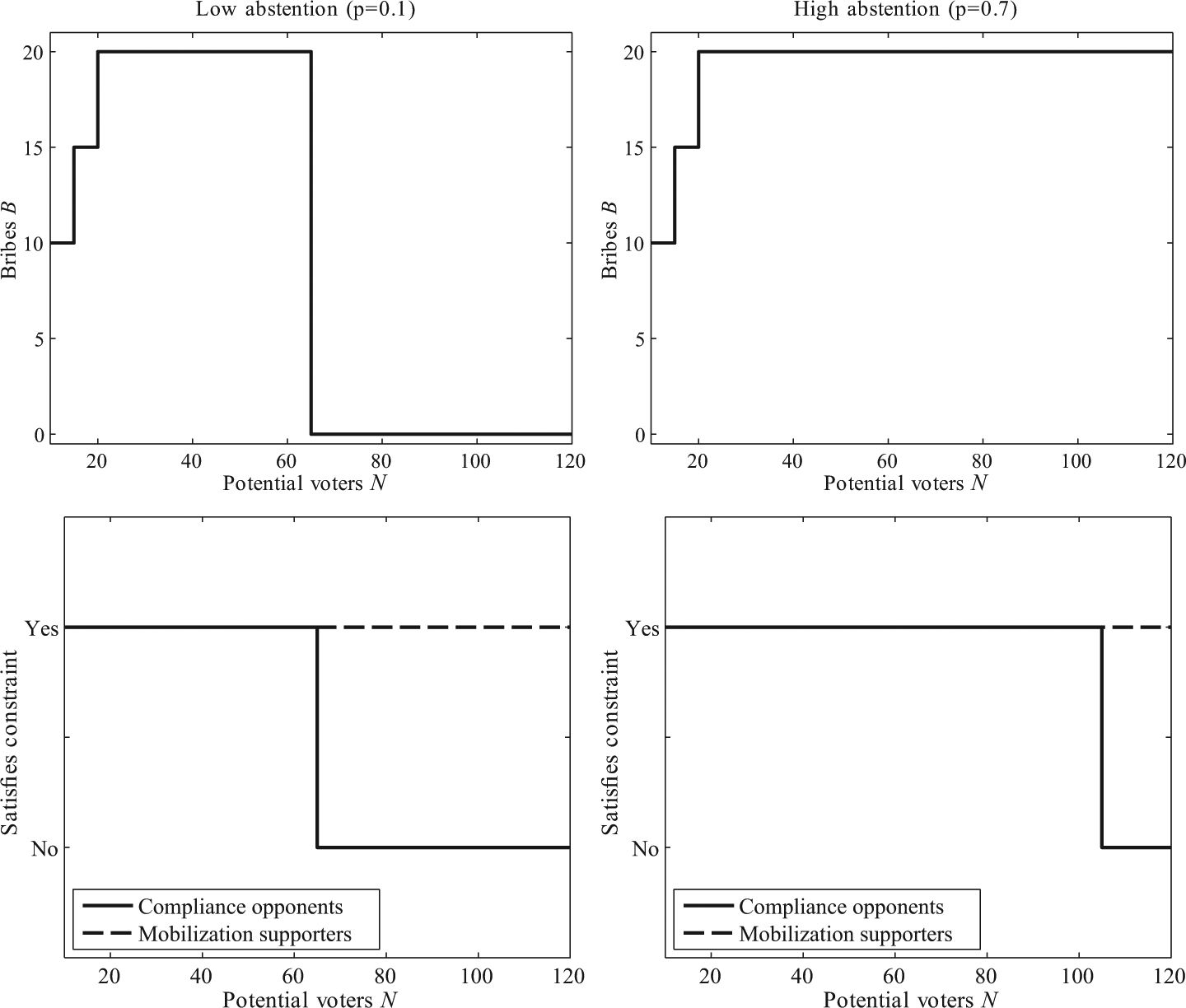
Aggregation levels of electoral results and optimal number of bribes.
In the two top figures in Figure 2 we have the optimal number of bribes chosen by the broker as a function of N, and the two bottom figures show whether the compliance constraint of opponents and the mobilization constraint of high-cost supporters are satisfied for a given N. 14 What we see is that when the broker perceives that most people will show up to the polls in the absence of inducements (p = 0.1), high levels of aggregation will deter vote buying. This occurs at around N = 65. When abstention is more likely (p = 0.7), she will continue bribing voters even when the opponents that get these bribes do not comply. In that case opponents stop complying at N = 105, but B is still positive for that and larger polling station sizes. The broker then adopts a pure mobilization strategy.
5.3. Group preferences
Case studies have documented the preference of parties to target people that are members of groups whose members have close social relations. Wang and Kurzman describe the case of a particular broker working for the Kuomintang in Taiwan whose relatives are an important part of her list of clients.
One voter was a nephew of the broker and helped the broker to buy votes in the family of the voter’s brother and two daughters; another relative, a cousin, helped the broker deliver the vote buying money to the voter’s neighbors.
In Thailand, brokers visit people’s houses handing out bribes for each registered voter that lives in the house (Arghiros, 2001: 94). Similarly, in Egypt benefits are distributed by family blocs (Blaydes, 2011: 107), and in Lebanon entire clans are targeted (see Worth, 2009). Parties do not only target groups that are defined by family ties. In Colombia, parties buy the votes of associations of seniors and associations of single mothers, organizing trips to recreational centers outside the city where all their expenses are covered (El Tiempo, 2007). Why do parties target groups with strong ties between their members?
There is one mechanism that explains these observations that is easily accommodated in the framework of the baseline model. A bribed group member that cares about the welfare of other bribed members is more likely to comply because by doing so she reduces the likelihood of bringing the punishment to both herself and to other members. Since her utility depends on the welfare of others in the group, that person is more likely to comply relative to someone who only cares about her own payments and voting choices.
To see this, consider the following changes to the model. The broker can now choose to bribe members of a group Ω of size G (1 < G ≤ N) and also voters outside this set. Formally, the broker selects at t = 0 the number of bribed voters who belong to the group BΩ, the number of bribed ones outside the group B−Ω,
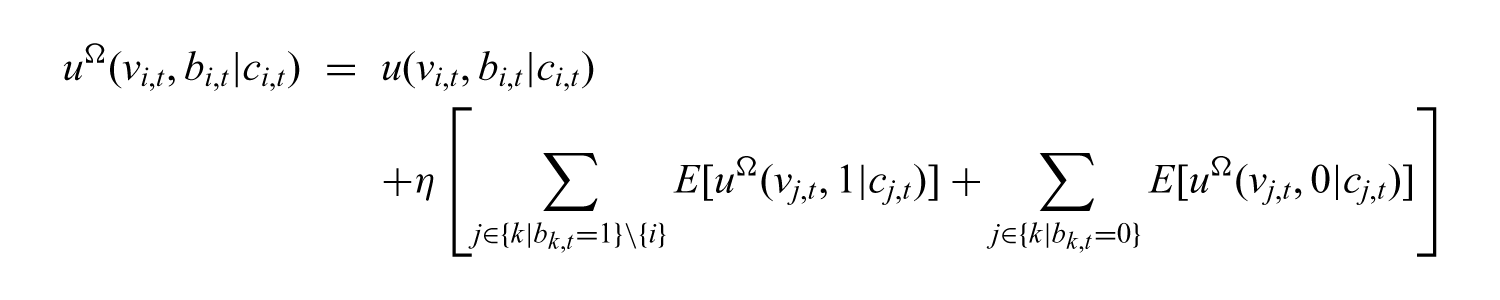
where
The assumption of interrelated preferences can capture pure altruism and un-modeled interdependencies among group members. For instance, if a member receives construction materials for voting for a given party, her friends in the group are more likely to receive those extra materials that she did not use. Or if a member receives extra cash around election time, she could be willing to spend some of it on activities that benefit her group. The likelihood of these types of situations occurring is captured by the magnitude of the parameter η.
We can now define the compliance constraint of a member of the group who opposes the broker’s candidate and receives a payment (for details see the Appendix). This inequality is as follows:

where

The term Δu(G) is the gain in one period derived by taking the broker’s money while voting for the preferred candidate—that is, the value of cheating. In the baseline model, this difference was just the value of voting for the preferred candidate. Here, this term is larger and is increasing in the size of the group and in the importance given to other members’ utility. This tells us that the short term incentive to cheat is stronger than the one present when the utility only depended on the voter’s own expressive voting and bribes. While it is more tempting for a bribed opponent in the group to cheat in one period than for a bribed opponent outside the group, the possibility of triggering a punishment that lasts several periods affecting herself and other members helps sustain compliance more easily than when group outsiders are targeted.
Given that the left-hand side of the compliance constraint for the opponent in the group is greater than or equal to that of the left-hand side of the constraint for the non-member, the broker might be able to choose lower thresholds and punishment lengths that sustain full compliance. Since less frequent and shorter punishment spells increase the broker’s payoffs, the broker would be inclined to target group members. An implication of Proposition 5.2 is that social capital might not always help to reduce clientelism. Investments in social capital are usually associated with people joining different groups in their communities. What the model shows is that the existence of groups in which people are interested in the welfare of other members can facilitate the capture of elections by clientelistic parties.
6. Evidence from Nigeria
There are three novel predictions derived from the model that have not been explored in the existing empirical literature. The first, which comes as an implication of Proposition 5.1, is that the negative association between electoral aggregates and vote buying should be stronger when brokers cannot perfectly observe political preferences; the second is that the negative relationship between electoral aggregates and vote buying should be stronger with high expected turnout; and the final prediction, implied by Proposition 5.2, is that people who are active members of groups should be more likely to be targeted with vote buying offers. In this section, I use survey data from the Afrobarometer Round 3.5 and the Nigerian National Bureau of Statistics to search for evidence of these relationships. The section proceeds by describing the political context of the 2007 Nigerian elections, it summarizes why this case study fits the assumptions of the model, and it presents the main patterns uncovered in the data.
The 2007 elections
Electoral misconduct was rampant in the Nigerian elections of 2007. 15 The incumbent party, the People’s Democratic Party (PDP), used all the tools of manipulation that were available to ensure its continuation of power: ballot stuffing, registration of underage voters, lopsided distribution of ballot papers to polling stations, printing errors in the ballots, delayed arrival of polling officials, intimidation of opposition candidates, violence against voters, falsification of results, and of course, vote buying (Omotola, 2009; Rawlence and Albin-Lackey, 2007; Suberu, 2007). Although it is believed that the opposition also engaged in large scale manipulation, the results of the elections were favorable to the PDP: Umaru Yar’Adua, the PDP candidate for the presidency won with 72 % of the votes, his party gained a majority of seats in both houses of the National Assembly and it took 28 out of the 36 state governorships.
There are at least four characteristics of the 2007 Nigerian elections that make them suitable for testing new theoretical insights derived by the model. The first is that elections in Nigeria were relatively new. After almost 33 years of military rule, in 1999 a new constitution was adopted which provided for multiparty elections. The 2007 elections were the third time Nigerians went to the polls under this constitution. The second characteristic is the use of electoral violence. A conservative estimate of the number of people killed around the 2007 elections is 200 (Suberu, 2007: 100). This induced people to avoid expressing their political preferences. In fact, 90% of the people surveyed by the Afrobarometer that year stated that they had to be careful of what they said about politics. The third characteristic is that voters could expect future interactions with party operatives and candidates, especially with those of the PDP. After 8 years in office, it was clear that president Obasanjo was determined to keep his party in power. The police and the Independent National Electoral Commission served the purposes of the PDP by denying permits for opposition rallies, carrying out politically motivated arrests, and issuing corruption indictments to other candidates. Even in the case that it lost the election, the PDP was going to continue being an important political actor. Finally, although compromised in many regions, the secrecy of the ballot inhibited the direct monitoring of the voting choices of some Nigerians. According to European Union observers, in half of the polling stations that they visited there was indeed privacy for voting (Polgreen, 2007). Such an electoral environment fits well the baseline model assumptions in which some brokers do not easily target voters on the basis of perceived preferences or voting proclivities and are likely to interact with the same voters in future elections.
To examine the relationships of interest, I use Logit models that have as a dependent variable an indicator for whether the person was offered something in return for her vote during the 2007 campaign. The variable takes the value of 1 if the respondent reports that she was offered a bribe and 0 otherwise. The main explanatory variables are: the size of the population in the district where the person lives, two measures that capture uncertainty about political preferences, whether a person is an active member of a group in her community, and the number of people that live in her household. Although the model makes predictions on how the size of a polling station affects vote buying, polling station sizes that can be linked to measures of vote buying according to geographic location are not available. However, since large polling stations tend to be located in more densely populated areas, the district population will be used as as a proxy of electoral aggregation. Two measures of uncertainty about preferences are used: a dummy variable that takes the value of 1 if the person states that people often or always have to be careful of what they say about politics and 0 otherwise, and the number of races (president, governor, national assembly, and state assembly) for which the respondent does not report a preferred party. The indicator of being and active member in a group takes the value of 1 if the person reports being an active participant of either a religious group, a union, a self help association, or a neighborhood watch committee and 0 if she belongs to a group but is not an active member, or if she does not belong to any of those groups.
All specifications include as controls: age, gender, level of education, a measure of basic unsatisfied needs, a dummy that indicates if the respondent lives in a rural area, level of disapproval of vote buying, and the perception of freedom and fairness of the previous election. 16 These controls capture alternative mechanisms that could explain why larger populations have less vote buying. More educated and wealthier voters tend to live in larger population centers and are less likely to receive offers. Also, rural areas might have different social norms that facilitate vote buying, such as generalized reciprocity, and they tend to have smaller populations. It is also important to include a control for whether the person thinks vote buying is acceptable, as this can affect reported levels of vote buying and can also be influenced by differences in social norms between small and large population centers. Finally, while the survey does not ask respondents whether they think the ballot is secret, their perception of freedom and fairness of the previous election could proxy for this unobservable. 17 Including this control addresses the concern that in large population centers people believe more in the effectiveness of the secrecy of the ballot which could deter vote buying.
Table 1 gives the main results of this section. Each column on the table presents a different specification of the empirical model. Only estimated coefficients of interest are shown. 18 Column (1) shows that there is a negative relationship between district population size and the likelihood of being offered a bribe. However, the coefficient for this variable is not precisely estimated. Columns (2) and (3) show how the relationship between district population and the likelihood of receiving an offer depends on the uncertainty about political preferences. We see that the coefficient of the interaction between the measure of being careful of what people say about politics and the district population is negative and significant. To have a better sense of the magnitude of the estimated relationships, Figure 3 presents the predicted probability of being offered a bribe for the average person in the sample as a function of the natural log of district population. The probability of someone being offered a bribe when she thinks that it is better not to express her political views in a small district like Kaura, which has a population 17, 008 (ln(17, 008) ≈ 9.74), is 47.6%. If the person lives in a large district like Alimosho, which has a population of 1, 277, 714 (ln(1, 277, 714) ≈ 14.06), the probability of her being offered a bribe falls to 6.77%. When brokers interact with people who express their preferences more freely, the same probability increases on the size of the district population as the figure on the right shows. The specification in (3) uses the number of races for which the respondent does not report a preferred party as a measure of uncertainty about preferences and it also supports the theory’s prediction.
Determinants of vote buying in Nigeria.
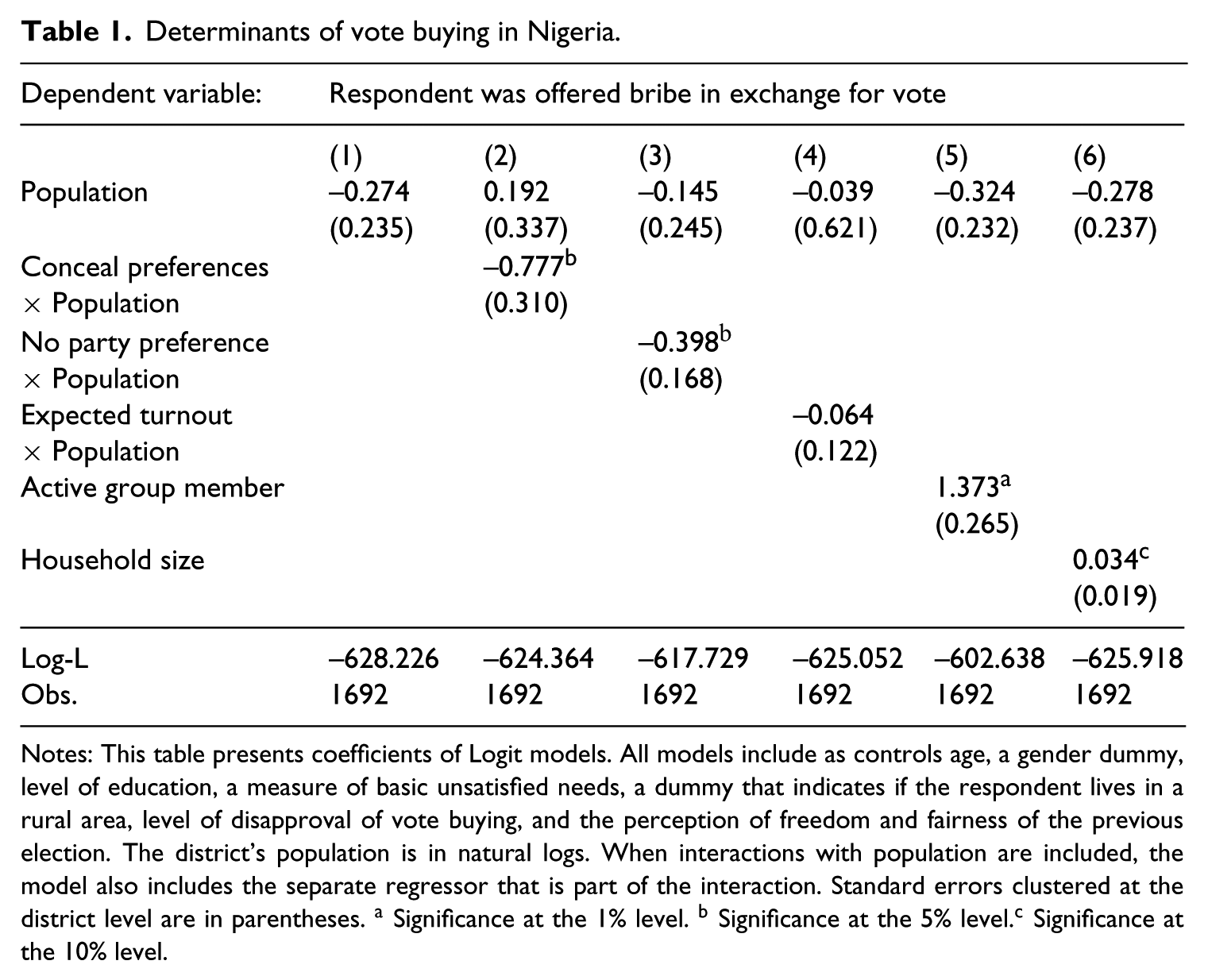
Notes: This table presents coefficients of Logit models. All models include as controls age, a gender dummy, level of education, a measure of basic unsatisfied needs, a dummy that indicates if the respondent lives in a rural area, level of disapproval of vote buying, and the perception of freedom and fairness of the previous election. The district’s population is in natural logs. When interactions with population are included, the model also includes the separate regressor that is part of the interaction. Standard errors clustered at the district level are in parentheses. aSignificance at the 1% level. bSignificance at the 5% level. cSignificance at the 10% level.
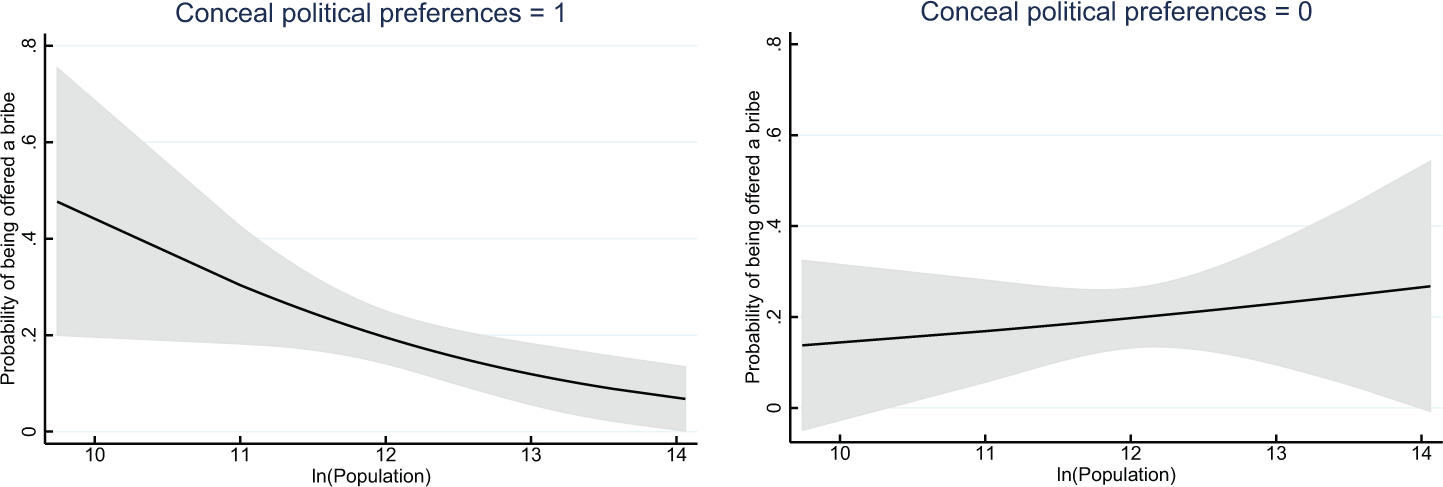
Vote buying, electoral aggregates, and uncertainty about preferences.
The formal model also shows that the association between vote buying and levels of aggregation of results depends on turnout proclivities, with high expected turnout inducing a stronger negative relationship between vote buying and electoral aggregates. Column (4), presents the results of a specification that includes an interaction between expected turnout and district’s population. 19 The results show that the coefficient of the interaction is negative as expected but it is not precisely estimated, showing only moderate support for the expected relationship.
In columns (5) and (6), I study the relationship between group preferences and vote buying. Being an active member in a group in the community can signal that the person’s utility is positively related to the utility of other members. Column (5) shows that an active member of a group does have a higher probability of being targeted with bribes. According to these results, becoming an active member of a group increases the probability of being targeted by 19.74% for the average voter in the sample. While this is consistent with the formal model’s result, there are other reasons that do not involve interrelated preferences that could explain this association. For example, active members of groups can value reciprocity more making them a better targets of vote buying, or it might be easier for brokers to find out about political preferences of group members. The model in column (6) uses the number of people living in the respondent’s household as a measure of group preferences instead of the active group membership dummy. The idea behind this is that the household is a group for which members are more likely to have interrelated preferences and after controlling for demographics, the specification in (6) brings us closer to the formal model’s mechanism. Moreover, large household are likely to be those of extended families where more than two potential voters live. 20 The results show that the chance of anyone being offered a bribe increases with the size of her household. In particular, increasing by one standard deviation the size of the household for the average person will raise the probability of her being offered a bribe by approximately 2.5%.
Although the uncovered correlations are consistent with our predictions, it is important to point out that this analysis is not a comprehensive test of the theoretical ideas developed in the paper and that future work should explore the role of aggregation, uncertainty, and social structures on clientelism further. In particular, we still need to assess the effect of the aggregation of results that is independent from the effect of constituency size. Regardless of how aggregated published electoral results are, a larger constituency is more expensive to influence and should also reduce this type of manipulation. 21 Moreover, the previous analysis proceeds under the assumption that misreporting of vote buying attempts, if it exists, is not systematically related to our explanatory variables of interest. This is a strong assumption and because of this, we should be cautious with the interpretation of the results. For example, people that are more active in their community might trust others more (including the interviewer), and as a result, they might not misreport vote buying attempts as much as other respondents. The indicator of whether people think vote buying is wrong can be considered to be a rough proxy for willingness to misreport and its inclusion in the model could alleviate these concerns; however, future analysis should use survey list experiments or similar methodologies to account for estimation biases generated by misreporting.
7. Concluding remarks
Previous research informed by characteristics of machine politics in Argentina (Nichter, 2008; Stokes, 2005) studied vote buying in environments in which parties seem not to face binding informational constraints. In such a context, parties are very effective at monitoring individual voters’ behavior or at selecting the ‘right’ type of voter to be bribed. However, vote buying does not always occur under those conditions. A lack of electoral history, weak party identification, candidate-centered systems that encourage intra-party competition, violence during the campaigns, opportunism on the part of voters, and rapid urbanization are all elements that limit the visibility of voters’ preferences and their voting proclivities. Yet, under these conditions, we still observe vote buying in secret ballot elections. Here, I examined the application of an outcome-contingent contract that sustains vote buying even when voters’ inclinations change over time and cannot be inferred and when it is not possible to observe bribed voters’ vote totals.
The model also highlighted one mechanism by which a more vibrant associational life can facilitate vote buying. However, there are other features of groups—besides the form that their members’ utilities take—that could be used by politicians to irregularly influence elections. It might be easier for brokers to acquire information about members of groups than for non-members, or by identifying group leaders, brokers could target them and pay them to induce their followers to vote for a given candidate. Future work should assess the relevance of separate mechanisms that account for the observed tendency of brokers to target active members of their communities, which would give us a clearer picture of how social capital might have unexpected negative consequences on democracy.
Finally, the results of the paper suggest potential reforms to improve the quality of elections. The model implies that pooling votes from all polling stations in a district before counting is one measure that can help eliminate vote buying. Such a policy can also inhibit other types of clientelism in which payments take the form of collective rewards as pointed out in Smith and Bueno de Mesquita (2012). Counting at higher levels of aggregation, however, can potentially facilitate other types of electoral manipulation like ballot stuffing. To sensibly assess the overall impact on clientelism of this or similar policies, it is important to address how parties choose between different manipulation techniques and what impact, if any, larger election aggregates have on them.
Footnotes
Appendix. Model details and proofs
Acknowledgements
I thank Avidit Acharya, Marcela Eslava, Gretchen Helmke, Tasos Kalandrakis, Brenton Kenkel, Bethany Lacina, participants of the Watson roundtable at the University of Rochester, participants at the CEDE seminar at Los Andes University, participants at the 2012 MPSA panel on Illicit Electoral Strategies, and particularly Mark Fey for their helpful comments and advice. I am also grateful for the suggestions from an anonymous referee. I am solely responsible for all remaining errors.
Funding
This research received no specific grant from any funding agency in the public, commercial or not-for-profit sectors.