



Abstract
In this article, we examine the role of intermediaries in sustaining political clientelism in rural Saharanpur, Uttar Pradesh. Drawing from fieldwork and electoral data, we show that clientelism in Saharanpur is based around providing three specific guarantees to the voter—security from or by the police, facilitation in the tehsil and mediation in cases that would otherwise go to court—which we collectively refer to as guardianship. We explain how guardianship, more than most other forms of clientelistic exchange, requires intermediaries. In the case of Saharanpur, these intermediaries are usually individuals occupying formal positions of power within various circles of Panchayati Raj Institutions. Finally, we argue that it is the concentric nature of constituencies provided by the decentralized political structure which is ultimately responsible for the sustenance of intermediary networks as well as the perpetuation of clientelism in rural Saharanpur.
Introduction
Kitschelt and Wilkinson define political clientelism as ‘the direct exchange of a citizen’s vote in return for direct payments or continuing access to employment, goods, and services’ (emphasis added) (Kitschelt & Wilkinson, 2007, p. 14). The direct interaction between the citizen and politician constitutes, for many early scholars of clientelism, an essential element of clientelistic relationships (Hicken, 2011, p. 290). For Lande, direct ‘connotes personal attachment’ rather than indirect attachment due to interconnected offices or group membership (Lande, Schmidt, Guasti, & Scott, 1977). Similarly, Scott claims that clientelism is ‘dyadic’; it is distinguished by ‘the face-to-face, personal quality of the relationship’ (Scott, 1972, p. 94). In the political context, dyadism is essential because a politician transacts with individuals rather than groups to create ‘a personal obligation of clientship’ (Stokes, 2007, p. 608).
Recent studies have, however, questioned the face-to-face nature of clientelistic relationships (Hicken, 2011, p. 291). In modern democracies, where constituencies are large and diverse, it is difficult for politicians to sustain direct clientelistic relationships with voters (Scott, 1972, p. 95). The first problem is information (Hicken, 2007, p. 293). A politician cannot know the preferences and motivations of several thousand voters. Some may want money, others public sector jobs, infrastructure or caste-based reservations. The second problem is accountability (Stokes, 2007, p. 611). Both politicians and voters are too far apart to ensure contractual compliance. Without direct interaction, neither can individual voters ensure that they will receive promised benefits nor can the politician ensure that voters will actually cast a vote in their favour.
To solve these problems, studies of clientelism have stressed the role of intermediaries who help mediate between politicians and voters. In large democracies, politicians are connected to voters ‘through a chain of broker relationships’ (Hicken, 2007, p. 291), which creates a patron–broker–client network ‘from the summits of national politics down to the municipal level’ (Hicken, 2007, p. 291). The lowest levels of this hierarchical network engage directly with the voter. They gather voter preferences and solve the problem of information by passing it through to the upper tiers. This proximity also ensures that voters and intermediaries can monitor each other and maintain accountability.
The existence of intermediaries poses another problem to the politicians—organization. As Kitschelt and Wilkinson put it:
Politicians need to organize the flow of material resources across the complex pyramidal network of client-broker-patron exchanges … they must overcome challenging problems of collective action and principal–agent conflicts through finely balanced systems of incentives. (Kitschelt & Wilkinson, 2007, pp. 8–9)
As with all hierarchical networks, politicians must guard against leakages, laxity and defections among the lower ranks. Lower-level brokers may defect to another politician, divert some of the goods they are meant to distribute or simply expect benefits without doing any work (Kitschelt & Wilkinson, 2007, pp. 8–9). A politician cannot afford alienating voters due to these organizational problems. Thus, to sustain productive clientelistic networks, politicians must ensure that intermediary networks are stable and efficient.
While many scholars have recognized this need for productive intermediary networks, few have discussed how the intermediaries in these networks operate (Hicken, 2007, p. 291). Ethnographic work on clientelism in India—despite highlighting the importance of intermediaries in Indian politics—rarely elaborates on the logistics of intermediary networks. 1 Who are appointed as intermediaries? What motivates them to work as intermediaries? What keeps the intermediary networks stable and efficient?
In this article, we examine these questions in the context of rural Saharanpur, Uttar Pradesh (UP). First, we show that clientelism in Saharanpur is based around providing three specific guarantees to the voter—security from or by the police, facilitation in the tehsil and mediation in cases that would otherwise go to court—which we collectively refer to as guardianship. We explain how guardianship, more than most other forms of clientelistic exchange, requires intermediaries. Second, we argue that the decentralized political structure resulting from the Seventy-third Constitutional Amendment provides a conducive base for intermediary networks. The concentric structure of electoral constituencies mandated by the amendment results in the establishment of a network of politicians, intermediaries and voters. Politicians, particularly at the state or national level, establish links with members of the Panchayati Raj Institutions (PRIs), who act as intermediaries between them and voters. In turn, these politicians extend support to these intermediaries in local elections. It is this concentric system, we argue, which solves the problems of information, accountability and organization, and this ultimately leads to the perpetuation of clientelism in Saharanpur.
Methods of Investigation
This article is a case study of the area under the Zila Parishad (ZP) in Saharanpur district. This area includes six assembly constituencies and two parliamentary constituencies with a total of around 1,200 villages. We chose Saharanpur because of our familiarity with the district and the privilege of access we enjoyed there due to earlier fieldwork by one the authors in 2012 and 2014. Due to its unique demographics and socio-economic status, Saharanpur is also a major battleground for all four political parties in Uttar Pradesh, making it an ideal laboratory to study the relationship between state and local politics in India. 2
We use a mixed method of research design. Our main source of quantitative data is electoral data of ZP and assembly elections obtained from the Trivedi Centre for Political Data, Ashoka University, Sonepat. We also use the National Election Survey 2014 (post-poll) (Lokniti-CSDS, 2014) and the Uttar Pradesh Election Study (Lokniti-CSDS, 2012) conducted by Lokniti-CSDS (Centre for the Study of Developing Societies). We use local published magazines and newspapers to ascertain background details of the candidates in these elections. Qualitative data were collected through personal and telephonic interviews. Of the 49 members of the ZP in 2015, we conducted personal interviews of 11 and telephonically interviewed 37. Of the seven MLAs of the district in 2016, we interviewed five. We also conducted interviews with five ex-pradhans (Village Council Presidents) and three incumbent pradhans. Finally, during the 2017 assembly elections, we interacted with a number of individual voters across two assembly constituencies. The names of interviewees and places have been changed to protect the identity of individuals.
The Nature of Clientelism in Saharanpur
Beyond distinguishing clientelism from other distributive political strategies, such as programmatic or pork-barrel politics, the definitional spectrum of clientelism is wide (Stokes, 2007, p. 605). Even within broad definitions, models vary considerably (Hicken, 2007, p. 291). Clientelistic exchanges may differ in, inter alia, ‘resource base of patronage’, ‘resource base of clientage’, ‘balance of affective and instrumental ties’, ‘balance of voluntarism and coercion’, ‘durability over time’ and ‘homogeneity of following’ (Scott, 1972, pp. 97–100). Clarifying these definitional ambiguities is beyond the scope of this article, but it is useful to describe the kind of clientelism that we posit takes place in Saharanpur.
Vote-Buying
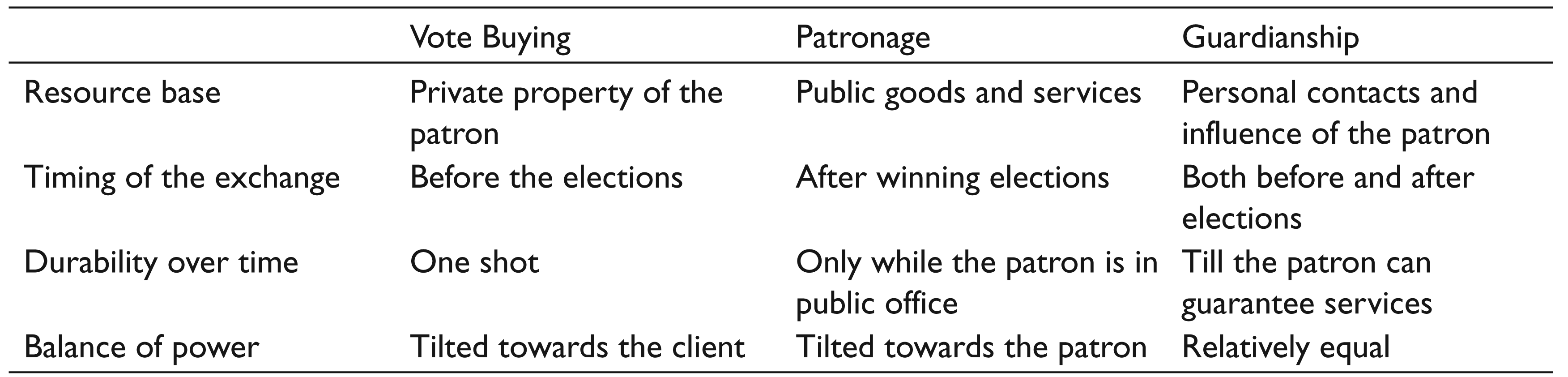
One of the subclasses of clientelism is what Stokes calls ‘vote buying’—‘the flow of direct material goods from the patron for the specific client resource of votes’ (Stokes, 2007, p. 606). For instance, a candidate might distribute money to potential voters expecting that recipients will vote for her. Here the resource base of the patron is private material goods which are distributed to voters before elections. The exchange is usually one shot, without a promise of further benefits after the patron is elected.
Yogesh Kumar, a resident of Salem village, explained the relevance of money, feasts and other gifts from candidates in state assembly elections:
Before, there used to be khana-peena (feasts) in assembly elections, though nowadays this does not happen. Money was never very important. Distribution of money takes place mostly in local elections because the total number of votes there are less. Even if parties attempt to buy votes, nobody would sell their vote for money.
3
Similarly, Buddhu Singh, a two-time Kshettra Panchayat (KP) member of Durrajpur, reiterated that money is seldom used to get votes in Saharanpur. 4 For Singh, money is only used as an entry point to communities where a candidate lacks direct contacts. Singh cites the example of Ashoka Bandhu, who was contesting for the Karanwala parliamentary seat in 2014 and was from outside the state, allegedly distributed money through a network of intermediaries to mobilize voters on his behalf. 5 Singh argued that unlike Bandhu almost all candidates are locally connected and have ‘personal vote banks’. There is thus no need for them to distribute money.
Almost all interviewees reiterated the absence of payments and feasts during the 2017 assembly elections. National Election Survey (NES) 2014 also suggests that vote buying is scarce. To a question, ‘[Have you observed any], Party/Candidate offering food/honorarium, etc. to voters in your locality?’, only 11.1 per cent respondents nationally and 7.9 per cent respondents in UP answered ‘Yes’. 6
Why does vote buying not work in Saharanpur? Stokes predicts that ‘the closer parties are to one another ideologically, the more likely vote buying is to occur’ (Stokes, 2007, pp. 614–615). In Saharanpur, there is a wide spectrum of ideological choices available to the voters in the assembly and parliamentary elections each of which are electorally viable. Voters are thus unlikely to vote for a non-ideological and non-accessible candidate for one-shot material gains. By the same logic, vote buying is more likely in local elections, such as those of the Zila Parishad wards in Saharanpur, where candidates are ideologically more homogenous. 7 One respondent explains that money becomes important in elections to PRI because the competition is intense, and most voters know the candidates well. Since local politicians offer similar things, the only distinguishing factor becomes who can give away more money, organize entertaining events and distribute food and other freebies. 8
Another possible reason for the absence of vote buying is its inability to solve the accountability problem. Secret ballots allow voters to defect, even after taking the material goods the politician provides (Banerjee, 2015, p. 149). Without monitoring mechanisms, these one-shot gifts, often distributed randomly, cannot ensure contractual compliance. Banerjee also highlights this difference between vote buying and vote selling—voters accept money from all parties but their decision to vote is based on ‘other considerations’ (Banerjee, 2015, p. 149). The exchange between voter and politician must create a ‘sense of obligation’, which vote buying does not (Banerjee, 2015, p. 149). Similarly, Björkman finds that while candidates in Mumbai distributed cash, this was ‘a leap of faith’, with no guarantee of success (Björkman, 2014, p. 630). Due to its ‘steep informational requirements’ as well as the low ‘guessability’ of voter preferences, vote buying is unlikely in rural India (Schneider, 2014).
Patronage
Another subclass of clientelism is ‘patronage’—‘the proffering of public resources (mostly employment) by the patron to the client’ (Stokes, 2007, p. 607). Unlike vote buying, the resource base in patronage is public goods or posts over which the patron has indirect control. These goods are allocated to select voters after winning the elections. The exchange is usually ongoing since the selected voter holds goods or posts at the pleasure of the politician.
Chandra classifies India’s political system as a ‘patronage democracy’ (Chandra, 2007, p. 86). In India, she argues, ‘the state has a “relative monopoly on jobs and services” and elected officials’ enjoy ‘significant discretion’ in their allocation (Chandra, 2007, p. 86). Here, clientelism takes a ‘form of rent seeking and corruption in which the returns to politicians take the form of votes rather than bribes’ (Chandra, 2007, p. 86).
In Saharanpur, we found few examples of politicians allocating public employment in exchange for political support. For example, Kisan Singh, an ex-ward member of the Nagar Panchayat, said his son had struggled to find a job. The intervention of the local MLA candidate finally secured him a job near his town in a sugar factory. 9
Such cases, however, are rare. Most respondents did not expect that their elected representative would get them a public job. Survey data suggests the same. In response to the question, ‘What was the most important consideration in favor of [party/candidate]? … I/members of my family have benefitted, or expect to benefit from the [party/candidate]’, 10 only 5.81 per cent of respondents as per Uttar Pradesh State Election Study (UPES) 2012 and 8.83 per cent of respondents in UP as per NES 2014 answered ‘Yes’. 11
In Saharanpur, that politicians have a monopoly over the allotment of public jobs seems doubtful for several reasons. First, digitization of job application procedures, the right to information act and increased public concern for transparency have reduced the job pool that a politician can control. Second, public employment can accommodate only a small part of the electorate—the qualified and unemployed. While patronage may ensure a few votes, it is unlikely to be the dominant strategy to woo a mixed electorate. Third, public employment is mostly in the hands of the government, not the candidate. Providing jobs to a large number of voters is only possible if the politician has absolute control of resources, lest the patron face competition from party and government colleagues seeking to reward their own clients. 12
As far as preferential access to other public goods is concerned, we found several examples of what the respondents call thekedari (contractorship). Thekedari, in this context, is the use of one’s political position in order to allocate tenders to preferred persons. 13 However, thekedari is not clientelism as we define it here as the motivation for it is seldom electoral votes. Several respondents shared instances of elected officials, especially members of the ZP, either allocating tenders in exchange for bribes or allocating them to their relatives. 14 Elected officials can also makes sure that the tenders, especially of road and building construction, are targeted at their constituency, so that they can claim credit for the work in front of their voters. These instances helped us identify a different patron–client link in Saharanpur, that of politicians and thekedars—a link which would deserve a paper of its own.
Differences between Vote Buying, Patronage and Guardianship
Guardianship
How do we classify clientelistic exchanges in Saharanpur if not in the categories of vote buying and patronage? Most respondents gave a similar answer—clientelistic exchanges with politicians help voters navigate various state institutions. Respondents inevitably mentioned three specific guarantees by the politician—that of security from or by the police, facilitation in the tehsil and mediation in cases that would otherwise go to court. We refer to the exchange of votes for these three functions as ‘guardianship’. The resource base of guardianship is the politician’s own personal contacts and influence. The exchange is ongoing—and continues both before and after election. Unlike patronage, guardianship does not give preferential access to a state resource, but merely helps secure state services the client should otherwise have received. (Table 1)
This is not to say that security from or by the police, facilitation in the tehsil and dispute resolution are the only services intermediaries offer in all places. In fact, the type of services that the intermediaries offer might differ geographically depending on the states’ reach, capacity and efficiency. For example, in an urban slum setting, Auerbach and Thachil list ‘ration cards, widow pensions, bank accounts, and caste certificates’, as services that intermediaries offer ( Auerbach & Thachil, 2018 ). Elsewhere, intermediaries may need to guarantee other public services that the state cannot such as quality primary education (Thachil, 2011).
The more general attribute of guardianship is that, unlike patronage, the relationship between the client and the intermediary does not depend on transactional, quid pro quo exchanges, but rather on an enduring guarantee of access to state services. As Auerbach found in Rajasthan and Madhya Pradesh, intermediaries engage in ‘assisting residents in securing ration cards, dealing with police cases, resolving disputes’. It is these ‘everyday acts of problem solving and brokerage’ which ‘provide a stream of rents for leaders who can attract a following’ (Auerbach, 2016, p. 121). Tariq Thachil similarly advocates moving away from an ‘episodic, individualized, and transactional’ understanding of patron–client relationships towards what he calls the ‘service’ conception reveals ‘the importance of quotidian social interaction’ between patron and client (Thachil, 2011, p. 465) According to him:
[Its success] is dependent at least in part on how [its] provision both necessitates everyday contact and provides a depoliticized framework through which activists can interact with ordinary voters. Service thus embeds parties within communities in ways that selective conditional cash transfers or public sector jobs and contracts do not.
Instead of ‘service’, which we think is too generic, we use the term ‘guardianship’ to identify the role the intermediary plays in this kind of clientelistic relationship. We also use ‘guardianship’ to contrast the patron–client relationship in Saharanpur with the paternalistic one suggested by Piliavsky. Piliavsky finds that voters refer to politicians with ‘honorifics’—mai-baap (mother and father) and anndata (bread giver) (Piliavsky, 2014, p. 164). In Saharanpur, however, we notice that the terms used to refer to candidates are bhaiji (brother), qazi sahab (judge) and vidhayakji (representative), suggesting a lower degree of asymmetry between patron and client.
Security from and by the Police
As the institution which embodies the coercive power of the state, the thana (police station) is the most effectual site of citizen–state interaction. The station officers (SO) in these thanas act as ‘nodal points of contact between the public and the criminal justice system’ (Jauregui, 2014, p. 237, 239) and are referred to as ‘kingpins’ (Jauregui, 2014, p. 240), who can through the threat or use of force dramatically alter the lives of citizens. The SOs are relatively autonomous and often use their power extra-legally for their own benefit (Jauregui, 2014, p. 239). SOs may also use their discretion to deny citizens legitimate police services—by inter alia refusing to take their complaints or file First Information Reports (FIR) (Jauregui, 2014, p. 249). It is not surprising, then, that one of politicians’ most important guardianship functions is ensuring security from and by the police.
Banerjee highlights the importance that security from and by the police has for the voter. One of the respondents in her fieldwork in western UP says, ‘I will vote for the leader who will save me from the pilkhan (police) and who will get my work done in a government office’ (Banerjee, 2015, p. 148). Our interviews corroborate this finding. For example, a resident of Ismailpur states that politicians help in ‘thana related work because people are never satisfied by the work of police officers. They need to have someone who knows the police and will make them feel less scared’. 15 Another respondent—a barber from Rahatpur—says, ‘mostly it is the police cases for which people go to the politicians’. 16
Politicians have a strong influence on police postings and transfers, making the police beholden to them (Jauregui, 2014, p. 249). As Jauregui explains:
[The police] is obliged to serve the politician as patron in whatever way he may demand, by ‘fixing’ investigations, providing official or unofficial protection, using other police resources to acquire information or ‘get something done’. In return, the politician protects [the police] against unwanted transfers and other pressures and may perhaps offer further favours, not least a transfer to an even more desirable posting later on (Jauregui, 2014, p. 250).
The power of politicians to affect policemen in Saharanpur is evident from an incident narrated by Gajju Singh, the nagar panchayat ward member from Taori:
In a village called Badi Garhi, a Gujjar man was accused of having molested a girl from the Julaha caste. The police had tried stalling the registration of FIR, until the Julahas reached an MLA candidate’s family through an intermediary who was responsible to take care of the matters related to the Taori Thana. After the MLA called them on the phone, the police not only registered the FIR but also actively engaged in settling the matter.
17
Facilitation in the Tehsil
Another form of exchange prevalent in Saharanpur is that of facilitation in the matters of tehsil (administrative office). All district land and revenue records are maintained in the tehsil office. It is the place where property deeds are registered and duties/taxes on property paid. As with the police, due to its relative autonomy and indispensable functions, citizens see the tehsil office as a site of corruption. Oldenburg documents the corruption in land matters in UP, where ‘ill-paid officials reallocate land to villagers, many of whom are illiterate and all of whom are wary of the bureaucracy as well as of the judicial system with which the land consolidation department is integrated’ (Oldenburg, 1987, p. 510). He highlights the role of middlemen, both political intermediaries as well as local touts, who benefit from this corruption. Today, there continue to be reports of officers in a tehsil asking for bribes for legally mandated work (India Today, 2015, October 21; Times of India, 2012, June 3; Times of India, 2016, February 28).
In land disputes and partition cases in Saharanpur, the tehsil office often requires a substantial bribe to perform their duties. To get over the hurdles of these cases without the payment of a bribe, citizens require the intervention of a politician. 18 As with the police, the politician has several ways to put pressure on the tehsil officer to ‘settle’ the matter. It is for this facilitation at the tehsil, that voters vote for politicians.
Informal Dispute Resolution
Unlike the police and tehsil, the court is not seen as a site of a corrupt state but is nonetheless perceived as an inefficient institution. Court trials in India, including minor ones, are seen as long, arduous and expensive affairs (New Indian Express, 2016, December 12; Times of India, 2015, October 8). Many citizens are also wary of engaging with the judicial process as it may cause badnami (bad-name), especially in local village disputes in Saharanpur, where engaging with the court is seen as taking an ‘inside’ dispute to the public. Many expect that these disputes should be settled by local resolution mechanisms by elders, caste leaders and relatives. The politicians here tend to form the highest rung of these local resolution mechanisms. They act as mediators, taking into account the narratives of local stakeholders and using their influence to create consensus.
This mediation is seen as a valuable activity in Saharanpur, where disputes are often across religious, caste and village lines. Kisan Singh narrates an incident that he witnessed where this dispute resolution translated for votes for an MLA candidate:
[An old time RSS pracharak] in Taori, tried to arrogate a piece of his neighbour’s land by constructing a boundary wall which encroached into the neighbour’s area. This led to a court case between the two, which went on for some years without any resolution. The neighbour decided to bring the dispute to a Samajwadi Party (SP) MLA candidate who through the help of the police brought the wall down and made sure that [the pracharak] withdraws the case. Ultimately, the neighbour’s family that had been traditionally Bharatiya Janata Party (BJP) supporters voted for the SP MLA candidate.
19
Mediation often represents competitive politics and reveals the preferences of an individual voter. For example, Gajju Singh states that parties only bring their disputes to politicians they trust and for whom they will ultimately vote. 20 The shift to another politician for dispute resolution is thus often seen as a change in voting preference.
The Intermediaries in Saharanpur
Guardianship is strenuous, requiring politicians to make connections with state functionaries, build trust among followers and intervene each time a voter faces a problem. After the electoral constituencies reach a certain size, politicians start facing problems of scale, including those of information and accountability. To keep effectively performing their guardianship functions, they require connections with a large number of thanas and tehsils. They also have to build influence among a large and diverse set of constituents to mediate disputes. Guardianship thus, more than most other forms of clientelistic exchange, requires intermediaries.
All MLAs and MLA-candidates we interviewed suggested that they do not perform guardianship functions personally but have their ‘people’ sort out matters on their behalf. As a prominent Samajwadi Party (SP) MLA candidate puts it, ‘The candidates can’t do all the work… [An intermediary] takes care of all work related to his village’. 21 Similarly, Kharak Singh, a Bahujan Samajwadi Party (BSP) MLA says, ‘I cannot be present everywhere … but I still help people through my intermediaries’. 22 This delegation works differently for each politician—some allocate intermediaries to villages and others to the type of work required to be performed. The weight of delegation also varies. Some MLA candidates prefer that their intermediaries merely act as communicators, while others give intermediaries full autonomy to deal with any situation. Even so, only in very rare cases, where indirect communication through the intermediary fails, will an MLA personally intervene.
Beyond guardianship, intermediaries perform mobilization functions for the politician. NES 2014 shows that 65.5 per cent of the electorate in UP is contacted directly in the national elections either by the candidate/party or any other person working for the candidate/party (party worker, local leader, etc.). 23 This is impossible without intermediaries, either within or outside clientelistic networks. In Saharanpur, electoral mobilization and campaigning is done by the same intermediaries who perform guardianship functions on behalf of politicians. 24
Who Are the Intermediaries?
Scholars on intermediary networks in India have sketched widely differing sociological profiles of intermediaries. Berenschot, for example, states that intermediaries are party workers who perform ‘organizational services’ to put politicians in their debt (Berenschot, 2014, p. 202). Similarly, Auerbach claims that, ‘[r]esidents look to party workers to mediate their demands, as workers possess a degree of connectivity to politicians and officials’ (Auerbach, 2016, p. 119). In contrast, Krishna suggests that most intermediaries are naya netas, who come from differing social backgrounds but have ‘functional literacy and certain personal qualities…including a willingness to work hard on behalf of ordinary villagers’ (Krishna, 2007, p. 148). Another seminal study by Manor suggests that intermediaries are basically professional political operatives ‘who do not hold any formal political or administrative positions’, but make a living practising ‘the art of approaching officials for favors and making the wheels of administration move in support of such favors’ (Manor, 2000, p. 817).
Intermediaries in Saharanpur do not fit any of these models. None of the intermediaries that we interviewed were strongly aligned to a single party. Party workers in Saharanpur are loyal to the party centre rather than individual candidates and move into different areas of the constituency based on party needs. Thus, they lack the proper base required to perform guardianship functions. It is also possible that since party competition is high in Saharanpur, the local influencers (non-partisan) take advantage and ‘hedge between competing party forces’ to ‘renegotiate rents’ before elections in exchange for mobilization on the ground (Chauchard & Sircar, 2018). We also could not find any evidence of the naya netas. One respondent reported that while ‘educated’ and ‘well-intentioned’ young men are active on the ground, they rarely interfere in politics and are unconnected to MLAs. 25 It would seem, then, that the kind of intermediaries and the types of function that they perform are heavily area-dependent (Kruks-Wisner, 2015, p. 14). For example, Ananth Pur finds in rural Karnataka that intermediary functions are performed by members of these traditional village councils (Ananth Pur, 2007a, 2007b).
Contrary to Manor’s characterization, intermediaries do hold political office in Saharanpur. One MLA described his intermediaries as ‘Pradhans or ZP members whom I call based on the area that the voter is from’. 26 When looking for intermediaries, patrons do not necessarily look for people with economic power or from their own caste. They need people with strong local connections who can mobilize votes from areas where the politician lacks influence. These qualities in here in anyone who wins a local election. Electoral office is advantageous to intermediaries as it grants two important benefits in assuring guardianship to the citizenry. First, it gives them access to the thana and the tehsil. Sheesh Pal, a four time ZP member, for example, states that his post is important as ‘No one listens to a common man. Police and the bureaucrats in Tehsil don’t do any work unless they see someone strong in support of the common man.’ 27 Second, the offices give legitimacy to the guardianship function—providing its clientelistic roots a governance facade.
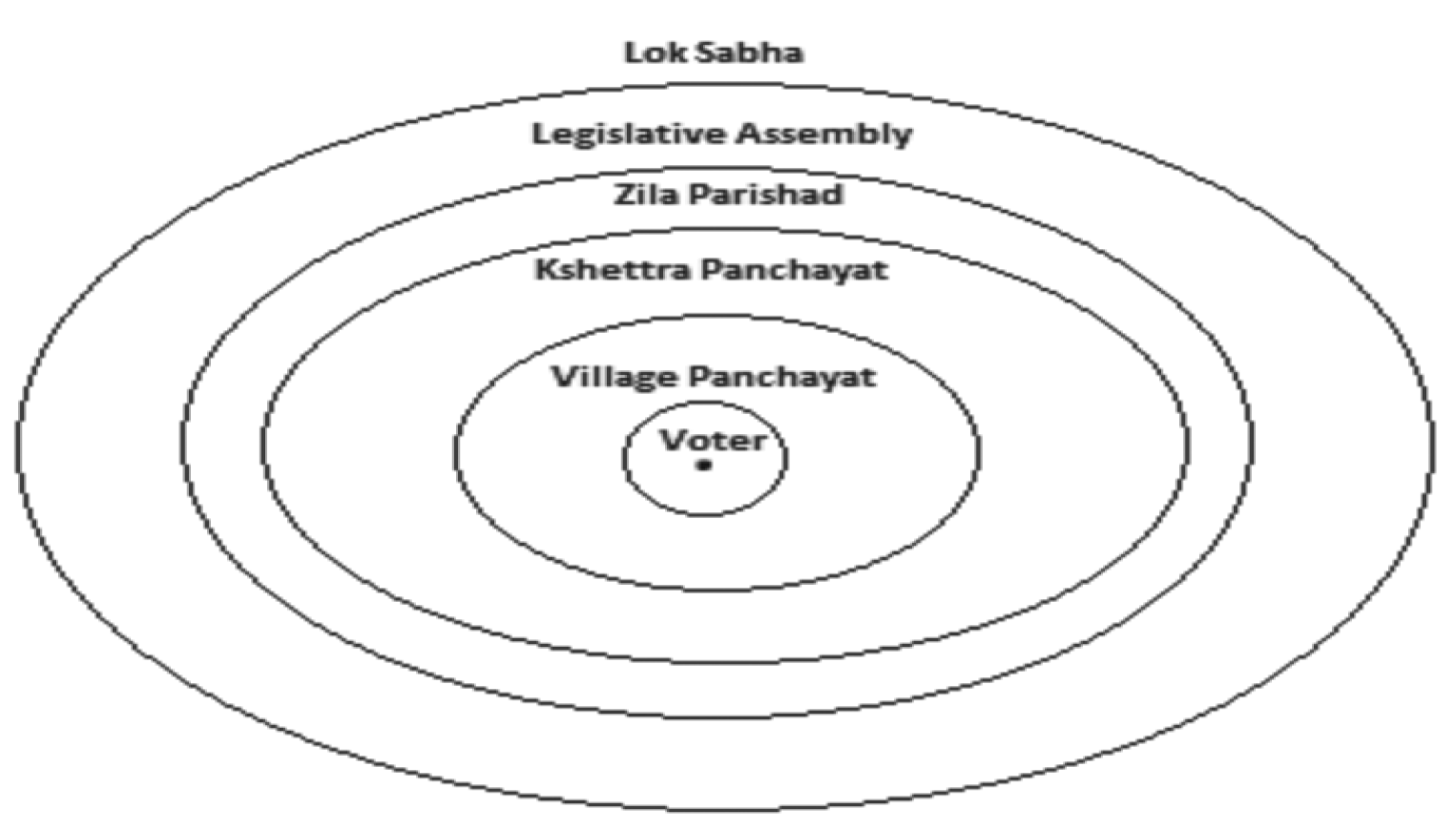
The structure of the local governance institutions in India is conducive to these intermediary ties. Since the Seventy-third Amendment to the Indian Constitution, every voter in rural India directly elects five different levels of representatives—village panchayat member, KP member, ZP member, MLA and MP. The territorial jurisdictions of these levels overlap and are concentric—the constituencies of the higher-level encompass the constituencies of lower-level representatives (Figure 1). Consequently, higher- and lower-level representatives target the same electoral base.
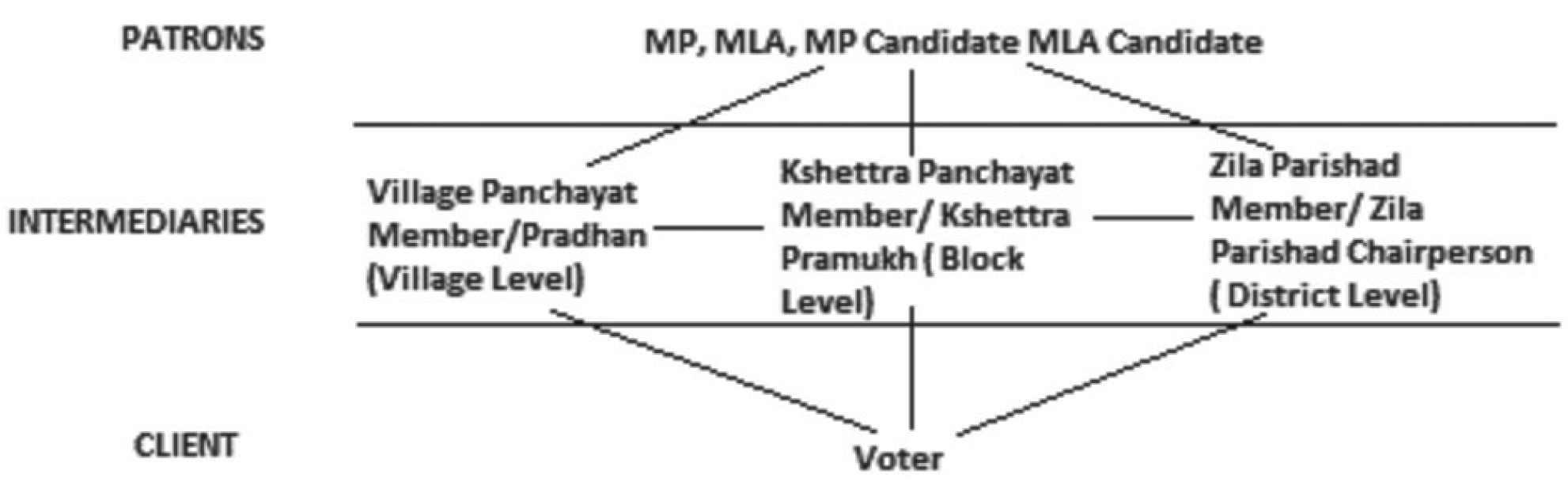
Due to their influence over the national and state governments, access to development funds and relatively large voter base, MPs, MLAs and candidates to these posts are uniquely placed to act as patrons. The members of the PRI, who have less influence, usually act as intermediaries to these patrons. The fact that there are three tiers to PRI, the district, block and village, allows hierarchical levels of intermediaries—each connecting the patron to the clients differently. This yields an intermediary network, organized around individuals occupying formal positions of power within the various circles of PRI, with the patron at the top connected to the voter at the bottom through several different channels (Figure 2).
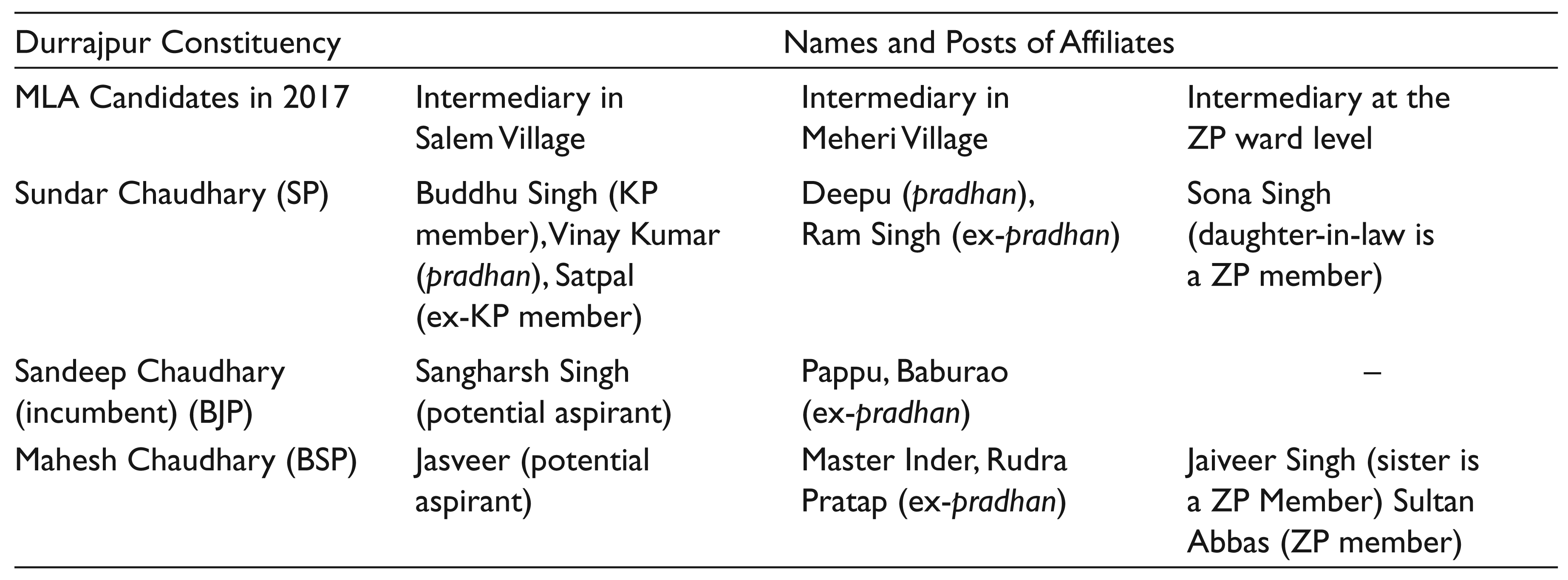
Our interviews produced a list of some intermediaries at the village and ZP levels for MLA candidates in Durrajpur (Table 2) and Rahatpur (Table 3) constituencies. As is evident, these are mostly current and former members in the three tiers of PRI. Further, the candidates have different intermediaries at each level of PRI. Sometimes, in case of seats reserved for women, these are female relatives of the intermediary. Finally, MLAs may allow a potential aspirant to these posts who can build a strong political base to act as their intermediary.
Intermediaries and MLA Candidates in Durrajpur Constituency
Intermediaries and MLA Candidates in Rahatpur Constituency

In all cases, MLAs try to maximize political gain through intermediaries. This typically involves selecting individuals from other castes and sub-castes who can mobilize areas that would have otherwise not voted for them. For example, a ZP member told us:
MLAs select various candidates and support them so that they can appease the people from other communities. For example Ahmad Sheikh chose Shalu Devi who is a Gujjar because Rahatpur is his own constituency and presence of Gujjar leadership can provide him inroads to the Gujjar vote bank. So is the case with Sikander Singh who is currently a cabinet minister (MLC). He was the leader of the SP faction, his personal vote bank is almost nil, but now he is trying to take Gujjars in confidence through ZP members.
28
These intermediaries become mobilizers for their respective patrons by encouraging their local following to vote for them. One respondent tells us, ‘Each village has different groups. Each group has their own leader who represents the MLA candidates.’ 29 Lokniti-CSDS data also shows that in the 2012 assembly elections in UP in choosing whom to vote for, nearly 34 per cent of the respondents considered the way their caste and locality members voted against 10 per cent of respondents who voted due to the candidates personality or accessibility. (Table 4)
Influence on Voting Choice

In some cases, this turns assembly elections into a proxy contest between local intermediaries. In Meheri, for example, the local power dynamics are the primary rationale to vote a certain way in state assembly elections. The local politics of the village was dominated by three families—the families of Ram Singh, Master Inder and Baburao. The main contest for the post of Pradhan is often between these families. Each of these families acts as an intermediary for a patron at the state-level and requests votes in their name. Consequently, the village is divided along factional lines rather than political parties or state agendas.
30
Ram Singh, the family patriarch, explains:
Now that I have organized Bhaiji’s (Sundar Chaudhary—a MLA candidate for SP) program in my village, other families have to shift their loyalties to the other candidates. To show this they conducted the program for the other candidates in the village. Master Inder organized for BSP and Baburao for BJP. Our program had two purposes. On one hand, it is our way of showing loyalty to Bhaiji. On the other hand, it is to let people in the village know that we are close to a senior leader of the area.
31
What Motivates Intermediaries to Work for Patrons?
Why do local politicians engage in guardianship on behalf of patrons? Berenschot claims that preferential access to state resources motivates intermediaries (Berenschot, 2014). Manor, in contrast, believes that motivation stems from monetary benefits from the patron (Manor, 2000, p. 818). We found some corroboration for both theses. A contractor told us that patrons often allocate tenders and rents to ZP members and their families in return for their intermediary services. 32 Another respondent narrated an incident when a local intermediary took a commission for his guardianship functions. In fact, a ZP member himself admitted that, ‘If I save a client a bribe of 2 lakh rupees to the tehsil officer, I don’t see what is wrong in taking 50,000 rupees from him.’ 33
However, the main motivation for working as intermediaries seems to be political. Our interviews and election data suggest that intermediaries work for the patron to win local elections. The patron can mobilize their local following and their political connections in support of an intermediary contesting a local election. Most intermediaries that we interviewed said the patron helped them win their respective elections. Intermediaries often use the patron’s name in campaign speeches to garner votes. Sometimes the patron’s photograph is used in campaigning material. 34 In a few cases, the patron himself addresses rallies for the intermediary.
In Saharanpur, a patron’s endorsement can swing a local election. For example, Brijesh Kumari won the 2010 ZP elections with the support of her patron Deepender Saini, a sitting BSP MLA. In the 2015 ZP elections, however, Kumari lost from the same constituency after Saini refused to support her. Admittedly, this is merely anecdotal evidence—but our interviewees were certain that Saini’s defection caused Kumari’s loss. 35 The pattern of candidates with patrons outperforming candidates without them recurs in every ZP ward. In patron-strongholds such as wards in Rampur, one can only win with the support of Vijay Jatav—the MLA from BSP (Singh, 2016).
Patron of Each ZP Member in Rahatpur and Durrajpur Constituency in 2015
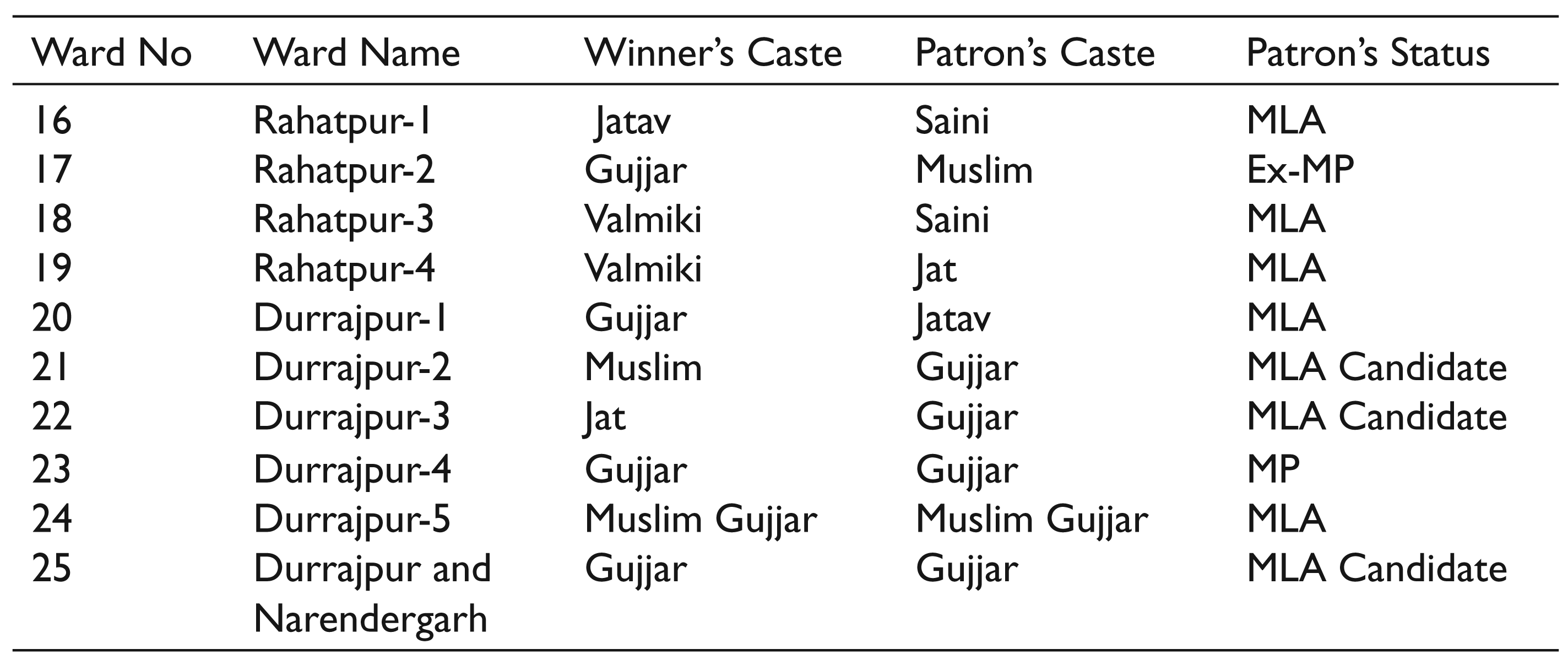
Local leaders can also use the link with an MLA to increase their ability to perform guardianship functions—both actual and perceived. In Rahatpur, Mohammad Shakeel claimed that he could rely on the leaders of their biradari (caste) in case of any problem with the police. For Shakeel’s Banjara community, the biradari leader is Haji Sahib. Sahib has previously contested Rahatpur’s nagar panchayat elections and plans to contest again in 2018, with Ahmad Sheikh’s support. 36 Shakeel explained that although he has never sought a politician’s help, in case it was needed, Sahib could help him because of the Sheikh connection. 37 Accordingly, while the patron needs political assistance from an intermediary in elections, the intermediary also requires the patron’s help to win her local seat. As Table 5 illustrates, all ZP members of the Rahatpur and Durrajpur constituency had a political patron, mostly belonging to different castes. In fact, almost every winning candidate of the Saharanpur ZP in 2010 and 2015 has a political patron—an MLA, an MP, an MLA candidate, or an MP candidate—who helped them win elections.
What Keeps the Intermediary Networks Stable and Efficient?
Due to its instrumental nature, clientelistic exchanges in politics are sustained by very weak bonds. Both patrons as well as clients have incentives to defect. According to Stokes, they cooperate only because of the repeating, fear-based nature of the transactions (Stokes, 2007, p. 608). Politicians continue to offer guardianship services to voters due to the fear of losing elections, while voters continue to vote due to the fear of not having a guardian to access essential state services. Unlike traditional patron–client ties, such connections are ‘more instrumental, less comprehensive, and hence less resilient’ (Scott, 1972, p. 107). One would expect that adding intermediaries to the already unsteady patron–client bonds would threaten to break the relationship altogether. A single defection, even if made in error, by any intermediary could set off a chain reaction of defections from both patrons and clients. With the risk of such a lose-lose scenario, it seems that for clientelism to survive, intermediary networks should not exist. Since intermediary networks do exist, we need to inquire into the reasons for their sustenance, despite the serious risk of disintegration.
Intermediary networks face three organizational threats. First is leakages, where intermediaries siphon off part of the patron’s goods meant for clients. Second is laxity, where intermediaries either ignore or are negligent in the transfer of patron’s goods to the client. Third is defections, where an intermediary in the possession of one patron’s goods defects to another patron. The former two are fatal to the clientelistic exchange since the goods from the patron never reach the client. The latter is fatal to clientelism because the goods and influence produced by one patron is converted and used for the benefit of another patron.
Leakages are rare in Saharanpur due to the kind of goods which are transferred. Unlike in the case of vote buying, where material goods are exchanged, guardianship merely requires that the intermediary use her own or her patron’s personal influence for security, facilitation and mediation. However, an indirect form of leakage might still occur in guardianship when, unknown to the patron, the intermediary starts demanding money for her guardianship service.
In Saharanpur, except for one ZP member, 38 our interviews did not reveal any instances of leakage. This is, we argue, because such leakages are antithetical to the idea of guardianship. Clients go to a patron or her intermediary because their problems do not have a market-based solution. When they price their services in monetary terms, intermediaries turn their political power and influence into a commodity. The consideration for the guardianship contract is no longer votes, but money. This transforms the intermediary into a common tout or agent—one without any form of political support and legitimacy. Since intermediaries work for patrons to gain political office, and patrons select intermediates by their potential for such office, it is highly unlikely that they would want to lose out on political office for monetary gain. As we see in Saharanpur, the intermediary has sufficient opportunities for monetary gains through thekedari and commissions. They need not jeopardize their relationship with their primary constituents by asking for money in return for guardianship.
This is also why we have consistently used the word ‘intermediary’ rather than the words ‘broker’ (Auyero, 2000, p. 56) or ‘fixer’ (Berenschot, 2014, p. 196; Manor, 2000, p. 816). The words ‘broker’ and ‘fixer’ signify that the primary motivation for the intermediary is ‘brokerage’ or money. In these cases, the patron–client contract is a two-person contract between the politician and the voter. The ‘broker’ or the ‘fixer’ is external to the contract—she does not control the goods being transferred. She is largely independent, having no significant connection to any client or patron, and is thus unconcerned about the exchange’s success. Brokers and fixers, used in this context then, are anathema to clientelistic networks. In contrast, intermediaries in Saharanpur are involved in a three-person contract among the politician, the voter and themselves. They control and sometimes generate the goods being transferred. As beneficiaries, they are interested in the guardianship contracts’ success. Due to this role, a more suited label for these intermediaries is ‘sub-patrons’.
The fact that intermediaries in Saharanpur are sub-patrons and not merely brokers also explains why they do not face problems of laxity. The political status of sub-patrons is fundamentally tied to the successful transfer of guardianship functions to the voters. In case of any negligence, it is not only the patron but also the sub-patron who will lose votes. The sub-patron is thus incentivized to perform the guardianship functions efficaciously to ensure future votes for her. Since electoral rivals at the local level also provide guardianship services, the sub-patron must provide services at competitive efficiency.
Jauregui also noticed this tendency in Uttar Pradesh:
The pradhan …. must balance his shifting position as patron and client. The pradhan is patron to his constituents, whom he provides with access to government development monies and protection from the police. He is also a client,…. of the party leaders, with whom he exchanges the votes and loyalty of his constituents in exchange for support necessary to remain in post (Jauregui, 2014, p. 255).
Defection among sub-patrons is a slightly harder problem for the patron. As a rational political actor, the sub-patron has a strong incentive to keep shifting to the patron who can help him get the largest share of votes. One way that a patron mitigates defection from sub-patrons is by maintaining a strong monitoring mechanism. One MLA said that he attends at least 500 local functions a year in his constituency. 39 This not only reinforces direct bonds with his voters but also reinforces the link between the sub-patron and himself in the voter’s mind. Once the sub-patron loses his perceived autonomy and becomes ‘bhaiji’s man’, it becomes very difficult for the sub-patron to shed this label. Another way is to develop local competitors for the sub-patron. These may be aspiring candidates, who have not yet won any electoral office, but have the potential to build a substantial vote bank. This also explains why a patron can sometimes deny her endorsement to an incumbent local leader in favour of a political rival. Thus, the patron can ensure that the position of Pradhan or ZP member becomes the intermediary rather than any person.
The three-tiered structure of PRI enables a patron to offer ‘promotions’ or ‘demotions’ to sub-patrons. Pradhans remain loyal to a patron expecting sufficient support from the patron to become a KP member. Similar are the cases of the KP member who wants to become a ZP member and a ZP member who wants to become a ZP chairperson. As they rise in the hierarchy, sub-patrons not only receive increased political status but also receive higher amounts of monetary kickbacks. The pinnacle of this pyramid, the ZP chairperson, is the head of almost all district-level developmental committees. As such, ZP chairpersons have extensive opportunities to increase their political base and become patrons themselves by contesting MLA elections. This was the case with Manoj Chaudhary, whose wife was the ZP chairperson in 2005 and who became an MLA in 2007.
It is important to recognize that this kind of clientelistic network would be impossible without the concentric nature of the constituencies in India. It is because the voter is the client for both the sub-patron and the patron that they are mutually interdependent. This alignment allows the network to efficiently seek the goal of guaranteeing guardianship to the centre of these concentric constituencies—the voter. It also owes to the hierarchy in the panchayati raj system that a patron can maintain a tiered system of sub-patrons that is required to keep the network internally competitive and externally stable.
Conclusion
Most scholars believe that clientelism is antithetical to democratic ideals (Piliavsky, 2014, p. 5). Hicken, for example, states that ‘the consensus in the literature is that clientelism has profound negative implications for the way in which democracy functions, citizen attitudes about the quality of their democracy, and the capacity of governments to produce needed public policies’ (Hicken, 2007, p. 302). The assumption in this literature is that clientelism is forced on the citizenry, who then lack the collective bargaining power to make a free choice between candidates. We show that at least in Saharanpur the actual logistics of clientelism are much more complicated. Patrons and sub-patrons are politically incentivized to pressure each other to deliver services to the voters, lest their own voter base suffers. The voter, the centre of attention of this network of several patrons and sub-patrons, is relatively free to choose one who best guarantees her essential services. In this way, clientelism in Saharanpur ensures an accountable political class while maintaining the voter autonomy. There are of course exceptions—some voters, especially those who are strongly tied to traditional caste or land orders, are stuck in the clientelistic trap.
One of our main quibbles with existing literature is its refusal to engage with the definitional breadth of clientelism. Normative conclusions about clientelism can only be made after extensively studying the kind of clientelistic exchange that takes place in a given area. Due to the diversity of traditional orders, political hierarchy and individual leadership, there are bound to be a large variety of clientelistic systems. In Saharanpur, for example, we found that our model does not apply to the urban assembly seat. Here, we found that neither was guardianship a prevalent form of clientelism nor did municipal corporation members act as intermediaries. Scholarly work on clientelism can miss some of these nuances and make normative generalizations about different clientelistic systems. We hope this study encourages more detailed investigations about the logistics of clientelism in different sociopolitical contexts.
Clientelism in Saharanpur primarily serves to counterbalance the failure of the Indian state to provide essential services. Clientelism, at least in the form of guardianship, would not exist if the thanas, tehsils and courts in India were effective. As Kruks-Wisner explains, claim making usually owes to ‘a failure of public service delivery’; where the state delivers such services, ‘citizens have little need to make claims on the state’ (Kruks-Wisner, 2015, p. 26) Similarly, Berenschot points out that ‘Political fixers exist due to large role the Indian State plays in the local economy and the mediated character of the Indian State’ (Berenschot, 2014, p. 200). Chandra disagrees with this defence of clientelism. For her, it is the political class which is, in the first place, responsible for the problems with the existing decay of state institutions. Clientelism ensures that these services, which the government should ‘provide to all citizens as a basic guarantee’ is ‘selectively provided (and withdrawn) in India by political parties in return for political support’ (Chandra, 2004, pp. 25–28).
We disagree with Chandra’s characterization for two reasons. First, there are well-documented historical and sociological reasons for corruption and inefficiency in Indian state institutions. 40 While governments might face incentives to maintain this status quo, (and we claim that such a strategy is in the long term, politically unfavourable), it is unreasonable to expect them to magically reform these institutions through policy and law. Politicians are simply economic realists, who recognize the demand for these services and their ability to ensure its supply on a case-by-case basis. Second, the alternative to clientelism is much worse. In Saharanpur, for example, we still find traces of the bhaichara and jajmani system where voters are beholden to their local Chaudhary (landlords and caste leaders). Here, voters are forced to a position of near servitude to access the most basic of services. The Chaudhary is the police of the thana, the officer of the tehsil and the judge of the court. The guardianship system, through the commodification of a singular political resource—the vote—gives voters preferential access to resources they would otherwise lack. As Schneider and Sircar argue, ‘where state capacity and mechanisms of electoral accountability are weak … the screening mechanism that local elections provide may be the best assurance of post-election distribution’ (Schneider & Sircar, 2016, p. 27).
In many ways, it is the dispersal of democracy that catalyzes clientelistic networks. Clientelism of the form seen in Saharanpur would be impossible were it is not for the panchayati raj system. The Seventy-third Amendment of the Constitution, brought about to deepen democracy by encouraging local self-government, paradoxically crystallizes clientelistic exchange in India. This is not to say that the amendment failed. By creating a networked political structure in every village in India, it ensured that each village could leverage political power in return for reasonable access to state resources. The tiered system of governance thus enabled concentric clientelism and indirectly reinforced the centrality of the citizen in the democracy.
Declaration of Conflicting Interests
The author declared no potential conflicts of interest with respect to the research, authorship, and/or publication of this article.
Funding
The author received no financial support for the research, authorship, and/or publication of this article.
Footnotes
Acknowledgements
The authors are grateful to Amit Ahuja, Anirudh Krishna, Francesca Jensenius, Garima Goel, Geoffrey Henderson, Gilles Verniers, Irfan Nooruddin, Neelanjan Sircar, Phil Oldenburg, Rikhil Bhavnani and to an anonymous reviewer for their valuable comments on a previous draft. We would also like to acknowledge Shreyas Shende for his gracious research assistance.