




Abstract
We consider a one-dimensional model of electoral competition with national and regional parties. There are two regions and three parties—one national party and one regional party for each region. We divide the paper into two parts—homogeneous and heterogeneous regions. In the former, the policy positions of the national party and the regional party of the region with the greater number of constituencies coincide with the favorite policy position of the region-wide median voter. In the latter, the national party chooses a policy position in a maximal isolation set, while the two regional parties choose policies on the same side of the national party’s policy as their own respective region-wide medians. For a given outcome function, the national party performs better when the regions are heterogeneous. In the homogeneous regions case, the national party can at best do as well as the regional party of the region with the greater number of constituencies. Our results are broadly consistent with intuition and evidence.
1. Introduction
Regional parties play a significant role in most countries with democratically elected governments, at both the national and the regional level. They form governments at the local level and also compete for and against national parties at the national level (Brancati, 2008). 1 Many papers model electoral competition over regions or districts. 2 However, none of these models considers regional parties. In this paper, we model the electoral competition between national and regional parties in a one-dimensional policy space.
There are many definitions of regional party in the literature on political science. However, the one we consider is the following one borrowed from Brancati (2008): ‘regional parties […] are defined as parties that compete and win votes in only one region of a country […] Besides competing in only one region of a country, regional parties tend to focus their agendas on issues affecting only these regions. Regional parties stand in stark contrast to state-wide parties (or national parties), which compete and win votes in every region of a country and tend to focus their agendas on issues affecting groups throughout the country.’ 3 In our model, however, we consider a more abstract version of this definition—a party is regional if and only if it competes only from the region it has been assigned to. 4
There are many countries with regional parties, for example, All India Anna Dravida Munnetra Kazagham and Dravida Munnetra Kazagham in India, the Bloc Québécois in Canada, which competes only from Québec (Massicotte, 2005; Ziegfeld, 2012). The UK has regional parties in Northern Ireland, Scotland, and Wales which compete with national parties. Even the national parties are mostly effective in particular regions, for example, in the UK, the Conservative party in the ‘south’ and rural areas and the Labour party in the ‘north’ and urban constituencies (Gallagher and Mitchell, 2005). There are regional parties in Europe as well—the Lega Nord in Italy, Convergència Democràtica de Catalunya and Esquerra Republicana de Catalunya in Catalonia, and Partido Nacionalista Vasco and Eusko Alkartasuna in the Basque region (De Winter and Tursan, 2003; Heller, 2002).
Regional parties influence policies significantly at all levels of government formation in these countries. Chhibber and Kollman (2009) find that regional parties are more prevalent in decentralized federal systems since parties at the regional level can implement policy outcomes. Chhibber and Kollman (1998) find that high levels of party aggregation across different states in the USA have contributed to the prevalent two-party system. In India, conversely, this inability to aggregate has made it possible to have as many as seven effective parties at the national level. Brancati (2008) finds that regional parties can win as much as 4% of the vote share in such countries as Argentina, Canada, Germany, India, and Spain. We now describe the model briefly.
There are two regions, which are divided into mutually exclusive constituencies i.e. every voter belongs to only one constituency, which belongs to only one of the two regions. There is a discrete distribution of voters’ ideal policy positions in the one-dimensional policy space. There are three parties—one national and two regional parties, one for each region. A voter in region j can only vote either for the national party or the regional party of region j. Once the parties have chosen policy positions, voting takes place. Regional and national parties compete on a national election platform to win as many seats as possible. 5
In our model, national parties have the advantage of garnering votes from constituencies across the regions. Regional parties, conversely, can contest from one region. We assume that these parties are given exogenously.
We consider two types of party motivation—constituency motivation and policy motivation. Parties are constituency-motivated if their only objective is to maximize the expected number of constituencies won. Parties are policy-motivated if they also have a preferred policy position and their only objective is to minimize the distance between the policy outcome and their most preferred policy position. 6
A key element of our analysis is the political outcome function (POF). This function maps the shares of constituencies into a probability distribution over party policy positions. We use this general formulation to capture a wide variety of circumstances. For example, in India and the UK, the party that wins the largest number of constituencies in a plurality vote forms the government and implements its policy position. Conversely, a coalition government may form where parties share office and one of their policy positions is implemented with some probability. The POF can also be used to capture proportional representation systems of voting.
We show that these POFs need not induce sincere behavior from voters. Under these circumstances, characterizing equilibrium strategic behavior depends on the exact specification of the POFs. We avoid these difficulties by restricting our attention to only sincere voting behavior. 7 The consequence of this assumption is that party equilibrium is independent of the POF, provided that the probability of a party’s policy position being implemented is increasing in the number of constituencies. We give a brief outline of the literature on electoral competition with multiple districts.
There are papers that consider electoral competition with multiple districts. Austen-Smith (1984) considers a model of electoral formation with multiple districts, characterizing conditions that need to be imposed on the way party members’ positions are aggregated within the party for equilibrium to exist. Austen-Smith (1984) finds that equilibrium, when it exists, involves parties converging to the median policy position even though the positions of the candidates do not. Austen-Smith (1987) captures the differences in outcome between Downsian and non-Downsian party types and finds that, as candidate autonomy within the party increases, additional conditions are required for the existence of a stable set of candidate policy decisions.
Callander (2005) considers a model of entry and deterrence of parties in a one-dimensional spatial model with multiple districts and finds that if districts are heterogeneous, policies of parties do not coincide with those of the median voter. The trade-off between electoral appeal and entry deterrence ensures that parties diverge in equilibrium. Eyster and Kittsteiner (2007) show that altruistic parties choose policies closer to their candidates’ positions to create a niche for themselves and deviate from the policy of the median voter.
All these papers study electoral competition in multiple districts, but none of these capture the effect of regional parties on policy outcome. As a result, we feel that it is imperative to study the effect of regional parties on outcomes in a theoretical model. We provide next a summary of our results.
For a fixed policy position of the national party, a regional party wants to locate ‘as close as possible’ to the national party’s policy on the same side of the region-wide median, by the standard Hotelling argument. In view of this behavior of the regional parties, the national party wants to locate in the interval between the policy positions of the region-wide medians.
The results are divided into two sections—homogeneous and heterogeneous regions. The regions are homogeneous if the smallest intervals containing all policy positions of constituency medians for the two regions are disjoint and ‘sufficiently’ distant. They are heterogeneous if they are not homogeneous. We provide results for varying degrees of heterogeneity.
When the regions are homogeneous, we observe convergence in the policy positions of the national party and the regional party of the region with more constituencies. They both choose the policy position of the region-wide median.
When the regions are heterogeneous, the precise location of the national party depends on the structure of isolation sets. These sets are constructed from the distribution of voter policy positions and have the following property: by choosing the policy position of a voter in this set, the national party can ‘isolate’ or ‘separate’ constituencies from their respective region-wide medians. 8
In this case, the national party locates in a maximal isolation set if it can isolate at least as many constituencies from both the regions as half the number of constituencies in the larger region. 9 The regional parties, conversely, locate on the same side of the national party’s policy as the ideal position of their respective region-wide medians. 10
The main insight of the paper is the following. For a given POF and a fixed number of constituencies, the national party’s performance improves as the degree of regional voter heterogeneity increases. In the limit case, where the distribution is homogeneous within regions, the national party can at best do as well as the regional party of the larger region. This result is broadly consistent with intuition and evidence.
For example, in India, where regions are more heterogeneous, the national parties tend to do well (Ziegfeld, 2012) compared with countries like Canada and Spain, where the regions are more homogeneous, thereby leading to stronger regional parties (Lancaster and Lewis-Beck, 1989; Strmiska, 1997).
The opposite is true for regional parties. The regional parties do better in the homogeneous case than in the heterogeneous case. However, the regional party of the smaller region does better, comparatively, because the national party restricts all its attention to the larger region and shares half the constituencies in equilibrium.
The paper is organized as follows. We describe the model and give definitions in Section 2. In Section 3, we present the results for the homogeneous and heterogeneous regions cases separately. We follow with a discussion in Section 4. In Section 5, we consider the case of policy-motivated parties. Finally, conclusions are drawn. Proofs are given in the appendix.
2. The model
The set of voters is
The set of constituencies of region j is denoted
There are two regional parties
Therefore, the strategy of voter i,
Voters have single-peaked preferences represented by concave utility functions
We use the plurality rule at the constituency level. The party with the most votes in a constituency wins that constituency. The total number of constituencies won by party l is
We say that a POF is admissible if

Therefore, POFs determine the outcome of the election and voters take this into account. We require that they are increasing in the number of constituencies won by each party. Suppose voter i is indifferent between voting for either of the two parties in
Voters are sincere if they vote for the party whose policy position is closest to their policy position according to the Euclidean distance norm,

We assume that parties are aware of the equilibrium strategies of the voters for a given tuple

Therefore, parties choose policies to maximize the expected number of seats. 13

A party equilibrium is a tuple
A political equilibrium is a strategy profile
The game. The distribution of voters’ policy positions is fixed through the analysis. Parties choose policies from the set
2.1. Examples of POFs
The POF captures a range of outcome functions. Our results hold for any admissible POF. We give two natural examples of admissible POFs—maximal and coalitional.
Maximal. Under the maximal outcome function, the set of winning parties is the party with the most constituencies. Let the set of winning parties be

Coalitional. We first introduce some notation. A minimal winning coalition or m.w.c. is a collection of parties C such that (i)
Let ℂ be the set of all possible m.w.c.s. For every C ∈ ℂ, let

We abuse the notation slightly by using
Suppose

We show that voters need not be sincere under either of the two POFs described.
Let
By definition,
Now consider the coalitional POF. Suppose

As before,
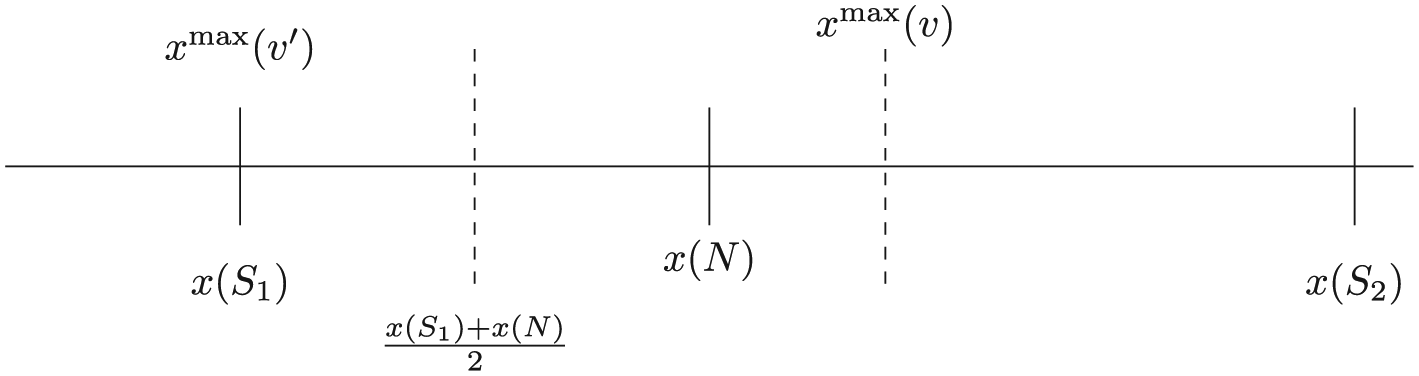
Strategic voting.
If i votes strategically for
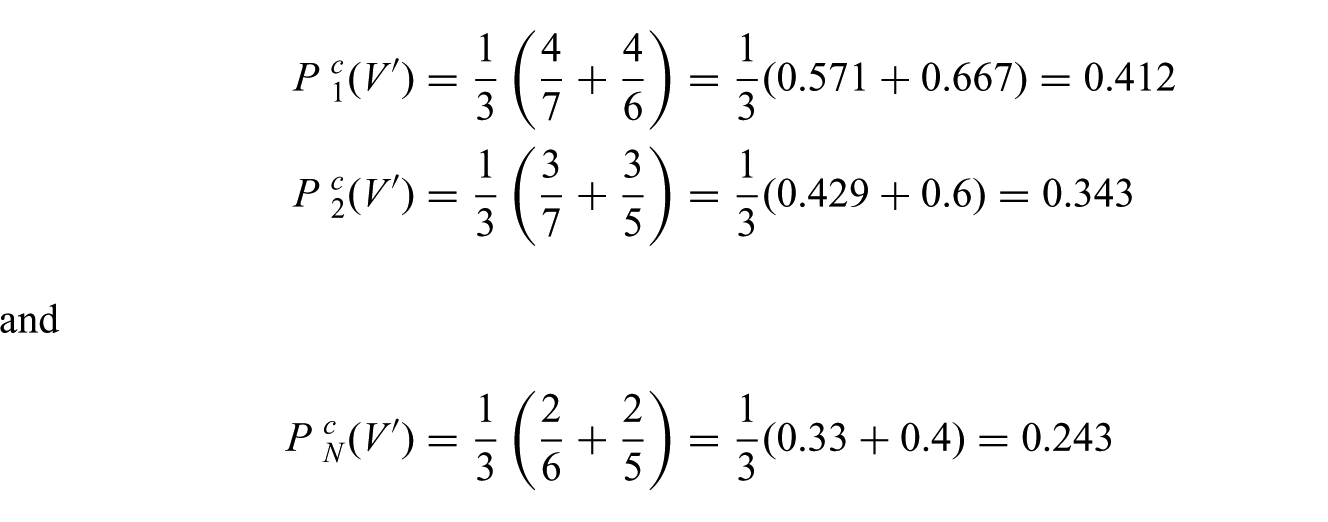
Therefore,
The example suggests that voters may have incentives to vote strategically. Of course, there are equilibria where voter i may not be pivotal, i.e. when the number of voters voting for a party is strictly greater than the majority of voters in the constituency. In such a case, no voter can improve the outcome by voting strategically. However, characterizing strategic voting is cumbersome. We therefore avoid these difficulties by studying only sincere voting behavior.
2.2. Voting equilibrium
In this section, we study the features of a sincere voting equilibrium. We denote the voter with the median policy position in constituency
For j ∈{1,2}, we have:
Proof. Suppose
We prove the claim by contradiction. Suppose
We prove the claim by contradiction. Suppose
Consider the following deviation by N:
Suppose, contrariwise, that
In any sincere voting equilibrium, the national party locates in the interval of the two region-wide medians. The regional parties, however, stay on the same side of the national party’s policy as their respective region-wide medians. Moreover, the regional parties win at least half the constituencies in expectation.
Part (iii) of the proposition states that, in any election, each regional party must win at least half the number of constituencies in its respective region. This points to a strong advantage for the regional party if the region has a large number of constituencies.
In the following propositions, we will show that the winning prospects of the national party depend on the distribution of median voters across the regions. For this, we introduce the concept of an isolation set. These sets have the property that by locating in one of these sets the national party can maximize the number of constituencies it can win. This is a result of Proposition 1, which states that the regional parties choose policies on the same side of their respective region-wide medians. This allows the national party to ‘isolate’ or ‘separate’ the remaining constituencies from the regional party’s policy. The national party, as we will show, can separate up to a maximum of
We introduce the notion of isolation sets to describe the equilibrium. Without loss of generality, assume

A set
There may be several or no isolation sets. If the latter is true, we will say that the isolation set is empty, i.e.

There are two isolation sets.
In Figure 2, there are two isolation sets: (i)

There are three isolation sets.
In Figure 3, there are three isolation sets: (i)

There are no isolation sets.
In Figure 4, there are no isolation sets. We will show that national parties must be located in isolation sets that maximize the number of constituencies that can be isolated. We introduce the notion of maximal isolation sets for this purpose as follows.
A maximal isolation set

There are three maximal isolation sets.
There are three maximal isolation sets: (i)
A voter policy position distribution
If the voter distribution is not regionally homogeneous, it is regionally heterogeneous. The distributions in Examples 2, 3, and 5 are regionally heterogeneous. The voter distribution is regionally homogeneous in Example 4.
We use the terms homogeneous and heterogeneous instead of regionally homogeneous and regionally heterogeneous, respectively, throughout the text. This should not be confused with ‘national-level’ homogeneity (or heterogeneity). We present the results in separate sections.
3. Results
3.1. Homogeneous regions
In this subsection, we describe the equilibrium for homogeneous voter distributions.


Then the following strategy
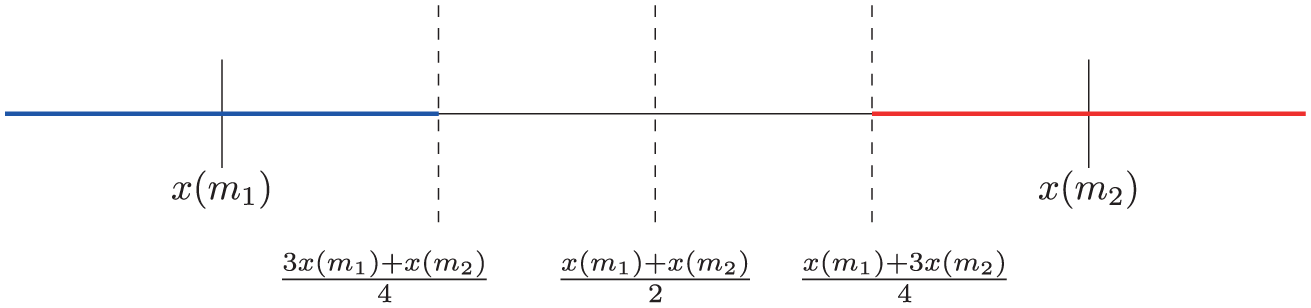
Illustration for Proposition 2.
Proof. Suppose
Suppose
The national party N wins
By condition (ii) and the fact that
Proposition 2 describes the equilibria when the regions are homogeneous. The national party locates at the policy position of the median voter of the constituency median of the larger region. The regional parties locate at their respective region-wide medians.
Conditions (i) and (ii) in Proposition 2 require all medians in region 1 to be located significantly apart from the medians in region 2. These conditions require the regions to be ‘sufficiently’ separated. This prevents deviations by the national party from their current policy platforms to other policy platforms. The regional party of the larger region has no incentive to deviate, since it cannot increase its win share as long as the national party chooses its region-wide median. The regional party from the smaller region cannot win any more constituencies, since it cannot move to a policy platform on the opposite side of the national party’s policy away from its own region-wide median. The following example shows that conditions (i) and (ii) are necessary for the existence of a political equilibrium.
Region 1:
Region 2:
These are illustrated in Figure 7.

Illustration for Example 6.
The distributional assumptions of Proposition 2 are not satisfied, since:


We show that the strategy profile
We show that the national party can deviate beneficially. Consider a deviation by N to
We show that no other equilibrium exists. Suppose
3.2. Heterogeneous regions
In this subsection, we describe the equilibrium when the voter distribution is heterogeneous. Let
(i)
If

If

If
The following strategy profile is a sincere voting equilibrium:
(ii) Suppose there exists k ∈{1…,K} such that
(A) Suppose the following conditions hold:
Then the following strategy is a sincere voting equilibrium:
(B) Suppose the following conditions hold:


There does not exist

Then the following strategy is a sincere voting equilibrium:
Proposition 3 describes the equilibrium when regions are heterogeneous. Figure 8 shows the bounds within which the maximal isolation sets must lie. The interval between the two bounds
Suppose all the maximal isolation sets contain the policy position of a region-wide median. Note that this is only possible when there are at most two maximal isolation sets, each containing the policy position of a region-wide median. The national party locates at the policy position of the region-wide median of the region with more constituencies if the latter is in a maximal isolation set. The regional parties are located at their respective region-wide medians.
Suppose there exists a maximal isolation set that lies in the interior of the interval containing the two region-wide medians. Then there are two types of possible equilibria. In the first type, the national party locates in the maximal isolation in the interior of the interval containing the two region-wide medians. The regional parties locate as close to the national party’s position on the same side of their respective region-wide medians. In the second type, the national party locates at the policy position of a region-wide median that isolates a significant number of constituencies from the other region. The regional parties choose the policy positions of their respective region-wide medians.
In both these cases, certain additional conditions must be imposed. If these conditions are not met, then our proposed equilibrium does not exist. In fact, the existence of equilibrium in such a case will not be guaranteed. The following example illustrates these observations.
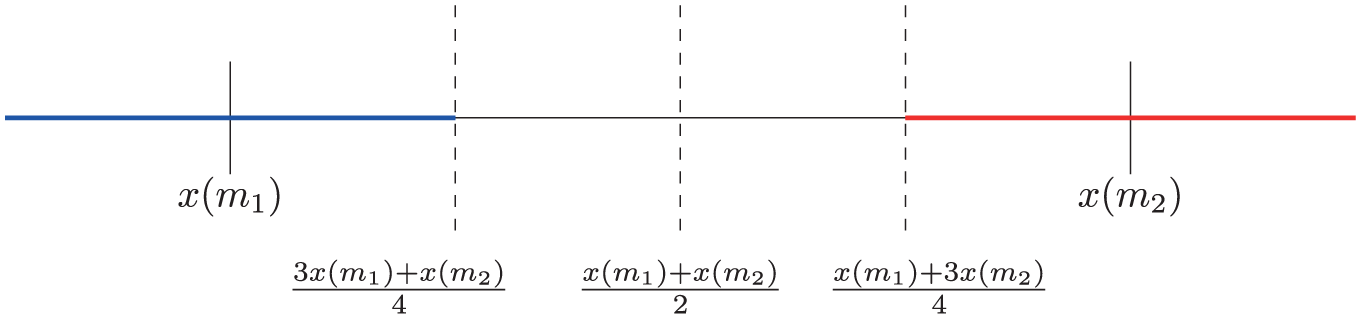
Illustration for Proposition 3.
This is shown in Figure 9.

Illustration for Example 7.
There are three maximal isolation sets: (i)
We show that the following strategy profile
We show that
We show that the following strategy profile
Suppose N deviates to a policy position
We give an example to illustrate an equilibrium.
The locations of the constituency medians are shown in Figure 10.

Illustration for Example 8.
The median positions are as shown in Figure 10. There is one maximal isolation set:
We show that the following strategy profile
Suppose
Suppose
Finally, we show that N cannot deviate beneficially. Clearly, any deviation
Therefore, the additional distributional conditions in these two propositions are sufficient to guarantee the existence of equilibria. As we showed in these examples, violation of the conditions will lead to failure to sustain the given equilibrium.
4. Discussion
When the regions are homogeneous, the national party’s policy coincides with the ideal policy position of the region-wide median in the larger region. Conversely, for the heterogeneous regions case, the national party’s policy, in most cases, belongs to one of the maximal isolation sets. Under some cases, this set may lie strictly in between the ideal policy positions of the two region-wide medians. Therefore, we witness divergence of the policy positions of the parties, in contrast to the predictions made by the median voter theorem.
The policy positions of the regional parties also differ from the ideal position of their respective region-wide medians under the heterogeneous regions case. This happens when the national party chooses policy in the interior of the interval containing the two region-wide medians. In such an equilibrium, the regional parties locate as close to the national party’s position, but on the same side of it, as their respective region-wide medians.
It is also possible to compare the winning prospects of the two types of party across the two types of voter distribution. The national party can win a greater number of constituencies from both the regions when the voter distribution is heterogeneous. To see this, consider the following arguments.
Suppose the heterogeneity between the two regions is maximum, i.e. there exists a maximal isolation set that isolates
Suppose

Hence,
Similarly, the regional parties win more constituencies when the voter distribution is homogeneous than when it is heterogeneous. When the voter distribution is homogeneous, the regional party of the smaller region wins all the constituencies from its region in equilibrium. Conversely, if the voter distribution has maximum heterogeneity, then either of the two regional parties can only win at most
The maximum possible payoffs of regional parties under the two types of region are

for the regional party in the larger region and

for the regional party in the smaller region. Therefore, the regional party of the larger region may perform better in the heterogeneous regions case. 17
The national party does better under extreme heterogeneity than under homogeneity, while the performance of the regional party in the larger region depends on the likelihood of different equilibrium. The regional party of the smaller region, however, performs better under the homogeneous regions case.
5. Policy-motivated parties
In this section, we assume that parties are policy-motivated, i.e. they have ideal policy positions and their only objective is to implement it. Hence, in addition to voters, parties also have single-peaked preferences represented by utility functions
We introduce some notation to define the median POF. For any n integer, let
A POF
Therefore, a median POF takes into account the number of seats won by each party and chooses the median policy among the parties’ policy platforms weighted by the number of seats won by them. This is similar to the partisan voting system in legislatures, where each elected member of the party supports the policy position of the party. The median POF then assumes that the median in the legislature is the winning policy.
18
We formally write the payoffs of the parties. Let
Party l chooses x(l) to maximize its expected utility from the policy positions of the parties with respect to any alternative policy position
All the other definitions remain the same as in the previous model. We provide the results. Our first proposition states that when the regions are homogeneous the ideal policy position of the region-wide median is implemented since both parties with highest seats converge to this policy position.
Suppose
Suppose
Suppose
We provide the sketch of the proof. In part (i) of the proposition, neither the national party nor the regional party of the bigger region finds it optimal to beat the other party’s policy platform to become the median. This is because the parties are purely policy-motivated and the move would make them worse off. This is in accordance with the literature on electoral competition with policy-motivated candidates. 19
In part (ii) of the proposition, the national party can choose its policy position and implement it without facing any opposition. This is because none of the regional parties can change the outcome favorably. Any move of policy platform to the other side of the national party’s policy makes that party worse off. Therefore, divergence from the median policies of the two regions is possible. Part (iii) is symmetric to the first part of the proposition. However, note that, in contrast with the previous model, the national party chooses to converge with the smaller regional party’s position.
Therefore, divergence of the policy positions of the regional party of the larger region and the national party is only possible when the national party and the regional party of the larger region are on the same side of the ideal policy position of the corresponding region-wide median. The national party is at an advantage since under the median POF it has the ability to win or tie in all circumstances. It can always choose a policy platform in between the policy positions of the two regional parties and implement the selected policy platform.
6. Conclusion
The model can be easily generalized to more than two regions in a straightforward way. The nature of the competition between regional and national parties will remain the same. The regional parties will stay on the same side of the national party’s policy as their respective region-wide medians. The national party will isolate as many constituencies as it can across regions.
It is possible to consider a multidimensional policy space with certain dimensions corresponding to regional issues. Although such a model would be more realistic, the existence of equilibrium will present significant challenges (Calvert, 1985; Plott, 1967). 20
Footnotes
Appendix
Acknowledgements
I am thankful to John Patty, co-editor of the Journal of Theoretical Politics, and two anonymous reviewers for their suggestions and comments, which helped improve the manuscript. I am thankful to Arunava Sen for giving feedback on the paper at each and every stage. I am thankful to Parikshit Ghosh for suggestions and comments. I also thank Nicolas Gravel, Debasis Mishra, Sourav Bhattacharya, Yann Bramoullé, Jean-François Laslier, and Bhaskar Dutta for suggestions and comments.
Declaration of Conflicting Interests
The author(s) declared no potential conflicts of interest with respect to the research, authorship, and/or publication of this article.
Funding
The author(s) received no financial support for the research, authorship, and/or publication of this article.
