




Abstract
Despite numerous studies showing that emotions influence political decision making, there is scant literature giving a formal treatment to this phenomenon. This paper formalizes insights about how fear influences participation in risky collective action such as citizen revolt against an autocratic regime. To do so we build a global game and analyze the effects that fear may have on participation through increasing pessimism about the regime’s strength, increasing pessimism about the participation of others in the revolution, and increasing risk aversion. The impact of the first two effects of fear is a clear reduction in the probability that people will mobilize. However, an increase in risk aversion may in some circumstances increase the probability with which citizens will mobilize. These results may help explain the unpredictable reactions of citizens to fear appeals, including the threat of repressive violence.
1. Introduction
Emotions affect political behavior. A large literature in psychology has established that emotions such as fear, anger, and happiness affect beliefs, preferences, and decision-making, particularly in situations involving risk and cooperation (Damasio, 1994; LeDoux, 1996; Lerner and Keltner, 2000, 2001). These findings have subsequently sparked a large research agenda on American political behavior (Albertson and Gadarian, 2015; Brader, 2005; Marcus et al., 2000; Valentino et al., 2011), and have recently been applied to the study of participation in high-risk contentious politics (Pearlman, 2016; Aytac et al., 2017; Young, 2015, Forthcoming).
However, despite the increasing influence that these findings in psychology have had on the empirical study of political science, the role of emotions has not been given much treatment in the formal theoretic literature (Elster, 1996), with a few important exceptions (Akerlof, 2016; Caplin and Leahy, 2001; Lupia and Menning, 2009; Wu, 1999). This omission is important for several reasons. First, given that emotions have been shown to have numerous effects on cognition, formal analysis may provide insight into the ways that emotions affect decisions in strategic situations. Second, a formal treatment may provide insights into the conditions in which emotional appeals might have particularly large effects, or counter-intuitive effects. Ultimately, this analysis may increase our understanding of how emotional appeals can be used by political elites to cause citizens to act against their long-run interests. This paper thus builds on efforts to incorporate behavioral assumptions into formal models such as Lupia and Menning (2009) and Little (2017) that have shown how deviations from the strict assumption of citizen rationality can have dramatic effects on the popularity and longevity of a regime.
As part of a larger project in which we seek to understand the effect of fear on coordination, in this paper we build a model based on a global game (Carlsson and Van Damme, 1993; Morris and Shin, 2003, 2004) in which people decide whether or not to take a potentially costly action to overthrow a regime. Based on theory and empirical findings in psychology and behavioral economics, we analyze various mechanisms through which this emotion may influence a citizen’s decision to mobilize against the regime. In particular, we focus on two of the most empirically established effects of fear on decision-making: that it increases pessimism about risks and increases risk aversion. In our models, fear may increase pessimism about the strength of the regime; independently, it may increase pessimism about the number of other citizens who will participate in the mobilization; and finally, it may increase risk aversion. When people are aware that the other players are also in a state of fear, its demobilizing effects may compound as not only will players themselves be more pessimistic and risk averse, but they will expect the same effects to change the behavior of others.
However, our formal treatment also shows that fear does not necessarily reduce participation in risky actions, as previous research has suggested. Instead, although increased pessimism always reduces participation in dissent, the effects of fear through risk aversion are ambiguous and depend on the effect the citizens’ emotional state on their utility function. The overall effect of fear will be negative when the effects via pessimism (which always reduce mobilization) dominate, or when the negative utility of a failed mobilization is large relative to the status quo. However, when the effect on mobilization via risk aversion is relatively large, and when what we call a ‘nothing-to-lose effect’ prevails, fear can actually make it more likely that citizens will mobilize. This result, while arguably a rare case, speaks to an important puzzle in the literature on repression and protest: why do autocrats use repression when in many cases it seems to backfire, setting off even larger cycles of protest (Davenport, 2007)? Our analysis suggests that fear may be a powerful but unpredictable tool for autocrats because its effects can depend on the balance of psychological processes that are hard for the autocrat to observe.
This project relates to a large literature on the importance of emotions for a range of political and economic behaviors, particularly participation in collective action, social sanctioning, and public goods provision. Past experimental work has shown that emotions may play an important role in social sanctioning (Reuben and Van Winden, 2008; Hopfensitz and Reuben, 2009), generosity (Kirchsteiger et al., 2006), and trust (Dunn and Schweitzer, 2005; Myers and Tingley, 2016). Much of this work has been focused on emotions thought to motivate prosocial contributions such as anger, guilt, and happiness. We seek to understand whether the emotion of fear may decrease prosocial participation, in part because this may shed light on how emotions can be used strategically by powerful actors trying to demobilize citizens.
Second, this project relates to our understanding of citizen mass action. The role of emotions has been a key point of disagreement in the study of contentious politics (see, for example, Goodwin and Jasper (2004) for an overview of the debate). Formal treatments of collective action have largely relied on the implicit assumption that emotions do not systematically change the way that actors make decisions. We build on a literature that models citizens’ decisions to participate in attempts to install a democratic system of government as a function of the risks and benefits of mobilization, taking into account the behavior of other citizens. Contributors to this literature have used both a collective action framework in which citizens view their participation and others’ participation as substitutes (Tullock, 1971), and a coordination framework, in which citizens’ participation decisions are complements, to analyze pro-democracy mobilization (Kuran, 1991). Recently, global games have been applied to the study of regime change to produce insights about how information quality or group size influence the size and frequency of pro-democracy protest (Angeletos et al., 2007; Edmond, 2013). 1 We adopt the framework of a global game in which citizens’ participation has strategic complementarities, and incorporate some of the well-documented effects of fear on risk perceptions and attitudes into citizens’ decisions. Our approach illustrates a way to model strategic interactions between citizens and autocratic elites that builds in a more realistic set of assumptions about how citizens make decisions.
Finally, this project makes a contribution to a small collection of models in political science that attempt to formalize insights from psychology (for a useful overview, see Tirole, 2002). Models addressing a variety of topics have simply added a term that captures the non-monetary or expressive benefits that individuals get from seemingly irrational behaviors like voting or low demand for social services (Riker and Ordeshook, 1968; Scheve and Stasavage, 2006). Others have relaxed the assumption that citizens are strategic for one period of a multi-period game (Lupia and Menning, 2009), or for some proportion of the population (Little, 2017), to model the effects of emotions or thoughtfulness of different voters. Other recent models have endogenized preferences to formalize the concepts of cognitive dissonance (Acharya et al., 2018), social identity theory (Dickson & Scheve 2006; Shayo 2009), or motivated reasoning (Little, 2018). We add to these efforts by showing how the effects of emotions on perceptions and basic preferences like risk aversion can be incorporated into a strategic game.
2. Emotions and decisions about risk
This section provides a brief overview of the research in psychology and neuroscience that motivates our models. Emotions are patterned chemical and neural responses that motivate behavior to deal with relevant events (Damasio, 1994; Frijda, 1994). Emotional responses are ‘brief, often quick, complex, organized, and difficult to control’ (Ekman, 1977: 25). They occur in response to a stimulus, which in the case of primary emotions like fear activates the amygdala region of the brain. The amygdala then sets off a number of reactions in the brain and body in response to the input using neurotransmitters and chemical signals through the bloodstream like endocrine (Damasio, 1994).
Theory in both neuroscience and psychology highlights the way that emotions are distinct from, yet inextricably linked to, cognition. One theory of emotions in psychology known as cognitive appraisal theory posits that emotions are determined by cognitive appraisals of the state of the world in relation to one’s goals (Lazarus, 1991, 1994). 2 Smith and Ellsworth (1985) identify six dimensions of appraisals that underly emotional responses: certainty, pleasantness, attentional activity, control, anticipated effort, and responsibility. For example, fear is defined primarily by low certainty, low pleasantness, low control, and high anticipated effort (Lerner and Keltner, 2000).
Lerner and Keltner’s (2000; 2001) appraisal tendency theory (ATT) integrates insight from both cognitive appraisal theory focused on the cognitive antecedents of emotions and functional theories focused on how emotions enable evolutionarily advantageous responses to stimuli. Specifically, ATT posits that emotions are not only induced by cognitive appraisals, but also that ‘each emotion activates a cognitive predisposition to appraise future events in line with the central-appraisal dimensions that triggered the emotion’ (Lerner and Keltner, 2000: 477). In other words, an individual’s emotional state should influence her perceptions of other information in a way that may reinforce an appropriate response. However, the effects of emotions are not specific to the particular situation that caused them.
There is strong empirical evidence in psychology and economics that emotions influence risk perceptions and risk aversion. In particular, there is experimental evidence that fear increases perceptions of risks (Lerner and Keltner, 2000, 2001; Lerner et al., 2003; Johnson and Tversky, 1983) and risk aversion (Cohn et al., 2015; Guiso et al., 2013). There is also some research in political science showing that fear affects perceptions of the risk of repression and risk aversion among opposition supporters living under autocracy (Young, Forthcoming). We interpret this literature as suggesting various channels through which fear may be operating. First, if fear affects risk aversion, then it changes the concavity of the citizens’ utility functions. 3 Second, if fear affects risk perceptions it should influence citizens’ beliefs of how strong the regime actually is or, independently from this, citizens’ beliefs about how likely it is that other citizens will participate in the revolution.
In sum, this project builds on the growing body of research in psychology, and more recently in the social sciences, about how emotions affect decision-making about risk and cooperation. Political psychologist Rose McDermott has argued that because political decisions are often ‘highly uncertain, ambiguous, and dynamic,’ the political arena is exactly where we would expect biases in perceptions to play an important role (2001: 9). Our application of citizen participation in mass mobilization that might be met with repression is a prime example of that argument.
3. Model
3.1. The Basic Model
We model the decision to join an anti-regime protest as a standard global game (Morris and Shin, 2004). This provides a framework similar to the one used in much of the recent formal literature on regime change (Angeletos et al., 2007; Edmond, 2013; Bueno de Mesquita, 2010; Shadmehr and Bernhardt, 2011), but that incorporates the role that fear may play in people’s decision.
4
First we will begin with the basic components of the model that will be common to all of our treatments of fear. Consider a model in which a mass z of citizens must decide whether to mobilize against an incumbent regime or to abstain from doing so. Denote the proportion of citizens that decide to mobilize as l. Depending on the (exogenously given) type of the regime,
Formally,

Citizens who decide to mobilize will receive particularlistic benefits in the case of a successful revolution. These can be understood as political favors or retributions from the new regime. This means that citizens are compensated for their participation in bringing down the ancien régime. When the revolution brings down the regime—a successful revolution (SR), meaning the government type is sufficiently low that the revolt succeeds—citizens who mobilize receive a benefit normalized to R. However, mobilization is costly. If a citizen mobilizes and the regime is strong enough to stay in power, meaning that the status quo (SQ) prevails, the citizens that mobilize receive a payoff of
Payoff summary.
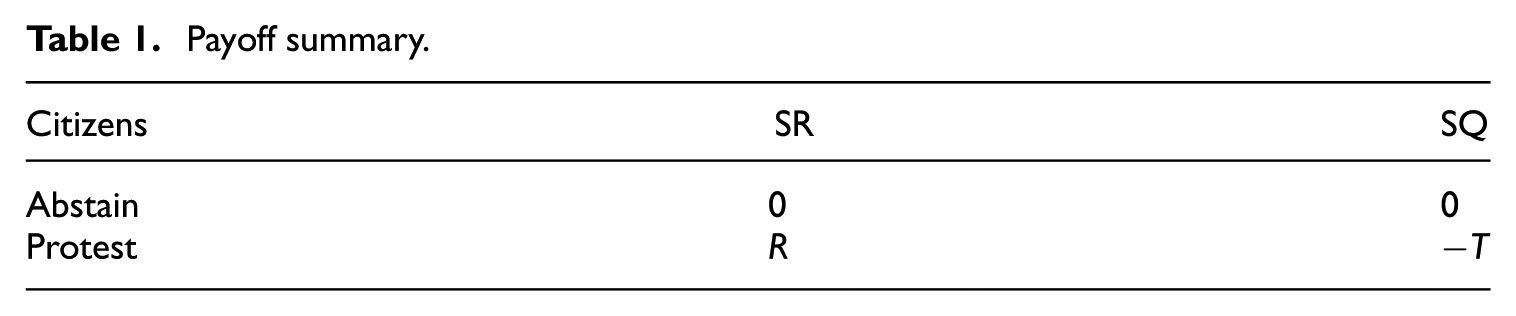
Note, importantly, that all these payoffs refer to the material benefits that people receive from either abstaining or mobilizing. Once

where
3.2. Model 1: Increase in perceived strength of the regime
In this section we model citizens’ emotional state as affecting how they perceive the signal of the regime’s strength that they receive. This prediction operationalizes findings from psychology and political psychology showing that fear makes citizens more pessimistic, including about their personal risk of repression (Lerner and Keltner, 2000, 2001; Lerner et al., 2003; Young, Forthcoming). It is important to note that results are substantively unchanged if we model pessimism as a change in the mean of citizen’s prior belief about the regime’s strength.
6
Citizens who are afraid behave pessimistically and act automatically as if they had received a signal

where F is a parameter that measures the amount of fear the citizen experiences. 7
Given that citizens do not observe
In this case, the equilibrium consists of the cutoff for dissidents

Using cutoff strategies, citizens who receive a private signal x will mobilize if

When should an individual join the mobilization against the regime? To answer this question, consider first an alternative simpler setting in which the type of the government is public information and thus common knowledge among all citizens. If
In particular, the expected payoff for mobilizing for the citizen who receives signal

and the payoff to abstain is 0. In particular it must be the case for a citizen who observes the signal

which turns into

Rearranging, this yields the citizens’‘indifference’ posterior

We can now substitute this ‘indifference’ posterior into equation (3)

Note that equation (5) has a unique solution if the derivative of the right hand side with respect to
We are now in a position to do comparative statics on the amount of fear that a citizen experiences. In particular we have the following results:
Proof. In equation (5), take the derivative of

Solving for

By assumption 1,
It is straightforward to note from equation (3) that since
Proof. Follows directly from substituting equation (4) into equation (2) and taking the derivative with respect to F. The rest of the proof is given by the argument in Proposition 1.□
3.3. Model 2: Increased pessimism about the participation of other citizens
The discussion so far underscores the importance of the effect of fear on two types of uncertainty: fundamental uncertainty and strategic uncertainty. Fundamental uncertainty refers to uncertainty concerning the payoff relevant state of nature, denoted by the regime’s strength,
In the previous model we considered the relationship between fear and collective action exploring how fear increases the perceived strength of the regime. In other words, Model 1 analyzed the effects of fear on fundamental uncertainty. In this section we isolate the effect of fear on strategic uncertainty. We study to what extent the effect of fear on mobilization and regime survival is driven by changes in expectations about the actions of others.
In this model, we assume that each player believes that everyone will only mobilize when optimal to do so with some probability that is decreasing with the level of fear they experience. As we show below, it does not matter for citizens’ decisions whether they think that they themselves are prone to making mistakes or whether they only think that others will fail to behave optimally. While this is a deviation from the standard assumptions of formal models of coordination, both cases have a basis in the psychology literature. On the one hand we can interpret fear as having certain actions tendencies, in this case that of avoiding danger (Lazarus, 1991). As fear increases people are more likely to want to avoid danger and believe others will too even if they should optimally not. On the other hand, the case in which citizens believe others will be prone to not taking an optimal action has a basis in the psychology literature on rosy self-perceptions and over-confidence. 10 One interpretation of the way that we model the strategic uncertainty of fear is that it enhances the common tendency to see others as less rational, brave, or strong-willed than we see ourselves. This argument requires that each player places sufficient probability on the event that others will fail to behave optimally. In particular, past empirical research suggests that fear may make citizens more pessimistic about how others will behave (Young, Forthcoming). 11
In this model, each citizen receives a signal
If citizens use a cutoff strategy, there is a switching point

The perceived probability of a successful mobilization depends on the beliefs about the actions of others given a signal
Formally, citizens believe that, upon receiving a signal that would make them rationally mobilize, everyone is only making a correct decision to mobilize with probability

The expected payoff for choosing to mobilize (note that citizens believe that they will only implement their choice to mobilize with probability

The indifferent citizen is given by

Note that
The mean of the posterior at which citizens are ‘indifferent’ is now given by

We can now calculate the perceived marginal regime,

Proof. Take the derivative of

Once we solve for

Recall that we assumed that
Since
Proof. The results follows from substituting equation (8) into equation (6), taking the derivative with respect to
If citizens’ beliefs are in fact true, and fear indeed makes people more error prone, we are done. In this case, the perceived critical regime in fact corresponds to the true critical regime. If however, citizens’ beliefs are incorrect, we still have to obtain the true critical regime,
Proof. The true critical regime is given by

which substituting in the value of

Taking the derivative with respect to

which by Lemma 1 is clearly positive.□
In the case in which fear reduces the perceived probability of a successful mobilization, citizens are less willing to mobilize. In this sense, pessimism is then a self fulfilling prophecy. If everyone believes that everyone will be less willing to mobilize against the regime, then everyone will be less willing to mobilize against the regime.
3.4. Model 3: Increase in risk aversion
So far in all of our modeling choices we have not made any explicit assumption about citizens’ risk preferences. However, as noted above, there is experimental evidence in economics and in cognitive and political psychology that fear may increase risk aversion (Cohn et al., 2015; Guiso et al., 2013; Young, Forthcoming). In this section we model fear as having an effect on the concavity of the citizens utility function. In order to do this, suppose now that citizens have utilities over the material payoffs they receive from this game
Payoffs with risk aversion.
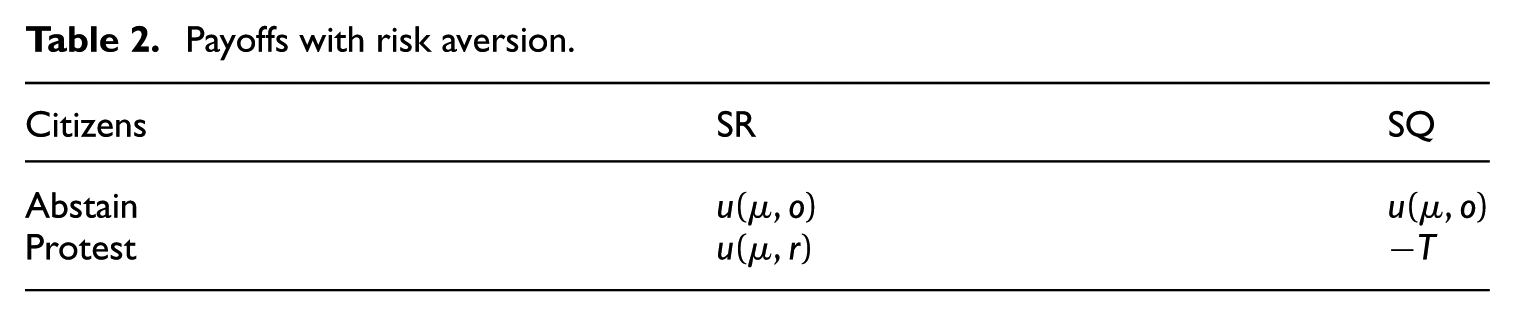
Consistent with the idea that fear makes citizens more risk averse and thus their utility more concave, we suppose that fear increases the Arrow-Pratt absolute risk aversion coefficient, which we will call A, and which we define as

Hence

In order for this equation to hold it must be that the numerator is positive. Under our assumptions it must be then that at least one of the following two hold: (1)
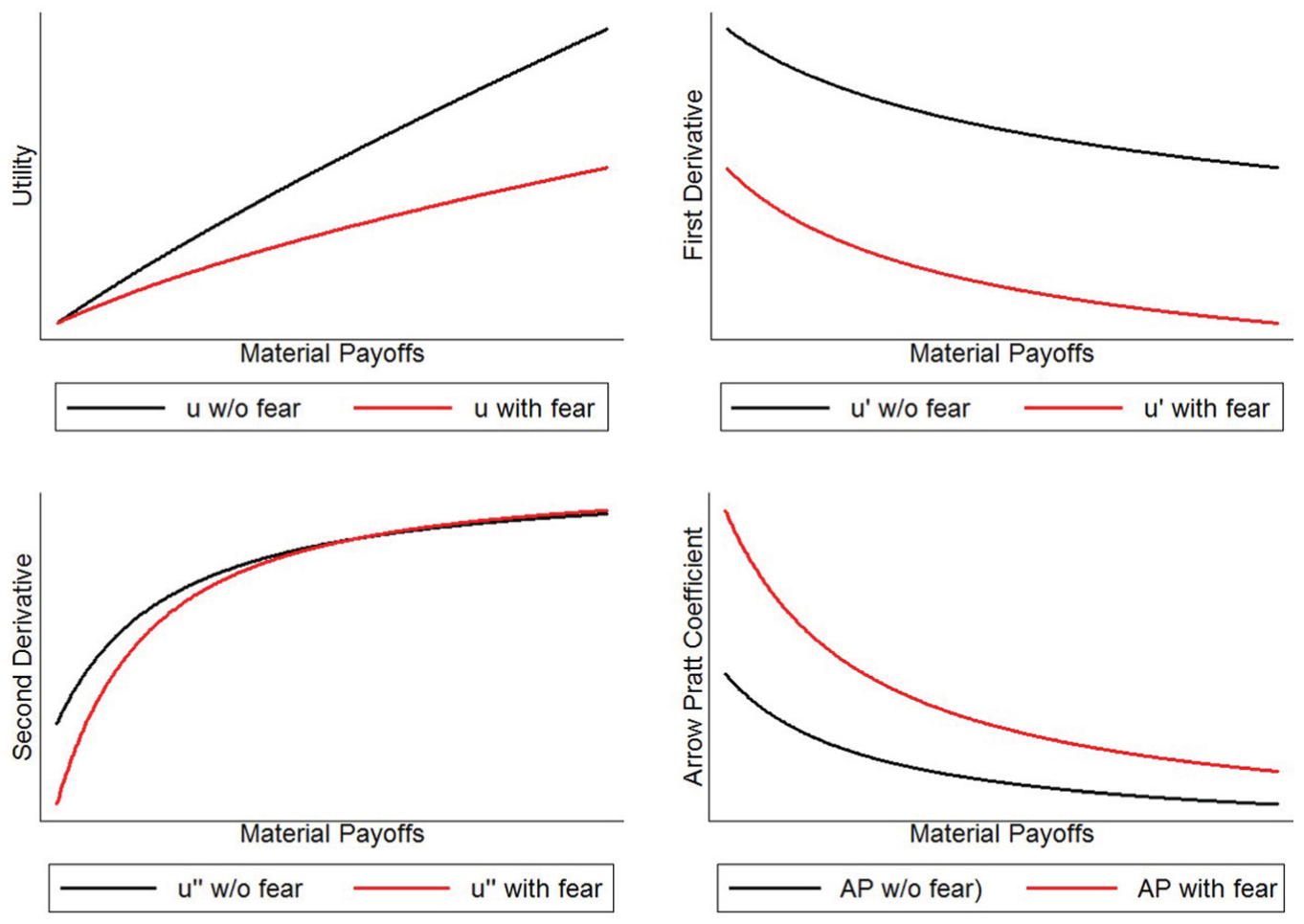
Larger effect of fear at higher levels of material payoffs.
Given Assumption 2, we can now solve the model. Recall that citizens receive a signal x of the strength of the regime,
Similar to what we observe in the other two models, if citizens use a cutoff strategy, there is a switching point

Recall that for a citizen cutoff

We now evaluate the decision for the citizen that is indifferent between mobilizing and abstaining. Citizens that are indifferent will receive the same expected utility from mobilizing and abstaining. Given the discussion provided at the beginning of this section, formally this means that

Note as above that

where

The posterior expected value of

We can now substitute this indifference posterior into equation (11) in order to obtain the marginal regime

We can now calculate the effect of fear on regime failure and mobilization. As proposition 5 shows, the effect is ambiguous.
Proof. Take the derivative of

Solving for

Note as above, that since the inverse of a Normal CDF is increasing, the sign that the expression takes is the the opposite sign that

Rearranging terms we have

Note that since we have assumed that
Similarly to the models in the two previous sections, we can now show the effect of fear on the critical signal. Not surprisingly it is also ambiguous.
Proof. Follows directly from the fact that from Proposition 5 we know that the effect of fear over
The finding that fear has an ambiguous effect on dissent through risk aversion is counter-intuitive. It stems from the fact that an increase in risk aversion may cause
Substantively, this model suggests that one of the effects of fear is to make citizens discount the status quo, or believe that they have nothing to lose by mobilizing. Although citizens get a higher payoff in the status quo than if they are repressed, an increase in risk aversion causes them to get relatively less utility from the status quo compared to an unsuccessful revolution in which they face repression. 17
4. Discussion
Machiavelli famously advised Lorenzo de Medici that it is ‘much safer to be feared than loved, when, of the two, either must be dispensed with’ (2006 [1532], XVII). This has often been interpreted as an unambiguous endorsement of repression. He also, however, recognized that ruling by fear involves a trade off between using enough ‘inhuman cruelty’ to be ‘revered and terrible,’ without creating a backlash. Authoritarian regimes, which maintain control by excluding a sizable proportion of the citizenry from power, continue to struggle with the risk that repression might end up mobilizing their citizens against them, particularly when emotions make citizen decision-making less predictable. Machiavelli’s early analysis seems to recognize that citizens’ decisions to revolt are inherently affective. Yet, modern research on protest and authoritarian persistence has tended to analyze the decisions of citizens facing the threat of repression without considering how the actual emotion of fear might affect their willingness to take action against the repressive regime.
Our model takes an important step towards bringing the emotion of fear into the study of authoritarian politics. Research in psychology and behavioral economics has consistently found that the emotion of fear affects how individuals perceive and process information, particularly information about risks in social environments. We incorporate the effects of fear on judgment and decision-making into a model of mass action against a repressive regime in three ways. First, we model how fear might increase citizen pessimism about the regime’s strength. Second, we model the effect of fear on pessimism about whether others will participate in dissent. Finally, we model the effect of fear on risk aversion.
Formalizing the effects of fear in this way may shed light on why repression is such an unpredictable tool for autocratic regimes. While the first two effects of fear through pessimism unambiguously reduce participation in dissent, the effect of fear through risk aversion may, under certain circumstances, actually increase mobilization. In cases where citizens get similar utility from the status quo and an unsuccessful revolution, an increase in risk aversion could push them into mobilization by discounting the utility that they get from the status quo. As a result, determining the overall effect of fear on mobilization requires assessing the magnitude of each of the three effects, and the direction of the effect of risk aversion. While under most circumstances it seems reasonable to think that the effects of fear on pessimism will dominate, when the effect of risk aversion is positive and large fear may actually be mobilizing.
This combination of factors that results in fear increasing mobilization may be particularly likely when citizens are almost indifferent between the status quo and being repressed. This is likely when citizens get little utility from the status quo and when the threat of repression associated with an unsuccessful mobilization is light. Considering that repression is often used by under-performing, unpopular regimes, it is easy to believe that many citizens facing the choice to mobilize against a frightening, repressive regime will perceive the utility associated with the status quo as quite low. Indeed, the ‘nothing-to-lose’ effect identified in our model has echoes in numerous case studies of pro-democracy protests. Jim Scott’s (1977)‘moral economy of the peasant,’ for instance, suggests that once peasants reach a certain level of deprivation, they are no longer sensitive to the risk of repression. Other accounts of mobilization against the regime in Chile (Salman, 1994), Zimbabwe (Young, 2015), and the Soviet Union (Lohmann, 1993) emphasize the importance of citizens who discount the status quo after fear appeals like repressive violence. Our model suggests that this ‘nothing to lose’ mentality may be enhanced by the effect of fear on risk aversion.
This project also opens at various possible avenues for further research. On the one hand, one can study the relationship between other type of emotions and political participation. An obvious next step is to consider the inclusion of other emotions such as anger and empathy. On the other hand, in all the models we assumed that fear was exogenously introduced. A future approach may include a regime that can endogenously decide whether to induce fear in the population. In light of our results, the regime’s decision is particularly interesting because inducing fear could backfire and empower citizens to mobilize against the regime. Finally, another promising way forward could be to treat the status quo as a reference point for citizens, and consider that they might have different attitudes towards risk when they are in the domain of losses (such as the risk of repression relative to the status quo) instead of the domain of gains (such as the potential benefits of a successful revolution).
Footnotes
Appendix
In this section we show that the results of the model hold when we change the payoff of abstaining from 0 to
We will consider the variation in each of the three models. In model 1, the new expected payoff for mobilizing for the citizen i who receives signal
while the payoff to abstain is
We then have that for the indifferent citizen
and conclude that the new critical type of a regime,
As a consequence, the effect of fear F on the regime,
For model 2, the expected payoff of mobilizing is now given by
and the payoff for abstaining is
The indifferent citizen is now
The new critical regime is given by
As in Model 1, changing the payoff for abstaining does not change the direction of the effect of fear on the critical regime nor on the critical value of the signal The statements proved in Lemma 1, Proposition 3, and Proposition 4 remain unchanged.
Finally, in Model 3 we consider the effect of fear through risk aversion. The payoffs with risk aversion are represented in Table 4.
As in the main corpus of the paper, suppose that in the case without fear a material payoff of b corresponded to a utility of B,
Let
Then the new critical value of
which is a clear analogue of equation (13) in the main paper. Similarly to our result in Proposition 5, the sign of
Since the denominator is a squared number, it is positive. We know that
Acknowledgements
Thanks are due to Eric Dickson, Tiberiu Dragu, Andrew Little, Zhaotian Luo, Scott Tyson, the anonymous reviewers and seminar participants at the NYU Graduate Political Economy Lunch, SPSA, and MPSA for helpful comments and suggestions.
Funding
The author(s) received no financial support for the research, authorship, and/or publication of this article.