



Abstract
The environment in which public sector organisations operate is becoming ever more volatile, with such organisations increasingly facing the dual pressures of growing customer expectations coupled with significant budget reductions. This study presents an exploratory research model to uncover significant relationships between generic strategies and the business and social performance of public leisure providers, in an attempt to ascertain if generic strategies are fit for purpose in the public leisure sector. The findings suggest that low cost and price-based strategies are inadequate for service delivery. Rather, a hybrid strategy – which seeks to add value while also having a cost base that permits low prices – is deemed fit for purpose in the public leisure sector, satisfying the dual strategic agenda of public leisure providers. This study provides contributions to the strategic management, public management, and leisure services literatures.
Keywords
The environment in which public sector organisations operate is becoming ever more volatile, with such organisations increasingly facing the dual pressures of growing customer expectations coupled with significant budget reductions (Berg et al., 2008; Laffin and Liddle, 2006). Therefore, public sector organisations are facing growing pressure to provide more effective, efficient and flexible ways of serving their constituencies (Caemmerer and Banerjee, 2009). One common response has been for public organisations to mimic their private sector counterparts by introducing a range of market-based reforms, intended to improve their efficiency and the value that they offer to their customers (Johanson, 2009; Heracleous and Johnston, 2009). Such reforms have introduced private-sector management practices into key areas of public service provision (Liu et al., 2008). Indeed, strategic thinking typical of the private sector – such as sustainable management (e.g. Enticott and Walker, 2008) and strategic marketing principles (e.g. Kaczynski, 2008) – is increasingly being transferred to public sector contexts. To date, most of the literature on strategy, in the public sector, has been conducted at a macro level looking at its effects at the sector, rather than the organisational level (Dereli, 2003). In recent times there has been a significant acknowledgement of this knowledge gap in the literature, particularly in relation to strategy and public service performance (e.g. Walker et al., 2010; Meier et al., 2007; Andrews et al., 2005, 2006, 2009; Enticott and Walker, 2008), but it remains under-explored (Boyne and Walker, 2010). Consequently, there is a pressing need for further investigation of the uptake and application of strategic management at the organisational level in the public sector, and more specifically, a clearer understanding of the performance outcomes of strategy content for public service organisations (Boyne and Walker, 2010).
The majority of research on the strategy–performance relationship focuses on generic strategies pursued by strategic business units (SBUs) of for-profit corporations and the ability to achieve a competitive advantage (e.g. Allen et al., 2007; Thornhill and White, 2007). In the public sector, strategy concerns either the way in which objectives and actions are selected (processes), or an organisation’s approach to service delivery (content) (Walker et al., 2010). Though the majority of the literature from the public sector is concerned with strategy processes, which reflects an assumption that processes of strategy formation and implementation are more relevant than the actual content of strategies (Boyne and Walker, 2004; Boyne, 2004), a number of studies have emphasised strategy content over process; applying the Miles and Snow (1978) typology in the context of public service performance (e.g. Andrews et al., 2005, 2006, 2009; Meier et al., 2007; Boyne and Walker, 2004). In extending this research, and in recognition that typically private sector strategies may benefit the public sector (Caemmerer and Banerjee, 2009), this study seeks to extend existing research by being the first to consider Porter’s (1985) competitive generic strategies and Faulkner and Bowman’s (1995) strategy typology as useful analytical frameworks to explore how different generic strategies are linked to different performance dimensions of public leisure providers.
The most fundamental contention to the direct application of private-sector frameworks, such as the above strategy typologies, to public agencies relates to the differences between the goals of public and private sector organisations (Vining, 2011). Vining (2011: 65) suggests that ‘while it may be plausibly argued that some concepts and tools originally developed for the private sector are directly transferable to public agencies, most are only likely to be useful if appropriately modified’. The balanced scorecard, critical success factors, and value chain analysis are examples of such tools that are used by public agencies (Gunn and Williams, 2007; Hodgkinson et al., 2005). Additionally, extant strategy research has successfully adapted ‘marketised’ models of organisational behaviour for their application in the public sector. Andrews et al. (2006), for example, draw on Porter’s typology of strategy content to identify types of action that public organisations may use to operationalize their strategic stance, while Vining (2011) makes the case for the value of a modified version of Porter’s five forces framework for public agency programmes. The public leisure sector is a particularly suitable research setting to consider the contribution of Porter’s and Faulkner and Bowman’s strategy typologies in a public service context, on the basis that public leisure providers are characteristically market-facing owing to both their close interface with customers and the increasing involvement of private agents in the management of leisure services (Audit Commission, 2006); furthermore, for many leisure services, customers are charged for using the service, which represents a revenue-generating capacity (Liu et al., 2008) and highlights competition for customers as a feature of the organisational environment (Robinson, 2003, 2004).
This study presents the first market-based approach to strategy in the public sector, while accounting for the dual strategic agenda of public leisure providers, which consists of both business and social performance objectives. This study therefore seeks to develop research on the strategy–performance relationship in the public leisure sector and provide evidence of whether business and social performance returns can be achieved through the transference of strategy typologies, typical of the private sector, to public leisure providers. In so doing, it was envisaged that this study would make a number of contributions to the strategic management, public management, and leisure services literatures. First, this study explores whether generic strategies employed by public leisure providers satisfy their dual strategic agenda. Second, in applying strategy typologies typical of the private sector to the public leisure sector, this study extends the existing strategy literature. Finally, the findings from this study will highlight the relationship between different strategic stances and different dimensions of performance, which will have important policy and managerial implications; herein lies the key contribution of this study.
This article is structured as follows: the next section presents the relevant literature for the application of strategic management and generic strategies to the public leisure sector. The research design and data generation method are then outlined, before the analysis and results are presented. This is followed by a discussion of the findings and the contributions these carry for strategic management, public management, and leisure services literatures, in light of the study’s limitations.
Literature review
Public sector managers are expected to use managerial strategies to improve organisational performance (Pablo et al., 2007). Strategy can be defined as the broad way in which an organisation seeks to maintain or improve its performance (Boyne et al., 2009; Andrews et al., 2008). Consistent with the private sector, strategy is about purpose, direction, and goals, which are as important in public sector organisations as in private (Johanson, 2009; Meier et al., 2007). As such, strategy is a choice by management to establish a consistent response to problems or environmental challenges (Meier et al., 2007). The outcome of strategic choice is strategy content, or ‘strategic stance’, which is an organisation’s approach to service provision (Walker et al., 2010). The notion that strategy content is applicable to both public and private domains is explored by Boyne and Walker (2004), who evaluate the relevance of the Miles and Snow (1978) typology to public organisations. Andrews et al. (2006, 2009) subsequently tested a modified version of this typology on English and Welsh local governments, supporting the view that strategy is as applicable to the public sector as it is to the private. Strategic management, then, can be utilised by managers in public organisations to influence performance, since a core managerial function is to shape strategy content – defined as ‘the patterns of service provision that are selected and implemented’ (Andrews et al., 2006: 52). The idea that strategy content influences performance is a central element of generic management theory (Meier et al., 2007) and implies that managers can make a significant difference in service standards through the strategies they follow (Andrews et al., 2006). However the relationship between strategy content and performance in public organisations is under-explored (Boyne and Walker, 2010).
It has been suggested that strategic management is not appropriate for the public sector, on the basis that there is no competition and subsequently no need for strategy (cf. Hutchinson, 2001). Yet, competition is an essential management tool in the public service sector via the use of benchmarking to compare relative performance across public service providers (Coalter, 2000). This emphasis on performance measurement has been reinforced by public reforms including Compulsory Competitive Tendering, Best Value, Local Public Service Agreements, Comprehensive Performance Assessment (CPA), and more recently, the single set of National Indicators (Liu et al., 2007; Andrews et al., 2005). In addition, Andrews et al. (2009) provide evidence demonstrating that public services do have distinctive and consistent strategies that fit the Miles and Snow (1978) typology (e.g. prospectors, defenders, and reactors), which is typically applied within the private sector, and furthermore that strategy content matters to the performance of English local governments (Andrews et al., 2006). One of the most important functions of public organisations is to provide services that meet the expectations of citizens (Boyne and Walker, 2010), which has to be realised within an environment of serious funding difficulties (Liu et al., 2008). With recent public management reforms emphasising the value of a comprehensive approach to strategy (Andrews et al., 2009), it can be argued that strategy is a means by which public organisations can improve their performance and provide better services (Boyne and Walker, 2010). As evidence, Hodgkinson and Hughes (2011) demonstrate that public leisure providers can increase their performance through the effective implementation of a business strategy; therefore, since strategic management varies across public organisations, performance can be considered in relation to strategy differences (Boyne and Walker, 2010).
By contrast, it is important to acknowledge accountability requirements in the public sector and more specifically the need to ensure equity (Andrews et al., 2008). This study accounts for a fundamental strategic objective of public leisure providers, that is, recreational welfare. Perhaps the most frequently expressed view of the process of developing a strategy is as a rational process (Hutchinson, 2001) such as the normative approach to stakeholder management, which proposes that stakeholder interests have intrinsic worth beyond that of their instrumental worth. An organisation shapes its strategy around certain moral obligations to its stakeholders. The strategic stance of an organisation is subsequently pursued to meet the needs and expectations of particular groups. Social inclusion is the policy or act of overcoming barriers such that people have more opportunity to take part (Collins, 2004) and has become a major policy objective of the British government (Liu et al., 2009). This has been a strong tradition in UK local government leisure provision, which has focused on the promotion of equal opportunity for participation (Liu, 2009). The rationale for state provision is to ensure access for all citizens to sport and leisure opportunities (Robinson, 2004) but more recently, the initiative to pursue social inclusion has been a direct expression of government intervention on the grounds of equity (Liu et al., 2009). Equity in this context ‘implies that the unequal should be treated unequally and involves allocating services so that economically disadvantaged groups receive extra increments of resources’ (Liu et al., 2009: 5). Therefore, public leisure facilities are provided at subsidised prices by local government (Liu, 2009). However, large differences remain in participation as measured by social groups (Collins, 2008). Moreover, it has been established that there is pressure for providers to increase income in response to budget cuts (Berg et al., 2008; Audit Commission, 2006). Public leisure providers are therefore required to strike a balance between financial and social objectives (Simmons, 2004).
Public leisure providers, then, can be said to have a dual strategic agenda, since they have financial pressures to survive, while simultaneously having a social duty to effectively deliver a range of services to nominated consumer groups (Perrott, 1996) – that is, the recreationally disadvantaged. Thus, public leisure providers require an effective strategy as a means to satisfy this dual strategic agenda and such a strategy should accrue both social and business performance returns.
Empirical studies of the strategy–performance relationship in the public sector have typically drawn on the Miles and Snow (1978) typology (Boyne and Walker, 2010). The measures of strategy in these empirical studies are derived from responses by managers to survey questions that tap the central components of the Miles and Snow typology through either single-item or multiple-item measures (Boyne and Walker, 2010). Andrews et al. (2005, 2006), Enticott and Walker (2008) and Walker et al. (2010) adopt single-item measures to capture strategy content. For example, Andrews et al. (2006: Table 1) use single-items to capture prospecting (‘the service is at the forefront of innovative approaches’), defending (‘focusing on core business is a major part of our approach’), and reacting (‘pressures from auditors and inspectors are important in driving performance improvement’); while other studies such as Andrews et al. (2007, 2008, 2009), Boyne et al. (2009) and Meier et al. (2007) have used multiple items to measure prospecting, defending, and reacting. These studies have developed and tested the hypotheses that different strategies have different effects, and in so doing have extended the broad but mixed support for the Miles and Snow model of strategy and performance from the private to the public sector. However, as Boyne and Walker (2010) highlight, the pool of articles from which to draw conclusions about the strategy–performance relationship is limited and the range of dependent variables used is narrow. While the measurement of strategy remains under-explored, Boyne and Walker (2010) cite organisational performance as requiring urgent attention, since public mangers may trade different dimensions of performance (e.g. efficiency vs. effectiveness) when setting and implementing strategies; thus an empirical examination of the strategy–performance relationship should account for a variety of dimensions of performance (Boyne and Walker, 2010).
This study draws on Porter’s and Faulkner and Bowman’s strategy typologies as useful analytical frameworks to extend existing research on the strategy–performance relationship in the public domain; these are critically reviewed in the following section. More specifically, this study is prompted by a call for future research to examine the relationship between different strategic stances and different dimensions of performance in the public sector (e.g. Boyne and Walker, 2010).
Generic strategies
While various types of organisational strategies have been identified over the years, Porter’s generic strategies remain the most commonly supported and identified in strategic management literature (Allen et al., 2007). Porter (1985) argued that there are two bases of advantage a firm can possess: low cost or differentiation. These combine with the range of market segments targeted to produce three generic strategies for achieving above-average performance in an industry: cost leadership, differentiation, and focus or narrow scope (Mintzberg et al., 1998). These generic strategies are approaches to outperforming competitors, and each involves a distinguishable route to performance advantage but shares the underlying principle that performance is at the heart of any strategy.
As Johnson et al. (2008) note, however, too often managers conceive of generic strategies in terms that are internal to the organisation. While the uniqueness of internal measures may be realised in technical terms, they are of no value in achieving organisational performance unless they are of value to the customer, beyond those of competitors (Johnson et al., 2008). Thus, Johnson et al. argue that generic strategies need to be thought of in relation to that which the market values. Faulkner and Bowman’s (1995) typology of strategy content provides a number of developments from Porter’s (1985) typology, incorporating perceived use value and perceived price and includes price-based, value-added, and hybrid strategies. These strategies are developed on the basis that customers may choose to purchase from one source rather than another because either the price of the product or service is lower than that of another firm, or the product or service is more highly valued by the customer from one firm than another (Johnson et al., 2008).
By drawing on both Porter’s and Faulkner and Bowman’s typologies of strategy content, this study negates the well-documented limitations of Porter’s (1985) competitive generic strategies by incorporating Faulkner and Bowman’s (1995) market-based perspective, which accounts for perceived value and price on behalf of the customer. ‘Customerism’ has been at the centre of the changing management of public services in the UK (Liu et al., 2008) and is highlighted by Liu et al. (2008: 190) in the public leisure sector: ‘the success of a customer orientation will only come to the organization that best determines the perceptions, needs and wants of target markets and satisfies them through the design, communication, pricing and delivery of appropriate and competitively viable offerings’. Due to the revenue-generating capacity of public leisure providers, they reside within a quasi-commercial operating context and are in direct competition with the commercial sector (Robinson, 2003, 2004). This reinforces the relevance and applicability of a market-based approach to generic strategies in order to develop customer-oriented services and maintain competitiveness in the public leisure sector. Even in the context of social inclusion, it is inappropriate to treat disadvantaged groups as homogeneous, since different groups place different emphasis on specified service dimensions (Liu et al., 2008).
In the following section an overview of the generic strategies is presented, which form an exploratory research model to investigate the potential relationships between generic strategies and business and social performance.
Exploratory research model
This section outlines five generic strategies that may effectively satisfy the dual strategic agenda of public leisure providers. The following generic strategies are now each discussed: cost leadership, focus, value-added, price-based, and hybrid.
Cost leadership
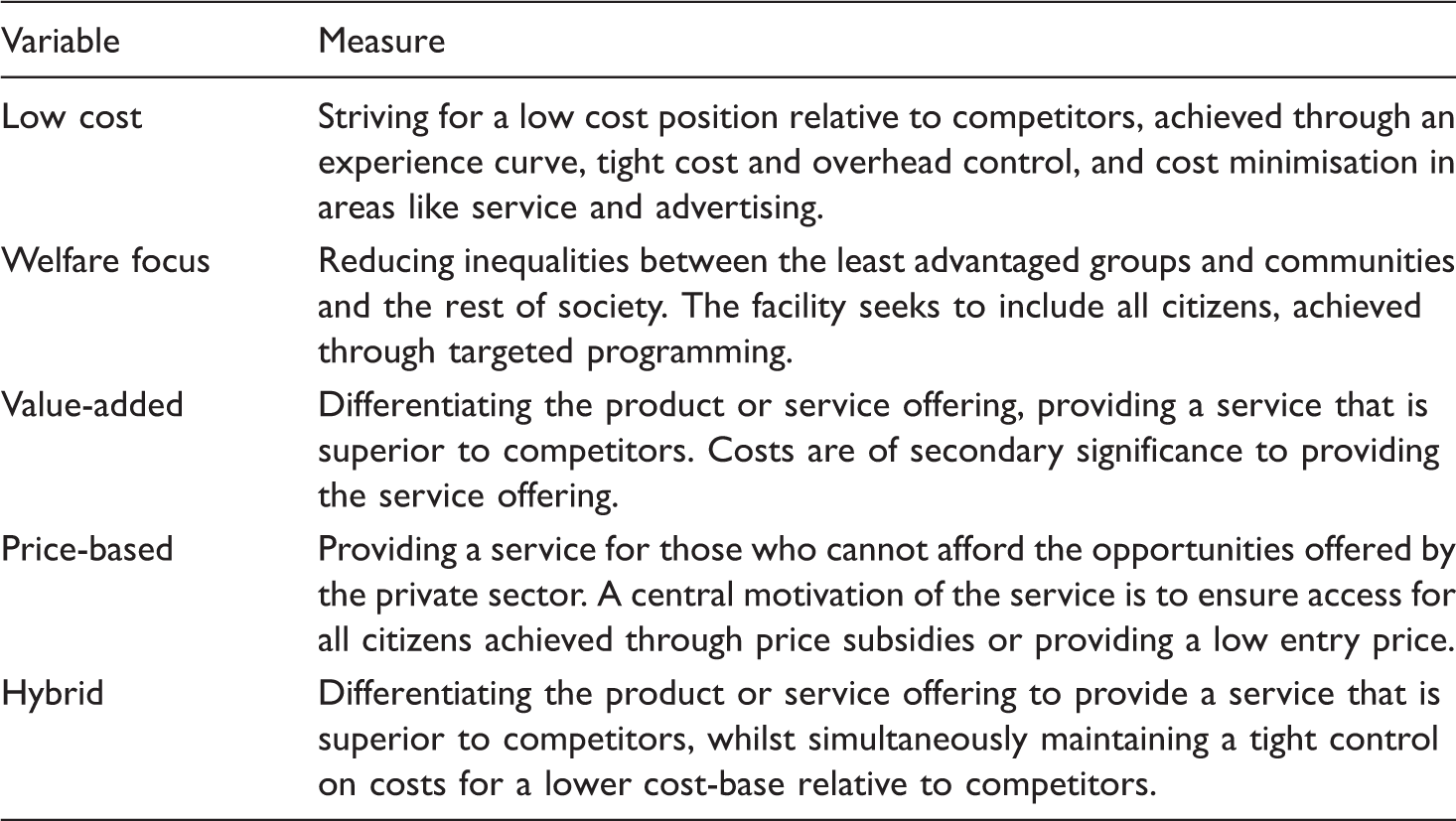
The generic strategy of cost leadership strives for a low cost position relative to competitors, achieved through an experience curve, tight cost and overhead control, and cost minimisation in functional areas like service quality and marketing (Porter, 1985). To pursue this generic strategy, an organisation will lay emphasis on cost reduction throughout the whole organisation. Subsequently, a successful cost leader in an industry will be the lowest cost producer in the sector and will offer the mass-market services of a quality comparable to that offered by direct competitors (Capon, 2008). However, it should be noted that overall cost leadership does not necessarily imply a below average price; for example, the organisation could charge an average price and reinvest the extra profits generated (Lynch, 2003). This strategy requires that a broad target or mass market be supplied with standard products or services (Capon, 2008). This generic strategy is typical of the welfare state of the past that had focused upon the provision of a minimum standard of service to all citizens (McClaughlin et al., 2002).
Focus
The focus strategy is built around serving a particular target market better than competitors and rests on the notion that the organisation is able to serve the narrow target market more effectively than competitors who are competing on a broader scale (Porter, 1985). The generic focus strategy is adapted in this research to account for the social objectives of public leisure providers. While the premise of the focus strategy remains, it is referred to as the welfare focus strategy pursued by public leisure providers that seek an inclusive strategy to reduce the inequalities that exist between the least advantaged groups and communities and the rest of society, ensuring access for all citizens through targeted programming (Simmons, 2004). This strategy is shaped around moral obligations to stakeholders and specifically represents a concern for recreational welfare provided through the targeting of provision for services to be delivered specifically to recreationally disadvantaged groups.
Value-added
Value-added strategies offer perceived added value over competitors at a similar or relatively higher price (Johnson et al., 2008). The aim is to offer the customer added value, rather than the reduced costs and lower prices of a cost leadership strategy (Capon, 2008). Through adding value to the product or service offering, organisations are able to provide a quality service that is superior to competitors (Prajogo, 2007). When the organisation is able to differentiate its offering, it is able to charge a price that is higher than the average market price (Allen et al., 2007), which covers the extra costs incurred in being unique and results in a performance advantage. This generic strategy is consistent with the strategic shift in the public sector from traditional producer-led to customer-oriented services, thereby making services more responsive to the needs of the community (Stevens and Green, 2002).
Price-based
The price-based strategy is defined here as reducing price while maintaining the quality of the product or service (Johnson et al., 2008). Customers always have a particular price they are willing to pay for a service and they will perceive high value for money if they get high perceived value at a price below that which they are willing to pay. Value for money is therefore a perception of the customer; however, organisations can contribute to this by reducing the price of the service, which will increase perceived value for money. Thus, through adopting a lower price than competitors, whilst maintaining similar service benefits, a performance advantage can be achieved (Johnson et al., 2008). Such a strategy though may lead to an inability to reinvest in the service, resulting in a perceived loss of benefit. Hence, such strategies cannot be pursued without a low-cost base. It is proposed that by creating equality of opportunity through affordable and accessible facilities (Reid, 2003), price-based strategies may increase the inclusion of recreationally disadvantaged groups.
Hybrid
A hybrid strategy challenges the need for strategic purity. The aim of a hybrid strategy is to achieve differentiation from competitors’ products and services, while charging lower prices (Capon, 2008). Thus, the success of this strategy depends on the ability to deliver enhanced benefits to customers together with low prices, whilst achieving sufficient margins for reinvestment to maintain and develop bases of differentiation (Johnson et al., 2008). This strategy enables a performance advantage through providing a unique service offering whilst restricting costs in other areas to enable lower prices relative to competitors. With escalating customer expectations (Laffin and Liddle, 2006) and the expensive leisure opportunities offered by the private sector, it is apparent that a hybrid strategy may satisfy changing customer needs through perceived added value, while simultaneously delivering on social objectives through low prices.
The applicability of these generic strategies to public leisure provision is supported on the basis that the strategies identified are consistent with strategic behaviour in public leisure services. As evidence, Benson and Henderson (2005) examine the competitive characteristics of UK sport and recreation provision through SPACE (Strategic Positioning and Action Evaluation) analysis. They assess a number of strategic variables pertaining to the competitive strength of 83 public leisure facilities; these variables include relative cost, relative price, quality standards, and service range. These strategic variables are informed by the strategy literature and research evidence on the effective strategic management of leisure facilities, in so far as strategic positioning. Competitive strength estimates the competitiveness of service provision, which is defined as: the ability to provide a service comparable to alternative providers at lower cost (although the provider may choose to retain a higher price) or the ability to provide superior service at comparable cost (although the provider usually sets a higher price). (Benson and Henderson, 2005: 257)
These variables are indicative of the strategic characteristics captured by the above generic strategies. Moreover, public leisure managers were consulted widely to ensure that the variables were recognisable and relevant (Benson and Henderson, 2005), which suggests that the above generic strategies are consistent with current strategic behaviour in the public leisure sector.
It is acknowledged that it would be naive to argue that strategy content alone affects the performance of public organisations (Andrews et al., 2006). Therefore, the intended purpose of this exploratory model is to identify whether associations exist between the above generic strategies and public service performance, with the aim to inform future research. The following section outlines the design, execution and validation of the research method employed to test the exploratory research model.
Research method
This study adopts a positivist research philosophy, which was deemed appropriate for the testing of the exploratory research model and the subsequent answering of the research question: are generic strategies ‘fit for purpose’ in a public service context? Using a mail survey approach, this study targeted 1,060 local government-owned public leisure facilities in England. This population was sourced from The Leisure Database (TLDCi). A public leisure service, for the purposes of this study, refers to a publicly owned site with at least one of the following facilities; health and fitness suite, swimming pool, or sports hall, where at least one is available to members of the general public on a pay and play or membership basis. Leisure facilities in this study differ from other leisure venues (e.g. parks or libraries) as customers are charged for using the service, representing a revenue-generating capacity (Liu et al., 2008). Public leisure facility managers were deemed key informants because such individuals have the knowledge necessary to measure the variables under investigation and would have most knowledge on strategies pursued and the business performance of their facility. Identifying the facility level manager as a key informant is also consistent with previous research examining the strategic characteristics of sport and recreation provision (e.g. Benson and Henderson, 2005); this study does not account for the broader strategy formation process, which would need to consider hierarchical levels within service delivery (e.g. Heads of Service), as this was beyond the scope of the current study.
The items capturing the dependent variable of business performance were adapted from Delaney and Huselid (1996) and encompass perceptual measures regarding new customers, profitability, market share and marketing. The analysis of business performance is conducted at the facility level; therefore the inclusion of perceptual measures enables an analysis of the performance of public leisure service providers, as specific objective data for individual facilities is largely unavailable (Krohmer et al., 2002). Performance measures such as profitability and market share are widely used in extant strategy literature. However, the items adopted place emphasis on financial performance, specifically new customer sales, profitability, market share and marketing, which refers to the ability to refine organisation activities now and into the future which can generate significant benefits in the form of sustainably superior performance (Lichtenthaler, 2009). Therefore, since the items focus on economic outcomes (Delaney and Huselid, 1996), it was deemed appropriate to combine the four measures into a single dependent variable termed business performance. Business performance measures were scaled as (1) very poor to (7) excellent, when comparing performance over the past three years, to that of other competing leisure facilities. To gauge the degree of internal consistency of the business performance scale, Nunnally’s (1978) threshold of 0.70 or greater for acceptable scale reliability is adopted in interpreting the Cronbach alpha coefficients. Since the business performance (0.82) scale displays an acceptable level of reliability, it can be concluded that internal consistency exists among the business performance variables that comprise said scale.
Social performance was gauged by the degree of social inclusion achieved by the leisure facilities examined, using objective individual facility usage records derived from TLDCi. Here, social inclusion is calculated on the basis of the postcode distribution of a facility’s usage compared with the postcode analysis of the population in the facility’s catchment area (defined as a three-mile radius). This is similar to the socio-economic profile of facility catchment used in the National Benchmarking Service for sports halls and swimming pools (NBS) developed by the Sport Industry Research Centre (Liu, 2009), which employs a fifteen-minute drive-time facility catchment area. To measure participation, then, analysis of facility usage data can be compared with catchment demographics. Experian’s demographic classification system, Mosaic (the leisure industry standard in consumer segmentation systems), is utilised to ascertain the percentage of target groups who are using the facility within the given facility catchment area. The legitimacy of the tool used is established on the basis that Sport England use Mosaic classification to inform its own market segmentation research and the tool has been previously applied to leisure and recreation contexts (e.g. Doward, 2009). The focus here is on the participation of recreationally disadvantaged groups, which are defined as welfare borderline, municipal dependency and twilight subsistence using the parameters of the Mosaic classification system. These specific groups are considered recreationally disadvantaged based on an identified exclusion to leisure opportunities of lower socio-economic groups (Audit Commission, 2006) and exclusion among older people (Liu, 2009).
Measures of the independent variables
Content and face validity was established on the basis of expert judgement. Content validity was determined by distributing the questionnaire to several academics who had substantial knowledge of the literature from which the constructs were derived, and consequently could comment on the degree to which the measures used captured the afore-mentioned constructs. Similarly, distributing the questionnaire to several public leisure managers, with the objective to ensure that the measures employed were appropriately worded and understood by the respondents, assessed face validity. To ensure the accuracy of responses, feedback given by academics and public leisure managers on the measures employed was used to enhance and modify the research questionnaire. Therefore, the content and face validity of the measures contained within the questionnaire was established.
The survey instrument followed the recommendations, directions and principles of good questionnaire development practice set forth by Dillman (2007). In total, an overall useable response rate of 26 per cent (280) was achieved. Non-response bias was examined by performing a respondent–non-respondent comparison on a random sample of 100 respondents and 100 non-respondents, following the prescriptions of Morgan et al. (2009) and Hughes et al. (2010). Significant differences were tested for between these public leisure service providers using objective data on adult membership numbers and ‘pay and play’ cost. No significant differences were found between respondents and non-respondents for adult membership (F = .129; ns) and ‘pay and play’ cost (F = 2.126; ns).
A single source self-report questionnaire was used to generate data in this study and a drawback of this approach is that common method bias may underlie the data. To protect against common method bias, in developing the instrument, the directions of Spector and Brannick (1995) were followed: measurement scales were placed in random order; non-idealised responses and wording neutrality were adopted; questionnaire length was short (three pages); and detailed instructions for completion were provided. Moreover, given that a mix of subjective (generic strategies and business performance) and objective (social performance) data is used, common method bias is not of concern in this study.
Analysis and results
Correlation matrix and descriptive statistics

Correlation is significant at the .05 level (2-tailed).
Correlation is significant at the .01 level (2-tailed).
The initial analysis demonstrates a number of significant positive and negative correlations between the study variables. Specifically, the relationship between low cost strategies and both indicators of performance is negative, while price-based strategies are also found to have a negative relationship with business performance. On the other hand, hybrid strategies have a significant positive relationship with both indicators of performance, while value-added strategies are also found to have a positive relationship with business performance. Table 2 presents an early indication of the relationship characteristics between generic strategies and leisure provider performance. Correlation analysis is employed as a precursor to more extensive statistical testing through multiple linear regression analysis.
Regression analysis: generic strategies and performance
Note. (ns) = non-significant.
p ≤ 0.1; *p ≤ .05; **p ≤ .01.
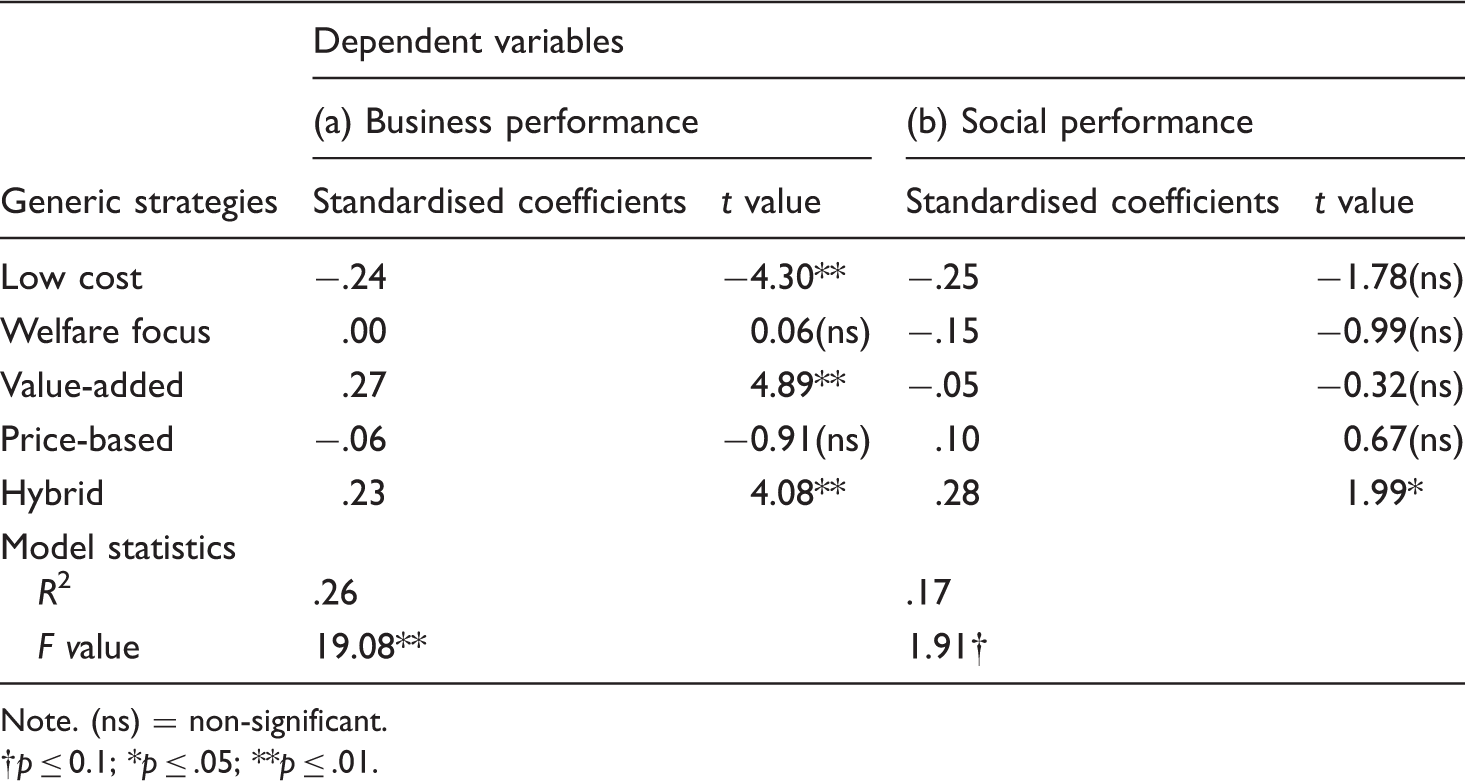
The regression analysis tested for relationships between the five generic strategies outlined and business and social performance. In considering the business performance of public leisure providers, value-added (0.27, p ≤ .01) and hybrid (0.23, p ≤ .01) strategies have a significant positive relationship with business performance. Low cost strategies (−0.24, p ≤ .01), on the other hand, are identified as having a significant negative relationship with this dependent variable. Hence it is contended that value-added and hybrid strategies positively benefit business performance of public leisure providers, but the pursuit of low cost strategies may result in negative business performance outcomes. No further significant relationships are found between the other generic strategies and business performance. In considering the social performance of public leisure providers, only hybrid (0.28, p ≤ .05) strategies have a significant positive relationship with social performance. This suggests that the inclusion of recreationally disadvantaged groups can be increased by the pursuit of hybrid strategies. However, no significant relationships are found between the other generic strategies and social performance.
Regression analysis: controls and performance

Note. (ns) = non-significant.
p ≤ .05.
p ≤ .01.
The results indicate that adult membership size (0.50, p ≤ .01) has a significant positive relationship with social performance, while no significant relationships are found between the other control variables and either dimension of performance. This suggests that the number of facility members is positively associated with the percentage of defined target groups using a facility within the given facility catchment area, which would be expected.
In summary, the results suggest that strategy content, as captured by the generic strategies adopted, effects public service performance. A hybrid stance is associated with organisational success delivering on both business and social objectives; a value-added stance is associated with enhanced business performance; welfare focus and price-based stances are neutral; and, a low-cost stance is associated with strategy failure.
Discussion
The findings presented are derived from a national survey questionnaire, which sought to explore whether generic strategies, typical of the private sector, are appropriate in the public leisure sector. Appropriateness was measured against the dual strategic agenda of public leisure providers, which refers to both business and social performance objectives. This study has adapted two established typologies of generic strategies developed by Porter (1985) and Faulkner and Bowman (1995), respectively. The examination of the relationship between these generic strategies and performance of public leisure providers highlights a significant contribution to strategic management and public management literatures. Particularly, the findings demonstrate that strategy content developed in a private sector context is relevant to the study of generic strategies in the public sector. This finding is consistent with the adoption of private sector–based approaches to the organisation of public services and reflects efforts of government reforms to introduce private-sector management practices to public service provision (Liu et al., 2008). This supports the view that strategy matters not only in the private sector but also in the public sector (Meier et al., 2007; Andrews et al., 2006). Public managers can exercise strategic choice even in the face of external constraints; they can, for example, seek performance returns through high quality as expressed in major management theories (Meier et al., 2007). Therefore, this study demonstrates that there is no need for a fundamental redefinition of strategy content, but simply a need to acknowledge and reflect the specific context and characteristics of public services, such that existing conceptualisations can be suitably adapted for the operating environment of public organisations. This is underpinned by the contention that public services are not fundamentally different or unique, evidenced by the creeping privatisation of many such public services (Laing, 2003). The findings from this study provide a new understanding of the relationship between different strategic stances and different dimensions of public leisure service performance, extending strategic management research into a new context while contributing to public management literature by advocating the application of generic strategies for service provision. This builds support for future research to be conducted at the organisational level, rather than the macro-level, in the study of the strategy–performance relationship in the public sector. In turn, such research should seek to garner a clearer understanding of the performance outcomes of strategy content for public service organisations beyond the Miles and Snow (1978) typology, and across different performance dimensions.
According to Worthington and Dollery (2000), performance measurement of public services consists of two components: efficiency and effectiveness. In this study efficiency refers to the extent to which public leisure providers can maximise business performance, while effectiveness refers to the degree to which policy objectives are achieved (i.e. social inclusion). In light of these components of performance measurement, there are two main contributions to the public management and leisure services literatures. Firstly, a major strategic task for public organisations is ensuring they have sufficient revenues to maintain or expand services (Andrews et al., 2006). It has been established that there is increased priority for public services to generate additional revenue, and a default response to such financial pressure has been the adoption of low cost strategies through ‘cost-cutting opportunism’ (Thomas and Dunkerley, 1999). However, such strategies are not optimal solutions for the long-term health of public leisure providers and have had a detrimental impact on the quality and maintenance levels of public leisure facilities (Liu et al., 2007; Carter, 2005). On the basis of the findings, it is suggested that public leisure providers seek to move away from this default response to financial pressure and adopt other strategies that may better enable them to perform. Specifically, public leisure providers may be able to increase their financial return through service value and responsiveness to changing customer needs by investing in facilities and increasing perceived value. More specifically, ‘physical evidence’, which refers to the quality of tangibles such as the facility and equipment, is considered to be the most important factor to customers (Lentell, 2000). This is supported by the findings, as value-oriented strategies (e.g. value-added and hybrid) are positively associated with the business performance of public leisure providers. It is recognised that this strategic decision, however, is likely to be counter-balanced by the concerns of social inclusion imposed by central government. Again, the dual strategic agenda of public leisure providers to secure economic survival while simultaneously increasing inclusion of recreationally disadvantaged groups is clearly apparent.
Secondly, although entrance charges are one component of participation decisions, the findings suggest that they have a relatively small influence, since price-based and welfare-focus strategies do not appear to be positively associated with business or social performance of public leisure providers. This may well indicate a level of price inelasticity from customers, who are likely to look beyond simply price as a determining factor for public leisure facility usage. This is consistent with the failure of public access schemes to combat social exclusion (Coalter, 2000) and the decline in the use of leisure facilities amongst the younger age and disabled groups; despite the focus of public policy on these target groups over a long period of time (Liu, 2009). Liu (2009) poses the question: how far can under-representation or decline be overcome by innovative management (e.g. pricing, programming, transport provision)? In response, it appears that reducing the entry price to public leisure facilities through price-based and welfare-focused strategies does not result in increased social inclusion, arguably because low price may be associated with perceived low quality by recreationally disadvantaged groups. As evidence, Robinson (2006) states that customers use their expectations of a service to determine whether the service received is of an acceptable level of quality. Recreationally disadvantaged groups may therefore be exercising a preference not to use such facilities, rather than any lack of means on their part to participate (Liu, 2009). Indeed, Liu et al. (2008) suggest that older and lower socioeconomic groups (which are defined in this study as recreationally disadvantaged groups) may be more critical of the physical evidence. This assumption is supported in that hybrid strategies are found to have a significant positive relationship with social performance, which suggests that price is not a main driver of participation among recreationally disadvantaged groups, but rather, such groups may also desire value-added facilities.
A hybrid strategy – which seeks to add value while also having a cost base that permits low prices relative to competitors – appears to be fit for purpose in the public leisure sector, as it satisfies the dual strategic agenda of public leisure providers. The mechanisms that underlie the hybrid strategy may be central to understanding its performance implications for public leisure providers. In pursuit of this strategy, public leisure providers need to be able to offer superior perceived-use value, which requires knowledge about what customers value and the ability to provide it. Resource commitment is a necessity in delivering value through the generation of market intelligence required to understand and deliver against customer needs. By simultaneously maintaining a tight control on costs in other areas that are less valued by customers, the costs assumed to be incurred by public leisure providers in delivering against customer needs are inconsequential when compared with the business and social performance returns. This requires clarification of customer service needs from the demand side, since the effectiveness of this strategy depends on the responsiveness of public leisure services to such needs, which includes those of recreationally disadvantaged groups, and to identify less valued service dimensions, which do not significantly contribute to delivering higher use value, for cost reduction. By adding value on multiple fronts simultaneously, this strategy is beneficial in markets where customers exhibit strong preferences for quality and/or price. Thus, the success of this strategy depends on the ability to deliver enhanced benefits to customers together with low prices, which can be sustained through a low-cost base to realise sufficient margins for reinvestment into bases of differentiation. This strategic approach to service provision will enable providers to sustain quality of provision within acceptable budgets through an emphasis on both value and cost relative to competitors. This study does not account for the strategic actions that public leisure providers may use to operationalize such a strategic approach; however, as Andrews et al. (2006) highlight, the key dimension of strategy content (i.e. strategic stance) is partly about how an organisation sees itself and what it is attempting to achieve rather than the specific small steps that are taken to realise its goals. The findings presented provide empirical evidence to support the suggestion of Andrews et al. (2006: 58) that the key to public service improvement may in fact be the ‘big picture of strategic orientation rather than the pixels of strategic operationalization’.
Nevertheless, this study was not without its limitations. First, this study was based on cross-sectional survey data and gives a snapshot of the relationship between strategy content and performance, and therefore causality cannot be established. Second, the analysis has been conducted on a specific group of public organisations (i.e. leisure providers) in a particular time period, which leaves open the possibility that the results are an artefact of where and when the survey was conducted. Third, the use of perceptual business performance measures is accepted as a limitation of this study but it is argued that they do not detract from the findings and implications of this study. Fourth, judgements about strategic stance and business performance, although qualified, have been reported by a single informant and may not sufficiently capture the multi-faceted aspect of these constructs. Fifth, the survey questionnaire contained only one measure for each aspect of strategic stance. A wider set of measures may reveal stronger links with performance. Finally, the author did not have access to social inclusion data for the whole sample and only assessed it via one method. Whilst this is acceptable, it would be more robust for future studies to derive social inclusion data from multiple sources in order to fully appreciate the effects of the generic strategies on social performance.
Concluding remarks
Though caution must be exercised against generalising the results to populations markedly different to that examined here, this study offers a number of contributions to the strategic management, public management, and leisure services literatures. Firstly, this study has explored an under-researched area in the strategic management literature by examining the relationship between different strategic stances and different dimensions of performance in the public domain. Secondly, this study has explored the appropriateness of generic strategies for public management. Thirdly, the empirical evidence presented provides an insight into how the dual strategic agenda of public leisure providers can be effectively realised to enhance the performance of their provision.