



Abstract
When Benny Hjern and David Porter announced (perhaps prematurely) the death of the “single lonely organization” in the study of implementation, they initiated the increasing recognition of the complexity of that fundamental policy process. The basic logic of their argument, and of a good deal of subsequent literature concerning implementation, is that making a program work effectively generally, and increasingly, involves multiple actors. Much of the initial spate of literature on implementation recognized the role of multiple public sector organizations in implementation but continued to assume a more top-down logic for implementation, meaning that the implicit question in implementation was why did all of these pesky organizations interfere in putting programs into effect as intended.
Keywords
When Benny Hjern and David Porter (1981) announced (perhaps prematurely) the death of the “single lonely organization” in the study of implementation, they initiated the increasing recognition of the complexity of that fundamental policy process. The basic logic of their argument, and of a good deal of subsequent literature concerning implementation (see Winter, 2012), is that making a program work effectively generally, and increasingly, involves multiple actors. Much of the initial spate of literature on implementation, e.g. Pressman and Wildavsky (1973), recognized the role of multiple public sector organizations in implementation but continued to assume a more top-down logic for implementation. That meant that the implicit question in implementation was why did all of these pesky organizations interfere in putting programs into effect as intended.
In addition to the research involving multiple actors within the public sector itself, much of the literature on implementation following Hjern and Porter has tended to emphasize the interactions of public and private organizations in processes of implementation (see also Torenvlied and Akkerman, 2004). Both the New Public Management (NPM) and the “governance” approach to public administration have emphasized the importance of involving actors from outside the public sector. The former approach (see Christensen and Laegreid, 2001) has tended to emphasize utilizing market actors and instruments such as contracts, partnerships, and private finance initiatives, while the latter has tended to emphasize the involvement of a range of social actors through networks and other more collaborative instruments (see Sørensen and Torfing, 2007). Both of these approaches, however, assume some form of structured interactions among public and private actors.
Although the Pressman and Wildavsky approach to implementation, and indeed the Hjern and Porter approach, tended to focus on the implementation of a single program, it may well be that the single lonely program is as deceased as is the single lonely organization. That is, with the emphasis on “joined-up government” (Pollitt, 2003; Davies, 2009) and other forms of collaboration within the public sector, a good deal of implementation involves multiple organizations at the same level of government whose success may depend in many ways on the success of other programs. Implementation may therefore involve collaborative action by multiple organizations rather than the actions through individual programs.
While accepting the general premise that implementation has become more multi-organizational, some important public functions remain peculiarly governmental and may be managed by a single public organization. At the national level, public pensions fit that more étatiste model in many countries. At the local level, functions such as sanitation, water, and the like remain in the public sector and may be implemented through relatively simple structures. The general point about complexity in implementation is not, however, undermined by these relatively sparse examples.
The above two categories of implementation structures are to some extent ideal types, whereas the reality of much contemporary public administration is that there are stable but often convoluted patterns of interaction among public and private actors. Implementation is being conducted through interactions across multiple levels of government, and at each level non-governmental actors maybe involved. Therefore, regardless of which actors are involved in the implementation of public programs, there are complex structures involved in making programs function effectively.
Three forms of implementation structures
As described briefly above, there are at least three forms of implementation structures that are operative within the public sector and between the public and private sectors. Although these three structures share some attributes, notably the involvement of multiple actors in implementation, they also have some distinctive features that should be considered. These differences extend beyond the simplistic differences based on which types of actors are involved and have implications for the manner in which those actors interact and indeed how they may implement policies.
The public sector
The simplest implementation structures would be those functioning entirely within the public sector. These structures may be themselves complex and involve a number of different organizations, but they would still be, ceteris paribus, less difficult to manage than will be other forms of these structures involving actors with different priorities (see below). As well as potentially having relatively common commitments to the public sector (Moulton, 2009), these public organizations tend to be populated by people with relatively simple values, especially when the organizations are functioning within the same general policy area. 1
Before considering patterns of interaction among nominally different public organizations, it is important to remember that even single lonely organizations within the public sector may not be so single. There is a tendency within much of the literature on public administration to treat organizations as relatively well-integrated structures with uniform commitments among all the members of the organization. In reality, however, the assumption of a unitary actor is almost certainly false, and most organizations are themselves composites. For the purposes of understanding implementation, the lower echelons of organizations—the street level bureaucracy (Meyer and Vorsanger, 2004)—may consider themselves somewhat divorced from the upper echelons of those organizations.
For implementation structures formed from multiple organizations primarily from within the public sector, there may be marked differences depending upon whether the structures are vertical or horizontal or perhaps “diagonal” (Torfing et al., 2012). The vertical implementation structures involving several levels of government are analogous to the concept of “multi-level governance” that has become a growth industry in European political science (Bache and Flinders, 2004). 2 These interactions across levels of government were central to the initial research of Pressman and Wildavsky on implementing federal programs, and the problems certainly continue today.
The horizontal implementation structures might usually be considered as coordination problems (Peters, forthcoming). That is, these implementation structures tend to create implementation problems largely through implementation problems. These structures require getting multiple organizations, all of which are related in some ways to the ultimate success of certain programs, to cooperate in making the policy function well. These organizations may not be in the same policy area as usually defined, but they may all contribute to the eventual success or failure of the program in question. Horizontal implementation structures may be more about coordination than implementation in a narrowly defined sense, but these relationships may still be crucial for the effectiveness of public programs.
Whatever the characteristics of these public sector implementation structures, they will have some common features. Obviously, these are all public sector organizations that should share public sector values (Lyons et al., 2006) and therefore should share some commitment to implementing programs legally and efficiently. Further, their general pattern of management is the use of hierarchy and authority. Finally, these organizations are also all linked to political authority as well as to administrative hierarchy, a linkage that may both facilitate and hinder the implementation of public programs. That is, they may be linked to different political authorities with different priorities, and those partisan differences can exacerbate implementation disputes.
NPM and the private sector
The second form of implementation structure that has become more central to governing involves the private sector and especially market actors. As the ideas of the NPM became more dominant within the public sector, much of the thinking about the public sector, implementation became conceptualized more in terms of instruments that rely on markets and market actors. For example, instruments such as contractualization, the private finance initiative (Ball et al., 2001), and delegation to market actors all involve linkages between the public sector and the market.
Most of these implementation structures involve principal–agent relationships between the public sector and those market actors actually delivering the services. To some extent, all implementation structures involve principal–agent relationships (Miller, 2005), but they are perhaps clearer in the NPM system or market version of implementation. Whereas the various actors involved in the public sector (hopefully) share some common public service ideas (Perry and Wise, 1990), the agents operating on behalf of the public sector within the NPM model generally will be motivated more by profit than by public service values. Hence, their actions may be more subject to the usual problems of moral hazard (see Burgess and Ratto, 2003) and may therefore require more monitoring and control than will other forms of implementation structures.
Although these relationships between the State and private organizations may be very much like any others found in the market, the public sector often tends to develop relational contracts (Williamson, 1995) with private sector actors. 3 That is, rather than engaging in new contracting processes for each instance in which there is a need for external services, the public sector develops standing relationships with organizations that have proven themselves reliable and cooperative in the past. This pattern of interaction is particularly important for social programs provided by government, given the difficulties in elaborating specific performance for programs of that nature.
Governance and implementation
The third format for implementation structures involves utilizing social actors such as labor unions, third-sector organizations, religious organizations, and a host of other types of actors to implement public policies. In some cases, the relationships between the State and these organizations may be quite similar to those found with market organizations. The involvement of the social actors could be relatively simple contracts between themselves and the State. For example, many social programs in the United States are delivered through faith-based organizations under contracts with the Department of Health and Human Services or the Department of Agriculture.
The more common pattern of involving social actors in implementation, especially in Europe, is to work through larger aggregations of organizations (both public and private), usually characterized as networks (see Klijn and Koppenjaan, 2004). Networks are formed from a number of organizations or perhaps individuals who have some common interest in the policy area. The participants in networks tend, however, to be interested in the policy area but at the same time do not necessarily share the same perspectives on the policies. Indeed, the interests of the members of networks may be very much opposed to each other, so that their interactions within the network may be more competitive, rather than the cooperative style of involvement that is assumed in much of the literature of networks (Sullivan and Skelcher, 2002).
The network style of implementation structure therefore is, on average, more complex and less determinate than either of the other two types of structures. While the legalistic logic of the first generation of implementation studies (see Hogwood and Gunn, 1984) assume that the “formators” of policies (Lane, 1981) would determine the content of policies and then those policies would be implemented as intended when possible. The network logic, however, implies that policies will be made at the same time as they are being implemented through the rather complex bargaining processes found within networks (O’Toole, 2000).
These implementation structures based on networks also involve principal–agent relationships, as did the structures based more on markets, but these relationships are likely to be substantially more complex. Although the relationship between the ministry or other political actor and the members of the network may be analogous to those in the NPM, they may not be enforced through mechanisms other than the financial incentives central to the involvement of market actors in these structures. The difficulty for managing networks, however, is that they may have no clear leadership structure with which to make “deals,” and also that there are complex bargains and understanding among the participants. Given that the participants may well have different ideas and interests about policy, there may not be a unified actor with which to bargain.
Summary
The single lonely organization may be dead, but it has not been replaced by any single model of implementation structure. Rather, at least three versions of the complex linkages among organizations, both public and private, charged with implementing public services have emerged to provide alternatives to the traditional form of implementation. These three more complex models all share some attributes, notably complex relationships among the participants and the need to find ways to create some level of commitment to finding means working together for effective implementation.
It is important to note at this point that both the NPM version of networks and the governance style are not necessarily formed autonomously and through the pressure of external actors. To some extent, governments design implementation structures to include non-governmental actors. This has been true in Northern European countries for decades but has been increasingly evident in American public administration (Hall and O’Toole, 2004) as well as in Westminster systems (Cashore, 2004).
Implementation structures as institutions
As well as being social structures, these implementation structures can be understood as institutions. At the most basic level, these structures have established and predictable patterns of interaction. Whether the implementation structures are composed entirely of public sector organizations or involve a variety of private sector actors, they constitute structural arrangements among actors. That is, there are continuing patterns of interaction among the various actors involved that tend to reduce some of the variability in behaviors. The argument that Hjern and Porter advanced concerning implementation structures was that these were relatively stable relationships among the actors that could be used to put policies into effect. These interactions could be successful even if they involved a number of actors.
Although these structures may involve a number of actors with different interests and different levels of involvement, they are assumed to be stable structures. They therefore can be considered to be institutions in most meaningful senses of that term. That said, however, the question becomes whether treating them as institutions provides any analytic leverage and provides any insights into their role in implementation. Further, given the diversity of approaches to institutions and institutionalism within the literature (Peters, 2012), which of those available lenses provides the greatest insight into implementation structures.
One of the significant problems with contemporary institutional theory in political science is that it contains a number of contending versions of the approach that at times do not appear to have much in common with each other (Peters, 2012: chapter 9). While that disparate nature of the approach can disguise a number of points of commonality, there is still the clear danger that institutional analyses of political phenomena may have little to hold them together theoretically, other than their common concerns with structures and organizations.
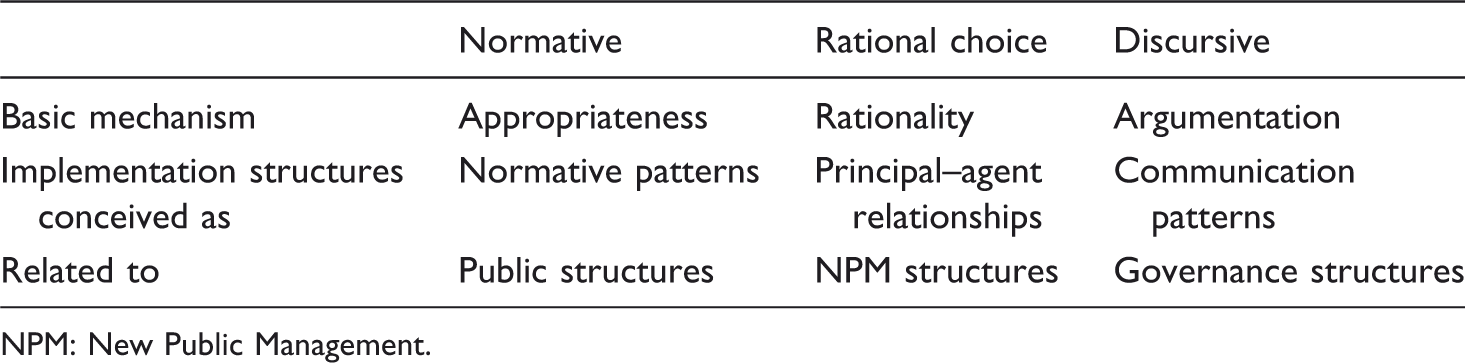
Considering how to apply institutional theory to these various versions of implementation structures tends to exacerbate the underlying differences within the institutional theories commonly used in political science and public administration. For example, those implementation structures composed primarily of actors from within the public sector appears to be best approached through the normative version of institutionalism, while those implementation structures composed of market actors interacting with government may be more appropriately analyzed through rational choice versions of institutional theory. Finally, the network models of implementation appear most suitably approached from the perspective of discursive institutionalism.
Normative institutionalism within the public sector
Given that the alternative forms of institutionalism within the discipline, I will begin by applying three particular forms of this approach to the three forms of implementation structures, and then attempt to see what might be done to integrate formats for implementation structures and institutional theories. There may not be a sufficient core in institutional theory to be able to create a single understanding of the role of institutions in political life. That said, each of the available models does provide substantial insights into the way in which government, and perhaps particularly public administration, functions.
The first of the major approaches to institutional theory in political science was the “normative institutionalism” usually associated with March and Olsen (1984, 1989). The logic of the normative institutionalism is that individuals within an institution have their behavior shaped by a “logic of appropriateness,” meaning a common set of values, myths, symbols, and routines. Members of an institution learn this appropriateness as they become members of an institution, and more successful institutions are those that can create and maintain the normative commitment of their members. Phrased somewhat differently, the preferences of members of institutions are assumed to be endogenous to the institution.
The implementation structure composed primarily or entirely of members of the public sector appears most amenable to this form of institutionalism. As noted above, the assumption would be that these public sector employees would all share some common commitment to public sector values. The nature of the public sector may vary across levels of government, especially in federal regimes, but there may still be distinctive values within government that will facilitate communication among participants in these implementation structures. 4 This facility of communication will be enhanced given that generally these structures constitute “functional villages” (Peters, 1987) that share not only common public sector values but also share common interest in, and commitment to, particular areas of public policy.
While the internal integration of these implementation structures will facilitate many aspects of their performance, we must remember that these normative commitments also pose some difficulties for implementation as well. First, the normative commitment of actors to specific policies may make policy change more difficult. It is one thing to change a structure, but it is quite another thing to change the value structure that supports the structure (see Brunnson and Olsen, 1993).
For some of the same reasons that make change more difficult, the normative commitments of actors to a particular approach to policy (and its implementation) may make coordination across structures more difficult. If a policy area and its associated implementation structure have embedded in them particular ways to solve underlying problems (see Payan, 2006), then cooperating across those competitive “logics of appropriateness” will not be easy. Some approaches to coordination, notably the collaborative approach of Bardach (1999; see also Schon and Rein, 1996), emphasize the need to discuss ideas about policy and find some common understanding. 5
Rational choice institutionalism and the NPM
As noted above, the NPM, although it has a number of logics and components (Hood, 1991), is in many ways infused with a market ideology. The dominant assumption of the NPM has been that government would function better if its organizations operated more like those in the private sector. Likewise, the assumption is that individuals within the public sector can be motivated more effectively through monetary rewards than they will be through the service values and solidary incentives (Clark and Wilson, 1961) more associated with working within the public sector.
The implications of the NPM for implementation structures are functions of the principal–agent relationships that are assumed to exist among the actors involved with implementation. The assumption that individuals and organizations are involved in implementing public programs primarily for reasons of financial benefits is compatible with the underlying utilitarian concepts within the rational choice institutionalism. In that perspective, the actors involved in these structures have exogenous preferences for maximizing their own utility and enter into contracts with the public sector in order to enhance that utility.
While the principal–agent version of rational choice institutionalism appears the most relevant for the analysis of implementation structures, other approaches might also have some utility. For example, the approach of Elinor Ostrom on the emergence of norms and rules for solving common pool resource problems implies a more evolutionary approach to developing institutional approaches to implementation (see Lustick, 2011). Although coping with collective action problems through the creation of rules that rationally constrain behavior, the Ostrom approach also emphasizes the creation of common norms.
Discursive institutionalism and network implementation
The third variety of implementation depends upon the creation and utilization of networks of social actors as well as their interactions with public sector actors. Although much of the network literature tends to assume that these structures will be well integrated and cooperative, the reality is perhaps not so harmonious. Although they are meant to work together, networks are generally formed from individuals and groups with different interests (Baumgartner and Leech, 1998), and therefore they will attempt to enact different policies and pursue different paths toward implementing programs.
The discursive model of institutionalism (Bakir, 2009; Schmidt, 2010) argues that the participants in the institution enter the interactions associated with implementation with rather different discourses that not only explain the nature of the policy enacted by the institution but also serve as means to persuade other members. Thus, unlike the normative version of institutionalism, there is no single set of symbols, myths, routines, etc. that define the institution but rather there are contending sets.
Most analyses of networks assume that the participants somehow become angels once they join these structures. That assumption does not appear viable, given that the participants join the network in order to advance the interests of the members of their organizations. While there is, of course, some evidence that groups and organizations, and especially the leadership of groups, become coopted when they participate in structures such as this, the conflict hypothesis may be equally viable. At least the possibilities of conflict among the participants in networks should be considered when conducting research, and the discursive model of institutions provides a useful approach to that conflict (see LaPorte, 1996).
This version of implementation, perhaps more than others, emphasizes that implementation is a political activity, and that indeed some of the more decisive acts in shaping public policies may occur within the implementation process. If there are multiple participants in the process, having different policy goals, then coming to an integrated perspective on implementation is difficult. In this perspective, many of those differences have to be worked out as decisions that are made in implementation. Political actors may be able to off-load their own differences and inconsistent preferences on to implementers, saving them the difficulties of making difficult decisions.
The discursive model of institutionalism reflects some of those political conflicts involved with implementation. While the “coordinative discourse” within the institution (implementation structure) may be used to attempt to develop some common understandings within the structure, it is not clear that this common discourse is sufficiently powerful to overcome more particularistic discourses of the participants. Those particularistic discourses are associated with the various components of the implementation structures and represent both their ideas and their interests.
The logic of discursive institutionalism implies that there may be relatively short-term equilibria among the participants within the institution. These actors may agree on one solution to one problem and a set of ideas that can justify the adoption of that solution. Discursive institutionalism therefore assumes that there will be a continuing competition among the actors for control that is resolved only for relatively short periods. That temporary equilibrium can be the source of a continuing communicative discourse that will be used in attempts to explain the behavior of the implementation structure to non-participants (including perhaps participants in the public sector).
Going against the grain?
To this point, I have taken the rather easy approach, matching the particular conception of implementation structures to a conception of institutionalism that appears most compatible with that conception of implementation. What happens, however, if I move beyond these relatively congenial confines for the analysis and attempt to consider mixing and matching these approaches in different ways? Does institutionalism simply provide “horses for courses” or is some more general applicability for the individual versions of institutionalism and/or for the approach more generally.
One means of addressing these questions about the general applicability of institutional logics is to attempt to ascertain the extent to which the underlying logics of each approach apply across a range of implementation issues. For example, does the normative approach, with its emphasis on agreed upon ideas and symbols apply to managerialist approaches to implementation as well as to the network approaches. One can argue, for example, that the NPM is as much an ideology as it is a plan for managing the public sector (see Christensen and Laegreid, 2001). Therefore, the normative version of new institutionalism might well be applicable for NPM, even if that type of implementation structure appears rather contradictory to the normative assumptions of this form of institutionalism. 6
Likewise, the principal–agent model central to at least model of rational-choice institutionalism may provide a rather useful mechanism for understanding the dynamics of implementation within the public sector itself. The basic logic of traditional models of implementation was that legal controls over the implementers should produce compliance. In other words, the assumption was that these controls should prevent shirking by the agents (but see McCubbins et al., 1989), a logic clearly central to the principal–agent model. Thus, the rational choice model may be at least as applicable to implementation structures within the public sector as it is to the NPM approach to implementation. Both versions of implementation structures involve delegation, and hence can be analyzed through public administration models.
Other aspects of rational choice institutionalism, for example, Elinor Ostrom’s (2000) concern with the evolution of norms and rules as means of resolving collective action problems, also can provide insights into the functioning of implementation structures, especially when there are inherent conflicts among the actors involved. This version of rational choice institutionalism, therefore, to some extent can supplement the discursive model by examining other means for coping with conflicts and different conceptions of appropriate policies. And at the extreme discourse can be seen to be a mechanism for developing rules for resolving collective action problems.
One institutionalism or many?
Varieties of institutionalism and implementation structures
NPM: New Public Management.
This paper has to this point followed the already well-worn path of using alternative approaches to institutionalism and indeed utilizing the available alternatives with different empirical referents (but see Katznelson and Weingast, 2005). Although each of the approaches does provide substantial insights into the capacity to implement programs, this analysis may not be sufficient to say that institutionalism can provide more comprehensive insights into implementation structures. The triangulation of these implementation structures and decisions provides a more complete perspective on the choices that are being made.
But the concept of implementation structures itself was somewhat vague at its inception and cannot be said to be uniform and has internal variations that should be differentiated for any meaningful analysis of the phenomenon. The original presentation of the concept was directed primarily at the decline of the monopoly of state actors over implementing public policies. That version of implementation structures implied in that model was described as networks here, but there are also complex structures involving only public sector actors and market actors that require equal consideration.
The real test of the utility of this general approach to implementation structures is whether the utilization of institutional analysis can provide greater insights into implementation than can a more general approach. I would argue that each of the approaches constitutes a lens through which to consider how these structures operate. The original Hjern and Porter conception of structure was relatively informal in how it constructed the structural element of the analysis, but the use of institutionalist analysis takes the interest in structure that much further. By looking at the various elements that can define a structure (values, rules, ideas), institutionalism provides a means of understanding how a number of different organizations can interact effectively in the implementation of public policies.
Further, the basic institutional characteristic of implementation structures is apparent regardless of the types of organizations involved or the nature of the formation. Governments do create implementation structures.