



Abstract
This article investigates European Union and International Monetary Fund influence on Hungary's public sector reforms in the period 2004–2013, that is, a time period that saw the initiation of the European Union's Excessive Deficit Procedure (the whole period) and an International Monetary Fund bailout programme (2008–2010). In this case, public sector reforms became derailed from the externally proposed trajectory and took the opposite direction: instead of fostering decentralization of the state administration and deepening the Europeanization process, Hungary's restructuring of the public sector delivered centralization and a ‘power grab’ that eventually impinged on some core values of the European Union ‘constitution’ (the acquis communautaire). This study aims to explain this empirical puzzle by in-depth analysis of how external influence was exerted and became interwoven with dynamically changing domestic factors in circumstances of conditionality. The research is framed by existing policy transfer and public sector reform theories. The article argues that the Hungarian case provides evidence of the unintended consequences of European Union-driven public sector reforms.
Introduction
This article analyses the influence of the European Union (EU) and the International Monetary Fund (IMF) on fiscal consolidation and public sector reforms in Hungary in the period 2004–2013. The Hungarian case – although it gained some fame internationally – is relatively unknown in detail, but it provides an interesting insight into how external influence is actually exerted in circumstances of conditionality. The case is especially remarkable because in the last phase of the time period under investigation (i.e. post-2010), there was a reversal in the direction of public sector reforms and a divergence from Hungary's earlier Europeanization drive. This empirical puzzle is investigated here. The research process is mainly inductive in its thrust and provides a thick description of the main features of the reforms. The doctrines behind the trajectory taken are then examined and the effects analysed. The research topic lies at the interface of the streams of literature dealing with policy transfer and public sector reform. The study focuses on (1) the applicability of policy transfer theories whose aim is to explain how public policy models or existing policy practices (or models) are transferred from one place to another and (2) the relevance of public sector reform theories, arguing that reforms are shaped by multiple factors, including various socio-economic forces, the political and the administrative system and even chance events (Pollitt and Bouckaert, 2011).
Hungary, a country with 10 million citizens, is a unitary state with a unicameral parliament and a majoritarian political system. The government administration is composed of three plus one layers: central level, county level, and municipality level, with the additional regional level (between national and county level). 1 Hungary's public administration system had its roots in the centralized and hierarchical traditions of the Austro-Hungarian Empire (Nunberg, 2000). After the fully fledged centralization of the post-World War II Soviet-type communist regime, the political changes from 1989 onwards brought the decentralization of public administration. Hungary became a member of the EU in 2004. The process of adopting the acquis communautaire in the pre-accession period is labelled as a general Europeanization drive (Bruszt, 2007; Hughes et al., 2004; Shimmelfenning and Sedelmeier, 2004), whereby the doctrines underlying the public sector reforms were derived from the Washington consensus in general and the new public management (NPM) approach in particular (Csáky, 2009; De Vries and Nemec, 2013). Public sector decentralization led to a high degree of independence from central state administration for municipalities and for various state agencies. This also resulted in increasing functional inefficiencies, the proliferation of state organizations on all levels, financial waste and an environment that hindered central decision-makers' ability to facilitate change (Hajnal, 2014; Vass, 2001). Central governments made recurrent attempts to reverse the previous trends throughout the 2000s, but the centralization breakthrough (i.e. cutting state agencies' authority, hollowing out the functions of mezzo and local governments) did not happen until after the 2010 elections when Fidesz 2 gained an absolute (two-thirds) parliamentary majority that allowed the government party to change most rules of the political game, to rewrite the constitution, and to dismantle the strong system of checks and balances (Greskovits, 2015; Hajnal, 2013; Hajnal and Kovács, 2015; Kornai, 2015; Körössényi, 1999). This latter metamorphosis of the Hungarian public administration constitutes the main interest of this study.
The article covers the period 2004–2013, an era that the country spent under the EU's Excessive Deficit Procedure (EDP). In 2008–2010, Hungary participated in an IMF bailout programme. The EDP is an action initiated by the European Commission (EC) against those member states whose public budget deficit runs above the set threshold. 3 According to EDP rules, the national government is responsible for the content of the programme designed to eliminate the excessive deficit, whereas the role of the Directorate General for Economic and Financial Affairs (DG EcFin) is to formulate country-specific recommendations on the necessary policy measures (including public sector reforms) and to track their implementation. If a member state fails to comply with the approved fiscal consolidation trajectory and does not reduce its public sector deficit accordingly, a financial penalty may be imposed. The macroeconomic situation, the level and the intensity of external influence on national level decision-making and elite decision-makers' ownership of public sector reforms were rather heterogeneous during these 10 years. Accordingly, this article distinguishes and analyses three qualitatively distinct phases: (1) the first phase of fiscal consolidation and public sector reforms in 2004–2008; (2) the IMF bailout programme in 2008–2010 and (3) the post-2010 public sector reforms and fiscal programmes.
Both the EDP and the IMF bailout programme have inherent conditionality features (more implicitly in the first case and absolutely explicitly in the second). These circumstances provided a wide window of opportunity for the EU and the IMF to influence domestic public policy reforms. Persistent direct and explicit coercive policy transfer interplayed with the domestic context exemplified by the dynamics of socio-economic factors and the specificities of the political and the administrative system. How then did coercive policy transfer mechanisms work, and how did the actual public sector reforms unfold amidst the dynamically changing environment characterized by deep economic and social crises and major repositioning of domestic political actors in Hungary during the 2004–2013 period?
This study aims to (1) uncover the connections between fiscal consolidation and public sector reform to map their processes and their substantive content, (2) analyse the instrumental role of domestic factors of elite decision-making on the reform process and reform content, (3) identify EU and IMF influence on public sector reforms and (4) interpret the interaction of the two (i.e. external influence and domestic decision-making) in light of the literature on policy transfer and on public sector reform. The research question (RQ) posed in this article is: How applicable are existing policy change theories for interpreting the empirical puzzle embodied in the Hungarian case?
The article proceeds as follows. First, the terminology is defined, the methodology is presented and the theoretical frame is outlined, with the underlying objective of exploring the suggestions that policy change theory might have for our case and how the emerging stream of public sector reform literature might be helpful in understanding the empirical puzzle. In the subsequent sections, the article recounts and discusses the three qualitatively different periods of the 10 years under investigation in chronological order. In these sections, the relationship between fiscal consolidation and public sector reform is investigated, as well as the role of domestic elite decision-making and EU and IMF influence in the whole process. In the Discussion section, the reform trajectory suggested by the policy change literature and the actual developments exhibited by our case are compared in order to answer the RQ (How applicable are existing policy change theories for interpreting the empirical puzzle embodied in the Hungarian case?). Ultimately, the study aims to amend and refine the emerging public administration applied research agendas on EU influence on public sector reform, especially those of Kickert and Randma-Liiv (2017), Ongaro (2014) and Ongaro and Mele (2014).
Theories and method
This section first provides this study's interpretations of the terms used referring to external (EU and IMF) influence on domestic policymaking in the field of fiscal consolidation and public sector reforms, and the theoretical framework of the study is then introduced. Fiscal consolidation is understood here as government policies aiming to cut the public deficit and debt accumulation (OECD, 2001). Public sector reforms are ‘deliberate changes to the structures and processes of public sector organisations with the objective of getting them (in some sense) to work better’ (Ongaro, 2008; Pollitt and Bouckaert, 2011: 25). However, reform may not necessarily result in modernization or general improvement. This study puts the emphasis on the original meaning of the expression: that is, re-form the previously existing arrangements and give them a new structure, form or process, driven by specific considerations and political actors’ interests. Here, public sector reforms are understood in line with the concept as used by authors like Barzelay (2001) and Ongaro (2009), that is, government-wide in scope and cross-cutting all public services. Thus, the focus here is on broad-scope public sector reforms; specific sectoral reforms are not encompassed in the investigation, mainly for reasons of space.
Policy change lies at the centre of our investigation. Public sector reforms inherently entail a process of change. We are interested in circumstances under which the need for policy change gets articulated and the sources of the newly set policy directions and content in a given jurisdiction. We are also looking at the evolution of the policy change process and aim to identify the factors facilitating (or, conversely, hindering) change. Therefore, the emerging scholarly literature centred on explaining the policy change process appears a particularly suitable theoretical frame of our investigations. This public administration-based literature finds its roots in the seminal book Public Management Reform by Pollitt and Bouckaert, first published in 2004. Their initial findings were most recently further enriched by literature on state responses to the crisis (Kickert, 2011; Kickert and Randma-Liiv, 2017; Ongaro, 2014).
The public sector policy change literature identifies various factors that facilitate policy change. These include: (1) the window of opportunity provided most notably by a crisis situation ‘since it delegitimizes long-standing policies underpinning the status quo’ (Kickert and Randma-Liiv, 2017: 91); (2) external pressures, including pressures emanating from supranational institutions (Christensen and Laegreid, 2017) and (3) the form of political executive that affects – among other things – reform ownership (Pollitt and Bouckaert, 2011). In our case, Hungary's deep economic crisis embodies the window of opportunity particularly in the second part of the period under investigation (2008–2013); in the first part (2004–2008), the crisis was less evident. Accordingly, the window of opportunity theory would suggest that public sector reforms were more successful in the second part. External pressure, on the other hand, existed throughout the whole period under investigation, albeit its strength varied across the periods (it peaked during the IMF programme). We find the Pollitt and Bouckaert model instructive for our case because top-down reforms driven by elite decision-making – influenced by ideas and pressures from elsewhere – constitute the core of the process. In the model, elite decision-making is circumscribed by economic and socio-demographic factors, political and intellectual factors and administrative factors; and the form of the political executive influences the degree of leverage to launch reform and the stability and the ownership of the reform (Pollitt and Bouckaert, 2011). We are interested in the evolution of domestic reform ownership and its impact on the outcomes of public sector reforms. Therefore, we utilize the elite decision-making model for the evaluation of public sector reforms in our case study. According to the model, a political weak government theoretically results in low levels of reform ownership and eventually hinders durable public sector reforms (valid for the 2004–2010 period in Hungary), whereas a politically strong government (2010–2013) results in resilient reforms.
As our case is characterized by external influence on policy change, we are interested in the content and the techniques of the inherent policy transfer processes. Policy transfer therefore is the second theoretical frame used. The theory suggests that public sector reforms could emerge as a result of the presence of external pressure in the entire period. Moreover, the reform content is supposed to be tailored by, or at least aligned to, the agenda of the external agents. External influence heralded both the pre-2004 and post-2004 periods. The adoption of the acquis communautaire, the general Europeanization trend ahead of EU membership (not within the scope of the current study), the conditionality features of the EC's EDP, and more pronouncedly the IMF bailout programme (characterizing the 2004–2013 period in Hungary) inherently entail some forms of policy transfer. It is therefore reasonable to investigate the applicability of policy transfer theory in our case. The notion of policy transfer refers to the process whereby actors borrow policies, administrative arrangements and institutions developed in one setting to make them work within another setting (Dolowitz and Marsh, 1996). Policy transfer can refer to policy goals; structure and content; administrative techniques (i.e. policy instruments); institutions; ideology; ideas or concepts (Robertson and Waltman, 1992). In our case, this would translate into the most commonly agreed, accepted, and shared institutions, structures and mechanisms of modern liberal democracies’ public sector arrangements in the Western world. Policy transfer can happen voluntarily or coercively (Bennett and Howlett, 1992; Heclo, 1974; Rose, 1991). When conditionality is involved in the relationship between two actors, then there is inherently a certain degree of coerciveness. Policy transfer occurs on a continuum between ‘purely voluntary’ policy transfer and ‘purely coercive’ policy transfer. Most cases fall along the continuum rather than at one pole (extreme). Hungary, however, fell quite squarely into the coercion case, exemplified by the EDP (i.e. a window of opportunity for the EC to exert more direct influence than otherwise on public sector reforms) and the IMF bailout programme (i.e. involving straightforward conditionality in the form of policy prescriptions). Policy transfer theories therefore suggest that the Hungarian public sector reform trajectory in the 2004–2013 period should have resulted in an extended format of the pervious Europeanization drive, including decentralization and voluntary collaboration of stakeholders; demand-driven and responsive government; performance evaluation; customer orientation; local capacity building; territorial development strategies; novel budgeting techniques; various public–private partnerships, and so on – that is, the public sector recommendations of the EC and the IMF. Policy transfer can happen alongside qualitatively different mechanisms, such as copying, emulation, hybridization, synthesis, and inspiration (Rose, 1991). Emulation refers to a case where not every detail is copied. Hybridization and synthesis are about combining elements of programmes found in two or more cases to develop a suitable policy for the actual problem. Hybridization and synthesis take into consideration the domestic policy legacy, and they prioritize expert decision-making. They work better under tranquil circumstances in general. Crises times (2008–2013) provide a less appropriate environment for such a policy transfer trajectory, whereas the apparent lack of crises theoretically would have facilitated it in the first phase (2004–2008) under investigation. Inspiration happens when familiar problems in an unfamiliar setting can inspire fresh thinking about the necessary solutions (Rose, 1991). Such a policy change trajectory is viable when external pressure is limited. The success of policy transfer depends on the actual qualities of the process. Generally, it is helpful if the domestic policy legacy and institutional/cultural setting is taken into consideration (hybridization, synthesis) and/or if the domestic agents internalize the policy change process (inspiration). The qualitative features (i.e. levels) of the policy transfer process are scrutinized in the analysis. We adopt policy transfer as our theoretical framework, coupled with the Pollitt and Bouckaert model of public management reform processes, with amendments from recent public sector reform studies (Kickert, 2011; Ongaro, 2014).
The study applies the process-tracing method for within-case analysis in order to establish causal relations (Beach and Pedersen, 2013; Bennett and George, 2005). Three sources of data are used: (1) relevant media sources; (2) publicly available official reports issued by the national and supranational institutions (e.g. national reform and convergence programmes, country-specific recommendations, IMF documents); (3) interviews with representatives of ministries, the central bank, the fiscal council as well as the IMF and the EC – both on expert level and on decision-maker level. Altogether, 10 persons were interviewed in the 2015–2017 period (see details after References). The interviewees were selected in light of the intention to get a broad account of the case both horizontally (public sector representatives, central bank and fiscal council representatives, EC and IMF representatives) and vertically (junior employees, executives, high level decision-makers, experts and political appointees). A peculiarity of the interviews was that in most cases the interviewed persons changed their positions throughout the time period under investigation (2004–2013), and therefore they could report relevant information from multiple viewpoints. 4
The first phase of reforms (2004–2008)
The year 2004 was a busy one: Hungary joined the EU in May, EDP was launched in early summer, the government parties (the socialist MSZP and the liberal SZDSZ) lost the European Parliament elections 5 in June, and the ensuing internal coalition crisis resulted in a change of prime minister 6 in August. The incoming Prime Minister Gyurcsány busied himself restoring the popularity of the government party, as the next (national) parliamentary elections were scheduled for within 18 months. The Hungarian government had no intention of implementing unpopular fiscal austerity measures. 7
In order to formally comply with the EDP, the Ministry of Finance prepared a national programme in autumn 2004 – without consulting fellow ministries, the central bank, or economic thinktanks. 8 The fiscal consolidation programme and structural reform proposals were aligned with the EU recommendations – although they lacked any detailed action plans, and they were not implemented. 9 The EC preferred not to interfere in internal political developments (such as parliamentary elections); this explains the absence of strong pressure on the Hungarian government to start fiscal consolidation before the elections.
This changed after the elections, however, and fiscal consolidation had to commence. The prime minister won the 2006 election, but the government coalition remained fragile: it had a narrow parliamentary majority, and the prime minister's political profile was damaged. 10 The lack of a strong political coalition weakened political leaders' capacity to implement comprehensive reforms. All decisions were made eventually by the prime minister. 11 Ministry of Finance staff provided technical assistance, that is, calculating the financial impact of the measures. 12 Political consent was secured by party-politicking through behind the scenes deals among the coalition parties. Various interest groups were only minimally involved in policy formulation. Previously well-functioning and influential corporatist institutions, most importantly the National Interest Reconciliation Council (a tripartite council dealing with labour market and general economic policy issues involving the government, the trade unions, and the various employer groups), were side-lined (Hajnal, 2013; Sárközy, 2012). In order to enhance the efficiency of the austerity programme's implementation, a centralization process took place within the state bureaucracy. On the institutional level, the number of ministries and central executive agencies was cut (merged or subordinated to their parent ministry), and agencies' autonomy was curtailed. Within the government structure, the position of the administrative state secretary was eliminated (typically a bureaucrat responsible for professional administration as opposed to the political state secretary who was typically a politician). At the same time, new coordinating institutions were created in order to improve the management of key policy areas (e.g. National Development Agency responsible for EU funds, Committee on State Reform responsible for the implementation of the fiscal package). The prime minister became the chairman of the most critical cabinet committees. The prescribed roles and functions of the ministers were transformed, whereas previously the minister represented the ministry and the corresponding policy area in the cabinet with a high level of autonomy, now the minister represented the cabinet at the top of the ministry and subordinated to the prime minister (Sárközy, 2012). The prime minister–minister relation became that of a principal–agent type. Strengthening political control and containing organizational resistance facilitated the implementation of the fiscal austerity measures (Hajnal and Kovács, 2015).
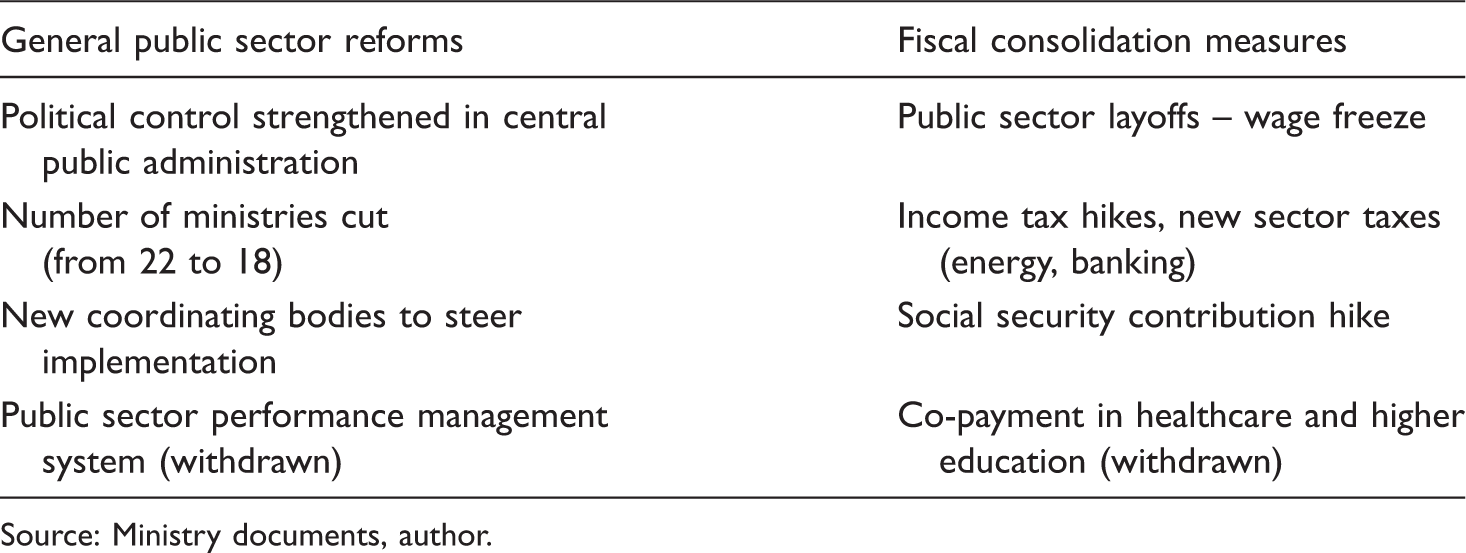
Public sector reforms – aimed at improving spending efficiency – were also included in the programme. Elite political decision-makers' attitude to public sector reforms was dominated by the inertia of the Europeanization drive pursued in pre-EU accession times. These reforms aimed to: exploit economies of scale through voluntary collaboration between local governments; invest in local capacity building (with training programmes for civil servants and effective monitoring and evaluation mechanisms for government performance); foster territorial development strategies; adopt performance-oriented budgeting practices; introduce a private insurance system-based healthcare system. These reform ideas did not take into consideration domestic policy legacies, lacked sufficient political ownership and resulted mostly in no action or quasi (symbolic) action. Implemented reforms (i.e. performance management system in public administration; co-payment in healthcare and education) faced professional and institutional resistance, political blocking and popular discontent, and therefore they were ultimately withdrawn. 13 Centralization (decision-making, public sector arrangements, implementation, and so forth) was a means to overcome domestic political resistance.
General public sector reforms and fiscal consolidation measures in the 2004–2008 period.
Source: Ministry documents, author.
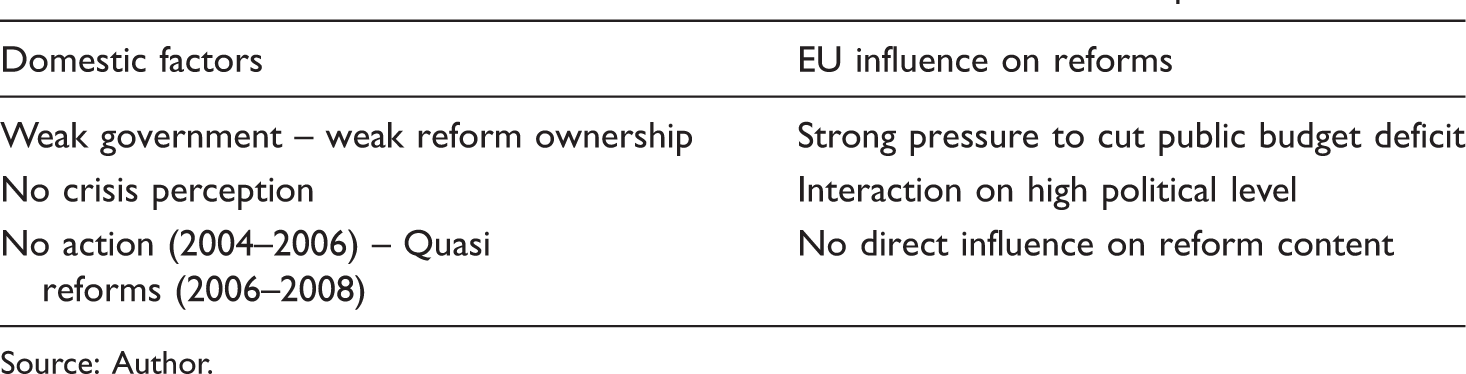
Domestic factors and EU influence on reforms in the 2004–2008 period.
Source: Author.
The main ingredients facilitating reforms stipulated by theories (i.e. window of opportunity, sufficient reform ownership, and coercive policy transfer) were weak or missing. Existing scholarly literature explaining policy change therefore is helpful for interpreting public sector reform developments (i.e. no actions, failed reforms) in this time period.
The second phase: the IMF bailout (2008–2010)
The IMF bailout programme took place in a period of major economic crisis and was characterized by strict conditionality. Amidst the emerging global financial crisis in autumn 2008, a complete freeze on the government primary bond market necessitated a call for financial assistance in order to avoid the country defaulting on its debt servicing. In late October 2008, the government signed a stand-by arrangement (SBA) with the IMF, supplemented by a loan contract signed with the EU and another one with the World Bank. 16 The EU was involved in the bailout programme under the terms of the EU Treaty. According to article 119, before a non-Euro-area member state seeks financial assistance from an outside source, it has to consult with the EC and the Economic and Financial Committee. Hungary's IMF bailout package was such a case – actually the first case in the history of the EU.
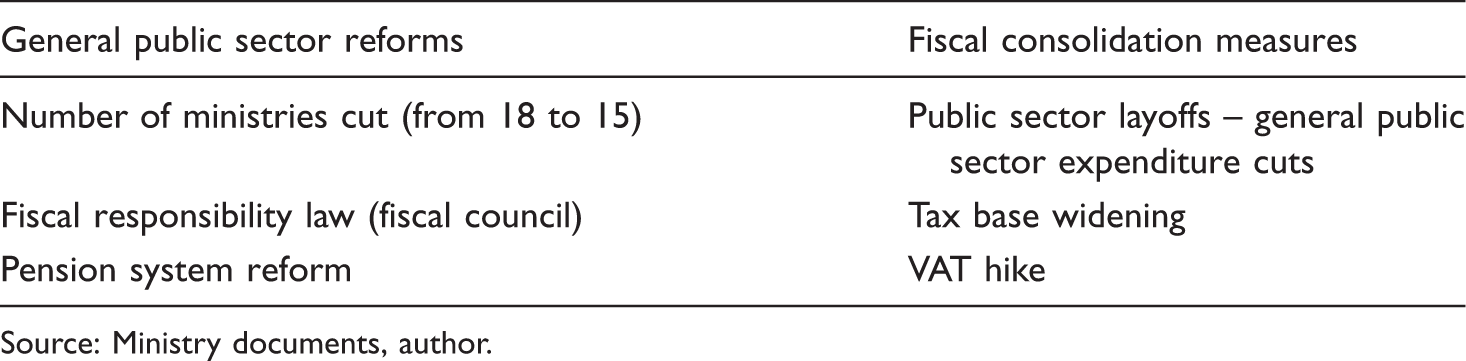
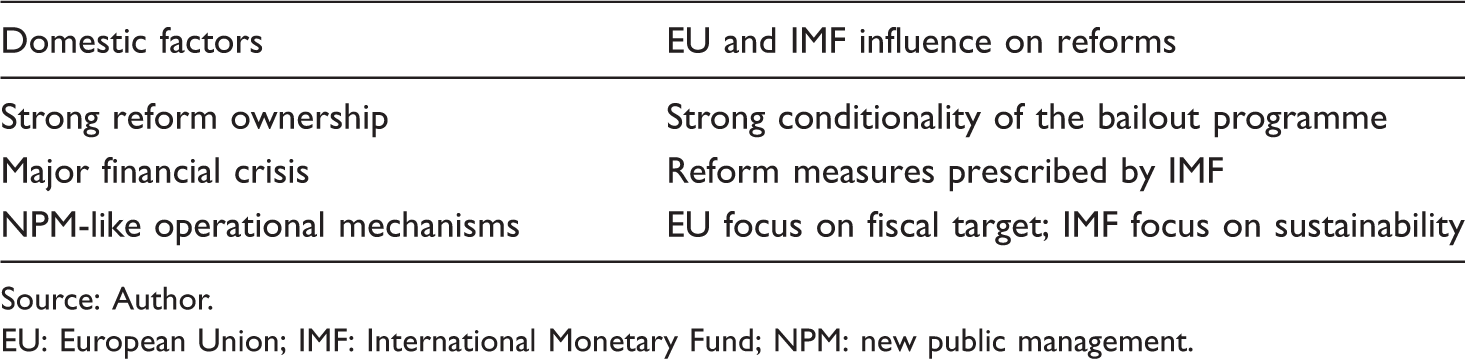
The IMF arrived for the very first preliminary negotiations with a detailed set of policy prescriptions about what to do and how to do it. 17 The IMF required the Hungarian government to deliver additional fiscal adjustment, focusing mainly on expenditure-side measures. 18 The SBA included detailed policy prescriptions with (1) quantitative targets in the form of policy measures with numerical objectives and (2) qualitative targets in the form of public sector reforms. The implementation of both the quantitative and the qualitative policy targets was strictly monitored. The programme had firm conditionality features involving several quantitative performance criteria (i.e. indicative macro and fiscal targets, structural performance criteria, and so on). The Hungarian government had to report monthly; the IMF–EU missions conducted quarterly monitoring. Each mission started with an expert level consultation (on the macro trends), followed by scrutiny of the fiscal trajectory with the policymakers, and ended with the chief negotiators bargaining on the next fiscal measures. A successful round of quarterly screening was necessary before the loan window would be opened (i.e. access to the next loan tranche). Whereas formally the programme was a joint product of the IMF–EU and the Hungarian government, in reality the IMF delegation prepared a list of policy measures that served as a menu, and the Hungarian government had the choice of which ones to select. More precisely, the Hungarian government had to implement most of them, but it had a small amount of freedom to reject some. The focus was on the cumulative financial impact of the selected policy measures. 19 Under the IMF bailout programme (2008–2010), the perceived task of the central government was crisis management, with the underlying objective of implementing the agreed (i.e. prescribed) fiscal consolidation measures and the public sector reforms. Prime Minister Gyurcsány resigned in March 2009, and the incoming caretaker government was headed by Bajnai, a former manager, until the next elections (scheduled for one year later). Early elections were not called. Bajnai's government had several members from outside politics (businessmen, experts), and the operating processes started to resemble business-like mechanisms, at least at the top echelons of central state administration. It would be an exaggeration to label it as an NPM approach, but its operational mechanisms (efficiency-driven management approach, corporate governance-style leadership patterns) resembled NPM. 20 Nevertheless, the caretaker government acted as the agent of the IMF and the EC, without a high level of domestic support or political legitimacy.
General public sector reforms and fiscal consolidation measures in the 2008–2010 period.
Source: Ministry documents, author.
Domestic factors and EU/IMF influence on reforms in the 2008–2010 period.
Source: Author.
EU: European Union; IMF: International Monetary Fund; NPM: new public management.
The post-IMF programme (2010–2013)
The post-IMF programme period brought about radical changes in the direction of reforms. Opposition party Fidesz campaigned with anti-austerity rhetoric and tax-cut promises ahead of the 2010 parliamentary elections. Eventually, Fidesz won a two-thirds parliamentary majority. The new government led by Prime Minister Orbán faced the challenge of pleasing voters (i.e. deliver tax cuts, refrain from further austerity measures), while also continuing with fiscal consolidation and public sector reforms according to the IMF programme and the EDP. First, the government introduced a banking tax – without any consultation with the IMF or the EC. 22 This was a violation of the programme. Several other policy measures followed that contravened EU rules (e.g. allowing home distilling of the fruit brandy pálinka, curbing the independence of the central bank and the fiscal council). Given the confrontational stance of Prime Minister Orbán, the relationship between the new government and the IMF/EC soured rapidly. Experts (both on the national side and the IMF/EC missions) worked diligently, however, in order to keep the programme running. 23 Finally, the IMF and the EC decided to terminate the bailout programme prematurely in summer 2010. 24 The EDP was still in place though, and therefore fiscal consolidation had to continue. The details of the national programme and its fiscal impact were actively discussed with DG EcFin at expert level. 25
The centralization drive – a main political initiative of the Orbán government – was fully accomplished. The parliamentary supermajority allowed a quick and fundamental redesign of the whole political system, including that of central and local state administration. The previous ministry structure was abandoned, and eight integrated super-ministries were created (previously 13 ministries). The personal competencies of the prime minister were strengthened as he took charge of all senior appointments in the central administration (Sárközy, 2012). Central control increased not only over central government, but also over county and local governments (i.e. the concentration of discretionary decision power, the establishment of regional government offices, the changing of the regulatory framework). Decision-making powers shifted within the central government: public service officers and executives lost their previous roles in the decision-making process; all important decisions were taken at state secretary level (Hajnal, 2014). Central political control was the key feature of civil servants’ new recruitment and promotion system. Appointments even to middle and lower level management positions required the approval of the state secretary. The county level offices of central executive agencies were integrated into the newly created County Government Offices. Political appointees were put in charge of these entities, and they operated under government control. Several important functions and institutions were transferred from elected county level governments to the politically appointed leaders of County Government Offices. Similar changes occurred at municipality level. District Government Offices were established, subordinated to the County Government Offices. Culture, education and healthcare competencies and duties together with their financing were removed from the municipalities (whose budget shrank to one quarter of the original). 26 The National Interest Reconciliation Council and other consultative, tripartite arrangements aimed at collective bargaining, as well as sectoral level consultative forums, were either abolished or replaced by new institutions with limited authority. The corporatist nature of the Hungarian civil service was largely curtailed. As far as the general public sector reforms were concerned, some earlier ‘conventional’ or ‘mainstream’ reforms continued (social welfare system, pension system, tax regime reforms started under the IMF bailout programme). The Orbán government's public sector reforms also targeted the simplification of administrative procedures: move towards e-government, implement one-stop shops.
General public sector reforms and fiscal consolidation measures in the post-2010 period.
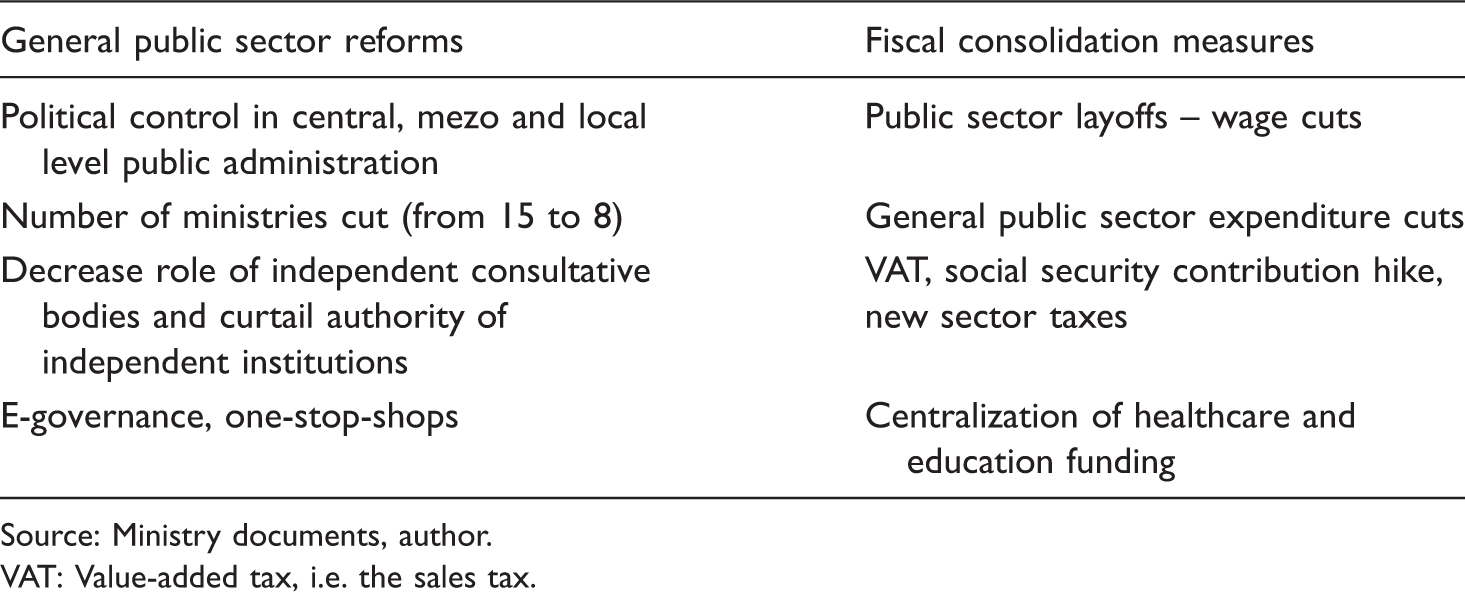
Source: Ministry documents, author. VAT: Value-added tax, i.e. the sales tax.
Domestic factors and EU/IMF influence on reforms in the 2010–2013 period.
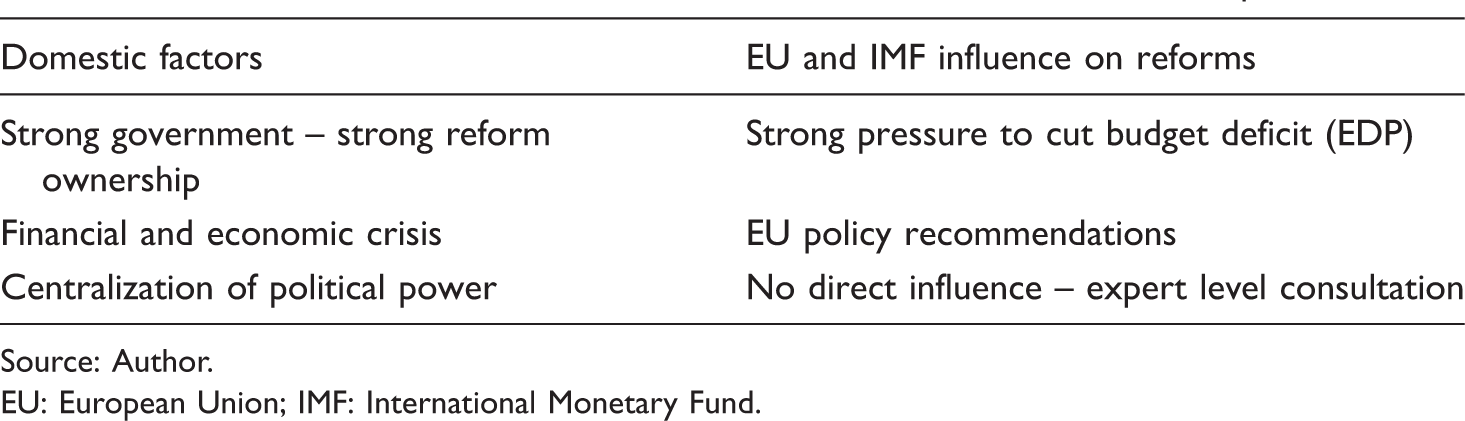
Source: Author.
EU: European Union; IMF: International Monetary Fund.
In the post-IMF programme period (2010–2013), the Orbán government aimed to reduce external influence as much as possible. Freedom of policy choice became a prime objective. The IMF bailout programme and its strict conditionality were quickly dispatched, but the EDP remained in place. The underlying government goal was to exit the EDP as soon as possible in order to further limit external influence. The government had very strong political support: a single-party government with a parliamentary supermajority and a continuously high popular approval rate. 28 This provided a domestic political window of opportunity for public sector reforms in the form of strong reform ownership and capable managers (i.e. not constrained by internal political forces, such a coalition partner or strong opposition).
Major public sector reforms took place in the post-2010 period in Hungary. Existing policy change theories are applicable for the case as long as the indispensable ingredients of such developments were present in the period (window of opportunity, strong reform ownership, external pressure). The reform contents were largely running contrary to the agenda of external agents though (Table 6).
Discussion
The characteristics of public sector reforms in Hungary.
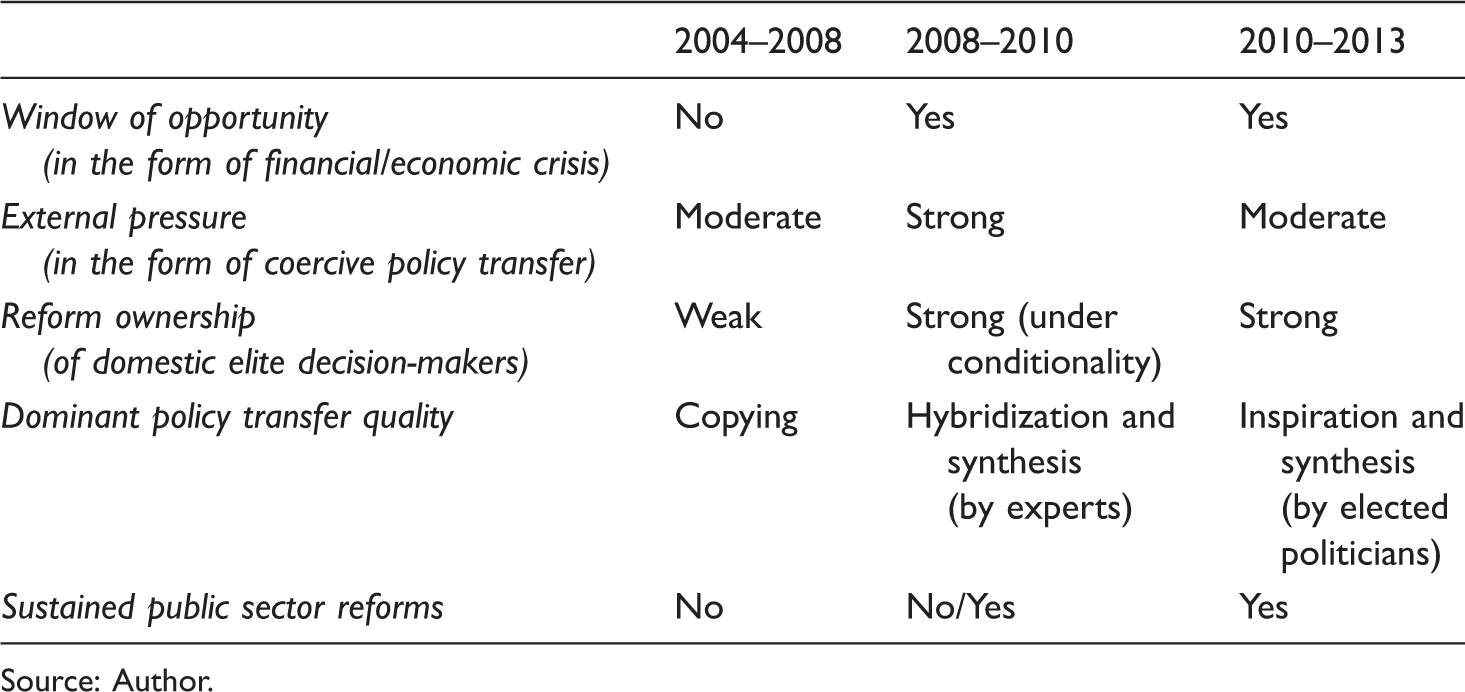
Source: Author.
Does the Hungarian case support policy transfer theories?

Source: Author.
How then are existing policy change theories useful for interpreting the empirical puzzle embodied by the country's derailment from its previous Europeanization drive concerning public sector reforms? The empirical puzzle presented by the case shows that the term ‘reform’ denotes changes that do not necessarily represent modernization, general improvement, or technically optimal arrangements. Indeed, the analysis corroborates the thesis that the success of a policy transfer is a function of the actual qualitative features of the policy transfer process and echoes mainstream texts on public management reforms, especially those that postulate that the nature of the executive government affects reform perceptions of desirability and feasibility, reform content, the implementation process and the extent of reform achieved. Moreover, the empirical puzzle provides evidence that the theory must adopt a more granular approach in order to fully seize the various policy reform trajectories. Both the complexity of the real-life situation (i.e. socio-economic factors, domestic policy legacy, previous reform trajectories and actual qualities of external influence) and the cultural and political attributes and motivations of domestic elite decision-makers need to be taken into consideration. Accordingly, in the Hungarian case: the deviation from the public reforms prescribed by EU policy models and values in the post-2010 period is well explained by the particular socio-economic, political, and administrative factors and the form of the political executive. These features are embodied in the emerging stream of public administration applied research agendas on EU influence on public sector reform (Kickert and Randma-Liiv, 2017; Ongaro, 2014). This article argues that it is worthwhile to amend and refine policy transfer theories with the findings of this study, that is, public sector reform content is aligned to the dominant elite decision-makers’ agenda. The main finding of this study is that the Hungarian case gives evidence of how EU-influenced public sector reforms could eventually produce outcomes with consequences that are the exact opposite of what was intended.
Footnotes
Declaration of conflicting interests
The author(s) declared no potential conflicts of interest with respect to the research, authorship, and/or publication of this article.
Funding
The author(s) received no financial support for the research, authorship, and/or publication of this article.