




Abstract
This paper undertakes the first stakeholder analysis of the Nigerian oil and gas industry local content development (LCD) policy to gain a better understanding of the extent of stakeholders’ interactions and how such interactions align to conditions conducive to local content development. Drawing from policy documents and semi-structured interviews, 15 stakeholder groups are identified, and seven of them categorized as key “players.” A social network analysis then reveals that (i) a significant proportion of relationships between key players are unidirectional; (ii) a marginal role is played by higher education institutions within the network; (iii) it is international oil companies rather than indigenous operators that exhibit “global centrality” within the industry network, with the former stakeholder group pivotally determining industry activities. Our findings provide a valuable first step toward the development of a polycentric framework for the appraisal of the Nigerian local content development policy.
Keywords
Introduction
The Nigerian local content development (LCD) policy is an initiative by the Federal Government to help develop local capacity building in the Nigerian oil and gas industry and to enable Nigerians to actively participate. LCD has been defined by many authors in different ways but essentially refers to the quantum of composite value added or created in the Nigerian economy through the utilization of Nigerian human and material resources for the provision of goods and services to the petroleum industry within acceptable quality, health, safety, and environmental standards in order to stimulate the development of indigenous capabilities (NOGIC Act, 2010: 26).
LCD in Nigeria has generated a large body of literature, with its focus ranging from the development of theoretical frameworks (Heum, 2008; Heum et al., 2003; Ihua, 2010; Omenikolo and Amadi, 2010) to surveys and early empirical work aimed at appraising LCD policy objectives (Bakare, 2011; Ihua et al., 2011). However, to our knowledge, to date, no study has conducted a rigorous analysis of the key stakeholders in the Nigerian oil and gas industry who are in a position to “affect and be affected by” the LCD policy and the relational structure that characterizes this network.
This gap is striking when considering the potential contribution of such knowledge for a polycentric understanding of the Nigerian oil and gas industry and for the identification of ways in which the effectiveness of the LCD policy could be increased. Drawing from stakeholder theory, we aim to fill this gap and thus contribute to the development of a more comprehensive framework for the appraisal of the efficacy of the Nigerian LCD policy. As suggested by Bryson: Governmental and non-profit reforms across the world are also prompting the need for more attention to stakeholder analyses […] An emphasis on markets, participation, flexibility and deregulation all imply the need for more focused attention on a wider array of stakeholders. (2004: 24)
A brief review of the history and objectives of Nigeria’s LCD policy
The history of the LCD policy in Nigeria is traceable to the Petroleum Act of 1969, which stated that “the entire ownership and control of all petroleum in, under or upon any lands […], shall be vested in the State” (Petroleum Act, 1990: 2), notwithstanding allowances for foreign-owned companies to provide services or operate directly in the sector. The Act also entails a directive that obliges owners of oil drilling leases to ensure that—within 10 years from the time the lease is granted—at least 75% of the workers employed in their operations are Nigerians.
The Petroleum Act of 1969 was later amended by the Petroleum (Drilling and Production) Amendment Regulations Act. Such legislation was followed by the Joint Operating Agreement (JOA) and Production Sharing Contracts (PSCs) Act, which became effective from 1971 (Ameh, 2006). These legislative arrangements mandated the Nigerian government to acquire a 33.3% participation interest in AGIP (“Azienda Generale Italiana Petroli”—General Italian Oil Company). The government’s stake in AGIP rose to 60% in 1979, a transaction undertaken through the Nigerian National Oil Corporation (NNOC), which had been established in 1972.
The Petroleum Training Institute (PTI) Act of 1972 led to the establishment of the PTI in 1973. Although the institute was established as a prerequisite for the membership of the Organization of Petroleum Exploring Countries (OPEC), it was also set up to train Nigerians to meet the labor force requirement of the Nigerian oil and gas industry. The objective was, and still is “… to deliver quality education and provide efficient technological manpower to build a competent and committed workforce that will sustain and service the continental oil and gas industry” (Petroleum Training Institute, 2011: 13).
In 1973, the Gulf Oil Company Fund was repealed by the promulgation of the Petroleum Technology Development Fund (PTDF) Act No. 25, which established the PTDF specifically to build indigenous capability as well as in-country technological development through training of Nigerians in various industry fields.
The development of the Marginal Field Programme as contained in the Petroleum (Amendment) Decree No. 23 of 1996 was also geared toward the development of LCD. A “marginal field” is defined as any field that has reserves booked and reported annually to the Department of Petroleum Resources (DPR) and which has remained unattended to for a period of 10 years (Ayodele and Frimpong, 2003).
This law was promulgated to help recover marginal fields from various international oil companies (IOCs) and re-allocate them to indigenous firms. The conditions for this re-allocation were such that current holders of oil prospecting licenses (OPLs) and oil mining licenses (OMLs) were excluded from applying, owning, operating, or acquiring participatory interests in any marginal field (Emole, 1996). However, indigenous companies that desired allocation of these oil fields were only eligible if they relinquished their OPLs and OMLs. In view of this, IOCs were made to farm-out these oil fields only to citizens of Nigeria who owned registered companies, with sound knowledge of the industry as well as financial and technical capabilities. Invariably, this decree prevented IOCs already operating in Nigeria from “farming-in” because they would have had to relinquish their licenses for probably smaller quantities of oil wells. This was to enable Nigerians to get more involved in the industry upstream and midstream sectors, thereby increasing local content. The guidelines stipulated that “the farmee” (the person to whom the marginal field is farmed out to) may form a business relationship with a foreign partner (with the latter having a maximum of 40% equity). These guidelines were aimed at creating a “win-win” situation.
In 2003, the National Committee on LCD was established by the Federal House of Assembly. The Committee was charged with the responsibility of developing a Local Content Bill. The Bill was passed by Senate in 2006, ratified by the House of Representatives in March 2010, and finally signed into law in April 2010 and renamed as “Nigerian Oil and Gas Industry Content Development Bill 2010” with the acronym NOGIC Act (2010).
The main thrust of the NOGIC Act (2010) is value addition. Having realized that the lifeblood of Nigeria resides in the oil and gas sector, the Nigerian government aims to utilize in-country human and material resources to add value to the economy. Five specific objectives are highlighted in the policy document.
The first objective (NOGIC Act, 2010: Section 3.1) stipulates that Nigerians are to be considered “first” in the award of exploration and contractual rights, though quality, cost, and timely delivery would still be considered as part of the competitive process. The second objective (NOGIC Act, 2010: Section 51.1 and 52.1) mandates that all operators and contractors requiring legal or financial services shall retain only the services of Nigerian firms. The third objective (NOGIC Act, 2010: Section 28.1) extends the principle of “first consideration” to training and employment.
The NOGIC Act (2010: Sections 36–40) also states that adequate R&D should be carried out by operators for the promotion, training, research, and development in Nigeria. This does not necessarily require operators to engage in R&D directly but expects them to file an R&D plan detailing planned expenditure and how R&D programmes are to be carried out by, for example, involving higher education (HE) institutions.
The final policy objective (NOGIC Act, 2010: Sections 43–46) mandates that technology should be transferred to indigenous firms to enhance in-country technological development, drive efficiency savings, and improve competitiveness.
Stakeholder theory and analytical framework
Since publication of Freeman’s (1984) “Strategic management: a stakeholder approach,” stakeholder theory has attracted considerable attention (e.g. Friedman and Miles, 2002). Freeman (1984) proposed a managerial perspective that calls for the identification of key stakeholders of the firm. Although the nature of what is a stakeholder is still subject to debate (see Miles, 2012), it is generally accepted that this nomenclature should include all those who may “affect or be affected by” a corporation such as owners, customers, employees, and suppliers (Clarkson, 1995; Freeman and Reed, 1983; Phillips, 2003).
In the search for the identification of which stakeholders deserve attention, analyses that drew from a variety of other perspectives (exchange transactions, power dependencies, etc.) led to extensions of the stakeholder framework, to include also government, consumer advocates, the media, and a variety of other interest and pressure groups (see Bailur, 2006; Cummings and Doh, 2000; Donaldson and Preston, 1995). Stakeholder theory assesses stakeholders’ identity on the basis of the possession of one or more of three relationship attributes: power, legitimacy, and urgency. According to Mitchell et al. (1997), the greater the possession of these attributes, the more a stakeholders’ claims should be taken into account.
Perspectives on stakeholder theory have developed around three different approaches, namely descriptive, normative, and instrumental. As argued by Donaldson and Preston (1995), the descriptive approach is merely used to explain the characteristics of stakeholders. The instrumental approach is more empirical in nature, aiming to identify the connections that exist among stakeholders, and how these relations align to overall goals. Finally, the normative approach critically examines the functioning of these relationships with the aim of providing guidelines for successful coordination and/or implementation.
Donaldson and Preston (1995) add that descriptive stakeholder analysis acts as a necessary precursor to the normative and instrumental approaches; a proposition which precisely characterizes the modeling stages of the analysis carried out by the present study.
Even though stakeholder theory was originally conceived with reference to the private sector firm, it has now begun to be applied to public sector organizations as well as government policies. The relevance of the theory to public policy is confirmed by the fact that some (albeit still few) studies have already concerned themselves with conducting a stakeholder analysis of government projects. For example, Bailur (2006) applied stakeholder theory to a public sector policy program, by analyzing the Gyandoot telecenter projects in Madhya Pradesh (India). Reed et al. (2009) applied stakeholder theory to participatory natural resource management by performing an exemplary stakeholder analysis of the Rural Economy and Land Use (RELU) program. Mandarano (2009) provided a novel, state-of-the-art application of a series of SNA methodologies to evaluate the social capital resulting from the U.S. Environmental Protection Agency National Estuary Program, an ecosystem-based collaborative planning program.
Against this backdrop, and drawing broadly from the templates developed by previous applications, our stakeholder analysis follows the process sketched in Figure 1.
Framework for stakeholder analysis of Nigerian LCD policy.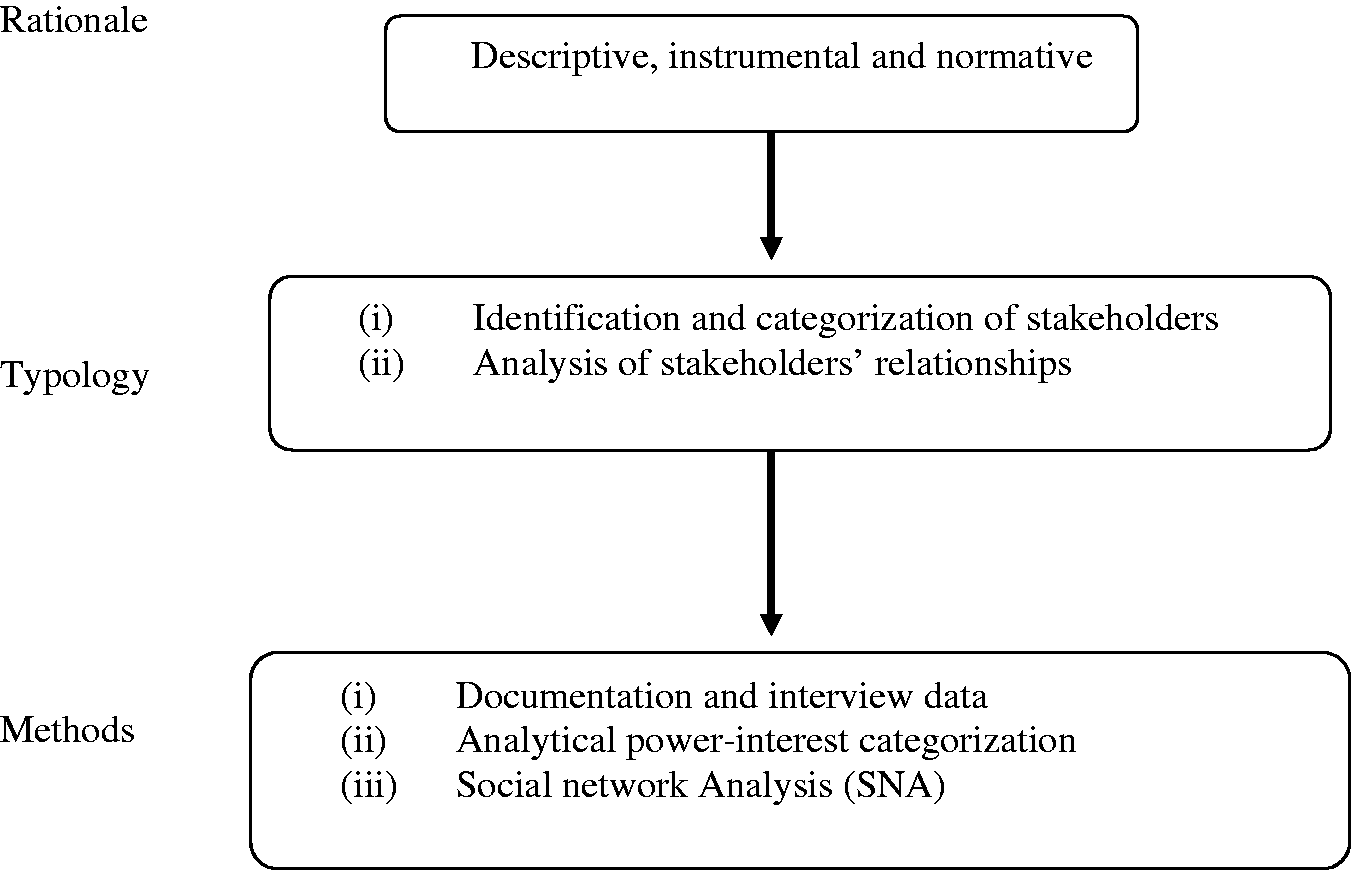
Several authors (e.g. Ackerman and Eden, 2011) have suggested different methods for identifying stakeholders, including focus groups, interviews, and secondary sources. Given our aim, and to remain faithful to the policy documentation, secondary evidence (in the form of documentary material) provided a valuable initial tool, though interviews via snow-ball sampling were our main instrument to identify successive respondents from a cross-section of stakeholder groups, as well as to collect network data to inform our analysis of existing relationships within the oil and gas industry.
For the stakeholder identification and differentiation, we adopt the stepwise framework suggested by Bryson (1995). Bryson’s approach enables us to identify each of the various stakeholder groups within the industry and draw distinctions in terms of their level of interest and influence with respect to key LCD policy objectives.
The identified stakeholders are then mapped onto the power-interest framework of Ackermann and Eden (2011), which allows for the categorization of relevant actors as “subjects,” “players,” “crowd,” and “leaders” or “context setters” on the basis of two variables, “interest” and “power.” Given the context and purpose of our study, the “power” variable was operationalized in terms of “degree of involvement in LCD policy implementation” (the closed question required interviewees to answer either “direct” or “indirect” involvement), the “power of employment within the industry” of each stakeholder group surveyed (using a three-point scale rating such power as “weak,” “medium,” or “strong”), and the level “influence” through a question probing “the extent to which a stakeholder group can exert influence on the development of emerging indigenous entrepreneurs” (similarly rated on a three-point scale ranging from “weak” to “strong”). “Interest” was operationalized with specific reference to “the level of interest vested by each stakeholder group in the outcomes of the LCD policy” (again, rated as “weak,” “medium,” or “strong”). Key “players” are those who have a high interest and high power (Reed et al., 2009), with at least three of the four items that make up the “power” and “interest” constructs rated on the upper bound of the measurement scales. According to Ackermann and Eden (2011), it is “players” in a network that warrant the nomenclature of “stakeholders.” Although “context setters” are highly influential, they tend to have low interest. “Subjects” are seen to have high interest but low power. However, there are occasions whereby “subjects” may form coalitions to enhance their influence. On this account, interest and influence can and often do change over time.
We then investigate the relational structure that exists among stakeholder groups populating the oil and gas industry “network” (linkage and structure), and the strengths of such ties, by means of SNA. Although the origins of social network theory can be traced back to the work of Moreno (1934), it was not until 1956 that Cartwright and Harary (1956) formalized the use of graph theory as the official tool to conduct SNA.
As noted by Serrat (2009), SNA employs a unique set of measurements by utilizing structural information to study social networks. Social networks are “nodes” of individuals, groups, organizations, agencies, and related systems that tie in one or more sets of interdependencies. As such, we see the applicability of SNA to our quest for a better understanding of both the relationships among key stakeholders in the oil and gas industry, and the extent to which the current operational connectivity of this network appears to be conducive to the achievement of the LCD policy objectives, as self evident.
Drawing from interview data, our SNA entails the computation of several descriptive indices of the social structure constituted by the stakeholders populating the network. This process involves the presentation of matrix data in both “valued” and “binary” form from which analyses of local and global “centrality,” “betweenness,” and overall network “density” are conducted. These analyses will be complemented by sociograms, which are visual representations of the network structure (Hatala, 2006).
Methodology
The data collected for this study were obtained from semi-structured interviews though documentary evidence based on policy documents also complemented the analysis at the stakeholder identification stage.
Interviews were preferred to focus groups because there are clear cut responsibilities (as detailed in the NOGIC Act) of each stakeholder group within the oil and gas industry. Moreover, assembling a focus group of executives alongside government officials would not have been feasible given their busy schedules. This approach is consistent with ego network analysis. Hatala (2006) argues that ego network analysis aims to gauge the perspective at each end of a relationship, since it is the independent information they individually supply that counts as data. On the other hand, complete network analysis deliberately brings individuals who are part of a network together, to exchange their views. For this study, ego network analysis was preferred since we wanted to let stakeholders speak freely on existing relationships, with no external influence.
Interviews were conducted by telephone rather than face-to-face. This approach offered several advantages, including greater personal safety/security and reduced costs of transport. Data collection began with a pilot study (with eight respondents, drawn from across the stakeholder groups identified for the main study) aimed at ensuring both face and content validity of the interview questions to be posed during the interviews. The primary reason for this exercise was to develop, through expert feedback, the most appropriate wording for the core questions of our study, namely, that concerning the analysis of the relationship characterizing the stakeholders populating the oil and gas industry network (for which no blueprint exists in the literature), as well as the critical constructs of “power” and “influence” of stakeholders in the context of the LCD policy (which also required fresh development). The pilot exercise also proved helpful to ensure that all the questions to be posed to respondents were clear and devoid of any leading or misleading elements which may have caused any form of bias.
An initial schedule of two interviews with representatives of each of the 15 stakeholder groups was carried out. This initial sample was identified, in the first instance, through contacts made at the Global Local Content Summit (London, 24–27 September 2012) and via further enquiries made to the Nigerian Content Development and Monitoring Board, the Nigerian National Petroleum Corporation, and the DPR, whose management provided a useful set of initial contacts. From this, a total of 28 semi-structured interviews were then conducted with four respondents from each stakeholder group subsequently categorized as a key “player.” As noted earlier, additional interviewees were identified using a snow-ball technique, a process which terminated when recurrent answers and recognizable data patterns signaled data saturation. We refrain from claiming “theoretical saturation” given that, admittedly, our exercise was not intended to discover a new theory, and despite the fact that our number of interviews compares well against what is customary in standard qualitative research of this kind, our sample cannot be deemed to be representative of the substantial number of individuals populating each stakeholder group identified. Nevertheless, we deem it sufficient to draw preliminary conclusions that can pave the way for future studies on the key issues that flow from our main findings.
To preserve anonymity, we do not refer to any respondents by name nor disclose the specific organization or government department where they work. The analysis is carried out on a “stakeholder group” basis. We have simplified our nomenclature by choosing a “3 letter abbreviation” for each stakeholder group as follows: “GOV” for government; “IOC” for international operating companies; “INO” for indigenous operators; “MSP” for multinational oil and gas companies; “ISP” for indigenous oil and gas service providers; “EPC” for engineering, procurement and commissioning contractors and fabricators; and “TUT” for HE engineering and geo-science tutors.
The four respondents from GOV consisted of three senior managers in the LCD division and one LCD coordinator. These respondents were drawn from various parastatals of the Federal Government of Nigeria. Each respondent had at least seven years of experience in government and had been involved in ensuring due process for LCD policy implementation.
The four respondents from the IOCs were all LCD managers. Each respondent had over nine years of experience and had the opportunity to work for various oil and gas divisions before managing the LCD division for at least three years. Their experiences span from writing and evaluating LCD strategies to ensuring full compliance with the directives contained in the NOGIC Act (2010). Their responsibilities also entailed reviewing tenders to ensure conformity with the LCD plan regarding the procurement of materials and equipment leasing.
The four participants from INOs were all LCD managers with at least seven years of industry experience. Although this stakeholder group is made up of indigenous companies which mostly benefit from OMLs farmed out by IOCs, they still partner with foreign firms especially in the areas where they lack capability.
The respondents from the MSPs were all LCD managers with an average of seven years of industry experience. Their main responsibilities entailed building indigenous capacity as well as ensuring that the LCD element contained in their bids conforms to the requirements of the NOGIC Act (2010).
The respondents from the ISPs were all senior executives with at least 11 years of industry experience. Of particular interest is that each of the respondents also played a role as LCD manager/advisor, given their in-depth knowledge of LCD affairs.
The respondents from the EPC stakeholder group were all LCD managers. These participants had spent at least five years in the engineering industry before managing their LCD division. The four TUT were all experienced academics from reputable Nigerian universities involved in engineering and geo-science courses that have been fully accredited by the National Universities Commission (NUC). The respondents were veterans in their fields and knowledgeable about the LCD policy. Three of them also had oil and gas industry experience before joining academia.
In order to examine stakeholders’ relationships, we base our analysis on the responses to one of our core interview questions which asked: “Can you please rate your working relationship with each of these stakeholder groups on a scale of 1 to 5, where 1 is very weak and 5 is very strong.” Based on the feedback from our pilot study, by working relationship, the respondents were made to understand that this encompassed contract awards, corporate social responsibility (CSR) activities, and any other meaningful interaction and/or form of collaboration. Follow-up questions then probed on qualitative aspects of the relationships identified, also in terms of the “direction” of these linkages and relative strength so as to allow us to determine whether the underlying exchanges or joint activities were based on “a two-way relationship” or, instead, were “primarily driven, initiated or managed by one stakeholder group.”
The analysis of social network data was carried out using the software package “UCINET 6” (see Borgatti et al., 2013). Our findings from the SNA are presented in both matrix and sociogram form. The matrices are developed by transforming qualitative data (obtained from participants’ responses) into quantitative form, to enable a quick overview of all the data across the stakeholder groups analyzed to be formed. From these matrices, sociograms are generated.
Findings
Identification and categorization of stakeholders
Scrutiny of the NOGIC Act (2010) reveals that the policy document identifies only four main stakeholder groups which should work together toward the achievement of the LCD policy objectives. These are (i) government; (ii) operators (IOCs and INOs); (iii) the legal service sector; and (iv) the financial services sector.
Identification of and differentiation between stakeholders

Source: Authors’ findings based upon scrutiny of NOGIC Act (2010) and field survey (interviews).
LCD: local content development; ISPs: indigenous oil and gas service providers; HE: higher education; NCCF: Nigerian Content Consultative Forum.
Following Bryson’s stepwise approach, as shown by the additional findings reported in Table 1, our further analysis (based on field survey and interviews) allowed us to identify 15 stakeholders in total, including first- and second-tier suppliers, fabricators, HE institutions, local resident pressure groups, etc.
From the analysis we conducted, the stakeholder groups that we deem fit to be classified within the “players” category are IOCs, INO, international (multinational) oil and gas service companies (first-tier suppliers), indigenous oil and gas service companies (second-tier suppliers), EPC contractors and fabricators, HE institutions, and of course, the Federal Government. Indeed, these are the only stakeholder groups who, according to our operationalization of the “power/influence” and “interest” constructs, record sufficiently high scores (see also the third, fourth, fifth and sixth columns of Table 1, alongside our concluding remarks in the final column). Given their insufficient scores for “power/influence” and/or “interest,” the other stakeholders, including the residents of the Niger Delta region, fall within the “subjects,” “crowd,” and “context setters” quadrants of the Akermann and Eden’s (2011) matrix, as shown in Figure 2.
Application of Ackermann and Eden’s (2011) power-interest framework.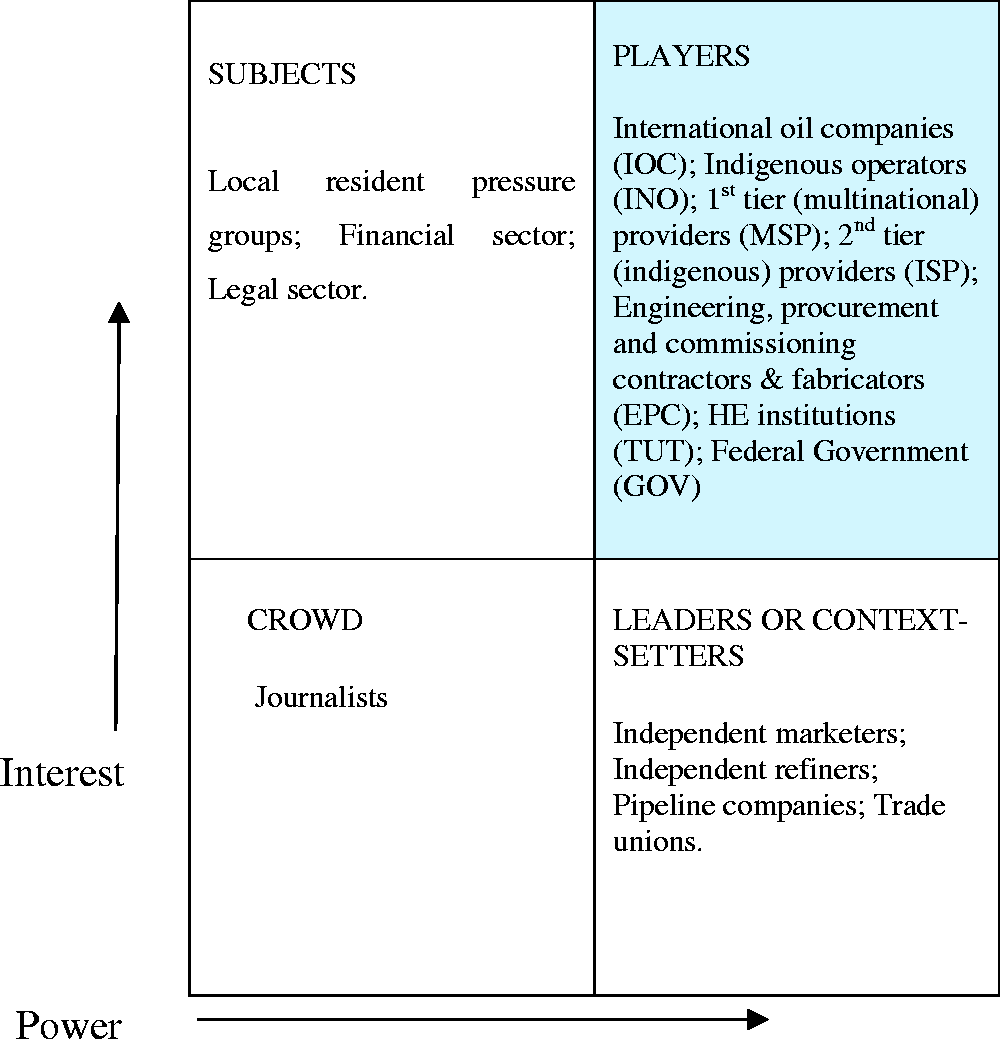
Some may view our findings as evidence confirming the typical critique of stakeholder analysis; that it involves a lot of rigmarole that produces not too surprising and rather thin results. Yet, we consider these findings significant in at least two important respects.
First, they complement previous analyses of the Nigerian oil and gas industry by highlighting the importance of a multiplicity of “actors,” many of which, in spite of considerable interest in both the activities of the Nigerian oil and gas industry and the LCD policy, are found to exert limited influence, having no power roles to instigate a change in the current state of affairs (best exemplified by the fact that a very large proportion of jobs within the industry is still carried out by non-nationals and most of the profit generated by the industry is repatriated abroad). This observation resonates with Phillips’ (2003) call for a normatively legitimate redefinition of “stakeholders”; one that going beyond the traditionally derivatively legitimate stakeholder status, accounts for the actors to whom an organization or even more so, a government (as in our case), holds a moral obligation. Opening the analysis of the sector to consideration of all the constituencies that have a stake in the industry and to whom the government may have a moral or social responsibility toward is, in this sense, an endeavor that promotes transparency by encouraging further scrutiny through the lens of stakeholder groups that have had, traditionally, no voice in shaping policy. In this respect, the findings also call for a greater empowering of Nigerian citizens, by instilling a sense of ownership of their natural resources that would enable, in turn, a more vigorous demand for accountability. As eloquently emphasized by one of our interviewees: We are still deprived of a rightful share of the benefits that the natural resources of our land should offer to us, and of the opportunity to develop a collective, social conscience capable of fuelling public demand for the government to be transparent and accountable on how substantial revenues from control over such resources are distributed. (Representative of local residents of the Niger Delta region)
We would argue that to enhance local capacity so as to deliver proactive strategies to sustain the Nigerian common interest requires soliciting the support and cooperation of a much wider array of stakeholders. In short, what is required is “community participation” in LCD policy, which is currently conspicuous by its absence.
Social network analysis
Our stakeholder analysis would be incomplete without an in-depth investigation of the relationships between the key players in the industry and the resulting context effects of the linkages among them.
Matrix of “valued” data
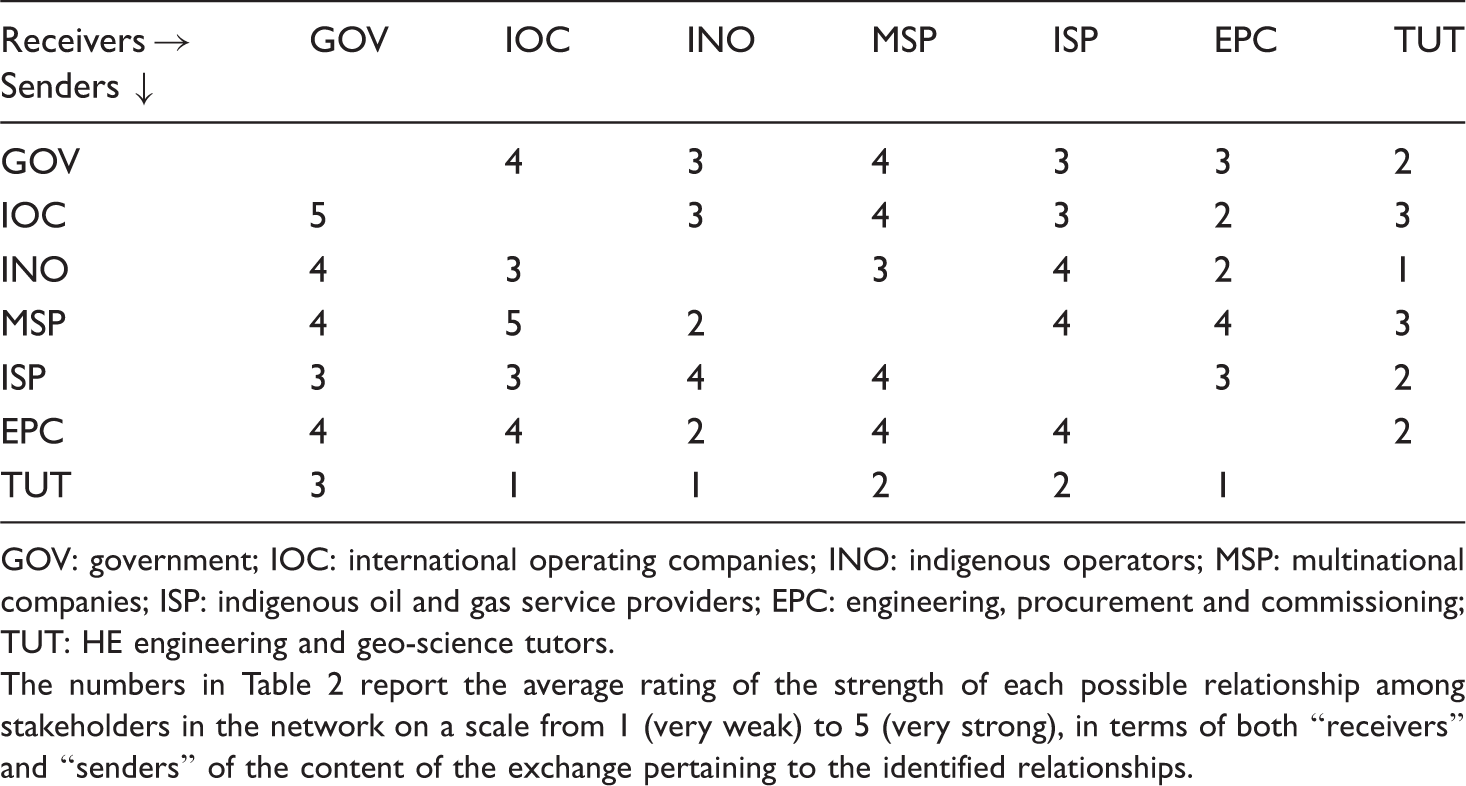
GOV: government; IOC: international operating companies; INO: indigenous operators; MSP: multinational companies; ISP: indigenous oil and gas service providers; EPC: engineering, procurement and commissioning; TUT: HE engineering and geo-science tutors.
The numbers in Table 2 report the average rating of the strength of each possible relationship among stakeholders in the network on a scale from 1 (very weak) to 5 (very strong), in terms of both “receivers” and “senders” of the content of the exchange pertaining to the identified relationships.
Matrix of “dichotomization 1” data
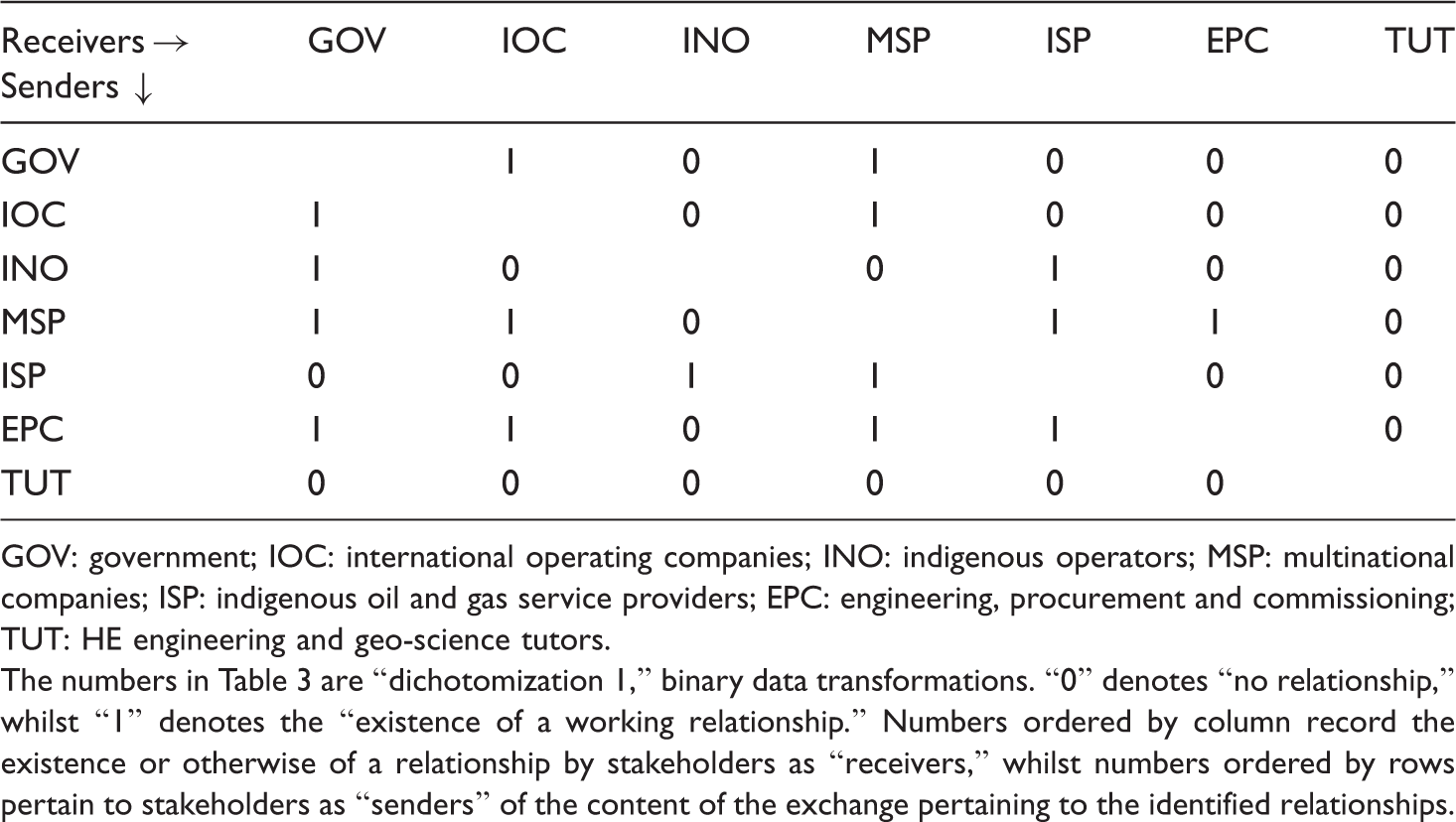
GOV: government; IOC: international operating companies; INO: indigenous operators; MSP: multinational companies; ISP: indigenous oil and gas service providers; EPC: engineering, procurement and commissioning; TUT: HE engineering and geo-science tutors.
The numbers in Table 3 are “dichotomization 1,” binary data transformations. “0” denotes “no relationship,” whilst “1” denotes the “existence of a working relationship.” Numbers ordered by column record the existence or otherwise of a relationship by stakeholders as “receivers,” whilst numbers ordered by rows pertain to stakeholders as “senders” of the content of the exchange pertaining to the identified relationships.
Since selection of any single dichotomization specification of data generated from a five-point Likert scale is always inevitably arbitrary and hardly defensible, we present data dichotomized according to two opposite interpretative scenarios. The first leans toward a rather rigid, strict interpretation of what constitutes a meaningful working relationship among stakeholders, while the second takes a more flexible, lenient interpretative approach. First, we recode values 1 to 3 as binary code “0” (i.e. “no relationship”) and values 4 to 5 as “1” (to denote the “existence of a relationship”). Henceforth, we refer to this data transformation as “dichotomization 1.” In order to account for a more flexible interpretation of the responses, we then repeat the process by recoding values 3 to 5 as “1,” and values 1 to 2 as “0” (henceforth referred to as “dichotomization 2”).
Table 3 presents the binary data matrix from dichotomization 1. In Table 3, numbers ordered by column record the inexistence (“0”) or otherwise (“1”) of a relationship from the perspective of stakeholders as “receivers,” whilst numbers ordered by rows pertain to stakeholders as “senders” of the content of the relationship exchange. Consideration of these results suggests the preponderance of the absence of meaningful working relationships between pairs of key players making up the network. For example, TUT emerges as a rather marginalized “actor” within the industry (“0” relationships as a receiver and as a sender, as indicated by the last column and the last row of Table 3, respectively). The implication of this is that there appears to be no link between HE institutions (TUT) and any other industry players, including the GOV. EPC contractors only record one single “bidirectional” working relationship in the matrix displayed in Table 3, with MSP, though EPC also acts as “sender” in unidirectional ties with GOV, ISP, and IOC. Most interestingly for our purposes, EPC displays no relationship whatsoever with INO. INO themselves only appear to have established a single bidirectional working relationship, with ISP, and only one additional tie with GOV, for which INO acts as “sender” in the flow of the information exchange, further denoting the limited collaboration and joint coordination of activities between indigenous and foreign (multinational) members of the wider industry network.
An even clearer representation of the results obtained from “dichotomization 1” data, is provided in the sociogram represented in Figure 3. The absence of a relationship between TUT and other stakeholder groups is seen even more clearly in this sociogram format as there is no line (tie) that connects the TUT node with any other stakeholder group. The visual structure reveals that some sort of relationship, either unidirectional or bidirectional, exists between some other stakeholders. However, the government only exhibits a bidirectional relationship (recorded by arrowheads at both ends of a line) with IOC and MSP, suggesting that there is still a significant level of foreign dominance within the Nigerian oil and gas industry. This finding is of critical importance as it reveals that for local content to be fully developed there is a need for additional bidirectional relationships, particularly between the government and HE institutions, INO and service providers, so as to promote indigenous capacity and capability development.
Sociogram of industry network (from dichotomization 1).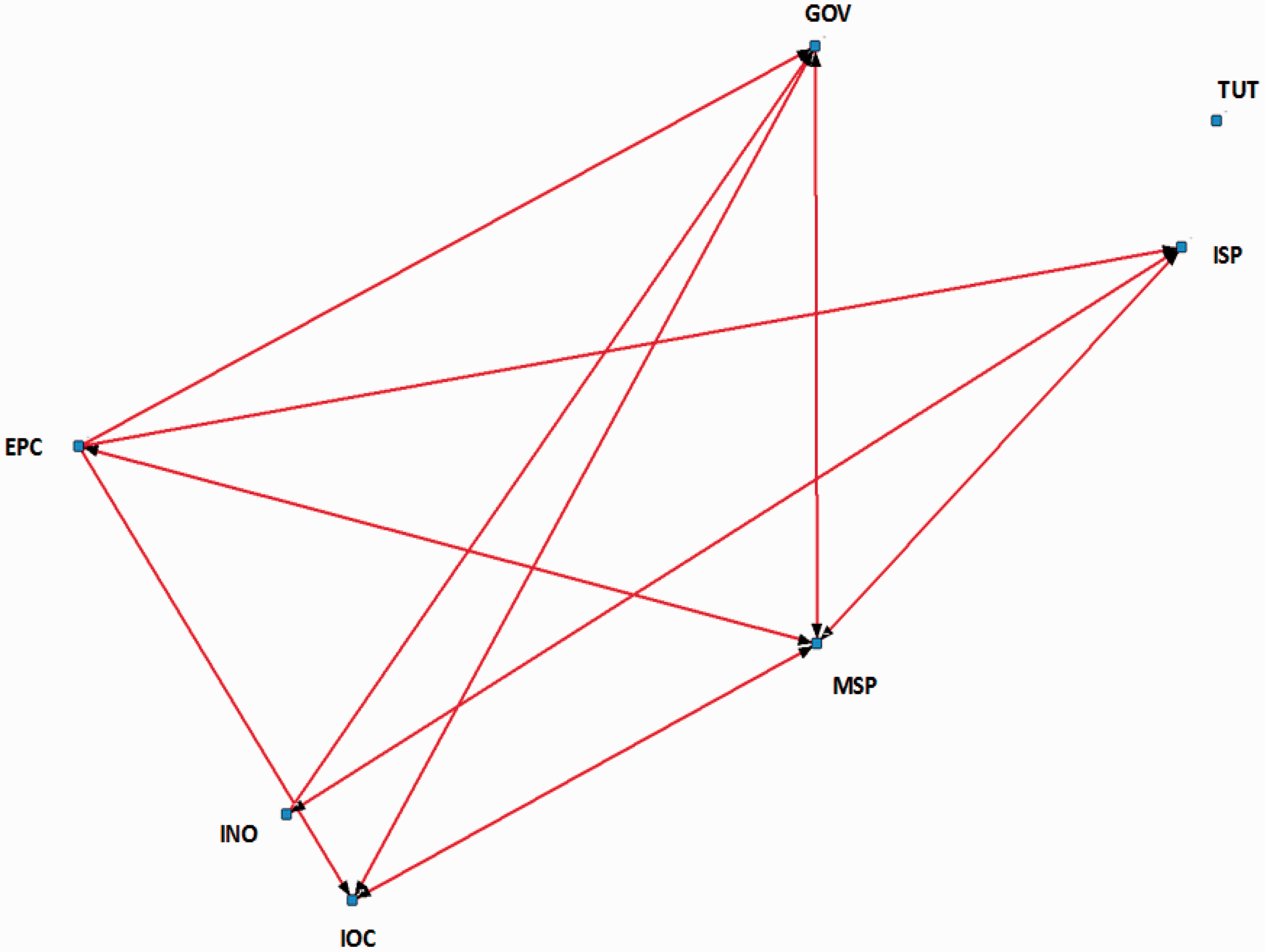
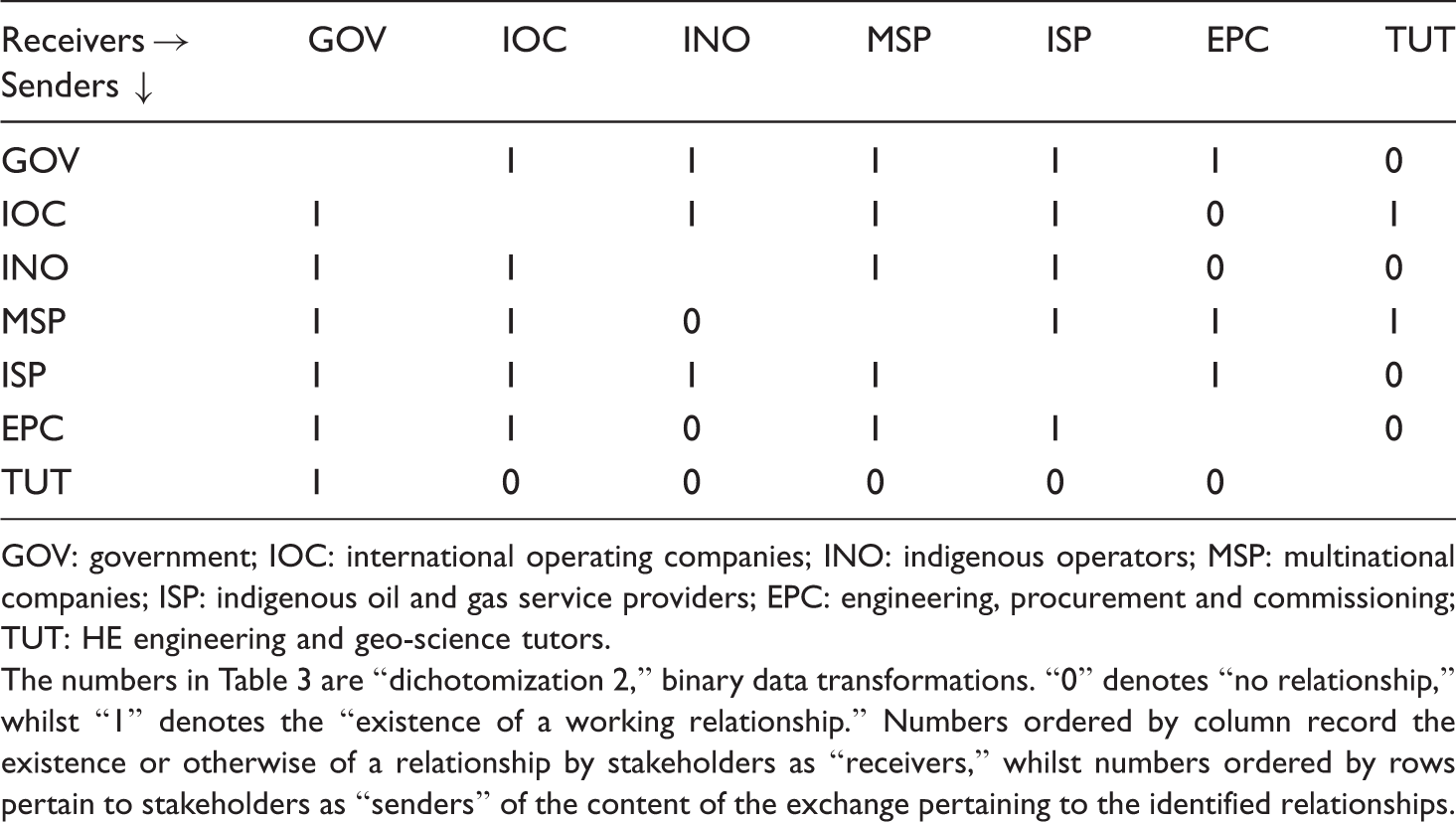
The binary data matrix from “dichotomization 2” is presented in Table 4. Unsurprisingly (given the benevolent specification of this particular data transformation), a slightly improved picture emerges, as we now see, for example, the government accounting for more relational ties. TUT now also exhibits some connections. Specifically, it has a relationship with GOV, IOC, and MSP. Yet, as shown by Table 4 and the associated sociogram (Figure 4), the TUT ties with the IOC and MSP stakeholder groups are unidirectional (with TUT merely acting as the “receiver” in such relationships), and so is the tie with GOV, though in this case TUT acts as the “sender” of the flow of exchange. Evidently, there is a need for these ties to become stronger, and for more relationships to be forged by and with HE institutions.
Sociogram of industry network (from dichotomization 2). Matrix of “dichotomization 2” data GOV: government; IOC: international operating companies; INO: indigenous operators; MSP: multinational companies; ISP: indigenous oil and gas service providers; EPC: engineering, procurement and commissioning; TUT: HE engineering and geo-science tutors. The numbers in Table 3 are “dichotomization 2,” binary data transformations. “0” denotes “no relationship,” whilst “1” denotes the “existence of a working relationship.” Numbers ordered by column record the existence or otherwise of a relationship by stakeholders as “receivers,” whilst numbers ordered by rows pertain to stakeholders as “senders” of the content of the exchange pertaining to the identified relationships.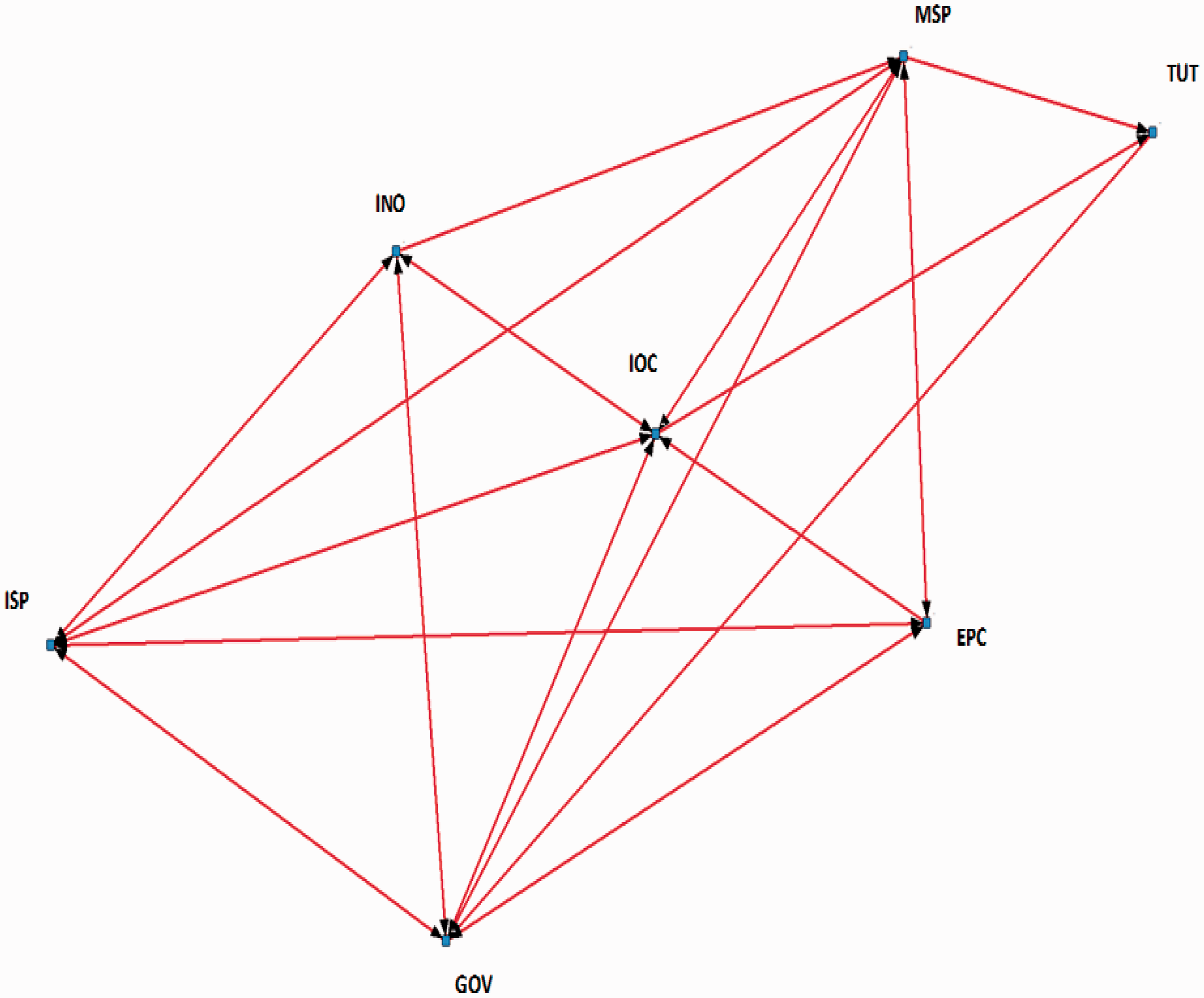
Section 57 of the NOGIC Act (2010) formed the platform for the Nigerian Content Consultative Forum (NCCF), which was set up primarily to enhance collaboration among stakeholders, but the extent to which this collaboration is being facilitated requires critical appraisal. As Omenikolo and Amadi (2010) argue, the R&D ties between Nigerian universities and the oil and gas industry constitute an important weak link. This is an issue that came out strongly also from our wider interview data, with one interviewee from the TUT stakeholder group explicitly stating: To drive LCD, the government itself should establish a strong path linking Nigerian universities’ capacity to supply first class graduates with proper, large-scale apprenticeships programs (to be co-sponsored by the State) in foreign-owned as well indigenous operators in the oil and gas industry. Instead, Nigerian universities continue to be highly underfunded, and the scale of such programs is so small so as to make hardly any difference. (Geo-science university tutor)
It should be noted that a wide range of measures of centrality have been proposed in the literature, but for our purposes, adoption of these two most popular measures should suffice. Local centrality refers to the position of a node (stakeholder group) within the entire network. Following Hatala (2006), we operationalize this measure by computing the number of direct ties a particular node has with other nodes. Global centrality, on the other hand, is concerned with how strategically a particular node is positioned within the overall network. To operationalize this measure, we refer specifically to Freeman’s (1979) notion of the structural center of the graph, and hence to the overall cohesion or integration of the nodes in the whole network. This measure is an important complement of the local centrality indicator since it attempts (by simply looking at distances between points in the graph) to identify any unique central point in the network. Indeed, even a node that displays high local centrality may lie physically toward one side of the connecting nodes, and its centrality, therefore, would be a purely “local” phenomenon.
Our analysis suggests that TUT in particular exhibits limited local centrality compared to other stakeholder groups (especially GOV, IOC, and MSP). It is also important to highlight that although GOV’s local centrality is considerable, it is purely a “local” phenomenon since the GOV node is located at the margin of the network illustrated in Figure 4 and, after TUT, it is the node displaying the lowest degree of “global centrality,” being placed at the greatest distance from the other nodes (stakeholder groups) that make up the network. According to the sociogram depicted in Figure 4, it is IOC that stands out as the stakeholder group exhibiting global centrality within the network given its “central” position of considerable strategic significance in the overall structure. As such, it is reasonable to conclude that IOCs play a pivotal role as far as oil and gas activities are concerned, irrespective of the exploration and production (E&P) arrangement (JOA and PSCs) they have with the Nigerian government and the Nigerian National Petroleum Corporation (NNPC). It is also striking that the government itself (the regulators) does not exhibit global centrality, as should be expected given their institutional responsibilities in driving the LCD policy. Instead, IOCs still appear to play such a central role. Effectively, all the main activities in the upstream (E&P)—which determine midstream and downstream activities—are still primarily under the steering control of IOCs.
Another way of measuring how close network members are to the “centre of the action” in the network (industry) is the determination of “betweenness” of a node, simply measured by computing the number of times a node (stakeholder group) lies between each other pair of nodes who lack a direct connection. Scott (2000: 86) defines betweenness as “the extent to which an agent can play the part of a ‘broker’ or ‘gatekeeper’ with a potential for control over others.” Figure 4 indicates that, alongside GOV, IOCs play such part, acting de facto as the intermediary between other stakeholder groups in the network (e.g. ISP < > IOC > TUT; INO < > IOC < EPC), most significantly, between INO and EPC (EPC contractors and fabricators). This measure, which corroborates the global centrality results, additionally suggests that INO are dependent on the IOCs for carrying out industry activities, and perhaps even for their survival.
These disconcerting findings are also backed up by Freeman’s (1979) approach to “betweenness” that is built around the concept of “local dependency,” according to which a node in a network is dependent upon another if the paths which connect it to other nodes pass through it (Scott, 2000). This is shown clearly in Figure 4, where IOCs appear to be the middle node, with several points intersecting this stakeholder group to connect to other nodes. Our analyses of centrality and betweenness, therefore, show that IOCs play a pivotal role in the industry and, invariably, without this stakeholder group, oil and gas activities at midstream and downstream level could not take place.
Our analysis of the level of “connectivity” within the network concludes with the computation of the “network density index” (Hatala, 2006: 56) using the formula {L / [n(n−1) / 2]}, where L represents the number of lines (ties) and n the number of nodes present within the network. The value of the density ranges from 0 to 1, where 1 depicts a situation whereby 100% of network members have formed direct relationships with all other members. As noted by Mandarano (2009), the density index can be used as an indicator of the community’s social capital, which Mandarano defines as an important outcome of collaborative planning and “a precursor to collaborative planning success” (Mandarano, 2009: 245). For dichotomization 1, we obtained a density of 0.43. In other words, the actual number of ties present within the network is 43% of the potential number of possible ties. For dichotomization 2, a density of 0.76 was obtained. From these two values, a mean density of 59.5% can be determined. We agree with Mandarano (2009) who suggests that different network types have different densities. Hence, de-contextualized comparisons can be misleading. Being the present SNA the first carried out in the context of LCD, we are, unfortunately, unable to benchmark our density index against that obtained in comparable studies in a similar setting. However, in this context, a mean density just short of 60% would seem to indicate a highly inadequate level of connectivity to generate the kind of shared information, collaborative efforts, and consensus building required for network participants to act effectively in pursuing LCD objectives. Hence, much work still needs to be done by stakeholders to ensure a shared and interrelated modus operandi that would aid and hence facilitate the achievement of the LCD policy objectives.
Concluding discussion
This paper aimed at identifying the key industry “players” in the Nigeria oil and gas industry, and the existing process of interaction among them. The findings of our stakeholder analysis unveil a wider array of actors besides those typically identified in relevant literature (government and operators). However, in spite of considerable interest and involvement in the activities of the Nigerian oil and gas industry, most of these additional stakeholders are found to exert a limited influence, having no real power to instigate the much needed change.
Our investigation of the relational structure that exists among the stakeholders also highlights that in spite of the existence of some relationships among key industry players, a significant percentage of these relationships are unidirectional. Bidirectional relationships found were mostly between the government on one side, and international operating companies and multinational service providers on the other.
Another significant finding is the marginal role played by HE institutions, as evidenced, for example, by the minimal level of local “centrality” displayed by this stakeholder group vis-à-vis others. This is particularly striking when it is acknowledged that HE institutions are responsible for providing the knowledge base to fuel the development of in-country capacity and competence-based capabilities.
Significantly, our data showed that it is IOCs rather than INO that exhibit global centrality within the network, suggesting that in spite of the ratification of the NOGIC Act (2010), this stakeholder group still pivotally determines the activities of the Nigerian oil and gas industry. Our analysis of “betweenness” further revealed that other stakeholders, including indigenous companies, are dependent on the IOCs for their survival in the industry.
So, what implications and recommendations can be drawn from our findings to increase the efficacy of the LCD policy? First and foremost, our analysis underscores that the achievement of the LCD policy objectives is a collective responsibility, with each stakeholder group’s contribution being singularly necessary but individually insufficient for the operational efficiency of the network. Computation of the mean density index of the network revealed a very modest level of connectivity, thus underscoring that considerable effort is still required by all stakeholder groups to strengthen their ties, and forge new ones.
Notwithstanding the above, the coordination and facilitation of the collaboration needed for LCD to come to fruition is evidently the main responsibility of the regulators, i.e. the government. Yet, the inability of the government to ensure that indigenous oil companies alongside local oil and gas service providers exhibit global centrality in the industry network is a major weakness, particularly when it is acknowledged that this role is currently still being played by the very stakeholder group that is meant to benefit the least from the successful achievement of LCD, i.e. IOCs.
Our findings contribute to a more in-depth analysis of the Nigerian oil and gas industry and, contextually, provide a valuable first step toward a more comprehensive framework for the appraisal of the efficacy of the Nigerian LCD policy. Indeed, consistent with a much overdue shift toward a polycentric understanding of policy making and assessment, our novel application of stakeholder analysis to Nigerian LCD can be seen as an essential blueprint for any policy analysis aimed at establishing its effectiveness.
By way of acknowledgement of limitations, some caveats should be borne in mind. First, within the confines of a journal article, we had by necessity to be selective in both the range of analytical tools used to examine our data, and our treatment of issues. For example, empirical tractability demanded limiting the adoption of the centrality indicator with reference to the two most important and relevant measure of centrality in SNA (local and global centrality). However, future studies could employ additional centrality indicators (eigenvector centrality, beta centrality, etc.), alongside further quantitative analyses to accompany the visual representation of the network, in order to draw a wider range of statistical inferences. Future studies could also extend our coverage of the issues by considering, for example, the political economy connotations of the “resource-curse” dichotomy that the wealth of Nigerian oil and gas resources represent, and the way in which such connotations interact with the well-documented legacy of corruption that “affects and is affected by” the intricate power networks not only across industry sectors that are part of the network but also within societal structures. Second, replication studies across countries, including countries at different stages of both socioeconomic development and LCD, would offer a profitable extension, both for comparative purposes and to aid the development of the policy application of stakeholder analysis to different contextual settings.