




Abstract
Stakeholders include scientists, interest groups, leaders, professionals, government and NGO employees, and activists; they are individuals or groups that play an increasingly important role in public policy. As such, stakeholders are frequently used as a source to better inform public decision making. Given the growing importance of stakeholders’ understanding and thus communication concerning the issues on which they inform the public, it is timely to ask: How do stakeholders comprehend, or mentally construct an understanding of the policy issues upon which they are asked to weigh in? In an attempt to address this issue, this paper uses a case study of a policy issue, river restoration. Results from a survey of 85 stakeholders and a follow up interview of 20 stakeholders shed light on whether stakeholders predominantly prefer to think of river restoration in terms of science or through policy narratives. The findings indicate that stakeholders prefer explanations that use science and the engaged citizen narrative when they think about the river’s restoration. Additionally, stakeholders who work for government particularly emphasize that the river should be described in scientific terms. We use this data to further analyze what elements of science and narratives are divisive to stakeholders and which are not and conclude with advice on how stakeholders can speak in a non-divisive way to the public and other stakeholders.
Keywords
Introduction
Stakeholders are people or groups who act upon their concern for a given issue. Stakeholders include scientists, interest groups, leaders, professionals, government and NGO employees, and activists; they are individuals or groups that play an increasingly important role in public policy. As such, stakeholders are frequently used as a source to better inform public decision making (e.g., Bryson, 2004). Given the growing importance of stakeholders’ understanding and thus communication concerning the issues on which they inform the public, it is timely to ask: How do stakeholders comprehend, or mentally construct, an understanding of the policy issues upon which they are asked to weigh in? In an attempt to address this issue, this paper looks at human cognition not merely as an academic issue, but as one of great practical importance. Stakeholders are often divided by seemingly contradictory trends in how they mentally construct an understanding of public policy; differences that can create difficulties for moving policies forward. Today in the US political system, many stakeholders value science, and thus utilize it to detail policy problems and offer solutions (e.g., Heikkila and Gerlak, 2005). However other stakeholders use policy narratives, or stories, to “explain” policy issues, ascribing blame for a policy problem, detailing who can fix it, and offering solutions (e.g., Crow and Berggren, 2014). Battles between individuals preferring science and those preferring a narrative can lead to divisiveness and intractability. Thus, discerning if stakeholders use scientific knowledge as their basis for understanding a particular issue, or if they comprehend the issue through narrative, can help explain how stakeholders will present information to the public and provide a better understanding of what might contribute to divisiveness.
This study addresses a gap in literature by evaluating whether stakeholders in a real-time (meaning occurring now and not one that is hypothetical or in the past) environmental controversy chose a science-based statement or a thematic narrative as best reflecting how they comprehend a given policy issue. Understanding which message style best reflects a stakeholder’s own views is important since a stakeholder’s dominant message choice is often a reflection of that stakeholder’s values. After a review of the literature and an explanation of the theoretical framework, this paper examines the differences and determinants among river management stakeholders as reflected by their choice of either a science or a thematic policy narrative. We also examine how message choice impacts evaluation of narrative characters and descriptive elements, and whether similar stakeholders identify with particular narratives or the science statement.
Literature review
In order to develop and contextualize our study, we examine literature on stakeholder analysis and the role of science and narratives in public policy, and consider prior research findings regarding the power of science and narratives in shaping public policy.
Stakeholder analysis
Stakeholder analysis can be used to develop logical solutions to problems (Rogers, 2006) or to explore the values and narratives behind policy choices (Hampton, 2009). Bryson (2004: 22) defines a stakeholder as “persons, groups, or organizations that must somehow be taken into account by leaders, managers, and front line staff.” With respect to river management literature, stakeholder analysis is important both nationally and internationally (e.g., Borsuk et al., 2001; Orr et al., 2007; Rogers, 2006; Torpen and Hearne, 2008; Wester et al., 2003). Previous studies characterized stakeholders and the differing values embedded within stakeholder groups (Weible, 2006), and policy narratives and stakeholders (e.g., Hampton, 2009). While research has examined how stakeholders choose their message when communicating with the public (Lybecker et al., 2016) and if stakeholders switch or do not switch between the message they prefer and the one they view as best for the public (McBeth et al., 2016), only scant research examines how stakeholders are attracted to elements from various messages, and how message choice may reflect group or organizational identity.
Science and public policy
Science is knowledge about or systematic study of a subject based on empirical observation and hypothesis testing. Individuals that prefer science messages for communicating policy issues may believe that science is objective, value-free and generally unencumbered by political interference, though studies have demonstrated that the boundaries between science and politics are often blurred (Carter, 2013), that significant conflict occurs between stakeholders over interpretations of science and the role of science in policy decision making (Jasanoff, 1987), that science statements are ripe with political considerations (Fernandez et al., 2014), and that science is becoming privatized (Lave et al., 2010). Additionally, science itself is regularly used as part of policy narratives (Schlaufer, 2016). In issues such as climate change, for example, the “knowledge-deficit” model (Kellstedt et al., 2008), asserts that some stakeholders believe more scientific knowledge will convince the public and decision makers that climate change is a problem and requires policy action. Yet, the public and decision makers are often not convinced solely by science. Sometimes, this situation results in stakeholders who prefer science finding themselves frustrated with citizens and decision makers who do not view environmental problems through a scientific lens.
Narratives, public policy, and identity
Narrative is a classic feature of communications literature (e.g., Fisher, 1987). Scholars in public policy and political science increasingly use narrative to better understand the public policy process. In fact, the power of narratives in public policy is expanding as research finds that human communication and cognition occurs commonly through narrative (Miller, 1995; Shank and Abelson, 1995). Outside of communication literature, narrative is also a central form of inquiry in fields as diverse as psychology (e.g., Green and Brock, 2000) and marketing (Escalas, 2004). Narratives are, additionally, often reflections of group identity. Studies have demonstrated the power of identity in policy issues as disparate as climate change (Jaspal et al., 2014) and regulating video games (Nauroth et al., 2015). And research has found individuals trust scientists whom they view as sharing their cultural beliefs (Kahan et al., 2011).
The study of policy narratives
A unique form of narrative is policy narrative. The study of policy narratives is expanding, and includes frameworks for investigation such as the Narrative Policy Framework (NPF) (e.g., Crow and Berggren, 2014; O’Bryan et al., 2014). The NPF seeks to test specific hypotheses about how policy narratives influence policy processes and outcomes (McBeth et al., 2014a). Within the NPF, a policy narrative is defined as a form of communication having some combination of core elements: a setting (situated in a policy context), characters (heroes, villains, and victims), a plot (the relationship between characters), and a moral (a policy solution) (McBeth et al., 2014a: 228). A policy narrative does not have to contain all of these elements but, according to the NPF, must have “at least one character and some reference to a public policy preference or stance” (McBeth et al., 2014a: 229). Characters are of particular importance in NPF research and are classified, drawing inspiration from Deborah Stone (2012: 158), into three categories: heroes who fix problems, villains who cause problems, and victims who are harmed by problems (and villains). Within the NPF, characters are viewed as playing an essential role in creating tension within a policy narrative. This tension is socially constructed as heroes are pitted against villains and innocent victims are identified within the context of a policy issue.
Within policy narratives, the use of villains is divisive and, particularly by advocacy groups, often designed to expand the scope of conflict within policy issues (Shanahan et al., 2013). Heroes are often less divisive in policy narratives, focusing on fixing problems and not on assigning blame. The NPF analysis of victims, in this case at the micro-level, shows that victims considered “innocent,” or who are seen as attempting to change their own situation, are more powerful than victims whose problems are attributed to individual defects or lack of responsibility (Husmann, 2015). The powerful victims are, in the language of Schneider and Ingram (1993), more “deserving” of favorable policy.
As part of the NPF, researchers ground policy narratives in various concepts and theories, such as cultural theory (Jones, 2010), social construction (Husmann, 2015), and Dalton’s (2008) work on “good citizens” (Lybecker et al., 2013; McBeth et al., 2010, 2014b). Of particular importance here is the NPF research examining how citizenship narratives impact citizens’ and experts’ views of and support for recycling using Dalton’s framework. Specifically, Dalton (2008) asserts that how individuals answer the question “what is a good citizen?” changed with generations, from a duty-based perspective (stereotypically associated with the World War II generation) to an engaged citizen perspective (associated with the Millennial generation). The former focuses on the citizen’s duty to perform certain citizen functions (e.g., paying taxes, voting, serving on a jury) while the latter takes a more active, critical, and global approach to citizenship (e.g., boycotting businesses for political purposes, helping others globally, being directly involved in politics and community life).
Lybecker, McBeth, and colleagues’ research transforms this view of citizenship into competing narratives and tests how different demographic variables relate to various narratives. These researchers, working in the US, found that the duty-based narrative (applied to recycling) has strong support from both US liberals and US conservatives whereas the engaged citizen narrative is more strongly supported by US liberals (and in fact is not supported by conservatives) (Lybecker et al., 2013). McBeth et al. (2014b) added science to their study of communication choices regarding US recycling and found that experts chose the duty-based narrative as the most effective way to educate the public about recycling. This research line also shows that if recycling is discussed within the context of a heroic policy narrative (where the hero in the narrative is characterized as exercising individual responsibility and demonstrates good business sense and efficiency), there is strong support for recycling across both liberal and conservative ideologies. However, if recycling is discussed within the context of a villain-based narrative, blaming and boycotting corporations and suggesting that recycling is a form of global citizenship, the narrative will invoke deep ideological splits in recycling support (with US liberals supporting and US conservatives opposing).
Our study adds to previous research by asking the general question: How do stakeholders comprehend, or mentally construct, an understanding of the policy issues upon which they are asked to weigh in? This general question is addressed by examining three research questions: (1) Do stakeholders in a policy controversy regarding management of a local river in the western US prefer a science statement, a duty-based narrative, or an engaged citizen narrative as best reflecting their values?; (2) How does support for the various characters differ among those choosing the science statement, duty-based narrative, or engaged citizen narrative?; and (3) Are the individual message preferences of stakeholders associated with specific group identities or organizational affiliations?
Stakeholders in a regional river ecosystem
The river ecosystem
The Portneuf River is approximately 200 kilometers long and begins on the Fort Hall Native American reservation in southeastern Idaho as a small creek and which flows into an irrigation reservoir as it leaves the reservation. Below the reservoir, the river flows through agricultural and ranching land and small communities (Lava Hot Springs, McCammon, and Inkom) for 90 kilometers. The river continues through the mid-sized city of Pocatello before winding its way back to the reservation. In its upper stretches, the river sustains native cutthroat trout and introduced rainbow and brown trout species despite impaired water quality from high nitrate levels. The middle stretch of the river suffers from similar water quality problems, supports fewer native fish, and experiences dewatering during the summer irrigation season. Cattle overgrazing also impacts a major tributary in the middle river section and has led to significant erosion and sediment issues in the tributary and main stem of the river. Within Pocatello, the river was diverted from its natural channel, straightened for the development of a rail line, and channelized in concrete walls for flood control. The urban section of the river is further polluted by storm water runoff and provides minimal recreational opportunities or aesthetic benefits.
The stakeholders
The Portneuf River region is characterized by typical rural-urban dichotomies. Republican, conservative and libertarian political beliefs predominate the rural areas, while Pocatello traditionally votes Democratic, and leans more liberal in political beliefs than the rural areas. In terms of economics, the rural areas are dominated by agriculture and ranching whereas Pocatello is more economically diverse with some corporate headquarters, a large transportation sector, high-tech, medical services, and a regional university.
Within this context, a diverse group of stakeholders including scientists from government agencies and the local university, activists, and some business people have supported efforts for river restoration, with the goal of reinvigorating the city’s downtown, providing recreational opportunities, expanding the economy, and promoting public health. Some projects (fencing portions of the upper river, streambed restoration in the middle river) have been non-controversial. However, as with any river restoration project, there are divisions among stakeholders that reflect economic, social, political, and geographic differences. For example, in the current case, agricultural and ranching groups often resist efforts to regulate nutrients and grazing and oppose the purchasing of water rights by Pocatello. A segment of Pocatello resists efforts to remove the concrete channel and shift the river to its original course, as it would necessitate re-addressing public-private land ownership. Finally, some river activists are unhappy with the federal government’s (the US Army Corp of Engineers) channelization of the river in Pocatello in the early 1960s after historic floods, and demands for tree removal on the river’s levy systems. These trees had provided a rare riparian zone in the city and their removal led some activists to conclude the federal government has too much power over river management. Others, however, believe the US Army Corp has become more progressive and that the federal government must play an important role in the river’s restoration.
Overall, this diversity provides an excellent case to examine stakeholder preferences between science and narratives, not because the river management conflict is particularly unique, but rather because the battle over its restoration is not unlike river restoration efforts nationally and internationally (see for example, Del Tánago et al., 2012; Eden and Turnstall, 2006; Tadaki et al., 2014; Wharton and Gilvear, 2007).
Methods
To answer our three research questions, we used two research methods. First, we surveyed via email Portneuf River stakeholders to determine whether they favored a science statement, an engaged citizen narrative, or a duty-based narrative. The survey dealt with a wide variety of river restoration issues with only data on narrative and science references included here. Second, follow up interviews were conducted with 20 stakeholder respondents.
Respondents
To develop the email sample, stakeholders were first identified through media coverage, personal knowledge of stakeholders, and attendance at public meetings. Subsequently, a snowball sampling technique was used to collect names of previously, unidentified stakeholders, as it is the most appropriate sampling method for identifying members of a rare population (e.g. Kalton and Anderson, 1986). Stakeholders represent a rare population that is difficult to identify since not every member of an organization that might be involved in a policy dispute will be actively engaged in that particular dispute. Finally, the survey included a question that allowed respondents to identify additional stakeholders. Through these mechanisms a total of 157 stakeholders were identified.
Identified stakeholders were asked via email to participate in an on-line survey administered through SurveyMonkey and each stakeholder received email reminders. This resulted in 85 completed surveys. A profile of the stakeholders includes 31% of stakeholders working for a government, 46% classified as activists, and 23% classified as representing the business sector. Sixty-one percent of stakeholders were male and 39% female. The distribution of stakeholders by organization in our sample is similar to the distribution of groups and organizations in our sampling list suggesting sampling bias was minimized.
Research question 1
The dependent variable used in research question 1 came from a series of questions in which stakeholders were asked to indicate whether they individually preferred a duty-based narrative, an engaged citizen narrative, a science statement (non-narrative form of communication), or a “no change is necessary” statement on river management (the survey is available upon request). The river narratives were constructed using characters, villains, victims, and heroes, in a manner consistent with either a duty-based or engaged citizen view of citizenship (see Dalton, 2008). Each narrative was designed using a “story of decline” (Stone, 2012: 160–165) plot. The plot was held constant with only variation in characters between the two narratives. Within the duty-based narrative, heroes represented citizens promoting individual responsibility, efficient use of resources and good business sense, the victims were local recreation users and businesses, and the villain was the federal government (which could mean regulatory agencies like the USEPA or the US Army Corp of Engineers).
Conversely, within the engaged citizen narrative, the heroes were portrayed as local individuals demonstrating good global citizenship, fighting climate change, and providing a way to participate in the community, while the victims were non-human organisms such as plants and animals in the river ecosystem harmed by river pollution and channelization. The use of non-human entities as victims has precedent in the work of Weible and Schlager (2014: 240) who write that non-humans are “often characters in stories.” Industries and economic interests were presented as villains.
As a comparison, we also included a science statement written by a university scientist that presented a factual, science-based message about the river. Finally, to meet the broadest range of possible preferences, we included a brief statement that allowed respondents to express the opinion that no change to river management is necessary.
The stakeholders were asked to read the four accounts of the river and then respond to the question: “Which of the four accounts of the Portneuf River best represents your point of view?” Responses were coded as dichotomous variables (with each communication message representing a different dependent variable) such that a stakeholder was assigned a value of “1” if they preferred that narrative/statement, and “0” if they did not. Since there was only one stakeholder who selected the no change needed statement, we did not include this response category in the analyses. The models were estimated using probit regression.
For control variables (variable definitions can be found in Appendix A), we measured risk aversion versus a more ecological approach (e.g., Stoutenborough, 2015; Stoutenborough et al., 2015). We also measured attitudinal indicators of adaptation or mitigation. Adaptation is a management approach that focuses on adapting to current environmental problems (in river management this could mean finding ways to improve water quality without necessarily preventing future pollution); mitigation focuses on policies that seek to eliminate a problem’s cause (e.g., Arbuckle et al. 2013). We also measured how often respondents used various tributaries to the larger river system, as well as the size of the respondent’s hometown, since familiarity with the river could influence how individuals think about river restoration and past research has found differences between how individuals who grew up in urban versus rural settings think about environmental issues (Berenguer et al., 2005). Finally, we included demographic measures since past research found age, political ideology, party identification, education, and income are often predictors of environmental attitudes (Dunlap and McCright, 2008; Jones and Dunlap, 1992).
Research question 2
To answer the second research question, narratives’ descriptions of heroes, villains, and victims, along with elements of the science statement, were presented to respondents who were asked to indicate, on a scale of 1 (strongly disagree) to 5 (strong agree), their agreement with each. Using these results along with each respondent’s personal message choice preference, we calculated t-tests to look for differences in agreement between message preference types.
Research question 3
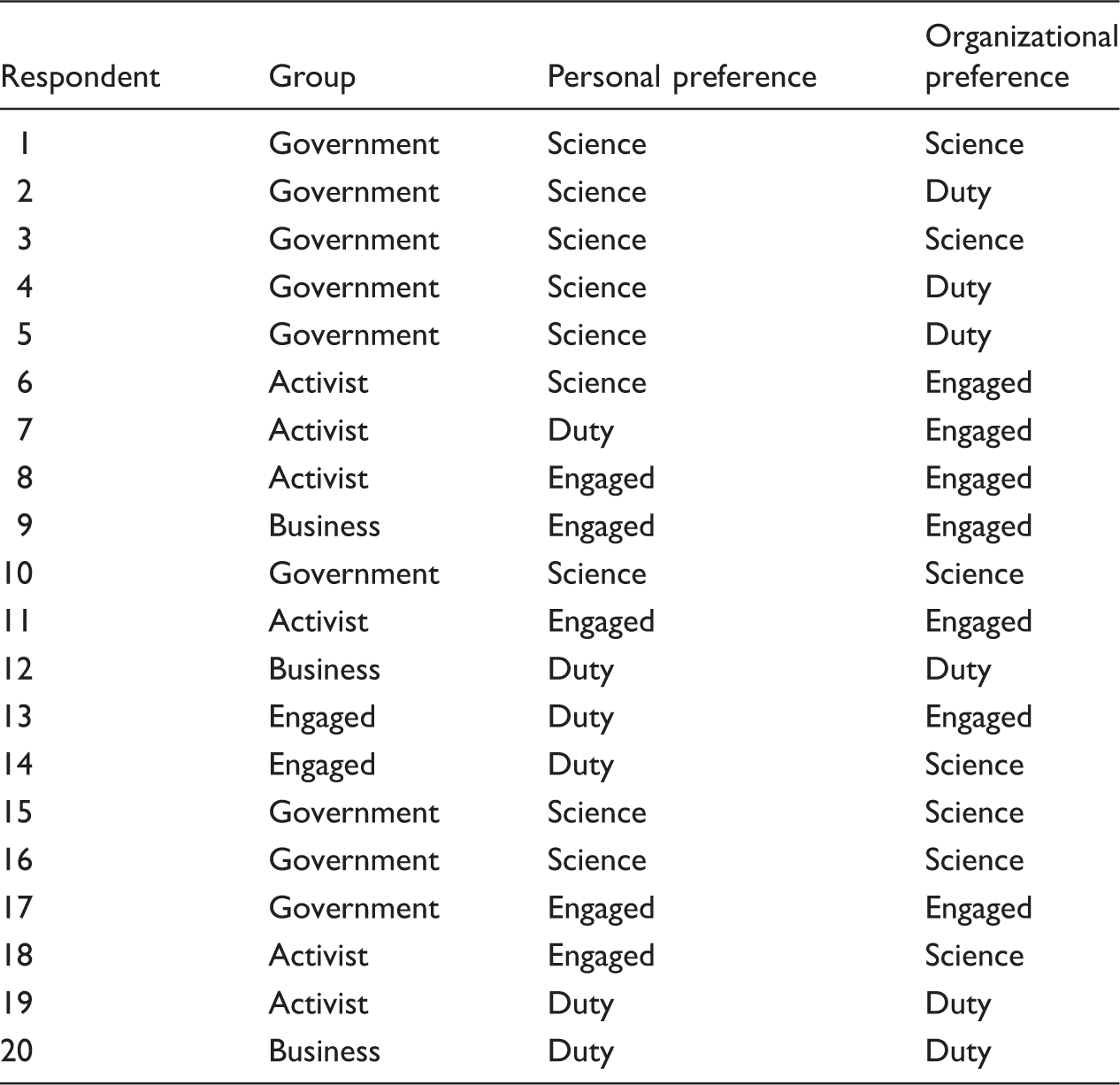
Finally, to answer the third research question, we used the 20 follow-up interviews, conducted immediately after the completion of the email survey. A random stratified sample was drawn from the stakeholders with interviewees nearly equally representing stakeholders from the business, governmental, and environmental activist communities. Interviewed stakeholders were presented with the same choices as on the email survey (duty-based narrative, science statement, engaged citizen narrative, do nothing statement), and asked which communication message they preferred, and which they believed their organization would prefer.
Results
The results help to answer the general question: How do stakeholders comprehend, or mentally construct an understanding of, the policy issues they are asked to weigh in on? After answering the three specific research questions, we provide a discussion addressing this overarching question.
Research question #1
Research question 1 asked, “Do stakeholders in a policy controversy regarding management of a local river in the western US prefer a science statement, a duty-based narrative, or an engaged citizen narrative as best reflecting their values?” Figure 1 visually displays the responses.
Stakeholder preferences related to their own beliefs.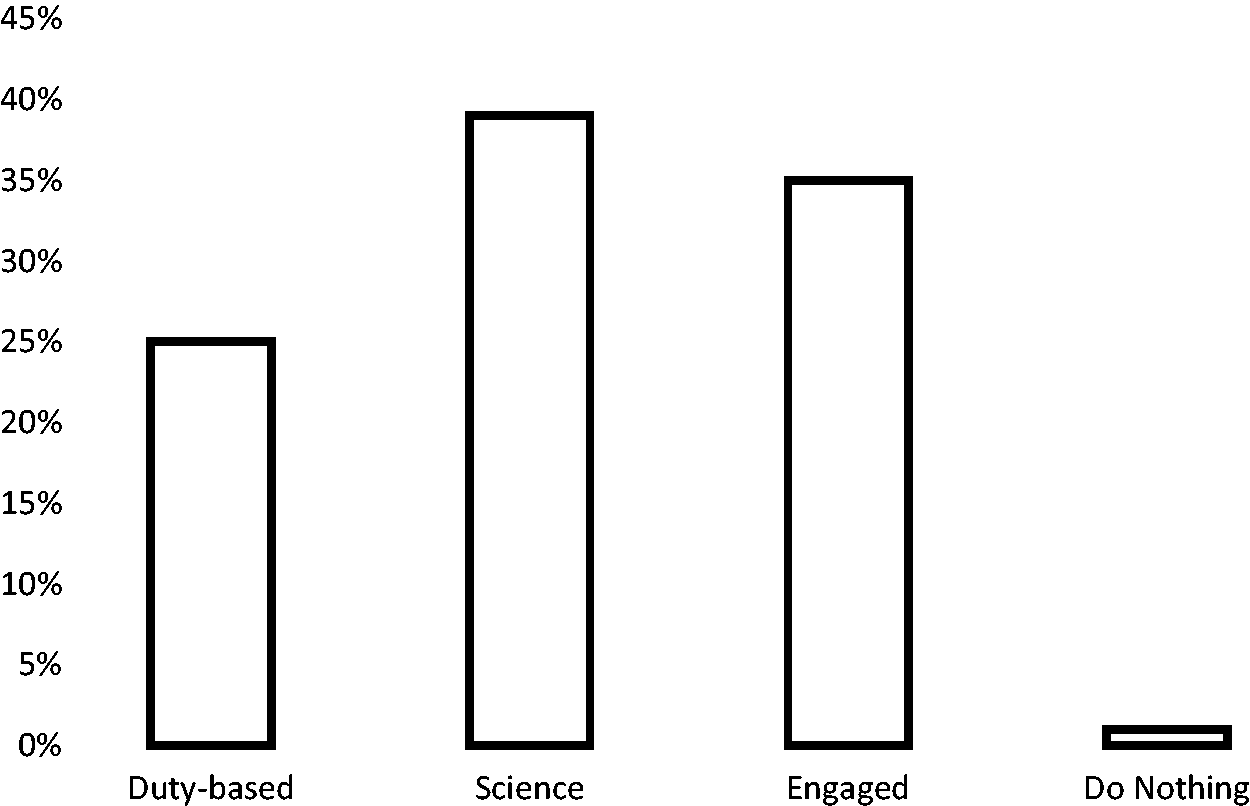
Science statement
Determinants of stakeholder preferences
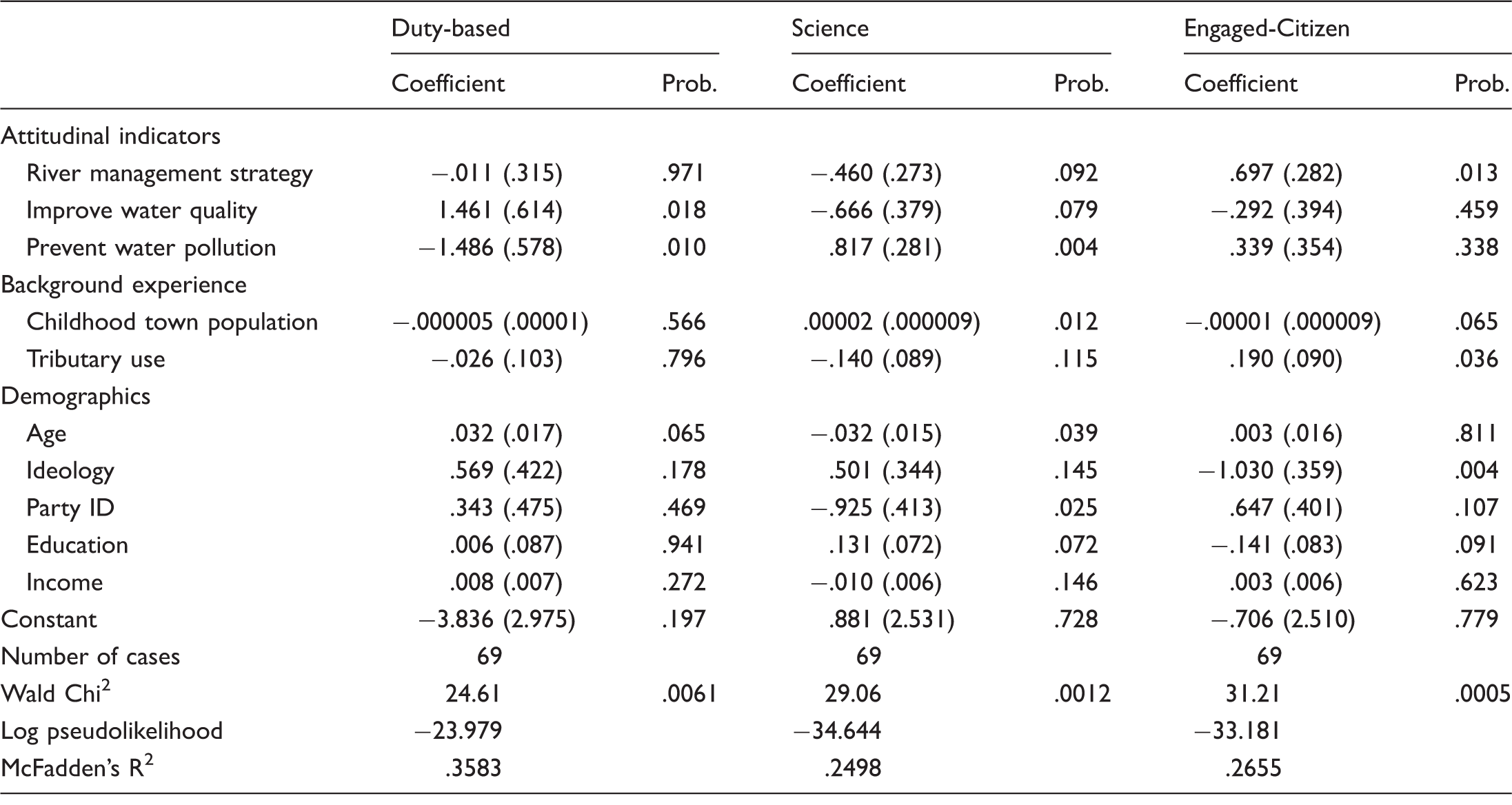
To correct for heteroscedasticity, all of the models are estimated with robust standard errors. Robust standard errors in parentheses. Two-tailed test.
Engaged citizen narrative
Twenty-seven stakeholders (35%) chose the engaged citizen narrative as best representing their own views. Our analysis (see Table 1) indicates that only one of the attitudinal indicators—supporting a more ecologically sound river management strategy—was a predictor of this message choice. Additionally, those who use more of the river’s tributaries, those who are more liberal, and those with less education were more likely to choose the engaged citizen river narrative.
Duty-based narrative
Nineteen stakeholders (25%) chose the duty-based narrative as the message best representing their own views. The model reveals (see Table 1) that the more strongly a stakeholder agreed with improving the water quality of the river, the more likely they were to choose the duty-based narrative as reflecting their own views. Additionally, those who more strongly agreed with preventing water pollution were less likely to choose the duty-based narrative. Finally, those older in age were more likely to choose the duty-based narrative.
Research question #2
Research question 2 asked, “How does support for the various characters differ among those choosing the science statement, duty-based narrative, or engaged citizen narrative?”
Narrative characters by message preference.

Significant differences: Birds, fish, biodiversity (engaged citizen versus duty-based), t = 1.68, df = 44, p. 09.
We expected those who chose the duty-based narrative to be most supportive of exercising individual responsibility but this was not the case. There were also significant differences among those who agreed with the statement, “working to restore the Portneuf River is a way to counterbalance the effects of climate change.” Those who chose the engaged citizen narrative were more likely to agree with the statement (mean = 3.63) than were those who chose the science statement (mean = 3.10).
Table 2 also presents the data for the stakeholders’ agreement with statements about villains. There were significant differences in agreement for the statement, “the federal government has had too much say in the management of the Portneuf River,” between stakeholders who chose the duty-based narrative villain (mean = 3.89) and those who chose the science statement (mean = 3.03), with the duty-based stakeholders more likely to agree. Additionally, those who chose the engaged citizen narrative villains (mean = 3.81) and those who chose the duty-based narrative (mean = 2.89) significantly differed on the statement, “economic interests have had too much say in the management of the Portneuf River.”
The bottom of Table 2 presents the data for agreement with statements concerning victims (those harmed by a polluted river). There was one significant difference between those who chose the engaged citizen narrative (mean = 4.70) and those who chose the duty-based narrative (mean = 4.36) and the statement, “a polluted river harms fish, birds, and other organisms that contribute to biodiversity”: those who chose the engaged citizen narrative were significantly more in agreement that these organisms are the victims of a polluted river.
Science elements by message preference
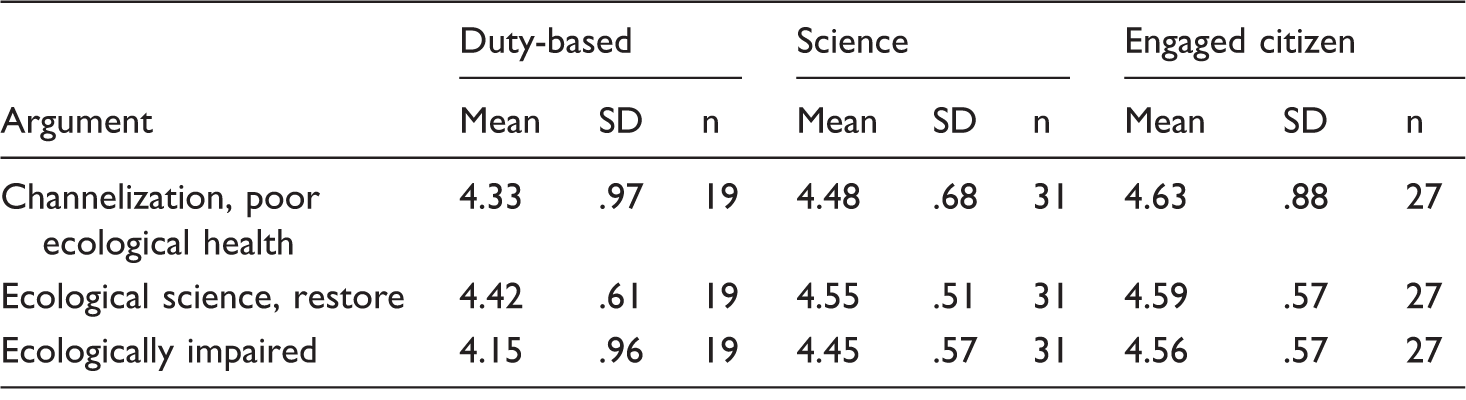
Significant difference: (Duty-based versus engaged citizen), ecologically impaired (t = 1.82, df = 44, p. 07).
Research question #3
Research question 3 asks, “Are the individual message preferences of stakeholders associated with specific group identities or organizational affiliations?”
Interview results
Variable definitions.

Discussion
This study produced several significant findings. In terms of our first research question, we found that, in our sample, stakeholders most frequently chose the science statement, followed by the engaged citizen narrative, and then the duty-based narrative as their individual preferences. Below we discuss possible explanations of why individual stakeholders make these choices.
First, stakeholders choosing the duty-based narrative were older, a finding which is consistent with Dalton’s (2008) more general work on citizenship and Lybecker et al.’s (2013) findings on the personal characteristics of people who prefer the duty-based narrative. Choice of the duty-based narrative did not relate to a stakeholder’s political ideology—again consistent with previous research (Lybecker et al., 2013), showing that multiple political ideologies use the duty-based narrative.
Second, the more strongly a stakeholder agreed with improving the water quality of the river, the more likely he/she was to prefer the duty-based narrative. Those who more strongly agreed with mitigating water pollution were less likely to prefer the duty-based narrative. Thus, although there was not an ideological element to the selection of the duty-based narrative as expected, there were differences in favored management approaches.
Third, a plurality of stakeholders (39%) chose the science statement as the message that best reflected their own views. Though we had no previous literature for comparison, this outcome is not necessarily surprising given the fact that environmental stakeholders include a substantial number of scientists. While the general public might well understand policy issues through stories or narratives, scientists appear more inclined to connect the issues to scientific data.
Fourth, the engaged citizen narrative was the choice of 35% of the stakeholders. A surprising finding was that the less educated were more likely to choose the engaged citizen narrative, which contradicts Dalton’s (2008) research on the demographics related to engaged citizenship. This may reflect the addition of the science statement to the list of message choices, as the “proof in science” may have attracted some of the more educated respondents. Those who chose the engaged citizenship narrative were, however, significantly more liberal, which is consistent with previous studies (e.g., Lybecker et al., 2013; McBeth et al., 2010).
In terms of our second research question, we surprisingly found that respondents who chose the engaged citizen narrative more strongly agreed with the characterization that heroes are those working to restore the river and are exercising individual responsibility. Given past research, we expected this duty-based heroic characterization would have equal support among the different stakeholders (Lybecker et al., 2013). However, the other duty-based characterizations (business sense, efficient use) did have the same level of agreement among the stakeholders. The engaged citizen characterization, where those trying to restore the river are counterbalancing climate change, was surprisingly divisive in that those who chose science did not agree with the statement as much as those who chose the engaged citizen narrative. This may be because scientists do not necessarily see a direct link between river restoration and climate change reduction.
The villains in the narratives were divisive as expected (Shanahan et al., 2013), with both the duty-based federal government villain and the engaged citizen’s villain of industry and economic interests prioritizing economic growth over other concerns creating significant differences among stakeholder groupings.
The engaged citizen narrative’s victims of “birds, fish, and other organisms” was divisive between those who chose the duty-based versus the engaged citizen narrative. The duty-based narrative’s declaration that local recreation users and businesses have also been victims of past river management was not divisive, with all three groups agreeing that these groups have been harmed.
In terms of our third research question, we found that stakeholders who work for government identify with the science statement (all eight chose that statement). Comments about why these stakeholders favored the science statement referenced their personal identity as a scientist. Examples of these comments include, “because I am an environmental contamination biologist and this is my job,” “it is data supported,” “I always start with evidence and a scientific approach,” and “there is no emotion or unsubstantiated claims.” Scientists are clearly trained to assess evidence and, in this case, did not connect as well with the narratives. This is not surprising despite some literature showing that science itself is often value laden and ripe with political interpretation (Carter, 2013; Fernandez et al., 2014; Jasanoff, 1987) and that scientists do not trust all science (Lave et al., 2010).
These very stakeholders also provided more mixed responses when they were asked to choose the message that best represented how their organization viewed the river. In the interviews, five of the eight stakeholders working for a government agency stated that their organization viewed the river through the science statement while three of these eight stakeholders chose the duty-based narrative. This discrepancy may be because some governmental employees work for regulatory governmental agencies while others work for governmental agencies with broader mandates.
Overall, results related to the three research questions help answer the overarching question, “How do stakeholders comprehend, or mentally construct an understanding of the policy issues upon which they are asked to weigh in?” We found that stakeholders’ personal experiences (age, education level, partisanship, ideology, and job) impact their preferred message choice. Stakeholders, furthermore, do pay attention to what characters are presented within a narrative, and these play a role in how the stakeholder comprehends a message: villains are divisive, but some victims can draw attention to and consensus around an issue. Finally, using science can be effective, but should be used selectively and with one’s audience in mind. In this manner, our study contributes to research (Niederdeppe et al., 2011) concerning how to communicate divisive policy issues.
Conclusion
Our research findings indicate that a consensus message among stakeholders to move river restoration beyond intractability would: (1) focus on duty-based heroic characterizations of those trying to fix the river as exercising good business sense and efficiency in the use of resources; (2) not include a villain; (3) focus on recreation and business users as victims; and (4) use some selected scientific evidence. A scientist who works for an environmental regulatory agency, when asked about how he communicates to the public in difficult river management issues, states it this way: “I don’t ever try to pinpoint blame. Instead, I try to find how the river’s problems are harming people (like kids cannot swim in the river because it is polluted). I look for solutions, and I look for good people to champion those solutions.” The practitioner is, in essence, saying that he does not use villains in his communications but instead uses popular heroes and worthy victims in order to promote cooperation. Our data lends support for this scientist’s communication strategies.
Footnotes
Acknowledgements
This publication was made possible by the NSF Idaho EPSCoR Program and by the National Science Foundation under award number IIA-1301792. Its contents are solely the responsibility of the authors and do not necessarily represent the official views of NSF.
Declaration of conflicting interests
The author(s) declared no potential conflicts of interest with respect to the research, authorship, and/or publication of this article.
Funding
The author(s) received no financial support for the research, authorship, and/or publication of this article.