




Abstract
This study utilizes the Narrative Policy Framework (NPF) and cultural theory to examine the use of policy narratives by coalitions (meso-level) and the institutional uptake (macro-level). We analyze Parliamentary hearings about genetically modified (GM) salmon in Canada to associate narrative strategies with certain cultural worldviews and policy-stances. We explore narrative strategies used by cultural groups with regard to whether they contain the scope of GM salmon issues to “science-only” (direct health and environmental impacts) or expand the issues to “science-plus” (to include broader economic, social, or cultural impacts). Finally, we examine whether certain framings of GM salmon issues or specific cultural narratives are preferentially taken up in the final policy documents generated after the hearings. Our findings reveal significant relationships between policy-stance (pro-vs anti-GM), the cultural disposition of a policy narrative, the narrative strategies being used, and ultimately policy uptake. For example, narratives with hierarchical cultural dispositions were more likely to expand the scope of the issue to science-plus when supporting their own policy position (typically pro-GM) but contain the scope to “science-only” when refuting an anti-GM policy-stance. With regard to policy uptake, final government documents referred more to narratives that contained the scope to “science-only” and expressed hierarchical or individualistic dispositions in comparison to the hearings. This study has practical implications for understanding whose perspectives and arguments are legitimized in national policy debates about GM foods. It also extends NPF theory to how narratives containing specific cultural dispositions and risk-based framings influence policy uptake at the macro-level.
In controversial debates involving science, policy actors often construct narratives to ascertain favorable outcomes (McBeth et al., 2014a, 2014b; McBeth and Lybecker, 2018; Schlaufer, 2018). Across a wide range of policy issues, scholars have suggested that the strategic use of narratives can be identified by studying patterns of use among coalitions (Brewer, 2020; Crow and Berggren, 2014). Others have suggested that narratives can be used differently to maintain a policy actor’s cultural belief (Ripberger et al., 2014; Shanahan et al., 2011). According to McBeth et al. (2007), “narratives are both the visible outcome of differences in policy beliefs and the equally visible outcome of political strategizing” (p. 88).
The Narrative Policy Framework (NPF) offers a systematic approach for examining the content and role of narratives in policy processes (McBeth et al., 2014a, 2014b). It allows scholars to measure socially constructed realities such as those based on cultural perspectives and used in narratives (Crow and Jones, 2018; Ripberger et al., 2014). While some scholars have found support to show that scientific evidence is embedded in narratives (McBeth et al., 2014a, 2014b; Schlaufer, 2018; Shanahan et al., 2017), others have stated that narratives are sometimes not as persuasive as the basic facts (Jones, 2014). Still, many studies have provide support for the NPF’s central claim: influential arguments are presented as stories (see for example, Jones et al., 2014; Jones and McBeth, 2010; Schlaufer, 2018), and these stories are often shaped by a belief system (Ripberger et al., 2014). The study of narratives can provide deeper insights into the meanings and beliefs that influence the policy process in comparison to statistical models and quantitative correlations, which may investigate relationships among variables but lack explanatory power (Bevir and Rhodes, 2006). The NPF provides both a structured way to analyze narratives quantitatively and to explore underlying beliefs of actors in a policy system.
Unsurprisingly, some narratives are more effective than others in policy processes, and the framing of policy issues matters. Narratives affect how the public and stakeholders engage in the policy process and have their voices be heard. The approval of genetically modified (GM) foods reflects an area of controversy where narrative issue-framing has affected whose perspectives are legitimized and taken into account in policymaking. For example, in GM food regulatory policy in the U.S. and Canada, “science-based” decision-making has been a mantra used by groups in power (typically technology developers and regulators) to frame GM food issues narrowly around direct risks to human health or the environment, as these are the risks which federal agencies can review under their limited regulatory authorities (Kuzma, 2017; Meghani, 2014; Meghani and Kuzma, 2011).
As such, there has been a historic marginalization of concerns that lie outside of these “science-based,” direct toxicological risks, as national policymakers base their decisions about whether to approve GM foods on information supplied by natural-science experts and regulatory studies conducted by the very companies making and promoting the technology (Kuzma et al., 2009 Meghani, 2014; Meghani and Kuzma, 2011; Thompson et al., 2007; Winickoff et al., 2005). There is a lack of national policy venues to discuss broader social, economic, ecosystem, and cultural risks and benefits of GM foods, as they lie outside of narrowly constructed government regulations (Megahani and Kuzma, 2018; Thompson et al., 2007). Yet, other, scientific-, evidence- and ethics-based issues remain important to multiple stakeholders with regard to GM foods, such as longer-term impacts on biodiversity or public health, animal welfare, equitable distribution of risks and benefits, economic benefits or harms to small versus large industries, control over the food supply, transparency and autonomy, and cultural respect (Kuzma, 2017; Meghani, 2014; Meghani and Kuzma, 2011; Thompson et al., 2007; Winickoff et al., 2005).
We designed our study with the above policy context in mind and utilized the NPF to analyze a rare window for public participation in GM food decision-making in Canada, a place where broader narratives about GM foods might be found. The NPF focuses on three levels of analysis: micro (individual), meso (group/coalition), and macro (institutional/societal/cultural). NPF studies at the macro-level investigate how narratives at the institutional- or societal-scale shape policy outcomes (Crow et al., 2017; Jones et al., 2014). We analyze the hearings with respect to the narratives that are voiced by different coalition groups (meso-level), the cultural worldviews expressed in those narratives (using Cultural Theory) (meso-level), and the narrative strategies and cultural views that are most influential in the final policy documents (macro-level). In comparing narratives from GM food public hearings to their uptake in final policy reports, our study applies the NPF at the macro-level, where there has been significantly less theory development and research (McBeth et al., 2014a, 2014b). We develop findings with regard to the cultural narratives and narrative strategies that resonate most in policy formulation for GM foods at the national level in Canada. As Sievers and Jones (2020) discuss, macro-level NPF studies can also examine “third dimensional/preference-shaping power” or the ability of “a dominant group to shape the beliefs and preferences” through narratives. They also note that “macro-narratives become proxies for the social and institutional mobilization of bias” (Sievers and Jones, 2020: 107). Thus, our study is motivated not only by a potential contribution to macro-level NPF theory, but also by the desire to understand which cultural arguments or narrative strategies have the most salience in policymaking in order to raise consciousness about biases and power in the GM-food policy process. Through a better understanding of narratives that resonate in final policy documents, our findings might also help those with perspectives that are usually marginalized (e.g., those with concerns that lie outside of direct risks to human health and the environment) better advocate for their positions if given the opportunity to participate in GM food dialogs at the national level.
In this article, we use the case study of the first GM animal-food approved for sale and consumption in Canada, the AquAdvantage Salmon (AAS), to ask the following questions: What cultural worldviews do stakeholder groups display through their narratives during a key public participation event (i.e., Parliamentary hearing)? What narrative strategies, such as scope contraction to “science-only” (i.e., direct human health and environmental risks which are currently the focus of regulatory decision-making) 1 or expansion to “science-plus” (beyond direct toxicological risks), do certain stakeholder or cultural groups use during participation? Do these strategies correlate with groups that are policy winners (pro-GM in this case, as the GM salmon was approved prior to the hearings analyzed) versus losers (anti-GM in this case)? Finally, what narratives get incorporated into the final policy documents (as proxy for “voice” in policy processes) and do these correspond to certain cultural groups, or narrative strategies?
Although the results from this one case-study are not immediately generalizable, the research approach and findings can be instructive to develop hypotheses associated with the NPF at meso- and macro-levels which can be tested in other contexts. In particular, this article contributes to a deeper understanding of NPF in several ways: (1) it identifies narrative elements that correspond to the worldviews described by cultural theory and in the novel policy domain of emerging food technologies; (2) it associates scope expansion (science-plus) and contraction (science-only) as a narrative strategy with different stakeholder groups, cultural groups, and policy winners or losers in technological decision-making (meso-level); and (3) it measures the “policy uptake” of certain narratives in the final policy document (at the macro-level) as an indicator of which cultural and stakeholder groups (from the meso-level) have most influence.
Before turning to a discussion of the specific methods and results, we review prior literature relating to the NPF, cultural theory, and the narrative strategy of scope expansion to describe how we frame our study.
The narrative policy framework: Situating our study
Identifying policy narratives by cultural story type.

Narrative strategies
Narrative strategies are part of the narrative content and refer to a specific method of persuasion used by policy actors to influence decision-makers or the public (Shanahan et al., 2018). Researchers have explored many different narrative strategies. The most common ones include the devil and angel shift (to identify an opponent as a villain, while portraying one’s own coalition as the hero); causal mechanisms (ascribing a causal relationship to the characters in the narrative); and, constructing narratives that expand or maintain the scope of conflict (Crow and Berggren, 2014; Heikkila et al., 2014; Schlaufer, 2018).
The manipulation of the scope was originally introduced by Schattschneider (1975) to explain the behavior of groups that use power dynamics to manipulate policy outcomes. NPF researchers posit that groups manipulate the scope of the issue by expanding or containing an issue based on whether they are winning or losing on an issue (Jones and McBeth, 2010; McBeth et al., 2007, 2013). For example, McBeth et al. (2007) demonstrated that winning groups would utilize stories that contain the scope of the conflict (to concentrated benefits or costs), whereas losing groups would tell stories that expand the scope of the conflict (to more diffuse costs or benefits) to demonstrate the policy problem and recruit more members to their coalition.
Scholars have noted that it is sometimes difficult to determine exactly who is a winning or losing group in a dynamic policy system at any given time, complicating NPF studies of scope expansion or contraction as a narrative strategy for policy losers or winners (Brewer, 2020). However, in our study, the GM salmon had been approved by the Canadian regulatory agencies prior to the Parliamentary hearings that we analyze using the NPF (see Case Study section below); thus, pro-GM salmon groups could be determined to be the initial policy winners and anti-GM salmon groups the policy losers.
As discussed in the Introduction, when science and policy interface over the approval of GM foods, the discussions are inherently value-laden, yet the decision-making process usually only makes space for legitimized “science-based” arguments (e.g., Behringer and Feindt, 2019; Kuzma et al., 2009; Meghani, 2014; Meghani and Kuzma, 2011; Pressman and Wildavsky, 1973; Thompson et al., 2007; Winickoff et al., 2005). “Science-based” decision-making in the context of GM foods and other emerging technological products has historically referred to the risk issues that can be readily studied in the laboratory for regulatory approvals, such as direct human-health and environmental toxicity (reviewed in Thompson et al., 2007). As a result, the concerns of broader experts (e.g., social scientists, economists, ecologists, ethicists, and stakeholders) and non-expert publics are often marginalized, and the perspectives of biotechnology developers are privileged as they submit the studies for regulatory review of their own products (Besley et al., 2008; Kuzma, 2017; Meghani, 2014; Thompson et al., 2007). Thus, in GM food policymaking, we expected scope contraction to “science-only” to be a strategy for policy winners like pro-GM technology developers for them to continue to dominate in policy circles (see Hypotheses section below).
In light of the above, this research takes a novel approach to study the narrative strategy of scope contraction or expansion that fits the policy dialogs over GM foods. We examine the way that risk is constructed as a form of scope manipulation: either (1) containing definitions of risk to “science-only” (i.e., direct human and environmental harms from allergenicity and toxicity that typically fall under regulatory authorities; see footnote (1); or (2) expanding definitions of risk to “science-plus” (i.e., economic, ethical, religious, and socio-cultural concerns, as well as more indirect ecological and human health risks stemming from land use, chemical use, loss of biodiversity, etc.).
Although there is previous literature utilizing the NPF to study risk-based science policy issues like climate change, hydraulic fracturing, and wildfires (e.g., Jones and Song 2014; Blair and McCormack 2016; Crow et al., 2017) and scope expansion/contraction (McBeth et al., 2007; Brewer 2020), we are not aware of other studies that frame scope expansion or contraction using the “science-only” and “science-plus” framing as we do. Yet this framing is relevant to the GM-food policy debates, as well as for the approval of other emerging technological products.
As regulatory approval is the rate-limiting step for approving biotechnology products for market use, the “science-only” basis for regulatory decision-making in these policy domains has affected which perspectives are legitimized or marginalized during policy processes (e.g., Kuzma 2017; Kuzma et al., 2009; Meghani 2014; Meghani and Kuzma 2011).
Narrative belief systems and cultural theory
In addition to narrative strategies, the NPF also provides a framework for analyzing narrative content according to beliefs. Weible et al. (2009) define a belief system as a common or shared approach for understanding and knowing amongst policy actors. Belief systems are thought to be stable overtime and can be used to examine a policy debate to understand opposing coalitions (Shanahan et al., 2018). For example, researchers have examined the belief systems of opposing coalitions based on the relationship between humans and nature (see Pinchot-Muir debate in Shanahan et al., 2011) or through cultural theory (CT) (Jenkins-Smith et al., 2014; Ripberger et al., 2014; Thompson et al., 1990).
CT provides a framework based on “shared values and beliefs” and social relations (i.e., patterns of interpersonal relations), which explain preferences for decision-making (Simmons, 2018; Thompson et al., 1990). CT was originally developed to explain cultural differences in the perception of risks (Douglas, 1970, 1992). Since then, it has been used to examine controversial issues related to nature and other social phenomena (Gerlach and Rayner, 1988; Johnson and Swedlow, 2021; McNeeley and Lazrus, 2014; Ney and Thompson, 2000; Simmons, 2018; Slovic and Peters, 1998; Swedlow et al., 2020).
CT posits that social relations that explain how humans relate to others and the world are demonstrated across a two-dimensional grid (corresponding to social regulation) and group (corresponding to social integration) (Douglas and Wildavsky, 1982). Individuals who ascribe to ‘high-grid’ social regulation are guided by rules and authority, instead of ‘low-grid.’ Meanwhile, individuals who ascribe to ‘high-group’ social integration exhibit social-relational patterns typical of strong group membership; these patterns are weaker in ‘low-group.’ The grid and group dimensions are the basis for four worldviews (Fatalism, Hierarchy, Individualism, Egalitarianism) which can be used to understand how individuals communicate and justify social relations.
These four worldviews have also been shown to correspond to attitudes, behaviors, and beliefs about technological risk and regulation (Douglas and Wildavsky, 1982; Jenkins-Smith et al., 2014; Johnson and Swedlow, 2021; Simmons, 2007; Tansey and O’Riordan, 1999). Egalitarians (E) exhibit strong beliefs about equality and perceive that human decisions concerning nature should be based on caution to avoid negative consequences. Hierarchs (H) revere the knowledge of higher authority and perceive that decisions concerning nature should only be based on the perspectives of skilled experts and managers. Individualists (I) perceive government intervention as an intrusion, and they believe that progress is the most important byproduct of nature. Fatalists (F) consider negative consequences inevitable. Therefore, they believe that altering nature will negatively affect others because it is impossible to avoid or reduce harm.
According to a body of research, risk perceptions are often based on these underlying four cultural worldviews (H, E, I, F). Findings across multiple technology-policy domains indicate that people who have more egalitarian views tend to perceive risks of new technologies as greater and are more cautious toward acceptance of them (Finucane and Holup, 2005; Jones and Song, 2014; Kahan et al., 2011). Thus, in our study, we expected that those holding egalitarian beliefs (as expressed in their narratives) would be more likely to be precautious and skeptical of GM foods and present anti-GM arguments (see also Hypotheses section).
CT provides a foundation for examining not only how a narrative can convey the construction of risk but also how those narratives can be used to legitimate specific perspectives during a policy-setting process (Hulme, 2009; Lazrus, 2015; Thompson and Rayner, 1998). As such, we wanted to see if certain cultural-theory based arguments would resonate more in GM-food policy processes. As discussed, policy processes for GM foods have centered around top-down regulatory decision-making, with few opportunities for public participation. Thus, we expected that narratives expressing hierarchical views would resonate more in GM-food policy processes and be taken up more in final policy documents than egalitarian narratives (see also Hypotheses section). We also expected individualistic narratives to resonate more than egalitarian narratives, given the push in the GM policy domain that regulations should be “market friendly” so as not to stifle innovation (e.g., see Meghani and Kuzma, 2011)
In summary, we structured our analysis of narrative beliefs using cultural theory in order to fit the GM policy domain and its history, just like we structured our analysis of scope contraction or expansion. However, we believe that our approach is relevant to investigating other science and technology policy-processes, as cultural worldviews broadly affect risk perception across multiple technologies and national decision-making for other technological products tends to focus on direct human and environmental safety.
Study framework: Applying the NPF and CT
Our approach uses NPF in combination with CT to unpack narratives and understand how they are used and taken up within public hearings for GM foods in Canada. Previous studies have demonstrated that the narrative format outlined in the NPF is used when policy actors in a subsystem craft stories to convey meaning in policy processes (Berinsky and Kinder, 2006; Crow and Jones, 2018; Dahlstrom, 2010). Unpacking narratives according to NPF and CT is possible because shared beliefs and meaning can be identified in the structural elements of a narrative (i.e., characters, settings, moral, and plot) and subsequently connected to one’s way of seeing the world. In this way, combining the NPF with CT analysis provides the underpinnings necessary for identifying any statistical differences between different narrative beliefs being conveyed by opposing coalitions. For example, studies utilizing CT identified dominant cultural stories within narratives used in public discourse by different coalitions (e.g., Linsley et al., 2016; Mcbeth et al., 2010; Ney and Thompson 2000; Verweij et al., 2006). These studies inform our expectations—policy actors will use different narrative strategies based on a policy actor’s cultural worldview and policy-stance, as well as whether they are winning or losing (reviewed in Shanahan et al., 2017).
A conceptual model of our study is illustrated in Figure 1, adapted from Shanahan et al., (2017) structure for meso-level NPF studies (p. 239). We adapt this structure and specify the variables for our particular study. The model starts with two primary coalitions that hold differing policy-stances, in our case pro- or anti-GM salmon views (Figure 1; Row 1). These coalitions also correspond to initial policy winners (pro-GM) and losers (anti-GM) in our study, as the GM salmon was approved by the federal agencies prior to the Canadian Parliamentary hearings that we analyze (see Case Study section for more detail). Conceptual model of the study. Note. Adapted from “The Narrative Policy Framework,” by E. Shanahan, M. Jones, M. McBeth, and C. Radaelli, Theories of the Policy Process (p. 239), 2017, Westview Press.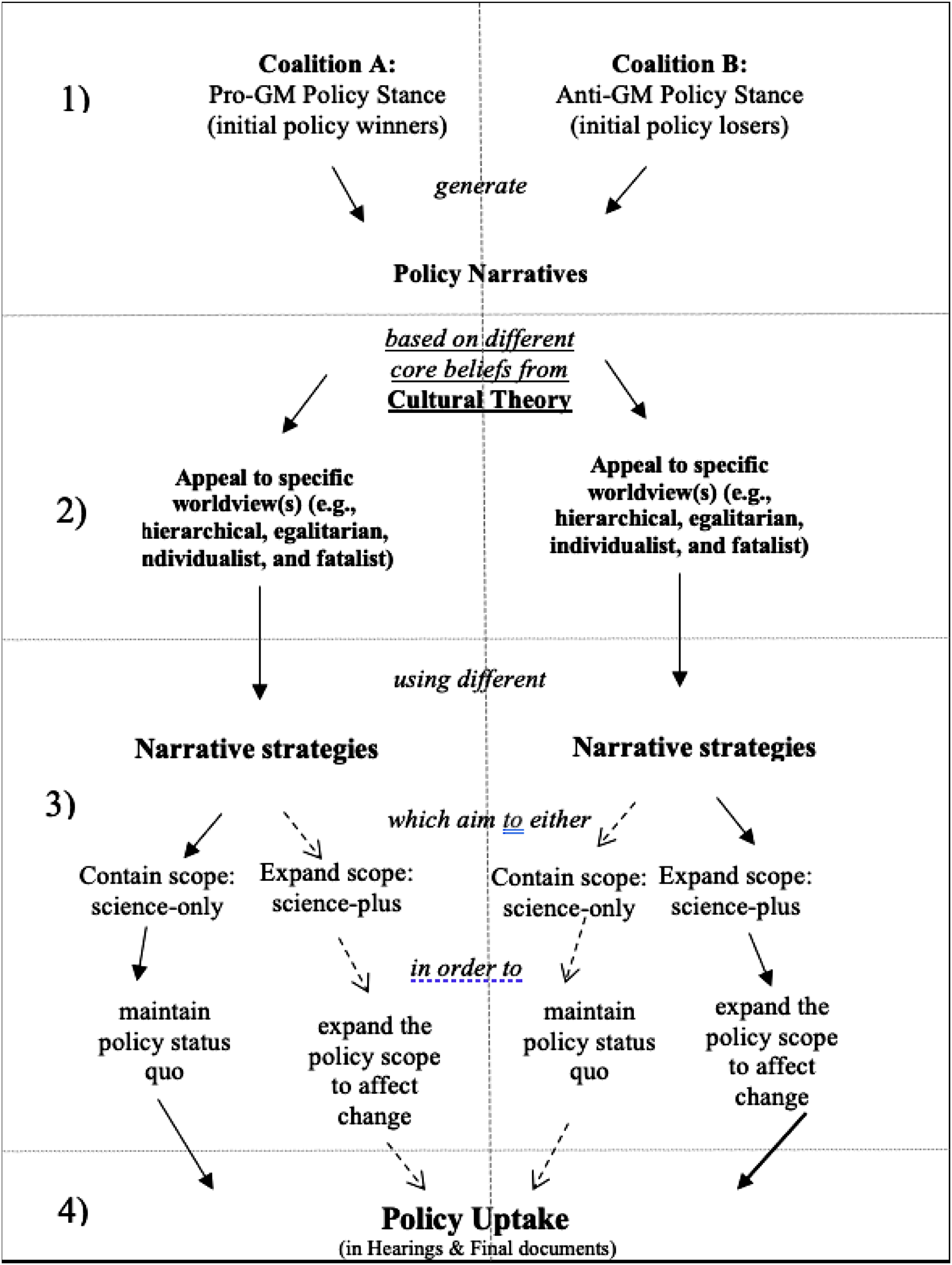
In the NPF model, Shanahan et al. (2017) also depict how core beliefs hold coalitions together. Therefore, we examined pro- and anti-GM salmon narratives to see if they associated with the four sets of core beliefs identified by cultural theory (i.e., do they represent H, I, E, or F worldviews?) (Figure 1, Row 2). We then investigate if the pro- or anti-coalitions (and the cultural subgroups they represent—H, I, E, or F) utilized scope contraction to “science-only” or scope expansion to “science-plus” more often to influence the policy process (Row 3). Solid arrows in Row three denote what would be predicted from prior NPF studies—that is, policy winners (in our case the pro-GM coalition) would tend to contain the scope of the issues to maintain status quo, while policy losers would tend to expand the scope to affect policy change (McBeth et al., 2007). Finally, our work also contributes to the macro-level of NPF by looking at the policy uptake of certain cultural narratives (H, I, E, F) and narrative strategies (science-only versus science-plus) at the national, institutional level (Row 4). Specifically, we compare cultural narratives and narrative strategies identified during the Parliamentary hearings to final policy documents generated after the hearings.
In order to type narratives according to CT (Figure 1, Row 2), we use narrative elements such as characters, morals, and plots to identify the four worldviews (Table 1; see also Methodological Approach). We based our typing on that of previous research. For example, Jones and Song (2014) developed H, E, I narratives in the context of climate change and used them to expose people to different information conditions in a micro-level NPF study. Simmons (2018) describes the content of H, I, E, and F narratives across multiple policy domains. Linsley et al. (2016) look at the four cultural-theory archetypes in narratives during participatory policy dialogs about financial reporting. Using these studies as a guide, we developed Table 1 to identify the CT worldviews. Some of the narrative elements in Table 1 involve attitudes toward technological risk that have been previously associated with each cultural group (e.g., egalitarians beliefs about the fragility of nature under “Setting”), while others refer more to group-grid social relations (e.g., hierarchical and appeals to authority).
At the meso-level, our study innovates in the specific way it brings together an analysis of narrative strategies (science-only vs science-plus) and narrative beliefs according to cultural groups, although some prior studies are important to discuss. For example, Crow and Berggren (2014) investigate opposing coalitions—policy winners and losers—and whether or not they use appeals to “science” generally to support or refute their policy positions. However, they do not utilize scope expansion (from “science-only” versus “science-plus”) or operationalize narrative beliefs using cultural theory as we do. According to Ripberger et al. (2014), an explicit examination of beliefs is not widely incorporated into studies examining the strategic use of policy narratives. Crow and Jones (2018) emphasize this point by stating that “ideology is often easily observed to play a role in many policy areas, but…more refined beliefs such as cultural types…do a far better job of getting at what people actually believe” (p. 222). Also, while we focus on general types of evidence (science-only vs science-plus) that different coalitions or cultural groups invoke in their narratives, other studies have focused on different appeals to a single study as evidence in narratives (e.g., Schlaufer 2018).
Our study also innovates by applying the NPF at the macro-level (McBeth et al., 2014a, 2014b), as we investigate how narratives at the institutional scale shape policy outcomes (Crow et al., 2017; Jones et al., 2014) (Figure 1, Row 4). According to Knackmuhs et al. (2020), as of 2020, “only one macro-level study has been conducted” (p. 293)—referencing Knox (2013). Knox (2013) investigated the historical narratives surrounding the Everglades restoration and their influence on policy formation at the societal level, although they did not use an explicit NPF approach. In this study, we address the gap in macro-level NPF studies by looking at narratives from Parliament hearings (institutional level) and how they shape the final policy documents generated after the hearing (policy outcomes) (Figure 1, Row 4). Our study also has the advantage of a tighter linkage in time between the policy process (hearing) to the policy outcome (summary documents from the hearing), which occurred within months of each other. Thus, confounding variables influencing policy outcomes are reduced. Furthermore, we connect these findings to cultural groups and narrative strategies that resonate most in policy formulation for GM food, linking meso-level inquiries with macro-level observations.
In summary, we contribute to the NPF by identifying narrative elements that correspond to the worldviews described by cultural theory and in the novel policy domain of emerging food technologies (Figure 1, Row 2); associating the narrative strategy of scope manipulation with different stakeholder groups, cultural dispositions, and policy-stances (i.e., winners or losers) in technological decision-making to explore persuasion mechanisms (Figure 1, Row 3); and measuring “policy uptake” of specific narratives in the final policy document (at the macro-level) as an indicator of which cultural and stakeholder groups (from the meso-level) appear to have the most influence (Figure 1, Row 4). Before turning to a deeper discussion of the methodology and results, we describe our case study in more detail.
The case study: regulatory approval of GM animal foods in Canada
The AquAdvantage Salmon (AAS) was the first GM animal approved for human consumption in Canada and the U.S. In Canada, the regulatory approval of AAS involved several government agencies and laws. The Canadian Environmental Protection Act ((McBeth et al., 2014a, 2014b) provides guiding authority for foods derived from biotechnology. The Government of Canada ensures that these substances are assessed for their potential harm to the environment and human health. The New Substances Notification Regulations (Novel Substance Organisms) [NSNR(NSO)] provides guidance prior to the import or manufacture of new organisms, such as requiring public notification and risk assessments. Risk assessments evaluate whether a product is toxic: a substance is considered to be “CEPA toxic” if it may enter the environment; have an immediate or long-term harmful effect on the environment or its biological diversity; constitute a danger to the environment on which life depends; or, constitute a danger to human life or health (Government of Canada E and CCC, 2014).
In accordance with the guidance, the Canadian Science Advisory Secretariat (CSAS) conducted an external assessment in addition to the risk assessments done by the environmental and health agencies. The purpose of this assessment was to allow for “peer review” of the conclusions presented in the preliminary government assessments. However, it was not an external advisory process, as only three of 23 participants were not government officials. Shortly after this review, AAS was approved for commercial egg production in Canada (see Figure 2). Timeline of AAS approval in Canada.
In response to the decision, environmental advocacy groups sued the Canadian government. Advocacy groups were opposed to GM salmon approval because the assessment did not consider the invasive behavior of AAS, potentially putting ecosystems and species such as wild salmon at risk (Wristen, 2014). Additional concerns were related to limited transparency in the NSNR(NSO) approval process because it did not involve public consultation. In 2015, the court ruled in favor of the Federal government for its NSNR(NSO) decision but limited egg production to a single facility. The court also moved to discontinue issuing waivers for NSNR(NSO) without public notification.
After AAS received approval for consumption and sale in Canada, there was an opportunity for the public to provide input about future GM animal regulations during Parliament’s House of Commons subcommittee hearings (House of Commons, 2016). Our study focuses on this opportunity for public participation which was designed to review the decision to approve AAS in order to consider future policy processes and approvals for other GM-animal foods. Because there was regulatory certainty about the approval of AAS at the time of the Parliamentary hearings (it had been approved already), we could consider the pro-GM salmon coalition as the winning coalition and the anti-GM coalition as the losing coalition in our analyses (Figure 1). However, both coalitions were still vying for influence in the hearings in order to have impact on future GM animal regulations which were more uncertain.
After the hearings, in Dec 2016, Parliament’s summary report was released and became available online along with full transcripts of the meetings (House of Commons, 2016). In April 2017, the government agencies involved in AAS approvals and GE animal regulation responded to Parliament’s report by authoring a subsequent Federal government report.
Figure 3 breaks down our study into phases according to which documents were analyzed. In phase one of our study, we examined the hearing transcripts for the cultural beliefs and the narrative strategies used within pro- and anti-GM salmon narratives. We examined how scope expansion or contraction related to cultural groups and policy winners versus losers, as well as how these groups used scope contraction or expansion (“science-only” or “science-plus”) to support their position or refute the opposing group’s position. The results from phase one (meso-level NPF) were then used in phases two and three (macro-level NPF) to assess the types of cultural appeals (H, I, E, or F) and narrative strategies that were taken up in the Parliament subcommittee report (Phase 2) and the Federal government response documents (Phase 3), which were both generated after the hearings (see Figure 3). Assessment of policy narratives (Cultural Appeals and Narrative Strategy) and Uptake.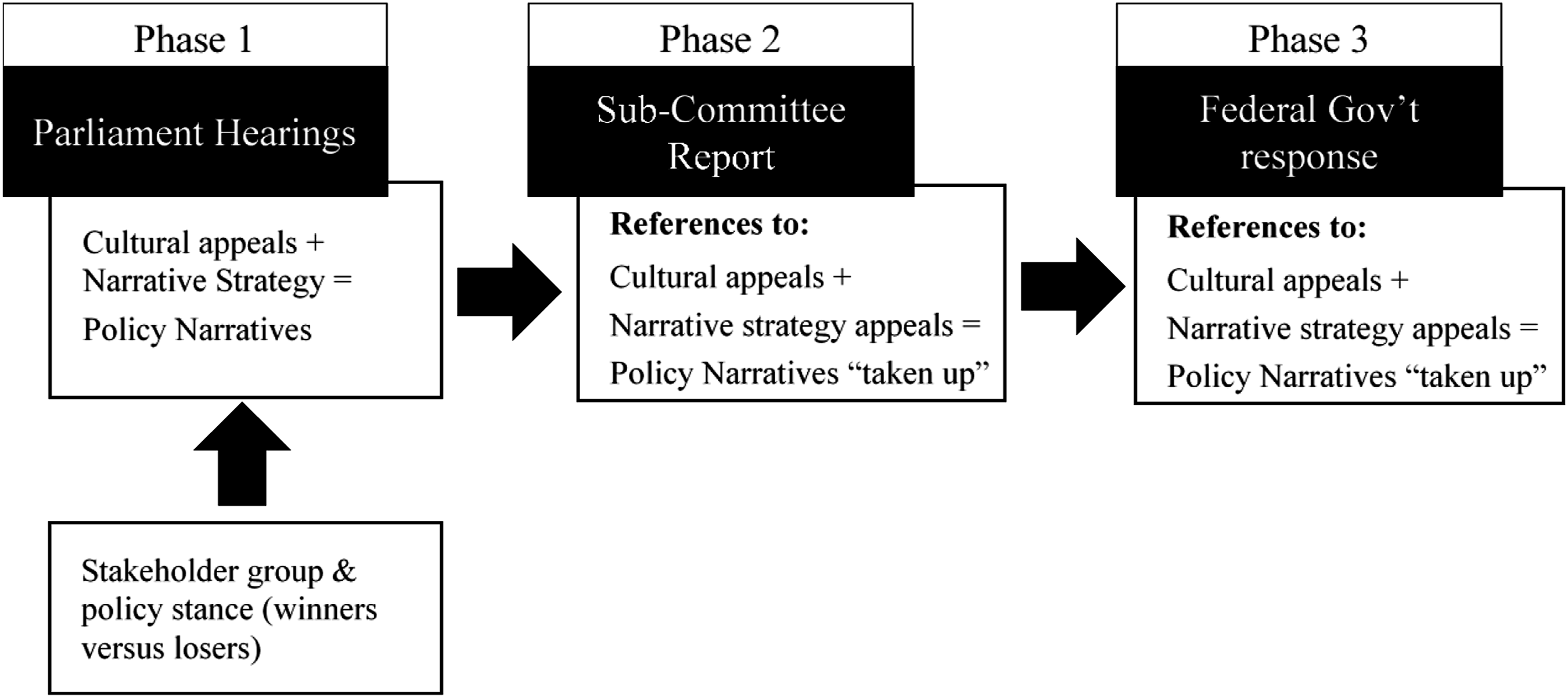
Hypotheses
As discussed, prior literature on the framing of issues in GM debates and policy-stances informed our hypotheses about relationship among cultural world views, policy positions, and the scoping of GM issues as “science-only” or “science-plus” (see Introduction and Narrative Strategies). Studies have indicated that groups with strong pro-biotechnology views, generally technology developers or government regulators, tend to defer to objective science in regulation (Dietz, 2013; Herrick, 2004; Meghani, 2014; Meghani and Kuzma, 2011). For our hypotheses about cultural theory-based groups, research findings across multiple policy domains have indicated that people who have more egalitarian and fatalist views perceive new technology risks as more significant and are more cautious toward acceptance of new technologies than people who have more hierarchical or individualistic views (Finucane and Holup, 2005; Jones and Song, 2014; Kahan et al., 2011). Thus, we expected that narratives with hierarchical and individualistic cultural appeals (often shared by technology regulators and developers) would more likely frame GM food risks as “science-only” (H1) and be associated with a pro-GM salmon policy-stance (H2). H1: Policy narratives with Hierarchical and Individualistic appeals are more likely to be associated with constructing risk as “science-only.” H2: Policy narratives with Hierarchical and Individualistic appeals will associate more with stakeholders holding pro-GM policy positions.
Groups with strong pro-biotechnology views also tend to diminish concerns outside of objective science related to direct environmental or human health risk (Dietz, 2013; Herrick, 2004; Meghani, 2014). Therefore, given hypothesis 2 (individualists/hierarchs associating with pro-biotechnology stances), we also posited that hierarchical and individualistic worldviews would associate with the use the narrative strategy of scope containment to “science-only” in order to dismiss arguments made by the anti-GM coalition, so that broader concerns would not be considered in decision-making and the status quo (favoring pro-GM stances) could be maintained (H3; see also Figure 1). We expected that these groups would dismiss broader concerns about the approval of GM foods as “anti-science” or based only on lay understanding (Maeseele, 2010). H3: Policy narratives with Hierarchical and Individualistic appeals are more likely to use “science-only” narrative strategy to refute arguments that do not support the pro-GM salmon policy-stance.
At the macro-level, we expected that some claims were likely to resonate more with Parliamentarians and regulatory agency officials such that those appeals would be taken up in their final policy reports. Previous research indicates that agency officials are more likely to respond to narratives more similar to their own (Eckerd, 2014). Thus, the final documents should reveal which narratives containing specific cultural appeals or narrative scoping strategies were most influential to officials. Since officials are responsible for the final policy or regulatory changes, they are likely to gravitate toward narratives that appeal to their top-down authority. Also, regulatory officials in the GM food policy domain often keep market-based interests in mind (Meghani and Kuzma, 2011). As such, we expected to see references to narratives containing hierarchical and individualistic appeals that reflect top-down principles or free market-based philosophies, more so than egalitarian appeals in the final Federal government response documents. Regulatory agencies are guided by science-based regulations with authority for decision-making placed mainly in their hands. Therefore, we expect to see more appeals to “science-only”-based narrative strategies in the final Federal government response document (H4). H4: References to policy narratives containing hierarchical and individualistic appeals and scope containment (i.e., “science-only”) narrative strategies will be more predominant (prevalent) than others in the Federal government’s response document.
We were less sure about the dominance of references to narratives containing specific cultural appeals and narrative strategies in Parliament’s final report, given that they are elected representatives and might see their authority as coming from the bottom-up, based on the will of the people. Regardless, as a starting point, we put forth a similar hypothesis as we did for the Federal government document; that is, references to narratives containing hierarchical and individualistic appeals and the science-only narrative strategy will be more prevalent in the final Parliament report (H5). H5: References to policy narratives containing hierarchical and individualistic appeals and scope containment (i.e., “science-only”) narrative strategies will be more predominant (prevalent) than others in the Parliament’s subcommittee report.
Methodological approach
Descriptive statistics for stakeholder type by the cultural appeal of the policy narratives identified in public hearing comments.

Analysis
NPF and cultural theory concepts, as described generally above and specifically below, were used to develop the codebook to guide quantitative and qualitative content analyses. The unit of analysis for coding the hearing transcripts and reports was at the paragraph level (i.e., the individual comment). According to Sabatier (1988), content analysis is the best prospect for examining systematic empirical work. CT researchers utilize content analysis methods for studying decision-making processes because it provides rich details (Brewer, 2020; Lodge, 2011; Ripberger et al., 2014; Tansey and O’Riordan, 1999).
In general, content analysis should be guided by theory when being used for identifying phenomena that are not directly observable (Krippendorff, 2018). The quantitative content analysis involved coding the textual data based on predetermined categories from NPF and cultural theory to create variables used for statistical analysis (Krippendorff, 2018). Binomial logistic regression and correlational analysis explored the relationships between narrative strategy (scope expansion or containment as “science-plus” and “science-only,” respectively), cultural appeal of the narrative (H, I, E, or F; Table 1), stakeholder group, and policy winners or losers (pro- or anti-GM).
To establish confirmability 2 before coding all of the documents, one of the authors and two additional coders analyzed a sample of 20% of individual comments from the transcripts. After several rounds of iterative coding and discussions between coders, the codes were refined to achieve higher confirmability. Individual comments were the primary unit of analysis (N = 263). Data were coded using MaxQDA, a software package used to collect, organize, and visualize data (VERBI Software, 2019). Data were further analyzed using Stata. Stata is a general statistical software package used for various quantitative analyses (StataCorp, 2019).
As a test of interrater reliability, three coders analyzed a sample of 20% of the coded data (Neuendorf, 2016). Interrater reliability was calculated using MaxQDA. A Cohen’s kappa was performed, and the results were significant with 93% agreement on narrative elements, 81% agreement on narrative strategies, and 77% percent agreement on cultural theory appeals (Table 1). Previous scholars have published work using similar approaches with satisfactory agreement ranging from 75% to 100% agreement among two coders (Shanahan et al., 2018).
Operationalization of variables
Operationalization of narrative strategy, narrative use, and policy-stance.

Narrative strategy
The narrative strategy, scope expansion or containment, was operationalized based on how risks have been constructed in the GM and other technology policy domains: namely, “science-only” (i.e., science-based assessments of direct harms from allergenicity and toxicity) or “science-plus” (includes economic, ethical, religious, and socio-cultural concerns, as well as indirect ecological and human health risks stemming from land use, chemical use, loss of biodiversity, etc.) (Table 3). In the Introduction and Narrative Strategies sections, we discuss that this approach was taken in order to capture the historical controversies over what concerns have typically been seen as more legitimate for GM food decision-making (i.e., “science-only”) or less legitimate (i.e., “science-plus”). We also build on prior theoretical work by examining whether winning policy actors (i.e., those more in favor of GM salmon approval) will employ narratives that serve to narrow the scope of risk to “science-only” or losing policy actors (i.e., those more against the GM salmon approval) will expand the scope of risk issues to “science-plus.” In the context of this case study, issue expansion might serve to recruit additional members to the anti-GM salmon coalition and to encourage Parliament to pressure regulatory agencies to reverse the AAS approval decision in light of emerging and broader concerns that are not usually taken into consideration during regulatory approvals which are the key point of decision-making in policy processes for emerging technological products like GM foods. The “science-plus” and “science-only” narrative strategy not only looks at the type of evidence that is being used but also explores the reflexive nature of expanding or containing the conflict based on the policy-stance and whether a coalition is winning or losing (in this case pro-GM were the initial policy winners). As discussed, other NPF studies have shown that policy winners will often use narrative strategies that contain the scope in order to maintain their winning position (e.g., McBeth et al., 2007).
Cultural appeals
As previously discussed, the structural elements of a narrative are used to convey shared beliefs and social relations (Berinsky and Kinder, 2006; Crow and Jones, 2018; Dahlstrom, 2010). Therefore, we based the criteria for identifying the cultural appeal of a narrative on the elements of a narrative (i.e., character, setting, and moral) in alignment with the operationalization of each cultural worldview (i.e., H, I, E, and F) within the context of food and technology policy (see Table 1). The alignment between these two bodies of literature provided the criteria necessary to validate the presence of a cultural appeal in a policy narrative (see also Study Framework).
The codebook was developed using the structure of a narrative (i.e., character, setting, plot, and moral) in alignment with the operationalization of each cultural worldview (i.e., H, I, E, and F) within the context of food and technology policy (Table 1). We first coded the documents to confirm at least one element of a policy narrative (i.e., characters, setting, and moral) (Shanahan et al., 2018). Second, we coded narratives for keywords or phrases within the text to determine the cultural worldview as described in the codebook (see Study Framework section for literature-basis for this approach). For example, narratives with appeals to a hierarchical cultural worldview focus on tradition, authority, policing access, and respect for rules. Appeals to an individualistic worldview center on entrepreneurial activity, advancing the country, and creating trade opportunities (Table 1). Appeals to egalitarian worldview focus on idealism, justice, fairness, and ethical consideration of additional constituencies. Lastly, appeals to a fatalistic worldview center on ideas that drastic change is arbitrary, capricious, resignation to fate, and worst-case scenarios (Table 1). Data were coded for presence or absence of the appeal to a cultural worldview.
The analysis of cultural appeals used within the narratives revealed 121 Hierarchical appeals, 65 Individualist appeals, and 83 Egalitarian appeals (see Table 2). Notably stakeholder groups opposed to the GM salmon (advocacy groups) were largely expressing egalitarian narratives, while agency officials (that approved the GM salmon) largely expressed hierarchical narratives (Table 2). Other stakeholder groups exhibited more balance on the types of cultural beliefs expressed in their narratives in at least two of the three categories present (H, I, or E). Fatalistic worldviews were not identified in the hearings. Because of the low numbers in some stakeholder categories (e.g., research scientists) statistical and quantitative significance testing was not conducted to correlate cultural narratives quantitatively with stakeholder groups.
Findings
The following sections describe the results of our analyses using the NPF. In phase one (meso-level; Figure 3), we found significant relationships between the cultural appeals, winning versus losing policy-stances, narrative strategy (scope expansion or containment), and how pro-versus anti-GM groups use the narrative strategy to refute or support their position (H1, H2, and H3). In phases two and three (macro-level NPF), we then use qualitative thematic coding and descriptive statistics to explore the extent to which references to specific cultural appeals and narrative strategies are taken up in the Parliament subcommittee report (H5) and the Federal government’s response statement (H4).
Policy narratives with hierarchical appeals are more likely to be associated with containing the scope (i.e., “science-only”) and pro-GM salmon policy-stances (
Cultural appeal association with expansion to “science-plus” as a narrative strategy.
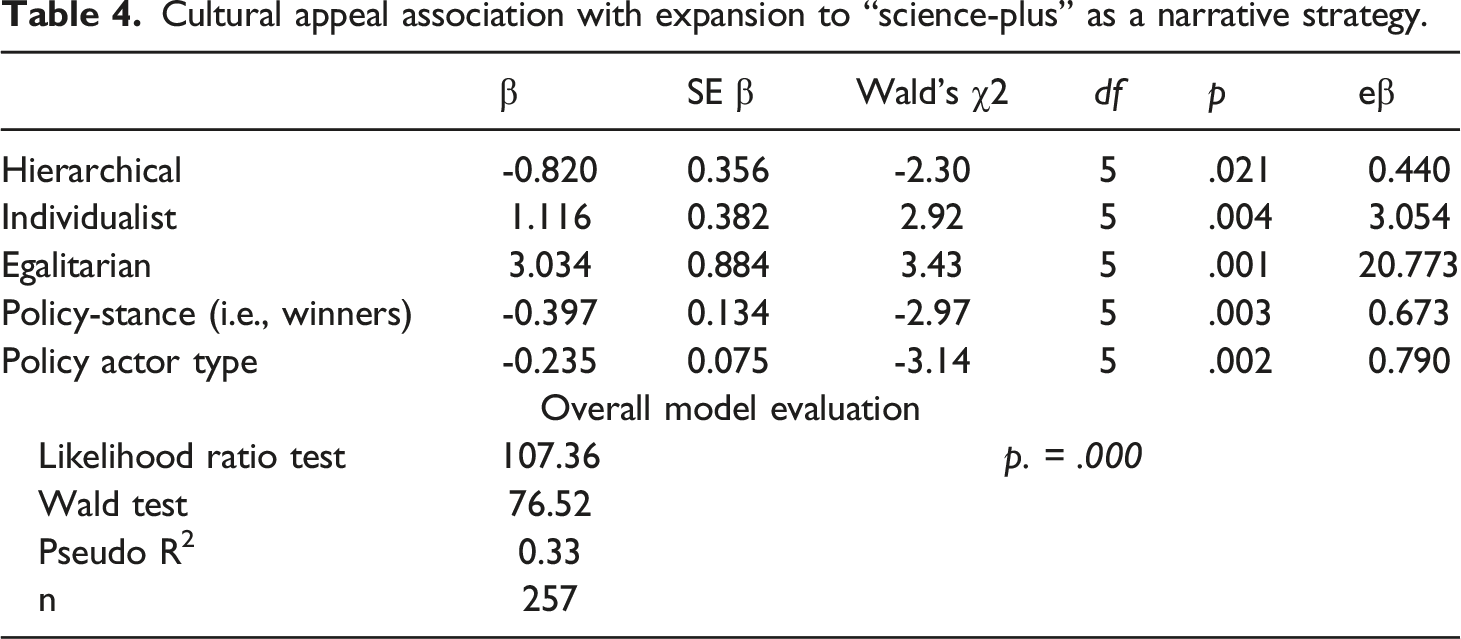
Policy narratives with appeals to egalitarian worldviews were significantly and positively associated with using the scope expansion narrative strategy (Table 4). Egalitarian appeals were 20.77 times more likely to construct the issue as “science-plus” (p = .001). On the other hand, narratives with appeals to hierarchical worldviews were negatively associated with “science-plus” narrative strategies and thus more likely to construct the issue as “science-only” (p = .021) (Table 4), lending partial support for hypothesis 1. As expected, policy winners (pro-GM stances) were also significantly more associated with the “science-only” narrative strategy than with “science-plus” (p = .003) (Table 4). However, contrary to hypothesis one, narratives with appeals to individualistic worldviews were positively and significantly associated with the “science-plus” (p = .004) narrative strategy (Table 4). However, this association was not as strong (odds ratio about 3) as it was for egalitarians (approx. 20). Narratives containing appeals to fatalistic worldviews were not present in the data, so they were not included in subsequent analyses.
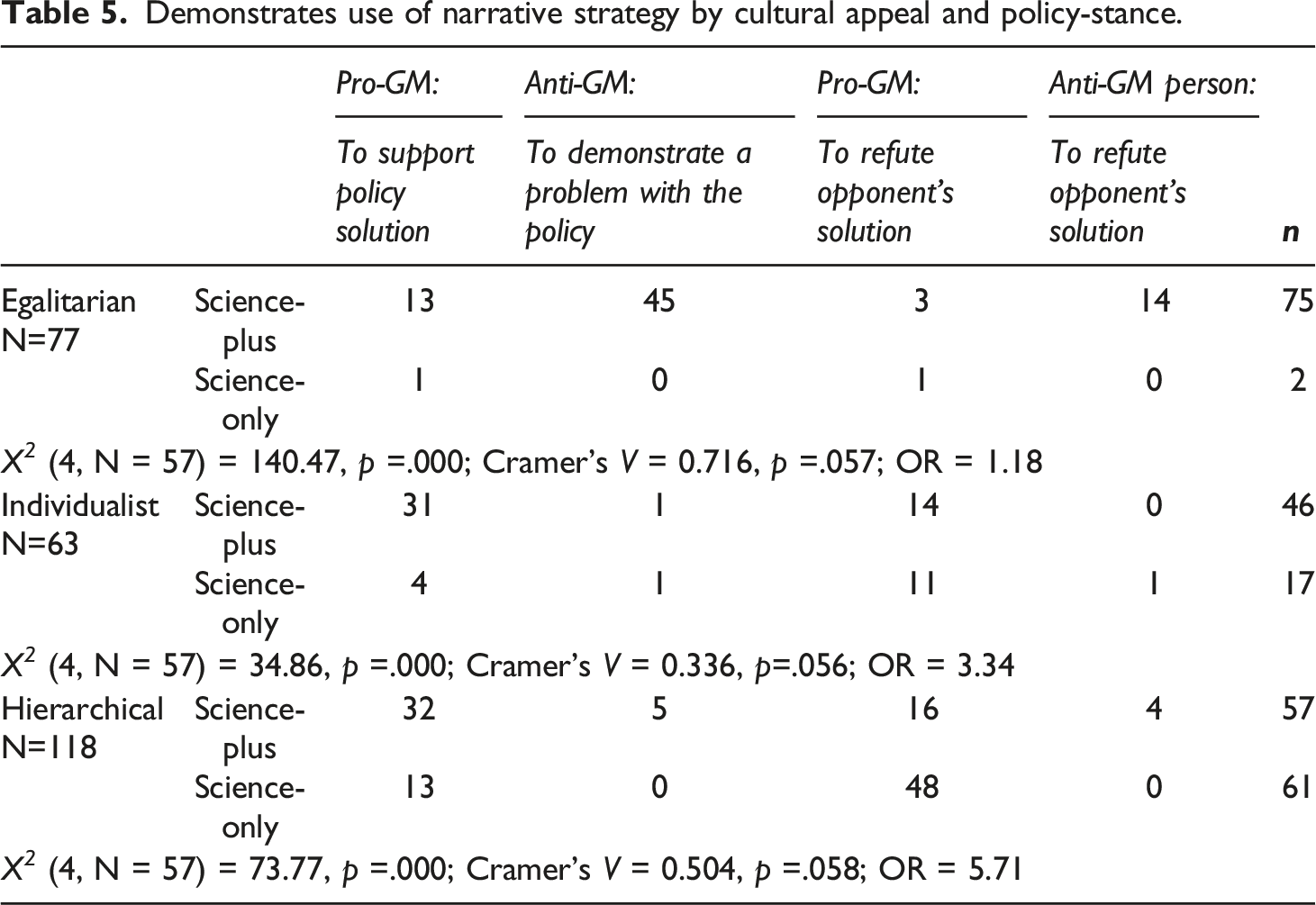
Demonstrates use of narrative strategy by cultural appeal and policy-stance.
Scope expansion or containment as a narrative strategy to refute or support policy-stances (H3)
We then examined how scope expansion, the “science-plus” narrative strategy, was used to support or refute pro-GM or anti-GM policy-stances depending on the narrative’s cultural appeal. Science-plus and science-only narrative strategies were coded based on whether they were used to support or refute an argument that expressed pro-GM or anti-GM sentiment (see Table 3 for coding; Table 5 for results).
As we discussed earlier, narratives with hierarchical appeals construct the GM salmon issue more often as “science-only” than narratives that appeal to individualistic and egalitarian worldviews. Narratives with egalitarian appeals almost exclusively used the “science-plus” narrative strategy (75 out of 77 comments), and individualists used the “science-plus” narrative strategy 46 out of 63 times. Narratives with hierarchical appeals expanded the scope to “science-plus” fewer times (n = 57) in comparison to containing the scope to “science-only” (n = 61) (Table 5). However, hierarchical appeals were about 2.5 times more likely to use the “science-plus” (32 out of 45) narrative strategy than “science-only” (13 out of 45) when arguing in support of a pro-GM policy-stance (Table 5; column 1). In contrast, narratives with hierarchical appeals were over three times more likely contain the scope to “science-only” (48 out of 64) narrative strategy when refuting the anti-GM policy-stance (Table 5; column 3). These findings suggest a selection bias based on how the “science-only” narrative strategy is used by those with hierarchical world views (who are generally pro-GM) (X 2 (4, N = 57) = 73.77, p < .000).
Similar to narratives containing hierarchical appeals, narratives with individualist appeals also use the narrative strategy “science-plus” (31 out of 35) more often than “science-only” (4 out of 35) to support the pro-GM policy-stance (X2 (4, N = 57) = 34.86, p < .000). However, unlike narratives with hierarchical appeals, those with individualist appeals were slightly more likely to construct the issue as “science-plus” (14 out of 25) than “science-only” (11 out of 25) when the argument was used to refute the anti-GM policy-stance (Table 5). Like individualists, egalitarians also used “science-plus” more frequently than “science-only” both to support their (generally anti-GM) arguments and to refute opposing arguments (Table 3).
The above results therefore lend partial support for hypothesis 3, narratives containing hierarchical appeals predominantly used the “science-only” narrative strategy to refute anti-GM positions (but individualists do not). Interestingly, we find that hierarchs switch their narrative scoping strategy depending on whether they are arguing for their pro-GM position or against the opposing, anti-GM position (Table 5). The predisposition of hierarchs seems to be to go beyond the science when arguing for the approval of GM animals (e.g., by stating that GM foods are good for the economy, society, or sustainability), but to refute arguments of those who oppose GM animals by forcing them to stick to the direct scientific risks (or safety). The broader objections to GM animals that anti-GM groups may have related to economic, societal, or sustainability harms thus become marginalized. Our findings match the literature that describes how decision-makers and technology developers have tended to force anti-GM groups to argue against GM foods in the context of risks to human health and the environment (i.e., regulatory concerns), while dismissing their broader objections about industry concentration, ethics, economics, and sustainability (e.g., Kuzma, 2017; Kuzma et al., 2009; Meghani, 2014; Meghani and Kuzma, 2011; Thompson et al., 2007).
Parliament uptake of specific cultural appeals and construction of risk narrative strategy (H5)
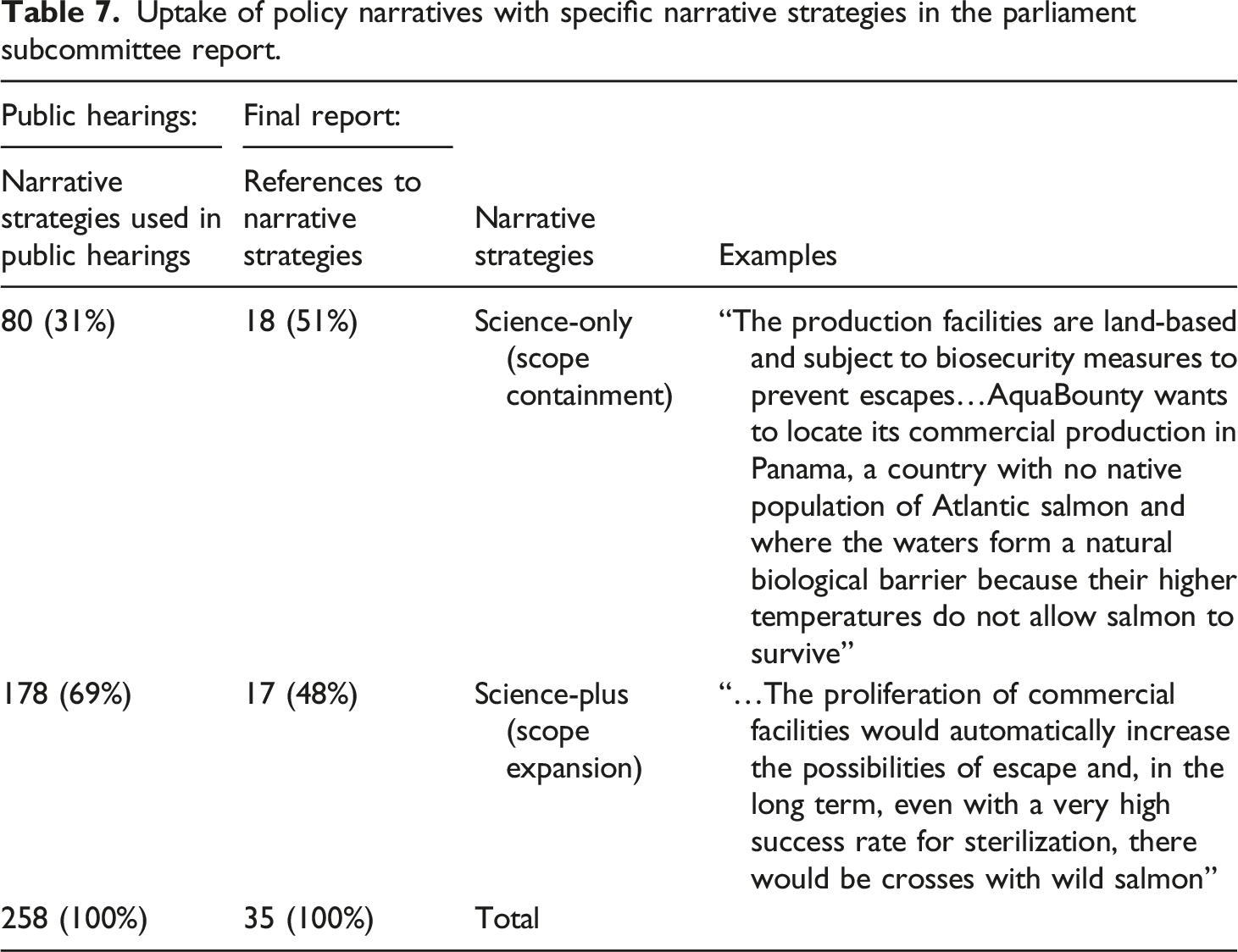
Policy uptake occurs when issues are brought to government officials' attention, and they respond to or “uptake” considerations toward the policy decision (Panisset et al., 2012). To assess institutional policy uptake in the macro-level of the NPF, we examined references to cultural appeals and narrative strategies in Parliament’s final subcommittee report and compared them to the data from Parliament’s hearings. As discussed in the Case Study section, Parliament’s report was authored after the hearings, but before the Federal government report.
Uptake of cultural appeals in the parliament subcommittee report.

Uptake of policy narratives with specific narrative strategies in the parliament subcommittee report.
Federal government uptake of cultural appeals and construction of risk narrative strategies (H4)
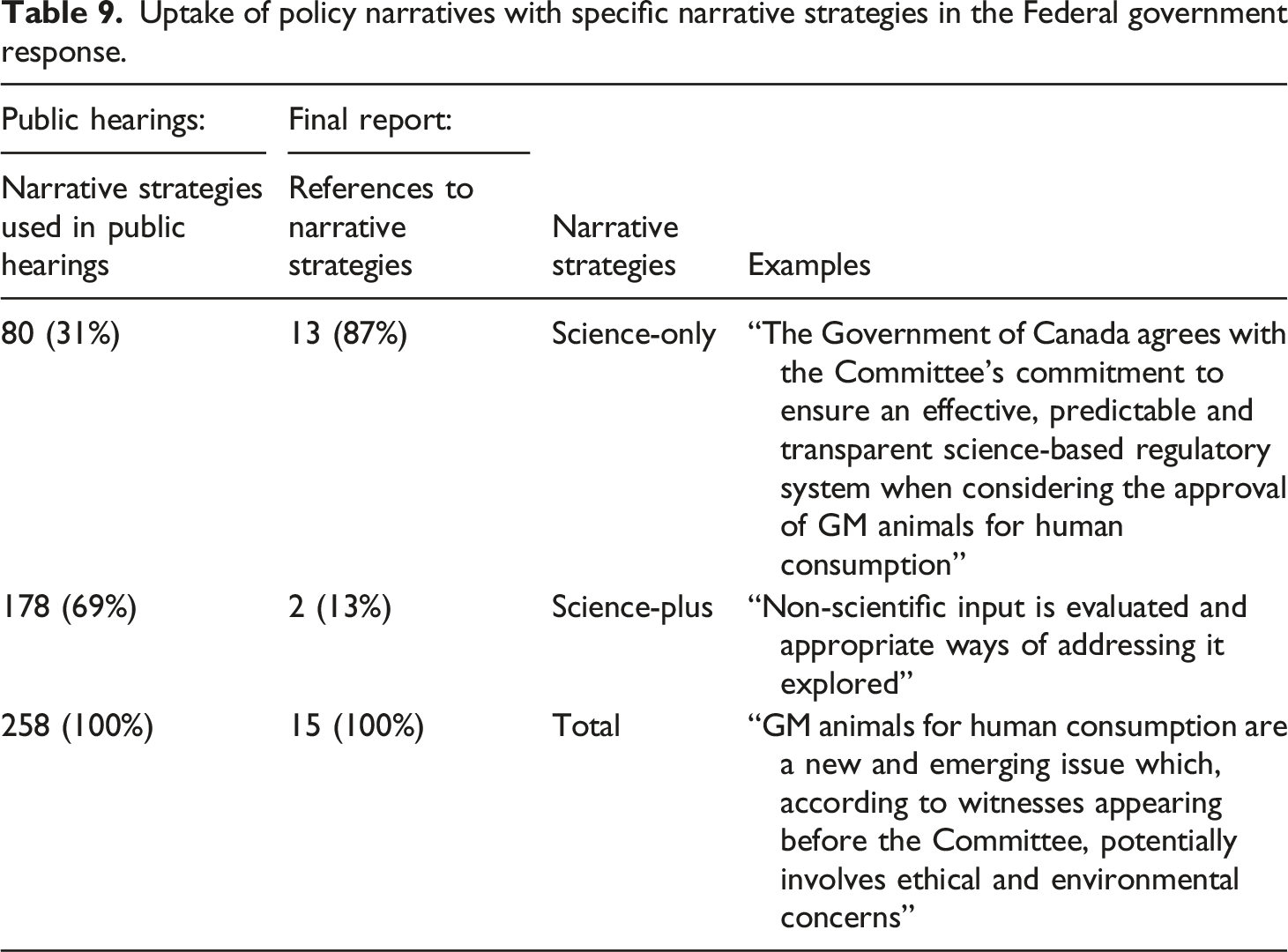
The scope of their authorities binds federal agencies in making decisions. For example, the NSNR(NSO), rules under which the GM salmon were considered, focus on whether the fish is “CEPA toxic” (Canadian Science Advisory Secretariat Science, 2013). This focus makes direct environmental risk the main subject of regulatory assessment. Thus, we expected that the Federal government’s response document to the Parliament hearings would reference more narratives containing “science-only” narrative strategies to contain the scope to direct risk issues (
Uptake of cultural appeals in the Federal government’s response document.

Uptake of policy narratives with specific narrative strategies in the Federal government response.
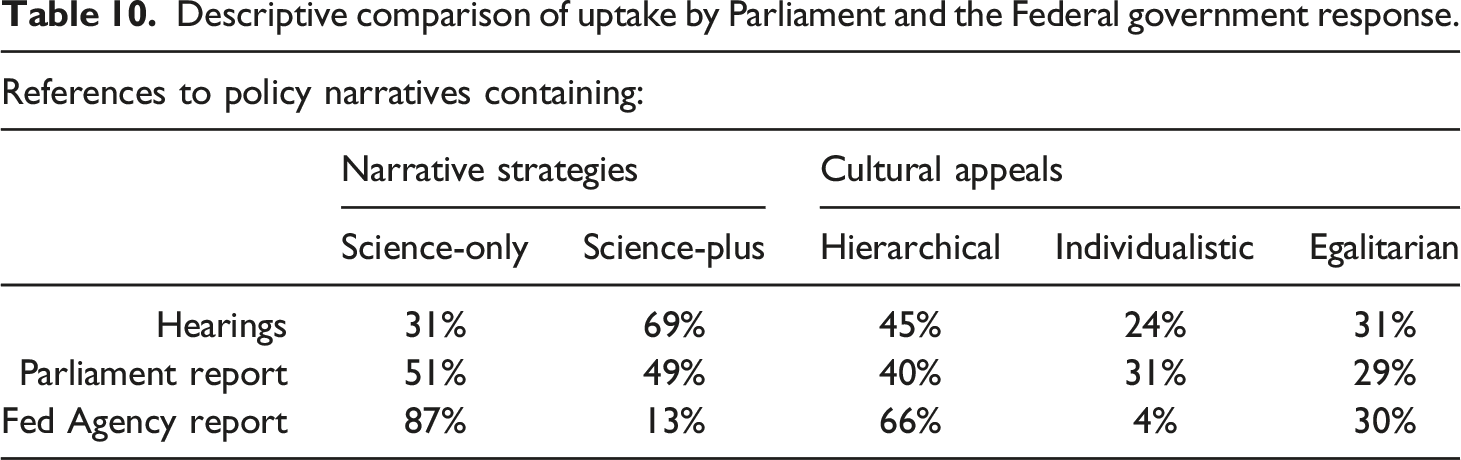
Descriptive comparison of uptake by Parliament and the Federal government response.
Discussion
Our results provide important insights into how narrative strategies vary based on cultural worldviews and policy winners or losers at the NPF meso-level, and how narrative strategies might be used to influence policy uptake at the macro-level. Figure 4 shows our revised conceptual model based on our results. In summary, we found partial support for our initial hypotheses and amend them as follows: (1) narratives containing hierarchical appeals are more likely to be associated constructing the risk as “science-only” (scope containment); (2) narratives containing hierarchical and individualistic appeals are more likely to be associated with “policy winners” (in our case the pro-GM coalition); (3) narratives containing hierarchical appeals are more likely to use the “science-only” construction (scope containment) to refute an anti-GM policy-stance but use the “science-plus” (scope expansion) to support their pro-GM policy-stance; (4) references to narratives containing individualistic appeals and the “science-only” narrative strategy (scope containment) are slightly more prominent than others in Parliament’s subcommittee report; and (5) references to narratives containing hierarchical appeals and the “science-only” narrative strategy are more dominant than others in the Federal government’s response document. We also found that narratives with egalitarian appeals were more significantly more likely to expand the scope of issues to “science-plus” and associate with policy losers (anti-GM) (Figure 4). Below we summarize how our work may more broadly contribute to meso- and macro-level understandings of policy processes related to GM foods and other emerging technologies. Revised conceptual model and findings.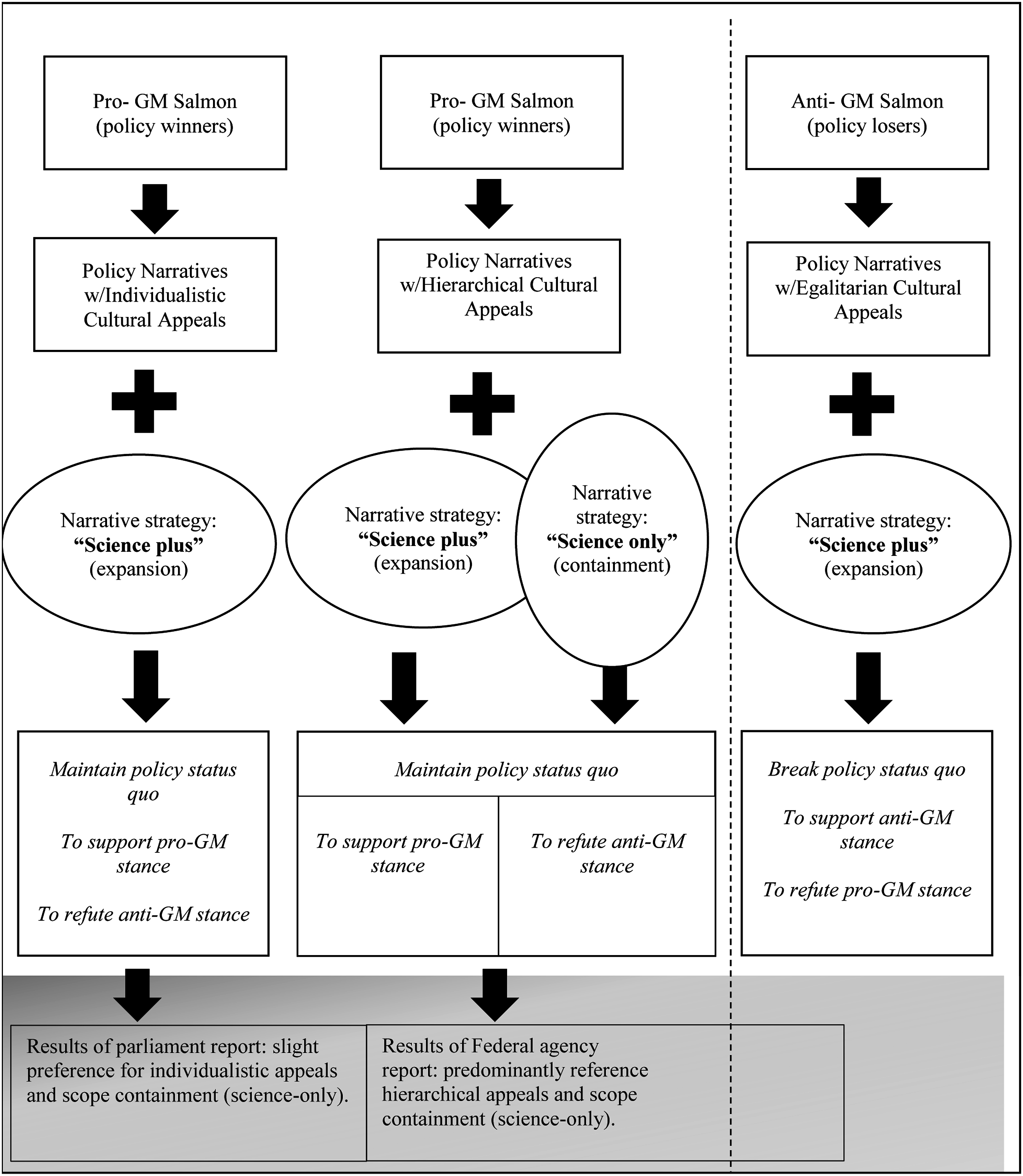
Meso-level
At the policy coalition or NPF meso-level, our findings support previous literature stating that those in favor of the winning policy are least likely to expand the scope of the issue (Baumgartner and Jones, 2009; McBeth et al., 2007). However, this only held true for hierarchical worldviews in our study, as individualist appeals, although more likely to be policy winners, often expanded the scope of the issues to “science-plus.” Based on previous literature about how groups contain the scope of the issue when they favor a policy outcome (Baumgartner and Jones, 2009; McBeth et al., 2007), this finding was somewhat surprising. Therefore, our study contributes to the body of NPF literature by suggesting that scope contraction might not only be related to policy winners, but also certain cultural worldviews.
One of our most interesting observations was the way that hierarchical groups as policy winners and pro-GM used scope contraction to “science-only” issues. Narratives containing hierarchical appeals largely referenced “science-only” when refuting anti-GM arguments, for example, by arguing that “GM foods are safe to eat” but expanded the scope of the issues to support their pro-GM policy-stance. In other words, issues beyond scientific safety were acceptable to hierarchs only if used to support GM-approval. The hierarchical “science-plus” narratives in support of GM foods focused on themes related to the potential for positive economic impact, a faster regulatory process, indirect environmental benefits, advancing science, and the country’s ability to succeed in technology development over other countries. Similarly, policy actors using individualist appeals were likely to use the “science-plus” narrative strategy to support GM salmon approval. These narratives also reflected the potential positive economic impact, improving food scarcity, advancing science, and a more expedient regulatory process.
Narratives exhibiting egalitarian appeals, often the policy losers with more anti-GM perspectives, used the “science-plus” narrative strategy to both support their position and refute the policy of approving GM salmon. However, many of the statements and questions did not express outright condemnation of GM salmon. Instead, they had concerns about the long-term impacts, indirect environmental harms, indirect health risks, potential economic burdens, the use of “sound-science,” transparency, and socio-cultural concerns. Egalitarian appeals were on occasion supportive of the GM salmon within specific stipulations, such as the desire for a labeling requirement. Overall, narratives exhibiting egalitarian appeals were based on strong beliefs about equality and caution concerning nature (Lodge, 2011). A significant issue of concern presented within narratives with egalitarian appeals was transparency and respect for consumers' views. Overall, our findings suggest that egalitarian cultural perspectives and broad concerns about GM technology are de-legitimized in the policy process.
Together, these findings are also interesting because McBeth et al. (2007) posited that discussions about science are inherently associated with core policy beliefs and cannot be a dynamic narrative strategy. However, we found that the construction of risk in the Canadian Parliamentary GM salmon hearings was used as a dynamic narrative strategy to contain or expand the scope of the issue depending on one’s cultural worldview and policy-stance (Table 5; Figure 4). This observation relates to the GM food policy domain literature (e.g., Behringer and Feindt 2019; Meghani 2014; Thompson et al., 2007) in the following ways—the predisposition of those in positions of power and expertise (often hierarchs—see Table 1) is to go beyond the science when arguing for the approval of GM animals by making appeals to the economy, markets, or sustainability, but to refute arguments of those who oppose GM animals (in positions of lesser power) by forcing them to stick to the scientific risks (i.e., their objections to GM animals must be “science-based”). Our study using the NPF at meso and macro-levels supports the historic marginalization of anti-GM perspectives that are not “science-based” (e.g., Meghani, 2014; Thompson et al., 2007). It also highlights the hypocrisy in the debates. Namely, those in favor of GM animals, particularly with hierarchical worldviews, reject arguments against GM-animal approval for broader socioeconomic or cultural reasons (e.g., control of agriculture by big companies, harm to organic industries, and threats to biodiversity) yet use similarly broad issues to support their position for GM animals (e.g., advancing industry and promoting global food supplies).
Macro-level
At the macro-level of institutional policy uptake, we found preferential uptake of “science-only” arguments in the final policy reports. This bias was worse for the Federal government report, as would be expected given the focus on “science-based” regulation in the federal agencies. We also found a strong preference for hierarchical worldviews in the Federal government report, and a slight preference for individualistic worldviews in the Parliament report (Figure 4, bottom row). Given that the policy review process is described as “science-based,” it is not surprising that hierarchical appeals appear more prominently in the Federal government’s response document given this worldviews deference to experts and top-down decision-making. Overall, broader concerns about GM salmon (science-plus) were not incorporated into the final policy documents in proportion to their presence in the hearings.
These macro-level findings speak to the question of who has “voice” in policy processes for decision-making about GM foods and other emerging technologies when public participation events occur. Equal access to public dialogs does not necessarily mean equal opportunities to be heard if your arguments do not resonate as much with those in power. Our study thus begins to touch upon calls for investigating dimensions of power in policy processes, which can be unmasked using the NPF at the macro-level according to Sievers and Jones (2020). According to Stone (2002), narratives are used to articulate and promote a specific understanding of an issue (Shanahan et al., 2017). Policy actors socially construct narratives to communicate information about policy problems to influence potential solutions while often excluding specific alternatives that they do not support to manipulate the scope of the issue (Pierce et al., 2014). Overall, our findings underscore the historical bias in the GM food oversight system to incorporate “expert-based” and “science-only” arguments, thereby negating constituents’ concerns and limiting who has “voice” in policy processes (Meghani, 2014).
Both reports illustrated a shift in perspectives when considering those expressed during the hearings to the “science-only” narrative strategy. Yet the purpose of the Parliamentary hearings is to advance constituents’ concerns because they are representative of a conduit between elected representatives and citizens (Miliken and Hays, 2002; Simmons, 2007). Our findings shed light on how narratives can contain policy issues in imbalanced ways and thus create differentials in power during a conversation among groups with opposing views.
Limitations and future work
Although quantitative content analysis is an acceptable approach for understanding different perspectives on an issue (see Morgan 1993; Morgan and Zhao 1993), it does rely on interpreting secondary data. Therefore, for our macro-level studies we do not claim a direct relationship between narratives expressed in the hearings and the final documents. There is the possibility that the final document’s content is more of a reflection of the pre-dispositions of policymakers than of policy uptake. Regardless, these findings demonstrate that narratives using specific narrative strategies and cultural appeals resonate with policymakers in final documents. Future studies could examine the relationship between the cultural appeal of narratives and narrative strategies using focus groups or survey data under experimental conditions (e.g., Williams, 2021). Still, this study’s practical implications are not trivial and suggest that cognitive bias should be acknowledged within the regulatory decision-making process.
Similar to other NPF studies (Blair and McCormack, 2016; Crow et al., 2017; Schlaufer, 2018), our study uses a single-case study of Canadian Parliamentary hearings and GM salmon. Therefore, it is limited in generalizability. The systematic-structuralist approach of the NPF makes it likely that these findings could be replicated across different policy contexts (i.e., across different applications of emerging technologies) when there are similar belief systems with generalizable narrative context (McBeth et al., 2014a, 2014b; McMorris et al., 2018). Future research could apply our methods and lines of inquiry using the NPF to study meso-level linkages between coalitions, cultural worldviews, and narrative strategies, as well as to investigate macro-level policy uptake in other countries, policy domains, and types of participatory processes.
Regardless, this analysis contributes to understanding the relationship between beliefs, narrative strategies (scope expansion or containment), and policy-stance. It is the first to our knowledge to explore these relationships using the NPF in the contested policy domain of GM animal-based foods. The research also contributes to macro-level investigations utilizing the NPF by exploring policy uptake of narratives at the institutional level, during a window of public participation. Thus, it adds to building hypotheses at the macro-level of NPF, where few studies exist (Veselkova and Beblavy, 2014).
In summary, examining the policymaking process through the lens of cultural theory and the NPF can enhance our understanding of how specific narratives influence uptake more than others. It can also serve to inform ways to improve legitimacy in the policymaking processes by exposing bias and power struggles over scope, as expressed through narratives. By acknowledging the bias that manifests itself through well-articulated stories, decision-makers can seek to identify ways to overcome the tendency to disenfranchise stakeholders whose world views about risk and science do not match their own.
Footnotes
Acknowledgments
The authors gratefully acknowledge the SSHRC @Risk team and the University of Ottawa’s Institute for Science, Society and Policy (https://issp.uottawa.ca/en) for their input and feedback. The authors also thank the Genetic Engineering and Society (GES) Center of North Carolina State University ( ) for their input, feedback, and support. Kuzma was also funded by the Fulbright Canada Research Chair in Science and Society.
Declaration of conflicting interests
The author(s) declared no potential conflicts of interest with respect to the research, authorship, and/or publication of this article.
Funding
The author(s) received no financial support for the research, authorship, and/or publication of this article.