



Abstract
During the influx of neurological research into France from across Europe that took place rapidly in the late 19th century, the philosophy course in lycées (the French equivalent of high schools) was mobilized by education reformers as a means of promulgating the emergent brain sciences and simultaneously steering their cultural resonance. I contend that these linked prongs of philosophy’s public mission under the Third Republic reconciled contradictory pressures to advance the nation’s scientific prowess following its defeat in the Franco-Prussian war of 1870 without dropping France’s distinct tradition of 19th-century spiritualism, which extended from Maine de Biran’s philosophical psychology to Victor Cousin’s official eclectic spiritualism. Between 1874 and 1902, the French Ministry of Public Instruction transformed philosophy into a national project designed to guide the reception of experimental psychology generally and neurology in particular. This article features original archival research on philosophy textbooks and students’ course notes that illuminate the cultural and intellectual impact of these sciences in the fin de siècle from inside the classroom. I argue that the scientific turn in the psychology section of the lycée philosophy course reflected and brought about a distinct philosophical movement that I call ‘scientific spiritualism’. While historians have analysed philosophy instruction as a mechanism used by the Third Republic to secularize students, this article sheds new light on lycée philosophy professors’ campaign to promote scientific spiritualism as a means to advance incipient brain research and pare its reductionist implications.
Introduction
Amid the rapid influx of the emergent brain sciences into France from across Europe during the late 19th century, education reformers mobilized the philosophy course in lycées (the French equivalent of high schools) as a vehicle to promulgate experimental psychology and simultaneously steer the incipient science’s cultural resonance. These twin prongs of philosophy’s public mission under the Third Republic reconciled contradictory pressures to advance the nation’s scientific prowess following its defeat in the Franco-Prussian War of 1870 without unmooring France’s tradition of 19th-century spiritualism, extending from Maine de Biran’s philosophical psychology to Victor Cousin’s official eclectic spiritualism. Between 1874 and 1902 the French Ministry of Public Instruction introduced lessons on experimental methods, psychopathology and brain physiology into the psychology section of the lycée philosophy course. These educational transformations both reflected and brought about a scientifically revivified spiritualism that broke with the Cousinian heritage. This ‘scientific spiritualism’, as I am calling it, casts into stark relief the institutional contexts in which the nascent brain sciences shaped the fin de siècle.
Scientific spiritualism was an intellectual formation in academic philosophy whose proponents occupied posts across French education, from lycées and universities to the upper echelons of the Ministry of Public Instruction. Before teeming crowds filled his lectures at the Collège de France, Henri Bergson, the most celebrated thinker to have revitalized spiritualism on the basis of science, taught the official philosophy curriculum at Lycée Blaise Pascal in the town of Clermont-Ferrand. Bergson opened the psychology section, the focal point of the course, with a thorough introduction to neurology, and proceeded to critique its reductionist implications: ‘If sadness were in the heart, if thought were in the head, it would occupy a place there, and not reside in the brain’ (Brady, 1998: 65). 1 The textbook Bergson used was Paul Janet’s Traité élémentaire de philosophie (1879) (Conche, 1996: 6), the first to feature diagrams of the brain and acknowledge the cerebral bases of consciousness (see Figure 1). Before the author’s nephew, Pierre Janet, became one of France’s leading clinical psychologists, the elder Janet was a guiding architect of education policy who charged lycée philosophy professors with the responsibility of confronting new brain research – what contemporary historians identify as the 19th-century origins of the neurosciences (Young, 1970; Clarke and Jacyna, 1987; Rose and Abi-Rached, 2013). Bergson used Janet’s popular textbook both for its novel analysis of brain physiology and for its trenchant refutation of experimental psychologists who used the science to localize mental phenomena: ‘leaving the body and the role it plays in our life out of the discussion’, the textbook advised, ‘would leave a dangerous weapon in the hands of materialism’ (Janet, 1879: 6). This article examines philosophy textbooks and students’ course notes in order to open an intimate look onto the scientific turn in late 19th-century lycée psychology instruction – a turn that opened a significant rupture in the official philosophy doctrine of French secondary education.

Diagrams of dual hemispheres (Janet, 1879: 21–2).
Since 1809, the lycée philosophy class has been mandatory for all French students during the final year of secondary education. Philo, as the year is called, was originally designed as the coronation of students’ studies, synthesizing a scientific and humanistic education. Most lycées were boarding schools where students lived through the year. And life inside, especially in provincial lycées, left much to be desired: ‘Never-ending and obscure corridors, smoke-filled classrooms, bare and narrow lessons, the freezing atmosphere of dormitories, heady kitchen odors too close to the cafeteria, unclean lavatories, dusty courtyards, soulless parlors’, so one former lycée administrator described lycée conditions (Gerbod, 1968: 16). The typical school day lasted 15 hours, 4 of which were shared between two courses, while the rest were spent studying (Poucet, 1994: 70). The philosophy professor usually opened class by dictating a summary of the day’s lesson, which students copied in their notebooks. Students would rewrite their notes and submit them the following day. Following the lesson, students were welcome to pose questions. The professor would conclude by distributing essay prompts. ‘The professor expounds…and the student composes’, as a typical dissertation manual presented the method: ‘The former is a kind of scientific work, the latter is a work of art’ (Boirac, 1890: xvii). Yet, under the Third Republic, philosophy professors also became the public stewards of the emerging discipline of experimental psychology.
The official philosophy curriculum, or ‘programme’, was composed by the Ministry of Public Instruction and contained 5 sections: psychology; logic; metaphysics; ethics; and the history of philosophy. Psychology had been the centerpiece of the programme since Cousin introduced the section in 1832 from his position atop the ministry. To this day, psychology persists as the first section of the terminal philosophy course under the title ‘the Subject’, which all lycée students study before sitting the baccalauréat, the official exit examination.
Cousin’s eclectic spiritualism reigned as France’s official philosophy for much of the 19th century, from 1830 until after his death in 1867. Spiritualism should be distinguished from ‘spiritism’, understood as contact with a cultish ‘spirit’ world, which also drew wide interest in France (Monroe, 2007; Bower, 2010). Rather, spiritualism was a philosophically robust movement that posited psychology as a window onto ontology. Cousin derived the doctrine from Biran’s guiding idea that consciousness, in opposition to matter, is a reflexive activity carried out by the self, or moi. The psychology section of the philosophy curriculum analysed the self by examining the faculties of consciousness – sensation, reason and the will – using metaphysical methods culled from the western canon. These methods were eclectic, as Donald Kelley highlights, because ‘history in effect took precedence over unassisted and unencumbered reason and became “first philosophy”’ (2002: 9). There were cracks in eclectic spiritualism’s pedagogical monopoly. The Second Empire suppressed philosophy instruction in 1853 until it was reinstated a decade later. But beginning with the education reforms of 1874, in the wake of the Cousinian regime, the psychology section incorporated physiological methods, indicative of the historical bifurcation of the field between metaphysical and experimental psychology.
‘The new spiritualism’, the philosopher Étienne Vacherot wrote in 1884, ‘is not a new doctrine: it is spiritualism renewed by science’ (1884: i). This new spiritualism retained conceptual affinities with its eclectic ancestor, notably a resolute opposition to materialist reductionism; but it also paved a distinct philosophical path. Whereas Cousin was wed to faculty psychology, scientific spiritualists adopted the sensory-motor language of experimental psychology and conceived consciousness as an embodied activity carried out in a shared biological and social world. This transformation took place within a philosophical horizon in late 19th-century France oriented around the problem of what constitutes conscious activity, or what Frédéric Worms calls the problem of spirit (2009: 31–64). Although experimental psychology shed light on the nervous system’s disposition toward action, scientific spiritualists argued that an irreducibly creative activity inheres in the rich inner life of consciousness. As the philosopher Édouard Le Roy argued, ‘Scientific investigations reduce the incessant becoming of spiritual life [la vie spirituelle] and consequently cannot alone account for their very genesis: there you have the necessity of a complementary discipline to research psychic reality and reach into the mystery of its creative activity’ (1899: 717). Scientific spiritualists like Le Roy thus deployed metaphysics, not in order to deduce the mind’s unity from its distinct faculties as eclectic spiritualists held, but instead, as a means to restore the fluidity of conscious experience and thereby bring experimental psychology to completion.
The new attention devoted to experimental psychology in the official curriculum was also part and parcel of the Third Republic’s laïque reforms. Defined negatively as the curtailment of religious influences over the official curriculum, laïcité found its positive content in scientific instruction. Education ‘passed on first and foremost a cult of science’, according to Philip Nord, ‘and the republic elevated that cult into a secular religion, reverencing scientists as men of progress, raising statues to them and extolling their virtues to the young’ (1995: 32). Scientific values – subsumed under the banner of positivism – filled the moral void left by the Roman Catholic Church’s diminishing role in public life. A predominant historiographical narrative holds that the ascent of positivism, understood as a civic ideal promoted by Republican politicians as well as an intellectual doctrine enforced in the new university system, came as a blow to France’s spiritualist legacy. Positivism’s ‘dominance during the 1880s and 1890s was not absolute’, Fritz Ringer contends. ‘The old eclectic “spiritualism” still retained a measure of influence within the University’, but Ringer nonetheless concludes that Cousin’s influence ‘did not undermine the role of positivism as an orthodoxy, and as an ally of the Radical Republic’ (Ringer, 1992: 211).
Renewed focus on Cousin has duly challenged the narrative that positivism was central to late 19th-century French intellectual culture (Brooks III, 1998; Carroy and Plas, 2000). In particular, Jan Goldstein documents the intellectual and institutional support that eclectic spiritualism, inculcated as an anti-naturalist study of the self, furnished for the bourgeois masculine ideology of post-revolutionary France (2005). In an incisive recent article, Goldstein traces Cousin’s influence beyond his death: ‘As a regime that embraced scientific positivism and an active anticlerical policy once it became fully “republicanized” around 1880…the early Third Republic would seem to have had every reason to unseat the old Cousinian philosophy’ (2013: 53). She claims this was not the case, however, because ‘Psychology, still presented as the first and foundational branch of philosophy, still operated with a tripartite consciousness comprised of sensation, reason, and will’ (ibid.).
Although Goldstein aptly corrects historiographies of Republican intellectual culture anchored in the ascent of positivism, her own analysis remains tethered to a false opposition between spiritualism and positivism. As I will argue, the educational reforms of the late 19th century set the stage for spiritualist philosophy professors, Bergson chief among them, to break with Cousin and advance a scientific spiritualism. In so doing, these thinkers jettisoned the anti-naturalist thrust of eclecticism in order to revolutionize their spiritualist commitments to the autonomy of consciousness and the reality of free will on the basis of experimental research. This is not to suggest that the educational reforms of the Third Republic completely abandoned France’s Cousinian heritage. Rather, my argument is that the scientific turn in the psychology section of the philosophy course precipitated a revolution within French spiritualism. The notes and textbooks from Bergson’s courses in particular illuminate the public mission of scientific spiritualism and explain the philosopher’s meteoric rise to fame. Indeed, it is my contention that Bergson, so often misconstrued as a singular thinker of the fin de siècle, climbed the academic hierarchy in large part because he so effectively carried out the educational campaign under the Third Republic to confront the brain in the classroom.
The scientific turn in psychology instruction between 1874 and 1902
Following the Franco-Prussian War, French politicians and education reformers placed blame for the nation’s defeat on retrograde scientific institutions. In the face of the technologically advanced German Empire, the Third Republic promoted scientific education as the key to surpassing the perpetual foe across the Rhine. Yet, it was in the lycée philosophy curriculum that education reforms confronted the competing imperative of preserving France’s intellectual heritage. Even though, as Paul Janet reflected, ‘Germany has become our idol since it humiliated us’ (1894: 54), it was secondary education that distinguished the French. Philosophy instruction was not mandatory in the German Gymnasium, while it marked the apex of the French lycée. It was the responsibility of the towns to manage collèges, where students spent the first 4 years of secondary education; however, the lycées, covering the final 3 years, fell under the national purview. Collège included a section in practical moral education, but philosophy, instructed as a systematic science humaine, was unique to the final year of lycée, and became a conduit for cultivating rational Republican citizens.
For much of the century, the majority of secondary students attended ecclesiastic, or ‘free’ schools. But Jules Ferry set about integrating the nation’s youth into public schools in a series of educational reforms. The law of 21 December 1880 organized girls’ collèges and lycées, bringing young women under public tutelage and chipping away at ecclesiastic schools’ authority. Unlike secondary schools for boys, however, there was no baccalauréat. Young women received a ‘diplôme d’études secondaires’, a non-vocational degree. Moreover, there was no philosophy instruction, a discipline reserved for the sons of the bourgeoisie. Ferry’s reforms culminated with the law of 28 March 1882 barring religious instruction in public schools. The Republic’s anti-clerical initiatives left it up to families and private schools to inculcate religion, propelling laïcité toward its consummation in the law of 9 December 1905, which formally separated church and state.
It was during this period that philosophy instruction underwent 4 major reforms in 1874, 1880, 1885 and 1902 that progressively integrated experimental research into the psychology section. By 1907, the psychologist Alfred Binet surveyed 300 lycée philosophy professors to measure the impact of these lessons in the classroom. He concluded that, since 1874, ‘psychology has moved closer to biology and medicine: less introspection, in short, and more objectivity’ (1907: 167). Lycée students had the choice of pursuing one of two degree tracks in either classical or mathematical (modern) studies. With each reform, the importance of philosophy for those pursuing the latter diminished, while the content of philosophy in the classics degree became more scientific. This transformation was by no means uncontested. It reflected a synthesis of academic and parliamentary power. As George Weisz documents, academics and professionals trained in universities made up a significant portion of the government’s deputies (1983: 9). The Ministry of Public Instruction recruited philosophers into its ranks, including three deputies of education: Ferdinand Buisson, the 1927 Nobel Peace Prize winner who served as director of primary education from 1879 to 1896; Élie Rabier, director of secondary education from 1889 to 1907; and Louis Liard, director of the universities from 1884 to 1902 (Havelange, Huguet and Lebedeff, 1986).
Jules Simon first implemented his vision of secondary education as the Minister of Public Instruction from 1870 to 1873. His tenure stood out for its momentary stability among the 11 heads of the ministry during the tumultuous first decade of the Third Republic. A former student of Cousin, Simon saw himself as representing his master’s legacy (Simon, 1887). He replaced the Imperial Council of the University with a Council of the Ministry whose 48 members included numerous philosophers drawn from the university. The spiritualist philosophers Charles Jourdain, Michel Bréal, Ernest Bersot, Paul Janet and Félix Ravaisson (who served as secretary) were ‘the friends’, Simon wrote, ‘who met in my cabinet every Saturday and who, without an official title, by their friendship for the minister and above all for solid scholarship, worked with me on all the reforms’ (1874: 77).
It was on 23 July 1874 under the subsequent minister, Anselme Batbie, that the ministry released the first programme reflecting the scientific turn in the spiritualist curriculum. True to the Cousinian legacy, it opened by distinguishing philosophy from other sciences, followed by the first and most significant section, psychology. But the 1874 reform brought about a significant rupture: psychology ceased to be studied as a deductive inquiry, and instead opened with a lesson on the nature of psychological facts, which were distinguished from physiological facts. The lesson set the scientific tenor of the course, which preserved the spiritualist approach to psychology by outlining the faculties of consciousness and categorizing ideas according to propaedeutic rules of reasoning. Yet, in recognizing the material bases of consciousness, the lessons no longer took for granted the long-standing introspective approach of eclectic psychology. ‘It appears therefore that the general tone of this rubric was profoundly marked by the empiricism of a new discipline, psychology,’ Bruno Poucet writes, ‘a sign, along with the presence of political economy, of the defeat of the unity of the philosophy programme, which no longer marked the triumph of spiritualism as the only point of view’ (1999: 136).
Jules Ferry, a devotee of Comtian positivism (Nicolet, 1982: 256), announced the new philosophy programme on 12 August 1880. The physiological orientation of psychology was reinforced. The curriculum continued to organize the subject around sensibility, intelligence and the will, but these domains were no longer taught under the rubric of faculties. They were instead presented within the experimental classification of distinct psychological activities, representative of the sensory-motor account of consciousness adopted by scientific spiritualism. The lesson on liberty in the psychology section, for example, abandoned the Cartesian title, ‘moral liberty or free will, its demonstration, and negation’. The Ministry of Public Instruction refashioned the lesson into ‘the voluntary act’, which discussed experimental insights into instinctual behavior, reflexivity and habituation alongside the metaphysical domain of consciousness’ intentional content (Marion, 1880). The reform established scientific and philosophical psychology as complementary fields. Yet many saw it as a direct assault on Cousin’s faculty psychology. Francisque Bouiller, a Cousinian loyalist, argued: [D]espite the authors of the program, the word ‘faculty’ is not more a part of our philosophical language than it is a part of our literary language. But the moment seems poorly chosen to ban the concept, while the reformers return more than ever to the honor of physiology, which they believe has definitively localized certain faculties in the brain. (1880: 289)
To ensure that local departments carried out the reforms, Ferry’s ministry expanded the role of the inspectors general. Created in 1802 under Napoleon, the inspectors monitored all public schools across the three levels of instruction. Under Ferry, 2 were assigned to primary schools, 6 to secondary schools (evenly shared between letters and mathematics), and 8 to universities (3 for letters, 3 for sciences, 1 for law and 1 for medicine). Appearing in each classroom once a year, the inspectors graded the professors. Soon after Ferry assumed the ministry, the spiritualist philosopher Jules Lachelier, the professor of so many young philosophy students at the École normale supérieure, became an inspector general for secondary education. He worked alongside the lycée philosophy professor, François Evellin.
Lachelier served as the primary intermediary between philosophy professors and the Ministry of Public Instruction. When many expressed dissatisfaction after having to learn new material, including brain anatomy and social science methods, it was up to Lachelier to propose an alternative curriculum. What followed was a new programme released on 22 January 1885 (Programme de philosophie, 1885). Professors no longer had to teach the political economy lesson. It instead became the watered-down ‘relations between morals and political economy’. Élie Rabier, who drafted the curriculum for the psychology section, eliminated the metaphysical lessons, ‘the idea of God’ and ‘the idea of the external world’. Lachelier renamed the ‘metaphysics and theodicy’ section ‘metaphysics’, and, against the scientific trend, added a lesson titled ‘Providence and Natural Religion’. The final section, ‘History of Philosophy’, was replaced with ‘Notions of the Principal Philosophical Doctrines’. The lineage it traced commenced with Socrates and, as if extending an olive branch to the old guard, concluded with Cousin.
Released on 28 May 1902, the final programme elevated the scientific tenor of psychology and further trimmed metaphysics. The latter section was demoted to a mere 3 lessons, the last of which was titled ‘Metaphysical Relationship between Science and Ethics’. ‘Our old philosophy must still be conserved’, Louis Liard, the director of universities, announced, ‘but while reducing its excessive dialectics and developing the scientific spirit’ (1903: 11). The Latin and Greek requirements were abridged, which proponents praised as philosophy’s modernization and critics lambasted as an affront to its historical backbone. The final section dedicated to the history of philosophy, over which Cousin’s legacy still claimed a crumbling foothold, was eliminated and replaced by a less systematic appendix of key historical texts.
The 1902 programme completely dropped the Cousinian schema of sensibility, intelligence and the will, and instead divided the psychology section into the dual categories of ‘Intellectual Life’ and ‘Affective and Active Life’ (Programme de philosophie, 1902). The division cleanly separated physiology from metaphysics, paving the way for the concluding lesson reconciling ‘the physical and the spiritual’ (ibid.). The programme thus promoted a dialogue crossing the widening gulf between metaphysical and experimental approaches to the study of consciousness. Yet, despite Cousin’s waning influence over the curriculum, this dialogue was by no means neutral. Attuned to the new horizon opened by the brain sciences, yet simultaneously wary of their materialist implications, education reformers lent traction to a revivified strand of spiritualism, no longer grounded in faculty psychology, but nonetheless committed to the irreducibility of conscious – or spiritual – activity. A new generation of spiritualist professors seized their lycée teaching posts as an opportunity to forgo the narrowly historical project of the bygone spiritualism and instead to mine incipient research on hallucinations and psychological abnormalities, the duration of attentive and perceptive psychic acts, and bourgeoning brain localization, including the cortical bases of memory and language. These subfields progressively found their place with each reform to the psychology section. And by 1902 the chronic upheavals to the philosophy class subsided until the Ministry of Public Instruction introduced the contemporary philosophy programme in 1960.
Bergson teaches experimental psychology in the classroom
Representative of this new generation was the young Henri Bergson, who first studied cerebral physiology and psychophysical methods as a fresh lycée instructor. Bergson was a typical state functionary who, like fellow professors, taught the official programme in a provincial lycée and set his sights on attaining one of the 16 philosophy chairs in the Université de Paris system. Yet Bergson stands out for his exceptionally rapid academic ascent – attributable in large part, I am suggesting, to his masterful exegesis of new experimental research in the terminal philosophy course.
Bergson finished his studies at the École normale supérieure by ranking second in a class of 8 who passed the agrégation in 1881 (Concours, 1881: 810). The competitive examination had been used to train the educational elite since its inception under Louis XV in 1766. But under the Third Republic, the agrégation came to serve the function of channeling professors from Paris to the provinces in order to disseminate laïque and scientific values. Like all newly minted lycée professors, Bergson wrote his doctoral thesis while teaching philosophy. Following posts at the Lycée d’Angers, a young women’s school, and then in Clermont-Ferrand, Bergson moved to the Lycée Henri IV in Paris. Following his two rejections for professorships at the Sorbonne, the École normale made Bergson a university professor in 1898. Two years later, he leapt into the Collège de France, where he remained until his retirement in 1921. By the age of 40, Bergson rose above fellow lycée philosophy professors through having swiftly climbed the educational ladder.
Bergson’s advancement depended on the inspectors general, who monitored all philosophy professors. Speaking clearly, holding students responsible and using relevant examples, were all criteria that the inspectors employed when evaluating professors’ performance. Following the 1880 reform, François Evellin enjoined philosophy professors to begin the course with a philosophical lexicon: ‘the first duty of a professor is to create a rational vocabulary’ (1884: 164). Evellin outlined the two best teaching methods: the expository method, whereby professors read a lesson and answer questions from the previous day, and the dialectical method, whereby the professor poses a series of questions (‘cold calling’ was standard practice). He deemed the latter ‘the method the most appropriate for the formation of a youth, who, in order to become a resource for the country, must penetrate in all directions of thought, before we ourselves have even done so’ (ibid.: 170).
In 1885, Evellin visited Bergson’s class at Clermont-Ferrand and wrote a positive report. 2 ‘It was at Clermont that I made my most essential discoveries’, Bergson recounted; indeed he was known for having voraciously read scientific journals to prepare psychology lessons. ‘But [François] Evellin and [Jules] Lachelier, who inspected me there, forcefully told me: you have to go to Paris and take your place’ (Chevalier, 1959: 178). In 1894, Lachelier evaluated Bergson as a professor at Lycée Henri IV in Paris. The inspector praised the ‘rigor of his method’, returning the next year to write another glowing report: ‘complete clarity compatible with his depth, and only here and there are some things a bit artificial for his thought and a bit thin on development’ (Soulez and Worms, 2002: 88). Soon after in 1896, Bergson was selected to teach courses in Greek and Latin philosophy as a docent at the Collège de France before taking a full professorship in 1900.
An essay prompt scrawled in the notebook of one of Bergson’s students in an 1893 course at Lycée Henri IV reveals the close engagement between scientific and metaphysical concepts in the classroom. Bergson had students respond to the question, ‘What does the philosophical spirit consist of? Determine the nature of the philosophical spirit by opposition with the scientific spirit and common sense’ (Waltz, 1893). ‘Common sense’ carried the particular meaning of a phenomenon’s appearance, which traditionally functioned as the starting point of dialectic reasoning in French philosophy instruction. Taking the concept of external perception as his example, the student compared, first, the utility of perception for survival according to common sense; second, the function of perception in making predictions according to scientific reason; and third, the knowledge that perception gleans from reality in itself according to philosophy. Although the student concludes, ‘there is therefore a real opposition between the philosophical spirit and the scientific spirit’ (ibid.), his outline reflects Bergson’s method of setting scientific and metaphysical concepts in mutual dialogue.
Nowhere was this more evident than in the psychology section. Bergson tackled the lesson on physiological and psychological facts in 1886 by forcefully articulating the stakes of neurological research. ‘Our moral life consists of science, art, and religion, but we cannot at all see how nerve cells, if they existed alone, could coordinate themselves in a manner to bring about these great thoughts and beautiful feelings’ (Bergson, 1990: 33). 3 Bergson employed the brain anatomy diagrams included in Janet’s Traité (1879). And he also addressed the developing science of psychophysics in the 13th lesson. Bergson presented Gustav Fechner’s quantitative approach to the measurement of psychic states, as well as that of the like-minded psycho-physicists Joseph Delboeuf and Ewald Hering. Bergson argued: ‘[T]he experiments and Fechner’s law are very debatable, even for those who admit the possibility of calculating sensation. We could even go farther: we can wonder if a similar law would not be fallacious in its very principle, for what does it mean for sensations to double, triple, or quadruple another?’ (Brady, 1998: 69). Bergson’s critical engagement with psychophysics was central to his guiding argument in his thesis, Essai sur les données immédiates de la conscience (1889): that affective states of consciousness are distinctly qualitative and are thus not measurable.
Contrasting Bergson’s performance in the classroom with that of his spiritualist contemporary Jules Lagneau, throws into stark relief not only the divergence between the scientifically revamped spiritualism and the eclectic program, but also the pedagogical premium that ministers afforded the former. A fellow normalien who passed the agrégation in 1875, Lagneau pursued the same career trajectory as Bergson. He hopped from provincial lycées in Sens (1876–8), Saint-Quentin (1879–80) and Nancy (1880–6). Lagneau made it to Paris in 1886, taking a professorship at Lycée Michelet where he remained until his premature death in 1894 at the age of 43 (Canivez, 1965: 368). But since Lagneau hardly invoked scientific examples in the psychology section, he drew the criticism of the inspectors general.
Lagneau, like Bergson, dedicated the bulk of his philosophy course to psychology. As one student commented, ‘During the major part of the academic year, [Lagneau] only treated the introduction to philosophy and psychology extensively. All the rest was taught briefly or passed on by means of copied texts’ (Canivez, 1965: 371). His approach to psychology, however, was markedly less scientific. Lagneau swiftly handled the same section on psychological and physiological facts in a class also taught in 1886. A student’s notes read: ‘It is known that in order to conceive of certain thoughts, we have to make use of a part of the brain…One might be tempted to substitute psychological knowledge for physiological knowledge, which arrives at tangible results’ (Lagneau, 1997: 24). 4 Lagneau believed that there was a strict separation between the two. ‘Physiological science can only go back to conditions of conditions: it would not know how to seek the reason for facts, but only the conditions in which they are produced’ (ibid.: 47). But rather than engage the brain sciences, Lagneau dismissed their relevance. In similarly summary fashion, Lagneau addressed required topics, ‘comparative or descriptive psychology’, ‘physiological or explanatory psychology’ and even ‘psycho-physics’, under the lesson ‘The Objective Form and Experimental Method in Psychology’ (ibid.: 54). But Lagneau made no references to neurology. It was thus unsurprising to find that inspectors as early as 1879 wrote in their reports: ‘Course too metaphysical’ (Rapport, n.d.).
When Lachelier evaluated Lagneau’s class in 1887, he wrote a positive review: ‘His class is one of the strongest that I have seen this year; not only do the students respond well and voluntarily, but they also handle the subjects with ease and clarity in their essays’ (Lagneau, 1996: 15). But when another inspector, Élie Rabier, visited two years later, the report was hardly as warm: ‘Without a doubt, no one can teach contrary to his doctrine, and unfortunately yours, I do think, is among the most difficult to teach because of the originality of your point of view, which is completely metaphysical’ (Canivez, 1965: 364). Rabier advised Lagneau to temper his abstract lessons with at least three scientific examples per week, ‘so that students could study sensations as ordinary facts’ (ibid.).
The difference between Bergson’s and Lagneau’s pedagogical approaches to the psychology section turned on their respective engagements with experimental methods. Whereas Lagneau took metaphysics as psychology’s point of departure, Bergson took it as psychology’s point of arrival – a divide emblematic of eclectic and scientific spiritualism. In his notes for Langeau’s lesson, ‘Psychology and Metaphysics’, a young Alain wrote: ‘[T]he true science of the spirit is not psychology, but metaphysics’, since metaphysics reveals the unity of the self on which thinking depends (Chartier, n.d.). Bergson, by contrast, oriented his psychology lessons around experimental psychology in order to demonstrate that the incipient field yielded problems of consciousness – notably the existence of subjective facts and the possibility of free will – that demanded metaphysical resolutions. While many, as Harry Paul documents, took this spiritualist method to be a criticism of ‘the bankruptcy of science’, Bergson saw himself as opening the study of consciousness to naturalist inquiry, a position all the more conciliatory in contrast to Lagneau’s anti-scientific spiritualist commitments (Paul, 1968).
Bergson and Lagneau both used the same psychology manual, Élie Rabier’s Leçons de philosophie (Conche, 1996: 6). Originally published in 1884, Leçons underwent 12 new editions until its last in 1912. A heavy tome with some 676 pages, Rabier’s textbook was dedicated solely to psychology, and it offered the most comprehensive introduction to the subject. It was Rabier’s belief that ‘Philosophy collaborates with scientific studies, in the sense that it must first of all better understand science, and appreciate it all the more’ (Rabier, 1886: 4). Rabier’s Leçons was one of the most widely used textbooks of the period, as Binet’s 1907 survey of lycée philosophy instructors confirmed (1907: 213). In fact, it was the same manual that the young Marcel Proust used as a lycée student in 1886 (Fonds de Marcel Proust, n.d.). Perhaps its success was due to the fact that the author was an inspector general and subsequent director of secondary instruction from 1889. Indeed, according to Alain, Lagneau only mentioned the textbook during his lectures out of deference: ‘Rabier was the “pedant”…kept in hand during his inspection’ (1925: 722).
It is clear from the notes taken by students in Bergson’s class, by contrast, that he regularly incorporated and even critiqued Rabier’s Leçons. In its lesson on consciousness, the textbook disputed the notion of the unconscious on the grounds that psychic facts are untenable outside of consciousness, and instead inhere among different degrees of consciousness (Rabier, 1886: 68). The unconscious, according to experimental psychologists of the late 19th century, signified neurological processes taking place outside of awareness (which was notably different from either Sigmund Freud’s or Pierre Janet’s understanding, which did not reduce unconscious drives to the nervous system). In his course at Clermont-Ferrand in 1887, Bergson remained faithful to Rabier’s claim (Bergson, 1990: 91). But by 1893 in Paris, Bergson took full advantage of his elevated teaching position and added an additional lesson on the problem of unconscious sensations. He asked: How can we explain them? A first solution would consist of purely and simply denying the possibility of unconscious psychic facts. That is where several contemporary psychologists stop, including Rabier. Their argument can be summed up thus: a psychological fact is by its very definition a conscious fact. (Bergson, 2008: 162) Without a doubt, the perfectly psychological state is a conscious state, but this property of psychological states, as important as it may be, is not the only one. Even though there are states that might not resemble the properties of conscious, psychological facts, they are infinitely more conscious than physiological or physical facts. (Bergson, 2008: 162)
Situating the emergence of Bergson’s thought within the educational context of the Third Republic invites historians of the fin de siècle to revise their understanding of the philosopher as a singular thinker. Moreover, his contribution to scientific spiritualism, I am suggesting, helps to reframe the historiographical narrative according to which Bergson led a ‘revolt against positivism’ (Hughes, 1958: 33–66), a ‘revolt against mechanism’ (Grogin, 1988: 1), or a ‘reaction against materialism’ (Burrow, 2000: 56–7). Far from having led an opposition to the sciences, Bergson profited from a scientific turn in lycée instruction. He and other scientific spiritualists, as I will show, sought to renew the metaphysical study of consciousness on the basis of the very sciences – experimental psychology generally and neurology in particular – that threatened the authority of metaphysics in the late 19th century.
Teaching scientific spiritualism in philosophy textbooks
The educational reforms of the Third Republic opened a new era of academic freedom that galvanized the market for publishing textbooks. Between 1874 and 1879, there were 20 new philosophy manuals, 9 between 1880 and 1884, and 14 more following the 1885 reform (Choppin, 1992). Most were written by philosophy professors seeking to achieve momentary fame by publishing their course notes in lieu of more significant scholarship. There were 4 types of philosophy textbooks: pedagogical books, which professors used to guide their own teaching; manuals published by and for religious schools; dissertation manuals, which instructed students how to write philosophy essays; and educational manuals used in the terminal class of the public lycées. I focus on the final type in this section.
Most philosophy textbooks shared a general form. They opened with an introduction in which the author clarified changes to the programme. And when honest, the author would make his philosophical commitments explicit, a characteristic feature of the textbooks used under Cousin’s tenure. ‘The doctrines of the manual are the pure and strict spiritualist doctrines’, a typical introduction read, ‘which the University, under the impulse and leadership of an illustrious philosopher, arduously sets about propagating’ (Jacques, Simon and Saisset, 1846: vi). With their increasingly scientific temperament under the Third Republic, fewer manuals expressed such idolatry of Cousin. A list of the lessons contained in the programme followed the introduction. Then the bulk of the textbook featured the contents of the lessons, with italicized headings indicating the most important paragraphs.
A number of textbooks open a window onto the pedagogical program driving scientific spiritualism. Paul Janet’s Traité élémentaire de philosophie (1879), as I noted earlier, was groundbreaking for having been the first to include diagrams of the brain’s dual hemispheres, as well as the ear, the eye, the nervous system and the spinal cord. Conceding that contemporary advances in physiological psychology left the Cousinian heritage outdated, Janet opened the textbook, following a brief introduction, with a significant neurology lesson, which he justified on the grounds that ‘All philosophy must depart from what really exists’ (Janet, 1879: vi). The lesson consisted of a thorough anatomy of the human body, the organs and their nutritional functions, and the circuitry of the nervous system, including an extensive discussion of the reflex arc. Janet wrote in clear and concise prose that served students as well as professors who had not received a formal training in physiology. The subsequent chapters of the Traité advanced higher in the hierarchy of psychological complexity, from affective phenomena, sensations and memory, to recent psychopathological discoveries on sleep, dreams and madness. Janet divided his textbook into two classes of psychology, ‘on the one hand those aspects which immediately pertain to the body, and which we share in common with animals, and on the other hand those aspects which raise us higher and belong only to man’ (ibid.). It was along these lines that Janet distinguished physiological and metaphysical methods respectively; and it was central to scientific spiritualists to demonstrate that the former, pursued to the limits of experimental psychology’s explanatory power, intractably led to problems of consciousness, notably the relation between mind and body, that metaphysics would uniquely address.
Janet’s Traité set the precedent for future philosophy textbooks such as Abel Rey’s Leçons élémentaires de psychologie et de philosophie (1903), which included even more extensive diagrams of the brain and nervous system. Rey, a philosophy professor and historian of science at the Université de Dijon, launched his career by publishing the most advanced psychology textbook following the 1902 reform to the programme. Leçons featured diagrams of the sympathetic and autonomic nervous systems and the anatomy of nerves in relation to the brain and spinal cord (see Figure 2). Sensory-motor functions were also represented in tables localizing nervous centers in the brain’s grey matter, including the centers of linguistic memory (divided into the motor images of writing, vocal motor images, vocal auditory images and visual images of words) as well as the centers of sight, taste and smell (see Figure 3). Although hardly a spiritualist partisan, Rey nonetheless employed Janet’s epistemological division between physiological and metaphysical psychology in order to ‘avoid distorting the minds of young students, by carefully distinguishing what fits scientific study and what is the simple object of philosophical reflection’ (Rey, 1903: i–ii; original emphases). The division reflected Rey’s commitment to psychophysical parallelism, the doctrine that nervous transmission and conscious activity are two aspects of the same psychic phenomena. But the division equally served philosophy’s public mission to demonstrate that ‘Metaphysics begins where science and experiments can no longer say anything’ (ibid.: 15).
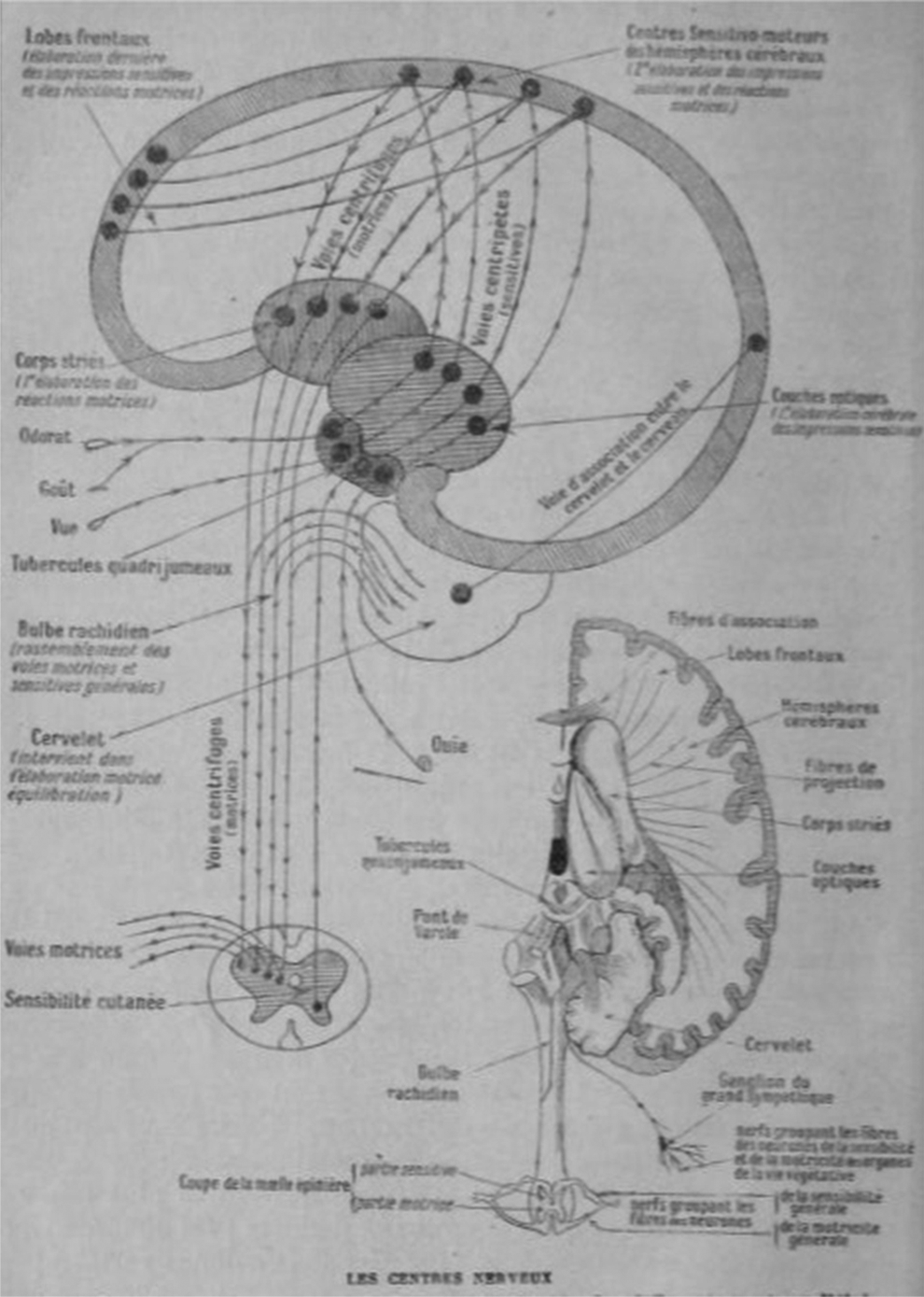
Diagram of nervous system (Rey, 1903: 29).
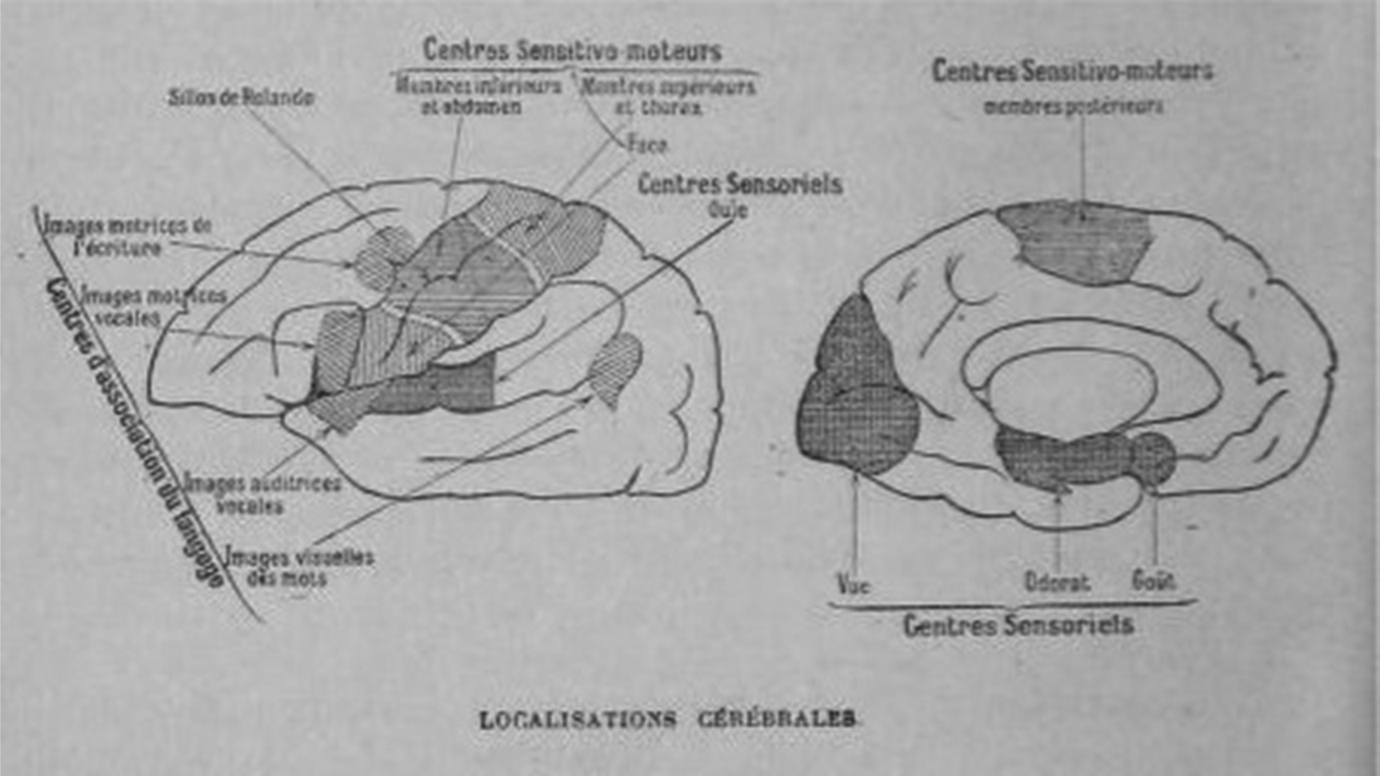
Diagram of sensory-motor cerebral localizations (Rey, 1903: 144).
Although these textbooks were not the only ones available, they provided the resources for, and gave expression to, scientific spiritualism in the classroom. The appearance of Janet’s Traité marked a transformative moment for his commitment to Cousinian spiritualism as well as for lycée philosophy generally. ‘Such an innovation, were it introduced some years before, would have been powerfully audacious, an individual revolt against academic traditions’, Serge Nicolas confirms. ‘But [Janet’s] attempt in 1879 indicated, on the one hand, that the academy began to open up to the new psychology…and on the other hand, that Janet himself had undergone a kind of conversion’ (Nicolas, 2009: 117). Indeed, the scientific turn in lycée psychology instruction was manifested across the conceptual arc that Paul Janet’s oeuvre followed, from trenchant anti-materialism to a reconciliation of experimental and metaphysical psychology.
Janet, who rode Cousin’s coat-tails into one of the three philosophy chairs of the Sorbonne in 1862, initially defended his master’s eclectic spiritualism against the mounting flood of brain research in Paris. In a series of polemic articles published in 1867 as Le Cerveau et la pensée, Janet argued that physiology psychology, catapulted by the work of Jean-Pierre Flourens and Louis-Françisque Lélut, remained tethered to the phrenological picture of mind–brain relations, according to which mental judgements are issued from determinate cerebral locales. Janet argued that psychology instead depends on the transcendental principle of conscious unity, which could not be deduced from mere facts about the brain. The brain does play a role in consciousness, Janet admitted, but only as its material condition: ‘Thought results from the conflict established between cerebral forces entrusted with external actions and the internal force or thinking force, the principle of unity, a possible center of individual consciousness’ (1867: 177).
Janet’s antipathy toward physiological methods gradually subsided. As a gatekeeper of young philosophy professors’ advancement, Janet came to open up the doors of the Paris philosophy faculty to experimental psychology. In 1875, the young psychologist Théodule Ribot complained that among the spiritualist bloc at the Sorbonne, Janet ‘was still very hostile toward the direction’ (1957: 2) of the Revue philosophique de la France et de l’étranger, the journal Ribot founded the following year as the first organ in France to disseminate psychological research from Britain, Germany and America. ‘Between natural psychology and metaphysics, there must be a choice’, Ribot proclaimed in the Revue’s inaugural issue, rebuking what he saw as spiritualists’ academic hegemony (1876: 3). Yet, obliged as he was to curry Janet’s favor, Ribot published an article by Janet in the same issue defending final causes against inductive psychological methods (Janet, 1876). A decade later, the aging Janet proved congenial to Ribot’s project and supported his candidacy for the first chair in experimental psychology of the Université de Paris (Brooks III, 1993: 130). Physiological methods, Janet came to acknowledge, need not threaten spiritualism’s commitment to the autonomy of conscious experience.
Janet’s transformation was of a piece with scientific spiritualism – the widespread movement that he diagnosed in advance of Bergson’s fame as ‘a new phase of spiritualist philosophy’. Throughout the 19th century, Janet wrote: ‘Accept God, soul, liberty, and the future life: you are a spiritualist’ (1873: 370). But what made the spiritualism of the post-Cousinian generation new, Janet posited, was the rapprochement its practitioners staged between experimental and metaphysical psychology.
Janet identified Alfred Fouillée as the most forceful proponent of this spiritualist current. One of the most prolific thinkers in the Third Republic, Fouillée amassed a voluminous corpus of 34 books and 100 essays. As James Kloppenberg argues, Fouillée was a vocal proponent of a ‘radical theory of knowledge’ that sought to reconcile metaphysics and science into a via media (1988). 5 Fouillée’s philosophy of ‘conciliation’, as he dubbed his method, was based on the guiding principle of idées-forces, which held that ideas are acts of volition within a biological and social world and not intellectual representations of the world. Kloppenberg rightly contextualizes Fouillée’s thought as part of a revolt against Kant’s legacy, and not against positivism (1988: 26). Kant’s strict separation between the phenomenal realm of nature and the noumenal realm of freedom was antithetical to Fouillée’s effort to set consciousness within a naturalist framework. In treating consciousness as a mode of psychic activity, Fouillée, and the ‘new phase of spiritualism’ that he led, borrowed the experimental lexicon of psychologists who analysed consciousness in terms of assimilation, association and attention, rather than as judgements issued by faculties. Like Bergson, Fouillée elevated a metaphysical account of consciousness on the basis of experimental methods in the face of the two domains’ bifurcation.
Fouillée’s pedagogical treatises gave voice to philosophy’s public mission to revamp the spiritualist curriculum in secondary education. It was up to philosophy professors, Fouillée argued, to restore France to prominence following the Franco-Prussian War by culling democratic values of active citizenship from scientific ideas. Echoing the strategy of Janet’s Traité, which incorporated physiological data to critique the limits of physiological methods, Fouillée affirmed that it was in the classroom where philosophy professors ought to confront biological reductionism head on. Fouillée posited the task as part of a broader project of national regeneration aimed at overcoming the instrumentalization of knowledge in the hands of ‘practitioners without ideas, specialists without general views’ (1909: 58). He outlined the three pedagogical principles that he deemed critical to secondary education: ‘The general critique of science and its conditions, the particular critique of materialism, and finally the possibility of a legitimacy of an idealism compatible with our knowledge of nature’ (ibid.: 333–4). In critically engaging psychological research, philosophy professors, Fouillée believed, simultaneously carried out the Republican project of cultivating active and rational citizens.
Conclusion
As physiological research opened a new horizon for psychology in late 19th-century Europe, a lycée philosophy curriculum emerged under the Third Republic that promoted the new science and steered its reception. The educational reforms issued between 1874 and 1902 progressively endowed a generation of philosophy professors no longer teaching under Victor Cousin’s academic monopoly with the responsibility of promulgating experimental psychology and paring the science’s reductionist implications. The evolving philosophy programme, and the scientific turn in its psychology curriculum, precipitated a significant rupture in France’s spiritualist heritage, and set the stage for a new wave of scientific spiritualism. The textbooks and course notes from this movement’s most accomplished representative, Henri Bergson, reveal an educational campaign that sought to stake a newfound justification for philosophical instruction, and the nation’s spiritualist tradition in particular, on the basis of scientific advancements in incipient psychological research.
This rapprochement between science and spiritualism left behind a contested legacy in the 20th century. On the one hand, it helps to explain the ascent of the philosophy of science, which after the First World War took off in the work of Georges Canguilhem, Jean Cavaillès and Gaston Bachelard. As Jean Wahl recounted in Vers le concret (1932), philosophy during this period adopted a widened empiricism, attentive to the human and life sciences’ elaboration of the qualitative facets of experience. On the other hand, many neglected the scientific moment in spiritualism, intent to subsume it within an overarching ‘irrationalist’ subjectivism, as when Louis Althousser lamented ‘French philosophy’s pitiful history’, especially the spiritualist tradition ‘from Maine de Biran and Cousin to Bergson’ (1996: 25). The antipathy continues to inflect representations of 20th-century philosophy framed according to the bifurcation between, on one side, an epistemological and scientific current and, on the other, an experiential and anti-scientific one (Badiou, 1995). Scientific spiritualism, and the institutional support underwriting it, frustrates this historical scheme. Practising psychologists, however, hardly adopted its commitments, save in the notable case of Pierre Janet, who expressed his debt to spiritualism, and to Maine de Biran in particular, in his doctoral thesis, L’Automatisme Psychologique (1889).
Scientific spiritualism was a distinct intellectual historical moment sustained by the brain’s newfound role in French secondary education, specifically in a psychology curriculum framed around the divisions between physiological and psychological facts and in textbooks propagating brain anatomy. This is not to suggest that scientific spiritualism was the only, or even the predominant, philosophical position of the period, but that late 19th-century French intellectual culture was not torn by an opposition between positivism and Cousinian spiritualism, as historians have claimed. The institutional contexts of philosophy reveal a pedagogy that surpassed this divide by mobilizing a Republican synthesis. In this light, scientific spiritualism inflected the Third Republic’s scientific imperative to rejuvenate France’s intellectual traditions and constituted a formative philosophical movement at the heart of the fin de siècle.