



Abstract
This article deals with the relationship between the creator of psychoanalysis, Sigmund Freud, and the Latvian-born Chilean professor of physiology – and endocrinologist and anthropologist – Alejandro (or Alexander) Lipschütz. Up till now, the historiography of psychoanalysis in Chile has ignored the existence of this relationship, that is to say, the fact that there exists an interesting exchange of correspondence as well as references to Lipschütz in some important works published by Freud and in Freud’s correspondence with the Hungarian psychoanalyst Sándor Ferenczi. There are also references to works on psychoanalysis carried out by Lipschütz in Chile. The Freud–Lipschütz relationship allows us to examine two interesting topics in contemporary historiographical approaches to psychoanalysis. First, it permits us to reflect on the connections that Freud and Ferenczi sought to establish between psychoanalysis and biology (endocrinology in particular) as a strategy to address criticism of the scientific foundations of psychoanalysis and, therefore, to help legitimize psychoanalysis in the field of science. Second, the relationship between Freud, working in a culturally influential city such as Vienna, and Lipschütz, working in a ‘peripheral’ country such as Chile, paves the way to reflect on the consequences of a history of psychoanalysis written from the perspective of the ‘margins’. This is a history that focuses not on regions where early industrialization and modernization processes, along with an important academic and scientific tradition, help explain the interest in and reception of psychoanalysis, but on regions where different sets of conditions have to be examined to explain appropriation and dissemination processes.
Keywords
The most important man in Chile never commanded regiments, never exercised a Ministry and did not give orders, but received orders in a provincial University. However, in our conscience he is a General of thought, a Minister of national creation, the Chairman of the University of the Future. (Pablo Neruda, on the occasion of the 80th birthday of his friend Alejandro Lipschütz in 1963)
Introduction
Those who investigate the appropriations of psychoanalysis in Chile can quickly find the ‘Lipschütz Collection’ in the library of the Faculty of Philosophy and Humanities of Universidad de Chile. This collection includes the works written by Professor Alejandro Lipschütz (1883–1980) in which he addresses psychoanalysis (Lipschütz, 2007, 1970, 1958) and a vast number of old editions of psychoanalytic works from his personal library. The Lipschütz Collection was donated by the university’s Faculty of Physical and Mathematical Sciences in December 2007. It accounts for about half of Lipschütz’s library and mainly comprises his books on humanistic studies. 1
When we search Freud’s works and correspondence for the name ‘Alejandro Lipschutz’ (as it is commonly spelled in Chile), there are no entries or references. But if we modify the spelling and search for ‘Alexander Lipschütz’, it is a different matter. The same man who was the recipient of the first National Science Award in Chile, in 1969, who was a key figure in early experimental physiology and endocrinology in the country and a renowned Latin American anthropologist and a member of the Chilean Communist Party, appears linked in different ways with psychoanalysis and with Sigmund Freud. 2
In this article, we will examine these links between Lipschütz, psychoanalysis and Freud in order to reflect on various aspects related to the history and historiography of psychoanalysis. After a review of Lipschütz’s life and work, we will examine and discuss different sources where Lipschütz is linked to Freud and psychoanalysis: some of Freud’s writings; Ferenczi’s review of a book by Lipschütz; a short but meaningful correspondence between Freud and Lipschütz; and some of Lipschütz’s writings and conferences in Chile on psychoanalysis and endocrinology.
We will show that Lipschütz’s early writings on the puberty gland and hermaphroditism (1919), which referred to his research with Eugen Steinach in Vienna, were useful to Freud in his objective to relate psychoanalytical and biological research on sexuality and therefore to consolidate the legitimization of psychoanalysis in the scientific field, an objective he shared with Ferenczi.
Far from asserting that Lipschütz and his writings were the main influence on Freud or Ferenczi in this regard, or that Lipschütz played a leading role in this process, we argue that he contributed positively to their struggle against what they called ‘resistance’ towards their findings, and also to their struggle to position psychoanalysis as a valid scientific discourse and practice on contemporary debates, such as those concerning sexuality and homosexuality. Therefore, Lipschütz, as one of a number of authors who served this purpose, and also as regards his links to psychoanalysis, is worth examining. This is especially true if we also take into consideration the fact that when Freud and Lipschütz corresponded, during the 1930s, the latter was already living and working in Chile – at the so-called periphery, or, as we prefer to call it, the ‘margins’ of cultural, intellectual and scientific production centres. Here, he contributed not only to the development of physiological and endocrinological research but also to the reception, appropriation and dissemination of psychoanalysis. Following this line of thought, the study of Lipschütz’s connections to psychoanalysis and Freud allows us to examine aspects of the history of psychoanalysis from a ‘marginal’ perspective and, thus, to discuss what impact this approach has on a more classical one, which generally focuses on the countries or regions of the ‘centre’ and on official psychoanalytic institutions and perspectives.
Lipschütz’s journeys: From Latvia to Chile, from experimental medicine to anthropology, from endocrinology to psychoanalysis
Alexander Lipschütz was born in 1883 into a German-Jewish family from the capital of Latvia, Riga. 3 He studied medicine in Berlin, Zürich and Göttingen, and obtained his PhD at Göttingen in 1907 (Concha-Quezada, 2007b: 13).
After his studies, Lipschütz settled in Zürich to pursue an academic career focused on scientific research and experimental medicine. Shortly after being appointed Privatdozent at the University of Berne in 1915, Lipschütz served as a doctor in the Russian army during the First World War (Concha-Quezada, 2007a; Lipschütz, 1972). The following year, he was forced to stay in Vienna while waiting for documentation to return to Berne. During this period, he collaborated with the renowned scientist Professor Eugen Steinach (1861–1944) 4 on experimental work in endocrinology and sex glands at the Institute of Biological Research in Vienna (Concha-Quezada, 2007a: 13), known as the ‘Vivarium’. On his return to Switzerland, he taught physiology at the University of Berne, from 1916 to 1919. In 1919, he published his work on the studies conducted with Steinach, under the title Die Pubertätdrüse und ihre Wirkungen: für Biologen und Ärtze (Lipschütz, 1919). This book dealt with the topic of hermaphroditism and was published with the objective of disseminating among the scientific community the conclusions drawn from the experiments conducted with Steinach in Vienna. These experiments had purportedly proven the possibility of creating masculine behaviour and characteristics in female guinea pigs, as well as female traits in male guinea pigs. These experiments allowed scientists to discuss a vast number of ideas concerning sexual behaviour and sexual identity in mammals, which supposedly could be used to help understand human sexuality. 5
He later worked at the University of Tartu until 1926, when he was hired by Universidad de Concepción, in southern Chile, in order to create the chair of physiology and the Institute of Physiological Research. Universidad de Concepción hired Lipschütz because it needed to expand, and legitimize, teaching and research within its new Faculty of Medicine, and also because it was interested in the kind of research conducted by Lipschütz in Europe, especially in Vienna with Steinach. 6
Once in Concepción, Lipschütz continued to study physiology and endocrinology, which was clearly a continuation of the work he had undertaken with Steinach in Vienna. As Concha-Quezada (2007b: 20, n. 14) affirms, the topics of his studies in Concepción were ‘ovarian and hypophyseal disorders in castration; transplantation of ovaries formally isolated outside the body…special problems of the sexual cycle in female guinea pigs; experimental hermaphroditism; compensatory reaction of the testicles after a unilateral castration; histological behaviour of the intrarenal testicular graft’, among others. Lipschütz was formally welcomed by the medical teaching staff in the capital Santiago (Lea-Plaza, 1926) and, very soon, his works on endocrinology began to be published in the most important medical journal in the country, Revista Médica de Chile (Lipschütz, 1927a, 1927b).
During his time in Concepción, he also started to show an interest in certain themes of anthropology that were linked to medicine. In 1935, he wrote his first work on anthropology, based on the study of Mapuche communities. Besides his medical and scientific duties, his research on indigenous issues widened and deepened over the years. He wrote about racism, colonization, the indigenous ‘problem’ during the conquest of America, and indigenous legislation. He also collaborated on the creation of indigenous laws in Chile and wrote about the need for indigenous autonomy. 7 Lipschütz moved to Santiago in 1937 tasked with creating the Institute of Experimental Medicine, part of the National Health Service. He ran the Institute of Experimental Medicine until 1960, while also teaching at Universidad de Chile. Along with his scientific and academic work, his political commitment to the Chilean Communist Party is also worth mentioning. He was an active member from 1945 until his death in 1980. Because of his contributions to the natural sciences and anthropology, Lipschütz won numerous awards and gained international recognition. In 1969, he became the first to receive the highest honour awarded for research in Chile, the National Science Award.
Along with his physiological and anthropological research, Lipschütz was also interested in psychoanalysis. In Chile, he published several articles about Freud and psychoanalysis, and three books containing large chapters on the significance of psychoanalysis in the modern world, in science and in philosophy: his posthumous work De Francis Bacon a Carlos Marx y otros ensayos (2007); Seis ensayos filosófico-marxistas (1959–1968) (1970); and Tres médicos contemporáneos. Pavlov, Freud, Schweitzer (1958).
The point of convergence between Freud, Ferenczi and Lipschütz: Psychoanalysis and biology
The first mention of Lipschütz’s work in the history of psychoanalysis dates back to the end of 1919. In two letters dated 20 November and 11 December, Freud and Ferenczi mention a recent publication by Lipschütz and discuss the review that they had agreed Ferenczi would write for the Internationale Zeitschrift für Psychoanalyse, the main journal of the International Psychoanalytical Association (IPA) at that time (Falzeder and Brabant, 2001: 231, 236).
The correspondence between Freud and Ferenczi on the subject of Lipschütz, as well as the aforementioned review by Ferenczi and the two references to Lipschütz by Freud in his own work, which we shall analyse below, centered on Die Pubertätdrüse, the book published by Lipschütz in 1919 on the experiments conducted with Steinach in Vienna. In the correspondence between the two psychoanalysts, it is clear that both considered it important to create a strategy to comment on Lipschütz’s book on the puberty gland and the experiments conducted by Steinach with the assistance of Lipschütz. As Freud writes, referring directly to Lipschütz’s book: ‘I hope you have found the tone that best expresses our superiority regarding the new findings, without lacking a certain satisfaction; more or less like we agreed in one of our pleasant Thursday evenings’ (Falzeder and Bravant, 2001: 231). Undoubtedly, they both deemed Lipschütz’s and Steinach’s conclusions relevant, but how could those conclusions be relevant for psychoanalysis? And in which aspects and for what reason was it imperative to show the ‘superiority’ of psychoanalysis, as Freud wrote?
Ferenczi’s review of Lipschütz’s Die Pübertatdrüse appeared in 1920 in the IPA journal, where his concerns regarding the dissemination of Lipschütz’s theses are clearly addressed. Faced with resistance against explaining everything from a psychological point of view, Ferenczi claimed the opposite: that psychoanalysis recognized the importance of biology. He explained that ‘a biochemical and biomechanical conception of life’s processes in general and sexual processes in particular is the basis for psychoanalysis’. But because there is no way to access them, ‘psychoanalysis leaves the work on these problems greatly in the hands of biologists and physiologists’ (Ferenczi, 1921: 144).
Ferenczi criticized Lipschütz and Steinach for insisting that endocrinological factors determine sexuality and for neglecting the psychological factors that, in his view, determine sexuality (Ferenczi, 1921: 145). Nevertheless, as he was aware, Lipschütz departed from Steinach’s strict biological determinism by recognizing that ‘man’s psychosexual behaviour cannot be explained solely from the effects of the internal secretion of the sex glands’ (Lipschütz, 1919, quoted in Ferenczi, 1921: 145). Lipschütz’s perspective, unlike Steinach’s, was thus useful for undermining scientific critics and detractors of psychoanalysis. It served as a form of scientific, specifically biological, legitimization and, perhaps, also as a kind of invitation to interdisciplinary dialogue on the subject. 8 Ferenczi (1921: 145) affirmed: ‘[W]e are willing to admit the great biological significance of the new findings. But we must not abandon hope that the worthy investigators of the new physiological territories will acquire sufficient psychoanalytic knowledge so that in time they will acknowledge the true limits of their competence and not exceed them.’ In this way, Ferenczi recognized a point of convergence between the results of physiology and psychoanalysis. Lipschütz’s work indicated that ‘the tremendously discussed infantile sexuality and the sexual perversion of adults may be considered infantile fragments of sexuality, to which normally new components are added in the course of later developments under the influence of the sex glands’ (Lipschütz, 1919, quoted in Ferenczi, 1921: 146). This confirmation of Freud’s discoveries by biology is certainly partial, argued Ferenczi (1921: 147), but it had the merit of pointing ‘towards a future, although certainly distant, in which biologists and psychoanalysts are associated in a common work’.
This desire for community and interdisciplinary dialogue between psychoanalysis and biology, which is expressed in the references to Lipschütz’s work by Freud and Ferenczi, as well as in the correspondence between Lipschütz and Freud, was not only Ferenczi’s interest but also Freud’s. 9 There are a number of paths to demonstrate this interest in Freud’s work: his persistent idea regarding the existence of an ‘archaic heritage’, boldly sustained through Lamarck’s thesis, even when biological research seemed to have discredited it in the 1930s; his project to write a contribution on ‘Psychoanalysis and Lamarck’ with Ferenczi during the war; and the manuscript of one of the lost meta-psychological papers, titled ‘Overview of the Transference Neuroses’, which Ilse Grubrich-Simitis (1987) found in 1983, where Freud applies the Lamarckian thesis of the inheritance of acquired characteristics to his theory of the neuroses. There are also a number of writings where his arguments point towards the convergence between psychoanalysis and biology: in the ‘Two Encyclopaedia Articles’, written in 1923, Freud affirms: ‘Though psycho-analysis endeavours as a rule to develop its theories as independently as possible from those of other sciences, it is nevertheless obliged to seek a basis for the theory of instinctual drives in biology’ (Freud, 2001f: 258). In his ‘Introductory Lectures on Psycho-Analysis’ in 1916–17, he affirms that he hopes for biological research to shortly discover the ‘chemical characteristics of the sexual processes, which we suspect, [but] are still awaiting discovery’ (Freud, 2001c: 320). In ‘Beyond the Pleasure Principle’ (2001d: 43), he writes that his ‘expectation that biology would flatly contradict the recognition of the death instincts has not been fulfilled’ and even more, that the ‘striking similarity between Weismann’s distinction of soma and germ-plasm and our separation of the death instincts from the life instincts persists and retains its significance’ (ibid.). 10
In the two references to Lipschütz’s 1919 book in Freud’s own works, which appear in 1920 in ‘The Psychogenesis of a Case of Homosexuality in a Woman’ (2001e) and in the fourth edition of the ‘Three Essays on the Theory of Sexuality’ (2001a), the main topic discussed is whether there is opposition or, on the contrary, a convergence between the glandular and the psychical – in other words, between psychoanalysis and biology. This must be understood by taking account not only of Freud’s aforementioned interest in the convergence between these two fields but also of the cultural and scientific environment that reigned in Central Europe between the 1890s and the 1930s.
At the turn of the century, research into sexuality helped change ideas about sexuality and gender significantly. 11 Freud was part of this cultural landscape: he was among the European researchers who were pioneers in that they approached the topic of sexuality – its nature and manifestations – from a scientific point of view. In this context, new light can be shed on the attention given by Freud and Ferenczi to Lipschütz’s 1919 book. We claim that this attention was strategically linked to the need to differentiate psychoanalysis from those other perspectives and to show the specificities of psychoanalysis. In particular, psychoanalysis could be separated from a ‘hard’ stance on biological heredity, on the one hand, and from political sexologists, on the other: ‘Whether it was the radical reinterpreters of sexual pathology, such as Havelock Ellis or Magnus Hirschfeld, or the more conservative commentators on the topic, such as Albert Moll, Freud positioned himself carefully in regard to them’ (Gilman, 1994: 47).
As Eliza Slavet (2008, 2009) has argued, Freud’s so-called Lamarckism, or his refusal, at the end of his life, to abandon the thesis of the inheritance of acquired characteristics, has to be understood in the political context of the 1930s, especially in regard to the position of Jewish people in Austria and Europe in general, and not solely on individual or theoretical grounds. She shows that August Weismann’s theory of the ‘germ-plasm’ (referred to by Freud in ‘Beyond the Pleasure Principle’, as quoted above, and also in his work On Narcissism) had encouraged the emergence of the so-called ‘Neo-Darwinians’, who, recovering Gregor Mendel’s theories, criticized Lamarck’s thesis on the inheritance of acquired characteristics – even if Darwin had agreed with Lamarck’s thesis. The Neo-Darwinians supported a ‘hard’ biological hereditary perspective, one that did not accept any influence of the environment. This position, along with other influences, was at the roots of radical political theories and practices, such as Nazism. 12 As Slavet argues, almost every Jewish and/or communist scientist took the exact opposite stance, claiming that biology, thereby inheritance, could be altered and transformed by educational and public health policies, and so on. In this context, Freud’s mention of Steinach’s and Lipschütz’s experiments becomes clearer in its motives: ‘Whereas many scientists argued that biological heredity (whether soft or hard) controls human experience, Steinach’s work suggested that humans could directly assert control over biology’ (Slavet, 2008: 46). In this sense, we agree with Slavet that Freud’s position concerning contemporary scientific research on sexuality cannot be explained only on theoretical grounds – political factors must be taken into account, too. Nevertheless, in what follows, we will examine this problem from a theoretical point of view, particularly in relation to the concept of ‘constitutional bisexuality’, introduced by the Berlin doctor Wilhelm Fliess (1858–1928). 13 We will argue that this concept acts as a hinge in the differentiation of Freud and psychoanalysis from other theories on sexuality.
Constitutional bisexuality points towards the idea that sexuality is not determined by an organic or hereditary element or disposition, but that every man and woman is initially bisexual, even from a biological point of view, and that his or her sexual orientation as an adult depends more on a complex relationship between infantile experiences, biology and the quantitative aspects that oppose instincts and defences.
In his work on a case of homosexuality in a woman, Freud discusses the problem of the aetiology of homosexuality. There, he argues that clinical experience shows that a certain constellation of aetiological, psychological or physical factors does not always provide the same result on the determination of sexuality. This leads Freud to suggest that it is not a qualitative matter that is at stake but a quantitative one: the strength with which one or another factor is imposed. That is to say, sexuality is finally determined by the strength with which accidental or hereditary factors prevail. Freud (2001e) stated that the confusion concerning this aspect is due to the fact that the existing research and writings addressing homosexuality did not distinguish the problem of ‘object choice’ on one hand, from the problem of sexual character and attitude on the other. These distinct sexual dimensions are intertwined in different ways, which take us far from the fixed relationship that is sometimes established. Freud distinguishes three dimensions: ‘somatic sexual characters (physical hermaphroditism)’; ‘psychical sexual character (masculine or feminine attitude)’; and ‘type of object choice’.
14
These distinctions, claims Freud, were hidden. They were not attainable in the type of biological research that did not recognize the existence of constitutional bisexuality, but were possible and attainable in research that – as he states referring to Steinach and Lipschütz – shared that premise. As he writes: ‘[P]sychoanalysis is situated on a common ground with biology to the extent that it adopts as a premise the primal bisexuality of the human individual (as well as animals)’ (ibid.: 157). In that common ground, the results achieved by psychoanalytical and biological research should converge and facilitate a more complete insight into the subject of sexuality. As he points out: [Psychoanalysis] must rest content with discovering the psychical mechanisms that resulted in the determination of the object choice, and with tracing the paths leading from them to the instinctual basis of the disposition. There its work ends, and it leaves the rest to biological research, which has recently brought to light, through Steinach’s experiments, such very important results concerning the influence exerted by the first factor mentioned above [somatic sexual characters] on the second and the third [psychic sexual character and type of object election, respectively]. (Freud, 2001e: 156–7) It would be unjustified to claim that these magnificent experiments have placed the doctrine of homosexuality on a new basis, as it would be hasty to expect them to open a direct path towards the universal ‘healing’ of homosexuality. Fliess was right to state that these experiments do not distort the doctrine of the universal bisexual disposition of superior animals. It seems more probable that subsequent inquiries of this type will provide direct confirmation for the hypothesis of bisexuality. (2001a: 128)
In January 1927, shortly after his arrival in Chile, Lipschütz sent Freud a letter and a copy of his inaugural lecture for the physiology chair at Universidad de Concepción, titled ‘La autorregulación orgánica’ (1926). In his letter, Lipschütz tells Freud about his ‘attempts to build a bridge between the findings that Medicine owes to Freud and the New Physiology’ (Lipschütz, 1958: 72). He adds that having revolutionized psychiatry and neurology, it was only ‘natural’ for him to encounter resistance, but that ‘despite this resistance, psychoanalysis has become one of the concepts tacitly accepted as basic for psychology, just like it happened with Darwin and Marx’ (ibid.).
In March, Freud responds with enthusiasm: ‘If other scientists in your new homeland value the analysis as much as you, then I am not afraid for the future of my long hated creation in South America either.’ 16 Freud’s letter helps sustain the lines of thought followed in this article, namely, that he believed that the dialogue and connections between psychoanalysis and biology served the purpose of legitimizing, and thus ensuring, the survival of psychoanalysis, not only in Europe but also beyond.
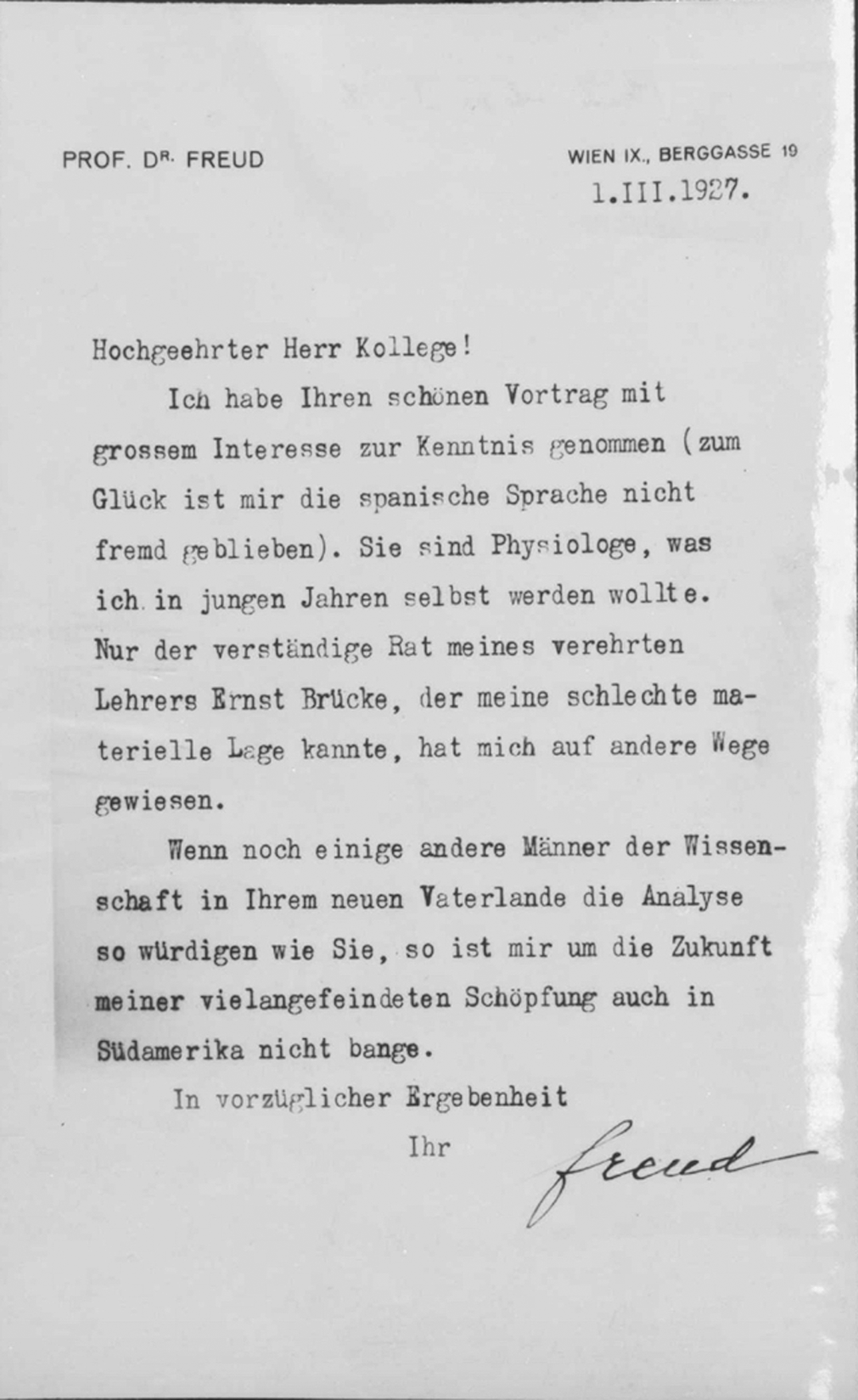
Box 36, Lipschütz, Alejandro, 1927, Sigmund Freud Papers, Sigmund Freud Collection, Manuscript Division, Library of Congress, Washington, DC.
In his inaugural lecture in 1926, Lipschütz praises ‘psycho-analysis [as] the most noble and fruitful theory of modern psychology and psychiatry, and because of this also the theory that has been more frequently discussed and opposed by official and conservative medicine’ (Lipschütz, 1926: 13). After this unprecedented recognition of psychoanalysis by a physician and scientist in Chile, Lipschütz draws an interesting analogy between a physiological process and a psychological one, both of which he calls self-regulation [autorregulación]. He argues that physiological self-regulation processes assure balance and harmony between healthy and sick parts of the body, as well as adaptation to the natural environment. The specific mechanism of physiological self-regulation is located in the nervous system and the hormones, Lipschütz claims. Similarly, psychological self-regulation processes, which he avers were described by Freud, are thought to aim towards ‘psychical integration’ and to be the ‘basis of adaptation to the social environment’ (ibid.: 289). In the physiological sphere, there are the nervous system and hormones; in the psychical, it would be repression and a mechanism Lipschütz calls ‘compensation’ that specifically produce self-regulation. Mainly by blocking out regretful or painful events, in the case of repression, and by assuring acts and thoughts that could heal a certain psychological injury, in the case of compensation, the psychical apparatus would aim towards health, well-being and integration.
In 1931, Lipschütz writes another letter to Freud, on the event of his 75th birthday, and comments on the reception in Chile of his own endocrinological research, mentioning ‘[A] passionate resistance not only to psychoanalysis, but also to certain new concepts in other fields, for example, sexual endocrinology’ (1958: 73). Freud replies in a letter dated 12 August, expressing his indignation at the behaviour of scientists before new findings. Then he adds: I am very happy to learn in your letter that you are not part of those who build a contradiction between psychoanalysis and endocrinology, as if it were possible to explain psychic phenomena directly from the actions of the glands or as if the elucidation of the psychical mechanism could replace the knowledge of the chemical process related to it. (Freud, 1963: 453)
17
The last correspondence between the two scientists dates back to 1936, on the event of Freud’s 80th birthday, when Lipschütz sends him a dedicated copy of Warum treiben wir wissenchaftliche Forschung?, the 1935 German version of a text previously published in Spanish in 1933 (Lipschütz, 1933, 1935). The dedication reads: ‘Professor S. Freud, with the most respectful greetings and best wishes on your 80th birthday. A. Lipschütz.’ 18
In this text, Lipschütz, by focusing on his research in the area of sexual development, gives an account of his understanding of what it means to conduct scientific research. He argues that, along with physiology, pathology and sociology, ‘modern Freudian psychology’ represents the ‘prophetic force’ of scientific research (Lipschütz, 1933: 309) – a force that could be deemed useful for the collectivity, as it points towards the ‘universal desire of “harmony” present in every man from immemorial times’ (ibid.: 307).
Lipschütz claims that the aim of scientific research is not to take a permanent, unmovable stance on ‘the determinant factor of sexuality’ (1933: 304), for example, but to reach certain ‘intellectual and harmonic images of reality as a whole’ (ibid.: 305), until new findings crack this image and allow new knowledge to emerge and produce a new and synthetic image. In his proposal, this kind of scientific investigation – dynamic, analytic and synthetic, like psychoanalytical research – has, thus, a prophetic force.
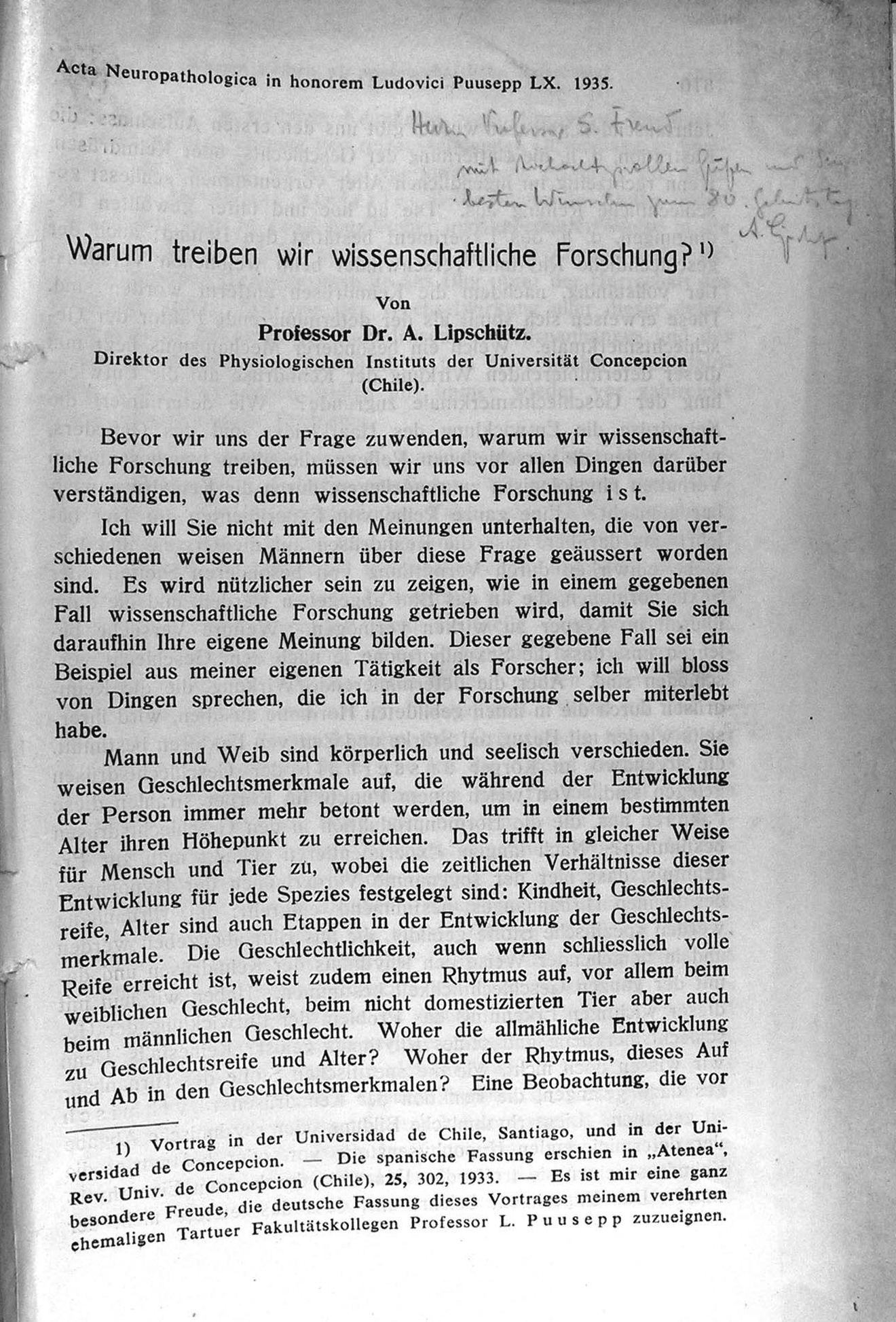
Lipschütz Collection, Faculty of Philosophy and Humanities, Universidad de Chile, 1936.
Lipschütz and psychoanalysis in the Chilean context
As we have pointed out, the previously unknown relationship between Lipschütz, psychoanalysis and Freud allows us to cast fresh light on the specific forms in which psychoanalysis was appropriated, developed and disseminated in Chile. It also allows us to propose some critical ideas on the consequences this might have for the traditional historiographical approaches to psychoanalysis.
As primary sources show, Lipschütz’s conference in Concepción in 1926 was the first scientific conference in Chile in which Freud’s theories were discussed in a favourable light. Furthermore, the particular interpretation put forward by Lipschütz, shared with Freud in his letters, has rarely been sustained in Chile in fields such as endocrinology, biology or even psychiatry, up until the present day. His belief that psychoanalysis shared with physiology and other disciplines the status of a scientific practice, and that they constitute not mutually exclusive but inclusive dialogical and complementary fields, was also demonstrated in Freud’s response to him and, additionally, in Ferenczi’s review and some of Freud’s works.
However, the ‘official’ history of psychoanalysis in Chile has systematically ignored the role played by Lipschütz in the history of Chilean psychoanalysis. 19 This official history, which the Chilean Psychoanalytical Association (APCh) 20 started putting together in 1980s, has produced a linear, internal and institutional periodization and interpretation which has, in fact, neglected not only the importance of Lipschütz but also the role played by several intellectuals and groups who contributed to the reception and circulation of psychoanalytic ideas in Chile in the first decades of the 20th century.
These kinds of historiographical accounts have followed a traditional model, first developed by Freud in ‘On the History of the Psychoanalytic Movement’ (Freud, 2001b) and in ‘An Autobiographical Study’ (Freud, 2001g; published in 1925), and then by Ernest Jones in his biography of Freud. They emphasize the role of ‘pioneers’, without distinguishing their own biographies from the history of psychoanalysis (hagiography). They also consider this history exclusively in connection with recognized and legitimate psychoanalytic institutions, and only from the perspective of official interpretations of psychoanalysis as sanctioned by the IPA (which we understand as orthodoxy). Moreover, They build a strict frontier between what is considered psychoanalysis and what is not: clinical psychoanalysis as practised by physicians and psychologists, on the one hand, and lay interpretations and uses of psychoanalysis as a broader cultural discourse related to contemporary subjectivity, on the other.
To sum up, this form of history, as any official history, tries to legitimize its own interpretations and practices as the only ones authorized, scientific and expert, while the others are thought to be extra-official heresies and profane deviations or, in the extreme, resistances to the true essence of psychoanalysis or Freud’s writings.
In Chile, this model has produced quite a monolithic historiographical corpus that affirms that psychoanalysis in the country began in 1949, when Ignacio Matte Blanco, 21 along with some followers, founded the APCh, that is to say, when an IPA subsidiary institution was created. Before that, these historical accounts recognize only two other events worth underlining as what they call ‘prehistory’: Fernando Allende Navarro’s book El valor de la psicoanálisis en policlínica, which was his dissertation for obtaining his MD in Chile; 22 and a 1910 conference by Germán Greve Schlegel 23 in Buenos Aires, titled ‘Psychology and Psychotherapy of Certain States of Anxiety’. 24 From 1949 onwards, this historical corpus distinguishes psychoanalysis only as it was developed within the APCh, neglecting, again, other authors, groups, interpretations or initiatives, while denying them the legitimate name of ‘psychoanalysis’ and ‘psychoanalysts’.
In this context, Lipschütz’s works and conferences and his correspondence with Freud stand out as a source for criticizing these traditional historical accounts in attempts to try to unveil another stratum in the history of psychoanalysis in Chile. This other history, which we have called marginal history, underlines the heterogeneous ways in which several intellectuals appropriated and disseminated psychoanalysis in Chile during the first half of the 20th century. It shows ways of understanding and using psychoanalysis beyond psychological expertise, as a broader cultural discourse, which has in fact permeated modern subjectivity in ways no other psychological theory has done before or after Freud. As Peter Berger wrote in the 1960s: ‘[P]sychoanalysis has become a cultural phenomenon, a way of understanding the nature of man and an ordering of human experience on the basis of this understanding’ (1965: 27).
This historiographical approach focuses not on the ways in which Freud’s ideas were implanted and reproduced in Chile, but on the cultural, social and political conditions that facilitated the appropriation of psychoanalytic ideas in the country. In this sense, we share the perspective that has been put forward by Joy Damousi and Mariano Ben Plotkin (2009: 4), who argue that ‘the history of a system of ideas cannot be distinguished from the system of its multiple receptions and appropriations’. This model requires also a new understanding of psychoanalysis as a ‘cultural artifact in the broader sense’, which can accept as psychoanalysis ‘all discourses and practices that are legitimized in their reference to a Freudian heritage’ (ibid.), without measuring and disputing the ‘real’ or the ‘pure’ interpretation of that heritage.
According to these definitions, Lipschütz helps us show that long before the foundation of the APCh, there were other versions of psychoanalysis circulating and permeating Chilean culture in different ways. These other versions continued to exist even after the APCh was founded. From the 1910s onwards, there were different newspapers and cultural magazines, such as El Mercurio, La Nación, Zig-Zag, Pacífico Magazine, Alejandra and Atenea, where psychoanalysis was commented on, reviewed and even used to analyse different cultural objects and practices. Psychoanalysis contributed to the theory and practice of biography, to literary and artistic criticism and, as those magazines and newspapers show quite frequently, to the understanding of everyday problems and issues such as those concerning family relationships, love relationships, child-rearing and guidance, and sexuality (Vetö, 2016). As Juan Marín Rojas (1938), another Chilean early reader of Freud’s work, affirmed:
25
Well, it happens with this demiurge that his doctrines have spread in such a way that the language expresses them in multiple turns, pedagogy walks on them as on its own wheels, sociology itself cannot do without their collaboration, history and biography are written in a new way because of them. And finally, the novel, theatre, sculpture, painting and music are drowned in its waters as marine algae rocks at high tide. (1938: 44)
It was to these social, cultural and political conditions that Joaquín Edwards Bello’s 1934 note ‘The Freudians’ in the newspaper La Nación pointed, when he described, with concern, the turmoil of people awaiting for a conference on psychoanalysis outside Universidad de Chile, or what the lawyer Juan Andueza Larrazábal pointed towards when he fretted about the fact that ‘[t]he most subtle and debatable conceptions of the Master, popularized in economic issues, today adorn profusely, among us, the windows of any town library, as a bite within everyone’s reach’ (1938: 518).
In 1939, a Santiago leftist magazine called Babel published Lipschütz’s article ‘Freud y el hombre Moderno’. It was the text of a speech he gave in April 1938 during a tribute to Freud in the Hall of Honour of Universidad de Chile, which was organized by the Alianza de Intelectuales por la Defensa de la Cultura and chaired by the poet Pablo Neruda (Ruperthuz, 2015). This event was presented as a defence of Freud’s cultural importance in the context of his persecution by the Austrian Nazi regime in Vienna. The tribute, which attracted a large audience, was said to be ‘undoubtedly the most magnificent and significant cultural act to take place in our country in recent times…The four stories of the Hall of Honour were physically too narrow to accommodate the immense crowd, in a silence full of introspection and emotion’ (Boletín Médico de Chile, 2 April 1938). This shows, quite eloquently, that psychoanalysis already had a receptive audience in Chile, which not only appropriated and disseminated, but also produced, psychoanalytic interpretations and readings.
The text of Lipschütz’s speech was later included in his 1958 book Tres médicos contemporáneos, and posthumously in De Francis Bacon a Carlos Marx y otros ensayos (2007). He argued that ‘modern man’ was the man that had achieved a ‘peak of self-consciousness, the man with a minimum of unconsciousness’, who has reintegrated the psyche and the body, and could reach a ‘mystical participation’ where the social subsumed the individual (Lipschütz, 2007: 241). Psychoanalysis, in his view, could point towards ‘unmasking’ the ‘social hypocrisy inherited from last century’ (Lipschütz, 1958: 105), and in this sense it was important not only in biology and physiology, but also in social thought, as he recognized in the 1933 paper he sent to Freud. In this context, it is interesting to note that during the Second Latin-American Congress on Criminology, held in Santiago in 1941, Lipschütz read a paper on ‘Eugenics and Criminality’, in which he strongly criticized an exclusively biological perspective: ‘There is nothing in human biology that is realized outside the human community. In human issues, there is nothing purely biological…We must act always in complex social reality as it is presented before us in the realm of humanity’ (Lipschütz, 1941: 280).
Lipschütz’s conference in 1926, his paper on scientific research which he sent to Freud in 1933, and the talk he gave in 1938, portray a picture of psychoanalysis in Chile that departs significantly from the aforementioned official historical accounts. Lipschütz appropriated psychoanalysis as a discourse that was not anathema to physiology and endocrinology, as a theory that helped him understand the human being as a force that sought to balance, integrate and regulate the psyche and body, the individual and the social. Thus, he also understood psychoanalysis as a practice that was not anathema to political concerns, for it sought to unmask illusions and hypocrisy. In this sense, his way of understanding and disseminating psychoanalysis was very heterodox, eclectic and pragmatic, as many of the Chilean appropriations of that time were. 27
Concluding remarks
Historically, the relationship between psychoanalysis and biology has not been a simple one. As it arises from our discussion, Freud seemed to need and at the same time reject biology’s contributions to psychoanalysis. On the one hand, he apparently feared that biology’s conclusions on sexuality could tear psychoanalytical conclusions on the subject apart, but on the other hand, he never ceased to long for biology to prove psychoanalysis right. This tension has been present in psychoanalysis since it was created, and does not seem to be fading away. On the contrary, the links between both disciplines are nowadays at stake. We believe that the general, and fundamental, problem that they indicate is that of the subject and of subjectivity. Is there a place for the subject in a profoundly biologized psychoanalysis? Is it possible to reflect on the subject and on subjectivity without considering its biological dimension? At the beginning of the twentieth century, when Freud grappled with the complex relationship between psychoanalysis and biology, the question of the subject and of subjectivity was not yet even posed as such. In his time, the main debate on the field of neuroses and other disorders referred to the dichotomy ‘nature–nurture’. A purely ‘natural’ stance meant that biographical, social and accidental influences did not play a significant role in the aetiology of neuroses and that, therefore, heredity and constitution had the final say on the subject. On the other hand, a purely social perspective would emphasize the role of education and social influences, such as family relationships, and diminish the importance of biology. Nevertheless, we believe that Freud’s insistence on what, since the beginning of the First World War, he called ‘meta-psychology’, which puts forward the role of the drives, forced him never to take a purely social stance on the subject. He believed that his ‘witch’, as he sometimes called meta-psychology, and specifically his drive theory, would give psychoanalysis the scientific legitimation it lacked. To sum up, we could argue that it was his drive theory, which was basis of his meta-psychology, that impeded him in resolving his ambiguous position towards biology.
Turning now towards Lipschütz’s appropriations of psychoanalysis, we must conclude that the official historical accounts of psychoanalysis in Chile have ignored and veiled these kinds of appropriations of psychoanalysis, which are profoundly rooted in its social, cultural and political contexts, and which consequently transform Freudian doctrine into new hybrids that include those local conditions. Bringing these ‘marginal histories’ to the fore contributes to creating a broader, more inclusive and thus more heterodox historical picture of psychoanalysis, one in which there is no longer a centre of production, but rather a proliferation of centres where psychoanalytic ideas and practices are built.
Following this line of thought, Lipschütz can be understood not only as an author Freud and Ferenczi commented on because of their interest in connecting psychoanalysis to biology, but also as an active agent in the process of ‘transnational’ dissemination of psychoanalysis (Plotkin and Damousi, 2009). That is to say, Lipschütz is someone who contributed to making psychoanalysis transcend its national, cultural and linguistic origins. 28
This kind of history of psychoanalysis, which we have called marginal, points towards what has been traditionally left outside the borders created by the official historiographical accounts, outside the walls of the recognized institutions, outside the frontiers of Europe and the United States. It is a history of what comes across those margins, what flows and reaches other lands and spheres, but it is also the history of those margins themselves, and this is something that has to be emphasized. We are dealing with a historiographical model that allows us to inquire how and why these margins have been constructed. 29 To protect which ‘possessions’? To control what kind of fluxes and hybridizations? To prevent which kinds of mixture? To hinder what sort of ‘plague’? Thereby, this historiographical approach not only reveals a different history of psychoanalysis, but also allows us to examine what is at stake when orthodoxy is built. What are the tensions, the disputes, the motives, the strategies and the apparatuses that appear? Therefore, this approach reveals nothing less than the politics of the historiography of psychoanalysis in itself.
As the critical historiography of psychoanalysis has shown, since around the 1970s, the official narratives of psychoanalysis have systematically attempted to hide, deny or reinterpret the influence of biology on Freud’s thought, integrating it into a rhetoric that diminishes its value and centrality in the processes of construction and validation of psychoanalytic concepts (Sulloway, 1992; Levin, 1985; Ellenberger, 1976; Andersson, 1962). 30 However, this influence is present, and in order to understand how theories are constructed, it is necessary to examine it. Part of psychoanalysis has to do with endocrinology, and in this regard, Lipschütz’s appearances in Ferenczi’s review and in Freud’s works and correspondence pave the way to analyse this relationship from a fresh perspective.
By tracing the relationship between Freud and Lipschütz, it has been possible to investigate fragments of Freud’s interest in biological knowledge in general and in endocrinological experimentation in particular. It has been possible to show that this interest reveals certain issues pertaining to the legitimization and validation of psychoanalysis in the scientific field, particularly in the area of scientific research on sexuality, and that a fundamental part of the construction of orthodoxy, official narratives and the boundaries that define and delimit psychoanalysis, is connected to the denial and the masking of these legacies.
As we have already remarked, Lipschütz’s relationship to Freud and psychoanalysis, as other agents of dissemination of psychoanalysis might do, contributes to the uncovering, in the plural, of different kinds of histories of psychoanalysis. These are histories that show how psychoanalysis might be understood not only as the possession of so-called official psychoanalysts or of a European tradition, but also as a cultural artefact that goes far beyond theoretical, methodological, spatial and cultural boundaries. Psychoanalysis has, accordingly, been transformed in interesting ways that it is now possible to examine and integrate.
Footnotes
Funding
The author(s) received no financial support for the research, authorship, and/or publication of this article.