



Abstract
The article examines sin through the lens of forgetfulness, as both are phenomena situated between passivity and activity, and intricately linked in the biblical tradition. It shows how the propensity to forget God is rooted in a particular form of presence that is characteristic of YHWH. The narrative of the making of the golden calf is analysed for its potential to highlight the ‘predicament’ peculiar to the Jewish and Christian faiths: to seek a more palpable divine presence than that in the word alone. The article explores this theme further by way of theologically juxtaposing the calf with the Agnus Dei and offering considerations on conscience, confession and the opacity of the Christian life.
Keywords
Two Ways of Overcoming Sin
Theologically, there are two ways in which sin is overcome: killing and letting die. Forgiveness, by virtue of divine grace, kills sin in its capacity to kill the sinner, when she is delivered from eternal death. This mode of dealing with sin belongs to justification, and the righteousness it achieves is alien and imputed. The other way in which sin is overcome belongs to sanctification – the moral sphere. Here sin is overcome by withholding its food, as it were, by starvation. It is the latter – letting sin die – that will concern us in this paper. The point I am trying to make is that spiritual practices of withholding sin’s food are best understood in terms of remembrance, which, in turn, prompts an inquiry into forgetting as a key to understanding the nature of sin.
Adopting a concern from the ascetic tradition that preceded them, the Reformers of the sixteenth century understood good works such as fasting, praying and almsgiving to be ‘good’ not by virtue of the good they revealed of the agent’s inner self or of the good they promoted towards the agent’s external world; rather, they were good by virtue of being done ‘from faith’. Taking his cue from St. Paul’s statement that ‘whatever is not done from faith is sin’ (Rom. 14:23 1 ), Luther insisted that whatever is done from faith cannot be sin; 2 and even more importantly, it will drive out sin. Good works were deemed necessary by the Wittenberg reformers as a natural companion of faith, not least for their capacity to keep sin in check. This displacement motif did not assume a merely temporal non-synchronicity – you cannot sin while you are busy doing good works – which they knew was not necessarily the case. The incompatibility of good works with sin was understood more in terms of these practices ‘feeding’ the new Adam towards outgrowing the old that needed to die. This occurred first through baptism, continuing on a daily basis 3 through love, formed and directed by faith.
The sanctified practices that drive out sin are, I suggest, best understood under the heading of remembering, as forms of ‘not-forgetting’ God’s word and deeds. 4 My proposal in this essay is that sin can be understood from this angle as well, as the very opposite of remembering. Exploring ‘sin’ as a form of forgetting differs from attempts to single out one particular instance of sin, such as pride, as particularly representative, 5 a kind of ‘mother of all sins’. While these attempts have their own merits, my inquiry is aimed rather at the phenomenological, asking what sort of thing sin is by likening it to another related phenomenon.
Understanding sin as a form of ‘forgetting’ corresponds to other metaphorical descriptions such as ‘transgressing’, ‘defiling’ or ‘rebelling’, which provide the background for some of the technical terms that the Hebrew Bible uses for sin. 6 Though the sheer variety of such terms should discourage us from privileging a single metaphor, ‘forgetting’ strikes me as a particularly significant one. It not only features prominently in biblical language but commends itself for a structural reason as well: like sin, it is a phenomenon that is situated between activity and passivity.
The Phenomenology of Forgetting between Active and Passive
On the one hand, we ‘simply’ forget. Humans are wired for forgetfulness, not merely because of the limited capacity of our memories but also because of a propensity to forget for reasons of self-preservation. As to the latter, Nietzsche called the tendency ‘a door keeper as it were, an upholder of psychic order’ 7 : a facility built into our brain’s operations which is also known to accelerate the fading of negative recollections over positive ones. 8 In this perspective, forgetting might appear a non-activity. What we do not actively keep in our memories simply slips into the zone of the forgotten. To the degree to which we experience ‘forgetting’ as something that simply happens rather than an activity, or at best as an unconscious activity such as being asleep, we tend to distance it from the sphere of moral responsibility: one cannot sin while being asleep.
This is why ‘forgetting’ can be expected to function as at least a partial excuse in moral contexts: ‘I forgot to pick up the kids from school this afternoon’ is less condemnable an explanation than ‘I wanted to watch football and decided they can just as well take the bus’. Forgetting appears more ‘forgivable’ if deemed a lesser state of consciousness. As such, we take forgetting not as an active denial of the moral claims we face, but their mere fading into the background; not a principled, permanent self-distancing from such claims, but a mere pragmatic, temporal one.
On the other hand, forgetting has undeniable aspects of agency, too. This is already suggested in the composition of the word itself: from the Old English forgietan, where the first syllable ‘for’ is used with negative force (‘away’, ‘amiss’) so that the imagery is one of loosening grip. To forget is to ‘un-get’, to dismiss something from the mind. When we say that a film we watched was ‘forgettable’, this aesthetic judgment instructs our memory not to waste its capacity by retaining something we feel we wasted our time watching. In contrast, when we experience something as ‘unforgettable’ we are not simply commenting on a future state of memory, but naming a quality that we know we should not allow to fade into oblivion but must actively keep ‘alive’ for our inner eye to revisit. This is a capacity Nietzsche called ‘a true memory of the will’. 9
Forgetting or not forgetting does, of course, not always proceed according to our intent. There are moments, such as those we describe as traumatic, that we wish to forget but cannot, when the imperative to forget is regularly defeated by the power of the experience to re-intrude and colonize our memory. Yet even then there are techniques by which medical practitioners can assist their patients to actively forget, even when it seems impossible to do so. 10
Scientific models of memory performance typically distinguish three aspects or stages: encoding, retention and retrieval of information. 11 Encoding is seen as related to the intensity with which something is impressed on us, when the experience that accompanies the reception of information engraves the latter into our mind; retention is improved with rehearsal, while the ability to retrieve retained information depends on ‘cues’ associated with encryption that allow access to the retained information when needed. Forgetting can occur at each of these stages, but for the purpose of our inquiry it would seem that ‘retention’ is of particular significance for the responsibility of the agent as it pertains to forgetting: when it comes to deciding which memories are worth retaining and hence should be rehearsed on a regular basis. ‘ Encoding’ and ‘retrieval’ appear, by contrast, more subject to external circumstances such as the physiological symptoms of diseases that heavily affect memory performance such as Alzheimer’s and dementia, but we shall later discover that even those stages are not as unrelated to the moral life as they might first appear.
Although Christian doctrines of sin vary in the degree to which they emphasise its active or passive dimension, none could be deemed serious that did not attempt to explain the complex way that sin is more than sinning, yet never without this active aspect either. As opposed to being a mere effect of a cause, sin is what the scholastics called a ‘power’, a causative force, which reveals itself in individual sinful deeds.
The understanding of sin as ‘power’ is already evident in Paul’s famous discussion in Romans 7, where sin is named as an agent inside the human being that commits it (Rom. 7:17). Yet, as Paul also emphasized, sin is not only a power within us, epithymia (misdirected desire, Rom. 7:7) but also parakoä (disobedience, Rom. 5:19): a more externally observable response to that desire, coterminous with rebellion against the moral order and its giver. The power that is sin does not simply overwhelm, but co-opts the person, including her will and intellect. 12
Moral theology is more than phenomenology. It typically comes into its own when we consider not only the form of an activity but also its objects. While it served a purpose to point out the phenomenological parallel between sin and forgetting, the key to unravelling its theological significance lies in the question: forgetful of what?
Forgetting God
There are plenty of candidates worth considering as possible objects of forgetting in the course of sinning – the moral order, the moral self,
13
the neighbour in her plight, and many more –, but the biblical emphasis is rather stubbornly on God as the prime object of human forgetting when it comes to sin: ‘Against thee, thee only, have I sinned’ (Ps. 51:4). In the light of passages such as Ezek. 22:12 (‘In you men take bribes to shed blood; you take interest and increase and make gain of your neighbors by extortion; and you have forgotten me, says the Lord
Other biblical passages speak of sin as forgetting God more specifically in terms of God’s word and deeds, the divine commandments, or historic events such as the deliverance of Israel from Egypt. This connection is particularly palpable in Deut. 8:11: ‘Take heed lest you forget the
The forgetting that is sin must hence be assumed an operation of the heart, the orienting faculty, not a merely ‘natural’ process of fading. As indicated in the subtitle of my essay, forgetting God might be understood as negotiation of distance; a distance at which we place ourselves from God by making him fade into the background of our lives. Such forgetting need not be a denial of God’s existence outright, which can well remain an item of knowledge stored in our memories; the forgetting that is sin is a more specific kind of denial which reduces God to merely ‘existing’ as opposed to being the living God who continually addresses us in his word. Sin-as-forgetting acts as though God were but a dumb idol, a god that ‘does neither good or bad’, as the prophet Zephaniah (1:12) portrays the attitude that reveals itself in the act of sinning. We turn then to the question of the ‘theo-logical’ basis of sin-as-forgetting, rooted as it is in the specific type of presence that Israel is granted of its God.
Presence in the Word
The second part of the first commandment – the ban on making visible representations of God in Israel (Exod. 20:4) – is correlative to the way Israel experiences the presence of its God. In contrast to the gods of other nations, the ‘I am who I am’ is present primarily, if not exclusively, in his word and deeds; yet words and deeds are ‘historical’ phenomena that exist only for the time of their duration and fade after their occurrence – unless they are ‘kept alive’ by active remembrance. When it comes to living in the presence of this God, Israel therefore depends both on their continuing exposure to the living word and on a trans-generational chain of narrative through which the divine words and deeds are remembered: ‘Make them known to your children and your children’s children’ (Deut. 4:9).
If Israel is thus given to understand forgetting as the most serious threat to the covenant, it is not because of the natural gravitation of the human mind towards oblivion, but more specifically because of the nature of Israel’s God and his kind of presence in the creaturely realm. In this sense Nietzsche was right is his assumption that sin is a concept that is deeply rooted in the specifics of Israel’s God, 14 even though he failed to grasp the real predicament that this dependence entails by focusing on the ‘revengeful nature’ of the Israelite God instead.
The ‘predicament’ of the Jewish and Christian faiths, when seen in light of our discussion above, is the continual temptation for the people to ‘make up for’ this peculiarly ‘feeble’ form of divine presence in the word by seeking more stable forms of representation that are less susceptible to forgetting.
The biblical story that powerfully demonstrates this point is the narrative of the golden calf.
Psalm 106 makes this connection explicit by characterising the idolatry of the molten image as arising specifically from, or being coterminous with, forgetting God (v. 21), and more specifically his ‘works’ and his ‘counsel’ (v. 18).
But they soon forgot his works; they did not wait for his counsel. They made a calf in Horeb and worshiped a molten image. They exchanged the glory of God for the image of an ox that eats grass. They forgot God, their Savior, who had done great things in Egypt… (Ps. 106:18-21).
Taking this hint from Psalm 106, it seems worth considering the longer narrative in Exod. 32–33 and its theological context in some detail.
Desiring a More Stable and Palpable Form of Divine Presence
With Moses’s lingering absence around Mount Sinai, the people turn to Aaron demanding an equally visible and available surrogate for the mediation of divine presence: ‘Fabricate us gods to walk before us’ (Exod. 32:1). They seek a steady, palpable and ‘manageable’ presence, unlike that of the word, which Moses mediated in his role as mouthpiece of YHWH. 15
It is for very good theological reasons that the story of the golden calf is attached to the particular narrative of Israel’s reception of the commandments. The suggestion is, however, not that the calf embodied a rival godhead in breach of the first commandment as indicated by Aaron’s proclamation of a festive day celebrating YHWH immediately after completion of the artefact (Exod. 32:5). This molten image was most likely not even understood as a direct depiction of YHWH in animal form, which would have been an equally gross violation of the first commandment. 16 It is much more likely that the linkage of the narrative with the giving of the law suggests that the calf was assuming precisely the place the commandments were intended to occupy: that is, the representation of God’s presence to and with his people.
This type of rivalry explains why both, tablets and calf, were soon to be destroyed. Wherever a rival form of representing and mediating God’s presence in the word is claimed, the covenant is broken, a disruption symbolised by the breaking of the stone tablets onto which the covenantal words had been written. The same logic extends in the other direction: where God is present in this commandment, any rival figuration of this presence must be given over to destruction.
It is with narrative irony, then, that the golden material Aaron is said to have requested from the people is specified to have come precisely from their ears (earrings, Exod. 32:2), the very organs that were created for receiving God’s presence in his word in the first place.
As the Exodus narrative continues, the theme of the particular form of divine presence is further developed. Immediately after the calf episode, and as a consequence of it, it is reported that God withdrew his presence from the ‘stiff-necked’ people that had committed a ‘great sin’ (Exod. 32:30) by seeking an illicit form of divine presence: ‘If for a single moment I should go up among you, I would consume you’ (Exod. 33:5).
Even when the divine presence was eventually restored in the wake of Moses’s intercession, the tent of meeting had to be located outside the camp. Whenever ‘Moses entered the tent, the pillar of cloud would descend and stand at the door of the tent, and the
The tabernacle was a portable vessel of a vessel of a vessel. It contained the ark of covenant as a container of the tablets, which in turn contained the letters of the word, as they were reportedly inscribed by God’s own hand (Exod. 32:16). This artful multiple ‘layered-ness’ speaks of the non-immediacy that characterised all forms of representing the divine presence in Israel, 17 and indicates that no such representation could ever substitute for the act of listening. This is not to suggest that the existence of such material forms of representation was superfluous. They acted as reminders that the encounter with the word is always fragile and threatened by forgetfulness, so assisting the people with the task of remembering.
Returning to the scientifically-described stages of forgetting previously discussed, we might perhaps say that the ‘encoding’ of memory is the work of the Holy Spirit directly, who facilitates both proclamation and reception of the divine word, whereas ‘retention’ involves the Spirit enlisting our cooperation in and through practices of individual and collective remembrance, for which aids known to facilitate such retention ought certainly not be despised.
This is why the biblical warnings against forgetfulness are routinely introduced with the exhortation ‘take heed’, while practices of remembering the commandments and God’s mighty deeds were woven into the fabric of Israel’s worship through the annual festive calendar and daily rituals and practices. One such practice was the wearing of tephilim, miniature leather boxes containing verses of the torah that were worn on the upper arm and on the forehead to keep the word close to the heart and literally ‘within sight’. This allowed one to look at the world through the lens of the torah: ‘For this commandment which I command you this day is not too hard for you, neither is it far off. But the word is very near you; it is in your mouth and in your heart, so that you can do it’ (Deut. 30:11,14).
Wearing tephilim on one’s forehead also served as a reminder of the moral character of remembering. It made those wearing them aware that spiritual forgetting would require pushing the torah aside or actively closing one’s eyes to this visible reminder of its presence. The realisation that one would have to so actively forget the law meant that the threshold of forgetting rose well beyond its ‘default’ setting, for which it was often enough to have a strong contender for presence, say a base desire, entering the site to ‘overshadow’ the presence of the word.
A powerful and concise portrayal of the connection between forgetting and Israel’s peculiar kind of divine presence is found in Deut. 4, as part of Moses’s extended sermon to the Israelites before they enter the land.
Then the Lord spoke to you out of the midst of the fire; you heard the sound of words, but saw no form; there was only a voice. And he declared to you his covenant, which he commanded you to perform, that is, the ten commandments; and he wrote them upon two tables of stone (Deut. 4:12-13).
The emphasis on divine word-form presence is then immediately connected in the subsequent verse with an imperative to not-forget, addressing the temptation that specifically arises from forgetting the God who is present in the word alone:
Therefore take good heed to yourselves. Since you saw no form on the day that the Lord spoke to you at Horeb out of the midst of the fire, beware lest you act corruptly by making a graven image for yourselves (Deut. 4:15-16).
As the plot unfolds further, we learn that even Moses is no exception to the people’s desire to have something more obvious, stable and palpable than a divine presence of ‘no form – only voice’. Shortly after the episode of the golden calf, Moses demands to see YHWH in his full glory, eye to eye – an experience so overwhelming, we would assume, that the one who has been granted it will be no longer dependent on the feeble act of remembering, as the ‘encryption’ is burnt into his memory rather than inscribed.
Moses is rebuked for his request, with God stating that ‘you cannot see my face; for man shall not see me and live’ (Exod. 33:20). By virtue of his special status before God, however, he is granted a particular and, once again, characteristic form of divine presence: of God’s goodness and grace, as they come with seeing YHWH’s back (v. 19), the traces that God leaves behind, as it were. From the perspective of Deuteronomy, it is God’s presence in goodness and grace that is deemed both sufficient and wholesome, precisely because it is perceptible to the eyes of faith – for Moses, and for all believers who come after him.
Misrepresenting God
As our take on the narrative of the golden calf has suggested, idolatry comes not only in the form of venerating false gods as opposed to the one true God, but also as veneration of the one true God under false, self-fabricated representations. If it is true that we cannot help but act out the sort of faith we have, then sin too must be ascribed a certain revelatory quality: it reveals what(ever) we make of God, at least in moments when sin is getting the better of us.
An example is found in the servant of Jesus’ parable who gets punished for burying his talents instead of using them (Mt. 25). While readers of this parable might stumble across the seemingly harsh punishment for mere inactivity, the key for understanding this is provided in the explanation that the servant gives. He acted in this way due to the particular representation of his master that he held: ‘I knew you to be a hard man, reaping where you did not sow, and gathering where you did not winnow’ (Mt. 25:24).
Forgetting God is never mere distancing, but always also a distortion, a misrepresentation of who God really is. In some cases, it might be difficult to say which comes first: distancing or distorting. On the one hand, we distort because we distance, when from a distance we see objects in a two-dimensional instead of a three-dimensional way: a flat picture without contours. On the other hand, what we fail to see in an undistorted way will likely make us wish to distance ourselves from it.
For all that has been said up to this point about the desire for a palpable representation of divine presence as an entry point for the temptation to idolatry, we should add that the desire as such need not be wrong in itself; it is rather natural. We are created as sensual beings, and divine presence should be assumed as perfectly capable of communicating itself to creatures in a way that corresponds to their make-up as sensual beings. What is wrong, according to the biblical narratives, is something more specific than the desire itself, namely, to be discontent with the type of representation that God is willing to give at any point in time. The pillar of cloud by day and the pillar of fire by night: these were manifestations of a presence that shared the features of the word as sensual fleeting phenomena, destined, so to speak, to point forward to the moment in salvation history in which the word would take on flesh (John 1).
Not-Forgetting God as Faith
How can God’s people ever forget their saviour? It is instructive to observe that when YHWH is portrayed in the Scriptures as bringing up this complaint against his covenant people, their forgetfulness of his deliverance and provision is not characterised as mere ingratitude, but as inconceivable as it would be for a bride to forget her attire (Jer. 31:2-3). The answer to this divine riddle, as I understand it, must have to do with the spiritual nature of the goods that God has bestowed on the people. By ‘spiritual nature’ I am not referring to non-corporeality such as, say, in gift of love over gift of land. Irrespective of their varying degrees of corporeality, all gifts are immediately palpable only according to their material aspects, whereas their spiritual aspect remains perceptible to faith alone. The biblical God does not simply ask his people why they have forgotten the escape from Egypt or all the rich harvests of the land they conquered; the form of the question is always more specific to the covenantal relationship (Isa. 51:12-16): how could you forget that it is I who set you free from slavery, that it is I who brought you to this land and gave it to you?
While spiritual forgetting can co-exist with material remembering, not-forgetting in the spiritual sense is apprehension by faith. Just as forgetting the good things with which God has endowed his people is portrayed as faithlessness, so remembering is not a mere absence of forgetting but a newly active grasp of the same faith that once helped grasp whence the goods received have come. To remember God’s goodness is to embrace it in the here and now, since the gift cannot be separated from the giver.
We have seen, then, that faith is in itself a form of remembering that mirrors – and overcomes – sin as a form of forgetting. It is for this reason that YHWH’s own re-narration of what happened in the camp blatantly identifies the making of the golden calf as idolatry (‘molten calf, and worshiped it’, Exod. 32:8), in spite of it being intended as a representation of YHWH. In light of our above analysis, we can understand that YHWH’s speech is not a misrepresentation of the event, making it appear worse than it actually was, but rather confronts the people with the spiritual truth of the matter. In other words, by understanding the calf incident in terms of the wider narrative of the establishment of the Sinai covenant, it becomes clear that the breach of the covenant is not simply the transgression of a rule but an abdication of faith in favour of sight. ‘Whatever is not from faith is sin’ (Rom. 14:23).
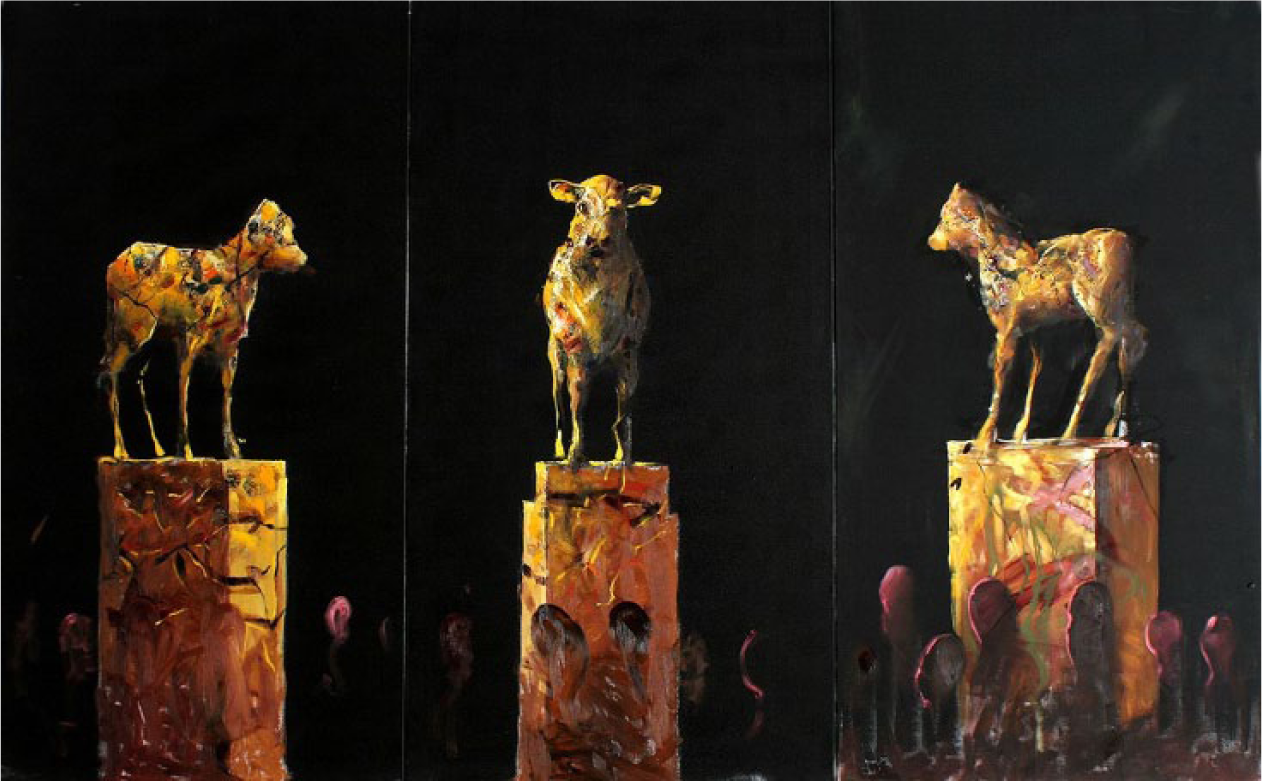
The Calf and the Lamb
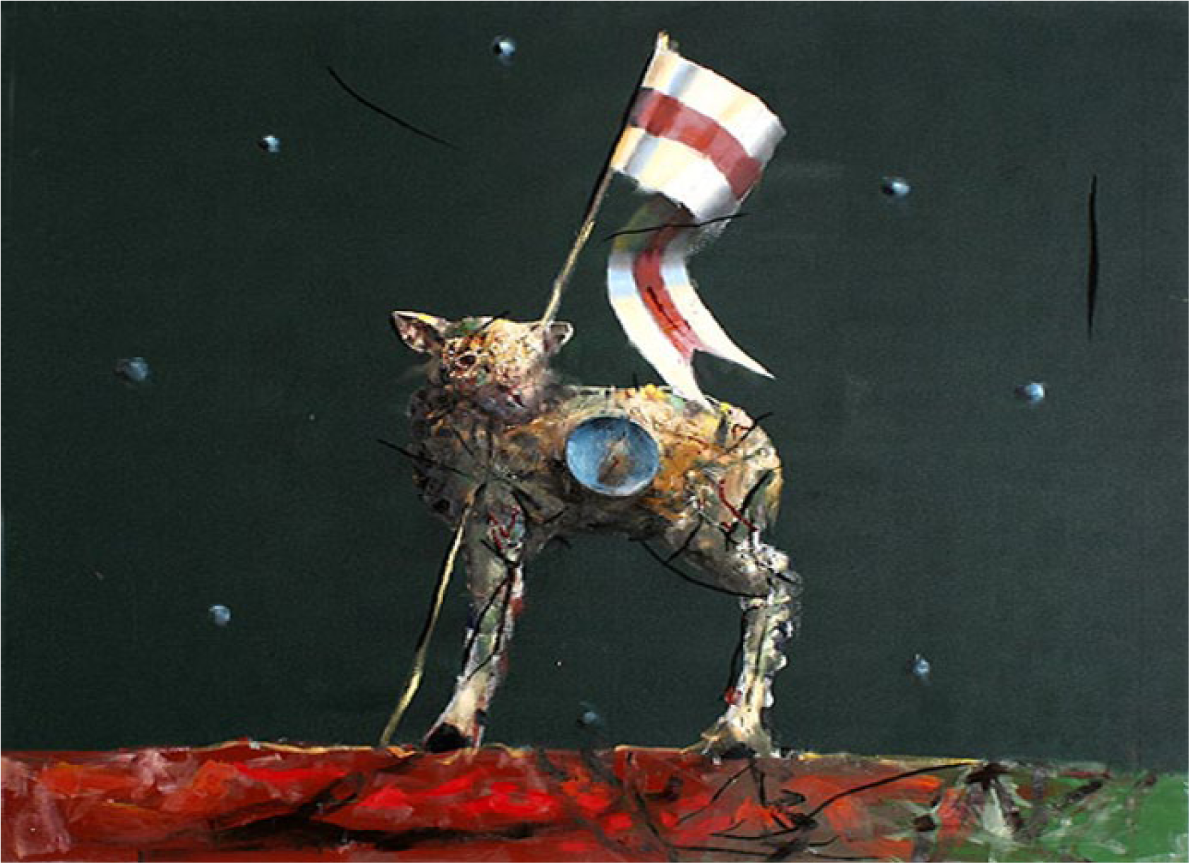
St. Magnus Cathedral of Kirkwall in Orkney currently features an exhibition of large canvas paintings by Norwegian artist Håkon Gullvåg which depict key episodes of salvation history. The respective episodes portrayed on these canvases from the Old and New Testament are positioned as two rows facing each other, resulting in disturbing combinations and juxtapositions. What especially struck me was the pairing of the golden calf with the Agnus Dei, 18 and how this pairing affects the sense of place in the observer. Whereas the lamb appears to be looking at you, the calf is strangely void of expression, even in the middle depiction of the triptych in its frontal perspective. In this way Gullvag’s portrayal appears reminiscent of the characterization of the idol in the Psalter: ‘They have mouths, but do not speak; eyes, but do not see. They have ears, but do not hear…’. In a telling move, the list of the idols’ deficiencies ends with a repetition of the opening claim to their lacking ‘word’, thus framing the polemic as a whole: ‘and they do not make a sound in their throat’ (Ps. 115:5,7). And the shadowy figures dancing around the posts might convey the idols’ capacity to make those ‘who trust in them’ become like them (Ps. 115:8).
This pairing is instructive for several reasons: First, the Agnus Dei is the anti-calf. In the lamb slaughtered we have divine presence, authorised by the power of the resurrection, that confronts, unmasks and overcomes all fabricated images that follow in the wake of the calf. As the letter to the Hebrews never tires of reminding us, Christ’s body, broken and given to Eucharistic consumption, is the form of divine presence that absorbs and supersedes all previous representations (Heb. 7–10).
But the aspect that makes the Eucharistic Christ more than an anti-calf is that his presence is one that relates gently to the natural aspect of our desire for a palpable divine presence that ‘took on flesh’ in the molten image of Exodus 32. The calf is hence both ante- and anti-lamb, an ill-conceived, premature ‘incarnation’ that, even as the self-fabricated numb and dumb surrogate it was, still points forward to the word that genuinely is ‘to behold’, a word that ‘became flesh and dwelt among us, full of grace and truth’ (Jn 1:14).
The Christian reader of the Exodus episode may find this link confirmed by the narrative detail according to which the calf, like the broken body of the lamb, would eventually be internalised – when Moses mixes the powder to which he reduced the calf with water and gives it to the Israelites to drink (Exod. 32:20). As potentially deadly Fluchwasser, 19 however, this potion is able to merely foreshadow the ‘alien’ aspect of the Eucharist as judgment (1 Cor. 11:29), not its primordial and live-giving work of mediating redemption, as when the believers take the element as ‘bread’ of life.
The manifestation of divine presence in the incarnation both differs and differs not from what the Israelites wished to see augmented by the calf: Agnus Dei is ‘voice’ and ‘form’, but the form itself does not supersede and replace the word. On the one hand, by taking on ‘flesh’, a full human being, bodily, touchable – and mortal – this word meets our desire for a more palpable form of divine presence. Yet oddly, the tangible presence that we experience in Eucharistic consumption (‘given for you’) is itself geared towards repetition 20 (‘do this in remembrance of me’), as the self-giving of the lamb is forever referenced by particular events in time, the cross and resurrection.
This helps us to understand how the Eucharist is tied to the dual way of overcoming sin that we pointed out at the beginning: it kills sin by virtue of the once-for-all self-sacrifice of the Agnus Dei; and it ‘lets sin die’ in a way that relates to the ‘remembering’ aspect of the Eucharist, which in its repetitious form helps us to keep this self-giving constantly before us and internalise its fruit.
Sinners and the Godless
There is a particularly troubling form of God-forgetfulness for which the psalms give a vivid description: a person assumes in his or her heart that ‘God has forgotten, he has hidden his face, he will never see it’ (Ps. 10:11). The person who ‘renounces’ God and says in his heart ‘Thou wilt not call to account’ (Ps. 10:13) is called ‘wicked’, or ‘godless’, by the Psalmist. It strikes me as instructive to see how the ‘wicked’ differs from the ‘sinner’. Although these types appear similar (and are not in every instance distinguished terminologically within the Psalter), a closer inspection reveals that ‘sinner’ and the ‘wicked’ belong to different, even mutually exclusive, groups. 21 Whereas the sinner ‘forgets’ God and his word temporarily, the wicked turns the tables on the issue of ‘forgetting’, attributing a particular type of forgetting to God-self, namely, complete indifference towards human acts. For the wicked, it is taken for granted that, as the prophet Zephaniah paraphrases this attitude, ‘God does neither do good or bad’ (Zeph. 1:12). 22
Ascribing such numb ‘forgetting’ to God is very different from the lament, also found in the psalms, whereby one turns to God to ask ‘How long, O
The one who ascribes the forgetfulness of indifference to God is categorically different from the one who self-righteously assumes that he has no need for forgiveness. Self-righteousness may be the most troubling aspect of sin, as it blocks the way of grace. But even the self-righteous one is still a sinner, unknowingly perhaps, as long as he misunderstands his status at any given point in time without denying, in principle, the existence of sin that can befall anyone.
The wicked, on the other hand, is ‘godless’ in that he declares God non-existent, not necessarily theoretically but morally, taking it as a hard fact of life that God does neither good nor bad. In this sense, the wicked cannot be a sinner who, in contrast, knows herself to be under God’s judgement and hence remains in a state of hope. 23
It might appear that the ‘sin against the Holy Spirit’ 24 of which Jesus speaks in Mt. 12:31-32 puts the one guilty of committing this sin in the same boat as the ‘wicked’ or ‘godless’. Such sin is, after all, characterised as the one that cannot be forgiven. But we do well to expand the question towards the ‘status’ not only of the sin, but also of the sinner. If the sin against the spirit is to denounce the need for grace and hence the work of the Spirit in principle, then to remain in this posture means to be in a place that really is hopeless, in which forgiveness never sought cannot be imposed. Speaking ‘against the spirit’ in this sense means denying the very category of sin, and so hopelessly closing oneself off from forgiveness.
But what is true for this state of sin need not – by God’s grace – be true for the state of the sinner. While it is impossible to sin in as much as one remains ‘wicked’, it is possible to change from the state of the ‘godless’ to that of sinner. Contrary to popular myth, deals with the devil are never irreversible, and to return to the state of sinner implies that the sin that cannot be forgiven is no longer the defining reality.
Conscience and Confession
When formed by the narrative of redemption and salvation, conscience helps us to know ourselves ‘together with’ (con-science) the word. Conscience is our sustained co-presence with the word. As such, it is the opposite of any form of knowing that becomes forgetful of this co-presence of ours: when we know that the divine word is but ‘out there’ as opposed to ‘near’, an object we know to exist without it reaching us, affecting us, preventing us, spurring us on. A ‘troubled’ conscience, on the other hand, can be consequently understood as the hopeful state of ‘awakening from forgetting’, becoming painfully aware that we are – or, in retrospective cases, were – in the process of forgetting the word and hence begin to return to knowing ourselves together with the word, which can bear fruit in repentance and forgiveness.
The portrayal of sin-as-forgetting and the overcoming of sin as un-forgetting might also aid our understanding of the notoriously difficult passages in Paul’s discussion in Romans 7, where he characterises the place in which the sinner finds herself by way of a dichotomy of will and action: ‘I do what I do not want to do’ (Rom. 7:16). Since action is principally inconceivable without an element of will, Paul appears to be describing a seizure of the ‘wider’ will (that wills the good, v. 19) by another, inconceivable act of willing that drives the act of sinning.
This strange ‘clash of wills’ could perhaps be illuminated somewhat by an application of our discussion of sin-as-forgetting, especially when taking into account the distinction of stages as they are discussed in the science of remembering. In this perspective we might say that it is a particular type of forgetting which ‘allows’ sin to happen for the Christian; it would not, or at least not primarily, be conceivable as failure to encrypt memory in the first place or failure to retain memory – although the aspect of retention through rehearsal could be seen as akin to the duty to have one’s conscience ‘rightly informed’, the failure of which would fall under the rubric of peccatum omissionis. But the conflict that Paul describes in Romans 7 appears to be concerned not with erasure or fading, but rather with the failure to retrieve the memory in the very moment, when activation of it would have had the capacity to prevent sin from happening.
Paul’s description of being entrapped in doing what he does not will could be understood as the sinner’s failure to activate the ‘cues’ that are responsible for retrieving retained knowledge from memory that we associate with the ‘basic’ will as it has been informed by the knowledge encrypted and retained – in Paul’s case the instruction of the Christian Gospel.
It would be worth exploring further the potential of this analytical lens, say by examining the role and nature of ‘clues’ that the sinner fails to activate with regards to her Gospel memory in the moment of giving in to temptation. But we must leave it with these hints, sufficient perhaps to suggest that this perspective holds more promise for shedding light on the difficulty in Romans 7 than the well-worn attempts to explain it away by suggesting a dichotomy between the status of the person pre- and post-conversion or between his internal faculties (will and desire) that are assumed to be at war with one another.
The church has a practice of remembering that is particularly suited to overcoming sin as a form of forgetting: confession. In confessing we remember our own wrongdoings together with God’s grace, which allows for our wrongdoings to be faced and acknowledged as sin. If we therefore assume confession must be particularly bound up with not-forgetting, a further look at the Exodus narrative surrounding the golden calf episode indicates a detail that is worth noting in this context: when Aaron is confronted with the sin that had been committed by the Israelites, the account he gives of his own share in the communal act of idolatry is rather instructive: ‘And I said to them, “Let any who have gold take it off”; so they gave it to me, and I threw it into the fire, and there came out this calf’ (Deut. 32:24).
While Aaron acknowledges his complicity in the people’s sin to a certain extent, that is, insofar as it pertains to his prompting to give him the material, his confession implies a self-justifying twist: ‘there came out this calf’ – no centre of agency is identified here. What Aaron ‘forgets’ 25 to tell is what the biblical narrator had reported him doing: that he took the gold, constructed a mould, and fabricated the idol.
In her book The Mark of Cain, 26 Katharina von Kellenbach analyses letters exchanged between clergy and Nazi perpetrators, notes of prison chaplains, memoirs and sermons, for what they reveal about attitudes towards such wrongdoing and crimes. What shines through in these documents is that the ‘shape of sin’ that we described as forgetting can be still present even when it appears that it is being overcome: when the confession of sin – remembering and naming – is drenched with ‘forgetting’ of certain aspects of their commission, thus effectively turning confession into a hybrid form of self-justification. 27
Examples of the incapacity or unwillingness to confess without partial forgetting shed light on the discussion about the ‘completeness’ of confession, as is mandatory in the Catholic ritual wherein it is the penitent’s duty to name ‘all mortal sins’ of which she is cognisant.
Protestant criticisms of this requirement have tended to stress that comprehensiveness in confession is neither possible nor even healthy for its alleged encouragement to superficial formality or even spiritual works-righteousness, when a particularly meritorious character might be presumed of the confession when ‘complete’. In the light of our discussion of sin as a form of forgetting, however, it makes perfect sense to say confession must be ‘complete’ in order to be genuine: precisely by not withholding consciously from confession to our own peril those aspects of our moral agency that we wish to protect from the un-forgetting which overcomes sin by letting it die. Such ‘completeness’ of not-withholding is not something we could simply elicit from ourselves, but is itself ‘made’ by the same grace that first prompts confession and affords forgiveness eventually. The temptation in confessing is not unlike the temptation that befell Israel at the foot of Mount Sinai, resulting in the making of the golden calf: the desire to stay in control of one’s recollecting and the reception of God’s benefits – whether in the form of the aspiration towards ‘comprehensiveness’ of one’s confession or in the form of an attempt to determine its ‘dose’ by withholding certain aspects.
Opacity of Sin or Sinner?
The discussion about ‘completeness’ is intrinsically related to the ‘opacity’ of sin, its character as a phenomenon never fully transparent to the sinner, as when Paul famously opens his meditation on the sinner’s inner conflict, ‘I do not understand my own actions’ (Rom. 7:15). The Apostle then goes straight into his attempt to understand this lack of understanding, describing in some detail what is so difficult to grasp. We should perhaps not be too quick to speak of the opacity of sin, based on the Augustinian definition of malum as privatio boni, when in fact it is the opacity of the person who is never fully transparent to herself, whether in sin or – to pick a positive opposite – love.
The reminder of our opacity to ourselves as sinners will be useful to keep in check the opposite extreme, that is, the assumption that if only we fully understood sin in all its operational patterns we would be able to control it – a truly non-spiritual attitude. It is true, we are never really and fully transparent to ourselves, but then such transparency is not a requirement of moral agency and responsibility. For the agent, it will be sufficient to take this opacity into consideration and act on the basis of the ever-fragmented insights we are able to muster of ourselves as well as of the world around us. Aaron, for example, did not have to have at his command a complete and unbiased insight into his own mix of motivating factors, anxieties and hopes, to know that the calf did not simply happen (‘there came out this calf’), but rather came from the makings of his own hands.
My proposal to understand sin as forgetting should not be misunderstood as yet another way of emphasising the opacity of sin, but rather to enlighten this opacity at least somewhat. This suggestion might be countered by pointing out that forgetting must itself be deemed a perfect symbol for opacity, insofar as logic seems to imply that we can never know when we enter a state of forgetting. But is this actually true? 28 Take, for example, the moment during a conversation in which we have the sense of a word that we say is ‘at the tip of our tongue’. By this expression we rather sensibly describe a situation in which we know we have forgotten something – a word of our vocabulary – that we know we still have in our memories; a word that is close enough to be aware of its shape and function in our train of communication, but still not quite within reach. Although we cannot access it at the moment, we trust that this moment of forgetting will soon vanish, and that the expression will become available again.
Much, though not all, sinning appears to be a case of this type of ‘fore-grounded’ forgetting as opposed to the erasure or permanent loss of retrieval cues that we might rather associate with the ‘wicked’. That sinning is a way of forgetting God, of which we can to a certain extent be aware, leaves sin overtly culpable but, more importantly, also hopeful. While this assertion is by no means to deny the ongoing need to pray along with the Psalmist: ‘Clear thou me from hidden faults’ (Ps. 19:2), in many cases we can remember what we have forgotten momentarily. ‘Sin and forgiveness’ in the Christian life is not like a rapid alternating sequence of erasure and re-programming. It is rather a slow, sometimes painful, but overall hopeful journey of learning to not-forget God by remembering the grace that remains ‘near’ us, even when we have forgotten its form.
Footnotes
1.
All Bible quotations are taken from the Revised Standard Version.
2.
Martin Luther, Treatise on Good Works, 1520.
3.
In his Loci Communes Melanchthon compared the overcoming of sin with healing from a post-surgical wound which, again, emphasizes the temporal unflolding of redemption. ‘Christ puts us on His body, because He carried the punishment for our sins, and pours the Gospel into our wounds, He then binds them up, covers them and forgives our sin. But He still wishes the diseases in the church to be cured by continual exercises of the cross and of prayer.’ Philip Melanchthon, Loci Communes 1543, trans. J. A. O. Preus (St. Louis, MO: Concordia, 1992), p. 51.
4.
The moral significance of remembering for the Christian life has been particularly emphasised by Stanley Hauerwas: ‘Remembering as a Moral Task: The Challenge of the Holocaust’, in J. Berkman and M. Cartwright (eds.), The Hauerwas Reader (Durham, NC and London: Duke University Press, 2001), pp. 327-47.
5.
Cf. Augustine’s exposition of Ecclesiasticus 10:12-13: ‘Pride is the commencement of all sin’, in City of God XII, 6 and XIV, 13.
6.
For example, chata points to aberration, missing a target, mostly with a view to the sacral order; avon carries the imagery of ‘being twisted’, especially in one’s conscience, and paescha means ‘revolt’, ‘rebellion’; the latter’s political imaginary makes it the most severe form, especially in the perspective taken by the prophets. Cf. Gerhard von Rad, Old Testament Theology I, trans. D. M. G. Stalker (Edinburgh and London: Oliver & Boyd, 1962), p. 263.
7.
F. Nietzsche, On the Genealogy of Morality, trans. M. Clark and A. J. Swensen (Indianapolis, IN and Cambridge: Hackett, 1998), p. 35.
8.
Benjamin C. Storm and Tara A. Jobe, ‘Retrieval-Induced Forgetting Predicts Failure to Recall Negative Autobiographical Memories’, Psychological Science 23.11 (2012), p. 1356; DOI: 10.1177/0956797612443837.
9.
‘Precisely this necessarily forgetful animal in whom forgetting represents a force, a form of strong health, has now bred in itself an opposite faculty, a memory, with whose help forgetfulness is disconnected for certain cases,— namely for those cases where a promise is to be made; it is thus by no means simply a passive…but rather an active no-longer-wanting-to-get-rid of, a willing on and on of something one has once willed, a true memory of the will.’ F. Nietzsche, On the Genealogy of Morality, pp. 35-36.
10.
11.
12.
The Apology of the Augsburg Confession, Article 2, characterizes sin as both carentia iustitiae originalis, a deficit, and concupiscentia, misdirected desire. The Book of Concord: The Confession of the Evangelical Lutheran Church, trans. Theodore G. Tappert (Philadelphia, PA: Fortress Press, 1959), pp. 101-102.
13.
‘I have forgotten myself’ is generally assumed a plausible line of explaining moral failure, especially in the proverbial German habe mich vergessen.
14.
‘Sin, as it is now experienced wherever Christianity holds sway, or has held sway, is a Jewish feeling, a Jewish invention… Every sin is a slight to his honor, a crimen lease majestatis divinae’. F. Nietzsche, The Gay Science, Aphorism 135, trans. W. Kaufmann (New York and Toronto: Random House, 1974), p. 187.
15.
‘We shall not go wrong if we suppose that the static divine presence in a cultic image as an object of power at man’s disposal, from which potentialities could be drawn, at worst even by means of magic, could not possibly be reconciled with the nature of the revelation of Jahweh.’ Von Rad, Old Testament Theology, p. 217.
16.
As von Rad explains, in most cults with which Israel came into contact, images were not seen as direct depictions of the deity, but as forms of representation. As such they were not so much concerned with depicting the very being of the godhead, but with its mode of presence: ‘for the image is first and foremost the bearer of a revelation’. Von Rad, Old Testament Theology, pp. 213-14, quote at p. 214. In the episode narrated in Exod. 32, the strange plural ‘gods’ used in conjunction with the golden calf (Exod. 32:5) appears to confirm this assumption.
17.
Maimonides spotted the symbolic significance of the connection between the tabernacle and the calf in the biblical narrative. But his assumption that the tabernacle, along with the ark and its material contents, were meant as ‘alternatives’ for the human desire for palpable idols as it revealed itself in the episode of the moulten calf, misses the crucial point that the tabernacle and ark were specifically layered and non-immediate forms of materiality, so contrasting with the sheer and unifaceted physicality of the calf. Cf. Maimonides (Rambam), Guide for the Perplexed, Part 3:32, Part 11:39, Part 111:46.
18.
19.
Fluchwasser is a potion that mediates trial by ordeal. As Martin Noth argued, the idol water that Moses gives the people to drink is to be understood in parallel to the ‘water of bitterness that brings the curse’ of Num. 5:16-28. In the context of the golden calf episode the potion represents the suspension of human judgment in order to await divine judgement. Martin Noth, Das Zweite Buch Exodus, ATD 5 (Göttingen: Vandenhoeck & Ruprecht, 6th edn, 1978), p. 205.
20.
The inter-reformation discussions of the sixteenth century on whether the Eucharist is either (‘mere’) remembrance or (‘real’) consumption appear rather pointless when understood in this light: it is precisely by being real consumption that the Eucharist is a form of remembrance: a representation of divine presence that, by virtue of its bodily form, is geared towards repetition, and by virtue of being ‘word’ is ‘real’, since the word of the Lord ‘does not return…empty’ (Isa. 55:9).
21.
Cf. Buber’s interpretation of Psalm 1. Martin Buber, Right or Wrong: Exposition of some Psalms, trans. Ronald G. Smith (New York: Charles Scribner’s Sons, 1952), pp. 52-53.
22.
The forgetfulness that sin is, finds itself portrayed already in the biblical account of its very first biblical occurrence with its characteristic feature to throw into doubt God’s ‘doing of good and bad’. In the narrative of the Fall, the blinding out of God’s agency in grace and judgment is characteristic of the serpents’ strategy. First, it attempts to make Eve forgetful of God’s bounty: “Did God say…You shall not eat of any tree of the garden”?’ (Gen. 3:1), then it attempts to make her forget God’s judgment: ‘…you will not die’ (Gen. 3:4).
23.
A later and fatefully mutated incarnation of the ‘wicked’ as the hopeless opposite to the ‘sinner’ emerged in the figure of the ‘witch’. When witch-hunting mania peaked in the second half of the seventeenth century in the New England states it was determined that the sins committed by a witch, in spite of their phenotypical identity to those of sinners, were still of a categorical difference in that they resulted from a consciously willed decision rather than a succumbing to seduction or temptation. An act amounting to the wilful abdication of God, when a witch ‘signed the book of Satan with her or his own blood’, was assumed to be constitutive of a sealed and irreversible contract. Since a return to the state of a simple sinner was deemed inconceivable for the witch, to subject her life to death was seen as the only appropriate punishment. Cf. Elisabeth Reis, ‘The Devil, the Body, and the Feminine Soul in Puritan New England’, Journal of American History 82.1 (1995), pp. 15-36.
24.
For a wider discussion of this issue see Christoph Gestrich, The Return of Splendour in the Word: The Christian Doctrine of Sin and Forgiveness, trans. Daniel W. Bloesch (Grand Rapids, MI: Eerdmans, 1997), pp. 217-24.
25.
According to some recent psychological studies, severe instances of failing to live up to one’s own ‘moral self’ should – in a healthy person – be particularily deeply encrypted into one’s memory, so that forgetting cannot be assumed to be a matter of sheer fading intensity but must be seen as some kind of active distancing. Cf. Willem A. Wagenaar, ‘Remembering my Worst Sins: How Autobiographical Memory Serves the Updating of the Conceptual Self’, Theoretical Perspectives on Autobiographical Memory, NATO ASI Series 65 (1992), pp. 263-74.
26.
Katharina von Kellenbach, The Mark of Cain: Guilt and Denial in the Post-War Lives of Nazi Perpetrators (Oxford, New York: OUP, 2013). Kellenbach’s claim is that the story of Cain links forgiveness with remembrance as opposed to forgetting, thus constituting a rival link to the prodigal son tradition.
27.
A particularly well-examined example is that of Albert Speer, Hitler’s architect. See L. Gregory Jones, ‘Becoming a Different Man: Inside Albert Speer’, The Christian Century 113.6 (1997), pp. 516-19; Gitta Sereny, Albert Speer: His Battle with Truth (New York: Knopf, 1995).
28.
Augustine famously discussed this question in his ruminations on the complexity of memory and resolved it was near impossible to come to a satisfying conclusion, which he thought to approximate, at least, in the idea that a memory of one’s forgetfulness could be present only ‘through its image’: ‘From this it is to be inferred that when we remember forgetfulness, it is not present to the memory through itself, but through its image; because if forgetfulness were present through itself, it would not lead us to remember, but only to forget. Now who will someday work this out? Who can understand how it is?’ Confessions, Book 10.16., trans. and ed. Albert C. Outler, online:  .
.