




Abstract

Dear Editors,
We have read with interest the retrospective study: ‘Long-term follow up of HIV-infected patients once diagnosed with aciclovir-resistant herpes simplex viruses’. 1 In the study, Seang et al. reported some variable healing of aciclovir resistant lesions treated with imiquimod 5% cream. We have also seen a dramatic response to imiquimod treatment in aciclovir-resistant herpes.
A 49-year-old HIV-1 positive Ugandan man first presented to our clinic in 1997 with HIV wasting syndrome with baseline CD4 of 12 at which time he had penile herpes simplex virus (HSV) which has recurred frequently since then and has been treated with aciclovir. He was subsequently diagnosed with lower limb Kaposi sarcoma which responded well to chemotherapy treatment in 2005, mild nephropathy diagnosed in 2013 and has had antiretroviral therapy (ART) multi-drug resistance.
In 2011, he presented with a 3-cm diameter granulomatous hypertrophic penile lesion in the area of previous recurrent HSV which had not responded to high-dose aciclovir. The lesion was virologically confirmed to be HSV type-2 and also on biopsy. His ART at the time was raltegravir and BD-boosted darunavir, his CD4 count was 220 with a non-detectable HIV viral load. The HSV was treated with foscarnet 2% cream and oral famciclovir and the lesion apparently resolved.
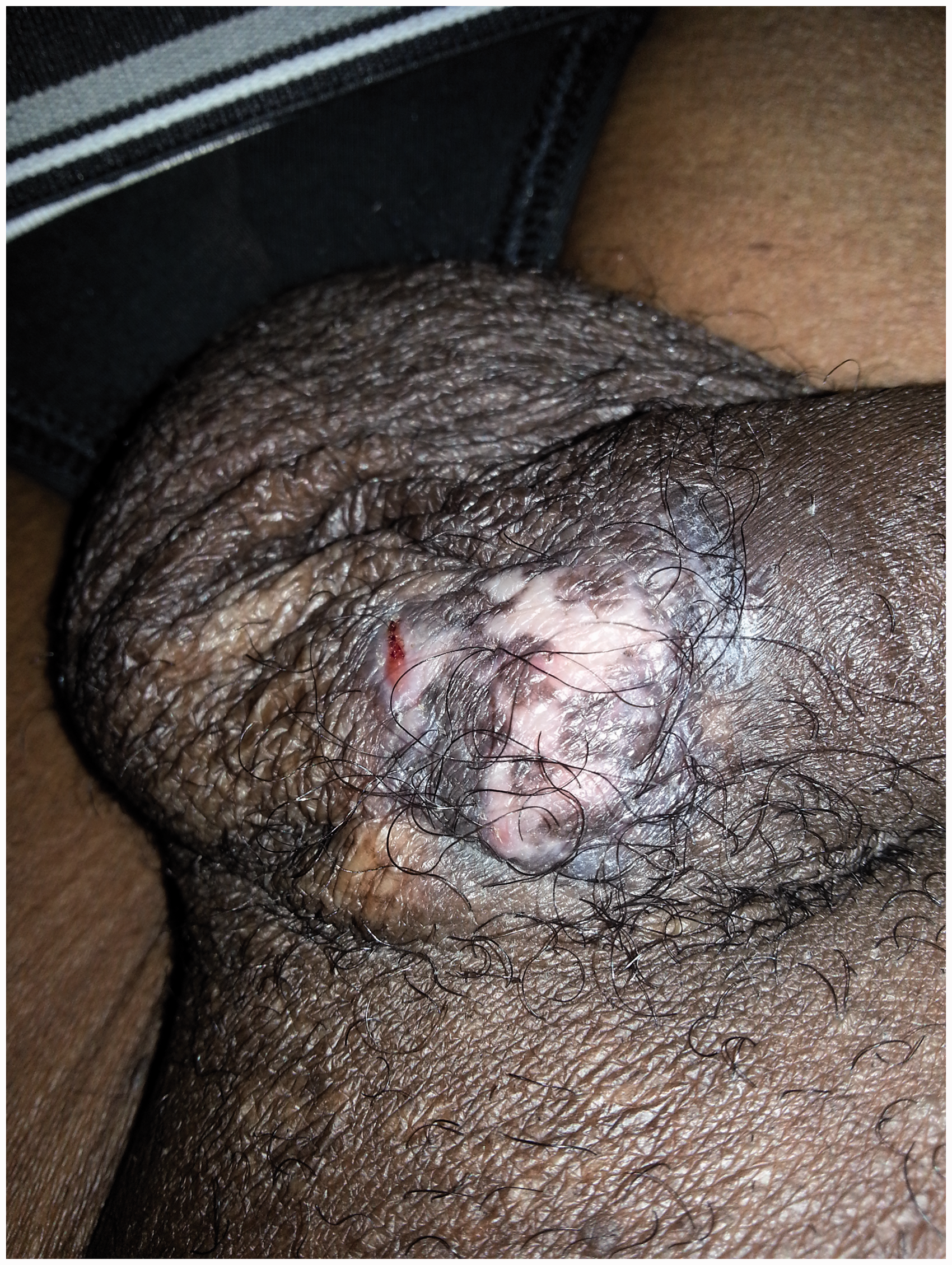
The 3-cm diameter hypertrophic lesion (see Figure 1) recurred on the penis in 2013, again not responding to high-dose aciclovir. His CD4 was 280, and viral load was non-detectable on the same ART. The patient reported that he had previously self-medicated in 2011 with topical 5% imiquimod purchased from the internet, as the lesion had not responded to foscarnet 2% cream and famciclovir and that the imiquimod had led to resolution of the lesion. He was, therefore, started on topical imiquimod 5% cream only. After two weeks, there was significant improvement, and by eight weeks, the lesion had completely resolved (see Figure 2). There has been no recurrence so far.
Aciclovir-resistant HSV, 260 × 173 mm. Complete resolution with imiquimod treatment, 1151 × 863 mm.
We believe such observations, limited as they may be due to number of cases (just the one case we are reporting), support the results of other studies1,2 that show that imiquimod 5% can be effective treatment in aciclovir-resistant HSV in HIV-positive patients, particularly when presenting as chronic hypertrophic lesions.