




Abstract
We describe the first case of chancroid seen in the Czech Republic, diagnosed in a 40-year-old heterosexual HIV-positive man. Despite genital localization of the ulcer, the transmission of Haemophilus ducreyi infection in our patient remains unclear, as he denied having sexual intercourse and he did not travel outside the Czech Republic for several months before the ulcer appeared. The correct diagnosis has been revealed by a multiplex nucleic acid amplification test. Physicians in countries in the eastern and central Europe region should be aware that chancroid can occur in their patients.
Keywords
Introduction
Chancroid is a sexually transmitted infection (STI) caused by the Gram-negative bacterium Haemophilus ducreyi. In the past decade, reported cases of chancroid in Europe have been very rare, with published case reports only from France and the UK.1,2 This report describes the first case of chancroid in the Czech Republic, which was diagnosed in September 2017.
Case description
A 40-year-old heterosexual HIV-positive (CD4 cell count 499 cells/mm3) man born in Sierra Leone, living in the Czech Republic for the past 15 years, was initially examined at the Dermatovenereology Department of the Na Bulovce Hospital in September 2017. He presented with an ulcer on the foreskin lasting for 1 week. The patient disclosed having performed masturbation but claimed not to have had any sexual intercourse (or other sexual activity with another person) in the past five years. The patient also reported that he had not travelled outside the Czech Republic during the past several months.
At the initial visit, he had a superficial, painful ulcer on the coronal sulcus with undermined edges and purulent secretion and inguinal lymphadenopathy was present (Figure 1). Swabs from the ulcer were taken for bacterial culture, darkfield microscopy and a nucleic acid amplification test (NAAT) (Allplex™ Genital ulcer Assay, Seegene, Seoul, Korea). This multiplex polymerase chain reaction assay simultaneously detects seven pathogens that cause genital ulcer: Herpes simplex virus type 1 (HSV-1), Herpes simplex virus type 2 (HSV-2), H. ducreyi, cytomegalovirus (CMV), Chlamydia trachomatis L1, L2, L3 (causing lymphogranuloma venereum – LGV), Treponema pallidum and varicella-zoster virus (VZV). Local treatment with a fusidic acid cream was prescribed. At the review visit that was performed five days later, the ulcer showed no signs of healing. Results of a blood test for syphilis were negative, darkfield microscopy was negative, culture was positive for methicillin-resistant Staphylococcus aureus (MRSA) and the NAAT was positive but only for H. ducreyi and negative for T. pallidum, LGV, HSV-1 and HSV-2, CMV and VZV. At the review visit another swab from the genital ulcer was submitted for culture with negative results (after application of topical fusidic acid). NAAT testing with the same assay was repeated in the National Reference Laboratory, Prague, Czech Republic, with a positive result for H. ducreyi. The patient was treated with a single dose of azithromycin 1 g in combination with co-trimoxazole 960 mg twice daily for 10 days for the MRSA infection. Two weeks later, the ulcer healed with only a small crust that remained (Figure 2). Repeat swabs for both NAAT and culture were negative after the treatment.
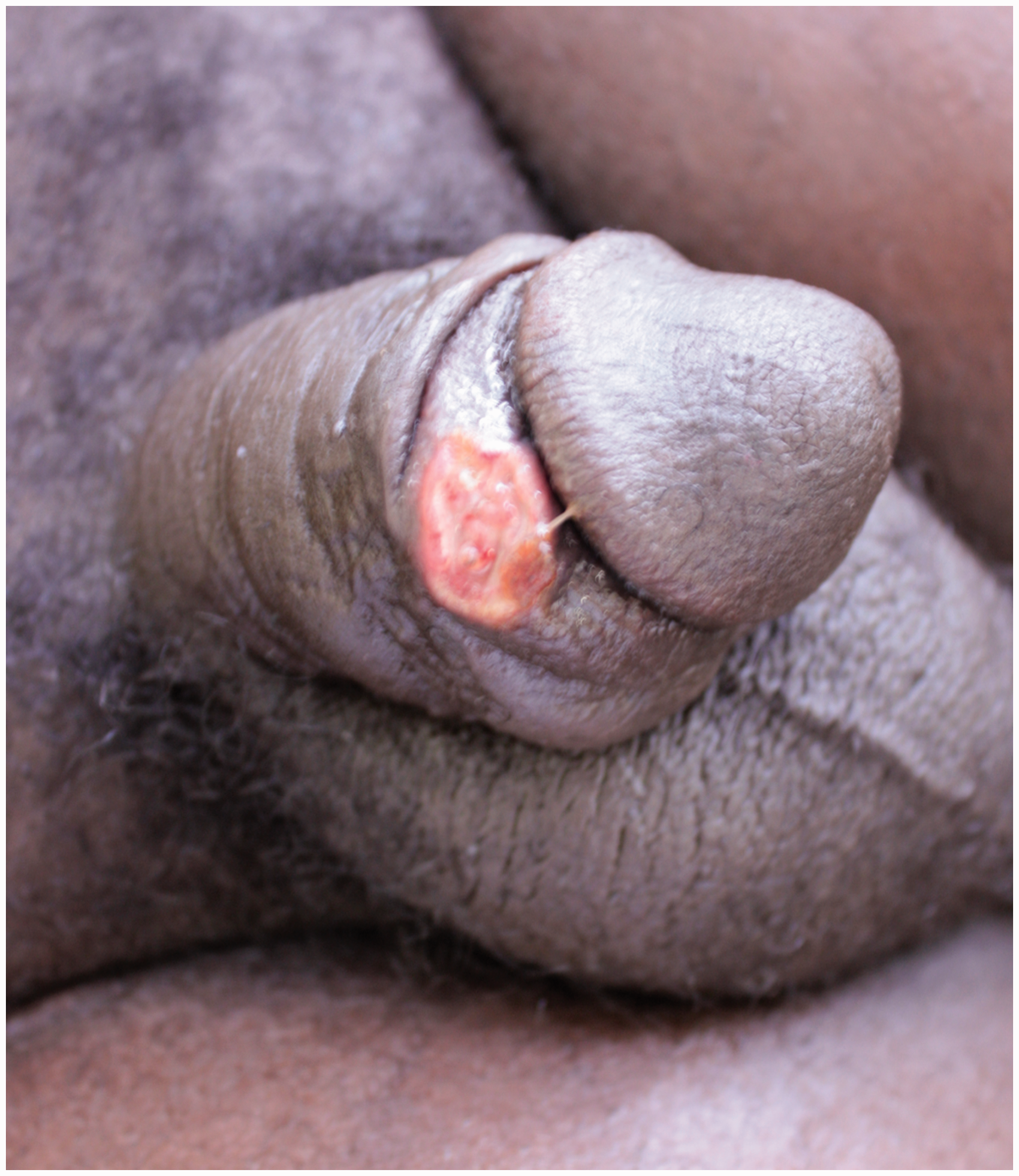
Chancroid at the initial visit.
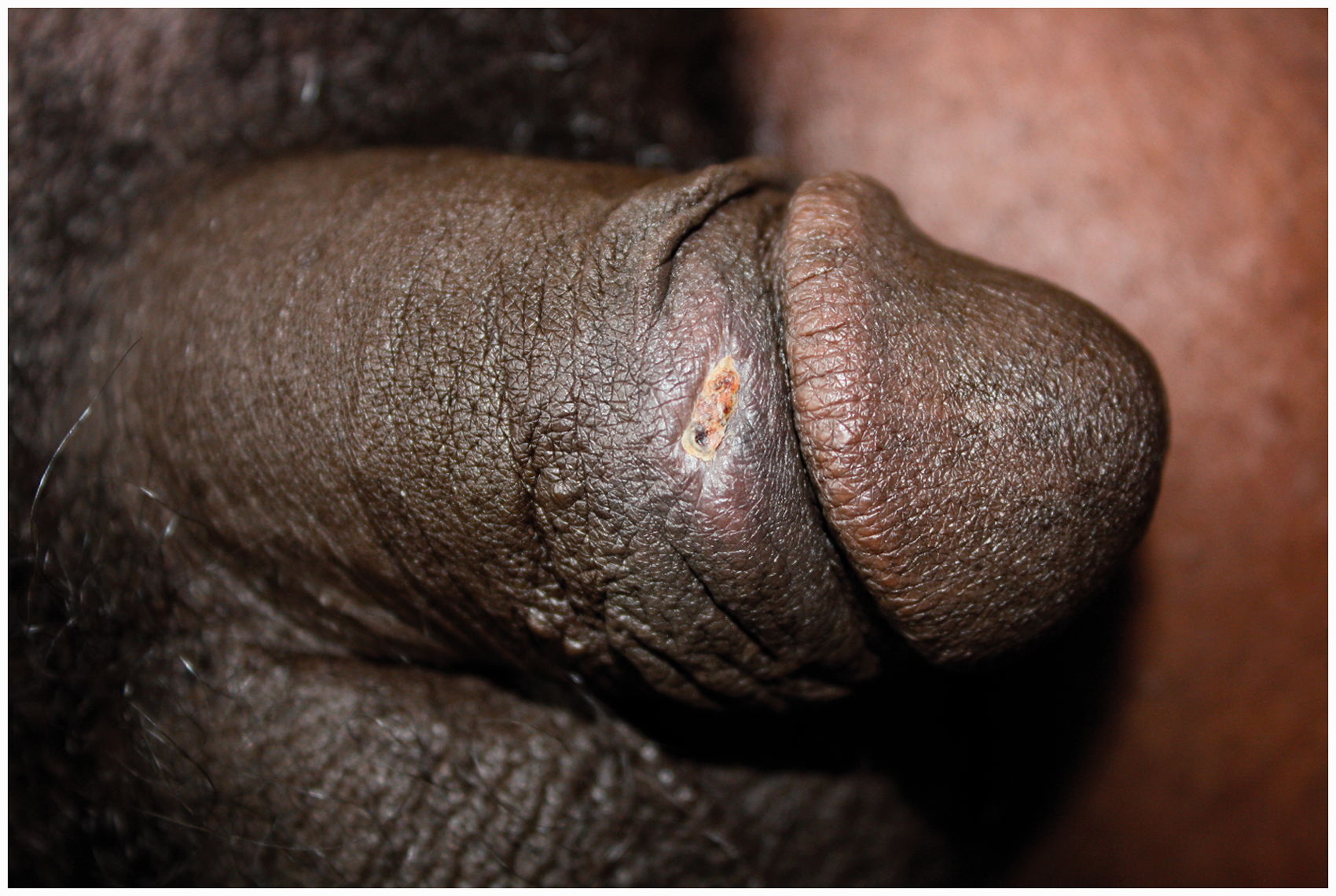
Healed ulcer with a small crust two weeks later.
Discussion
To our knowledge, this is the first published case of chancroid in an eastern or central European country. In the past decade, only sporadic cases of confirmed chancroid in Western Europe have been reported – in France, one case in a male patient returning from Madagascar and one case from the UK.1,2 In a recently published systematic review, sustained reduction in the proportion of genital ulcers caused by H. ducreyi was observed worldwide. This reduction of chancroid seems to be a result of antimicrobial drug syndromic management as well as the impact of major social changes. 3
Transmission of H. ducreyi infection in our patient remains unclear. Sexual transmission (genital localization of the ulcer) is the most probable cause despite the fact that the patient reported abstaining from sexual intercourse in recent years. The incubation period of chancroid is short, with the ulcer usually appearing about one week after sexual contact with an infected person. 4 The fact that the patient had not traveled for several months before the ulcer appeared should exclude the possibility that the patient recently acquired the infection outside of the Czech Republic. We also cannot exclude the possibility that the patient was an asymptomatic carrier of H. ducreyi and that mechanical trauma during masturbation led to autoinoculation of the infection, since cases of asymptomatic carriage of H. ducreyi and non-sexual modes of transmission have been reported.5,6
Because H. ducreyi survives for only a few hours on the swab, fast transport to the laboratory or direct inoculation of the required culture medium is essential. Furthermore, diagnosis of chancroid may be challenging because microscopy has low sensitivity and specificity and cultivation requires enriched culture media. 7 The use of NAATs for diagnosing H. ducreyi has been recommended. These NAATs have higher detection rates than culture and usually do not require a specific transport medium. 4 Moreover, commercially available multiplex NAAT assays allow testing of multiple causative agents of genital ulcers from one sample. Without the possibility of performing a multiplex NAAT, we would have concluded this case (based on the culture result) was an ulcer caused by S. aureus and we would very likely not have made the correct diagnosis. Therefore, this raises the question as to whether chancroid is so rare in Europe or if it is only under-diagnosed because of difficulties in confirming the microbiological diagnosis and the need for specialized diagnostics.
Footnotes
Declaration of conflicting interests
The authors declared no potential conflicts of interest with respect to the research, authorship, and/or publication of this article.
Funding
The authors received no financial support for the research, authorship, and/or publication of this article.