




Abstract

Dear Editor
As a follow-up to our study on ‘Chorioamnionitis in pregnancy: a comparative study of HIV-positive and HIV-negative parturients’ 1 published in this journal in 2016 we report results of the six months’ follow-up study on the HIV-positive study subjects and their babies. Information on the mode of feeding was obtained from the mothers. The polymerase chain reaction (PCR) for HIV test results were obtained from their records in the paediatric HIV clinics in the various PEPFAR sites to determine if the babies had been infected.
All the babies received nevirapine at birth. Their mode of feeding is shown in Table 1, and none of the babies tested positive for HIV DNA by PCR at six weeks and 24 weeks despite the fact that a large proportion of these women (57.1%) had histologic chorioamnionitis (HCA).
Infant feeding pattern of study subjects.
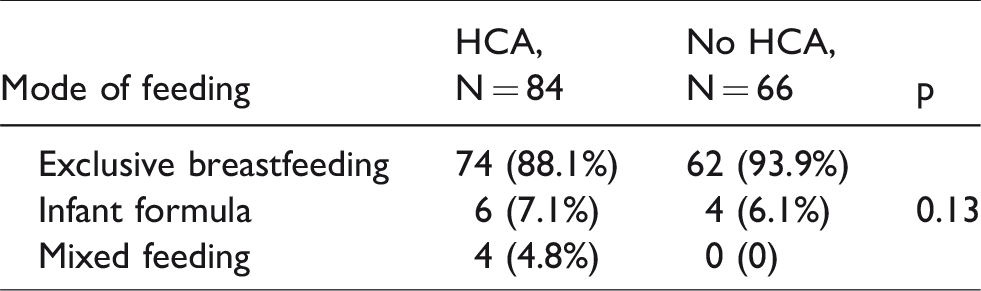
This differs from the findings of Mwanyumba et al. 2 which revealed that chorioamnionitis was independently associated with peri-partum HIV-1 transmission and is in contrast to the findings of Goldenberg et al. 3 in 2006 where HCA was not associated with mother-to-child-transmission of HIV. The study by Mwanyumba et al. 2 was carried out in 2002 prior to universal usage of highly active antiretroviral therapy (HAART) for all pregnant women. The use of HAART in this study by the study subjects and antiretrovirals by their babies has most likely prevented mother-to-child transmission of HIV in those with HCA. This would most likely have also eliminated the risk posed by mixed feeding practiced by 4 (4.8%) of the study subjects with HCA.
Footnotes
Declaration of conflicting interests
The authors declared no potential conflicts of interest with respect to the research, authorship, and/or publication of this article.
Funding
The authors disclosed receipt of the following financial support for the research, authorship, and/or publication of this article: This study was supported by the Medical Education Partnership Initiative in Nigeria (MEPIN) project funded by Fogarty International Center, the Office of AIDS Research, and the National Human Genome Research Institute of the National Institute of Health, the Health Resources and Services Administration (HRSA) and the Office of the U.S. Global AIDS Coordinator under Award Number R24TW008878. The content is solely the responsibility of the authors and does not necessarily represent the official views of the funding organizations.