



Abstract
A corymbose (or corymbiform) arrangement in secondary syphilis (derived from the Greek word korymbos) is characterised by a central large plaque or papule surrounded by smaller satellite lesions akin to an explosion, whereas annular plaques consist of a peripheral ring of erythematous papules with central hyperpigmentation. These are very rare cutaneous manifestations of secondary syphilis. This case report focuses on one such interesting case which presented with the annular and corymbose pattern involving the face and genitalia.
Case synopsis
A 25-year-old married male presented with a 15-day history of asymptomatic erythematous eruptions over the face and genitalia, not associated with fever, arthralgia or malaise. Nearly 2.5 months prior to presenting, he had developed a painless ulcer over the shaft of penis which healed on its own within 10 days.
He gave a history of unprotected sexual exposure several times with a heterosexual partner in the past 1 year. On examination, there were well-defined erythematous annular plaques, in a corymbose arrangement over the face, lateral aspect of neck and annular plaques over the scrotum and penis (Figure 1(a) and (b)). Buschke–Ollendorf sign was positive. Coppery to hyper-pigmented macules were noticed over bilateral palms and soles. The trunk, scalp and oral mucosa, lymph nodes and systemic examination were normal. (a) Annular and corymbose lesions involving the face and the neck. (b) Annular eruptions of secondary syphilis involving the scrotum and penis.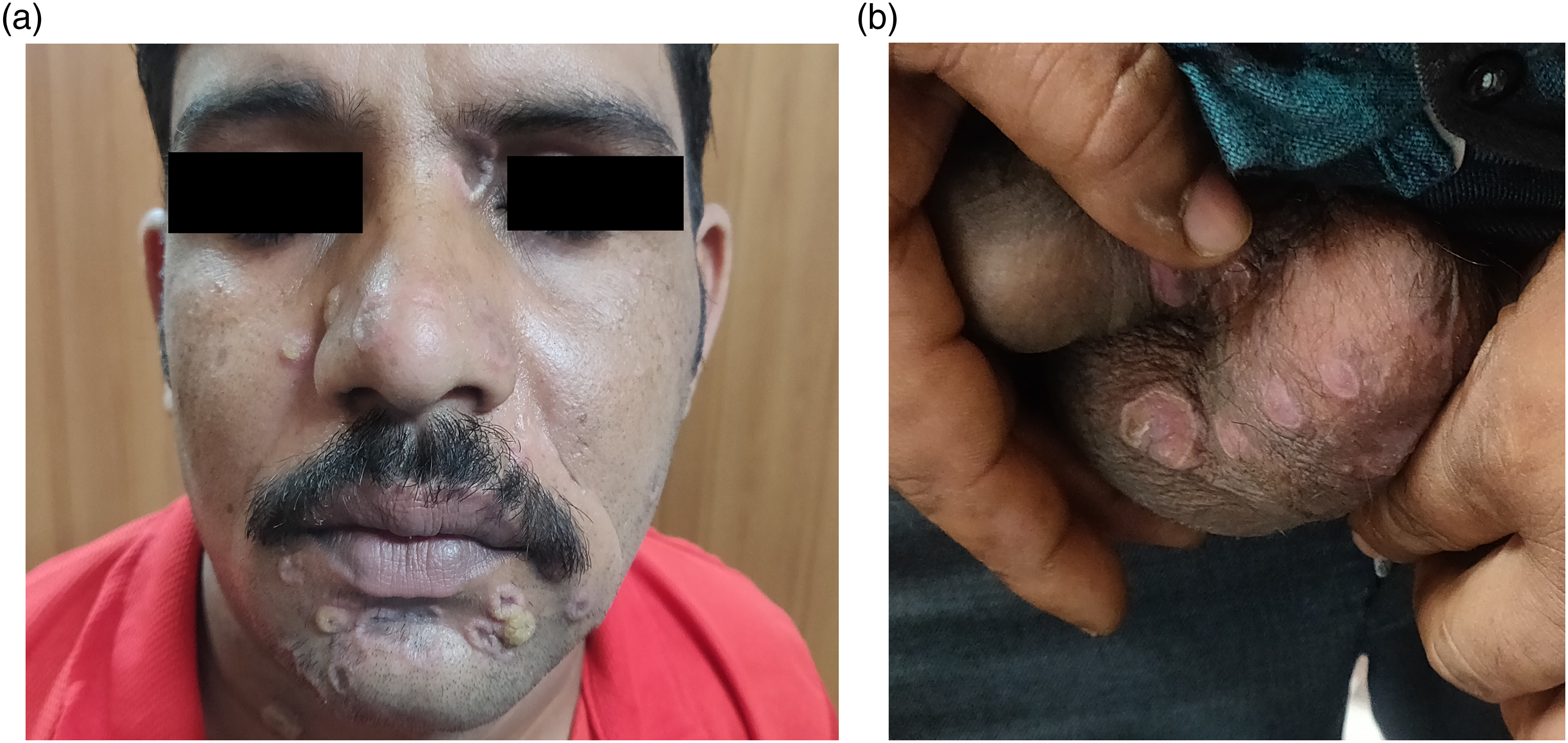
With a strong suspicion of secondary syphilis (SS), the Venereal Disease Research Laboratory (VDRL) test in dilutions up to 1:32 and the Treponema pallidum haemagglutination assay (TPHA) were done, both of which were reactive with titres of 1:8 and 1:2560, respectively. Serology for sexually transmitted infections showed a negative result for human immunodeficiency virus and hepatitis B and C viruses. Histopathological examination showed psoriasiform acanthosis and excess plasma cells in the deep dermis.
A diagnosis of annular and corymbose syphilis was made based on the reports, and he was treated with a injection of benzathine penicillin 2.4 MU. He showed complete clearance of lesions within 2 weeks with some post-inflammatory hyperpigmentation, which also cleared in a month. He had no recurrence of the lesions 3 months after the treatment, with a fall in VDRL titres to 1:4.
Case discussion
Secondary syphilis can present in various atypical cutaneous morphological patterns such as annular, framboesiform, corymbiform, nodulo-ulcerative and follicular in up to 29.6% cases. 1
Annular SS is quite uncommon and seen in 5.7%–13.6% individuals suffering from SS.2,3 It is localised to the areas around the angle of the mouth, and it can rarely be seen over the penis. 4 The corymbose or bombshell pattern has been considered extremely rare, significant and a late expression of SS by Fournier. 5 It was first described by Adamson in the early 20th century. 6 The corymbiform pattern has been reported only in a few cases so far.7–9 This rare pattern has also been considered as a sign of relapse of reinfection. 9 Baughn and Musher stated that no other dermatological condition presents with corymbose lesions. 10 Other conditions with similar presentations include granuloma annulare, annular sarcoidosis and cutaneous tuberculosis. These conditions were ruled out by a skin biopsy and serology for syphilis.
Conclusion
Our patient presented with two extremely rare manifestations of SS. The purpose of this case report is to emphasise the importance of recognising and accurately diagnosing rare manifestations of syphilis, the failure of which can lead to transmission of the illness and progression to the tertiary phase which can be fatal to the patient.
Footnotes
Declaration of conflicting interests
The author(s) declared no potential conflicts of interest with respect to the research, authorship and/or publication of this article.
Funding
The author(s) received no financial support for the research, authorship and/or publication of this article.
