



Abstract
Early diagnosis and treatment of incident cases of hepatitis C virus (HCV) infection is fundamental to eliminate HCV in HIV-positive patients. From January 2016 to December 2019, we attended 40 episodes of acute HCV infection (AHC) in 35 subjects (9 reinfections) who were coinfected with HIV. The patients were treated with direct-acting antiviral agents (DAAs) in seven hospitals in Andalusia, Spain. All were men who have sex with men (MSM), mean age was 42.9 (±8.3) years and median time of HIV infection was 46.6 months (IQR: 20.4–67.2). All received antiretroviral therapy and had undetectable HIV viral load (except 2 with 65 and 68 copies/mL); median CD4 count was 632 cells/mm3 (IQR: 553–896). Over half (74.3%) also had another concomitant sexually transmitted infection, syphilis (48.6%) being the most common. AHC was asymptomatic in 32 cases (80%). Genotypic distribution was G1a 65%, G4 32.5% and G1b 3%. Median time to DAA was 6 weeks (IQR: 4.3–18.3) and median baseline HCV RNA was 6.1 Log (IQR: 5.6–6.5). DAA regimens were SOF/LDV (19 episodes), SOF/VEL (14), ELB/GZV (5) and GLP/PIB (2). All presented sustained viral response and none discontinued due to adverse effects. In conclusion, early treatment with DAA in AHC patients proved effective and safe. It could be an excellent strategy to eliminate HCV infection in HIV-coinfected MSM.
Introduction
The roll-out of treatment with direct-acting antiviral agents (DAAs) has resulted in the prevalence of hepatitis C virus (HCV) infection among persons who are also HIV-positive falling from 22.15% in 2015 to 3.7% in 2018 in Spain, 1 suggesting that its complete elimination in this population may be possible within a few years. 2 One of the main pillars to eliminate HCV infection is the early diagnosis and treatment of new cases, thereby reducing transmission. 3 The incidence of new HCV infections in HIV-positive men who have sex with men (MSM) rose from 0.4 per 100 persons-year in 1991 to 1.3 per 100 persons-year in 2012 4 ; indeed, HCV is 19 times more common in MSM who are HIV positive than in MSM who are not HIV positive.5,6 The European AIDS Treatment Network, based on a viral kinetics model of acute HCV (AHC) infection, suggested that a spontaneous reduction of fewer than 2 log10 IU/ml of HCV RNA at 4 weeks and a positive HCV RNA at 12 weeks after diagnosis of AHC was associated with progression of chronicity. 7 Accordingly, persons who present these viral kinetics could be primary candidates for early therapeutic strategies, even more so considering the excellent response to DAAs in this setting.8,9
The aim of this study was to analyse the characteristics and the response to treatment in HIV-positive patients diagnosed with AHC and treated with DAAs.
Patients and methods
From January 2016 to December 2019, we undertook a prospective study in seven hospitals in Andalusia, Spain, involving a cohort of HIV-positive patients in order to determine HCV seroconversions. We also performed a substudy analysing patients with AHC who were treated with DAAs. AHC was defined as HCV seroconversion accompanied by a rise in transaminases or detection of HCV RNA that had been negative in the previous 6 months. The case was considered to be reinfection if HCV RNA was detected after a sustained viral response (SVR) or after spontaneous clearance, if there was also a change in the HCV genotype, or for the same genotype provided there existed high-risk behaviour. Subjects were eligible for inclusion in the study if, 4 weeks after diagnosis of AHC, they had not experienced a decrease of 2 log in the HCV RNA, or 12 weeks after diagnosis still had a detectable viral load and were treated with a DAA regimen during the first 6 months after diagnosis. The study period was from 1 January 2016 to 31 December 2019. Study variables included epidemiological, clinical and immuno-virological characteristics, the DAA treatment regimen, DAA treatment duration and SVR at week 12 after treatment (SVR12). The statistical analysis was carried out using SPSS, version 21.
Results
Baseline characteristics of the 35 subjects.
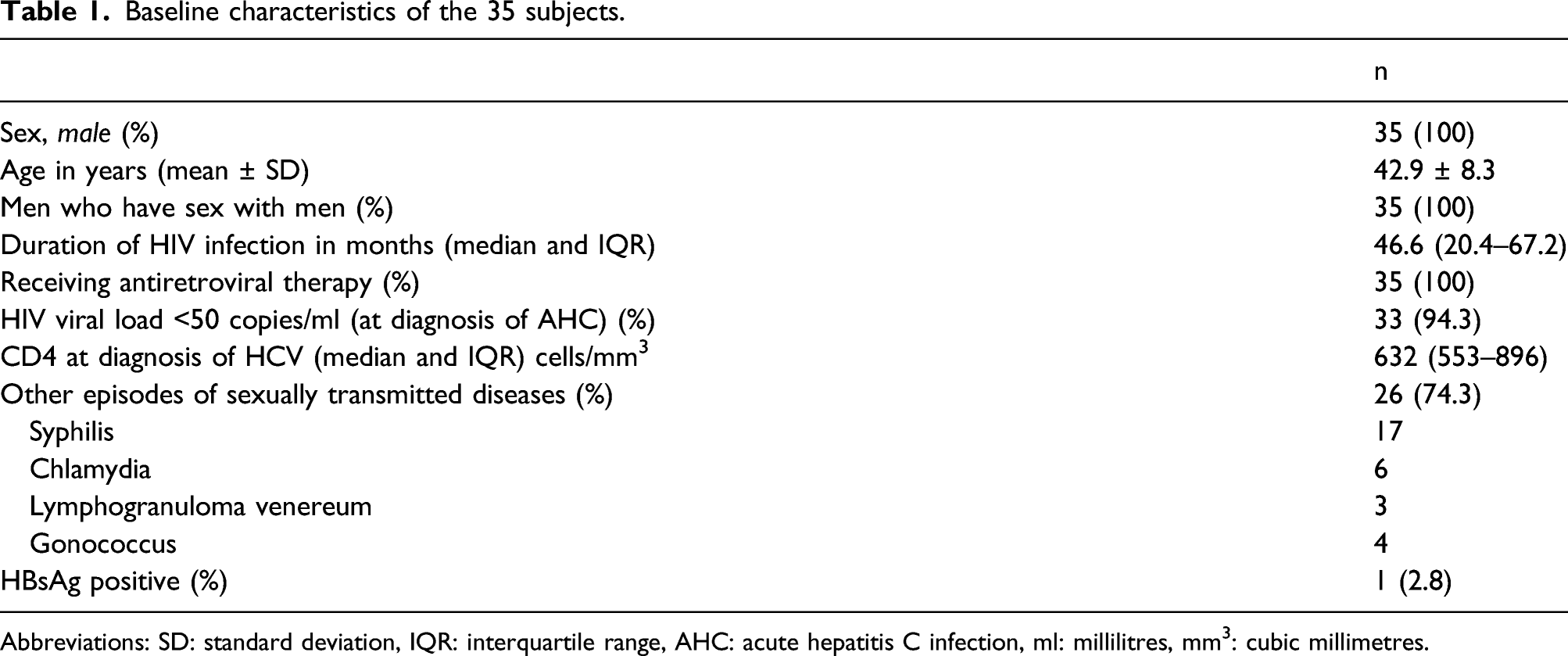
Abbreviations: SD: standard deviation, IQR: interquartile range, AHC: acute hepatitis C infection, ml: millilitres, mm3: cubic millimetres.
Characteristics of the episodes of acute HCV infection.
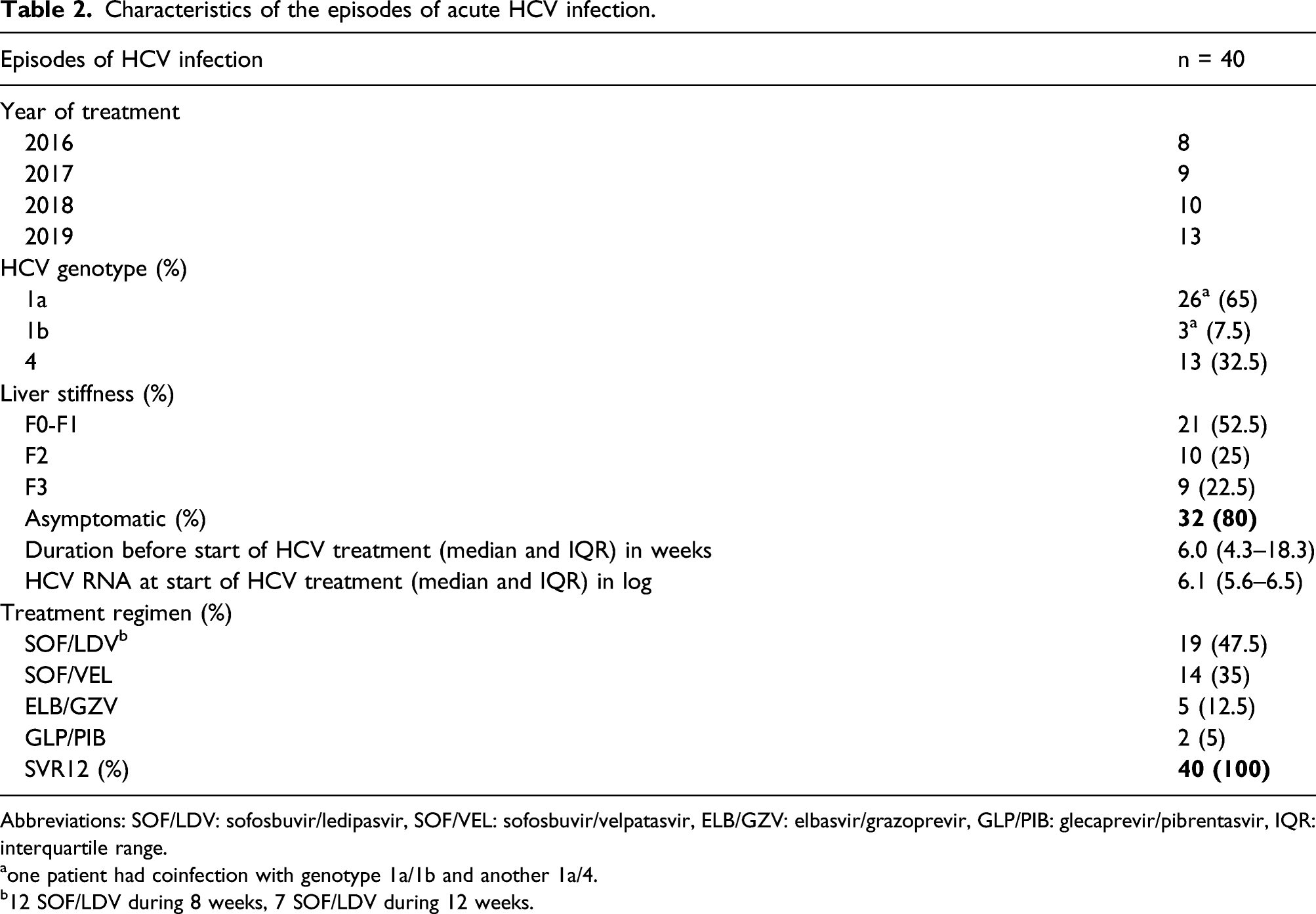
Abbreviations: SOF/LDV: sofosbuvir/ledipasvir, SOF/VEL: sofosbuvir/velpatasvir, ELB/GZV: elbasvir/grazoprevir, GLP/PIB: glecaprevir/pibrentasvir, IQR: interquartile range.
aone patient had coinfection with genotype 1a/1b and another 1a/4.
b12 SOF/LDV during 8 weeks, 7 SOF/LDV during 12 weeks.
Discussion
In this study, we report 40 consecutive episodes of ACH in HIV-positive MSM who were treated with different DAA regimens. SVR12 was achieved in all cases. No events associated with the HIV coinfection were noted, nor was treatment withdrawn in any subject due to adverse effects. Notably, most of the episodes (80%) in our series were asymptomatic, suggesting the need for regular screening in at-risk populations. Most guidelines10-12 recommend starting treatment early in patients with AHC. This has the advantage of limiting symptoms, avoiding disease progression,reducing transmission time and, theoretically, obviating the need for later follow-up. 3 Currently, the time to start treatment is not well defined. In our study, we used the criteria prevailing at the time 9 : waiting for at least 4 weeks from the first positive viraemia result, except for those subjects with a high risk of transmission, for whom it is recommended to start treatment immediately after diagnosis. 9 In fact, the latest update of the AASLD and IDSA guidelines also advises immediate treatment (‘test and treat’). 11 This is backed by the low percentage of spontaneous clearance. 9 In the PROBE-C cohort, only 11.9% of 464 HIV-positive MSM patients experienced spontaneous resolution of their AHC. 13 Concerning treatment duration, short regimens of 6 and 8 weeks of SOF/LDV have been reported,14-16 although the guidelines continue to recommend the same regimens as for chronic infection and for the same duration, with pangenotypic regimens in the event the genotype is unknown or there is suspicion of infection by more than one genotype [3,11]. In our series, we used standard regimens with a treatment duration of 8–12 weeks.
Over recent decades, HIV-positive MSM have become a vulnerable population for acute HCV infection.17,18 The incidence has remained almost the same despite generalized treatment with DAAs. 17 Nonetheless, non-restrictive access to this treatment in certain areas such as the Netherlands has resulted in a reduction in acute infections despite the increase in sexually transmitted infections, suggesting that this reduction in the incidence of AHC is not associated with changes in behaviour. 19 Another experience is that undertaken in a Swiss cohort in a prevention programme to treat hepatitis C. 20 This offered advice and early access to treatment using DAAs and achieved a reduction in AHC infections of almost 50% in an HIV-positive MSM population.
In summary, given the experience we have with treatment to prevent HIV infection, regular screening for HCV infection in susceptible populations and its early treatment, together with behavioural interventions, should lead to a reduction in the incidence of new cases, which in itself will be yet another step on the way to eliminating HCV.21-23
Footnotes
Acknowledgements
Thanks to all colleagues who collaborate in this study and all participants and HIV-infected persons who always trusted their clinicians. Special thanks to Jesús Santos for his involvement, daily effort and being a source of motivation for all of us who work with him.
Declaration of conflicting interests
The author(s) declared no potential conflicts of interest with respect to the research, authorship, and/or publication of this article.
Funding
The author(s) received no financial support for the research, authorship, and/or publication of this article.
