



Abstract
Sexual Health Hertfordshire provides integrated services for young people (YP) aged under 18 years at three sites. From January 2019 to June 2020, we saw 3483 YP, 60 of whom attended as a result of a sexual assault. Half were under 16 years, 87% female and 81% of white ethnic origin. Of this group, for 50%, this was their first sexual experience, increasing to 70% in the under-16s. Forty-three (72%) of the victims knew 46 of their assailants, and 75% of the assaults took place in a familiar place. Eighty-five percent of victims had identifiable vulnerability factors. The rate of sexually transmitted infection (STI) was 7%. Themes identified included facilitation of the assault by others, blurring of boundaries between consent and coercion, school refusal and reports of a rape culture at some schools.
Introduction
The myth that most sexual assaults involve an attack by a stranger, with a weapon, in an isolated spot at night, is slowly being eroded, and it is increasingly recognised that the majority of reported sexual assaults are committed by a person known to the victim, often in a domestic setting. 1 Less well documented are the characteristics of sexual assault in young people (YP).
The Hertfordshire Safeguarding Children Partnership has had a robust multi-agency framework for some time, and has responded to the NICE Guidance (2016) on harmful sexual behaviour 2 by developing its own local strategy. The Named Nurse for Safeguarding in Hertfordshire attends multi-agency meetings and also provides Safeguarding Supervision within the Sexual Health Department, where cases of interest or concern are discussed. This audit was prompted by trends identified during these meetings.
Sexual Health Hertfordshire provides an integrated sexual health service across the county, with approximately 70,000 attendances per year (pre-COVID-19), delivered from three hubs and eight satellite clinics in January 2019, reducing to three hubs by June 2020. Each hub has a dedicated YP clinic, although YP may also be seen at any of the other sessions; children younger than 11 years old are rarely seen. Between January 2019 and June 2020, 3483 YP aged 11 to 17 (under-18) attended, of whom 60 (1.7%) presented as a result of sexual assault.
Method
All under-18s have a detailed risk assessment done at first clinic attendance, based closely on the Brook/BASHH (British Association for Sexual Health and HIV) ‘Spotting the Signs’ format. 3 In addition, a proforma specific to sexual assault is used to collect relevant information. The records of the 60 YP seen were reviewed to determine the characteristics of the assaults.
Results
Demographics
Forty-nine of 60 (81%) were of white ethnic origin. Of the 52 females, all but one female identified as heterosexual.
Demographics. N = 60.
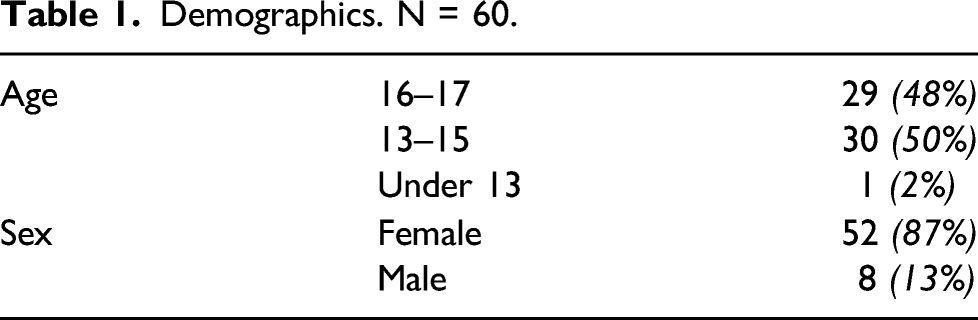
Twenty-nine were self-referred; 26 were referred by the Sexual Assault Referral Centre (SARC); three, by police; one, by Social Services; and one, by Accident and Emergency (A&E). None were identified incidentally as a result of the sexual health clinic risk assessment.
Sexual Assault
For 31 patients (52%), the sexual assault was their first sexual experience; 70% of these YP were under 16. Of the females, 43 experienced vaginal penetration; 19, oral assault; two, anal; and five, digital penetration and one was penetrated with a sex toy. Some YP suffered more than one site of sexual assault. Of the men (N = 8), six experienced oral assault and seven, anal assault. In all male assaults, the perpetrator was a lone male and similarly for the majority of female assaults, but in six cases, there were two perpetrators and in one case, three. Two of the perpetrators of assaults on young women were female. Information on age was available for 42 perpetrators; 62% were under 18 and the age range was 12–52 years.
Of the 10 victims of family/close friends, for nine YP, this was their first sexual experience and one YP had previously been assaulted by her father and uncles. Three of this group were male and two presented almost immediately after the assault. For the third, the assault had occurred 7 years previously. Among the seven females in this group, the assaults continued for a range of 4 months–5 years. The youngest perpetrator was 12 years old when he forced anal penetration on his 14-year-old cousin, although he had been digitally abusing her since he was 10 years of age.
Injuries, place where assault occurred, other services accessed and time to presentation.

Perpetrators
Forty-three victims knew 46 of their perpetrators; 13 were current or ex-partners, 10 were friends or classmates, 12 were acquaintances or friends of friends and 10 were family or close family friends. In one case, the relationship was not recorded. In the other 17 cases, there were 22 perpetrators identified; two were met online, two were holiday reps/entertainers, three were recognised local gang members and the others were complete strangers.
Vulnerability Factors
Vulnerability factors.

Drugs and Alcohol
In 12 cases, the victims had used alcohol or recreational drugs prior to the sexual assault and half were unclear about recalling the events as a result. In 11 cases, there was no reported alcohol or recreational drug use. This information was not recorded for 37 victims.
Use of Social Media
Recordings or photographs were taken of the assaults on three occasions and these were later shared with the victim as well as with others.
Sexually Transmitted Infection Testing, Rates of Infection and Prophylaxis
Sexually transmitted infection testing.

NG: Neisseria gonorrhoeae, CT: Chlamydia trachomatis, STS: serological test for syphilis, HIV: human immunodeficiency virus, HBcAB: hepatitis B core antibody.
Discussion
Rape is defined as use of the penis to penetrate vagina, mouth or anus of another person, knowingly, without their consent. 4 Legally, a person without a penis cannot commit rape. But a female may be guilty of rape if she assists the male perpetrator in the attack. Sexual assault occurs when a person is coerced or physically forced to engage against their will or when a person touches another person sexually without their consent. Touching can be done with any part of the body or with an object. We have used the term ‘sexual assault’ to include all of these.
Estimates of the prevalence of sexual assault in the under-18 age group vary. A study carried out by the University of Bristol for the National Society for the Prevention of Cruelty to Children (NSPCC) found that one in three teenage girls had experienced some type of intimate partner violence. 5 Figures from the 2017 Crime Survey for England and Wales quote a sexual assault rate of 3% in men and 8.8% in women aged 16–19 years. 6 An Edinburgh study from 2008 reported that 25% of their study group of 133 YP, aged under 16 years, who attended the genitourinary clinic, gave sexual assault as a key reason for their attendance, whereas our prevalence was 4.3% in the under-16 age group. 7 It is unclear why the reported figures seen in Hertfordshire are so much lower, but a possible explanation may be that 60% of those attending in Edinburgh were referred from other services including general practitioners, social workers, paediatricians, youth workers and police, whereas the vast majority of YP attending Hertfordshire sexual health services are self-referred, and also that the numbers included in this study were small. In our cohort, two-thirds of the assaults were perpetrated by YP under 18 years, which aligns with a study carried out in England in 2011 with 2275 YP which found that two-thirds of the sample reporting sexual contact or harmful sexual behaviour identified peer-on-peer sexual abuse. 8 A further study estimated that at least one-third of all sexual offences against children in the UK are committed by other children, with early adolescence and the onset of puberty representing a peak time for harmful sexual behaviour. 9
The number of young females experiencing sexual assault in this cohort far outweighed the number of young males although a quarter of those under 16 reporting abuse in 2019 were young males (males: 3.49%; females: 11.51%) 10 and data on the gender profile of historic cases of child sexual assault (CSA) reported in later life by adults would indicate that 25%–30% of victims are male. 11 Shame and stigma may prevent these young men reporting sexual abuse and therefore may be less likely to be identified early on in the grooming context.
Seventy-two percent of our victims knew the perpetrator and 75% of the assaults occurred in familiar places, both trends in reporting previously having been recognised.12,13 Although most multiple assaults are carried out by people unknown to the victim, in four of our seven cases, the perpetrators were known to the YP.
Information on alcohol and recreational drug use was consistently poorly recorded and may reflect reluctance on the part of the victim to disclose such information, fearing that it might have an impact on their allegations being taken seriously.
The number of cases reviewed was too small for meaningful statistical analysis but the following trends were recognised.
In six cases there was clear evidence of facilitation of the assaults by a third party, after excluding those assaults within families or by close family friends. In these cases, the victim and the perpetrator were brought together specifically so that the assault could take place – sometimes by a friend of the victim, on two occasions by strangers met randomly and one other may have been gang related. It is concerning that 40% of our cohort were known to CSC and 32% had had counselling prior to the assault; despite this, they still remained vulnerable in a variety of situations.
The lack of YP understanding or concern about consent to sexual activity was a recurring theme, with blurred boundaries between coercion and consent. The use of alcohol or drugs to render a victim more compliant was reported in some cases; this was sometimes boasted about, as was the assault, sometimes accompanied by sharing images on social media, within peer groups at school and colleges. 13 of the perpetrators in this study were either current or ex-partners who did not accept their victim’s right to refuse consent. Although YP consent to sexual activity, as a topic, is embedded in the school curriculum for Relationships, Sex and Health Education (RSHE), 14 it may be that those delivering the material need more formal training to facilitate exploration of the meaning of consent with YP in the context of relationships, using a multi-agency approach.
Some of the YP seen in clinic refused to return to school as a direct result of their assault, either because the perpetrator was still a pupil at that school, sometimes in the same classes, leading to ongoing harassment and abuse or because they were being openly condemned by their peers for having had sexual intercourse, although non-consensual. Efforts were made to keep victim and perpetrator apart only as long as the case was likely to progress to trial. Our findings support the suggestion of a ‘rape culture’ in many of our schools, where misogyny and sharing of non-consensual images create an environment where sexual violence and harassment are normalised.
The trends and themes raised are very much in the public domain at present, having been taken up by various social media platforms, such as Twitter ‘#Been Raped, Never Reported’ (viewed by 8 million people online), ‘The Everyday Sexism Project’ and more recently, ‘Everyone's Invited’, which focuses specifically on sex abuse in schools and colleges. Over 54,000 anonymous testimonies have been submitted to the latter since it was set up in June 2020. Various reasons are given in these testimonies for the assault not being reported at the time. These include shame, feeling that they themselves were somehow to blame and fear that they would not be believed. In some cases, the victim did not recognise it as sexual assault until a considerable time after the episode.
Ofsted was asked to investigate school safeguarding practices, as well as their teaching on RSHE, sexual abuse, cyberbullying and pornography, and consent. Their review, published in June 2021, 15 revealed sexual abuse to be commonplace but often underestimated by professionals, RSHE thought inadequate by pupils, and staff unsure how to proceed when criminal investigations of an alleged assault did not lead to a prosecution or conviction. They have recommended that schools should assume that sexual harassment and online sexual abuse are happening in their setting, even when there are no specific reports, and put in place a whole-school approach to address them.
This study was limited in terms of numbers, and the detailed outcome of each case was difficult to follow-up once the appropriate referrals have been made. There is no information on how many cases progressed to court or a conviction, or what the ongoing impact was on the quality of life of the victim after the assault.
Recommendations
It is useful to record names of friends attending with YP; they may previously have been highlighted as being at risk or as exhibiting risk-taking behaviour.
Share information with local Safeguarding Children Partnership in order to raise awareness when vulnerable YP are not receiving the support they need.
Service support of any proposed plans to improve the standard of RSHE in local schools.
Footnotes
Declaration of conflicting interests
The author(s) declared no potential conflicts of interest with respect to the research, authorship, and/or publication of this article.
Funding
The author(s) received no financial support for the research, authorship, and/or publication of this article.
