



Abstract
When the Associate Specialist grade shut in 2008 it left an untenable situation in which some Specialty Doctors were providing the most senior levels of care for patients without recognition of that seniority. Hence in 2021, the Specialist Grade was created as a new national grade for senior specialist and specialty (SAS) doctors. The post provides autonomous working and recognition of seniority for SAS doctors. Becoming a Specialist Grade doctor is not an automatic career progression and must be applied for when a position is created by the employer. The Specialist Grade route has potential to be an alternative but equally rewarding career choice to traditional training.
Background
Within genitourinary clinics across the United Kingdom, Specialty Doctors are integral as part of the team. Often described as ‘the work horse’ of the department, a specialty doctor can provide valuable clinical knowledge and continuity for both patients and staff. Studies have shown that Specialty Doctors contribute to a significant proportion of the clinical work in genitourinary medicine clinics 1 and many Staff, Associate Specialist and Specialty (SAS) doctors are very experienced and working at a senior level.
The Associate Specialist grade shut in 2008, leaving an untenable situation in which some Specialty Doctors were providing the most senior levels of care for patients without recognition of that seniority. This has led to specialty doctors feeling trapped in jobs with little career progression or recognition, having low morale and to Trusts having issues with recruitment and retention of SAS doctors.
During the negotiations for the new SAS contract in 2020/2021, efforts were made to address these issues by the introduction of a new grade called the Specialist grade.
What is a Specialist doctor?
The Specialist grade is a new national grade for senior SAS doctors, creating a clear career framework and giving senior Specialty Doctors the recognition they deserve. 2
To be eligible for this new contract, applicants need to ‘have completed a minimum of 12 years’ medical work (either continuous period or in aggregate) since obtaining a primary medical qualification of which a minimum of 6 years should have been in a relevant specialty in the Specialty Doctor and/or closed SAS grades. Equivalent years’ experience in a relevant specialty from other medical grades including from overseas will also be accepted. 3
Applicants must meet a set of generic capabilities criteria which fall under the following categories and produce evidence to support this
4
: Professional values and behaviours, skills, and knowledge, Leadership and teamworking Patient safety and quality improvement Safeguarding vulnerable groups Education and training Research and scholarship
A generic capabilities framework for the Specialist grade has been developed in partnership by the Academy of Medical Royal Colleges, the British Medical Association and NHS Employers. 4 Logbooks, job planning activities, 360-degree reviews, appraisal history, e-portfolios and references from senior colleagues are just some examples of appropriate evidence for the Specialist post.
All doctors on national Associate Specialist Terms and Conditions (TCS), 2008 and pre-2008, have been given the option to transfer to the new Specialist grade providing they can show their capabilities. 5
Becoming a Specialist doctor is not an automatic career progression. The position must be created by the employer in response to service needs, and candidates must apply for it.
Hence there is a risk that a dedicated, senior genitourinary Specialty Doctor with a senior level of competence and accountability could be working as a Specialty Doctor without proper recognition or financial renumeration, with their employers having little incentive to change this. 1
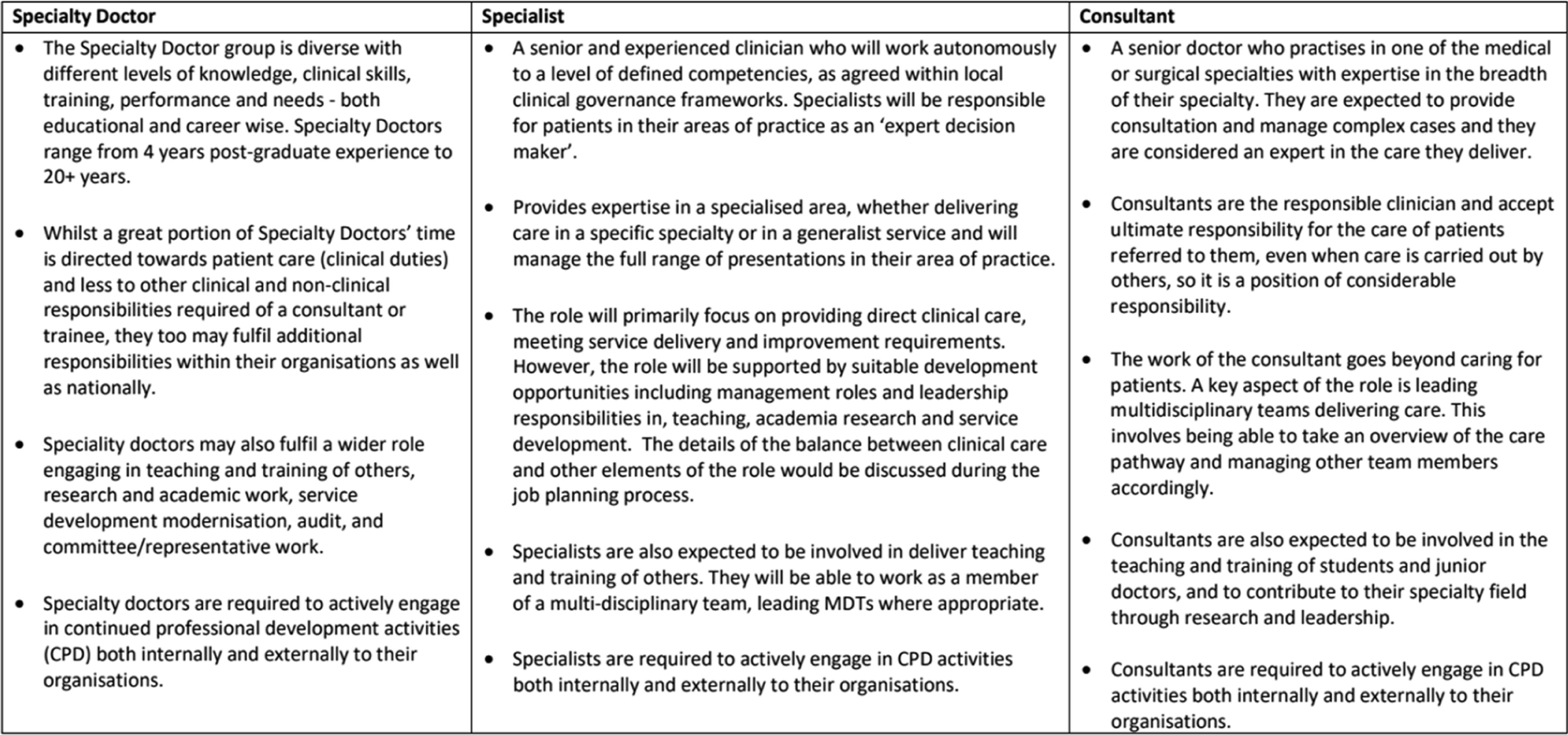
The BMA has created a table comparing Specialty doctors, to Specialist grade to Consultants. 6
What advice would you give to others who might be considering a becoming a Specialist?
If, as a Specialty Doctor, you are reading this and think you could be a Specialist then your next step is to gather evidence of your role, show how it aligns with being a Specialist Doctor and speak to your line manager.
Hopefully, some of the many positives of this new role will be more inclusion of SAS doctors in leadership and management roles. Pragmatically, the creation of the Specialist role may also help support Consultant colleagues particularly in areas with Consultant shortages.
Below we have a real-life case study by Dr Georgina Forbes. She describes how she became one of the first Specialists in Sexual Health in the United Kingdom and gives her advice for others.
‘I entered the Specialty Doctor grade almost by accident, a situation many of us find ourselves in. I had a specialty that I loved but training jobs were scarce especially when coupled with having a medical partner who was applying for training at the same time. At the time that I entered into the grade I was the first among my medical school cohort to leave training and head down the SAS route. There was surprise amongst my peers as we were still led to believe that formal training schemes were the only career route. I started as a Specialty Doctor in sexual health in 2013 having spent some time after foundation working in sexual health and gynaecology. My partner had been lucky to get his training number and I had no desire to move away or sacrifice the specialty I loved.
For the next 8 years I worked in a department where I was supported to develop my skills both clinically and in management. My study budget was generous, and I knew the department valued my contributions. Over time it became frustrating that there was always the Specialty Doctor ceiling for both progression and pay, a constant reminder of the limitations of the grade. Hope appeared in 2019 when the new grade was first discussed, and I was keen to be considered. I made sure to develop my curriculum vittae (CV) and continued working as a senior doctor taking on greater challenges to prove myself. As the contract was released it became clear that regrading wasn’t an option, and my existing department may struggle to advertise another job as this requires funding for the new post.
As sexual health is a small specialty, particularly in my area I was well known locally as a good specialty doctor. The clinical director of a neighbouring trust was advertising for an SAS doctor and was keen to gauge my interest. I was clear from the outset that I felt I met the new criteria for Specialist doctor and would only be interested if the job plan would support that. The Clinical Director was able to modify the budget to convert the post from specialty doctor to specialist doctor and advertise the job. I was delighted to be appointed in May 2021. There were a few hurdles to pass with medical staffing as I was the very first appointed within the Trust after the new contract was introduced but ultimately entirely worthwhile. I entered the new trust and was automatically welcomed as a senior doctor and key member of the senior management team. I have complete autonomy over my work and patients, have set up a specialist clinic and am the Safeguarding Lead Doctor. I am a firm believer that this opportunity should be extended to all senior specialty doctors and that the SAS route should be promoted to medical students and junior doctors as an alternative but equally rewarding career choice to traditional training.
As we all hopefully strive to create the new Specialist posts, whether as clinician or manager; remember the words of the renowned philosopher William James “The deepest principal in human nature, is the craving to be appreciated”
Key points
• The Specialist Grade is a new national grade for senior SAS doctors.
• Becoming a Specialist doctor is not an automatic career progression and must be applied for when a position is created by the employer.
• The post provides autonomous working and recognition of seniority for SAS doctors.
Footnotes
Declaration of conflicting interests
The author(s) declared no potential conflicts of interest with respect to the research, authorship, and/or publication of this article.
Funding
The author(s) received no financial support for the research, authorship, and/or publication of this article.
