



Abstract
Introduction
Anogenital warts (AGW) are manifestations of human papillomavirus (HPV) infection with papular, flat, or filiform lesions.1,2 Mohammad Hoesin General Hospital Palembang, Indonesia, reported 251 cases of AGW in 2018–2023, the most common sexually transmitted infection encountered.
Giant condylomata acuminata (GCA), or Buschke-Löwenstein tumor, is a rare presentation of AGW with cauliflower shape, slow-growth, ≥5 cm in size, invasive locally but does not metastasize.3–5 Management of GCA from CDC and European Guidelines suggest combination therapy based on available modalities and clinicians’ experiences.6,7 The combination of TCA and podophyllin has showed good efficacy comparable to cryotherapy, which may be costly.8,9 Electrocautery offers complete wart clearance, most effective for smaller lesions.6,10 This case report discusses successful GCA therapy using a combination of TCA 90% and podophyllin 25%, followed by electrocautery.
Case illustration
A 24-year-old male had a chief complaint of large warts on the base of the penis that had started to bleed for the past 4 weeks. The initial lesion appeared 8 months prior as a small varucose papule. The patient is unmarried and has history of condomless sex with female sex workers.
Physical examination of the proximal penile region showed multiple verrucous papules, flesh-coloured, cauliflower-like shaped, clustered into a tumor of 5 × 2 × 1 cm in size (Figure 1). There were no lymph node enlargements. Upon dermoscopic examination, multiple filiform and papillary projections with dendritic blood vessels were found (Figure 2). Testing for HIV was negative. Histopathological examination showed acanthosis, exophytic growth, parakeratosis, and koilocytosis (Figure 3) with no signs of malignancy. Proximal penile region examination showed a giant condylomata acuminata with manifestation of multiple verrucous papules, flesh-coloured, cauliflower-like shaped, clustered into a tumor 5 × 2 × 1 cm in size. Dermoscopic examination from the lesion on proximal penile region showed multiple filiform and papillary projections with dendritic blood vessels ( Histopathological examination with hematoxylin-eosin staining showed: (a) ×20 magnification, cauliflower-like exophytic lesions (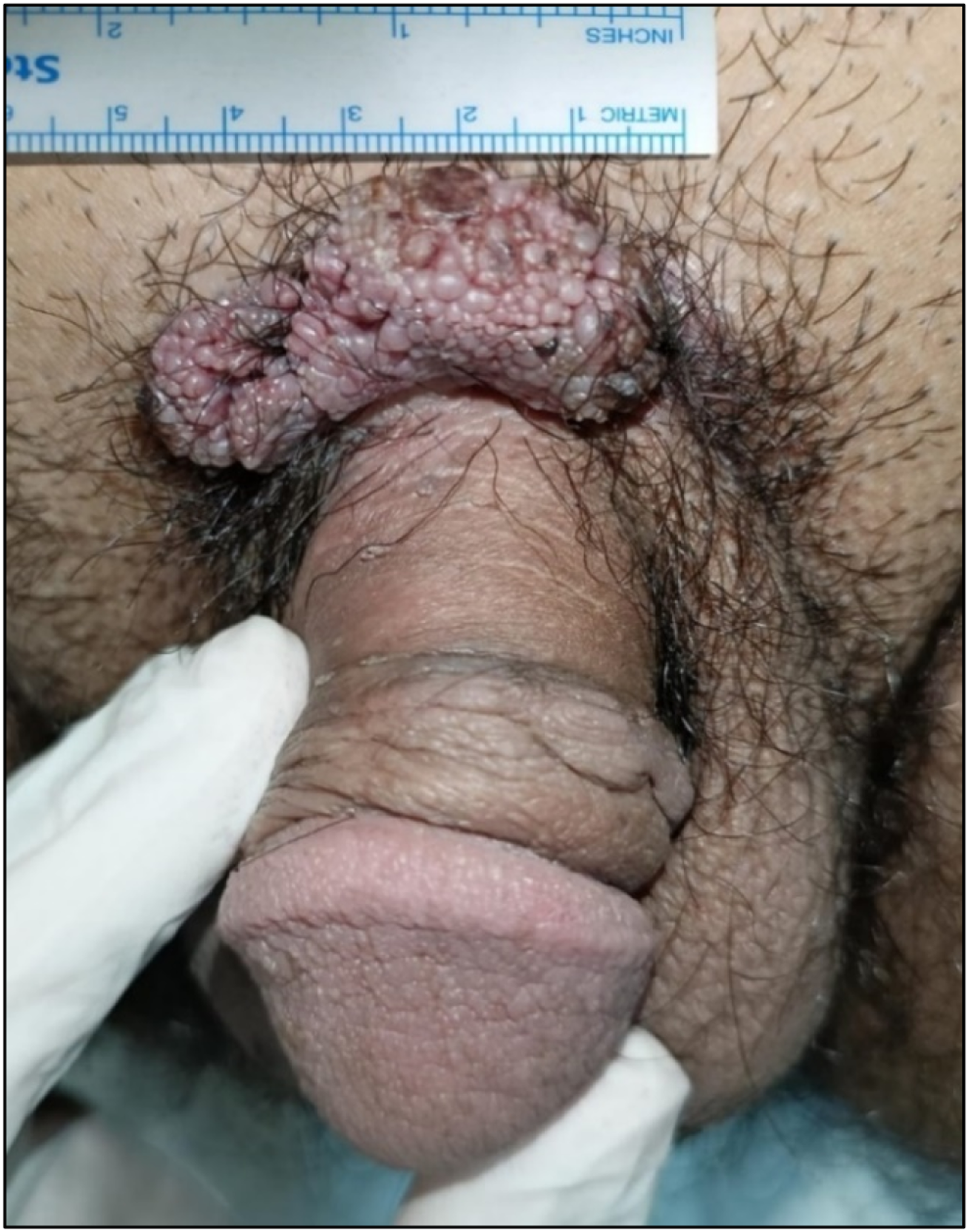
 ).) and acanthosis (
 ); (b) ×40 magnification, acanthosis and epidermal hyperplasia () with blood vessels proliferation (
 ); (c) and (d) ×100 magnification, parakeratosis (
 ) and koilocytes (
 ). No signs of malignancy were found.
This patient received a combination of TCA 90% and podophyllin 25% to initially reduce the tumor size, followed by electrocautery to eradicate the remaining lesions. The application of TCA and podophyllin was done in two clinical visits with a 2-weeks gap. The tumor size was reduced by more than half after the second application of TCA and podophyllin. Electrocautery was performed on the third visit with local anesthesia, followed by third application of TCA and podophyllin right afterwards. The tumor showed complete clearance 2 weeks later (Figure 4). Clinical image from patient’s follow-up: (a) After two applications of TCA and podophyllin with 2-weeks gap, the tumor size was reduced by more than half; (b) After electrocautery followed by the third application of TCA and podophyllin; (c) The tumor showed complete clearance 2 weeks later.
Discussion
Giant condylomata acuminata is considered a midway precancerous lesion between AGW and malignancy, mostly from HPV-6 and -11.4,11,12 Prevalence of GCA is rare, 0.1% of all AGW, more common in males (2.7:1), with age <50 years.4,5 Multiple sexual partners and sex workers are important risk factors.5,11 This case presented a 24-year-old male with a history of sexual intercourse with sex workers.
The diagnosis of GCA is mainly based on history and physical findings.13,14 The risk of malignancy is higher in persistant warts for 6 months with bleeding or lymph node enlargement.5,11,12 Physical findings of GCA present as a papillomatous tumor with irregular surface, cauliflower-like shape, flesh-coloured, size >10 cm.2,11,13 In this case, the patient had a tumor with irregular surface at his penile base for 8 months, enlarged to 5 cm in size and bled. The patient was clinically suspected of GCA.
Dermoscopy features of GCA shows multiple filiform and papillary projections, finger-like, knob-like, to mosaic-like patterns. Vascular features of dendritic, glomerular, hairpin, or dotted vessels are commonly seen.14–16 The dermoscopic features in this case showed multiple filiform and papillary projections with dendritic blood vessels, which was in accordance with GCA.
The histopathology of GCA resembles common AGW by the presence of koilocytes, vacuolated epidermal cells with clear cytoplasm and hyperchromatic nuclei, with hyperkeratosis, papillomatosis, and acanthosis. The dermis appears edematous with dilated blood vessels and lymphocytic infiltrates.5,11 Pathological evidence of malignancy is infiltration of the basement membrane, lymphatic invasion, angioinvasion or distant metastases. 11 Histopathological examination of the patient showed exophytic growth, acanthosis, parakeratosis, epidermal hyperplasia with blood vessel proliferation, and koilocytosis with no signs of malignancy.
There is no definitive evidence that one therapy is superior to completely eliminating warts.5,17 The most recommended topical therapy is chemical coagulation of proteins by TCA in 70%–100% concentration, with clearance rate of 56%–94% and 36% recurrence rate.5,10 Podophyllin resin, in 10%–25% suspension, induces tissue necrosis locally with 35%–100% clearance but high recurrence rate of 65%. 18 Combination therapy of TCA and podophyllin leads to complete wart clearance without additional adverse effects.9,17 Electrocautery destroys warty tissue by direct electrical current, effective for smaller and limited number (<10) of warts.10,19 Electrocautery has a 94%–100% clearance rate with 22% recurrency.5,10 Reported side effects of electrocautery include local pain, bleeding, and scar formation, especially on larger lesions. 10 The patient in this case was treated with a combination therapy of TCA 90% and podophyllin 25% to reduce the size of the tumor, then the electrocautery conducted to remove the remaining warts. The tumor showed complete clearance on 2-weeks follow-up after electrocautery.
Summary
A case of 24-year-old male with GCA has been reported. The patient received a combination of TCA and podohyllin to reduce the size of the tumor, followed by electrocautery to completely eradicate the lesions with minimal adverse effects.
Footnotes
Declaration of conflicting interests
The author(s) declared no potential conflicts of interest with respect to the research, authorship, and/or publication of this article.
Funding
The author(s) received no financial support for the research, authorship, and/or publication of this article.
