



Abstract
Cutaneous larva migrans (CLM) of genitals has been very rarely reported in the literature. We describe a case of CLM of the penis in a 38-year-old Caucasian patient who sunbathed naked whilst in Phuket island (Thailand). The patient was successfully treated with 1% ivermectin cream (2 applications/day for 2 weeks), under occlusive dressing.
Introduction
Cutaneous larva migrans (CLM) or hookworm-related cutaneous larva migrans is an infestation caused by penetration and migration in the epidermis of nematode larvae. Ancylostoma braziliense and Ancylostoma caninum are the most frequently involved species. CLM is characterized by slightly raised and erythematous tracks: they may be single or multiple, linear or, more often, serpiginous. The length of tracks is variable (sometimes several cm); the width ranges from 1 to 3 mm. Tracks are accompanied by more or less severe pruritus. Typical locations of CLM are the ankles and feet. 1 Involvement of the genitals has been very rarely reported in the literature.2–12 In a group of 92 Brazilian patients living in a hyperendemic area, genitals were involved in only two cases. 3 We present a case of CLM located on the penis.
Case
A 38-year-old Caucasian man was admitted because of a dermatitis located on the penis. The patient stated that he was in good general health and took no regular medication. He also stated that the dermatitis had appeared two weeks before, in Phuket island (Thailand), where he had often sunbathed naked. The patient complained of severe pruritus. Dermatological examination showed a single, serpiginous, mildly erythematous, raised track (Figure 1). The patient refused a biopsy. Laboratory examinations were within normal ranges. A clinical diagnosis of CLM was made. Due to the patient’s preference, topical therapy with 1% ivermectin cream was administered twice daily (under occlusive dressing) for two weeks, with complete healing observed by the third week. Follow up (at 8 months) was negative. Cutaneous larva migrans of the penis.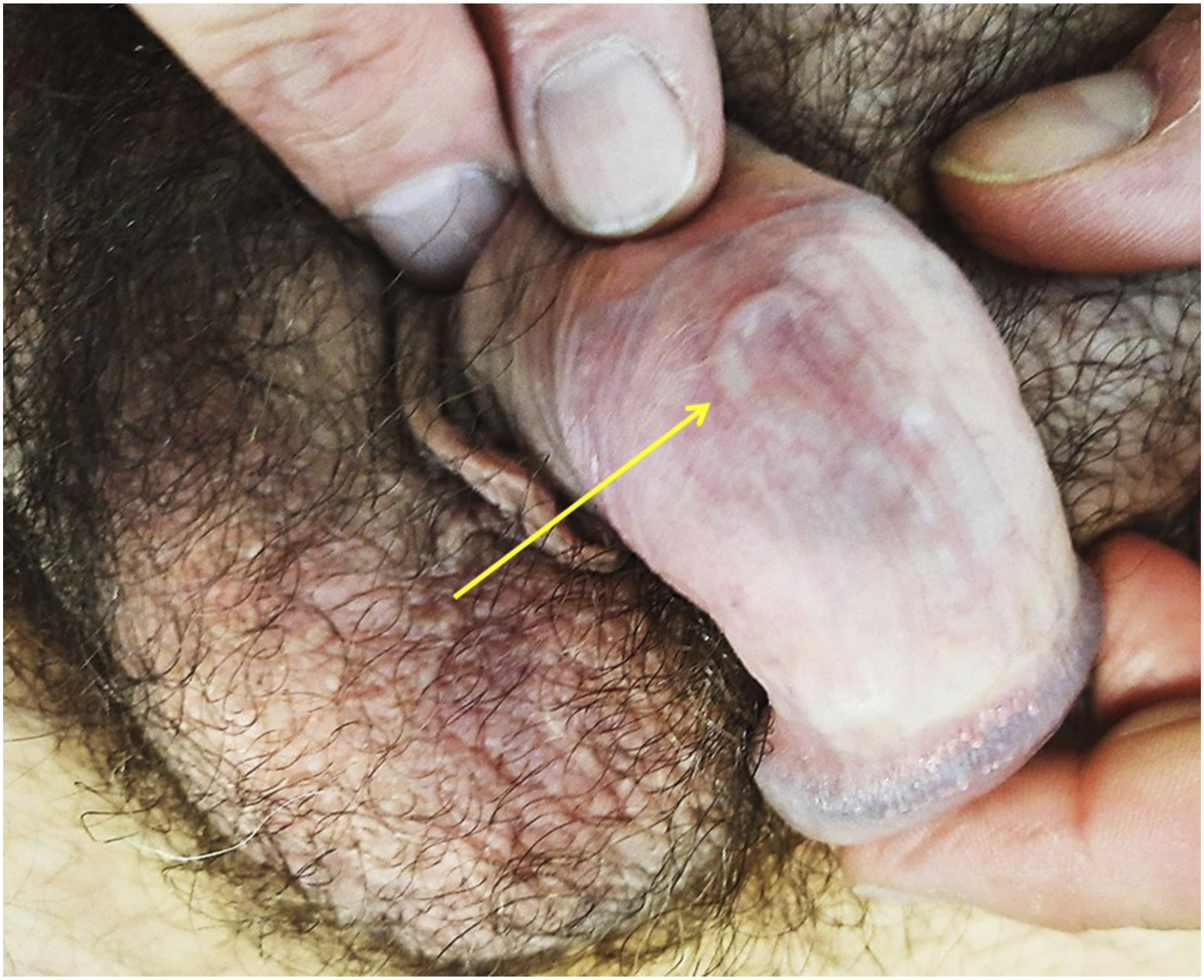
Discussion
CLM located on the penis is extremely rare. To our knowledge, since Pavithran described in 1982 the first case of CLM on the penis, 4 only eight further cases have been reported in the literature5–12; curiously, six of them were from India.5–7,9,10,12 In our personal clinical experience, based on more than 230 patients, 1 we observed only one child with CLM located on the penis. 11 The rarity of CLM on the penis is trivially due to the fact that underpants and bathing suits have a protective action against the penetration of the larvae: as previously mentioned, the patient we have described was used to sunbathing naked. Topical ivermectin in CLM was for the first time used in 2016. 13 Since then, ivermectin cream has been used in a small number of patients, with conflicting clinical results.11,14–19 In a group of 14 Caucasian patients [eight adults (four males and four females) and six children (five males and one female), with an age ranging from 4 to 55 years], who acquired the infestation in Fortaleza (Brazil), complete remission was observed in one child; significant improvement of itching was recorded in two adults. 14 On the contrary, successful clinical results were observed in other seven cases.11,15–19 It is possible that the best use of ivermectin in CLM is twice/day for two weeks,11,13,14,18 under occlusive plaster,11,14 although some authors used it once/day for ten days 19 or two weeks, 17 or twice/day for three days 16 or twice/day for four weeks. 15 Mometasone furoate was also added. 13 We think that ivermectin cream can be taken into consideration in children or in adults with small lesion of CLM. A larger group of patients is necessary in order to evaluate the efficacy of topical ivermectin in CLM.
Footnotes
Declaration of conflicting interests
The author(s) declared no potential conflicts of interest with respect to the research, authorship, and/or publication of this article.
Funding
The author(s) received no financial support for the research, authorship, and/or publication of this article.
Ethical statement

Data availability statement
Anonymized data will be shared upon reasonable request from any qualified investigator for purposes of replicating procedures and results.