



Abstract
Verruciform xanthoma is a rare, benign mucocutaneous growth, usually seen in the oral cavity, but uncommonly also seen on genital skin. It presents as a flat or raised skin lesion, varying in colour with an irregular surface. These lesions can mimic stigmata of sexually transmitted infections such HPV-genital warts, condyloma latum or cause concern for inflammatory or malignant conditions, with histopathology being crucial for diagnosis and to avoid anxiety or invasive procedures. Underlying cause of these lesions remains uncertain, but no link to HPV has been identified. We present an 89 year old male referred to the sexual health service for concern of genital wart, despite low risk sexual history. Following removal and analysis to ensure non-malignant, the patient has been well since, with no recurrence.
Presentation
An 89 year old man was referred to our sexual health service via his GP for the review and treatment of a single scrotal genital wart. The, otherwise asymptomatic, lesion had initially presented as a brown discolouration of the scrotal skin, increasing in size over a period of 4 months to a vascular pedunculated lesion approximately 1 cm in diameter. (Figure 1: patient-taken photograph) Patient taken photo. Lesion prior to excision on scrotal skin, shared with permission.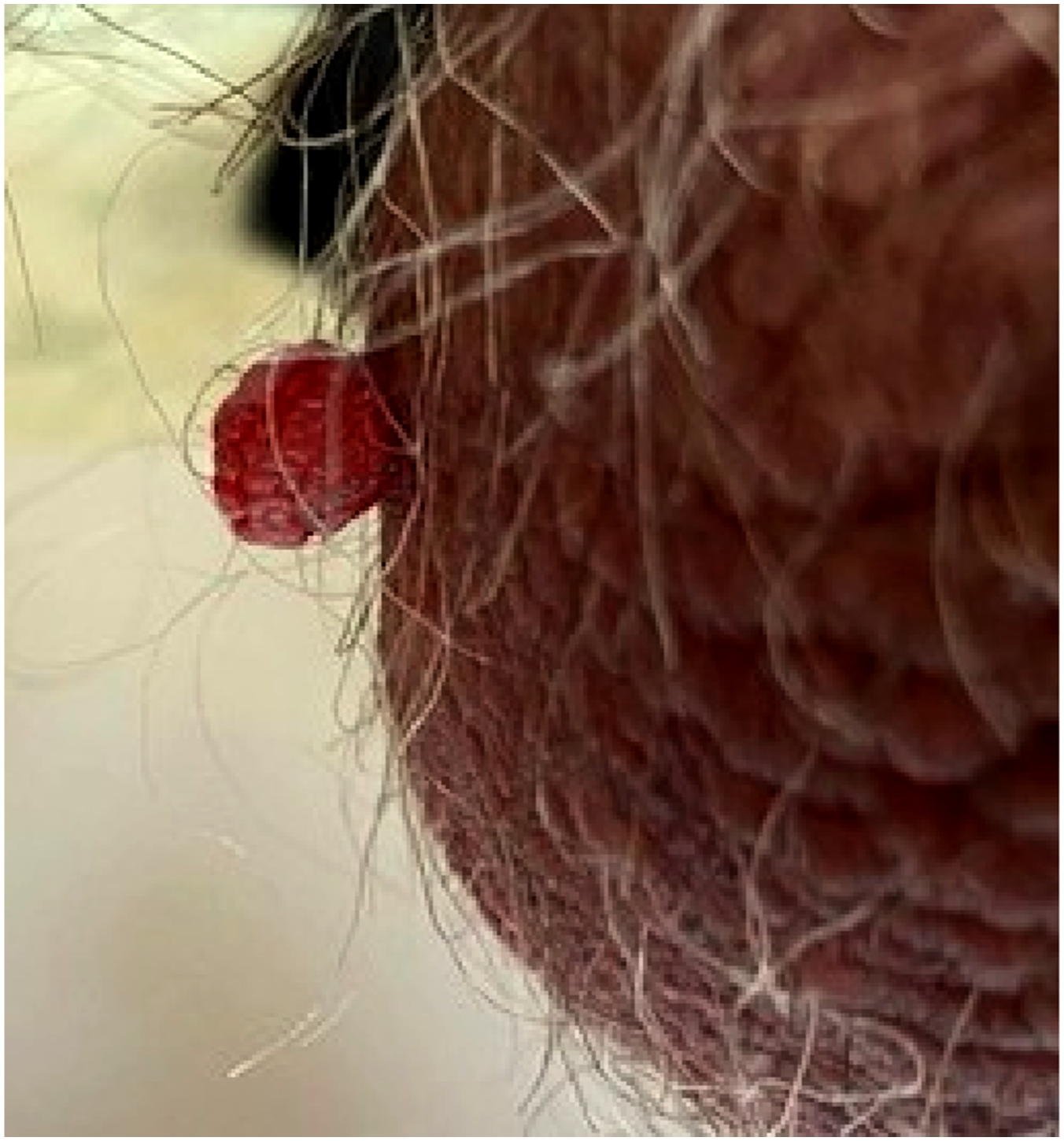
His medical history included asthma and hypertension; with regular prescriptions of antihypertensives, inhalers and a statin. He had a low risk sexual history, with a single sexual partner, as a monogamous heterosexual partnership, for over 50 years and had not been active in the last 14 years.
Diagnosis at initial review was unclear, although deemed unlikely to be a genital wart, alternatives included granuloma; the decision was made for removal and analysis to ultimately rule out pre-cancerous cause. Scalpel removal with local anaesthetic was performed the following week and sent for histopathological analysis, confirming the diagnosis of verruciform xanthoma.
Discussion
Verruciform xanthoma is an uncommon, benign growth, predominantly found in the oral cavity, but rarely as cutaneous genital lesions. Of those occurring at genital sites, also being described as Vegas (verruciform genital-associated), the majority have been found on the scrotum. 1
Clinically, these lesions present as solitary, wart-like lesions with an irregular surface, ranging in both size, 2–150 mm, and colour, including skin coloured, pink or red 2 ; of those identified on the genitals, initial differential diagnoses have including genital warts, 3 polyps, squamous cell carcinoma 4 or other malignant concern5.
Verruciform xanthoma are distinguished by aggregates of foam-cells within elongated connective tissue papillae and acanthotic epithelium; thus requires histopathological examination for diagnosis.6,7 The classical lipid-laden foam histocytes, also described as xanthoma cells, have been hypothesised to be secondary changes to trauma or inflammation, however exact eitiology remains unknown, with no link identified with HPV.7,8
As occurrence on the genitals is rare, exact incidence and prevalence is uncertain 9 - literature review from 2016 quoted only 194 documented cases. However, of the evidence available of Vegas, there appears to be a predominance in male patients, 6 with median age 61. 4 Excision being conclusive treatment, as well as fractionated CO2 laser therapy and imiquimod cream being shown to be successful – and although, generally considered curative, there have been some documented instances of recurrence. 6 Whereas previous missed diagnosis has resulted in incorrect treatment, such as prolonged high potency steroid use for the concern of lichen sclerosus. 10
This is an interesting case of rare diagnosis, which may present to sexual health clinics as concern of sexually transmitted disease, possible wart or concerning lump. Consideration is important, as excision is considered curative, histopathology vital for correct diagnosis and may avoid ineffective or invasive treatment. 5
Patient’s perspective
“It started off as a brown spot, after a couple of weeks it grew like a lolly pop stick & had this large round ball shape on the end with some weeping. It was then I decided to visit the Doctor. I had no pain from it. My Doctor said I should go to the sexual health unit because your department would know the best way to treat it in this delicate area of my body - he made the appointment for me, and I saw the team 5 days later. Regarding the treatment, it was perfect.”
We confirm that patient consent was gained for to writing and publication of this report, including use of images.
Footnotes
Declaration of Conflicting Interests
The authors declared no potential conflicts of interest with respect to the research, authorship, and/or publication of this article.
Funding
The authors received no financial support for the research, authorship, and/or publication of this article.
