



Abstract

Dear Editor,
Latin Americans are among the fastest growing non-EU migrant populations in London, yet their numbers are likely underestimated, given they are identified within “other” ethnicity categories on census. 1 Understanding why this diverse group access sexual and reproductive health services (SRHS) could help improve holistic support around their specific needs.
We conducted a retrospective 12-months analysis of all Latin American patients (identified from country of birth, based on a cultural/linguistic definition of Spanish and Portuguese-speaking countries), attending a central London SRHS during 2022. Quantitative data are presented.
In total, 4711 patients were identified, representing 5% of all SRHS attendances. The majority were male (73%, 3450/4711); and in those who responded (837/4711, 18%), 2% (20/837) identified as transgender. Over half the cohort were gay men (2602/4711, 55%), 18% (864/4711) heterosexual women, 4% (197/4711) heterosexual men and 2% (115/4711) bisexual. Over half, (59%, 2781/4711) were Brazilian; 12% (547/4711) Colombian; 45% (2112/4711) registered as ‘white’, 24% (1151/4711) ‘other background’, 20% (943/4711) ‘mixed’, and 2% (79/4711) ‘black’.
Over a third (34%, 1595/4711) were diagnosed with a sexually transmitted infection (STI), 11% (534/4711) were people living with HIV and 43% (2023/4711) were prescribed PrEP. Nearly half the cis-females (46%, 582/1261) requested contraception.
Sex-work was identified in 4% (208/4711), mainly Brazilians (90%, 187/208). Very few had a chemsex related attendance (1%, 46/4711), but both issues were likely under-reported. Only 5% (214/4711) required translation via Language Line services, in light of several Portuguese and Spanish speaking staff across sites.
A small proportion (2%, 96/4711) had a safeguarding log completed at least once since first attending the service; with documented recent or on-going domestic abuse in 35% (34/96), historical domestic abuse 9% (9/96), mental health concerns 18% (17/96), recent sexual assault 16% (15/96), historical sexual assault 6% (6/96), historical child abuse 11% (11/96), problematic substance use 9% (9/96), and other issues related to homelessness, trafficking, harassment, threats, concerns with sex-work and relationships 7% (7/96).
The Latin American community is not homogenous, with 20 countries of origin (Figure 1). This impacts potential vulnerabilities related to previous lived experiences, attitudes towards sex, sexuality and stigma. Additionally, many individuals arrive in the UK without any formal grasp of English. A combination of these susceptibilities coupled with language barriers can add to pre-existing challenges for accessing care and understanding their rights.2,3 However, Latin Americans are often analysed within a larger group of migrants, rendering them more invisible for commissioning resources, due to an absence of their specific ethnicity category. Map of Latin America.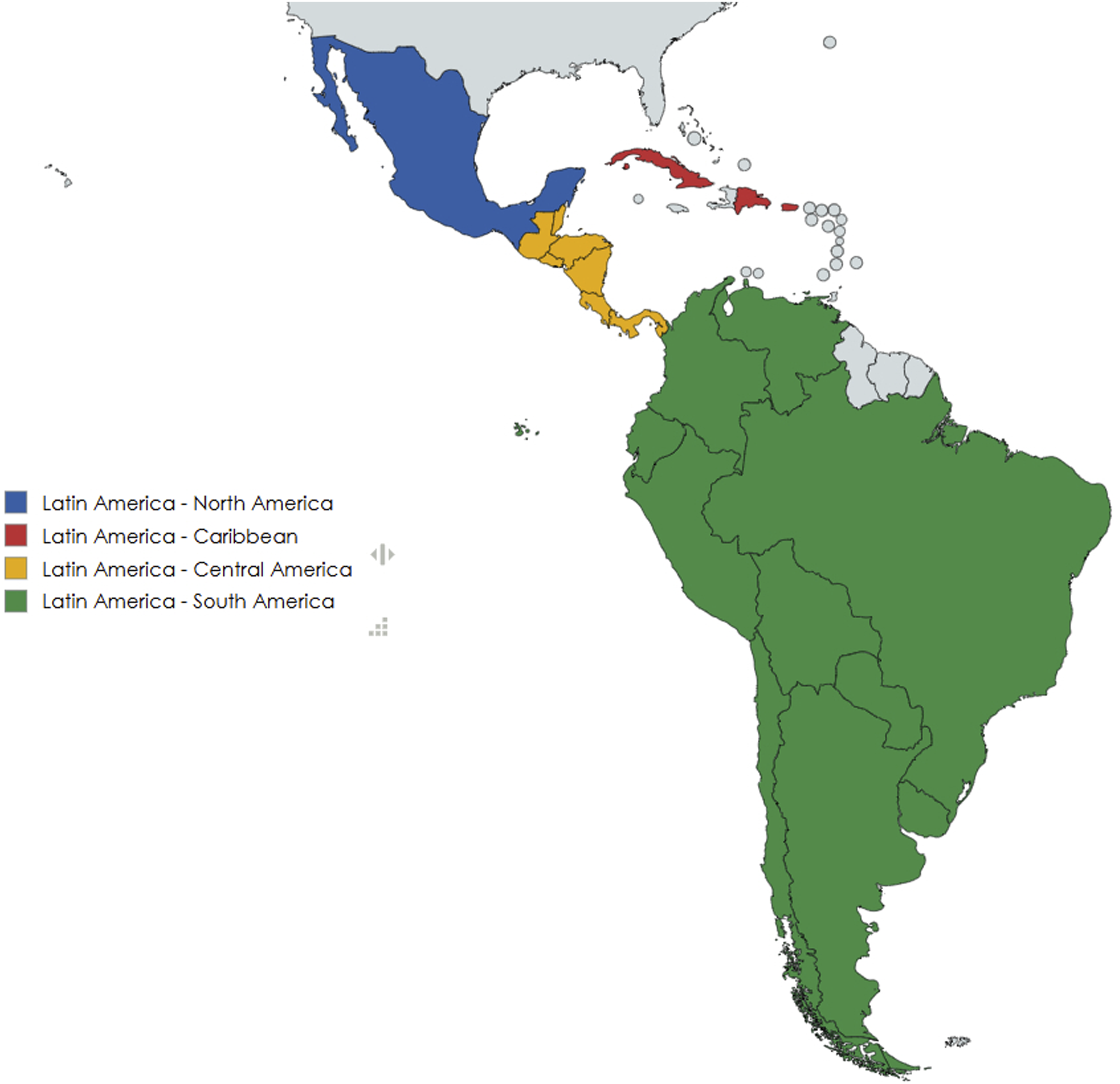
Initiatives locally in Hammersmith & Fulham and Kensington & Chelsea have led to a Brazilian community outreach worker specifically employed to provide advocacy support and improve access to health services. Our dedicated sex worker clinic also currently sees a majority of Brazilian patients (194/380, 51% in 2024).
Our data review has highlighted that Latin Americans are a uniquely distinct community, with significant SRHS, medical and HIV-prevention needs. Mainstream services must be linked to by-and-for organisations, promoting cultural awareness, trauma-informed care and inclusive environments for this extensive population with complex needs.
Footnotes
Acknowledgements
We would like to thank staff and patients at all the Sexual Health clinics within Chelsea and Westminster Hospital NHS Foundation Trust. We would like to acknowledge the by-and-for organisations and research teams who have been fighting for Latin American visibility and whose works were consulted as reference in the conceptualisation of this manuscript.

Ethical considerations
This project received local approval as a service evaluation.
Author Contributions
All authors participated in the conceptualisation, design and data acquisition for the project. TSC and EP conducted the data analysis. TSC, EP and CC interpreted the data and wrote the first draft. TSC and CC conducted the manuscript revision for the final draft. All authors read and approved the final manuscript.
Funding
The authors received no financial support for the research, authorship, and/or publication of this article.
Declaration of conflicting interests
The authors declared no potential conflicts of interest with respect to the research, authorship, and/or publication of this article.
Data Availability Statement
The data that support the findings of this study are available from the corresponding author upon reasonable request.