



Abstract
Background
Doxycycline post-exposure prophylaxis (DoxyPEP) has emerged as a biomedical strategy to reduce bacterial sexually transmitted infections (STIs), yet implementation remains contested due to antimicrobial resistance concerns and limited clinical guidance in many European settings. Evidence on clinician readiness to prescribe DoxyPEP is limited. This study examined awareness, attitudes and prescribing practices among sexual health clinicians in the Republic of Ireland.
Methods
A cross-sectional anonymous online survey was conducted among sexual health clinicians in early 2026. Survey items were informed by the Theoretical Framework of Acceptability (TFA). Descriptive statistics summarised responses. Group differences were assessed using χ2 tests, independent-samples t-tests, one-way ANOVA and non-parametric tests where appropriate. Pearson correlations explored relationships between implementation constructs.
Results
101 clinicians participated (60 doctors, 33 nurses, 8 other professionals). Awareness of DoxyPEP was high (95%) and 64% of doctors and nurses reported prior prescribing or recommendation. Current local guidance was variable, with only 28% reporting formal guidance, but willingness to prescribe with national guidance was high (82%) and did not differ between professional groups or specialties.
No significant differences were observed between doctors and nurses across knowledge or acceptability domains. Among doctors, implementation perceptions varied by specialty: GU/HIV clinicians reported higher knowledge, perceived effectiveness, intervention coherence and self-efficacy than infectious diseases clinicians and general practitioners.
Self-reported knowledge was strongly associated with intervention coherence (r = −0.601, p < .001) and self-efficacy (r = 0.600, p < .001). Ethicality emerged as the only independent predictor of willingness to prescribe (OR = 5.77, 95% CI 2.47–13.47). Concern about antimicrobial resistance was widespread (81%).
Conclusion
Irish clinicians demonstrate high awareness and substantial readiness to prescribe DoxyPEP. Implementation readiness appears shaped more by ethical acceptability and professional confidence than knowledge alone. National guidance, education and antimicrobial stewardship frameworks will be essential to support safe and equitable integration of DoxyPEP into sexual health services.
Introduction
Sexual health services in many high-income countries are undergoing change as biomedical prevention strategies expand beyond HIV to address the continuing burden of bacterial sexually transmitted infections (STIs). Syphilis, gonorrhoea and chlamydia remain disproportionately concentrated within key populations, and incidence has proven difficult to reduce despite sustained investment in testing and treatment.1,2 In Ireland, STI notifications remain substantially higher than pre-pandemic levels, highlighting the need for new prevention approaches. 3
Doxycycline post-exposure prophylaxis (DoxyPEP) has emerged as a promising strategy. Taken as a single 200 mg dose up to 72 h after sexual exposure, doxycycline significantly reduces syphilis and chlamydia in higher-risk populations such as gay, bisexual and other men who have sex with men (gbMSM) and trans women, with more limited impact on gonorrhoea due to tetracycline resistance.4–7 These findings have prompted rapid policy developments: the United States incorporated DoxyPEP into national guidance in 2024, and UK guidance followed in 2025.8,9
Across Europe, DoxyPEP implementation has been more cautious, with ECDC emphasising its effectiveness alongside uncertainty about its long-term public health impact and antimicrobial resistance. 10 Despite this, DoxyPEP is already expanding through both clinical and informal access.11–14 Alongside epidemiological uncertainty, DoxyPEP has become a site of explicit ethical contestation in sexual health policy, with sharply diverging views on whether population-level antimicrobial risk justifies limiting an intervention that may substantially reduce preventable STI morbidity.15–17
Research among potential users suggests DoxyPEP is generally viewed as acceptable and empowering when delivered through trusted sexual health services,12,18,19,20,21 although concerns about antimicrobial resistance, side effects, stigma and behavioural consequences remain prominent.13,22 These tensions highlight that implementation is not solely a question of efficacy, but of how interventions are understood, evaluated and integrated into routine care. This is consistent with broader work showing that ‘risk’ in gbMSM sexual health research is variably defined and operationalised, shaping what is prioritised, measured, and ultimately acted on in prevention and service delivery. 23
Recent Irish research indicates that DoxyPEP is already entering community practice, with evidence of informal access and self-directed use in the clinic-based provision. 12 Interim HSE (public health service) guidance was issued in 2024, 24 but formal national clinical guidance is awaited. Sexual health services in Ireland are delivered through specialist STI clinics, general practice, and private STI services, supported by a multidisciplinary workforce including doctors and nurses.
Understanding clinician readiness is therefore a critical next step. Early studies in the United States and Italy show high willingness to prescribe alongside strong antimicrobial resistance concerns and uncertainty about implementation pathways.25,26 However, existing evidence is limited to specific jurisdictions and professional groups, with little known about perspectives across the wider sexual health workforce, including general practitioners and nurses. Given differences in education, training pathways, and clinical roles across professional groups and medical specialties involved in sexual health, it was hypothesised that awareness, attitudes, and willingness to prescribe DoxyPEP would vary between clinicians.
This study aimed to examine awareness, attitudes and prescribing practices relating to DoxyPEP among doctors and nurses working in sexual health in the Republic of Ireland. Specifically, the study sought to assess clinicians’ knowledge and acceptability of DoxyPEP, explore perceived barriers and supports for implementation, and identify factors associated with willingness to prescribe if national clinical guidelines were introduced.
Methods
This study used a cross-sectional, anonymous online survey to explore clinicians’ awareness, attitudes, and prescribing practices relating to DoxyPEP. Survey items were informed by the Theoretical Framework of Acceptability (TFA) described by Sekhon et al., 27 a framework used to assess how healthcare professionals (and those receiving health interventions) understand, evaluate and feel able to deliver new interventions. The TFA includes domains such as affective attitude (how individuals feel about the intervention), perceived effectiveness (the extent to which the intervention is believed to achieve its intended purpose), ethicality (the fit of the intervention with an individual’s value system), intervention coherence (understanding of how the intervention works), self-efficacy (confidence in one’s ability to deliver or engage with the intervention), perceived burden (the effort required to deliver the intervention), and opportunity cost (the extent to which benefits or resources must be given up to deliver the intervention). Survey questions were refined by the entire team, representing all of the professional groups included in the survey, to ensure clinical relevance. The full survey instrument is provided in the Supplementary Materials.
The survey was administered between January and February 2026 using SurveyMonkey, through sexual health professional organisations including the Society for the Study of Sexually Transmitted Diseases in Ireland (SSSTDI), which has a membership of approximately 300 clinicians working in sexual health across the island of Ireland (although recruitment was limited to those working in the Republic of Ireland). A pragmatic convenience and snowball sampling strategy was used to recruit clinicians through professional networks and clinical services, whereby members of SSSTDI were asked to share recruitment information in their services. Eligible participants were clinicians (doctors and nurses) working in the field of sexual health in the Republic of Ireland. Participation was voluntary and anonymous, and no identifiable personal data were collected. Recruitment aimed to achieve coverage across urban and regional areas of the Republic of Ireland; however, no formal geographic stratification was applied. A formal sample size calculation was not undertaken; however, the study aimed to recruit approximately 100 participants, reflecting the exploratory nature of the study and the relatively small, specialised workforce. The survey took approximately 10 min to complete. Ethical approval for the study was granted by the University College Dublin Research Ethics Committee (REF: 324-LS-LR-25-Gilmore). No incentives were offered for study completion.
Responses were exported from SurveyMonkey and analysed using IBM SPSS Statistics (Version 29.0; IBM). Descriptive statistics were used to summarise participant characteristics and survey responses. Multi-item constructs were developed based on the TFA, with items grouped into affective attitude, perceived effectiveness, ethicality, intervention coherence, self-efficacy, perceived burden and opportunity cost. Negatively worded items were reverse-coded prior to scale construction so that higher scores consistently reflected more positive acceptability and implementation perceptions (except knowledge and self-efficacy, where lower scores indicated higher knowledge and greater confidence). Internal consistency of multi-item scales was assessed using Cronbach’s alpha.
Group differences between professional groups were examined using chi-square tests for categorical variables and independent-samples t-tests for continuous composite scores. Differences across medical specialties among doctors were examined using one-way analysis of variance (ANOVA) with Tukey post-hoc comparisons where appropriate. Pearson correlation analyses were conducted to examine relationships between TFA constructs and self-reported knowledge.
Associations between willingness to prescribe DoxyPEP (if supported by national clinical guidelines) and key study variables were examined using non-parametric tests. Differences in willingness to prescribe between two groups (e.g. doctors and nurses) were assessed using chi-square tests for categorical variables and Mann–Whitney U tests for continuous or ordinal composite scores. For comparisons across more than two groups (e.g. medical specialties), Kruskal–Wallis tests were used.
Assumptions for parametric testing were assessed. While Likert-scale data are ordinal, composite scale scores were treated as approximately continuous, and parametric tests (independent-samples t-tests and one-way ANOVA) were applied given their robustness to modest deviations from normality. To support the robustness of findings, non-parametric analyses (Mann–Whitney U and Kruskal–Wallis tests) were also conducted for key comparisons, yielding consistent results.
Findings
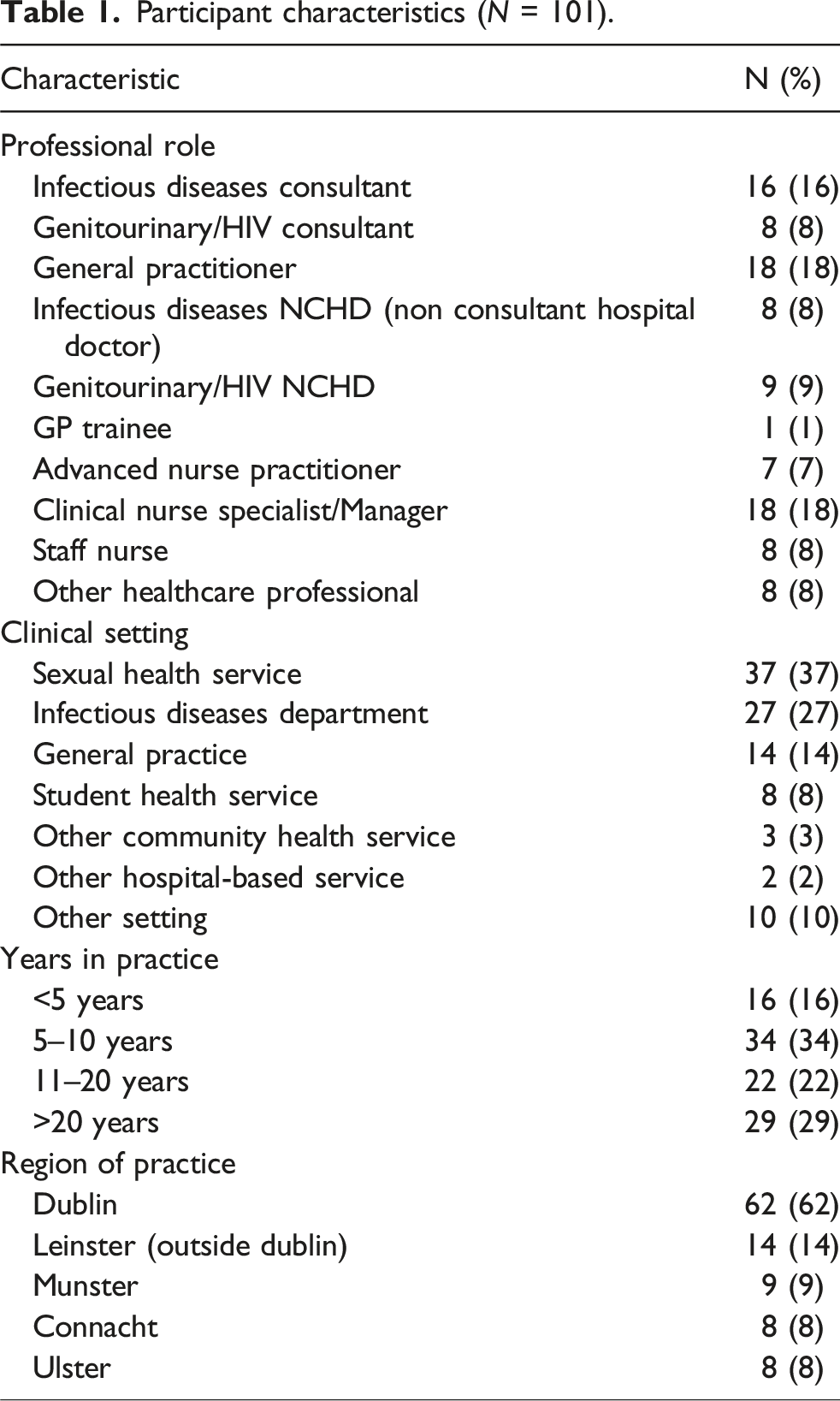
A total of 111 responses were received, of which 10 were removed due to substantial incompleteness (where only demographic questions were answered), leaving a final sample of 101.
Participant characteristics
Participant characteristics (N = 101).
Service context and implementation preferences
Clinicians identified a wide range of populations who may benefit from DoxyPEP, most commonly gbMSM with multiple partners (n = 93, 93%), transgender women with multiple partners (n = 83, 83%), sex workers (n = 82, 82%) and HIV PrEP users (n = 80, 80%). Sexual assault treatment unit attendees were also frequently identified (n = 65, 65%), while a smaller proportion identified people living with HIV (n = 36, 36%). Overall, 76 clinicians (76%) agreed or strongly agreed that DoxyPEP should be considered for individuals at high risk of recurrent STIs.
In terms of service delivery, almost half of clinicians indicated that DoxyPEP should be available by prescription only (n = 46, 46%), and a similar proportion felt it should be provided through specialist sexual health clinics (n = 45, 45%). Small minorities supported over-the-counter availability (n = 3, 3%) or felt DoxyPEP should not be available for STI prevention (n = 6, 6%).
When asked about factors influencing prescribing decisions, the most frequently selected were evidence of effectiveness (n = 77, 77%) and the presence of clinical guidelines (n = 76, 76%). Concerns about antimicrobial resistance (n = 62, 62%) and patient request (n = 61, 61%) were also commonly reported, alongside institutional or national policy (n = 47, 47%) and side-effect profile (n = 40, 40%). Personal ethical stance was selected less frequently (n = 11, 11%). Concern about antimicrobial resistance was high across the sample. Most clinicians agreed or strongly agreed that they were concerned that DoxyPEP could contribute to antimicrobial resistance (n = 82, 81%), while only a small minority disagreed (n = 7, 7%).
The most frequently anticipated barrier to implementation was concern about antimicrobial resistance (n = 83, 88%), followed by lack of national guidelines (n = 59, 63%) and lack of training or resources (n = 38, 40%). Patient adherence (n = 25, 27%), ethical or professional reservations (n = 23, 25%), and supply or access to doxycycline (n = 22, 23%) were also identified. The support most frequently identified as enabling clinicians to prescribe DoxyPEP was the introduction of national clinical guidelines (n = 52, 55%), followed by professional education or training (n = 18, 19%).
Awareness and prescribing practices
Awareness, knowledge, prescribing experience and guidance (doctors and nurses n = 93).
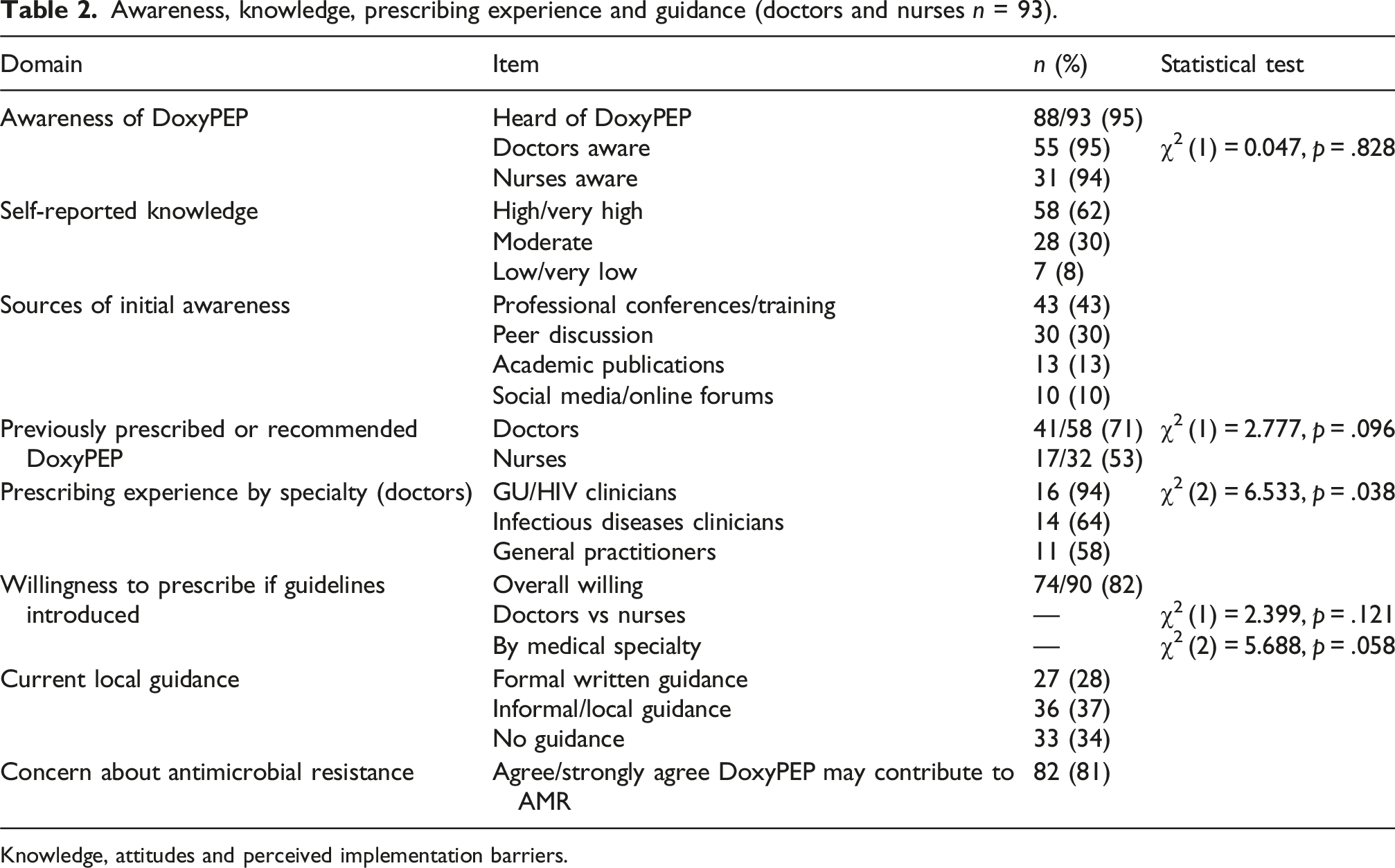
Knowledge, attitudes and perceived implementation barriers.
Willingness to prescribe DoxyPEP if supported by national guidelines was high overall (82%) and did not differ by professional group or specialty. Current local guidance varied, with roughly one third reporting formal guidance, one third informal guidance, and one third no guidance. Concern about antimicrobial resistance was widespread, with over 80% agreeing that DoxyPEP could contribute to antimicrobial resistance.
Across all domains, there were no statistically significant differences between doctors (n = 60) and nurses (n = 33). Across all comparisons, effect sizes were small, indicating broadly comparable knowledge, attitudes and implementation perceptions across professional groups (see Supplemental Table S1).
Non-parametric analyses (Mann–Whitney U tests) yielded consistent findings, with no significant differences observed between doctors and nurses across any domain.
Acceptability and implementation constructs by medical specialty
One-way ANOVA was conducted to examine differences in TFA domains across medical specialties (Infectious Diseases n = 24; GU/HIV n = 17; General Practice n = 19). Significant differences were observed across several domains.
Mean (SD) of acceptability and implementation constructs by medical specialty (Doctors only n = 60).

Higher scores indicate more positive perceptions for TFA constructs unless otherwise indicated. Lower scores indicate higher knowledge.
*Higher scores indicate greater perceived burden or opportunity cost. **Lower scores indicate greater self-efficacy.
Median (IQR) of acceptability and implementation constructs by medical specialty (Doctors only n = 60).
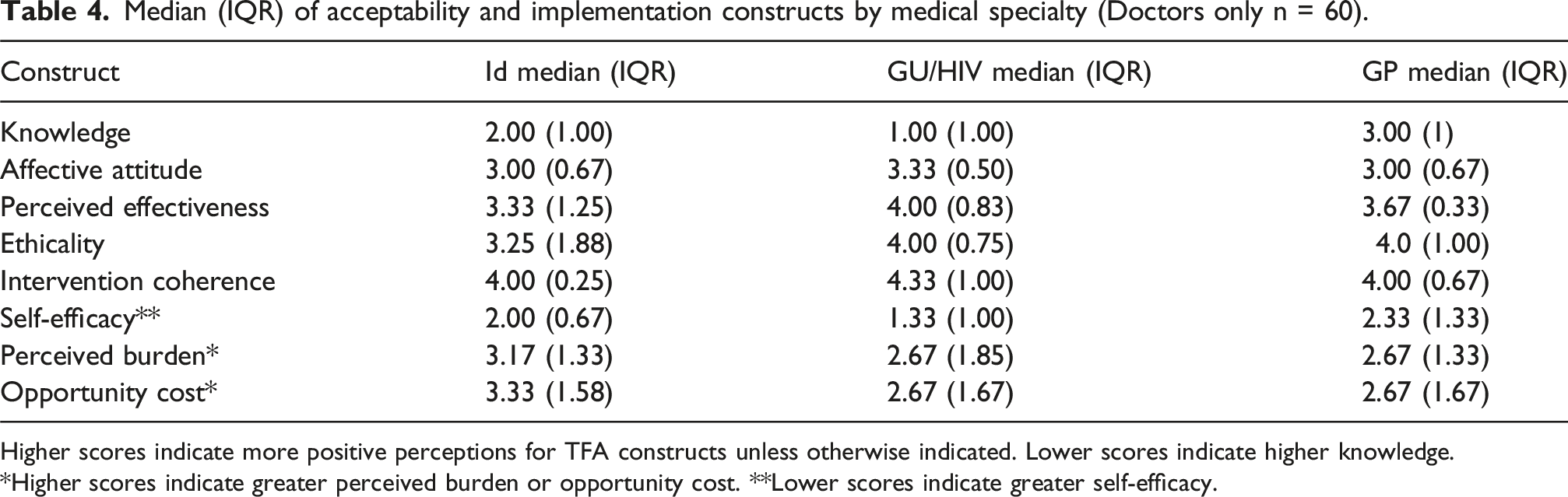
Higher scores indicate more positive perceptions for TFA constructs unless otherwise indicated. Lower scores indicate higher knowledge.
*Higher scores indicate greater perceived burden or opportunity cost. **Lower scores indicate greater self-efficacy.
Relationships between implementation constructs
Pearson correlations between knowledge and implementation constructs (n = 93).
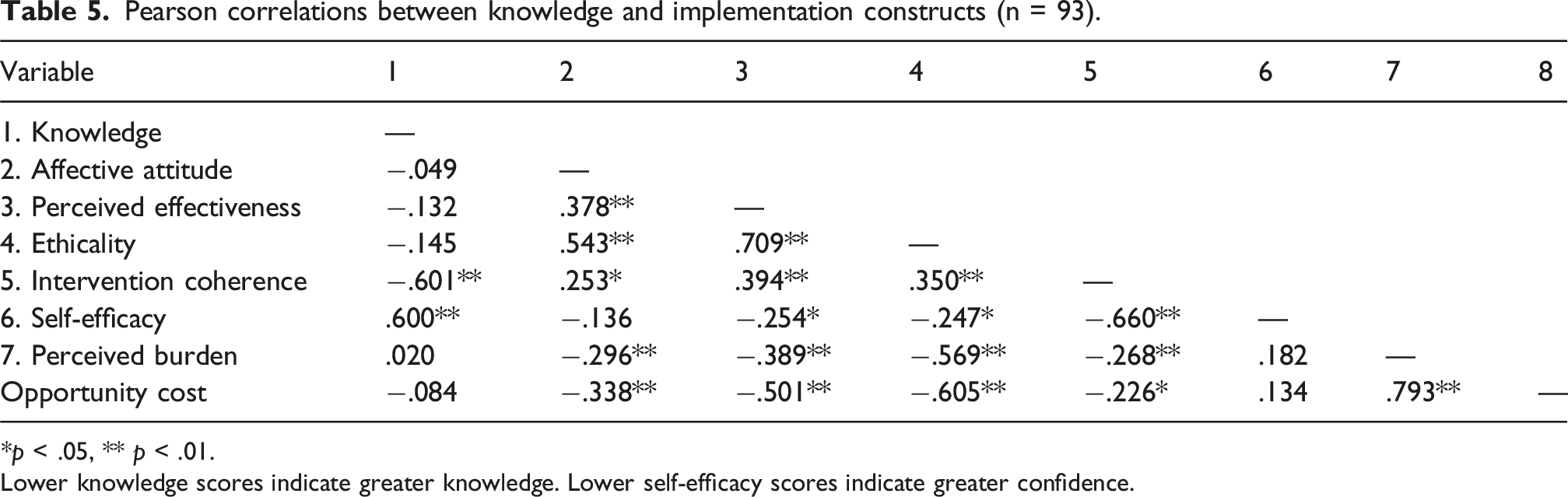
*p < .05, ** p < .01.
Lower knowledge scores indicate greater knowledge. Lower self-efficacy scores indicate greater confidence.
Discussion
This study provides the first national insight into clinicians’ awareness, attitudes and early prescribing experiences relating to DoxyPEP in the Republic of Ireland. Awareness was high, prescribing had already begun in a minority of settings, and willingness to prescribe was substantial if supported by national guidance, positioning Ireland at an early stage of implementation. These findings align with international evidence showing that clinicians are broadly receptive to DoxyPEP but remain cautious in the absence of clear guidance.25,26
The findings should be considered alongside recent Irish research demonstrating strong awareness, interest and early uptake of DoxyPEP among gbMSM despite the absence of national guidance. 12 Similar patterns of growing awareness, demand and informal use have been reported in Belgium and Spain, where community uptake has emerged alongside persistent concerns about antimicrobial resistance and the absence of formal clinical guidance.14,28 This suggests a widening gap between community demand and structured clinician-led access, with important implications for antimicrobial stewardship given the documented use of informal sourcing routes. 12 There is also the potential to exacerbate existing inequities within gbMSM communities, including for individuals living in rural or geographically isolated areas or those for whom English is not a first language who may face additional barriers to accessing clinically supervised care. National guidance, which takes cognisance of these potential inequities may therefore help shift DoxyPEP use towards clinically supervised pathways.
Medical specialty emerged as an important influence on implementation readiness. GU/HIV clinicians reported the highest prescribing experience and more favourable implementation perceptions, reflecting their closer alignment with sexual health services, while general practitioners reported lower knowledge but high willingness to prescribe if guidance were introduced. However, access to and engagement with these service settings may not be uniform across populations, and individuals who may benefit from DoxyPEP may differ in their likelihood of attending specialist sexual health services, general practice, or private providers. These findings highlight the need for coordinated cross-specialty implementation and targeted education for general practice. The findings were consistent across both parametric and non-parametric analyses, supporting the robustness of the observed differences
No significant differences were observed between doctors and nurses across knowledge or acceptability domains, and willingness to prescribe was high across both groups. Given the expanding role of nurse-led sexual health services in testing, PrEP delivery and STI prevention,29–31 these services may represent key delivery settings for DoxyPEP implementation. Evidence from sexual health services suggests that nurse prescribers and clinicians operating under patient group directions can provide safe and therapeutically appropriate prescribing. 32 Strengthening prescribing governance, including regular training, audit processes and reinforcement of patient group direction parameters, may therefore support safe and accountable DoxyPEP delivery within multidisciplinary models of care.
Concerns about antimicrobial resistance were prominent across survey sections and were consistent with international literature15,22,25,26 and recent European public health guidance. 10 Addressing antimicrobial stewardship, surveillance and risk communication will therefore be central to implementation.
Alongside policy developments, DoxyPEP has generated an explicit public health ethics debate: proponents emphasise substantial preventable morbidity and the equity value of offering effective prevention to groups with high STI burden, while opponents argue that uncertain population-level antimicrobial resistance (including potential “bystander” resistance in non-target organisms) may outweigh individual benefits, raising intergenerational justice concerns.16,17 Ongoing work is also seeking to clarify the balance of effectiveness, acceptability, feasibility, cost and antimicrobial resistance across settings, including trials comparing DoxyPEP to alternative STI-control strategies. 33
Ethical considerations appeared closely aligned with willingness to prescribe and broader acceptability perceptions across analyses, suggesting that clinicians’ moral/professional acceptability may be a key gatekeeper for implementation once baseline awareness is high. This aligns with recent ethics arguments that DoxyPEP sits at the intersection of individual benefit, equity, and antimicrobial stewardship, with clinicians needing to reconcile prevention gains against uncertain longer-term resistance risks when deciding whether prescribing is “the right thing to do” in practice.16,17 Overall, the findings mirror early implementation experiences with HIV PrEP, where demand for guidance and training preceded widespread adoption,34,35 suggesting DoxyPEP may be entering a similar early implementation phase.
Limitations
This study has several limitations. The sample size was modest which may limit generalisability especially in general practice. It should be noted that the GPs in this study were recruited through sexual health professional networks, and in Ireland this represents a minority of GPs. Respondents were predominantly based in Dublin and may not fully represent clinicians working in rural environments. The cross-sectional design captures attitudes at a single time point during a period of rapid policy change. Nonetheless, the study provides an important early snapshot of clinician readiness during a critical period of emerging evidence and evolving guidelines.
Conclusion
Our findings suggest that Ireland is well positioned to develop structured, clinician-led DoxyPEP services. High awareness, strong willingness to prescribe, and early prescribing experience indicate readiness for policy development. However, implementation will require national clinical guidelines, professional education, antimicrobial stewardship frameworks, and integrated pathways of care. Future research should explore training needs, service models, and patient–clinician decision-making to support equitable and effective implementation of DoxyPEP within comprehensive sexual health services. 36
Supplemental material
Supplemental material - Clinician awareness, attitudes and prescribing practices relating to doxycycline post-exposure prophylaxis (DoxyPEP) in Ireland: Cross-sectional survey of sexual health professionals
Supplemental material for Clinician awareness, attitudes and prescribing practices relating to doxycycline post-exposure prophylaxis (DoxyPEP) in Ireland: Cross-sectional survey of sexual health professionals by John Gilmore, Enda Barron, Joanna Bergi, Coleen Finlay, Fiona Lyons, Robert Lawlor, Chris Noone, Giovanni Villa, John White, David Field in International Journal of STD & AIDS
Footnotes

Ethical considerations
Ethical approval was obtained from the University College Dublin Human Research Ethics Committee (Ref: 324-LS-LR-25-Gilmore). The survey was anonymous and no identifiable personal data were collected.
Consent to participate
Participants provided informed consent electronically before participation.
Author contributions
Funding
The authors received no financial support for the research, authorship, and/or publication of this article.
Declaration of conflicting interests
The authors declared the following potential conflicts of interest with respect to the research, authorship, and/or publication of this article: JW is an associate editor of IJSA
JG is a member of the editorial board of IJSA.
Supplemental material
Supplemental material for this article is available online.
References
Supplementary Material
Please find the following supplemental material available below.
For Open Access articles published under a Creative Commons License, all supplemental material carries the same license as the article it is associated with.
For non-Open Access articles published, all supplemental material carries a non-exclusive license, and permission requests for re-use of supplemental material or any part of supplemental material shall be sent directly to the copyright owner as specified in the copyright notice associated with the article.
