




Abstract
Correlational evidence indicates that materialistic individuals experience relatively low levels of well-being. Across four experiments, we found that situational cuing can also trigger materialistic mind-sets, with similarly negative personal and social consequences. Merely viewing desirable consumer goods resulted in increases in materialistic concerns and led to heightened negative affect and reduced social involvement (Experiment 1). Framing a computer task as a “Consumer Reaction Study” led to a stronger automatic bias toward values reflecting self-enhancement, compared with framing the same task as a “Citizen Reaction Study” (Experiment 2). Consumer cues also increased competitiveness (Experiment 3) and selfishness in a water-conservation dilemma (Experiment 4). Thus, the costs of materialism are not localized only in particularly materialistic people, but can also be found in individuals who happen to be exposed to environmental cues that activate consumerism—cues that are commonplace in contemporary society.
Materialism can be defined as a value system that is preoccupied with possessions and the social image they project. Veblen (1899) argued that for many people, social status is defined by possessions, and that this definition produces an endless drive to acquire ever more impressive belongings. Attempting to derive a sense of self-worth from materialistic pursuits appears, however, to be a dubious proposition. Indeed, a wide variety of correlational studies indicates that individuals who score higher in materialism evince lower levels of mental and physical well-being (for reviews, see Burroughs & Rindfleisch, 2002; Kasser, 2002). For example, Kasser and Ryan (1993, 1996) found that more materialistic individuals showed lower levels of psychological adjustment and social functioning. More materialistic values also predict higher levels of anxiety and unhappiness (Kasser & Ahuvia, 2002) and are associated with lower-quality social relationships (Kasser & Ryan, 1993, 2001).
Although this literature has produced rich insights, its correlational nature raises two issues worth further consideration. First, there is the matter of causality; it could be the case that materialism is a consequence of personal dysfunction, rather than vice versa. For example, attachment to possessions could arise as a compensation strategy among individuals with social-affiliation deficits (Clark et al., 2011; Lastovicka & Sirianni, 2011). Experimental evidence would help to bolster the case that materialism undermines well-being. Second, the individual differences perspective on materialism could be usefully augmented by research investigating situational factors that can activate materialistic thinking. It may be that many individuals, in the right circumstances, will adopt a materialistic mind-set, possibly to their personal or social detriment. Experiments manipulating potential situational triggers of materialistic mind-sets are needed to explore these possibilities.
Culturally omnipresent consumer cues are obvious candidates for serving as triggers of situational materialism. Consider advertising. Although estimates of the average number of daily exposures to advertisements vary greatly, one of the most widely accepted estimates is 245 daily exposures (according to the Advertising Media Internet Community, 1997). Contemplating the desirable goods in advertisements may be a common route to the activation of materialistic mind-sets. Another common media practice is using the term consumers to refer generically to the public (as opposed to using other potential generic terms, such as Americans or citizens). A news story about American income-tax rates, for example, might focus on the impact of contemplated tax hikes on “consumers.” By framing the news in terms of its relevance to a consumer identity, these messages may directly activate a consumption mind-set in the audience. In the studies that follow, we developed experimental manipulations analogous to these features of everyday life situations to investigate whether such manipulations would situationally activate materialistic thinking and the unsavory social and psychological consequences with which dispositional materialism has previously been associated.
The possibility that materialistic mind-sets could have an immediate adverse impact on well-being is suggested by research showing that when particular values are situationally activated, an ensemble of corresponding values are likely to be co-activated, while incompatible values are inhibited (Maio, Pakizeh, Cheung, & Rees, 2009). Building on evidence that values can be classified into 10 broad categories that are related to one another in a circumplex structure (Schwartz, 1992), Maio et al. found that activating values in one portion of the circumplex resulted in collateral activation of neighboring values, but inhibited values on the opposite side of the circumplex. Materialism should activate values in Schwartz’s self-enhancement quadrant, which focuses on wealth, achievement, power, and status; at the same time, it should deactivate values in the self-transcendence category, which prioritize concerns about other people. Feelings of dissatisfaction may arise from this pattern for at least two reasons. First, as Veblen (1899) argued, activation of materialistic thinking is likely to elicit a vicious cycle in which one feels continuously dissatisfied relative to individuals who own more (Ordapayeva & Chandon, 2011). Second, if materialism deactivates social engagement, it could undermine momentary feelings of belonging that have proven to be of central importance to well-being (Baumeister & Leary, 1995; Helliwell & Putnam, 2004).
Experiment 1
Our first experiment examined whether common indicators of impaired well-being previously shown to be related to dispositional materialism—namely, negative affect and low social engagement—would be susceptible to influence by situationally induced materialism. A pilot study was conducted to determine whether presenting depictions of luxury goods can activate materialistic strivings. Specifically, 47 undergraduates were randomly assigned to view a series of either 24 images of luxury goods (e.g., electronics, jewelry, cars, clothing) or 24 images of natural scenes devoid of consumer products, and to rate their pleasantness. Then, as part of an ostensibly unrelated study, participants completed a series of questionnaire items (using 9-point response scales) that included portions of the Aspiration Index (Grouzet et al., 2005) that are commonly used to assess materialistic concerns (i.e., the Money, Social Image, and Popularity subscales). As shown in Table 1, the pilot study confirmed that exposure to desirable consumer goods increased materialistic aspirations. In Experiment 1, we sought to determine whether these same images could undermine mood and social engagement.
Effects of Consumer Cues on Participants’ Responses in Experiments 1 Through 4
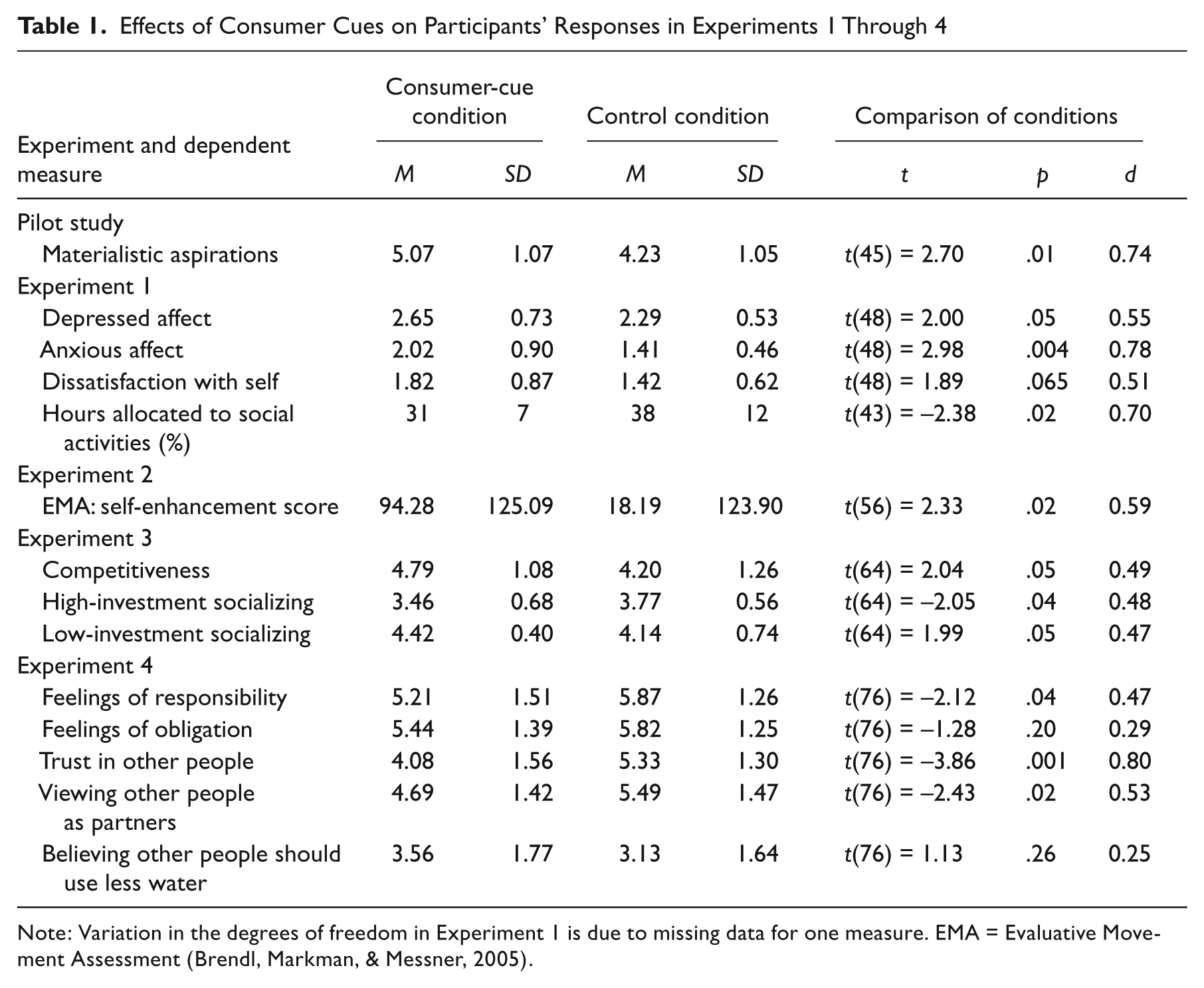
Note: Variation in the degrees of freedom in Experiment 1 is due to missing data for one measure. EMA = Evaluative Movement Assessment (Brendl, Markman, & Messner, 2005).
Method
Participants
Fifty undergraduates (28 female, 22 male; mean age = 18.84 years) participated as part of a requirement for their introductory psychology course.
Procedure and materials
Participants were seated in private cubicles. They were told that, prior to the main study, they would be asked to rate the pleasantness of visual stimuli that were being considered for possible use in research on visual perception. Participants were randomly assigned to view the same 24 images of luxury consumer goods used in the pilot study (consumer-cue condition) or 24 images categorized as neutral in valence in the International Affective Picture System (Lang, Bradley, & Cuthbert, 2008; control condition). Thus, the images in the consumer-cue condition were rated more pleasant than those in the control condition, but given our prediction of greater negative affect in the consumer-cue condition, this difference in stimulus pleasantness worked against obtaining support for our hypothesis.
The “main study” consisted of questionnaires that included items from the Positive and Negative Affect Schedule (PANAS; Watson, Clark, & Tellegen, 1988) and a measure of preference for social involvement. The PANAS items required participants to rate the extent to which they were feeling a series of emotional states at the present moment, on a scale from 1 (very slightly) to 5 (extremely). Nine items, including sad and happy (reverse-scored), assessed depressed affect (α = .84); seven items, including nervous and distressed, assessed anxiety (α = .90); and three items, including guilty and ashamed, assessed self-dissatisfaction (α = .67). Preference for social involvement was measured by asking participants to indicate what percentage of their free time they would like to allocate to various activities. The list included social activities (e.g., participating in a student group, going to parties) and nonsocial ones (e.g., reading, watching television); we summed the percentages allocated to the social activities to create an overall index of desire for social involvement.
Results and discussion
Participants in the consumer-cue condition reported significantly higher levels of depressed affect and anxious affect (and marginally greater self-dissatisfaction) than participants in the control condition (see Table 1). In addition, they expressed significantly lower preferences for social activities (see Table 1). Thus, situational exposure to stimuli that elicit materialistic mind-sets was indeed associated with the same indicators of lower well-being seen in studies of dispositional materialism.
Experiment 2
Our second experiment was designed to expand the prior findings in two ways. First, we investigated a different situational cue to materialism by employing a task-framing manipulation analogous to the media’s consumer-framing of the daily news. Specifically, we framed the experiment as a study of “consumer reactions” (or, in a control condition, “citizen reactions”). Second, we went beyond self-report measures to see whether materialistic mind-sets can also influence automatic reactions. We used the Evaluative Movement Assessment (EMA; Brendl, Markman, & Messner, 2005) to measure automatic evaluative impulses toward various personal values, particularly values that are central to materialism. To gauge automatic evaluative impulses, the EMA takes advantage of the tendency to approach positive stimuli and avoid negative stimuli. We examined whether participants’ automatic evaluative reactions to terms signaling materialistic values (i.e., words related to social status, success, wealth, etc.) would become more positive after exposure to a consumer cue. On an exploratory basis, we also measured participants’ reactions to several other types of values.
Method
Participants
Fifty-eight undergraduates (37 female, 21 male; mean age = 19.7 years) participated, receiving $12 for the completion of two unrelated studies; the present study always came first.
Procedure and materials
Participants completed the experiment at individual computer stations. The experimental manipulation was conveyed by the initial task instructions, to which participants were randomly assigned. In the consumer-cue condition, the heading for the instructions was “Consumer Reaction Study,” and the stated purpose of the study was to see “how well consumers can rapidly categorize objects.” At the end of the instructions, participants were asked to confirm their eligibility for the study by checking a box indicating that they were “an American consumer.” In the control condition, everything was the same except that the word “consumer” was always replaced with “citizen.”
After being oriented to the task in one of these ways, participants were asked to complete the EMA procedure. They were first given a list of the task stimuli, which fell into three focal categories: positive emotion words (e.g., happy), negative emotion words (e.g., sad), and non-emotion words. Although not described as such to the participants, the words in the latter category reflected a variety of social values. Of primary interest were words reflecting self-enhancement values (i.e., wealth, image, success, power, competitive). We also included words relating to conservative self-restraint (i.e., moderation, discipline, obedience, frugal, humble), to self-transcendence (i.e., honest, equality, helpful), and to self-indulgence (i.e., pleasure, enjoyment, indulgence, thrill). Participants were allowed to study the list until they understood which stimuli belonged to each of the three focal categories.
To begin the EMA task, participants typed their name into a box. Then, they completed a simple categorization task that consisted of five blocks of trials. On each trial, participants saw their own name alongside one of the experimental stimuli (i.e., a positive emotion word, a negative emotion word, or a value-relevant word). Whether the stimulus appeared to the left or to the right of the participant’s own name was determined randomly. Participants were asked to move the stimulus word toward their name if it was a positive emotion word, and to move the word away from their name if it was a negative emotion word; they did so by pushing the left button on a response pad to move the stimulus to the left, and the right button to move it to the right. Instructions regarding the value-relevant words varied by trial block.
In the first block, value-relevant words were not presented. In the second block, participants were instructed to move value-relevant words away from their name. Following the standard procedure (Brendl et al., 2005), we provided error feedback after anticipation responses (less than 100 ms following stimulus onset), late responses (more than 3,000 ms after stimulus onset), and responses in the wrong direction. Having familiarized themselves with the procedure for moving value-relevant words away from their name, participants completed the third block of trials using the same instructions. In the fourth block, participants were told to use a new rule regarding the value-relevant words, which should instead be moved toward their name. After practicing this response pattern in the fourth block, they completed the fifth, and final, block using these new instructions. Within each block, presentation order of the word stimuli was randomized, with the constraint that each stimulus appeared three times. Thus, in the critical blocks, participants responded to each of the value words three times (i.e., they moved each word away from their name three times in Block 3 and toward their name three times in Block 5). To the extent that participants had a positive evaluative impulse toward a given value term, response times for moving it toward their name should have been shorter than response times for moving it away from their name (see Brendl et al., 2005).
Results and discussion
After excluding trials on which participants responded incorrectly, we determined each participant’s mean response time for each item, separately for each movement direction (toward vs. away from name), and an EMA score was computed by subtracting the mean of the “toward” response times from the mean of the “away” response times. The larger the difference score, the more positive the evaluative impulse toward that stimulus. We then computed average scores for each of the four types of value items (self-enhancement, self-restraint, self-transcendence, and self-indulgence). These scores were analyzed as a function of the task-framing manipulation.
Although there were no significant or marginal effects involving the exploratory value categories, the critical, focal category of self-enhancement values showed the expected effect (see Table 1). Specifically, participants were faster to “approach” words reflecting materialistic values, such as wealth, image, and success, when the categorization task was framed as dealing with consumer reactions, compared with when the same task was framed as dealing with citizen reactions. Thus, situationally activated consumer cues can reorient automatic response tendencies, bringing them into greater alignment with materialistic concerns.
Experiment 3
In Veblen’s (1899) influential analysis of materialism, the human tendency toward acquisitiveness and conspicuous consumption reflects a competitive jockeying for social status (e.g., Ordapayeva & Chandon, 2011). Critiques of consumer economies have emphasized their tendency to engender competitive rather than cooperative social orientations (Kasser, Cohn, Kanner, & Ryan, 2007). In our third experiment, we directly examined the effects of consumer cues on feelings of interpersonal competitiveness. In addition, we utilized a different manipulation of consumer cues. This time, we relied on a common experimental procedure for priming mind-sets: the scrambled-sentences task (e.g., Srull & Wyer, 1979).
Method
Participants
Sixty-six undergraduates (42 female, 24 male; mean age = 19.0 years) participated as part of a requirement for their introductory psychology course.
Procedure and materials
Participants were asked to complete several experimental tasks on a computer in a private cubicle. The first one was presented as a study of “cognitive aspects of linguistic processing.” In reality, this was the priming task. Participants were given 30 word strings, each consisting of five words. For each string, they had to select and order four of the words to form a valid English sentence. For participants randomly assigned to the consumer-cue condition, 20 of these word strings (67%) contained a word related to materialistic concepts (e.g., buy, status, asset, expensive). In the control condition, highly similar word sets were created except that, in each instance, materialistic concepts were replaced with mundane, nonmaterialistic ones (e.g., replacing the word expensive with the word accurate).
Next, participants completed an ostensibly unrelated survey study that included, among filler items, a three-item measure of competitiveness and the desire to outdo other people that was adapted from the Contingencies of Self-Worth Scale (Crocker, Luhtanen, Cooper, & Bouvrette, 2003). Participants indicated their agreement with each statement (e.g., “Doing better than others gives me a sense of self-respect”) on a scale from 1 (strongly disagree) to 7 (strongly agree). To further explore the implications of materialistic mind-sets for social engagement, we also asked participants to rate their interest in pursuing a variety of social activities over the coming months, on a scale from 1 (not interested) to 5 (very interested). These included five high-investment activities (e.g., joining a student organization, volunteering for a good cause) and four low-investment activities (e.g., watching a movie on television with friends, having dinner with friends). We expected that the negative effects of consumer cues on social engagement would be especially pronounced in the case of the high-investment activities, which involve cooperative (rather than competitive) social structures. For low-investment forms of social engagement that do not require a particularly cooperative orientation or a concern for the common good, we expected the effects of consumer cues to be minimal.
Results and discussion
The measure of competitiveness showed good reliability (α = .81) and was influenced by the experimental manipulation in the expected manner (see Table 1); that is, participants in the consumer-cue condition reported a stronger desire to outdo other people than participants in the control condition did. In addition, situational activation of a materialistic mind-set resulted in significantly lower motivation for high-investment forms of social engagement. Unexpectedly, the consumer cues also elicited significantly higher motivation for low-investment forms of social engagement (see Table 1). This latter finding may reflect the fact that situational materialists are not devoid of social needs; being uninterested in more intensive, cooperative forms of engagement with other people, they may instead opt for cheap-and-easy ways to satisfy their need to connect. It may also be that situational materialists appreciated the low-investment, entertainment-related activities listed in our survey more for their hedonistic value than for their social value per se.
Experiment 4
Our final experiment further explored the social ramifications of situational materialism. To the extent that materialism reflects a competitive orientation toward other people, it is likely to be associated with selfish rather than cooperative behavior in social dilemmas. Indeed, past research has shown that dispositional materialists (who value money, fame, and other extrinsic rewards) are likely to take more from a limited common resource pool than individuals who value intrinsic rewards such as intimacy and self-acceptance (Sheldon & McGregor, 2000). In Experiment 4, we examined the ability of situational consumer cues to evoke similar antisocial reactions. We used a consumer-framing manipulation to investigate this issue.
Participants imagined themselves facing a water shortage that required restraint in their daily water use. They did so with the water crisis framed as affecting either various anonymous individuals or local consumers. Because “consumers” could potentially be regarded as a generic identity that is shared with other people (much as “Americans” could be a common generic identity), one might expect this framing to result in more prosocial behavior in a social dilemma. Indeed, prior research has shown that people involved in a social dilemma tend to show greater cooperative restraint in using a common resource if they feel that they have a common identity than if they are not united by some kind of shared identity (e.g., Kramer, 2011; Kramer & Brewer, 1984). However, we hypothesized that the competitive feelings associated with consumer identities would preclude the formation of feelings of trust and common cause that are otherwise associated with shared identities; instead, we expected to see greater selfishness and mistrust among “consumers” than among “individuals” facing a resource dilemma.
Method
Participants
Seventy-seven individuals (43 female, 34 male; mean age = 32.0 years) were recruited from Amazon.com’s Mechanical Turk Web site. They received $0.25 in compensation for their responses to a brief online survey.
Procedure and materials
Participants were directed to an online survey that they completed on their own computers. They were asked to read and respond to a scenario involving a resource dilemma. Specifically, they read about a water crisis affecting a set of four different individuals who access the same well for their water. Respondents were asked to put themselves in the place of one of these individuals (“A”). In the consumer-framing condition, all of the references to the persons involved in the crisis used the term consumers, and the specific individuals were referred to as Consumer A, Consumer B, and so forth. In the control condition, the term individuals was used instead (e.g., Individual A, Individual B, etc.) to refer to the parties involved. The description of the crisis indicated that, because of a drought, the local water supply was threatened, and the usual demand could not be met. Participants were then given information about past usage levels of the shared resource, which revealed that Consumer A/Individual A (i.e., the person they were role-playing) had been using more water than the others.
After reading the scenario, participants provided a number of ratings on 7-point scales (1 = not at all, 7 = very much). Specifically, they rated (a) how responsible they felt for dealing with the crisis, (b) how obligated they felt to cut their water usage, (c) how much they trusted the other parties involved to use less water, (d) how much they viewed the others as partners, and (e) how much they believed that the others should use less water than they themselves did.
Results and discussion
As expected, the consumer framing resulted in lower feelings of personal responsibility for dealing with the resource dilemma, markedly lower trust in the other parties, and a significantly lower tendency to view the others as partners in facing the dilemma (see Table 1). There were no significant effects on participants’ feelings of obligation or belief that the other parties should use less water than they themselves did. Unlike responsibility (which is a self-transcendence value related to benevolence), feelings of obligation involve conformity values, and as such, they are not directly in conflict with self-enhancement concerns the way that self-transcendence values are (see Maio et al., 2009). However, in general, it is clear that the consumer identity did not unite—it divided. Thinking like a consumer again seemed to work against positive, cooperative engagement with other people.
General Discussion
These experiments consistently document the adverse, causal effects of materialistic thinking on personal and social well-being. With its focus on extrinsic signifiers of value, the materialistic mind-set orients the individual to competitive concerns about relative standing, producing corresponding feelings of anxiety and dissatisfaction, and disinclination to trust other people and engage with them in deep, collaborative ways.
These results augment the rich literature on dispositional materialism by documenting the existence of situationally driven forms of materialism. The kinds of cues that triggered situational materialism in these experiments are highly analogous to features of everyday life that are extremely commonplace in contemporary postindustrial societies. Advertising, which depicts an endless parade of desirable commodities, is highly similar to the pictorial primes we used as consumer cues in Experiment 1 (and the pilot study). Framing information in terms of its relevance to consumers (rather than, e.g., citizens), as is very common in media discourse, is analogous to the framing manipulations we employed in Experiments 2 and 4. Although we did not explore how long lasting the effects of exposure to consumer cues might be, the ubiquity of these sorts of triggering conditions in everyday life suggests that even if the effect of any given cue is not particularly enduring, it probably is not long until another one comes along to reignite materialistic concerns and their negative implications for affect and social engagement.
The present findings are related to earlier findings (Vohs, Mead, & Goode, 2006) that reminders of money orient people to independence and therefore lead them to prefer greater distance from others and to be less helpful toward them. Vohs et al. argued that “money brings about a self-sufficiency orientation in which people prefer to be free of dependency and dependents” (p. 1154). Here, we showed that a variety of consumer cues can have a broad range of psychological consequences that include not only lower preferences for social contact, but also negative affect, competitiveness, mistrust, and diminished feelings of personal responsibility, as well as automatic activation of self-enhancement values. Although the concept of money is tightly connected to consumer mind-sets and luxury goods, it will be an interesting issue for future research to examine whether money is functionally interchangeable with other kinds of consumer cues. We have argued that consumer cues exert their effects through the activation of self-enhancement values, rather than via a self-sufficiency orientation per se. Future studies should examine whether money primes and other consumer primes can produce psychologically distinct consequences.
An impressive array of research has connected the most profound kinds of psychological well-being to intrinsic forms of motivation (e.g., Ryan & Deci, 2000), yet it seems that contemporary cultures have come to emphasize extrinsic motivation at every turn. Our findings corroborate the view that individuals and societies pay a high price for adopting a ubiquitously consumerist orientation that may undermine social cohesion. After all, it is by investing in efforts to connect with and benefit their communities that individuals often find personal happiness, health, and life satisfaction (Helliwell & Putnam, 2004).
Footnotes
Acknowledgements
This article discusses research conducted by Monika A. Bauer for her doctoral dissertation, under the direction of Galen V. Bodenhausen.
The authors declared that they had no conflicts of interest with respect to their authorship or the publication of this article.