




Abstract
There is good evidence that phoneme awareness and letter-sound knowledge are reliable longitudinal predictors of learning to read, though whether they have a causal effect remains uncertain. In this article, we present the results of a mediation analysis using data from a previous large-scale intervention study. We found that a phonology and reading intervention that taught letter-sound knowledge and phoneme awareness produced significant improvements in these two skills and in later word-level reading and spelling skills. Improvements in letter-sound knowledge and phoneme awareness at the end of the intervention fully mediated the improvements seen in children’s word-level literacy skills 5 months after the intervention finished. Our findings support the conclusion that letter-sound knowledge and phoneme awareness are two causal influences on the development of children’s early literacy skills.
It is important to base interventions for disorders on a clear theory of the nature and causes of that disorder (Hulme & Snowling, 2009). It is also generally accepted that the best form of evidence for addressing causal theories comes from randomized experiments that address putative causal processes (Foster, 2010). In this article, we show that combining randomized trials with mediation analyses is a powerful way of advancing theoretical understanding of the causes of developmental disorders. To illustrate this, we reanalyzed data from a previously reported large-scale randomized trial for children’s reading disorders (Bowyer-Crane et al., 2008).
It is now widely accepted that there is a close relationship between learning to read and children’s phonological skills (see Bowey, 2005, and Melby-Lervåg, Lyster, & Hulme, 2012, for reviews). Specifically, it has been argued that children’s ability to isolate and manipulate phonemes in spoken words is one causal influence on the development of word-reading skills (Muter, Hulme, Snowling, & Stevenson, 2004). Conversely, other researchers have argued that phoneme-manipulation skills may be a consequence rather than a cause of variations in children’s reading skills (Castles & Coltheart, 2004; Morais, Cary, Alegria, & Bertelson, 1979; Ziegler & Goswami, 2005; but see Hulme, Caravolas, Malkova, & Brigstocke, 2005, and Hulme, Snowling, Caravolas, & Carroll, 2005, for a different view). Similarly, it is well established that letter knowledge is a key independent predictor of the development of word reading, although this does not necessarily imply that letter knowledge causes improved reading skill; some researchers have argued that letter knowledge is better considered an indicator of parental support in literacy or of visual-verbal learning ability (Foulin, 2005).
Castles and Coltheart (2004) argued that the ideal way to test these causal hypotheses would be to train children on a key skill (phoneme awareness or letter knowledge) in isolation and monitor the effect of such training on their later word reading. Studies of this type generally show small effects (for discussions with respect to phoneme awareness and letter knowledge, see Castles & Coltheart, 2004, and Piasta & Wagner, 2010, respectively). However, Byrne (1998) argued that phoneme awareness and letter knowledge are both needed for a true understanding of the alphabetic principle (understanding how letters in printed words map onto the phonemes in spoken words), and this suggests that training each of these skills in isolation would not be particularly effective in improving early reading skills. In line with this view, the combined training of letter knowledge, phonological awareness, and reading tend to show larger effects, which suggests that the joint effects of these different types of knowledge is critical (Hatcher, Hulme, & Ellis, 1994).
A better approach to examining the effects of multiple causes in training studies is arguably provided by mediation analysis (Baron & Kenny, 1986; MacKinnon, Fairchild, & Fritz, 2007). A mediation model examines how the effects of training on an outcome are transmitted via an intervening (mediating) construct. In the study reported here, we examined data from a remedial reading intervention that was based on the theory that phoneme awareness and letter-sound knowledge are two causal influences on reading development. More specifically, we tested the theory that the improvements in reading and spelling produced by this intervention would be mediated by changes in phoneme awareness and letter-sound knowledge.
In Bowyer-Crane et al. (2008), we compared the efficacy of two randomly assigned interventions for children with weak oral language skills at school entry. One group of children received an intervention promoting phoneme awareness and letter-sound knowledge, along with practice in guided reading of simple books with a teaching assistant (the phonology-and-reading, or P+R, group); the other group received a contrasting program targeting oral language skills (vocabulary, grammar, and narrative skills; the oral-language, or OL, group). At the end of 20 weeks of intervention, the P+R group was ahead of the OL group in phoneme segmentation and blending, letter-sound knowledge, and measures of reading and spelling. In contrast, the OL group was ahead of the P+R group on a variety of oral language measures. Thus, as expected, the interventions had differential effects on measures of reading, and these differences were maintained 5 months after the interventions had finished. Following our theory, we expected the gains in reading made by the P+R group to be at least partly the result of the training these children received on letter-sound knowledge and phoneme awareness, and this is the hypothesis we examined in the present study.
Mediation models allow researchers to go beyond evaluating whether an intervention is effective to determine the factors that account for the intervention’s effects. We believe that the current study is unique in testing a cognitive theory of a learning disorder in the context of an intervention study. If the P+R intervention was effective in promoting reading skills because of its impact on phoneme awareness and letter-sound knowledge, then we expected that the intervention would have no further direct effects on reading once the impact of these variables was taken into account (full mediation). An alternative hypothesis is that there would be partial mediation, that is, the intervention would have direct effects on reading skills in addition to indirect influences via changes in letter-sound knowledge and phoneme awareness.
Method
In the present study, we reanalyzed data from Bowyer-Crane et al. (2008). We will describe only those aspects of the method and measures that are critical for understanding the analyses reported; full details of the study are provided in the earlier paper.
Participants
Participants consisted of 152 children who had an average age of 5 years 0 months at the beginning of the study. These children were recruited from 19 schools on the basis of their poor verbal ability. From each school, we selected children with the lowest verbal composite score derived from the Vocabulary and Verbal Reasoning subscales of the third edition of the Wechsler Preschool and Primary Scale of Intelligence, United Kingdom edition (WPPSI-IIIUK; Wechsler, 2003); on average, the children selected had scaled scores of 6.42 (Vocabulary) and 7.62 (Verbal Reasoning). The 8 children selected in each school were randomly assigned to the P+R or OL programs.
Design
Children received 20 weeks of intervention delivered in either a group (30 min) or an individual session (20 min) on alternating days. The P+R program combined training in letter-sound knowledge and oral phoneme awareness with book reading. The OL program focused on vocabulary development, narrative structure, and speaking and listening skills. Both programs were delivered by the same teaching assistants working in the children’s schools. Children were assessed four times: before the intervention began (Time 1), after 10 weeks of intervention (Time 2), after 20 weeks of intervention (Time 3), and 5 months after the intervention was completed (Time 4).
Tests and procedure
Each child was assessed using a broad battery of tests of spoken language, phonological skills, and literacy.
General cognitive ability
To assess general cognitive ability at Time 1, we administered the Block Design subtest of the WPPSI-IIIUK.
Phoneme awareness
At Time 3, phoneme blending, segmentation, and deletion tasks from the Test of Phonological Awareness (Hatcher, 2000) were used to assess children’s ability to segment and blend words.
Literacy measures
Four measures of literacy were administered. To assess letter-sound knowledge, we asked children to say the sounds of 24 letters (Times 1 and 2) or 26 letters (Times 3 and 4) of the alphabet. Single-word reading ability was assessed at all four time points using the Early Word Reading test (Hatcher et al., 1994); testing was discontinued after five consecutive errors. The Graded Nonword Reading Test (Snowling, Stothard, & McLean, 1996) was administered at Time 4 as a measure of decoding. Spelling was assessed by presenting children with either 5 words (“dog,” “cup,” “tent,” “book,” “heart”; Times 1–3) or 10 words (the same 5 words plus “chick,” “train,” “cake,” “dress,” “peach”; Time 4). Words were presented as pictures to be named and spelled.
Results
Analyses reported in Bowyer-Crane et al. (2008) showed that the P+R program produced selective improvements on phoneme segmentation and blending, letter-sound knowledge, spelling, prose-reading accuracy, and nonword reading at Times 3 and 4. Here, we present analyses that focused purely on literacy scores at Time 4 and the extent to which they can be attributed to differences in underlying skills produced by the P+R intervention at Time 3. Literacy at Time 4 was assessed with a composite measure of word-level literacy formed by averaging z scores for early word reading, nonword reading, and spelling (r = .65 for early word reading and nonword reading, r = .73 for early word reading and spelling, and r = .66 for nonword reading and spelling). Descriptive statistics for the measures used are shown in Table 1, and correlations among measures are shown in Table 2.
Descriptive Statistics for Key Variables Included in the Mediation Model
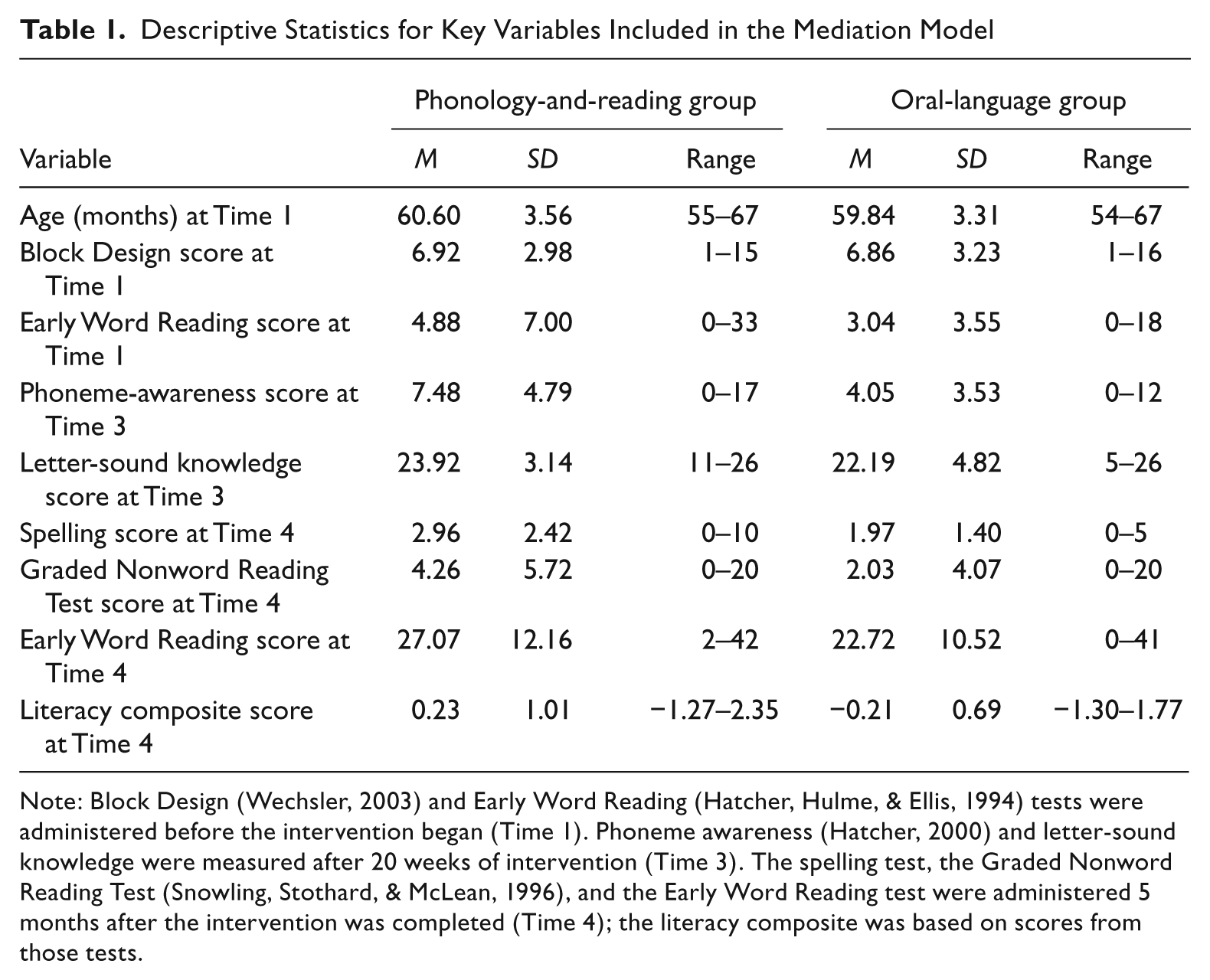
Note: Block Design (Wechsler, 2003) and Early Word Reading (Hatcher, Hulme, & Ellis, 1994) tests were administered before the intervention began (Time 1). Phoneme awareness (Hatcher, 2000) and letter-sound knowledge were measured after 20 weeks of intervention (Time 3). The spelling test, the Graded Nonword Reading Test (Snowling, Stothard, & McLean, 1996), and the Early Word Reading test were administered 5 months after the intervention was completed (Time 4); the literacy composite was based on scores from those tests.
Correlations Among Variables in the Mediation Model

Note: Early Word Reading (Hatcher, Hulme, & Ellis, 1994) and Block Design (Wechsler, 2003) tests were administered before the intervention began (Time 1), phoneme awareness (Hatcher, 2000) and letter-sound knowledge were measured after 20 weeks of intervention (Time 3), and literacy was measured 5 months after the intervention was completed (Time 4).
Because causal effects must operate forward in time, we used measures of phoneme awareness (the phoneme blending, segmentation, and deletion tasks) and letter-sound knowledge at Time 3 as possible mediators of the intervention effect on word-level literacy skills at Time 4. The analyses were conducted as a series of path models in Mplus (Version 6.1; Muthén & Muthén, 2010) using robust maximum-likelihood estimators to account for the fact that some measures were not normally distributed. To allow for the nonindependence of observations arising from the clustering of children within classrooms, we used robust (Huber-White) standard errors. The small amount of missing data was handled by full-information maximum-likelihood estimators (the default in Mplus).
We adopted an iterative approach to developing the final mediation model (shown in Fig. 1). We first assessed the effects of the intervention on the composite literacy outcome measure at Time 4. Because intervention group was dummy-coded (0 = OL group, 1 = P+R group), model estimates in which only the dependent variable was standardized expressed the mean difference between groups on the outcome measure in z-score units. In the absence of any covariates, the difference in literacy between the intervention groups was significant, d = 0.49, 95% confidence interval = [0.27, 0.71], p < .001. We next added initial levels of reading (scores on the Early Word Reading test at Time 1) and nonverbal ability (scores on the Block Design subtest at Time 1) as covariates (to control for baseline differences in reading ability and general cognitive ability on the outcome measures). Finally, we assessed the extent to which group differences in improvement on Time-4 literacy were mediated by changes in phoneme awareness and letter-sound knowledge at Time 3. Initial models assessed each of these mediators separately; then we examined their joint effects.
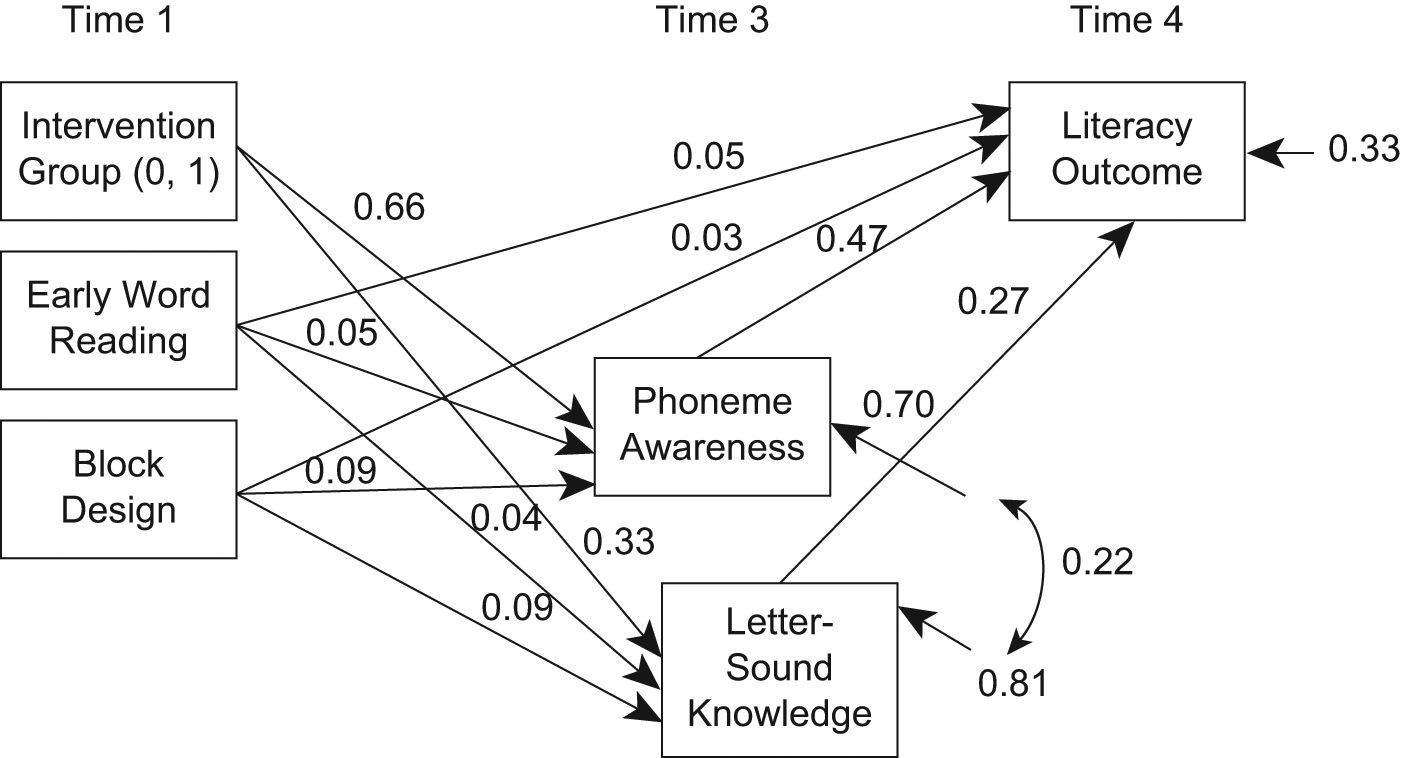
Path model showing the effects of a phonology and reading intervention on children’s literacy scores, as mediated by the intervention’s effects on phoneme awareness and letter-sound knowledge. At Time 1, before the intervention, children’s single-word reading and general cognitive ability (Block Design subtest of the third edition of the Wechsler Preschool and Primary Scale of Intelligence; Wechsler, 2003) were assessed. Phoneme awareness and letter-sound knowledge were tested at Time 3, after 20 weeks of intervention. Literacy was assessed at Time 4, 5 months after the intervention was completed. The oral-language group was coded as 0 in the model, and the phonology-and-reading group was coded 1. All path weights are standardized on the outcome (Y) variable only.
The final model showed that the P+R intervention was associated with differences in both phoneme awareness and letter-sound knowledge at Time 3. These differences, in turn, were associated with reliable influences on literacy scores at Time 4. Note that in this model, the direct path from the intervention to literacy at Time 4 was not significant and was therefore dropped. All retained paths in this model were statistically significant; dropping the nonsignificant direct path from intervention to literacy at Time 4 had no statistically significant effect on the fit of the model (Satorra-Bentler scaled χ2 difference = 0.86, n.s.). Furthermore, the strength of the mediated paths from intervention via phoneme awareness and letter-sound knowledge to literacy did not change reliably when the nonsignificant path was dropped.
The effects of the intervention on literacy scores at Time 4 can be completely accounted for by levels of the mediators (letter-sound knowledge and phoneme awareness) at Time 3. Both of the compound indirect paths (intervention → phoneme awareness at Time 3 → literacy at Time 4 and intervention → letter knowledge at Time 3 → literacy at Time 4) were statistically reliable. In terms of effect sizes, we derived an estimate of the size of the mean difference between the two groups in the literacy outcome that was associated with these indirect effects by using the model estimates in which only the dependent variable was standardized (i.e., the mean difference between groups on the outcome measure was expressed in z-score units). The total indirect effect expressed in this way was equal to 0.4 standard deviations; of this indirect effect, 0.31 standard deviations (p < .001) was attributable to the path via phoneme awareness and 0.09 standard deviations (p = .027) was attributable to the path via letter knowledge. Given concerns about the sensitivity of tests of mediated relations to violations of normality (Preacher & Hayes, 2008, we reassessed the reliability of these indirect effects using bootstrapped standard errors, which gave essentially identical results (p < .001 and p = .031, respectively).
Finally, note that this model included correlated errors for phoneme awareness and letter-sound knowledge, which indicated that these two measures were correlated, and the correlation between them was not accounted for by the effects specified in the model. Overall, this model provided an excellent fit to the data: χ2(1, N = 152) = 0.86, p = .35; comparative fit index = 1.00, Tucker-Lewis index = 1.0, root mean square error of approximation = 0.000 [0.000–0.208].
Discussion
In the study reported here, we tested the theory that the development of word-level literacy skills is causally influenced by children’s early letter knowledge and phoneme awareness. A phonology and reading intervention (Bowyer-Crane et al., 2008) that directly taught letter-sound knowledge and phoneme awareness produced significant improvements in these two skills and in early word-level literacy skills. More strikingly, levels of letter-sound knowledge and phoneme awareness measured at the end of the intervention fully mediated the improvements seen in the children’s word-level literacy skills measured 5 months later. Given that children in this study were randomly assigned to two interventions, we have good evidence that the improvements seen in letter-sound knowledge, phoneme awareness, and literacy skills were causal effects. Viewed in this light, the results of the mediation model provide strong support for the theory that weaknesses in letter-sound knowledge and phoneme awareness are two causes of difficulties in mastering word-level literacy skills (since differences at Time 3 in letter-sound knowledge and phoneme awareness can be attributed to differences between the two interventions that the children received).
In alphabetic writing systems, letters (graphemes) are used to represent phonemes, and it has been argued that children need to master the alphabetic principle in order to learn to read effectively (Byrne, 1998). To master the alphabetic principle, children must understand the mappings between letters in printed words and the phonemes in spoken words. To do this, they need to possess phonemically structured representations of speech, as well as letter-sound knowledge. Our study provides strong support for a theory that early reading development depends critically on phonemic skills and letter-sound knowledge.
Our findings have direct implications for reading instruction and methods of remedial teaching. The conclusion that phonemic skills and letter-sound knowledge are two causal influences on the development of reading skills leads to recommendations that these skills should be directly taught to all children in the early stages of learning to read. Arguably, such structured teaching may be particularly critical for children, such as those in the present study, who are struggling in the early stages of learning to read.
This study focused on the mechanisms of reading development and reading difficulties. However, the method we used to test a causal theory is potentially widely applicable in other areas. Combining mediation analyses with randomized trials testing theoretically motivated interventions is a powerful way of advancing the theoretical understanding of the causes of psychological disorders. Mediation models allow researchers to go beyond evaluating whether an intervention is effective to test theories about the factors responsible for the effects observed.
Footnotes
Acknowledgements
We thank Arne Lervåg for statistical advice.
The authors declared that they had no conflicts of interest with respect to their authorship or the publication of this article.