



Abstract
Understanding the determinants of socioeconomic status (SES) is an important economic and social goal. Several major influences on SES are known, yet much of the variance in SES remains unexplained. In a large, population-representative sample from the United Kingdom, we tested the effects of mathematics and reading achievement at age 7 on attained SES by age 42. Mathematics and reading ability both had substantial positive associations with adult SES, above and beyond the effects of SES at birth, and with other important factors, such as intelligence. Achievement in mathematics and reading was also significantly associated with intelligence scores, academic motivation, and duration of education. These findings suggest effects of improved early mathematics and reading on SES attainment across the life span.
Research aimed at understanding socioeconomic status (SES) attainment across the life course has increasingly focused on cognitive (e.g., Deary et al., 2005) and non-cognitive (e.g., Moffitt et al., 2011) differences apparent early in childhood (Reynolds, Temple, White, Ou, & Robertson, 2011). Existing analyses, however, have left around half the variance in SES unaccounted for; more specific factors may therefore play a role. In the research reported here, we tested whether early mathematics and reading skills predicted SES attainment over and above social status of origin, intelligence, academic motivation, and educational duration.
Childhood mathematics and reading skills are associated with educational achievement, translating into higher grades and greater attained qualifications (Duncan et al., 2007; McGee, Prior, Williams, Smart, & Sanson, 2002). In adulthood, these skills have also been shown to correlate with SES (e.g., Kutner et al., 2007). There are, however, at least two reasons to hypothesize that childhood mathematics and reading are causal influences on adult SES. First, these skills are associated with variables that could plausibly influence SES attainment. Individuals with greater academic skills are likely to be more successful in occupational contexts because their abilities afford them improved chances of career development. Further, numeracy is associated with successful financial decision making (Agarwal & Mazumder, 2013), and both poor literacy and poor numeracy are linked, through their effects on understanding of medical information, to ill health (Anker & Kaufman, 2007; Berkman, Sheridan, Donahue, Halpern, & Crotty, 2011), which limits SES (Cai & Kalb, 2006). Moreover, reading ability is positively associated with self-esteem (Kiuru et al., 2012), which predicts improved economic prospects (Trzesniewski et al., 2006) and is negatively associated with delinquency (Svensson, 2011).
Second, although mathematics ability and reading ability are cognitive skills, they are not completely subsumed by general intelligence; both mathematics (Hart, Petrill, Thomson, & Plomin, 2009) and reading (Harlaar, Hayiou-Thomas, & Plomin, 2005) show independent genetic effects, and reading and intelligence have been found to be neurally distinct (Tanaka et al., 2011).
We therefore hypothesized that, if mathematical and reading skills in childhood have substantial effects beyond the classroom—specifically, effects on midlife SES—we should find direct associations between these variables, even when controlling for intelligence, social class of origin, academic motivation, and educational duration. We also expected to find indirect associations between mathematics and reading ability and midlife SES, possibly via the effect of these skills on downstream variables such as education. We tested these relationships in a large, nationally representative, longitudinal sample spanning from childhood to midlife.
Method
Participants
Participants were members of the National Child Development Study, which used a sample of 17,638 infants born during 1 week in 1958 in England, Scotland, and Wales, along with 920 immigrants born during the same time. The 18,558 cohort members have been followed up on in eight waves, the first of which was in 1965, when participants were about 7 years old, and the most recent of which was in 2008 and 2009, when participants were about 50 years old. The present study focuses on data collected when participants were approximately 7 years old (Wave 1; n = 15,425), 11 years old (Wave 2; n = 15,337), 16 years old (Wave 3; n = 14,647), and 42 years old (Wave 6; n = 11,419); data files are available from the Institute of Education (2008a, 2008b). The sample size for each variable is shown in Table 1.
Heterogeneous Correlation Matrix and Descriptive Statistics for All Variables, for Female (Above the Diagonal) and Male (Below the Diagonal) Cohort Members

Note: RGSC = Registrar General’s Social Classes occupational classification. Asterisks indicate ordinal variables; all other variables were continuous.
Measures
SES of origin was a formative variable calculated from three measures completed by the cohort members’ parents when the cohort member was 7 years old. The first measure was the social class of the father’s occupation, measured by the Registrar General’s Social Classes (RGSC) class scheme and scored using a 7-point scale (Office of Population Censuses and Surveys, 1980): 1 = Class I, professional, 2 = Class II, managerial/technical, 3 = Class IIIn, skilled nonmanual or Class IIIm, skilled manual, 4 = Class IVn, semiskilled nonmanual or Class IVm, semiskilled manual, 5 = Class V, unskilled manual. The second measure, parental housing tenure, was rated on a scale from 1 (owner occupied) to 4 (rent free). The third measure was the reported number of rooms in the parents’ home.
Mathematics was a latent variable constructed from two measures recorded when participants were 7 years old. The first measure was the participant’s score on the Problem Arithmetic Test (Kellmer Pringle, Butler, & Davie, 1966), which was constructed specifically for this cohort and consisted of 10 arithmetic questions (e.g., “What is half of 38?”); one point was awarded for each correct answer. The second measure was a rating of the participant’s mathematical ability provided by his or her teacher; ratings were made using a scale from 1 (little, if any, ability in this sphere) to 5 (extremely good facility with number and/or other mathematical concepts).
Reading was a latent variable constructed from three measures of reading recorded when participants were 7 years old. The first measure was the participant’s score on the Southgate Group Reading Test (Southgate, 1958), a 30-item test of word recognition in which participants must match words to pictures. The second measure was the participant’s status as a reader as rated by his or her teacher, using a scale from 1 (nonreader) to 5 (avid reader). The third measure was the level of books the participant was able to read; each participant’s teacher was asked to indicate whether the participant was at the prereading level (Level 1), currently at the standard of basic graded classroom reading books (Levels 2–5, for Grades 1–4), or beyond basic reading books (Level 6).
Intelligence was measured at age 11 using a timed test involving matrices of linked words, symbols, or shapes; participants studied these and then completed an unfinished sequence from a set of alternatives. This measure contained 40 verbal items and 40 nonverbal items. The total score from this test correlates very strongly (r = ~.90) with scores on IQ-type tests and has high reliability (α = .94; Douglas, 1964, p. 131).
Academic motivation was measured using a questionnaire administered to cohort members at age 16. The questionnaire assessed their level of agreement with eight statements regarding motivation, self-regulation, and planning in school and beyond. Ratings were made using 5-point Likert scales. Two example items are “I find it difficult to keep my mind on work” and “School is a waste of time.” The eight items show acceptable reliability (α = .75).
The educational duration variable, reported at age 42, was the age at which the cohort member left full-time education.
Attained SES, measured at age 42, was a latent variable made up of three measures: the RGSC class of the cohort member’s occupation, the cohort member’s housing tenure, and the log of the cohort member’s gross income at his or her current job. For the RGSC measure, manual and nonmanual Class IV jobs were not classed into distinct categories, but the variable was otherwise identical to that used for paternal RGSC.
Analysis
Data were analyzed using OpenMx (Boker et al., 2011) in the R environment. A saturated structural equation model containing independent submodels for male and female cohort members was constructed (because of possible sex differences in the determinants of SES trajectories; see Ceci & Williams, 2010). Covariance of all continuous and ordinal variables was computed as a heterogeneous correlation matrix using the polycor package (Fox, 2010), with pairwise deletion for missing values.
Results
The correlation matrix—with separate correlations for males and females—used as an input to the model is shown in Table 1. The bivariate relationships between males’ and females’ mathematics and reading achievement at age 7 and SES at age 42 are shown in Figure 1.
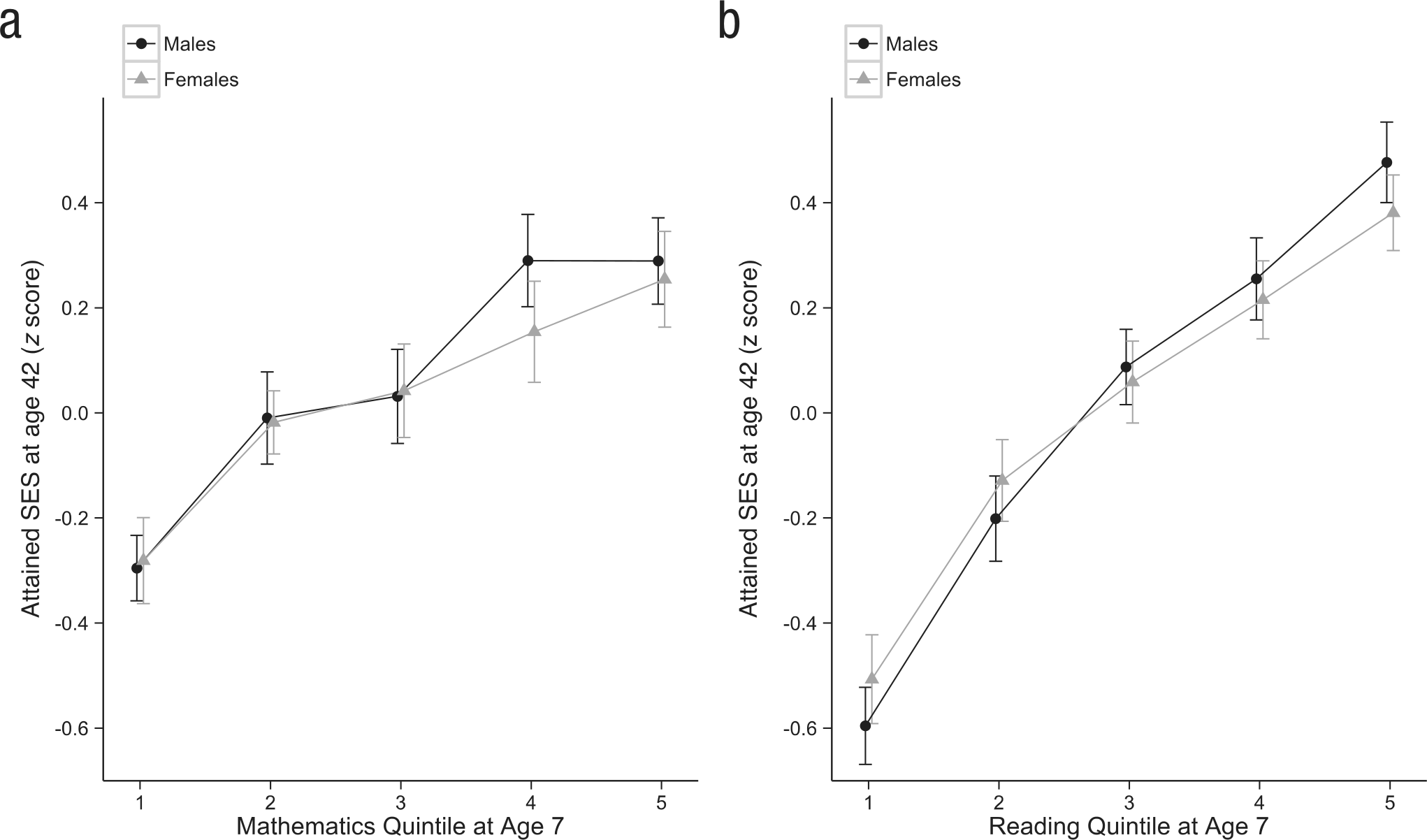
Associations of mathematics ability at age 7 (a) and reading ability at age 7 (b) with attained socioeconomic status (SES) at age 42 for male and female cohort members.
Model fitting proceeded as follows. We first examined the extent to which the models for males and females could be equated—that is, we tested which paths could be set equal across males and females without significant loss of fit (excluding the formative and reflective measurement-model elements). Of the paths among the variables, all but four could be equated across sex without significant loss of fit (Δ –2 log likelihood = 18.36, Δ df = 15, p = .24). Two paths were significantly stronger for male cohort members than for female cohort members: the covariance between mathematics and reading and the path from intelligence to motivation. By contrast, two paths were stronger for females than for males: the paths from both reading and education to attained SES. A diagram showing the path weights in the model prior to this sex-equation process can be found in Fig. S1 in the Supplemental Material available online.
We then examined the significance of the hypothesized effects in the sex-equated model by setting each path to 0 and examining the resultant change in −2 log likelihood. All paths were significant except for the path from mathematics to academic motivation, which could be dropped without significant loss of fit (see Table 2 for changes in −2 log likelihood and degrees of freedom, and for the associated p values, for all paths). Figure 2 shows the final model including path weights for both sexes, standardized within each sex.
Changes in Model Fit (−2 Log Likelihood) and Degrees of Freedom, With Associated p Values, After Dropping Paths in the Sex-Equated Model
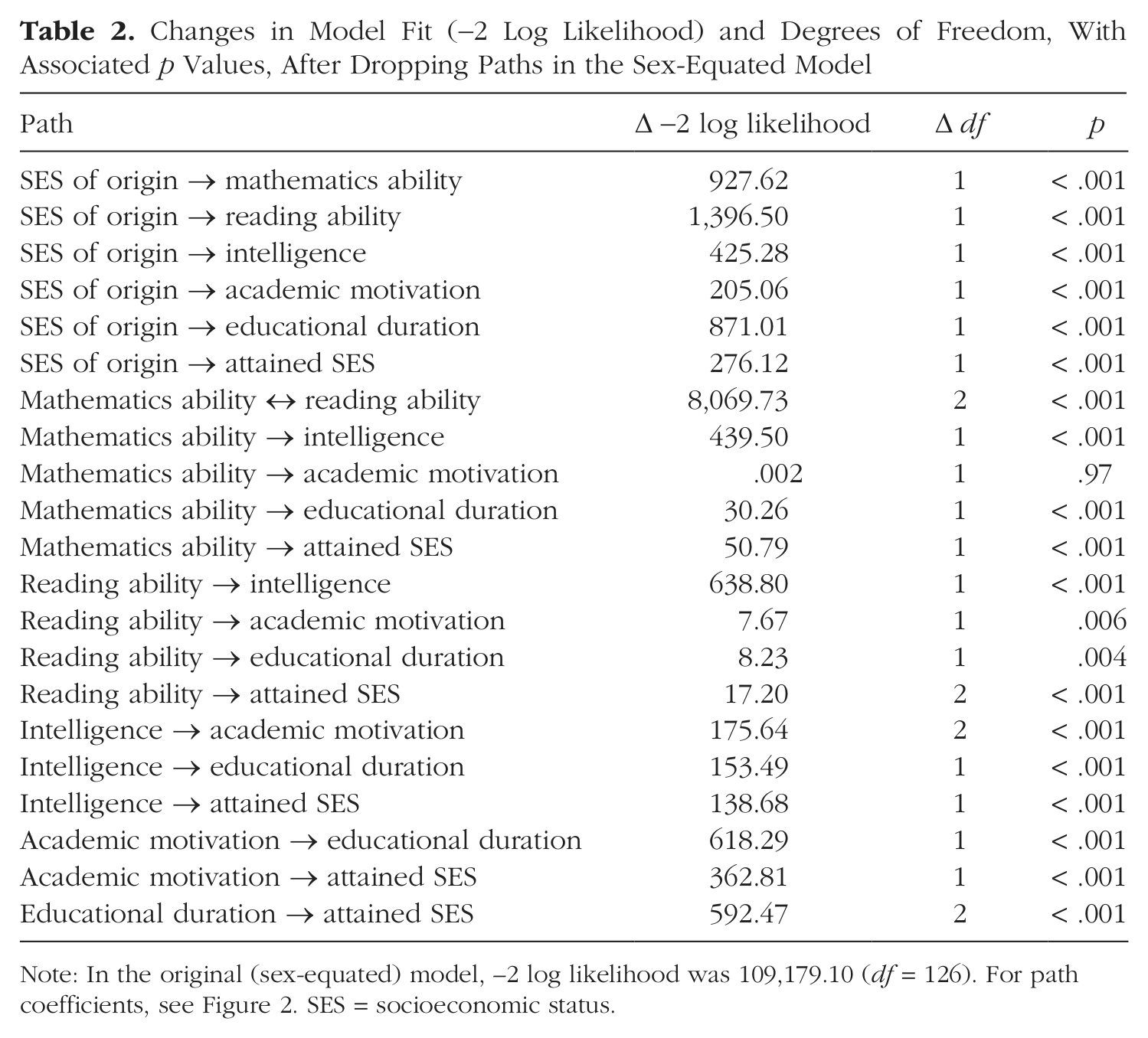
Note: In the original (sex-equated) model, –2 log likelihood was 109,179.10 (df = 126). For path coefficients, see Figure 2. SES = socioeconomic status.
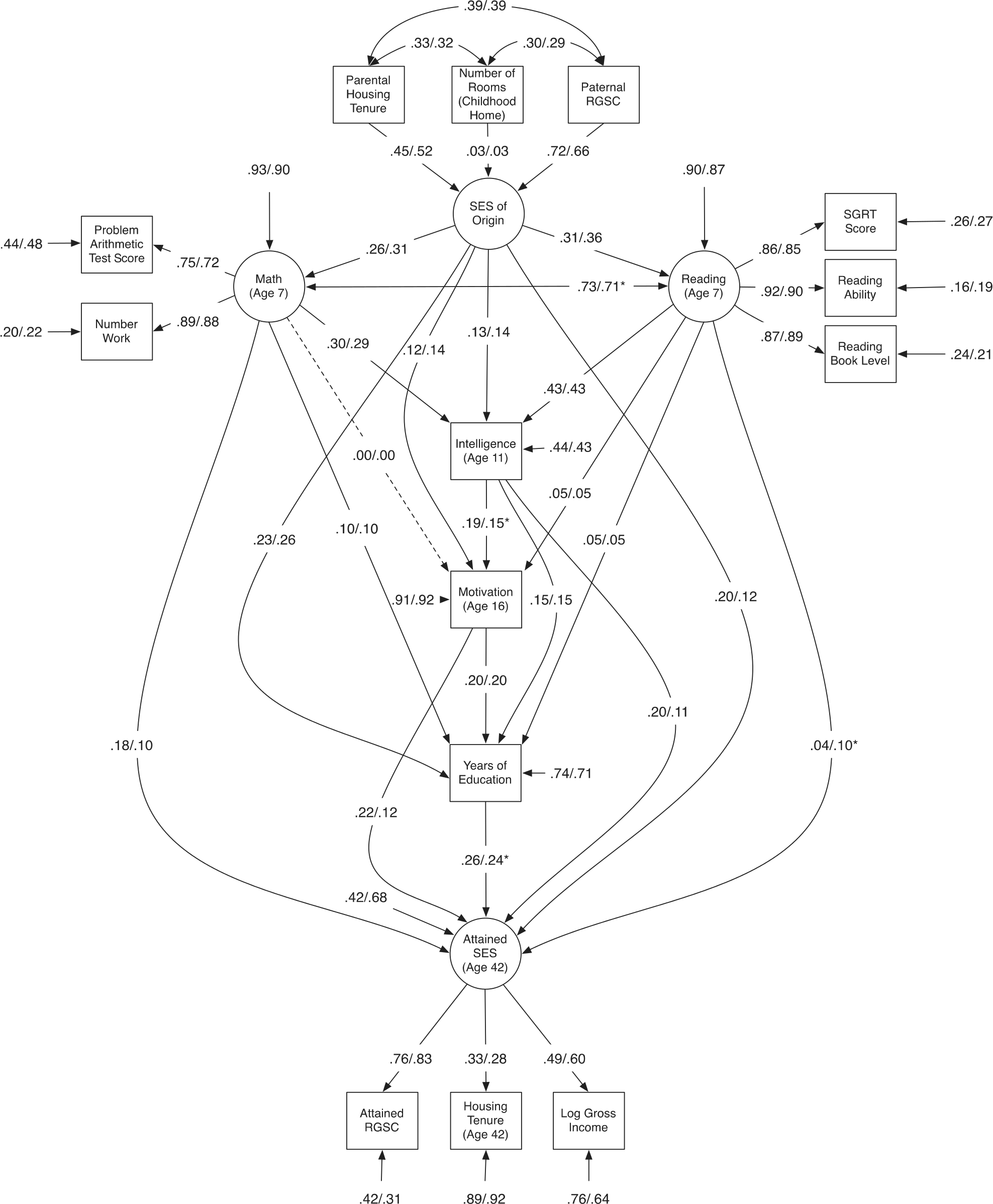
Associations of mathematics ability at age 7 and reading ability at age 7 with attained socioeconomic status at age 42, including all control variables. Values are standardized path coefficients (values for males are given on the left of the slash marks, and values for females are given on the right). Paths that could not be equated between the sexes (excluding formative and reflective measurement-model elements) are indicated with asterisks, and the nonsignificant path in the sex-equated model is indicated with a dashed line. Significance values are shown in Table 2. RGSC = Registrar General’s Social Classes occupational classification (Office of Population Censuses and Surveys, 1980); SES = socioeconomic status; SGRT = Southgate Group Reading Test (Southgate, 1958).
For both sexes, the latent factor of mathematics ability had a significant direct positive association with SES some 35 years later, with a model path weight of .18 for males and .10 for females (the difference between these weights was not significant). The direct path from reading ability to attained SES was significantly higher for females (.10) than for males (.04), for whom it was not significant. As can be seen from Figure 2, both reading and mathematics ability at age 7 had significant indirect associations with midlife SES: There were positive associations of mathematics and reading ability with both intelligence at age 11 and educational duration; reading ability was also significantly associated with academic motivation at age 16.
Two further models, each containing only one latent variable (either mathematics ability or reading ability), are available in the Supplemental Material (see Figs. S2 and S3, respectively). A comparison of these models reveals that mathematics ability and reading ability have similar associations with downstream outcomes such as educational duration, which may indicate that they both reflect a general factor present at age 7. However, a test of the discriminant validity of the two variables confirmed the significant effects of reading independent of its association with mathematics. All paths to and from reading were set to 0, except for the path between mathematics and reading, which was changed to a direct path from mathematics to reading and set to 1 to model the reading measures as a reflection of a general factor defined by mathematics and reading ability at the latent level. This model fit substantially and significantly less well (Δ –2 log likelihood = 776.14, Δ df = 17, p < .001), which indicated that the separate inclusion of both mathematics and reading was required for the best fit.
Finally, to test the robustness of the association between mathematics ability, reading ability, and midlife SES, we ran two additional models, including a new, theoretically motivated variable (oral ability at age 7 and aggression at age 16; see the Supplemental Material for details) in each. The inclusion of these new variables did not significantly reduce the associations we found using the original model. Further details of these models, with path diagrams, can be found in the Supplemental Material (see Figs. S4 and S5).
Discussion
Our results—illustrated in bivariate form in Figure 1 and in full, modeled form in Figure 2—show that mathematics and reading ability at age 7 are substantially and positively associated with SES at age 42, independently of relevant confounding variables. Both direct and indirect associations were found: Mathematics and (for females) reading ability directly related to attained SES, and there were additional positive associations of mathematics and reading ability at age 7 with subsequent intelligence, academic motivation, and educational duration.
These direct and indirect paths from mathematics and reading ability to subsequent SES may arise through a variety of mechanisms. First, it is plausible that the aforementioned links from mathematics and reading ability to intelligence, academic motivation, and, ultimately, educational duration increase one’s qualifications and thus open access to higher-paying occupations. Second, improved mathematics and reading skills may be of direct value in employment contexts; individuals with superior skills in these areas may, through their abilities in calculation, quantification, or extracting salient information, be more competitive in the occupational sphere. Third, the direct links from mathematics and reading ability to SES might be explained by the associations, noted above, between high mathematics and reading ability and variables that may improve SES, such as health literacy (Berkman et al., 2011) and management of personal finances (Agarwal & Mazumder, 2013).
Four paths to attainment differed between the sexes. First, intelligence was more strongly associated with academic motivation in males than in females. The mechanisms underlying this difference are unclear; the difference seems to indicate that, given the importance of education, targeting lower-ability boys for motivational interventions might be a worthy investment. Second, reading ability and educational duration were more strongly associated with attained SES in females than in males. After finding this stronger path between education and attained SES for females in the same sample, Schoon (2008) suggested that, at the time the cohort members were entering the labor market, “education was more of a necessity for women than for men to get ahead in the occupational hierarchy, while for men there might have been more opportunities to train on a job” (p. 79). Our finding of a stronger path between reading and attained SES for females than for males, then, may be explained by differences in the types of occupations available to, or chosen by, males and females. Finally, there was a small difference in the covariance between reading and mathematics, such that the path weight for males was slightly higher than that for females. This difference may reflect sex differences in risk for reading and mathematics disorders (e.g., Hawke, Olson, Willcut, Wadsworth, & DeFries, 2009), which might alter the relationship between reading and other variables across the sexes.
Two alternative causal explanations for our findings could be suggested. First, a “generalist genes” hypothesis (Haworth, Meaburn, Harlaar, & Plomin, 2007) might predict that mathematics and reading ability are manifestations of genetic cognitive ability, which was not controlled for by the later intelligence test administered to our sample. However, our discriminant-validity analysis indicated that separate inclusion of both mathematics ability and reading ability was necessary for the best model fit. In addition, there is evidence that high early reading ability may assist the development of intelligence (Harlaar et al., 2005), and high early mathematics ability may have similar effects. Second, it remains possible that childhood mathematics and reading ability are indicators of other variables that were not included in our model. However, these variables would have to be outside the four major cognitive and noncognitive variables believed to underpin SES attainment, which were controlled for in this study.
One limitation of the present study was that the items in the measure of academic motivation assessed two related, but separate, constructs: motivation and self- control/self-regulation. The inclusion of cleaner measures of these two constructs in future studies would allow researchers to disentangle their separate effects on SES outcomes.
The present study did not contain a randomized experiment to test the efficacy of an intervention to improve mathematics ability, reading ability, or both. However, other work has shown positive effects of, for instance, preschool education on these variables (Tucker-Drob, 2012), and interactions between the effects of genetics and the effects of teacher quality on reading ability (Taylor, Roehrig, Soden Hensler, Connor, & Schatschneider, 2010) indicate that levels of attainment of these skills are to some extent malleable.
In summary, our results strengthen the understanding of routes to social mobility, supporting not only the roles of SES of origin, intelligence, academic motivation, and educational duration, but also the specific faculties of mathematics and reading.
Footnotes
Acknowledgements
We are grateful to the Centre for Longitudinal Studies (CLS), the Institute of Education, and the Economic and Social Data Service (ESDS) for these data. Neither the CLS nor the ESDS are responsible for the analysis or the interpretation of the data presented in this article. We also thank Gary Lewis and three anonymous reviewers for their helpful comments. The writing of this article was supported by an Economic and Social Research Council scholarship awarded to the first author.
Declaration of Conflicting Interests
The authors declared that they had no conflicts of interest with respect to their authorship or the publication of this article.

References
Supplementary Material
Please find the following supplemental material available below.
For Open Access articles published under a Creative Commons License, all supplemental material carries the same license as the article it is associated with.
For non-Open Access articles published, all supplemental material carries a non-exclusive license, and permission requests for re-use of supplemental material or any part of supplemental material shall be sent directly to the copyright owner as specified in the copyright notice associated with the article.
