




Abstract
The social environment requires people to quickly form contextually appropriate social evaluations. Models of social cognition suggest that this ability depends on the interaction of automatic and controlled evaluative systems. However, controlled processes, such as reappraisal of an initial response, have rarely been studied in the context of social evaluation. In the two studies reported here, participants reappraised or simply observed angry or neutral faces. In Study 1, reappraisal modulated evaluations of angry faces on explicit as well as implicit behavioral levels. In Study 2, reappraisal altered both early and late phases of evaluative electrocortical processing. These studies suggest that controlled processes, such as reappraisal, can quickly and substantially modulate early evaluative processes in the context of biologically significant social stimuli.
As members of a social species, people are highly attuned to others’ behavior, especially their emotional facial expressions. Indeed, the human brain seems to process this particular stimulus class rapidly and automatically (Palermo & Rhodes, 2007; Tamietto & de Gelder, 2010). However, emotional faces do not trigger specific evaluations in an entirely rote fashion: Cognitive control mechanisms may be engaged in order to facilitate flexible and contextualized social responding.
Influential theories of social cognition and social neuroscience have broadly distinguished between two social-evaluative processing modes: one quick and automatic and one slow and controlled (e.g., Adolphs, 2009; Greenwald & Banaji, 1995; Wilson, Lindsey, & Schooler, 2000). These two modes are thought to lead to separate representations and potentially discrepant patterns of implicit and explicit evaluations. Recent work has tried to integrate these two modes by suggesting that there are two evaluative systems that interact dynamically. According to this account, early automatic evaluations are successively refined and modulated by controlled evaluation in iterative-reprocessing loops (Cunningham & Zelazo, 2007), and this process ultimately leads to one integrated memory representation. In the studies reported here, we examined whether (and how rapidly) a controlled regulation process, namely reappraisal of an initial response, influences social evaluations during processing of emotional faces.
Automatic Processing of Emotional Faces
There is now ample behavioral and neural evidence that emotional facial expressions are processed rapidly and automatically (for reviews, see Palermo & Rhodes, 2007; Vuilleumier & Righart, 2011). Affective-priming studies have shown that, on a behavioral level, briefly presenting task-irrelevant emotional faces as primes influences the affective processing of subsequent targets (e.g., Fazio, Jackson, Dunton, & Williams, 1995). This finding suggests that implicit evaluations of prime faces are rapidly activated.
On a neural level, event-related potentials (ERPs) are ideal for mapping the early time course of cognitive-emotional face processing. The occipital P100 (a positive deflection of the ERP occurring 100 ms after stimulus onset) is one of the earliest emotion-sensitive ERPs. It precedes the face-specific occipito-temporal N170 (a negative deflection of the ERP occurring 170 ms after stimulus onset, also called the N1), which is implicated in structural and emotional face processing (for reviews, see Eimer, 2011; Vuilleumier & Righart, 2011). Subsequent emotion-sensitive ERPs are the early posterior negativity (EPN, which occurs between 200 ms and 300 ms) and the late positive potential (LPP, which occurs after 300 ms). Both of these ERPs are elevated during processing of emotional faces (Muhlberger et al., 2009; Schupp et al., 2004; Wieser, Pauli, Reicherts, & Muhlberger, 2010). 1
Controlled Processing of Emotional Faces
Despite its popularity, the idea that social cognition is an inherently flexible process that allows for multiple forms of cognitive control (Adolphs, 2009) has rarely been demonstrated convincingly in the domain of face processing. Furthermore, it is unclear whether early ERPs (e.g., the P100, N170, and EPN) are sensitive to controlled processing. There have been only a few demonstrations of the influence of affective and contextual variables on neural face processing (Kim et al., 2004; Pizzagalli et al., 2002), but these demonstrations suggest that early face processing might be susceptible to controlled processes.
Indirect support for the strength and flexibility of cognitive control processes comes from studies on reappraisal, a cognitive emotion-regulation strategy that has been shown to modulate the processing of a wide range of emotional stimuli (Ochsner & Gross, 2008). Recent ERP research with emotional pictures demonstrated that this modulation happens in the LPP time range (Hajcak, MacNamara, & Olvet, 2010), but earlier effects have also been shown (Hajcak & Nieuwenhuis, 2006). However, with the exception of one neuroimaging study that does not allow strong inferences about early modulation because of poor temporal resolution (Goldin, Manber, Hakimi, Canli, & Gross, 2009), none of these reappraisal studies has focused on the early modulation of emotional face processing.
The Present Research
The goal of the research reported here was to assess the extent (explicit or implicit) and timing (early or late) of the effects of controlled processes during emotional face processing. In two studies, participants observed or reappraised neutral or angry faces while explicit and implicit evaluations (valence ratings and affective priming in Study 1) and ERPs (Study 2) were measured. Given the importance of flexible regulation of responses to social stimuli, reappraisal was expected to modulate emotion not only on explicit evaluative measures (Goldin et al., 2009) and a late ERP (the LPP; Hajcak et al., 2010) but also on implicit evaluations (affective priming) and a midlatency ERP (the EPN) or early ERPs (the N170 and P100; cf. Pizzagalli et al., 2002).
Study 1: Effects of Reappraisal on Implicit and Explicit Valence
The goal of Study 1 was to assess whether reappraisal affects both explicit face evaluations (subjective ratings) and implicit face evaluations (affective priming).
Method
Twenty female undergraduates from several colleges in the Palo Alto, California, area participated for course credit (mean age = 19.3 years, SD = 0.78 years). Women were selected to limit variability in affective responding (Wager, Phan, Liberzon, & Taylor, 2003).
Regulation task and valence ratings
Frontal photographs showing only the head and shoulders of 18 male actors with neutral or angry facial expressions (Tottenham, Borscheid, Ellertsen, Marcus, & Nelson, 2002) were presented in three experimental conditions. Male faces were selected because previous research has shown that it is easier to process angry male faces than angry female faces (Becker, Kenrick, Neuberg, Blackwell, & Smith, 2007).
In the three conditions, participants observed (O) neutral (N) faces (ON condition), observed (O) angry (A) faces (OA condition), and reappraised (R) angry (A) faces (RA condition). In the ON condition and the OA condition, actors with neutral or angry facial expressions (respectively) were displayed, and participants were instructed to engage with and naturally respond to them. In the RA condition, angry actors were shown, and participants were instructed to reappraise the face to “make the stimulus less emotional.” During a training phase, the experimenter gave examples of how to reappraise faces (e.g., “Imagine this person is not angry at you but just had a bad day or a fight with his boss”).
As Figure 1 shows, conditions were presented in separate blocks. Each block began with a self-paced phase in which participants viewed three individual faces and implemented the instruction given for that condition (i.e., observe or reappraise the faces). Then participants rated the valence of each actor’s expression on a visual analogue scale from pleasant to unpleasant. During the subsequent test phase, the same three actors shown in that block’s implementation phase were presented three separate times for 3,000 ms each in random order (intertrial intervals ranged from 800 ms to 1,200 ms). Participants continued to implement the instructions given for that block’s condition. Blocks were presented in counterbalanced order, and there were four blocks per condition. Different actors were presented in each of the three conditions (the assignment of actors to conditions was counterbalanced across participants).

Design of the regulation task. In the three conditions of the study, participants were instructed to either observe or reappraise their reactions to actors (shown in photographs from the shoulders up). Each block of trials (four blocks per condition) consisted of an implementation phase followed by a test phase. In the implementation phase, participants viewed three different actors and implemented the instructions given for that condition. In Study 1 only, participants then rated the valence of the actors’ facial expressions. In the test phase, the three actors from the implementation phase were presented three times each in random order, and participants continued to observe or reappraise their faces. In Study 2 only, electroencephalographic (EEG) recordings were made in the test phases of all three conditions. Capital letters refer to different actors (pictures of faces).
Affective priming
After the regulation task, we conducted an affective-priming task, in which we assessed participants’ implicit evaluation of the same actors they saw during the regulation task. Each affective-priming trial began with a 1,000-ms fixation cross, followed by a prime face for 200 ms. After a second fixation cross (lasting for 100 ms), a target word was presented. Target words were drawn from a list of nine positive personal attributes (e.g., friendly, happy) and nine negative personal attributes (e.g., angry, rude; see the Supplemental Material available online for further details). Participants were prompted to classify the target word as positive or negative as quickly and accurately as possible. A bias score was created by subtracting reaction times (RTs) to negative target words from RTs to positive target words: Positive RT bias scores reflect faster responses to negative relative to positive targets and thus negative implicit valence. RT data were lost for 2 participants, and one outlier (z > 3) was excluded from analysis.
Results and discussion
Explicit valence effects
Mean valence ratings in the three conditions are shown in Figure 2a. A univariate analysis of variance (ANOVA) revealed that valence ratings differed by condition, F(2, 38) = 38.9, p < .001, η2 = .672. An effect of emotion was evident in that valence ratings were more negative in the OA condition than in the ON condition, t(19) = 8.21, p < .001, d = 1.98. The expected effect of reappraisal was evident in that valence ratings were less negative in the RA condition than in the OA condition, t(19) = 6.07, p < .001, d = 1.54. Ratings in the RA condition were not significantly different from those in the ON condition, t(19) = 1.52, p = .145. These findings confirm that effects of emotion had a significant influence on explicit valence ratings, and that these effects were substantially reduced by reappraisal.
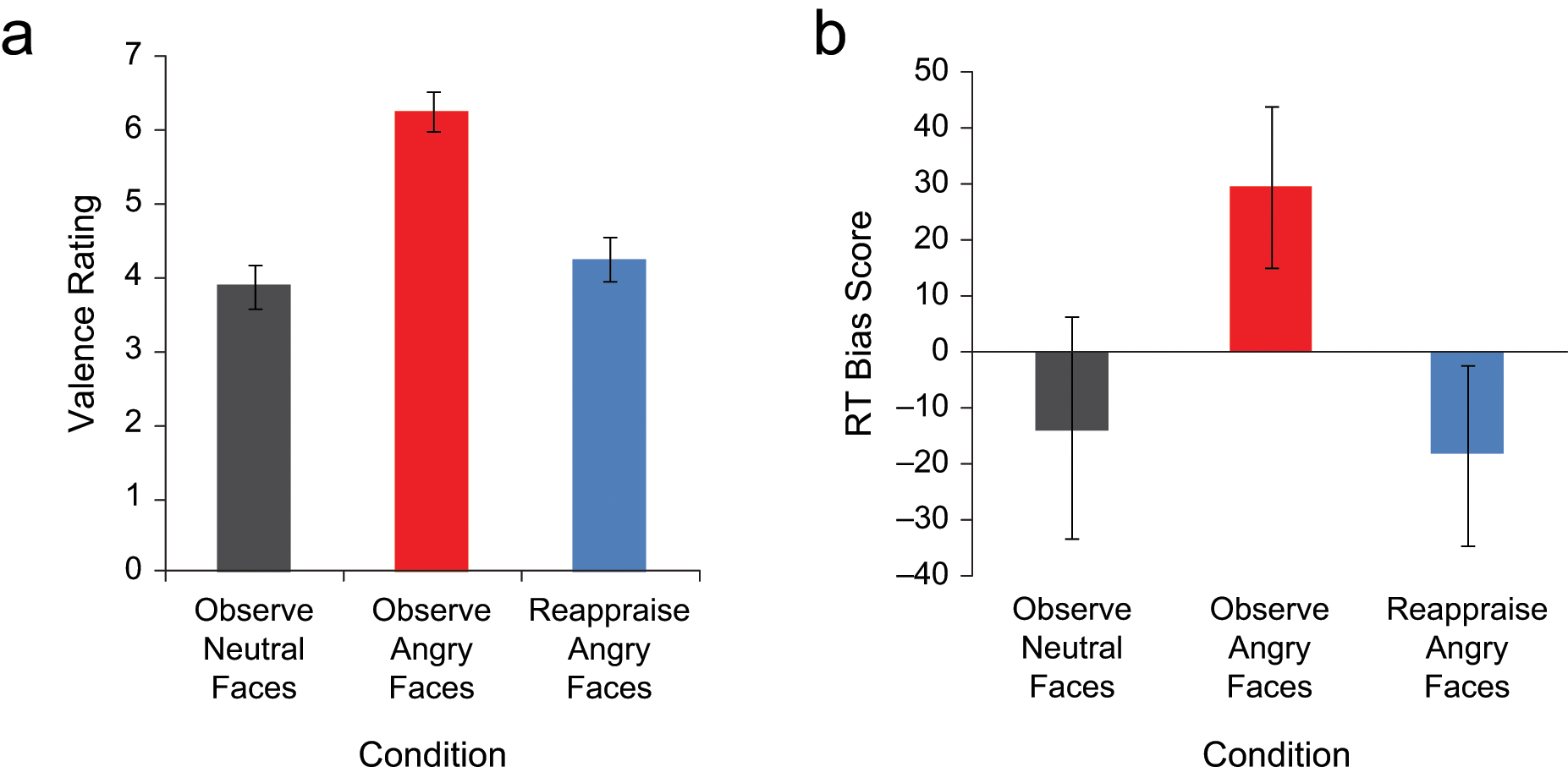
Results from Study 1: mean (a) valence rating and (b) reaction time (RT) bias score as a function of condition. Bias scores were created by subtracting RTs to negative target words from RTs to positive target words. Error bars show standard errors.
Implicit valence effects
Mean RT bias scores in the three conditions are shown in Figure 2b. A univariate ANOVA revealed that these scores differed by condition, F(2, 32) = 4.66, p = .020, η2 = .226, and showed a very similar pattern to that of valence ratings. An effect of emotion was evident in that RT bias scores were more negative in the OA condition than in the ON condition, t(16) = 2.17, p = .046, d = 0.60. An effect of reappraisal was evident in that RT bias scores were less negative in the RA condition than in the OA condition, t(16) = 3.12, p < .01, d = 0.76. RT bias scores did not differ significantly in the RA and ON conditions, t(16) < 1.00. Thus, implicit evaluations paralleled explicit evaluations: Angry faces triggered negative implicit evaluations, which were reduced by reappraisal.
Study 2: Early Electrocortical Processing
Study 1 showed that reappraisal of angry faces reduced both explicit valence ratings and rapidly activated, implicit evaluations. In Study 2, we utilized ERPs to assess the timing of the effects of reappraisal during electrocortical processing of angry faces.
Method
Participants
Thirty-two female undergraduates from several colleges in the Palo Alto, California, area participated in Study 2 for course credit (mean age = 21.9 years, SD = 4.87 years).
Procedure
The same regulation task was used as in Study 1, except that participants did not make valence ratings of the actors. Instead, in the test phase, we made electroencephalographic (EEG) recordings from 42 electrodes positioned according to the 10-20 system. Only test-phase trials were included in the ERP analysis. Impedances were kept below 5 kΩ. AFz was used as the ground, and Pz was used for on- line reference. EEG data were first corrected for eye-blink artifacts using the procedure developed by Gratton, Coles, and Donchin (1983). Single-trial EEG epochs were then extracted for a period beginning 200 ms prior to image onset and continuing for the entire duration of the image presentation (3,000 ms). Next, all activity was rereferenced to the average reference and low-pass filtered at 35 Hz. Trials that contained excessive physiological artifacts (i.e., voltages exceeding 150 μV) were discarded from further processing. The resulting ERPs were baseline-corrected using the average activity in the 200-ms window immediately preceding image onset.
Time windows for ERP components were chosen a priori (Muhlberger et al., 2009; Wieser et al., 2010), as were the electrodes used to measure the P100 and N170 (the P100 was measured at O1 and O2 between 90 ms and 120 ms, the N170 was measured at P7 and P8 from 140 ms to 180 ms, the EPN was measured from 240 ms to 280 ms, and the LPP was measured from 300 ms to 600 ms). There were no lateralized condition effects on the P100 and N170. Because of the broad scalp distributions of the EPN and LPP, we determined peak condition effects (combined effects of emotion and reappraisal) within previously established locations (cf. Schupp, Flaisch, Stockburger, & Junghofer, 2006) by visual inspection of F-value maps derived from electrode-wise ANOVAs on the effect of condition.
Results and discussion
Mean peak amplitudes for the four ERP components of interest are shown in Table 1.
Mean Peak Amplitudes (in Microvolts) for the Event-Related Potentials (ERPs) Examined in Study 2
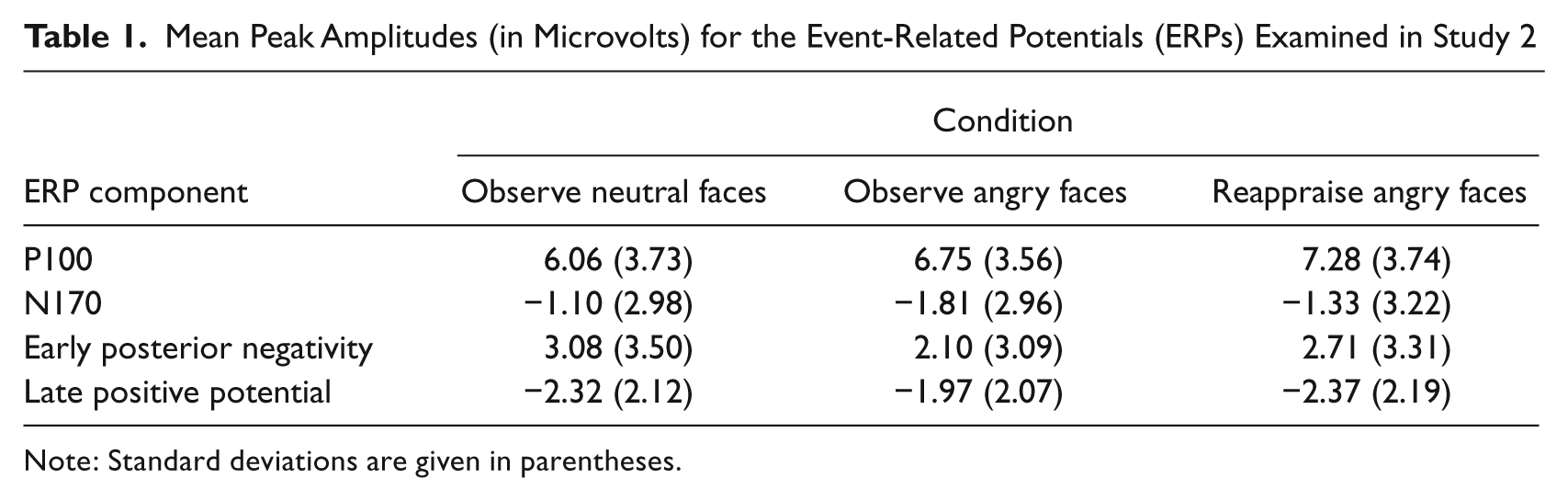
Note: Standard deviations are given in parentheses.
The P100 component
Figure 3a shows the ERP waveform for the P100 in the three conditions. A univariate ANOVA revealed significant effects of condition on P100 amplitude, F(2, 62) = 10.5, p < .001, η2 = .253. Follow-up t tests revealed the expected effect of emotion on P100 amplitude (i.e., amplitudes in the OA condition were greater than those in the ON condition), t(31) = 2.40, p = .022, d = 0.19; this result may be due to enhanced attentional processing of angry faces (cf. Luck, Woodman, & Vogel, 2000). Reappraising angry faces further increased P100 amplitude instead of reducing emotion-induced P100 amplitude (i.e., amplitudes in the RA condition were greater than those in the OA condition), t(31) = 2.06, p = .048, d = 0.15. Thus, more attentional resources were consumed during reappraisal in this early stage.
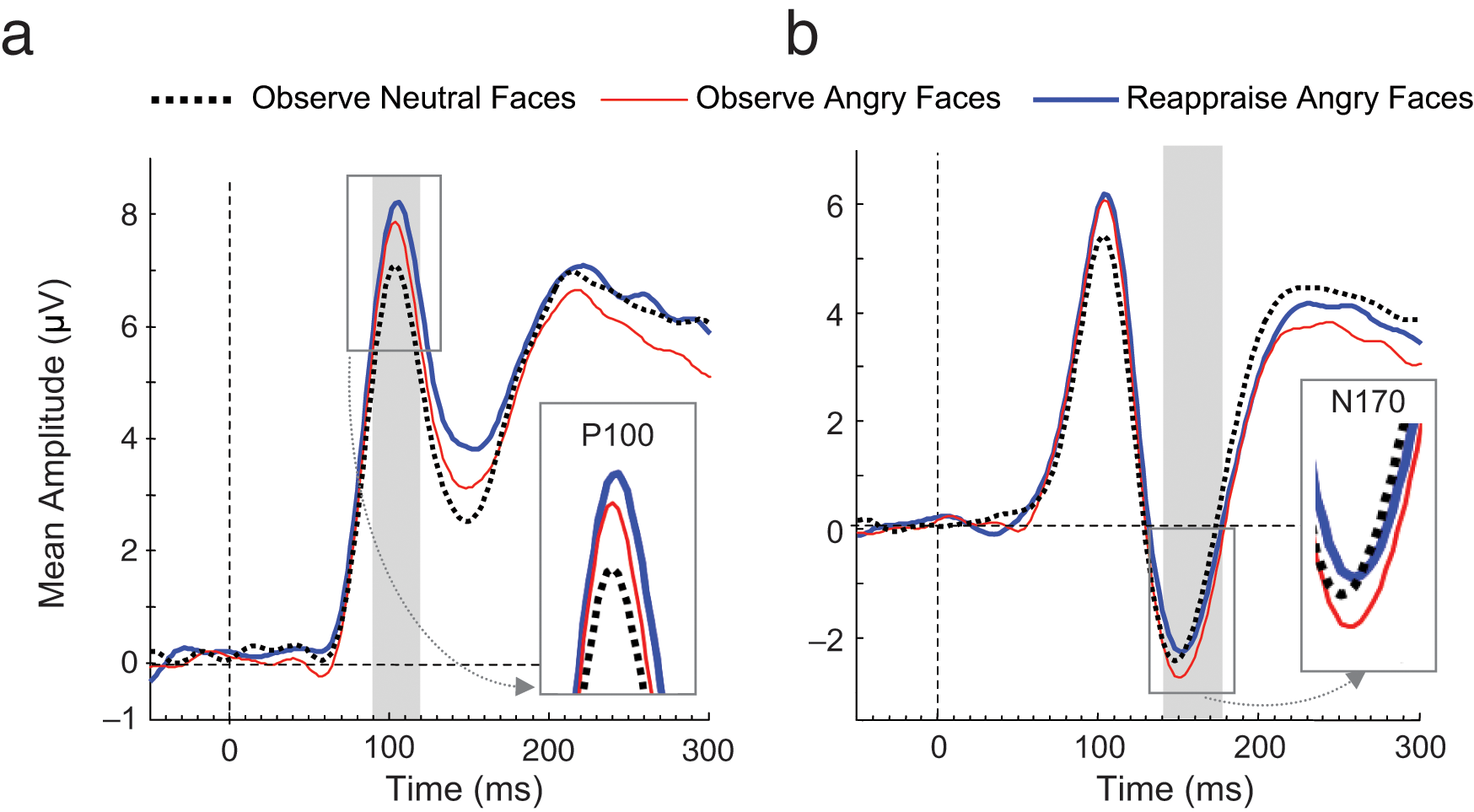
Event-related potentials illustrating the (a) P100 (occipital electrodes O1 and O2) and (b) N170 (temporo-parietal electrodes P7 and P8) in the three conditions of Study 2. The dashed vertical lines indicate stimulus onset.
The N170 component
Figure 3b shows the ERP waveform for N170 in the three conditions. A univariate ANOVA revealed that N170 amplitude differed by condition, F(2, 62) = 5.22, p = .008, η2 = .144. Follow-up t tests confirmed the expected effect of emotion on N170 amplitude (i.e., amplitudes in the OA condition were greater than amplitudes in the ON condition), t(31) = 3.50, p < .001, d = 0.24. Reappraising angry faces significantly reduced N170 amplitude compared with N170 amplitude in the OA condition, t(31) = 2.09, p = .045, d = 0.16; N170 amplitude was equivalent in the RA and ON conditions, t(31) < 1.00. Thus, the N170 as an early index of configurational and emotional face processing was reduced by reappraisal.
The EPN component
Effects of condition during the EPN time window peaked over right occipito-temporal sensors (Fig. 4a, left panel). The corresponding waveform analysis (Fig. 4a, right panel) indicated strong effects of condition, F(2, 62) = 9.45, p < .001, η2 = .234, due to significant effects of both emotion and reappraisal. Specifically, amplitudes in the OA condition were greater than those in the ON condition, t(31) = 4.42, p < .001, d = 0.30, and amplitudes in the RA condition were smaller than those in the OA condition, t(31) = 3.01, p = .005, d = 0.19. Amplitudes in the RA condition were not different from those in the ON condition, t(31) = 1.44, p = .159. These results suggest that reappraising angry faces reduced emotion-related attention during more detailed stimulus analysis (Schupp et al., 2006).
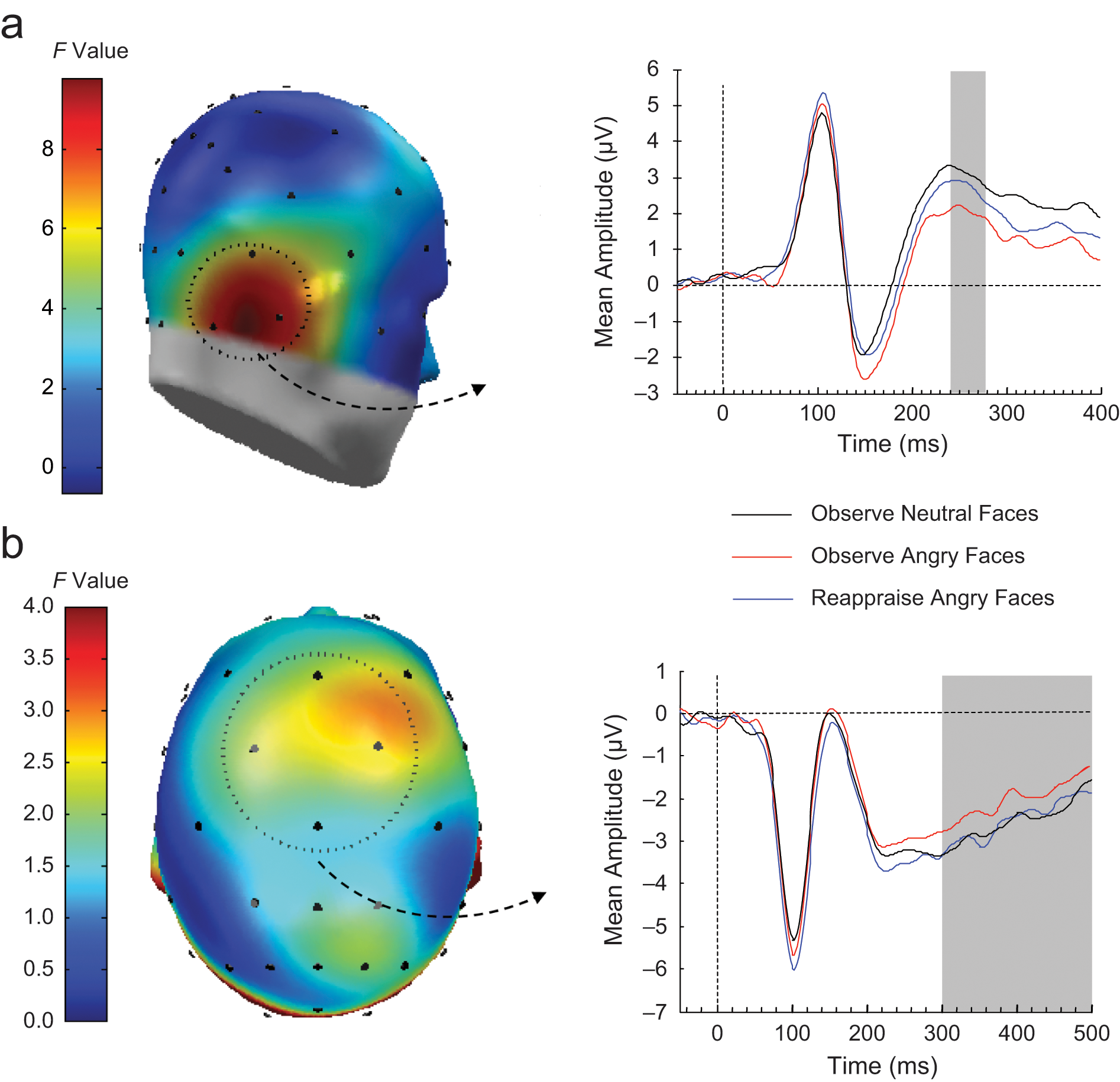
Results for the (a) early posterior negativity (EPN) and (b) late positive potential (LPP) in Study 2. The left column shows the scalp distribution of effects of condition on these components (F-value map of electrode-wise analysis of variance). The right column shows waveforms extracted from peak electrodes in each of the three conditions. Data from the electrodes TP10, PO8, and P8 were averaged to examine the EPN. Data from the electrodes Cz, Fc1, Fc2, and Fz were averaged to examine effects during the LPP time window. The dashed vertical lines indicate stimulus onset.
The LPP component
As the left panel of Figure 4b shows, the effects of condition in the LPP time window were broadly distributed over the frontocentro-parietal electrodes. Waveform analysis indicated the expected effect of condition, F(2, 62) = 4.98, p = .010, η2 = .138, due to effects of emotion and reappraisal (Fig. 4b, right panel). Specifically, amplitudes in the OA condition were greater than those in the ON condition, t(31) = 2.51, p = .017, d = 0.17, and amplitudes in the RA condition were smaller than those in the OA condition, t(31) = 2.70, p = .011, d = 0.19. Again, amplitudes in the RA and ON conditions did not differ, t(31) < 1.00. Thus, consistent with prior research (Hajcak et al., 2010), our results showed that reappraising angry faces reduced the LPP, which indicates sustained attention and meaning evaluation.
General Discussion
Flexible responding requires cognitive control over responses elicited by biologically salient stimuli. We provide converging evidence that cognitive reappraisal of socially salient stimuli modulates implicit and explicit evaluations as well as early through late emotion-related ERPs.
Early effects of reappraisal: implications for models of evaluation and emotion processing
The present findings of early effects of reappraisal during emotional face processing are inconsistent with dual-attitude models suggesting that controlled processes are slow and effortful. It also seems unlikely that automatic and controlled modes led to separate memory representations in the present task, because implicit and explicit evaluations were in agreement. These findings are better accounted for by the iterative-reprocessing model, which proposes that automatic and controlled evaluative processes interact in iterative reprocessing cycles to form one integrated and nuanced stimulus representation (Cunningham & Zelazo, 2007). However, the present results point to the possibility that iterative reprocessing might be particularly fast in the present context.
The findings reported here dovetail with the results of studies demonstrating the influence of affective and contextual variables on emotional face processing (Aviezer et al., 2008; Kim et al., 2004; Pizzagalli et al., 2002). Taken together, these findings suggest that face processing might be more susceptible to cognitive manipulations than previously assumed (cf. Palermo & Rhodes, 2007; Vuilleumier & Righart, 2011). The present data are also consistent with the findings of recent ERP studies of reappraisal (for a review, see Hajcak et al., 2010), but the present results indicate that reappraisal can be particularly fast in a social context.
What brain systems might underlie these early cognitive effects? Reappraisal is supported by prefrontal regions that can inhibit amygdala responses (Ochsner & Gross, 2008). Cunningham and Zelazo (2007) propose that amygdalar involvement at each processing stage orchestrates activity in several cortical and subcortical regions, including early visual areas (Freese & Amaral, 2005) that are possible sources of P100 and N170 (for a review, see Eimer, 2011). However, new models indicate that thalamo-cortical networks are involved very early during emotion processing. This finding points to alternative, distributed avenues of cognitive control during early vision (Pessoa & Adolphs, 2010). Future research might use tasks such as the present one to probe the multiple feedback routes available during processing of emotional stimuli (cf. Adolphs, 2009) to refine knowledge about the temporal dynamics and neuroanatomy of cognition-emotion interactions.
Reappraisal of facial emotion: a research tool for social cognition and experimental psychopathology?
The ability to respond to social stimuli in a contextually appropriate way is crucial to successful interpersonal functioning. Hyperreactivity to emotional faces is well documented in individuals with anxiety and depression, but the precise role of cognitive control processes, such as reappraisal, in emotional face processing remains largely unexplored. For example, it has recently been shown that patients with social anxiety disorder show reduced activity in cognitive regulation-related regions during reappraisal of contemptuous faces (Goldin et al., 2009). As noted by Cunningham and Zelazo (2007), such patterns of brain activity might be explained by insufficient controlled reprocessing, which would result in less contextualized automatic evaluations. The present findings sug- gest that healthy individuals can use controlled processes to modify automatic emotional responding very early before it gathers force. It may be that this important ability is lacking in individuals with relevant psychopathologies.
Limitations and future directions
Some limitations of the studies reported here bear emphasis. Our finding of enhanced P100 amplitude during reappraisal of angry faces seems inconsistent with the reductions observed on the other measures. Gallo, Keil, McCulloch, Rockstroh, and Gollwitzer (2009), for example, showed that cognitive intentions to ignore phobic pictures reduced P100 amplitude. Thus, increased P100 amplitude might reflect the need for enhanced stimulus processing as a prerequisite for successful reappraisal. Further research on this topic is clearly needed. Further, the present findings pertain to female participants exposed to male faces. Future studies could vary participant and stimulus gender to increase the generalizability of these findings. The interpretation of the ERP findings would be facilitated by combining ERPs with explicit and implicit valence measures in a single study.
There are many other interesting avenues for future investigation. For example, race, social status, or emotional state could be examined on the participant side (e.g., fearful participants watching angry faces). On the stimulus side, studies may focus on emotion (e.g., fearful instead of angry faces as an indirect or environmental threat signal) and presentation time (subliminal vs. supraliminal face presentation as a proxy for automatic vs. controlled processing; cf. Liddell, Williams, Rathjen, Shevrin, & Gordon, 2004; Cunningham et al., 2004). Investigating the regulation of emotional faces holds promise for modeling cognition-emotion interactions representative of many everyday life interactions. Such studies would help researchers to better understand when and why people see what they think.
Footnotes

References
Supplementary Material
Please find the following supplemental material available below.
For Open Access articles published under a Creative Commons License, all supplemental material carries the same license as the article it is associated with.
For non-Open Access articles published, all supplemental material carries a non-exclusive license, and permission requests for re-use of supplemental material or any part of supplemental material shall be sent directly to the copyright owner as specified in the copyright notice associated with the article.
