




Abstract
We hypothesized that an adaptive form of emotion regulation—cognitive reappraisal—would decrease negative emotion and increase support for conflict-resolution policies. In Study 1, Israeli participants were invited to a laboratory session in which they were randomly assigned to either a cognitive-reappraisal condition or a control condition; they were then presented with anger-inducing information related to the Israeli-Palestinian conflict. Participants in the reappraisal condition were more supportive of conciliatory policies and less supportive of aggressive policies compared with participants in the control condition. In Study 2, we replicated these findings in responses to a real political event (the recent Palestinian bid for United Nations recognition). When assessed 1 week after training, participants trained in cognitive reappraisal showed greater support for conciliatory policies and less support for aggressive policies toward Palestinians compared with participants in a control condition. These effects persisted when participants were reassessed 5 months after training, and at both time points, negative emotion mediated the effects of reappraisal.
Negative intergroup emotions play a crucial role in decisions that perpetuate intractable conflicts (Halperin, Sharvit, & Gross, 2011; Horowitz, 1985; Petersen, 2002); they do so by mobilizing public support for aggressive actions (Cheung-Blunden & Blunden, 2008; Huddy, Feldman, & Cassese, 2007; Lerner, Gonzales, Small, & Fischhoff, 2003; Skitka, Bauman, Aramovich, & Morgan, 2006) and hindering progress toward conflict resolution (Halperin, 2011; Maoz & McCauley, 2005). Given that negative intergroup emotions have negative implications for conflict resolution, there is reason to assume that decreasing such emotions could have important benefits.
How might this be done? Research on emotion regulation suggests that cognitive reappraisal, which involves changing the meaning of a situation to change the emotional response to it (Gross, 2008), might be effective at decreasing negative emotional experience (e.g., Gross & John, 2003; Richards, Butler, & Gross, 2003). Halperin and Gross (2011) studied this issue in relation to the Israeli-Palestinian war in Gaza and found that people who regulated their negative emotions to a greater extent, using cognitive reappraisal, were more supportive of providing humanitarian aid to Palestinian citizens. However, this correlational study provided no evidence of causality.
The goal of the research reported here was to examine the idea that reappraisal could play a causal role in reducing negative intergroup emotions and, in doing so, decrease aggressive reactions and increase conciliatory reactions to conflict-related events. We manipulated reappraisal in two studies related to the ongoing Israeli-Palestinian conflict—a highly charged real-world situation.
Study 1: Reappraisal and Political Reactions to Conflict-Related Events in the Laboratory
In our first study, we tested whether participants trained in cognitive reappraisal, compared with those who were not trained, would (a) experience less anger in response to conflict-related, anger-provoking information and (b), as a result, show greater support for conciliatory policies (i.e., providing humanitarian aid to the Palestinians) and less support for aggressive policies (i.e., aggressive militant actions) toward Palestinians in Gaza.
Method
Participants
Our 39 Jewish Israeli participants (13 female, 26 male; mean age = 24.51 years, SD = 1.98) mirrored the distribution of political attitudes in the Israeli population at the time (43.6% rightists, 17.9% leftists, and 38.5% centrists). Participants, who were university students, received a cafeteria voucher in return for their participation.
Procedure
Participants were invited to the laboratory, ostensibly to participate in two unrelated experiments. They were randomly assigned to a reappraisal condition or a control condition. Participants in the reappraisal condition were handed anger-inducing pictures and were asked to respond to them like scientists, objectively and analytically—to try to think about them in a cold and detached manner (see Richards & Gross, 2000). The experimenter explained how to use reappraisal in response to the first picture, and participants were then asked to apply the technique in response to each of four additional pictures. The experimenter ensured that participants applied the technique appropriately. Participants in the control condition saw the same four pictures, but were asked to respond to them naturally.
After the manipulation, all participants watched a 4-min anger-inducing PowerPoint presentation, including pictures, text, and music, describing Israel’s disengagement from the Gaza Strip and the Palestinians’ response to it (launching rockets, electing the Hamas, and kidnapping an Israeli soldier). Before watching the presentation, participants were asked to apply the technique they had learned earlier. On the basis of pilot studies we had conducted, we expected the presentation’s anger-dominant cognitive appraisals (i.e., the unjust behavior of the Palestinians, high control of Israelis over the situation) to induce anger. After the presentation, participants used a Likert-type scale ranging from 1, not at all, to 6, very much so, to indicate the extent to which they felt anger and rage (α = .87) toward Palestinians in the Gaza Strip, as well as the extent to which they had experienced any other emotions (e.g., fear, hatred). We also assessed participants’ general political ideology, religious conviction, and gender.
Next, in what was presented as a separate study on attitudes regarding the Israeli-Palestinian conflict, participants indicated their support of four items reflecting conciliatory political policies (e.g., “Regardless of the security situation, Israel needs to transfer food and medication to Gaza residents”; α = .80) and three items reflecting aggressive policies (e.g., “If the Israeli Defense Forces detects a terrorist in a building full of civilians, Israel should bomb the building even if most of the civilians will most likely be killed”; α = .71). The rating scale ranged from 1, highly oppose, to 6, very much in favor. Participants also completed the 13-item Marlowe-Crowne Social Desirability Scale (Reynolds, 1982).
Results
The effects of reappraisal on anger and political attitudes
Participants in the reappraisal condition felt less anger toward Palestinians (M = 3.67, SD = 1.33) than control participants did (M = 4.55, SD = 1.37), t(37) = −2.02, p < .05, Cohen’s d = 0.65. Reappraisal had no effect on other negative emotions (ps > .28). Compared with control participants, participants in the reappraisal condition expressed more support for conciliatory policies (M = 4.22, SD = 0.89, vs. M = 3.32, SD = 1.34), t(37) = 2.46, p < .05, Cohen’s d = 0.79, and less support for aggressive policies (M = 2.96, SD = 0.88, vs. M = 3.75, SD = 1.41), t(37) = −2.09, p < .05, Cohen’s d = 0.67. There were no interactions between condition and gender, religious conviction, or political stance.
Anger as a mediator of the effect of reappraisal on political attitudes
Anger toward Palestinians was positively associated with support for aggressive policies (r = .56, p < .001) and negatively associated with support for conciliatory policies (r = −.45, p < .001). Following Baron and Kenny (1986), we entered condition and experienced anger as predictors of conciliatory and then aggressive policies (Fig. 1). We employed Preacher and Hayes’s (2008) bootstrapping technique with 5,000 iterations to test the indirect effect (Preacher, Rucker, & Hayes, 2007). The effect of the manipulation on support for conciliatory policies was mediated by decreased intergroup anger, 95% confidence interval (CI): [−0.70, −0.01]. Similarly, the effect of the manipulation on support for aggressive policies was mediated by decreased intergroup anger, 95% CI: [0.01, 0.45]. Both indirect effects were significantly different from zero, p < .05. The effects persisted when we controlled for social desirability, gender, and political stance.
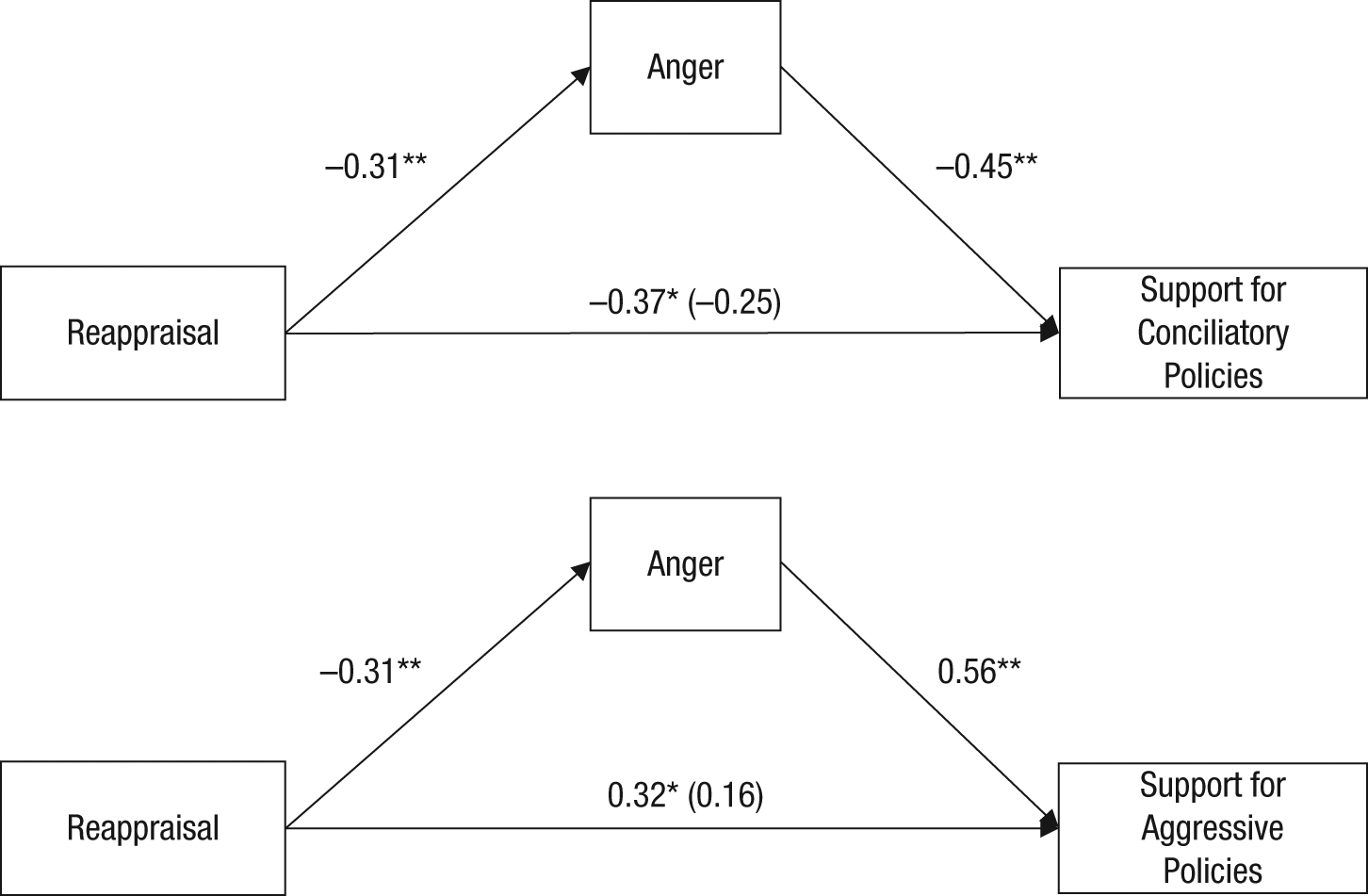
Results from Study 1: anger as a mediator of the effect of reappraisal on support for conciliatory (top) and aggressive (bottom) policies following an anger-inducing presentation. The model controlled for social desirability, gender, and political stance, but these variables were omitted from the figure to simplify the presentation. Along the paths from reappraisal to policy support, the numbers in parentheses represent the coefficients when anger was entered into the analyses. Asterisks indicate levels of significance (*p < .05, **p < .001).
Discussion
Study 1 demonstrates that regulating anger (through reappraisal) can change people’s support for policies that could escalate or de-escalate a political conflict. Emotion regulation modified conflict-related political attitudes, which are typically viewed as deeply rooted, rigid, and difficult to change (Bar-Tal & Halperin, 2011), and these effects were found in the context of a real-world, intense intergroup conflict. One question is whether the effects of a reappraisal manipulation would persist over time and outside the laboratory, when people react to conflict-related events as they occur in the real world. One such event was utilized in Study 2.
Study 2: Reappraisal and Political Reactions to Real-World, Conflict-Related Events
In September 2011, Palestinian President Mahmud Abbas presented a bid to the United Nations (UN), seeking full UN membership. For Palestinians, this event symbolized hope for independence; for many Jewish Israelis, however, it was perceived as a stab in the back and a betrayal of the bilateral track of negotiations (Palestinian Center for Policy and Survey Research, 2011). Because the Palestinians declared their intention well in advance, we decided to randomly assign participants to receive a reappraisal manipulation (or not) before the Palestinian bid, and we then examined the emotional and political effects of the manipulation a week after the bid. To test whether the effects reflected meaningful changes in our participants (rather than some form of demand characteristics), we also tested whether the effects persisted 5 months after the manipulation.
We predicted that reappraisal would result in lower levels of negative emotions toward the Palestinians and more conciliatory (and less aggressive) political attitudes toward them. We expected the effects of reappraisal to be mediated by decreased negative emotions. Finally, we expected the effects of reappraisal to persist 5 months after the manipulation, as participants responded to naturally occurring events.
Method
Participants
Sixty Jewish Israelis (36 female, 24 male; mean age = 17.94 years, SD = 0.28) participated in return for admission to a public lecture. The sample was balanced in terms of political affiliations and included 29.8% rightists, 36.8% centrists, and 33.4% leftists.
Procedure
Five days before the Palestinian bid, participants rated their current state positive affect (α = .81) and state negative affect (α = .82), using the Positive and Negative Affect Schedule (Watson, Clark, & Tellegen, 1988). They also rated their general support of conciliatory policies toward Palestinians (six items; e.g., “To what extent do you support the idea that Israel relinquish its control over Arab neighborhoods in East Jerusalem, in exchange for full peace with the Palestinians?”; α = .78) and their support of aggressive policies (three items; e.g., “Because of the Palestinian bid in the UN, Israel should prohibit Palestinians who need to receive medical treatment from entering its territory”; α = .69). The rating scale for these items ranged from 1, highly oppose, to 6, very much in favor. As in the first study, we also measured social desirability, gender, and political stance.
Participants were randomly assigned to either a reappraisal or a control condition. The manipulation took approximately 30 min to administer. It was similar to the one used in Study 1, except that participants practiced on six rather than four pictures. After the training, participants were asked to use the technique they had learned (i.e., reappraisal or natural responding) during the following week.
In the following week, participants received three reminders (via text messages to their cell phones) to employ the technique they had learned. A week after the training (2 days after the Palestinian bid), we assessed participants’ emotional and political reactions. Participants responded to four items assessing their negative intergroup emotions toward Palestinians (scale from 1, not at all, to 6, very much), indicating their feelings of anger, rage, empathy (reverse-scored), and hope (reverse-scored), α = .65. Participants also rated their level of support for five possible conciliatory Israeli responses (α = .68; e.g., “If the Palestinians withdraw their UN petition, Israel should transfer more territory in the West Bank to their control”) and their support for four possible aggressive Israeli responses (α = .61; e.g., “If thousands of Palestinians begin to march to Jerusalem, the Israeli Defense Forces should use ammunition in order to stop them, even at the cost of dozens killed and hundreds wounded”). The rating scale for these items ranged from 1, highly oppose, to 6, very much in favor.
Five months after the manipulation, participants took part in a daily seminar on an unrelated topic in a classroom located far from where the training and second assessment had taken place. They were approached by an unfamiliar experimenter and asked to complete a brief questionnaire for a class project. Participants were unaware of the link between this questionnaire and the study they had completed 5 months earlier. Of the original 60 participants, 51 (85%) completed the questionnaire. Given time limitations, participants were asked only about their anger and rage toward Palestinians (α = .75) and their support for four policies toward Palestinians that were relevant to current events; two of these policies were conciliatory (e.g., “Israel should transfer additional territories to the Palestinians in the West Bank in order to express the seriousness of its intentions in the current negotiation”) and two were aggressive (e.g., “Israel should add roadblocks in the West Bank in order to significantly restrict Palestinian movement there”). Because of the small number of items, we combined the four policy items into a single peaceful-policies composite (α = .68).
Results
One week after training
As expected, before the manipulation, participants in the reappraisal and control conditions did not differ significantly in negative affect, t(57) = 0.44, p = .65. A week after training, however, participants in the reappraisal condition reported lower levels of negative emotions toward Palestinians compared with control participants (M = 3.81, SD = 0.87, vs. M = 4.41, SD = 0.74), t(58) = 2.84, p < .05, Cohen’s d = 0.74. To test whether reappraisal influenced support for conciliatory policies, we ran a repeated measures analysis of variance, with time (before vs. 7 days after the manipulation) as a within-subjects factor and condition as a between-subjects factor. The Condition × Time interaction was significant, F(1, 54) = 4.43, p = .04. Participants in the reappraisal condition were more supportive of conciliatory policies than control participants were after the manipulation (M = 2.75, SD = 0.72, vs. M = 2.28, SD = 0.75; Cohen’s d = 0.63, p = .019), but not before it (M = 3.40, SD = 0.93, vs. M = 3.30, SD = 0.87; p = .67). We ran a similar analysis to test whether reappraisal influenced support for aggressive policies. Again, the Condition × Time interaction was significant, F(1, 54) = 3.80, p = .05. Participants in the reappraisal condition were less supportive of aggressive policies than control participants were after the manipulation (M = 2.50, SD = 0.81, vs. M = 3.00, SD = 0.71; Cohen’s d = 0.65, p = .016), but not before it (M = 2.61, SD = 0.88, vs. M = 2.71, SD = 1.13; p = .71).
We used Baron and Kenny’s (1986) mediation procedure to test for mediation. Negative emotions were negatively associated with support for conciliatory policies (r = −.48, p < .001) and positively associated with support for aggressive ones (r = .53, p < .001; see Fig. 2). We employed Preacher and Hayes’s (2008) bootstrapping macro with 5,000 iterations to test the indirect effect (Preacher et al., 2007). The effect of the manipulation on support for conciliatory policies was significantly mediated by decreased negative intergroup emotions, 95% CI: [0.05, 0.50]. Similarly, the effect of the manipulation on support for aggressive policies was significantly mediated by decreased negative intergroup emotions, 95% CI: [−0.54, −0.06]. Both indirect effects were significantly different from zero, p < .05.
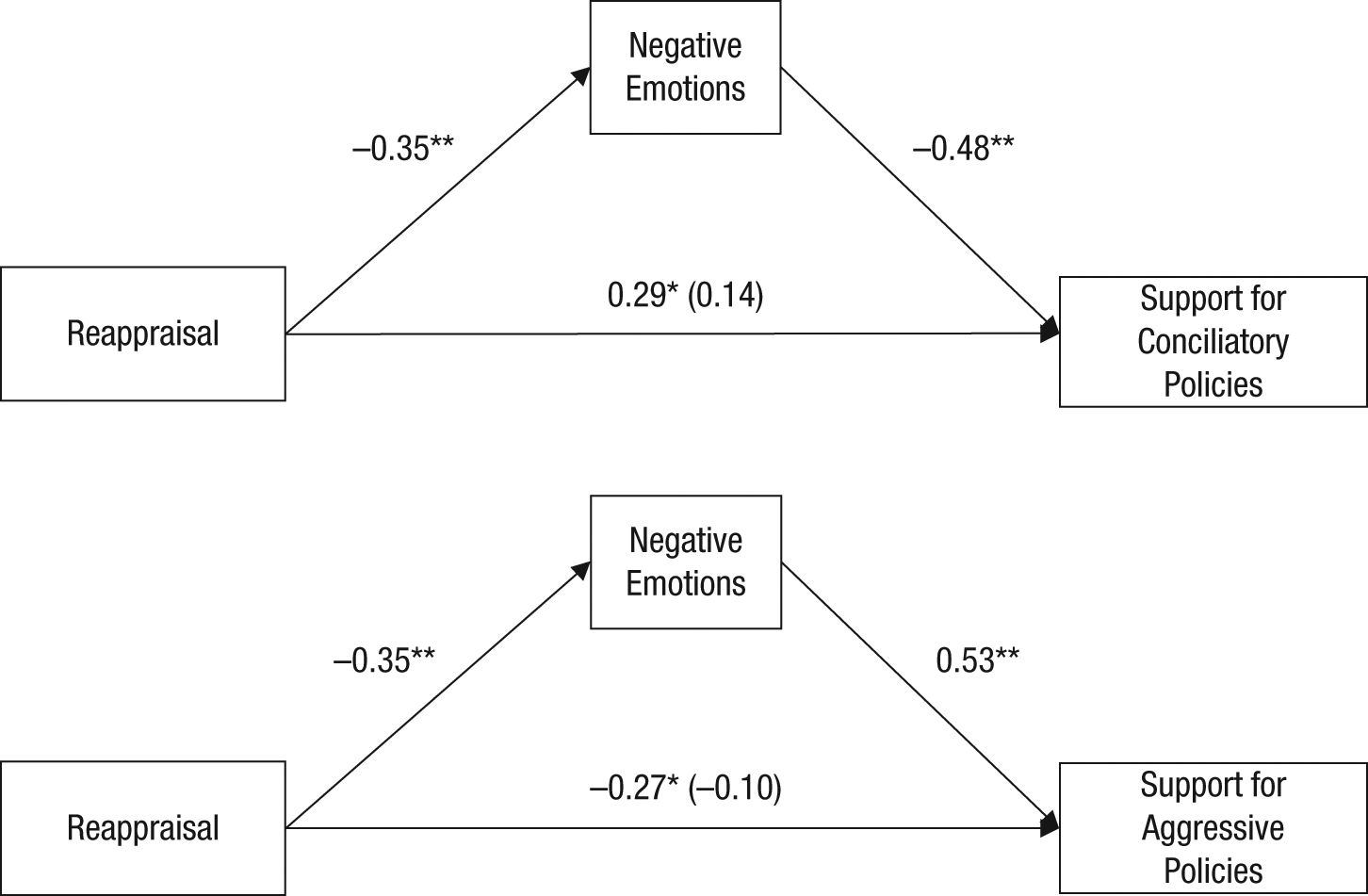
Results from Study 2: negative emotions as a mediator of the effect of reappraisal on support for conciliatory (top) and aggressive (bottom) policies in response to the Palestinian United Nations bid; support was assessed 7 days after the reappraisal training. The model controlled for social desirability, gender, and political stance, but these variables were omitted from the figure to simplify the presentation. Along the paths from reappraisal to policy support, the numbers in parentheses represent the coefficients when negative emotions were entered into the analyses. Asterisks indicate levels of significance (*p < .05, **p < .001).
Five months after training
We found that even 5 months after the manipulation, participants in the reappraisal condition continued to feel less anger toward Palestinians (M = 3.28, SD = 1.07) than control participants did (M = 3.97, SD = 0.77), t(48) = 2.58, p = .01, Cohen’s d = 0.74, and expressed more support for peaceful policies (M = 3.20, SD = 0.81) than control participants did (M = 2.79, SD = 0.61), t(49) = −2.03, p = .04, Cohen’s d = 0.57. The effect of reappraisal on support for peaceful policies was mediated by decreased anger toward Palestinians, 95% CI: [.05, .59] (see Fig. 3). Findings were unchanged when we controlled for social desirability, gender, and political stance.
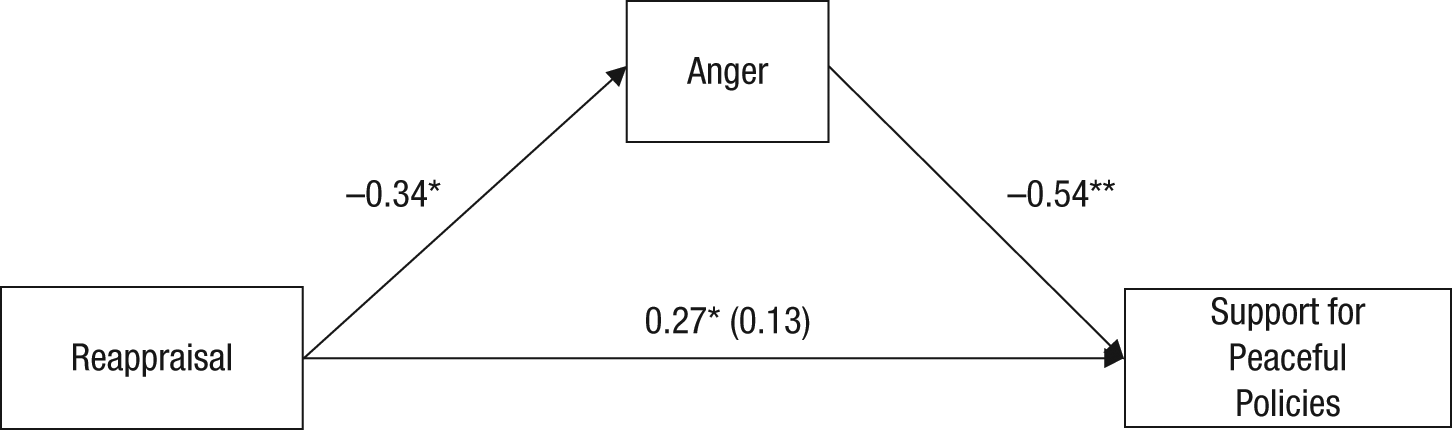
Results from Study 2: anger as a mediator of the effect of reappraisal on support for peaceful policies toward the Palestinians 5 months after the manipulation. The model controlled for social desirability, gender, and political stance, but these variables were omitted from the figure to simplify the presentation. Along the path from reappraisal to policy support, the number in parentheses represents the coefficient when anger was entered into the analysis. Asterisks indicate levels of significance (*p < .05, **p < .001).
General Discussion
Reappraisal can change people’s reactions to emotionally charged events, but can it work even in the context of the Israeli-Palestinian conflict, one of the most intractable in the world? Our findings are preliminary, but they are suggestive. In two experimental studies, we found that participants who underwent reappraisal training felt less negative emotions toward Palestinians than control participants did. This reduction in negative emotions, in turn, led them to express less support for aggressive policies, and more support for conciliatory policies, in response to conflict-related events. These effects were obtained both in the laboratory and as people reacted to events that unfolded in real life, and they persisted even 5 months after the manipulation.
In the theoretical realm, our results suggest that emotion-regulation strategies, such as reappraisal, can influence intergroup emotions, not just intrapersonal ones, and that emotion regulation can shape political as well as affective reactions. We hope that our findings will spark future studies on the possible effects of emotion regulation on reactions to intergroup conflicts. In the long term, such studies might lead to interventions that incorporate cognitive reappraisal to decrease negative intergroup emotions, change aggressive intentions, and increase support for peace in long-term conflicts.
We consider our findings to be preliminary, yet provocative. Political positions in conflict situations are generally rigid, entrenched, and driven by ideological (rather than emotional) considerations. It is therefore surprising to see shifts in these attitudes following such minimal interventions. Nonetheless, our findings are consistent with studies on empathy (e.g., Batson & Ahmad, 2001) and emotion regulation (e.g., Gross & John, 2003; Richards et al., 2003), which show that even intense emotional reactions can be modified in intrapersonal and interpersonal contexts. The question is whether the simple principles studied here can be effectively applied in the real world.
The present research has several limitations. First, we assessed the effects of reappraisal on self-reported emotions and self-reported support for aggressive and conciliatory actions. Given that negative affect can lead to more punitive behavior (e.g., Buckholtz et al., 2008), it is important to test whether reappraisal training can shape actual political behavior, such as voting patterns, or donations of money to political causes. Second, we focused on one side of the Israeli-Palestinian conflict, which is considered the more powerful side; potential effects on the other side of the conflict need to be tested as well. Third, in this investigation, participants were taught how to reappraise and then applied this training as they encountered conflict-related information. To apply a regulation strategy, however, people must be motivated to regulate their emotions (e.g., Tamir, 2009). Whether such motivation varies across individuals (e.g., as a function of ideology) and whether it plays a part in the successful regulation of intergroup emotions remain to be tested in future research. Finally, because this study examined negative intergroup emotions generally, future laboratory studies with proper controls are needed to test the effects of the regulation of more discrete emotions, including anger.
Footnotes
Acknowledgements
The authors would like to thank Noa Schori, Smadar Cohen-Chen, Ruthie Pliskin, Tal Meidan Lehman, and Varda Liberman for their great assistance and dedication in collecting the data for the current study.
Declaration of Conflicting Interests
The authors declared that they had no conflicts of interest with respect to their authorship or the publication of this article.