



Abstract
Recent research on the dynamics of moral behavior has documented two contrasting phenomena—moral consistency and moral balancing. Moral balancing refers to the phenomenon whereby behaving ethically or unethically decreases the likelihood of engaging in the same type of behavior again later. Moral consistency describes the opposite pattern—engaging in ethical or unethical behavior increases the likelihood of engaging in the same type of behavior later on. The three studies reported here supported the hypothesis that individuals’ ethical mind-set (i.e., outcome-based vs. rule-based) moderates the impact of an initial ethical or unethical act on the likelihood of behaving ethically on a subsequent occasion. More specifically, an outcome-based mind-set facilitated moral balancing, and a rule-based mind-set facilitated moral consistency.
Keywords
Previous research on moral self-regulation has convincingly demonstrated that one’s recent behavioral history is an important factor in shaping one’s current moral conduct (e.g., Monin & Jordan, 2009; Zhong, Liljenquist, & Cain, 2009). However, seemingly inconsistent effects have been reported. Some research has documented evidence for moral balancing (Nisan, 1991), or the observation that engaging in an ethical or unethical behavior at one point in time reduces the likelihood of engaging in that form of behavior again in a subsequent situation (Merritt, Effron, & Monin, 2010; Sachdeva, Iliev, & Medin, 2009). For example, Khan and Dhar (2006) showed that after committing to help a foreign student, participants were less willing to donate money to charity.
To explain moral balancing, it has been argued that individuals tune their actions such that their moral self-image (which represents individuals’ moment-to-moment perception of their degree of morality) fluctuates around a moral-aspiration level or equilibrium (Jordan, Mullen, & Murnighan, 2011; Merritt et al., 2010). Cultivating the moral self is an important source of self-worth (Aquino & Reed, 2002; Crocker & Knight, 2005), but acting ethically often conflicts with pursuing immediate self-interest. To understand how individuals solve that conflict, it is important to realize that an individual’s moral-aspiration level does not equate to moral perfection but rather to a reasonable level of moral behavior (Nisan, 1991) for that individual. Ethical and unethical acts respectively elevate and depress the moral self-image. Moral-balancing approaches argue that when the moral self-image exceeds the moral-aspiration level, the individual feels “licensed” to engage in more self-interested, immoral, or antisocial behavior (i.e., moral licensing). When the moral self-image is below the moral-aspiration level, people tend to experience emotional distress (Higgins, 1987; Klass, 1978) and become motivated to enact some corrective behavior (i.e., moral compensation).
In contrast to research investigating moral balancing, there is a long tradition of research on behavioral consistency (Cialdini, Trost, & Newsom, 1995; Festinger, 1957; Taylor, 1975), including research in the moral domain (Foss & Dempsey, 1979; Thomas & Batson, 1981). This work suggests that after engaging in an ethical or unethical act, individuals are likely to behave in the same fashion later on. For example, Gino, Norton, and Ariely (2010) demonstrated that participants who wore counterfeit sunglasses were more likely to cheat, compared with participants who wore branded sunglasses. Cornelissen, Pandelaere, Warlop, and Dewitte (2008) found that reminding individuals of their previous environmental conservation efforts provoked more subsequent proenvironmental behavior. These demonstrations of moral consistency are explained in terms of a psychological need to maintain one’s self-concept (Aronson & Carlsmith, 1962), self-perception effects (Bem, 1972), or the use of behavioral consistency as a decision heuristic (Albarracín & Wyer, 2000; Cialdini et al., 1995).
The unresolved question at hand is under which conditions either pattern of moral dynamics will occur. We suggest that the individual’s ethical mind-set moderates the influence of an initial behavior on subsequent actions.
Moral Frameworks and Ethical Mind-Sets
Two prominent frameworks in Western moral philosophy are consequentialism and deontology (P. Singer, 1991). In a consequentialist framework, whether an act is morally right depends on the consequences of that act (Sinnott-Armstrong, 2008). In other words, when taking a consequentialist perspective, one behaves according to an outcome-based mind-set. From a deontological perspective, what makes an act right is its conformity to a moral norm (Alexander & Moore, 2008). Moral behavior follows principles that impose duties and obligations, such as not to break promises or not to lie. In other words, when taking a deontological perspective, an individual adopts a rule-based mind-set. Past work has demonstrated that this distinction is not exclusively philosophical but that individuals consider it meaningful when reflecting on their behavior, are flexible in the use of either type of moral arguments (Uhlmann, Pizarro, Tannenbaum, & Ditto, 2009), and sometimes use a combination of both types of arguments (Bartels & Medin, 2007). In the current research, we proposed that the relative dominance of a given ethical mind-set moderates which pattern of moral dynamics will unfold.
An outcome-based mind-set produces an appraisal of the consequences of behavioral alternatives, both for the actor and for others involved. When people are confronted with a conflict between cultivating the moral self and pursuing self-interest, thinking in terms of outcomes allows them to be flexible and make a trade-off (Mazar & Ariely, 2006; Monin & Jordan, 2009). Balancing the two alternatives over time permits an acceptable compromise between both. Therefore, after choosing an ethical course of action that benefits mostly other people, an individual feels licensed to compensate and choose a course of action that benefits his or her immediate self-interest. In the reverse case, after an unethical action, an individual will engage in moral compensation. In line with previous theorizing (Monin & Jordan, 2009), we predicted that changes in moral self-image will mediate these balancing effects. An ethical act elevates the self-image and leads to licensing behavior, whereas an unethical act depresses the self-image, provoking acts of moral compensation.
Moral rules, in contrast, do not easily lend themselves to such trade-offs (Baron & Spranca, 1997; Tetlock, Kristel, Elson, Green, & Lerner, 2000). A rule derives its validity from its generalization across different instances (M. G. Singer, 1961). Inconsistency in following rules threatens an individual’s sense of psychological integrity (Festinger, 1957). Therefore, individuals with a rule-based mind-set seek consistency in how they resolve similar value conflicts on repeated occasions (Albarracín & Wyer, 2000). In other domains, for example for health behaviors such as dieting and physical exercise, individuals tend to reproduce the solution of previous value conflicts under certain conditions (Fishbach & Zhang, 2009). Individuals who were reminded of their wish to stay in shape, for example, were tempted more by unhealthy food after a perceived failure to work out sufficiently than after exercising successfully (Fishbach, Dhar, & Zhang, 2006). We expected the same effect to occur in the moral domain for participants with a rule-based mind-set. We tested these predictions in three laboratory studies.
Study 1
In this study, we tested our hypothesis that a consequential mind-set leads to moral balancing, whereas a deontological mind-set results in moral consistency. We first measured participants’ dominant ethical mind-set. We then asked them to recall an ethical or an unethical act in which they had recently engaged, and we observed how that recollection influenced levels of ethical behavior in a subsequent task. We expected participants identified as having a rule-based mind-set to use the ethicality of their recalled behavior as a guide, such that those who recalled an ethical behavior would behave more fairly than those who recalled an unethical act. For participants with an outcome-based mind-set, we expected the opposite effect.
Method
Participants and procedure
A total of 86 undergraduate students participated in a 1-hr study in return for a 4€ fee. They were seated in semi-enclosed cubicles in front of a computer. We first measured participants’ dominant ethical mind-set using a moral-dilemma scenario (the trolley dilemma). After 20 min of nonrelated filler tasks, we asked participants to recall either an ethical or unethical behavior in which they had recently engaged (Jordan, Mullen, et al., 2011). We subsequently observed behavior in the dictator game.
Materials
The trolley dilemma (Foot, 1967) was designed to pit consequentialist and deontological ethics against each other. Participants are asked to imagine the following scenario: “A runaway trolley is headed for five people who will be killed if it proceeds on its present course. The only way to save them is to hit a switch that will turn the trolley onto an alternate set of tracks where it will kill one person instead of five.” Consequential ethics prescribes flipping the switch as the appropriate behavior because the outcome of that act, the death of one person, is less undesirable than the outcome of doing nothing (which would result in the death of five people). Deontological ethics maintains that doing something that hurts an innocent person is wrong, so flipping the switch is ethically unacceptable. Participants were asked whether it is morally appropriate to flip the switch. Those who believed that it was appropriate were assumed to generally employ an outcome-based mind-set. Those who believed it was not appropriate were assumed to employ a rule-based mind-set.
Each participant was randomly paired with another participant in the room. Then they read the instructions of the dictator game. These instructions mentioned that one individual in their pair would be assigned the role of the decider. The decider would receive 10 coins of 50 euro cents each and would decide on the division of that money between the pair in whatever way he or she chose. All participants were told that they were assigned the role of the decider and were asked to indicate how many coins they wanted to give to the receiver. At the end of the session, participants were paid according to the allocations made in the game.
Results
On the basis of participants’ responses to the trolley dilemma, we classified 48 participants (56% of the sample) as having a dominant outcome-based mind-set and 38 participants (44% of the sample) as having a rule-based mind-set. An analysis of variance (ANOVA) testing the effect of ethicality of the recalled behavior (ethical vs. nonethical) and ethical mind-set (outcome-based vs. rule-based) on the number of coins given to the receiver showed that there were no main effects of ethicality of the recalled behavior (F < 1) nor of ethical mind-set, F(1, 82) = 1.50, p = .22, η2 = .02. However, the interaction effect between both was significant, F(1, 82) = 8.71, p = .004, η2 = .10 (see Fig. 1). Participants with an outcome-based mind-set gave less coins after recalling an ethical act (M = 2.37, SD = 2.31) than after recalling an unethical act (M = 3.71, SD = 2.13), t(46) = −2.07, p = .04. Participants with a rule-based mind-set gave more coins after recalling an ethical act (M = 3.18, SD = 2.40) than after recalling an unethical act (M = 1.76, SD = 1.92), t(36) = 2.15, p = .04.
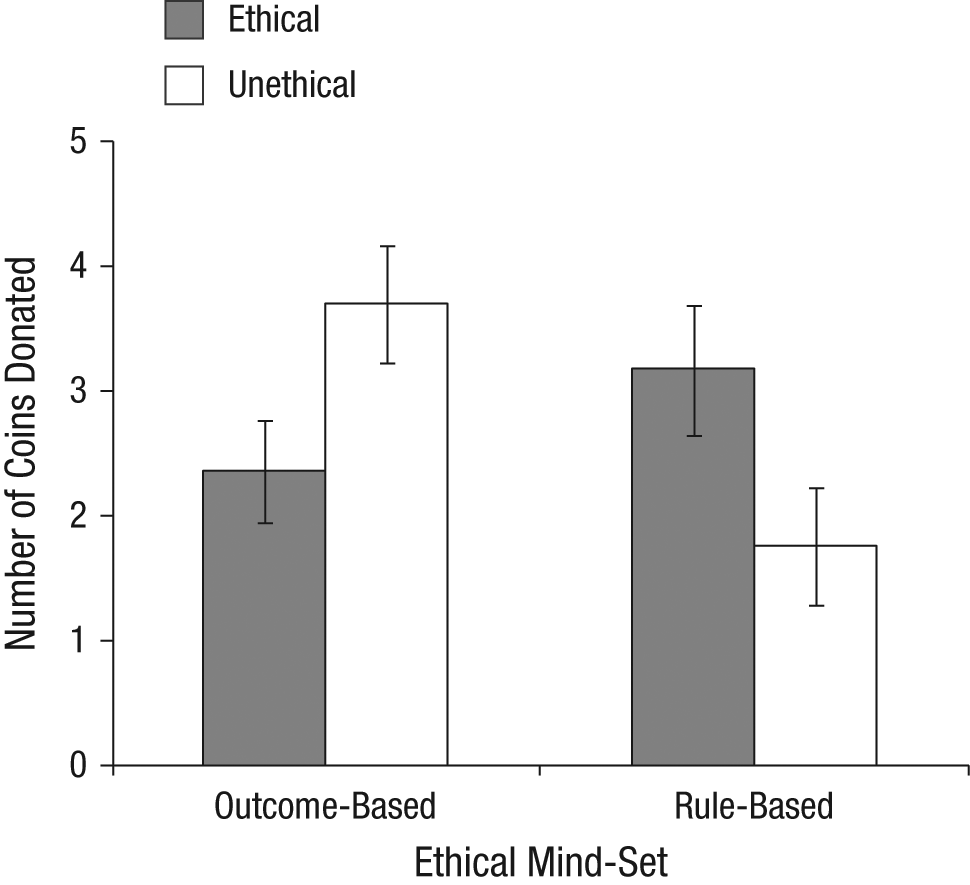
Results from Study 1: mean number of coins donated as a function of the donators’ ethical mind-set and the ethicality of the act they recalled. Error bars represent standard errors.
Discussion
The pattern of allocation decisions was consistent with our predictions. Participants with an outcome-based mind-set showed a balancing effect: Recalling something unethical they did in the past made them more generous in the dictator game than participants who recalled an ethical act. Participants in rule-based mind-set showed a consistency effect: Those recalling an ethical act were more generous than those recalling an unethical act.
Study 2
The objective of the second study was to provide additional evidence for the causal role of ethical mind-sets as a moderator of moral dynamics by manipulating instead of measuring them (Spencer, Zanna, & Fong, 2005).
Method
Participants and procedure
A total of 107 undergraduate students participated under the same conditions as in Study 1. In this study, however, we manipulated ethical mind-set (rule-based vs. outcome-based) and the ethicality of an initial act (ethical vs. unethical). We asked half of our participants to remember an episode in the past in which they did something ethical, and we asked the other half to remember an episode in which they did something unethical. In addition, half of the individuals in the outcome-based group were instructed to think about a behavior that was ethical (“because it benefitted other people”) and half were instructed to think about a behavior that was unethical (“because it hurt other people”). Likewise, individuals in the rule-based group thought either about a behavior that was ethical (“because you followed an ethical norm or principle”) or about a behavior that was unethical (“because you did not follow an ethical norm or principle”). As a dependent measure, participants again made an allocation decision in the dictator game. Participants were also asked to respond to the trolley dilemma as a manipulation check of our mind-set manipulation.
Induction of ethical mind-sets
To induce the appropriate mind-set, we provided elaborate instructions (see the Supplemental Material available online for details). The instructions defined ethicality as either a function of consequences or in terms of rule compliancy, and they provided three prototypical examples. Subsequently, we asked participants to provide an example of a behavior—not necessarily their own—that is ethical or unethical because of either its consequences or its rule compatibility. This induced the intended mind-set in participants before they reflected on their own behavior.
To further reinforce the mind-set manipulation, we asked participants in the outcome-based condition who was benefited or hurt by the behavior they described, and we asked participants in the rule-based condition which rule was respected or violated. We then invited participants to recall an instance in their own recent past when they themselves behaved ethically or unethically, either because of the consequences or because of the rule compliancy of that behavior. Again, we asked participants in the outcome-based condition who benefited and who were hurt by their behavior, and we asked participants in the rule-based condition which rule was followed or violated. In a control condition, participants were asked to describe what they do on a typical Friday.
Results and discussion
As a manipulation check, we analyzed participants’ judgments in the trolley dilemma. The percentage of participants who considered it appropriate to flip the switch (i.e., those who were supposed to follow an outcome-based argument) was 67% (16 out of 24 participants) in the control group, 76% (31 out of 41 participants) in the outcome-based group, and 50% (21 out of 42 participants) in the rule-based group, χ2(2, N = 107) = 6.00, p < .05. This suggests that the manipulation was successful. An ANOVA analyzing the effect of the four experimental and control conditions on the number of coins donated in the dictator game was statistically significant, F(4, 102) = 3.23, p < .02, η2 = .11 (see Fig. 2).
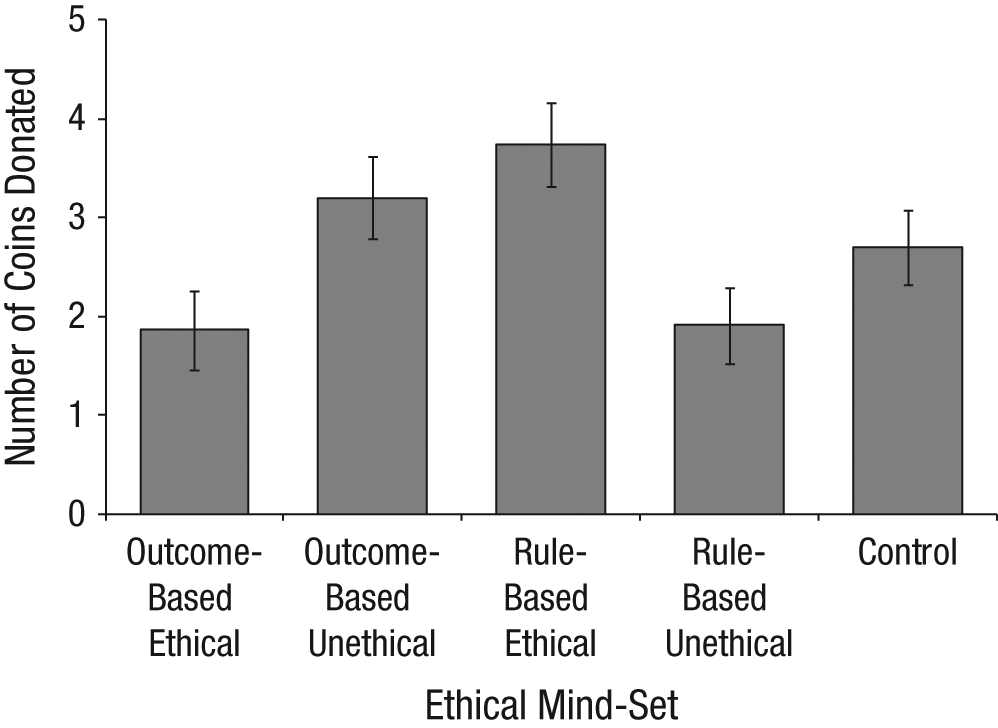
Results from Study 2: mean number of coins donated as a function of the donators’ ethical mind-set and the ethicality of the act they recalled. Error bars represent standard errors.
Simple contrasts did not indicate significant differences between the control condition and the experimental conditions. 1 To further analyze the obtained effects, we dropped the control condition and analyzed the interaction effect of ethical mind-set (outcome-based vs. rule-based) and ethicality of the recollected behavior (ethical vs. nonethical) on the number of coins given in the dictator game. There were no main effects of ethical mind-set or ethicality (Fs < 1), but the interaction effect between the two factors was significant, F(1, 79) = 12.09, p = .001, η2 = .13. In the outcome-based mind-set condition, participants who recalled an unethical act gave more coins in the dictator game (M = 3.20, SD = 1.91) than did those who recalled an ethical act (M = 1.86, SD = 1.96), t(39) = −2.22, p = .03. In other words, participants with an outcome-based mind-set showed a moral-balancing effect. By contrast, in the rule-based mind-set condition, participants who recalled an ethical act gave more coins in the dictator game (M = 3.47, SD = 1.77) than did those who recalled an unethical act (M = 1.91, SD = 1.93), t(40) = 2.71, p = .01. In other words, these participants showed a moral-consistency effect.
After replicating our hypothesized moderation effect, we wanted to evaluate the generalizability of our findings with a third study, so we changed the context to cheating behavior. Additionally, we evaluated the role of moral self-image as the underlying mechanism for moral-balancing effects.
Study 3
Method
Participants and procedure
A total of 135 undergraduate students participated under the same conditions as Studies 1 and 2. We manipulated ethical mind-set and ethicality of a recalled act with the same task used in Study 2. We then observed behavior in a cheating task and measured participants’ moral self-image.
Materials
We used a cheating task adapted from Mazar, Amir, and Ariely (2008). We gave participants a sheet with 20 matrices containing 12 three-digit numbers. They had 4 min to find a pair of numbers in each matrix that added up to 10. They were told they would receive 50 euro cents for each solved matrix. After 4 min, they self-reported the number of solved matrices on the computer and threw the worksheet in a recycling bin. After the experiment was done, we retrieved the worksheets. Using one number on the sheets that differed for each participant, we were able to match the worksheets with the participants and calculate the extent to which participants had overstated their performance.
We measured moral self-image using an adaptation of Aquino and Reed’s (2002) moral-identity scale (Jordan, Gino, Tenbrunsel, & Leliveld, 2012). To assess the discrepancy of perceived self with the aspired self, we asked participants to use a 9-point scale (1 = less honest than the person I want to be, 9 = more honest than the person I want to be) to indicate how closely they felt they currently rated on nine traits compared with the type of person they would like to be. The nine traits were honest, caring, compassionate, fair, friendly, generous, hardworking, helpful, and kind. We calculated the mean answer to these nine items as a measure of the moral self-image (Cronbach’s α = .68).
Results
There was a significant effect of our manipulation on the degree of overreporting performance (i.e., cheating), F(4, 130) = 2.51, p = .045, η2 = .07 (see Fig. 3). As in Study 2, simple contrasts did not indicate significant differences between the control condition and the experimental conditions. 2 We dropped the control condition and analyzed the interaction effect of ethical mind-set (outcome-based vs. rule-based) and ethicality of the recollected behavior (ethical vs. nonethical) on overreporting of performance in the matrix task. There were no main effects of ethical mind-set or ethicality of the recalled behavior (Fs < 1), but the interaction effect between the two was significant, F(1, 103) = 8.10, p = .005, η2 = .07, and replicated the pattern found in Studies 1 and 2. In the rule-based mind-set condition, participants who recalled an ethical act (M = 1.00, SD = 2.25) cheated to a smaller extent than did participants who recalled an unethical act (M = 2.23, SD = 2.10), t(51) = −2.05, p = .05, thus displaying a consistency effect. In the outcome-based mind-set condition, participant who recalled an ethical act (M = 1.74, SD = 2.03) cheated more than did participants who recalled an unethical act (M = 0.74, SD = 1.68), t(52) = 1.97, p = .05, in line with a balancing effect.
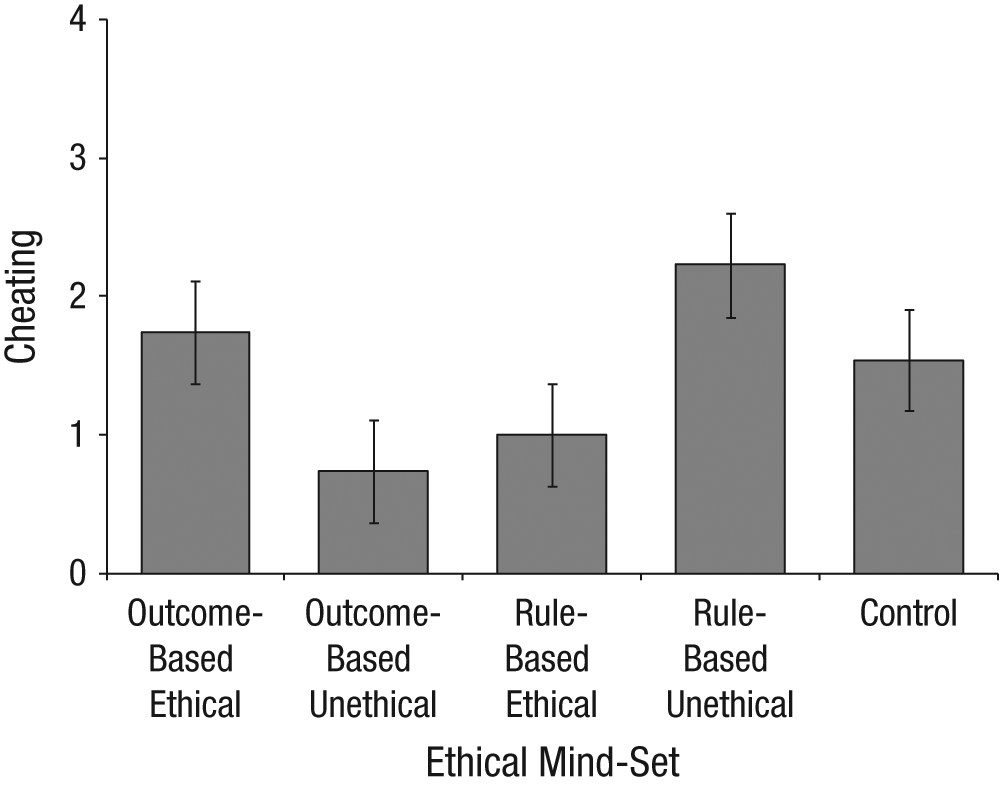
Results from Study 3: mean amount of cheating as a function of participants’ ethical mind-set and the ethicality of the act they recalled. Error bars represent standard errors.
We further found a main effect of ethicality of the recalled act on participants’ moral self-image, F(1, 102) = 11.64, p = .001, η2 = .10. As expected, those recalling an ethical act had an elevated moral self-identity (M = 4.77, SD = 0.77) compared with those recalling an unethical act (M = 4.28, SD = 0.72) and those in the control condition, (M = 4.54, SD = 0.86). Neither the effect of ethical mind-set, F(1, 102) = 1.60, p = .21, nor the interaction between ethical mind-set and ethicality (F < 1) was significant.
A moderated mediation analysis (Preacher, Rucker, & Hayes, 2007) revealed a conditional indirect effect of ethicality of the recalled act (0 = ethical, 1 = unethical) on the level of cheating, as mediated by participants’ moral self-image (see Fig. 4). The mediation was conditional on participants’ ethical mind-set (0 = outcome-based, 1 = rule-based). More specifically, both the effects of ethicality of the recalled act on moral self-image (b = −0.49, SE = 0.15, p = .001) and the interaction effect of moral self-image and ethical mind-set on overstating the number of correctly solved matrices (b = −1.11, SE = 0.53, p = .04) were significant. The indirect effect of ethicality of the recalled act on cheating, as mediated by moral self-image, was significant in the outcome-based condition (95% CI = [−1.23, −0.24]), but not in the rule-based condition (95% CI = [−0.38, 0.21]).
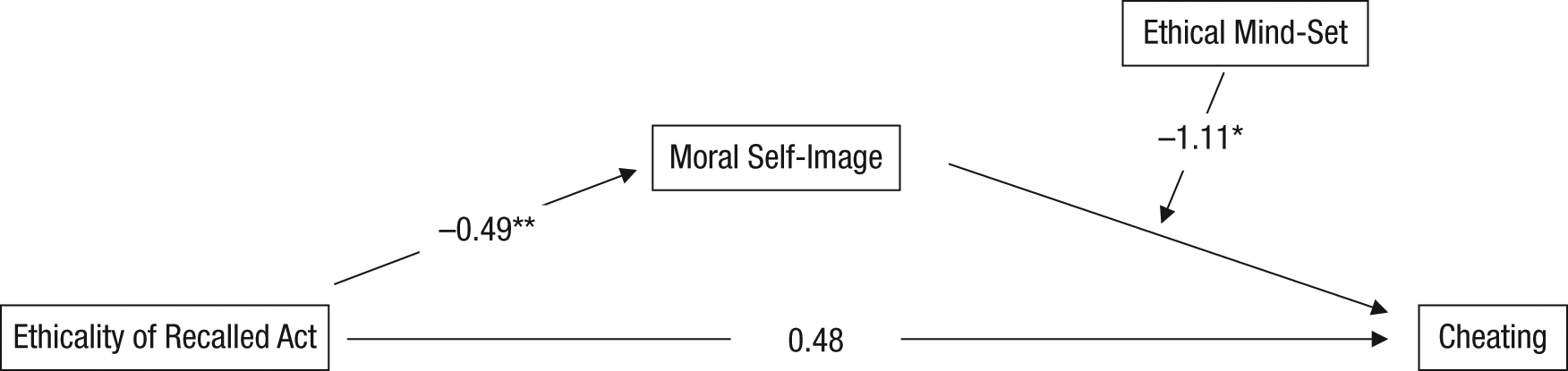
Results from Study 3: moderated mediation model showing the influence of the ethicality of a recalled act on cheating, as moderated by participants’ moral self-image and the ethicality of their mind-set. Asterisks indicate significant path coefficients (*p < .05, **p < .01).
Participants’ moral self-image was measured after they reported on the matrix task and thus could have been affected by participants’ degree of cheating. However, further analysis suggested that this effect could not be responsible for our pattern of data. There was a significant correlation between cheating and moral self-identity in the outcome-based condition, r(54) = .38, p < .01, but not in the rule-based condition, r(52) = .02, p = .87. If behavior on the cheating task had a strong effect on reported moral self-identity, then the correlations would have been significant in both conditions. Additionally, the conditional indirect effects of ethicality on moral self-identity, as mediated by cheating, were nonsignificant for those in the outcome-based condition (95% CI = [−0.17, 0.03]) and in the rule-based condition (95% CI = [−0.01, 0.21]).
Discussion
In this study, we generalized the moderating effect of ethical mind-sets to another area of ethical behavior, viz. cheating. Additionally, we tested the mediating role of moral self-image on moral-balancing and consistency effects. Individuals with an outcome-based mind-set seemed to attend to their moral self-image and balance their ethical behavior. A positive self-image liberates the individual temporarily from the need to cultivate the moral self and allows the pursuit of selfish interests. A negative level activates a mechanism to restore the moral self-image, which leads to more ethical behavior. However, such a mechanism fails to explain the moral-consistency effect we found for those with a rule-based mind-set.
General Discussion
In these three studies, we provided empirical support for the hypothesis that ethical mind-sets moderate how an individual’s behavioral history shapes his or her current ethical behavior. An outcome-based mind-set facilitated moral-balancing effects, whereas a rule-based mind-set led to moral consistency. This was demonstrated both when measuring participants’ ethical mind-set as an individual-difference variable (Study 1) and after manipulating it (Study 2 and 3); these findings establish the role of individuals’ ethical mind-set as moderators of patterns of moral dynamics.
The framework we developed reconciles two streams of research that have produced seemingly conflicting findings (moral balancing and moral consistency). We illustrated how the two dominant perspectives in Western moral philosophy (i.e., consequentialism and deontology) find a counterpart in individuals’ mind-sets when making moral judgments and that the mind-set adopted may have important behavioral implications. Moreover, we provided evidence for the mediating role of moral self-image in moral-balancing effects, although not for moral consistency. It is possible, however, that the consistency effect we found in the rule-based mind-set condition involves a different dimension of the moral self. Rather than moral self-identity (“How moral am I, compared with my moral aspirations?”), moral self-importance (“How important is it for me to be moral?”; Aquino & Reed, 2002) could play a role. Future research should address this issue.
Much previous research has documented behavioral- consistency effects and provided multiple explanations for the phenomenon (Albarracín & Wyer, 2000; Bem, 1972; Cialdini et al., 1995; Fishbach & Zhang, 2009). Of special interest is the case in which individuals are consistently unethical. In the current studies, we showed that a rule-based mind-set can lead to a consistent pattern of unethical behavior, in which violating a rule becomes the norm. Such a pattern resembles the slippery slope of moral decision making (Tenbrunsel & Messick, 2004). Previous work suggests that, in such a case, taking distance from the moral self or the violated rule can be used as a self-protection mechanism (Bandura, 1999; Detert, Treviño, & Sweitzer, 2008; Monin & Jordan, 2009). Further research is required to explore these mechanisms and, from an applied perspective, to identify ways to halt the repetition of unethical behaviors.
Footnotes
Declaration of Conflicting Interests
The authors declared that they had no conflicts of interest with respect to their authorship or the publication of this article.
Funding
This research was supported by Grant ECO2008-01768 from the Spanish Ministry of Science and Innovation.

Notes
References
Supplementary Material
Please find the following supplemental material available below.
For Open Access articles published under a Creative Commons License, all supplemental material carries the same license as the article it is associated with.
For non-Open Access articles published, all supplemental material carries a non-exclusive license, and permission requests for re-use of supplemental material or any part of supplemental material shall be sent directly to the copyright owner as specified in the copyright notice associated with the article.
