




Abstract
In the study reported here, the main question we investigated was whether attention style could be a conditional adaptation. We organized participants of the TRacking Adolescents’ Individual Lives Survey (TRAILS; N = 2,230) into shifters, sustainers, and two comparison groups, depending on their performance on a shifting- and a sustained-attention task at age 11 years. Compared with sustainers, shifters reported more pre- and perinatal risk factors and more childhood stress, and they adopted a faster life-history strategy. These differences were not found between the comparison groups, who performed well or poorly on both tasks, which suggests that specialization for either sustained or shifting attention is the key to conditional adaptation. In a subsample (n = 860), we found that stress did not increase depression risk in shifters, whereas a mismatch between early and recent stress predicted depression in sustainers. Cumulative stress predicted depression in the comparison group. These results suggest that shifters retain high levels of plasticity throughout life, whereas sustainers’ adapted their phenotype early in life to the expected mature environment.
Highly energetic individuals who divide their attention over multiple tasks could easily be labeled as maladapted from a psychopathology perspective but as well adapted from an evolutionary perspective (Glover, 2011). These vigilant individuals might underperform in stable, predictable situations that they would call boring, such as school, but outperform less vigilant individuals in situations that are relevant to them (Frankenhuis & de Weerth, 2013). It has been suggested that individuals’ early environments program them in ways that will be advantageous in their expected mature environments (Belsky, Steinberg, & Draper, 1991; Boyce & Ellis, 2005; Frankenhuis & Del Giudice, 2012; Nederhof & Schmidt, 2012). Individuals growing up under unpredictable, high-stress environments adopt a fast life-history strategy, which is characterized by short-term investments, insecure attachment, impulsivity, risk taking, and a preference for smaller immediate rewards over larger future rewards, whereas individuals growing up under predictable, low-stress conditions adopt a slow life-history strategy (Belsky et al., 1991; Ellis, Figueredo, Brumbach, & Schlomer, 2009). This evolutionary-developmental perspective is increasingly popular in various fields of research, including psychology (Ellis, Boyce, Belsky, Bakermans-Kranenburg, & van Ijzendoorn, 2011; Glover, 2011).
As a consequence of early programming, a mismatch between early and recent stress might result in increased disease risk (Schmidt, 2011), which suggests that individuals who grow up under high stress might be better off, compared with individuals who grow up under low stress, in conditions of high stress later in life; some preliminary support exists for this hypothesis (Sandman, Davis, & Glynn, 2012). This is a provocative theory, because the prevailing idea is that an accumulation of stressors increases disease risk (McEwen, 2003; Monroe & Simons, 1991). There is also ample evidence that not all individuals are programmed by their early environment to the same extent (see Ellis et al., 2011). Nederhof and Schmidt (2012) proposed that the mismatch hypothesis only applies to individuals who adapted to their early environment.
In the present study, we investigated whether attention style could be part of an adaptive strategy. In predictable, low-stress environments, it could be beneficial to be able to focus on a task for prolonged periods of time without scanning the environment for potential threats or new opportunities, whereas in unpredictable, high-stress environments, it could be beneficial to be able to switch easily between specific tasks. We defined attention-style specialization by determining whether individuals performed better on a sustained-attention task (sustainers) or on a shifting-attention task (shifters; Table 1). To control for differences in performance on each task, we created two comparison groups who were equally good or bad at both tasks.
Organization of the Four Groups in the Present Study
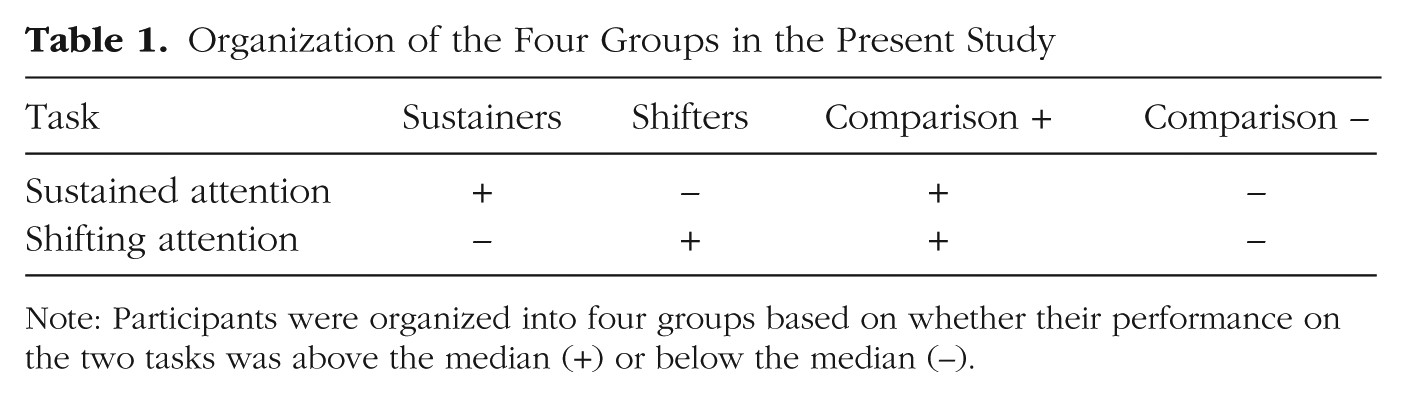
Note: Participants were organized into four groups based on whether their performance on the two tasks was above the median (+) or below the median (−).
We tested three hypotheses to investigate whether attention-style specialization could be the result of conditional adaptations to the early environment. First, we hypothesized that shifters experience more early life stress than sustainers, whereas the comparison groups experience equal amounts of early life stress. Second, we hypothesized that shifters have a faster life-history strategy than sustainers; specifically, shifters reach puberty earlier, have earlier sexual debuts, and engage in more risky sexual behavior. In contrast, no clear distinction in life-history strategy was expected between the comparison groups. Finally, we tested the cumulative-stress versus the mismatch hypothesis by predicting depressive episodes from the interaction between early life stress and recent stress. To investigate whether the mismatch hypothesis applies to all individuals or selectively to individuals who adapted their phenotype to their expected mature environment, we stratified our analyses for shifters, sustainers, and the comparison group.
Method
Sample
Data came from the first four waves of the TRacking Adolescents’ Individual Lives Survey (TRAILS; de Winter et al., 2005; Huisman et al., 2008; Nederhof et al., 2012; Ormel et al., 2012). TRAILS is a prospective cohort study of Dutch adolescents, who have been measured bi- or triennially and will be measured until they are at least 21 years old. The first wave ran from March 2001 to July 2002, the second wave from September 2003 to December 2004, the third from September 2005 to December 2007, and the fourth from October 2008 to September 2010. The key objective of TRAILS is to chart and explain the development of mental health from preadolescence into adulthood, both at the level of psychopathology and the levels of underlying vulnerability and environmental risk. For a detailed description of the sampling procedure and methods, see de Winter et al. (2005) and Huisman et al. (2008).
Briefly, the TRAILS target sample involved 10- to 12-year-olds living in five municipalities in the North of The Netherlands, including both urban and rural areas. Of the 135 primary schools within the municipalities, 122 agreed to participate in the study, that is, 90.4% of the schools accommodating 90.3% of the children. School participation was a prerequisite for eligible children and their parents to be approached by the TRAILS staff. Of all children approached for enrollment in the study, 6.7% were excluded because of disability or language problems. Of the remaining 2,935 children, 76.0% (n = 2,230; mean age = 11.09 years, SD = 0.55; 50.8% girls, 49.2% boys) were enrolled in the study. Response rates at the second, third, and fourth waves were 96.4% (n = 2,149; mean age = 13.6 years, SD = 0.5; 51.0% girls, 49.0% boys), 81.4% (n = 1,838, mean age = 16.13 years, SD = 0.59; 52.0% girls, 48.0% boys), and 83.4% (n = 1,881; mean age = 19.1 years, SD = 0.6; 52.3% girls, 47.7% boys), respectively (for detailed information about the representativeness of the sample at Waves 1 and 4, see Nederhof et al., 2012; de Winter et al., 2005). The sample size in the present study ranged between 2,189 and 860.
Measures
Attention style
During the first measurement wave, 2,189 participants completed the sustained-attention task and the shifting-set task from the Amsterdam Neuropsychological Tasks program (de Sonneville, 1999). Adolescents were tested individually by trained test assistants in a separate room at their school or at a nearby community center (Harakeh et al., 2012). The stimulus in the sustained-attention task consists of a square displayed continuously at the center of the screen. At each trial, three, four, or five dots are displayed within the square. Participants are required to press the “yes” key when they see the target signal, which contains four dots, and to press the “no” key when they see nontarget signals, which contain three or five dots. The participant is shown 600 signals, presented in 50 series of 12 trials each. The task takes 14 to 20 min. Variability in task completion time reflects the ability to maintain stable performance over a prolonged period of time and is operationalized as the within-subjects standard deviation of completion times for the 50 series. The mean reaction time was regressed by the standard deviation and the residual was saved to correct for differences in speed .
In the shifting-set task, a colored square jumps randomly on a horizontal bar to the right or left. Depending on the color of the square, the subject has to execute a compatible response (press the key in the direction of the jump) or an incompatible response (press the key in the opposite direction). This test consists of three parts. The first part requires only compatible responses (fixed-compatible condition; 2–3 min), and the second part requires only incompatible responses, in which it is imperative to inhibit the prepotent responses of the first part (fixed-incompatible condition; 3–4 min). In the third part, the color of the square varies (random condition), which requires participants to show mental flexibility by continuously adjusting the response set on the basis of the color of the square after the jump (6–8 min). Attentional flexibility refers to the ability to switch between two competing, unpredictable response sets. Attentional flexibility was operationalized by subtracting the mean reaction time in the first part from the mean reaction time in the third part. A higher score indicates slower switching and thus poorer attentional flexibility.
Four groups were created based on a median split of performance on the sustained- and shifting-attention tasks: Sustainers (n = 549) performed well on the sustained- but poorly on the shifting-attention task; shifters (n = 554) performed well on the shifting- but poorly on the sustained-attention task; and individuals in the two comparison groups performed equally well (n = 544) or equally poorly (n = 542) on both tasks.
Early stress
Prenatal and perinatal risks were assessed during the first assessment wave with the TRAILS Family History Interview (n = 2,119). The variable indexing pregnancy and delivery adversities was created based on questions about maternal prenatal smoking, maternal prenatal alcohol use, birth weight, gestational age, and pregnancy and delivery complications (Buschgens et al., 2009).
Childhood stress was assessed at Wave 2 by means of parent- and self-reported ratings of overall stressfulness of the child’s life between the ages 0 through 5 years and 6 through 11 years, respectively (n = 2,128). Parents were asked “How stressful was your child’s life in this life phase?” and the adolescents were asked “How many stressful events did you experience in this period?” Childhood stress was rated on an 11-point scale ranging from 0 (not at all) to 10 (very much) for parents and 0 (none at all) to 10 (very many) for adolescents. The two parent- and two self-reported ratings were averaged (M = 2.00, SD = 1.69, median = 1.50).
Life-history traits
Pubertal development was assessed during the first measurement wave (n = 2,114) by showing parents schematic drawings of secondary sex characteristics associated with the five standard Tanner stages of pubertal development (Marshall & Tanner, 1969, 1970; Oldehinkel, Verhulst, & Ormel, 2011). Stage 1 corresponded to the prepubertal stage, and Stage 5 corresponded to complete puberty. Parental reports using schematic drawings are generally considered an acceptable way to assess physical development and have demonstrated adequate validity (Coleman & Coleman, 2002). Tanner stages were standardized for boys and girls separately and regressed on age at the first measurement wave. The standardized residual was saved and used as a measure of pubertal timing.
During Waves 2, 3, and 4, participants were asked whether they ever had sexual intercourse and how old they were when it first occurred (n = 1,300). If a participant answered that he or she had had sexual intercourse prior to Wave 2, the age at first intercourse they indicated was used as their age of sexual debut. For participants who first indicated that they had had sexual intercourse prior to Waves 3 or 4, the ages indicated during these respective waves were used as their age of sexual debut. During the fourth measurement wave, participants who had had their sexual debut at any previous time were asked whether or not they had always used birth control, which was used as an indicator of risky sexual behavior.
Recent stressful life events
Stressful life events in the period between Waves 3 and 4 (n = 957) were assessed using Kendler’s Life Stress Interview (LSI; Kendler, Karkowski, & Prescott, 1998), which was based on the Life Events and Difficulties Schedule (Brown & Harris, 1989). The LSI encompasses 11 personal events, including assault, breakup of a romantic relationship, serious illness or injury, trouble with police, loss of a confidant, and serious difficulties at work or school. In addition, there are four classes of events occurring primarily to, or in interaction with, an individual in the respondent’s social network (e.g., a serious crisis, illness, or death). Each reported stressful life event was dated as accurately as possible by means of mnemonic aids, such as personal calendars. A distinguishing feature of the LSI is that the events are not rated by the respondent but by the interviewer. Furthermore, the ratings are contextual, that is, based on what most people would feel about an event given the circumstances and biography, taking no account of the respondents’ reaction or mental-health problems. Interviewer-based contextual ratings are essential to prevent intracategory variability and to disentangle objective event characteristics from the emotions and behaviors that may have been evoked by the event (Brown & Harris, 1978; Dohrenwend, 2006).
For each event that occurred between Wave 3 and Wave 4, we rated its severity (i.e., long-term contextual threat) and its dependence on the respondent’s will or behavior. Severity ratings were made on a 4-point scale (1 = minor, 2 = low moderate, 3 = high moderate, 4 = severe) as were possible dependence ratings (1 = clearly independent, 2 = probably independent, 3 = probably dependent, 4 = clearly dependent). All interviewers were extensively trained and regularly attended booster sessions in order to ensure reliable and valid scores. In addition, all interviews were tape-recorded and scored by a second rater blind to the interviewer’s scores. In cases of discordant ratings, the two raters discussed the scores until consensus was reached, or a third rater made the final judgment.
Because the LSI is labor intensive, it was administered only to a subsample of the Wave 4 participants who were interviewed for mental disorders. For the depressed adolescents, we included all events that occurred in the year of the depression onset and the preceding year. The time frame for the life events in the nondepressed group also spanned 2 years and was chosen in such a way that the distribution of the time lag to the Wave 4 assessment equaled the distribution in the depressed group.
Major depression
The presence of mental disorders was assessed during Wave 4 by means of the Composite International Diagnostic Interview (CIDI; Version 3.0; World Health Organization, 1990). The CIDI is a structured diagnostic interview that yields lifetime and current diagnoses according to criteria of the fourth edition of the Diagnostic and Statistical Manual of Mental Disorders (DSM–IV; American Psychiatric Association, 2000). The CIDI has been used in a large number of surveys worldwide (Kessler & Ustun, 2004) and has been shown to have good concordance with clinical diagnoses in adolescents (Kessler et al., 2009). Of all Wave 4 participants, 84.2% (n = 1,584) agreed to have the diagnostic interview.
The CIDI includes questions about the age of first onset, the age at which the last episode started, and the age at which the last episode ended, in addition to questions assessing the occurrence of a mental disorder at some point in the individual’s lifetime. In the present study, we used diagnostic information on major depression. Depression was operationalized as a major depressive episode in the period between Waves 3 and 4. Hence, we included all participants with a major depressive episode who started between the third and the fourth wave (n = 76) and all participants without an episode in this period (n = 784).
Alternatively, depressive symptoms were measured using the DSM–IV Depressive Problems scale (14 items; α = .84) from the Adult Self-Report form of the Achenbach System of Empirically Based Assessment (Achenbach & Rescorla, 2003), which was administered during Wave 4 and referred to any occasion during the past 6 months. The 85th-percentile cutoff was used as an indicator for depression, which resulted in 194 cases and 710 noncases.
Statistical analyses
To investigate whether attention style is a conditional adaptation, we compared shifters with sustainers and the two comparison groups with each other on early life stress and life-history indicators using t tests or chi-square distributions. To investigate consequences in terms of depression risk, we performed logistic regressions with prenatal and perinatal risks, recent stress, and their interaction as the predictors of depressive episodes in the whole group and in the sustainers, the shifters, and the comparison groups separately. To check the robustness of our findings, we used a depressive symptom cutoff as an alternative to CIDI diagnoses and childhood stress as an alternative to prenatal and perinatal risks. Additionally, we investigated depressive symptoms as the outcome. We performed complete case analyses, which resulted in sample sizes between 2,189 (attention styles) and 860 (depression risk).
Results
Descriptive statistics of all predictor variables can be found in Table 2; correlations between all predictor variables can be found in Table 3. First, independent t tests showed that shifters experienced more prenatal and perinatal risks, t(1053) = 2.30, p = .02; r = .07, and had higher childhood stress, t(1047) = 1.99, p = .047; r = .06, than sustainers, whereas the comparison groups did not differ in pregnancy and delivery adversities, t(1028) = 0.47, p = .64; r = .01, or in childhood stress, t(1039) = 1.49, p = .14; r = .05. Second, our data showed that shifters had a faster life-history strategy than sustainers, with significantly earlier puberty, t(1040) = 2.02, p = .04; r = .06, and, although they were not more likely to already have made their sexual debut, χ2(1, N = 815) = 0.97, p = .33; odds ratio (OR) = 0.86, if they had done so, it was at a younger age, t(568) = 2.89, p = .005; r = .12. Shifters were also less prudent about the use of birth control, χ2(1, N = 560) = 5.84, p = .02; OR = 0.58, than sustainers. The comparison groups did not differ on pubertal timing, t(1033) = 0.87, p = .39; r = .03, likelihood of sexual debut, χ2(1, N = 807) = 0.00, p = .98; OR = 1.00, age at sexual debut, t(564) = 1.27, p = .20; r = .05, or use of birth control, χ2(1, N = 560) = 0.50, p = .48; OR = 1.16.
Descriptive Statistics for Key Stress Measures and Indicators of Life-History Strategy

Correlations Between Key Measures of Stress and Indicators of Life-History Strategy
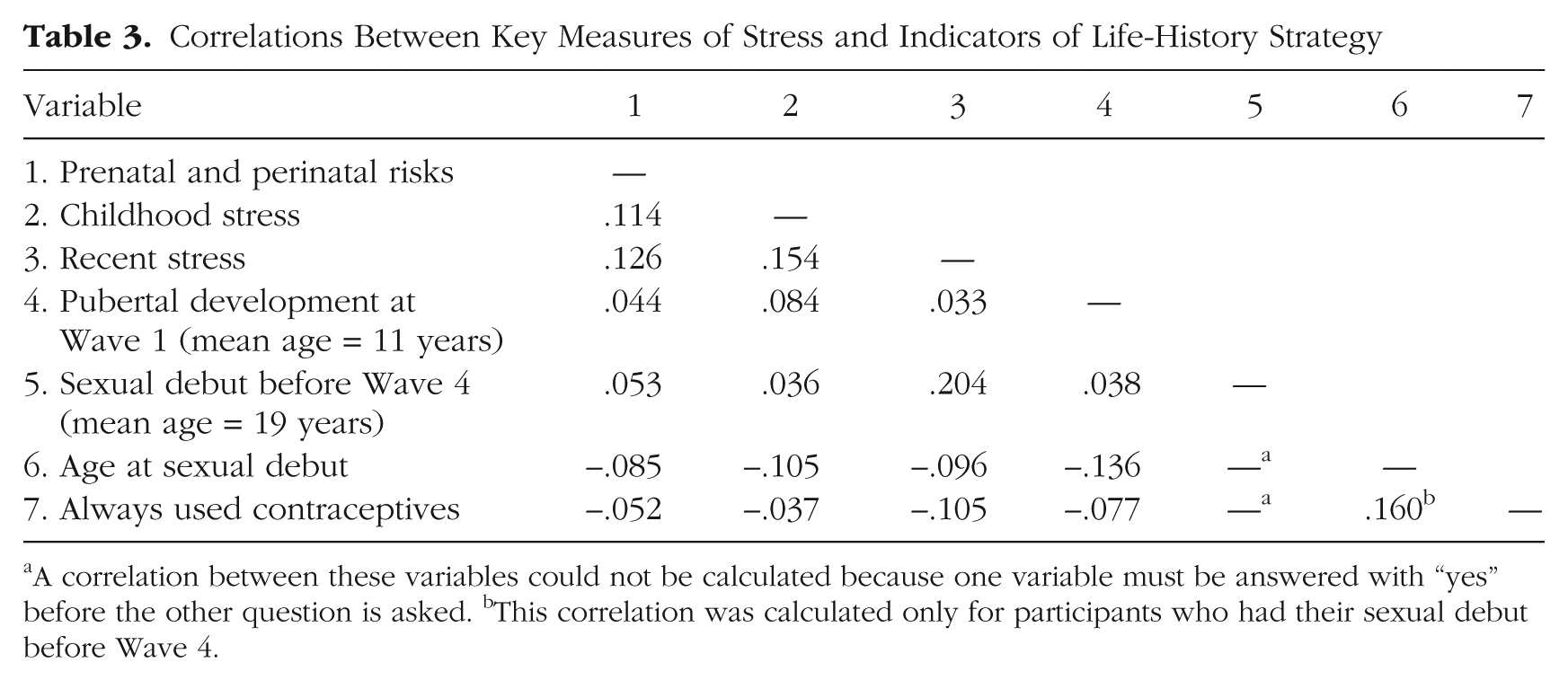
A correlation between these variables could not be calculated because one variable must be answered with “yes” before the other question is asked. bThis correlation was calculated only for participants who had their sexual debut before Wave 4.
Our final hypothesis, that cumulative stress would predict depression in the comparison groups, whereas a mismatch between early and recent stress would predict depression in the shifters and the sustainers, was partly confirmed. In the total sample, prenatal and perinatal risks (b = 0.377, p < .01; OR = 1.46) as well as early stress (b = 1.15, p < .001; OR = 3.17) predicted depressive episodes. The model significantly improved when the interaction between prenatal and perinatal risks and recent stress was added, χ2(1) = 8.32, p < .01. The interaction between prenatal and perinatal risks and recent stress negatively predicted depressive episodes (b = −0.29, p < .01; OR = 0.75). Next, we stratified our analyses for the shifters, sustainers, and the comparison groups (Table 4). In the shifters, neither prenatal and perinatal risks nor recent stress or their interaction predicted depressive episodes (Fig. 1a). In the sustainers, prenatal and perinatal risk, recent stress, as well as their interaction significantly predicted depressive episodes (Fig. 1b). In the comparison groups, only recent stress significantly predicted depressive episodes (Fig. 1c). Analyses with a symptom cutoff instead of CIDI diagnoses, childhood stress instead of prenatal and perinatal risks, and a continuous symptom score yielded similar results.
Results of the Model Predicting Depression in the Attention-Style Groups
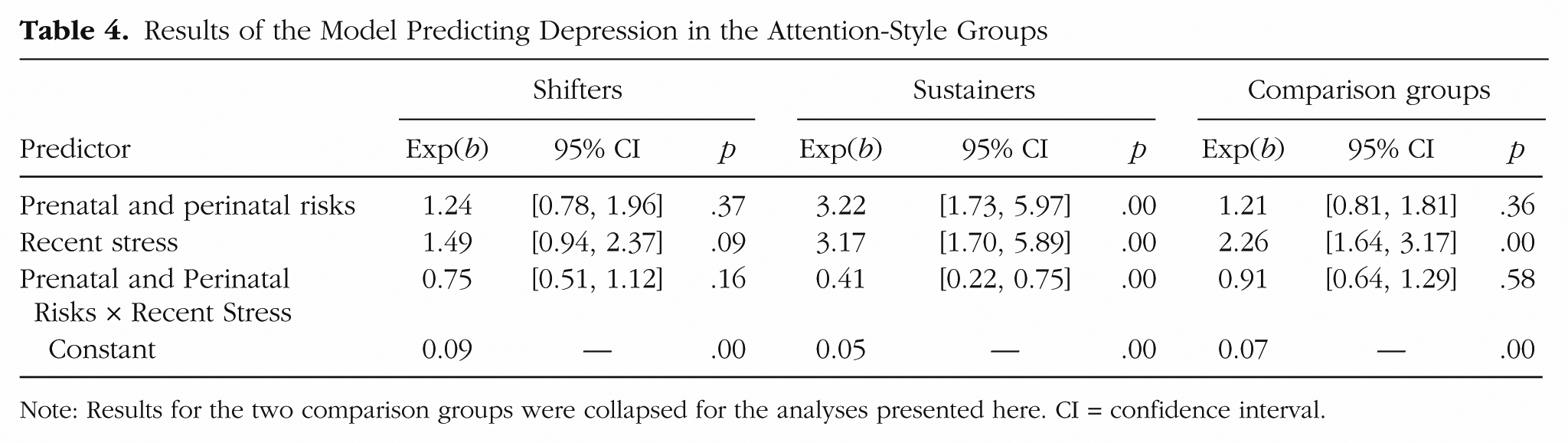
Note: Results for the two comparison groups were collapsed for the analyses presented here. CI = confidence interval.
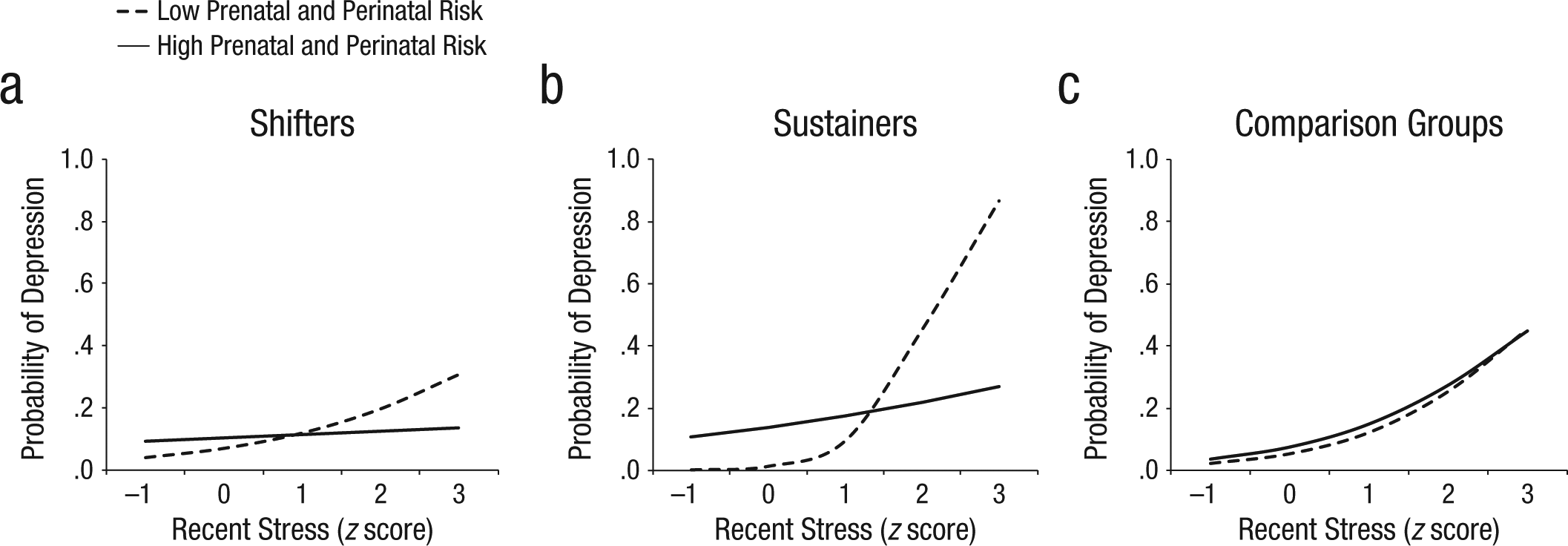
Mean probability of depression as a function of recent stress and prenatal and perinatal risk. Results are shown separately for shifters (a), sustainers (b), and the two comparison groups (collapsed; c). For prenatal and perinatal risk, “low” refers to levels 1 standard deviation below the mean, and “high” refers to levels 1 standard deviation above the mean.
Discussion
This study is the first to show that a specialization in attention style could be a conditional adaptation; it was associated with early stress and life-history strategy. A predominantly shifting attention style was associated with higher levels of early life stress compared with a predominantly sustained attention style. In our study, we could not disentangle a causal association from a gene-environment correlation. It might be that instead of early life stress steering in the direction of developing a shifting attention style, the shifting attention style merely represents a passive gene-environment correlation with prenatal and perinatal risks and an evocative gene-environment correlation with childhood stress (Knafo & Jaffee, 2013). Our findings of earlier puberty, earlier sexual debut, and more risky sexual behavior in shifters than in sustainers nicely converge with predictions from life-history theory (Belsky et al., 1991; Ellis et al., 2009) and other related theories, such as the adaptive-calibration model (Del Giudice, Ellis, & Shirtcliff, 2011), which confirms that attention style might be a conditional adaptation. The comparison groups, which consisted of individuals who either performed well or poorly on both attention tasks, did not show these differences, which suggests that the combination of performing well on one task and performing poorly on the other task was part of the adaptive strategy. Whether these profiles were the result of trade-offs is still an open question.
We also studied the possible consequences for the prospective risk for depressive episodes. In the literature, large interindividual differences in the outcome of early stress are found not only in human, but also in animal, studies. Whereas the findings of some studies suggest conditional adaptations, showing, for example, that rats who experienced more early life stress showed adaptations such as less depression-like behavior and increased learning under stressful conditions (Champagne et al., 2008; Kiank, Mundt, & Schuett, 2009), other studies exclusively suggest detrimental effects of stress (Chung et al., 2005; Llorente et al., 2011). Results of our study confirm these interindividual differences. In the comparison group, we found evidence for the cumulative-stress hypothesis (Fig. 1c), which coincides with the traditional psychopathology perspective (Power et al., 2013). In sustainers, however, we found evidence for the mismatch hypothesis (Fig. 1b). Sustainers who experienced relatively low levels of early life stress were found to be at increasing risk for depression with increasing levels of recent stress, whereas sustainers who experienced relatively high levels of early life stress were at equal risk for depression throughout a whole range of recent environments. This fits the idea that a match between the early and recent environment would result in a lower risk for depression in individuals whose phenotype adjusted to their expected later environment than in individuals whose phenotype did not (Frankenhuis & Del Giudice, 2012; Nederhof & Schmidt, 2012; Schmidt, 2011).
The most remarkable finding of the present study is probably the lack of an association between recent stress and depressive episodes in shifters (Fig. 1a). Although these findings are in urgent need of replication, one explanation could be that shifters retain higher levels of phenotypic plasticity throughout life, which results in a decreased risk for depression when they are confronted with events that require readjustment. This new evidence for the role of stress in depression is important because it has major implications for both future research and clinical practice. A question that rises from these results is whether the mismatch model applies to other domains as well, especially because the sustainers did not seem to have an advantage in terms of depression risk in low-stress conditions compared with both the shifters and the comparison groups. It might be that advantages should be sought not in the psychosocial domain but rather in, for example, the physical domain (Brody et al., 2013).
Although this study had several strengths, such as the large sample, the long follow-up, and the prospective assessment of depressive episodes using a diagnostic interview, several limitations must also be acknowledged. First, effect sizes were small. Although this is usual in large observational studies, it might also have to do with our characterization and operationalization of attention style. The two tasks were drawn from a standard neuropsychological test battery, and groups were created based on median splits. When using more ecologically valid tests of shifting and sustained attention, researchers might find larger effects. The use of a median split might be seen as a limitation as well. The procedure we used, however, could also be seen as a person-centered approach like a latent class analysis. Person-centered approaches are most suitable for testing if different models apply to different groups of individuals. Another potential limitation is the current lack of research data on the stability of performance on the neuropsychological tests we used. Despite these limitations, it is reassuring that our findings were confirmed using a subjective measure of early life stress instead of the interview-based measure of prenatal and perinatal risks, and when using a self-report questionnaire on depressive symptoms instead of information from a diagnostic interview.
In sum, we found evidence that the mismatch hypothesis applies to individuals whose phenotype adjusted to their expected later environment, the sustainers, whereas the cumulative-stress hypothesis applies to the majority of individuals, the comparison groups, just like Nederhof and Schmidt (2012) predicted. A third group of individuals, the shifters, seemed to retain high levels of plasticity throughout life, which rendered them insensitive to stress in terms of depression risk.
Footnotes
Acknowledgements
The research reported here is part of the TRacking Adolescents’ Individual Lives Survey (TRAILS). Participating centers of TRAILS include various departments of the University Medical Center and University of Groningen, the Erasmus University Medical Center Rotterdam, the University of Utrecht, the Radboud Medical Center Nijmegen, and the Parnassia Bavo group. We are grateful to all adolescents, parents, and teachers who participated in this research and to everyone who worked on this project and made it possible. TRAILS data from the first, second, and third measurement waves can be accessed at  .
.
Declaration of Conflicting Interests
The authors declared that they had no conflicts of interest with respect to their authorship or the publication of this article.
Funding
The TRacking Adolescents’ Individual Lives Survey (TRAILS) has been financially supported by various grants from the Netherlands Organization for Scientific Research (NWO), Zorgonderzoek Nederland Medische Wetenschappen (ZonMW), Gebieds Bureau Gedrags-en Maatschappijwetenschappen (GB-MaGW), the Dutch Ministry of Justice, the European Science Foundation (ESF), Biobanking and Biomolecular Research Infrastructure in The Netherlands (BBMRI-NL), the universities in TRAILS, and the Accare Center for Child and Adolescent Psychiatry.