




Abstract
Using the emergent friendship network of an incoming cohort of students in an M.B.A. program, we examined the role of extraversion in shaping social networks. Extraversion has two important implications for the emergence of network ties: a popularity effect, in which extraverts accumulate more friends than introverts do, and a homophily effect, in which the more similar are two people’s levels of extraversion, the more likely they are to become friends. These effects result in a systematic network extraversion bias, in which people’s social networks will tend to be overpopulated with extraverts and underpopulated with introverts. Moreover, the most extraverted people have the greatest network extraversion bias, and the most introverted people have the least network extraversion bias. Our finding that social networks were systematically misrepresentative of the broader social environment raises questions about whether there is a societal bias toward believing other people are more extraverted than they actually are and whether introverts are better socially calibrated than extraverts.
A fundamental notion of social psychology is that one’s beliefs about social behavior are largely determined by the individuals in one’s immediate environment (Sherif, 1936). Because social perceptions are shaped by the people one is connected to (McArthur & Baron, 1983), a deeper understanding of how individuals’ social networks are composed is valuable. It is particularly important to understand factors that may cause individuals’ social networks to be misrepresentative of the broader social environment. As a step in this direction, we explored whether individuals’ personalities could cause systematic biases in the composition of their social networks.
We examined whether the levels of extraversion of two individuals made them more or less likely to become friends and how these dyadic underpinnings influenced the composition of people’s social networks in aggregate. The likelihood that any two individuals in a social environment become friends is known to increase (a) as they have more opportunities to interact and (b) if they like each other upon interacting (Byrne, 1961; McPherson, Smith-Lovin, & Cook, 2001). We argue that extraversion, a fundamental personality variable, plays a role in shaping opportunities for interaction and interpersonal liking and is therefore an important psychological determinant of social-network composition. However, the effects of extraversion on social connection ultimately lead to a bias in social networks. Our results provide an underlying logic for why people may not be as outgoing as you think (unless you are very introverted).
Extraversion-introversion 1 —the extent to which one is outgoing and sociable, as opposed to reserved and quiet (McCrae & Costa, 1990)—has long been established among psychologists as one of the Big Five dimensions along which personality varies (Costa & McCrae, 1992; Eyesenck, 1981). The key features of extraversion are sociability, outgoingness, and assertiveness; compared with introverts, extraverts tend to engage in more social interaction (McCrae & Costa, 1990) and to seek and attract more social attention (Ashton, Lee, & Paunonen, 2002). Individuals who are more extraverted tend to be more talkative and to spend more time interacting with other people than individuals who are more introverted (John & Srivastava, 1999; Paunonen & Ashton, 2001). More extraverted individuals are more likely to initiate social interactions and enter more social situations, both of which are conducive to the formation of new relationships (Shipilov, Labianca, Kalnysh, & Kalnysh, 2014). Introverts, by contrast, are inclined to spend more time alone and, when they do socialize, tend to prefer more intimate settings. Support for the link between extraversion and popularity has been found in work on school children, online profiles, and self-perceptions (Jensen-Campbell et al., 2002; Ong et al., 2011; Paunonen, 2003). Therefore, we expected extraversion popularity: Extraversion should be associated with larger networks. More precisely, all else being equal, greater extraversion makes one more likely to become friends with any given other person.
Extraversion may also affect networks through social homophily—the tendency to associate with people similar to oneself (McPherson et al., 2001). For more than 50 years, psychologists have explored whether similarity leads to liking and attraction (e.g., Byrne, 1961; Montoya, Horton, & Kirchner, 2008) and whether greater similarity between people and their friends leads to greater happiness (Seder & Oishi, 2009); in particular, the research has been focused on attitudinal similarity (Byrne, Baskett, & Hodges, 1971; Condon & Crano, 1988). Sociologists have argued that homophily also occurs because similar people choose to enter into similar situations (Feld, 1981), which increases their opportunity to connect circumstantially, even in the absence of any underlying preference for such connection. Evidence for the link between extraversion similarity and relationship formation has been found in work on spouse selection, marriage distress, and “best friend” designation (Gattis, Berns, Simpson, & Christensen, 2004; Humbad, Donnellan, Iacono, McGue, & Burt, 2010; Selfhout, Branje, Raaijmakers, & Meeus, 2007; cf. Furler, Gomez, & Grob, 2013). Therefore, we expected that because of either greater liking due to similarity attraction or greater interaction due to choice of similar social situations (or both), people with similar levels of extraversion should be more likely to become friends than people with different levels of extraversion. We refer to this as extraversion homophily.
The extraversion-popularity and extraversion-homophily hypotheses are straightforward; in combination, however, they yield an interesting implication for the overall composition of individuals’ social networks. We will refer to the true mean extraversion of the entire social environment as the population extraversion. The mean extraversion of an individual’s social contacts—which we refer to as that individual’s network extraversion—may deviate from the population extraversion. If friendships are randomly developed among the population, then one would expect no systematic deviation between network extraversion and population extraversion. However, because we expect greater extraversion to make one more likely to build friendships, extraverted individuals will be overrepresented, and introverted individuals will be underrepresented, in the networks of other people. Network extraversion will therefore be systematically higher than the population extraversion. In making this argument, we build on and extend the “friendship paradox,” about which Feld (1991) provocatively argued that “your friends have more friends than you do” because of the mathematical truism that as one has more connections, one is present in a greater number of other people’s networks. Therefore, people’s social networks disproportionately contain individuals that have many connections. We extend this idea beyond a purely mathematical claim by joining the friendship paradox with extraversion popularity and hypothesize the existence of a network extraversion bias: On average, people have networks that are more extraverted than the overall social environment.
Finally, we argue that this bias should depend on one’s own level of extraversion. Throughout this article, we use the notation of person i as the focal individual and person j as an individual who may or may not be i’s friend. As illustrated in Figure 1a, for an introverted i, the popularity and homophily effects work in opposition: A more extraverted j is more sociable and popular (which increases the likelihood of friendship) but is also less similar to the introverted i (which decreases the likelihood of friendship). In contrast, for an extraverted i, the popularity and homophily effects work in concert (see Fig. 1b): A more extraverted j is both more sociable and popular (which increases the likelihood of friendship) and more similar to the extraverted i (which also increases the likelihood of friendship). Therefore, we expect that extraverts will have networks that are disproportionally populated with other extraverts. Introverts, by contrast, may have social networks that are less biased and more representative of the true population with regard to extraversion. In sum, we predict an overall network extraversion bias and expect the magnitude of bias to be the greatest for the most extraverted individuals.
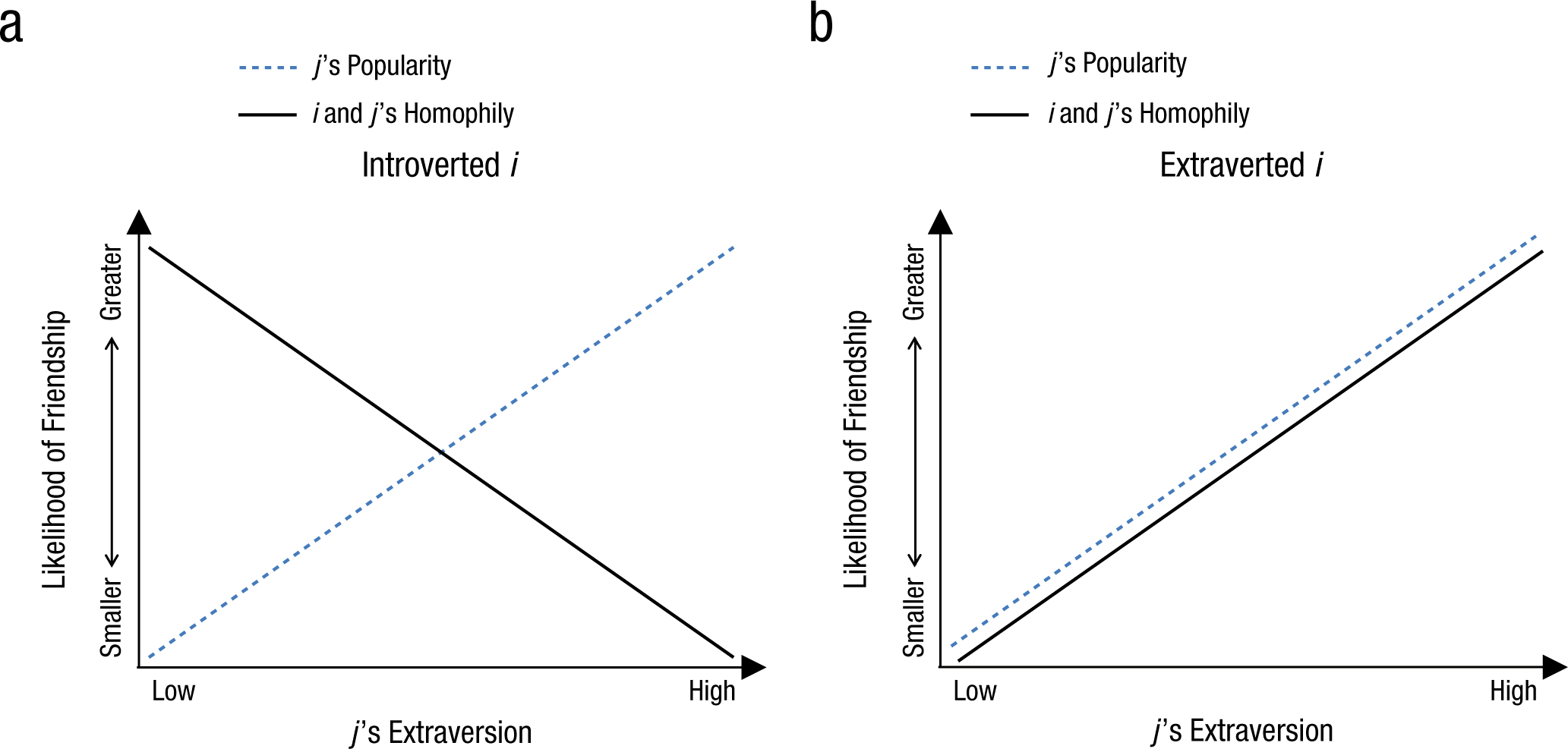
Dual effects of extraversion. The diagrams illustrate the dual effects of individual j ’s extraversion on the likelihood of a friendship between individual i and individual j when i is (a) introverted or (b) extraverted.
Data and Measures
To test these hypotheses, we studied a complete cohort of M.B.A. students at a private university in the northeastern United States. An incoming cohort of M.B.A. students is a useful sample because the students are initially unfamiliar with each other, they simultaneously enter a social environment, and friendships emerge in the first several months. This simultaneity, control, and access make it an ideal field setting in which to examine emergent social networks. Our sample included all 284 students (34% female; 56% White, non-Hispanic; 65% U.S. citizens; average age = 28.4 years) who began their graduate program in the fall of 2012.
The emerging social network within their cohort was measured at two points in time. Time 1 was 5 weeks after students had arrived on campus for orientation. Time 2 was 11 weeks after their arrival (and 6 weeks after Time 1). Given our interest in social relations in general, rather than close friendships specifically, we asked students the following question (adapted from Burt, 1992, p. 123) on the study Web site at each time point: Consider the people with whom you like to spend your free time. Since you arrived at [university name], who are the classmates you have been with most often for informal social activities, such as going out to lunch, dinner, drinks, films, visiting one another’s homes, and so on?
To avoid problems of incomplete recall (Brewer, 2000), we included in our survey a list of all other students in the first year of the M.B.A. program. The names were displayed in columns; each column represented one class section, and the names were listed alphabetically. 2 Each respondent indicated the other students with whom he or she socialized by checking a box next to those people’s names. A minimum of two contacts were required, but no upper limit was imposed.
Following the Time 2 network survey, each individual’s personality characteristics were measured using the Big Five Inventory (John & Srivastava, 1999), a well-established, 44-item instrument that measures extraversion, openness to experience, conscientiousness, agreeableness, and neuroticism. The extraversion measure required subjects to rate the extent to which they agreed or disagreed (on a 5-point scale) with each of eight statements about themselves. For example, the items included “is outgoing, sociable,” “is talkative,” and “is reserved” (reverse-scored). No analyses were initially run on any of the other personality characteristics in this project. 3
Finally, demographic data were provided by the school’s registrar about each student’s gender, race, citizenship, age, class section, study group assignment, and residence status (i.e., whether he or she lived on or off campus). For each source of data, all personally identifying information was removed, which left the various sources of data linked only by anonymous student ID numbers.
Models
Dyad-level models
We used dyad-level models to answer the following question: How does the extraversion of two individuals affect whether one names the other as a friend? Person i designated which other individuals in the social environment he or she considered to be friends, and person j was someone who could possibly be named as a friend by i. Therefore, each individual appeared in the data not only as an i but also as a j for all others in the social environment. In our dyadic models, an observation is a given ij ordered pair and the dependent variable was an indicator of whether i cited j as a friend (0 = no, 1 = yes).
We estimated our dyadic effects with linear probability models using fixed effects for each individual (Angrist & Pischke, 2009; Mayer & Puller, 2008). Fixed effects were important because they allowed us to control for all characteristics of one individual (i or j) while testing whether the extraversion of the other individual (j or i, respectively) affected the likelihood of friendship. In the similarity models, we use fixed effects for both individuals to control for all individual characteristics of both individuals, allowing us to isolate effects related to the combination of individuals, such as extraversion similarity. In the following section, we clearly state which fixed effects were used in each model before presenting the results.
Although fixed effects enabled us to isolate effects of interest, there were still many interdependencies across observations because of the dyadic and repeated nature of the data. We were careful to account for these interdependencies using clustering, which adjusted the standard errors of the coefficient (via the covariance matrix) by relaxing the assumption of independence within each cluster. 4 To account for common-person effects (e.g., whether A names B as a friend is not independent of whether A names C), 5 we clustered standard errors around each i and each j (Kenny, Kashy, & Cook, 2006). To account for reciprocal autocorrelation (e.g., whether A names B as a friend is not independent of whether B names A) and repeated measures across time, we clustered standard errors around each unordered dyad ij. The multiway clustering of standard errors was accomplished using Kleinbaum, Stuart, and Tushman’s (2013) implementation of Cameron, Gelbach, & Miller’s (2011) algorithm.
In estimating the dyad-level models, we controlled for i and j having the same class section, study group, gender, race, nationality, campus-residence status, as well as for their age difference (which was added to 1 and log-transformed). All of these covariates were mean-centered. Although including covariates that are known to affect the likelihood of social connection enabled more accurate parameter estimates for our variables of interest, we showed that identical patterns of significance held when they were omitted from the analysis. We also included a binary indicator for the time the network was recorded: −1 for Time 1 and +1 for Time 2. This variable coding scheme allowed us to directly interpret the estimators as the main effects of explanatory variables (i.e., by pooling both time periods) and also to test whether the key effects increased in magnitude over time, using interactions of the explanatory variables with time.
Individual-level models
We then proceeded to individual-level models to test how these dyadic underpinnings affected the composition of an individual’s network as a whole. The unit of analysis was the individual, and the dependent variables were measures of that individual’s network.
Our first individual-level models tested whether extraversion led to popularity. For these models we operationalized popularity in two ways: the number of people that named the focal person as a friend, and the number of people that the focal person named as friends. The popularity measures were count variables, which were truncated at the lower end. Because ordinary least squares regression is inappropriate with truncated data, these models used a Poisson quasimaximum likelihood specification 6 (Wooldridge, 1997).
The final individual-level model tested the network-extraversion-bias hypothesis. This model tested whether the average extraversion of the people in one’s network (i.e., network extraversion) was different from the average extraversion of the entire cohort (i.e., population extraversion). Extraversion was standardized, so the population extraversion was zero and the model was run using ordinary least squares regression.
To account for additional factors that might affect network composition, in our individual-level models we controlled for gender, U.S. citizenship, on-campus residency, and belonging to a racial minority group. All control variables were mean centered. Again, we controlled for the time when the network was recorded using a binary time indicator set to −1 (for Time 1) or +1 (for Time 2), a coding scheme that allowed us to interpret the estimated coefficients as main effects (i.e., by pooling both time periods and treating them equally) and to test whether the effect of extraversion changed in magnitude over time.
Results
The median respondent cited 16 friends at Time 1 and 26 at Time 2; both distributions had very long right tails (Time 1: range = 2–148, SD = 17.8; Time 2: range = 2–184, SD = 29.0). 7 The increase in network size across time indicates that social networks were actively being formed during the time period of study. Additional descriptive statistics appear in the Supplemental Material available online.
The reliability of the extraversion measure was very good (Cronbach’s α = 0.86). The extraversion measure had a mean value of 3.45 and a standard deviation of 0.81 (on a scale from 1 to 5) before being standardized. The response rate from the cohort for both network surveys was 100%; however, 4 of the 284 students failed to complete the extraversion scale and were dropped from all analyses, yielding a final response rate of 98.6%.
The results for each key significance test for each model described in the following sections is in boldface type in Tables 1 and 2. We were also able to replicate all results with a three-item subscale of extraversion using only the items that pertain to being energetic rather than outgoing: “is full of energy,” “generates enthusiasm,” and “has an assertive personality” (see Supplemental Material).
Dyad-Level Models Predicting the Number of Network Ties (N = 156,240)
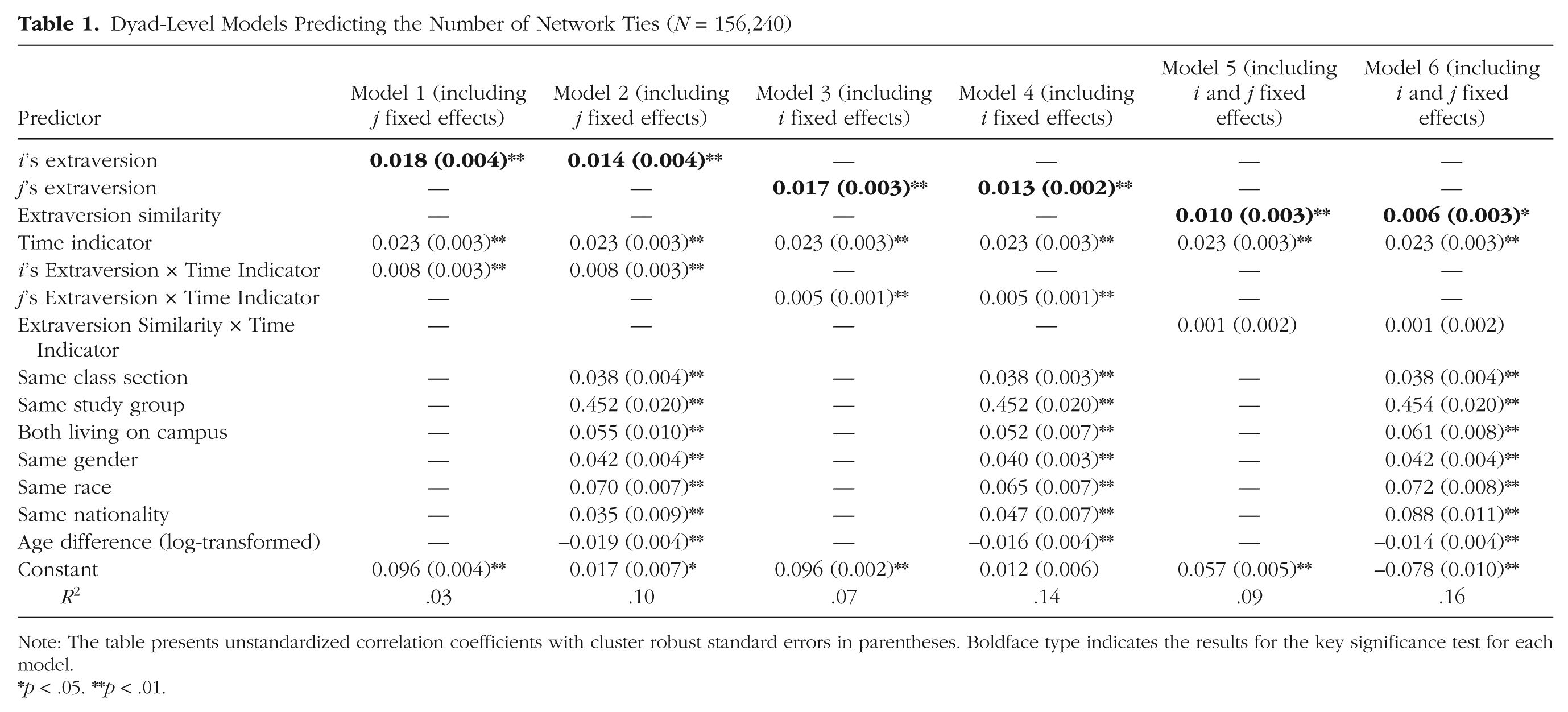
Note: The table presents unstandardized correlation coefficients with cluster robust standard errors in parentheses. Boldface type indicates the results for the key significance test for each model.
p < .05. **p < .01.
Individual-Level Models Predicting Number of Times Cited by Other People, Number of Friends Cited, and Network Extraversion (N = 560)
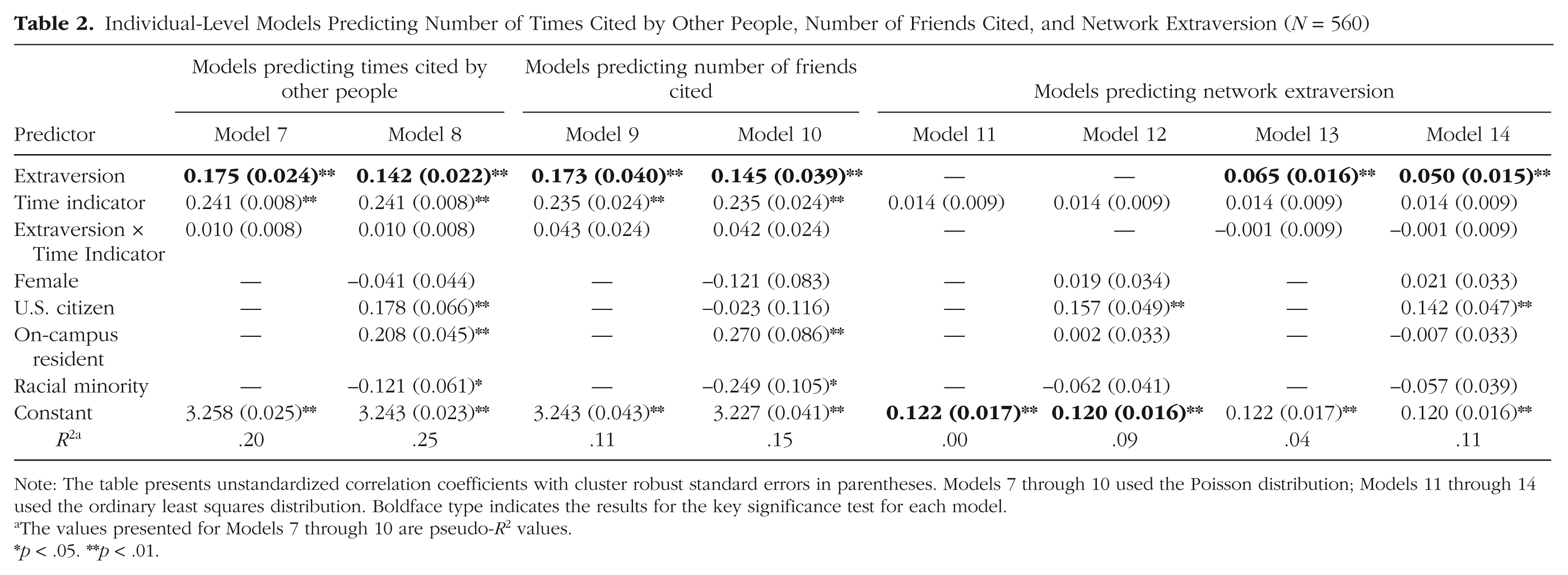
Note: The table presents unstandardized correlation coefficients with cluster robust standard errors in parentheses. Models 7 through 10 used the Poisson distribution; Models 11 through 14 used the ordinary least squares distribution. Boldface type indicates the results for the key significance test for each model.
The values presented for Models 7 through 10 are pseudo-R2 values.
p < .05. **p < .01.
Dyadic underpinnings
To begin establishing the dyadic underpinnings of how extraversion is associated with network composition, we examined whether the responder’s extraversion was predictive of the likelihood that he or she would cite a given other person as a friend. We controlled for all observable and unobservable attributes of j using individual fixed effects for j. We then tested whether i’s extraversion increased the likelihood that i would cite j as a friend (Model 1). In using these fixed effects, we controlled for all heterogeneity across js as possible targets for friendship. We then reestimated the model while controlling for dyadic covariates known to be associated with tie formation, which gave us a more accurate estimate of the effect size (Model 2). We found that being more extraverted significantly increased the likelihood that an individual would cite any given other person as a friend (see Table 1; p < .01 in both models).
Overall, the effect size was significant: After covariates and fixed effects were subtracted, a 1-SD increase in extraversion from the mean increased by 1.4 percentage points (from 9.6% to 11.0%) the probability that a person would cite any given other person as a friend. All other things being equal, the likelihood that an extravert in the 90th percentile of extraversion would cite any given other as a friend was 11.7%, whereas the same likelihood for an introvert in the 10th percentile of extraversion was 7.8%. Furthermore, disaggregating the Time 1 effects from Time 2 reveals that this effect grew substantially over time, from 0.6 percentage points (0.014 − 0.008) at Time 1 to 2.2 percentage points at Time 2 (0.014 + 0.008), p < .01.
Next, we tested whether being more extraverted makes one more likely to be cited by other people as a friend. In Model 3, we controlled for all observable and unobservable attributes of the responder i using fixed effects for i. We then tested whether j’s extraversion increased the likelihood that i would cite j as a friend. In Model 4, we added the dyad-level covariates that are known to affect social ties, which gave us a more accurate estimate of the effect size. We found that being more extraverted significantly increased the likelihood that an individual would be cited as a friend by any given other person (p < .01 in both models). After covariates and fixed effects were subtracted, a 1-SD increase in extraversion from the mean increased by 1.3 percentage points (from 9.6% to 10.9%) the probability that a person would be cited as a friend by any given other person. An extravert in the 90th percentile of extraversion had an 11.6% chance of being cited as friend by a given other person, whereas an introvert in the 10th percentile of extraversion had a 7.9% chance. Again, this effect grew larger across time, from 0.8 percentage points (0.013 – 0.005) at Time 1 to 1.8 points (0.013 + 0.005) at Time 2.
We then examined extraversion homophily. To isolate the effect of similarity, we included fixed effects for both i and j in Models 5 and 6 (Reagans & McEvily, 2003). These fixed effects accounted for all observable and unobservable individual attributes of both i and j that affected their propensity to form friendship ties, including their individual levels of extraversion. Again, established dyad-level covariates were added in Model 6 to improve the accuracy of the key parameter estimate. These models then tested whether the remaining variance could be explained by attributes of the ij dyad. The key independent variable of interest in Models 5 and 6 was extraversion similarity. This was operationalized as the absolute value of the difference between the extraversion scores of i and j, multiplied by −1 to convert a difference into a similarity score. We found that greater similarity in extraversion between two individuals significantly increased the likelihood that one would cite the other as a friend (p < .01). This effect did not change significantly across time periods. Specifically, compared with two people who differed in extraversion by 1 SD, two people with identical extraversion scores were 0.5 percentage points (9.8% vs. 10.3%) more likely to cite one another than were people without such similar scores. Examining a more extreme comparison, we found that highly similar dyads (similarity score in the 90th percentile) had a 10.2% chance of citing one another, whereas highly dissimilar dyads (with similarity score in the 10th percentile) had an 8.8% chance. The fixed effects for i and j ensured that this similarity effect was not a by-product of any extraversion-popularity effects. On the whole, although we found significant effects of extraversion homophily, it seemed to play a smaller role in shaping social interactions than extraversion popularity.
Consequences for individuals’ networks
Next, we examined how these dyadic underpinnings affected an individual’s network composition as a whole, in terms of popularity and network extraversion bias (see Table 2).
We found that more extraverted individuals were cited as friends by significantly more people (Models 7 and 8, without and with control variables, respectively; ps < .01) and cited significantly more people as their friends (Models 9 and 10, without and with control variables, respectively; ps < .01). 8 All else being equal, a 1-SD increase in extraversion from the mean corresponded with being cited as a friend by 15% more people and citing 16% more people as friends. Moreover, the model estimated that extreme introverts (in the 10th percentile of extraversion) would be cited as friends by 22 people, whereas extreme extraverts (in the 90th percentile of extraversion) would be cited as friends by 34 people. Although the aggregate number of friends increased significantly over time (as evidenced by the positive coefficient on the time indicator, with p < .01), there was no evidence that it did so as a function of extraversion.
We then tested the network-extraversion-bias hypothesis (i.e., that the average extraversion of the individuals in one’s network is systematically greater than the average extraversion in the population of potential friends). Because (a) all covariates were mean-centered, (b) the two time periods were coded as −1 and +1, and (c) the extraversion measure was standardized so population extraversion was zero, the ideal test statistic was the coefficient of the model intercept (Models 11 and 12, without and with control variables, respectively). That is, the test statistic for the estimated constant in the regression model examined whether, at the mean of all included explanatory variables and treating both time periods equally, network extraversion was greater than the true average extraversion in the social environment. We found that, on average, network extraversion was significantly higher than population extraversion (p < .01). 9 On average, people’s network extraversion is .12 SDs higher than the population extraversion, a finding consistent with the prediction of the network-extraversion-bias hypothesis. The coefficient of the time indicator is statistically insignificant, which suggests that the network extraversion bias was not increasing over time.
Finally, Models 13 and 14 tested the proposition that the magnitude of one’s network extraversion bias depends on one’s own level of extraversion. We found that being more extraverted corresponded with a significantly greater network extraversion bias (p < .01), which is consistent with that hypothesis. The magnitude of this effect did not change significantly across time periods (p > .05). All else being equal, a 1-SD increase in one’s own extraversion from the mean increases one’s network extraversion bias by 42% (from 0.120 at the population mean to 0.170). For a graphical depiction of the network extraversion bias, see Figure 2. The 95% confidence interval on the regression line represents an estimate of a statistically significant network extraversion bias for individuals at or above the 9th percentile of extraversion (1.31 SD below the mean), which is the point at which the 95% confidence interval intersects zero. The regression line itself intersects zero at −2.40 SD on extraversion, which implies that the model predicts that, all other things being equal, an individual at the first percentile of extraversion will have no network extraversion bias. The most extreme introverts have the best calibrated network extraversion, on average.
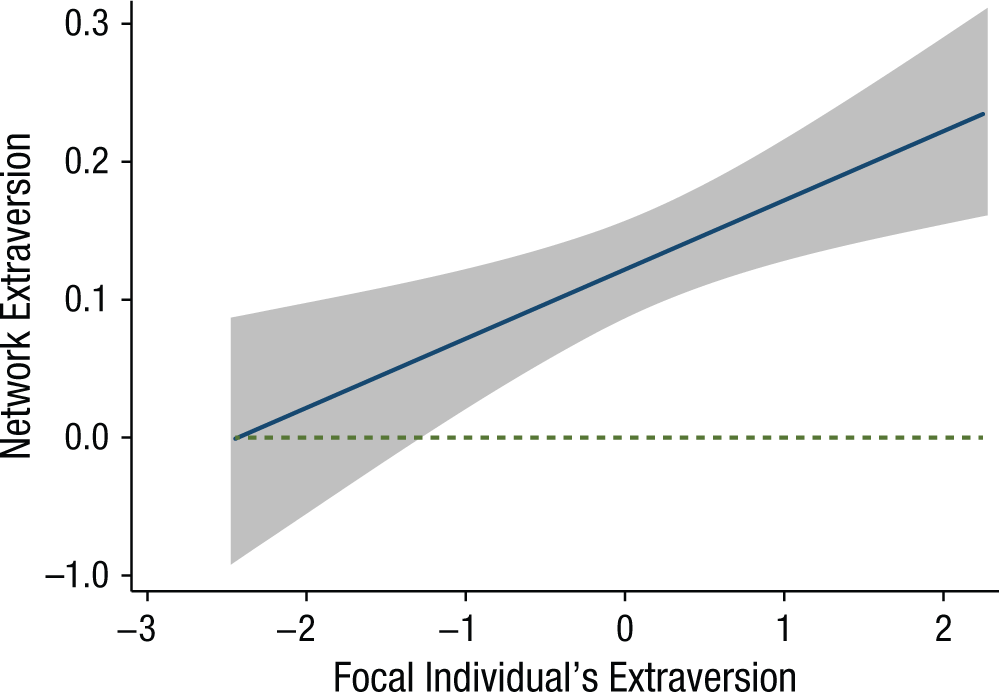
Fitted estimates of network extraversion as a function of the focal individual’s extraversion, according to Model 7. The shaded gray area represents the 95% confidence interval around the fitted solid line. The dashed line indicates the average extraversion of the population, which was zero by construction. The distance between the solid and dashed lines represents the estimated network extraversion bias at each level of extraversion.
The estimated coefficients on the covariates also shed light on the relative importance of location, demographics, and personality for the emergence of friendships in this setting. The effect of U.S. citizenship on popularity (measured here as the number of times someone was cited as a friend by other people) was roughly equivalent to that of a 1.04-SD increase in extraversion. Living on campus was associated with an increase in popularity equivalent to a 1.07-SD increase in extraversion. Finally, belonging to the racial majority was associated with an increase in popularity equivalent to a 1.3-SD in extraversion. The only demographic variable that was significantly associated with network extraversion was U.S. citizenship: Compared with foreign nationals, U.S. citizens have higher network extraversion, equivalent to a 1.1-SD increase in their own extraversion.
An important consideration is whether our conclusions here are influenced by our M.B.A. student sample, which may be more extraverted than the general population. Our claim is that within any given social environment, if extraversion popularity and extraversion homophily occur, they will give rise to a network extraversion bias in which the extraversion of the people to whom one is connected will be greater than the average extraversion of the population of that social environment. This claim is empirically manifest in our statistical test comparing each individual’s network extraversion with the mean individual extraversion within his or her social environment. Therefore, the theory is sufficiently general to apply in settings with varying levels of sociability.
Discussion
This article fills an empirical gap at the intersection of psychology and network science by documenting how the fundamental personality trait of extraversion is predictive of network composition. One is more likely to become friends with individuals who are (a) more extraverted and (b) similar in extraversion to oneself. The latter point is consistent with the notion of personality homophily. These dyadic underpinnings lead to two interesting network consequences. First, extraverts become overly represented, and introverts underrepresented, in the social networks of other people—put differently, the average extraversion of the people in one’s network is greater than the average extraversion in the whole social environment. Second, the most extraverted people have the greatest network extraversion bias, and the most introverted people have the least network extraversion bias. Despite limitations (e.g., correlational data, unobservability of network ties outside our sample, a binary measure of friendship, extraversion measured after the dependent variable) and boundary conditions on generalizability (e.g., tie formation rather than tie maintenance, a sample of highly educated adults, a high-interaction social environment), these findings shed new light on issues fundamental to psychology.
Psychologists have long held that an individual’s social beliefs are shaped by the people with whom they interact (e.g., McArthur & Baron, 1983; Sherif, 1936). Given the influence of availability in making judgments (Kahneman, 2011), people are likely to draw inferences about the general social environment on the basis of the people to whom they are socially connected. For example, Flynn and Wiltermuth (2010) showed that the structure of people’s network affected their perceptions of consensus on matters of ethics. However, our results suggest that in some important respects, social networks are likely to be misrepresentative of the population. Future research should explore whether the network extraversion bias contributes to a societal misperception toward believing that other people are more extraverted on average than they actually are. Our results provide an underlying logic for why people may overestimate the number of extraverts in the general population. Such social miscalibration might affect people’s self-perceptions or lead to poor policy and management decisions. A prevalent self-belief that one’s social behavior is more reclusive than the perceived norm may reduce feelings of belongingness, self-esteem, and self-worth. Moreover, societal miscalibration regarding norms of outgoingness may also affect the manner in which young people are educated and encouraged to behave.
This work also builds on a growing literature in which it is argued that greater extraversion is not always better (Bendersky & Shah, 2013; Grant, 2013; Grant, Gino, & Hofmann, 2011). Our findings suggest that introverts have the smallest network extraversion bias, which might aid them, for example, as leaders. If introverts do in fact benefit from a hidden social-calibration advantage, they may be more tolerant of both introversion and extraversion among their colleagues, team members, or employees (Grant et al., 2011). This may be an important direction for future research, because past work has found that although extraverts are more likely than introverts to attain leadership positions (Judge, Bono, Ilies, & Gerhardt, 2002), introverts and extroverts are equally effective leaders (Grant et al., 2011).
Although we have examined how personality affects whether one’s social network accurately reflects the general social environment, how individuals draw social inferences from their networks remains a critical empirical question. An important direction for future research will be to examine how misrepresentative social networks translate into skewed perceptions and inaccurate beliefs. We encourage further interdisciplinary collaborations to address and delve into these important questions.
Footnotes
Acknowledgements
We are grateful to Andy Bernard, Alex Jordan, David Krackhardt, Sunita Sah, Jack Soll, Thalia Wheatley, seminar participants at Carnegie Mellon University, and participants at the SunBelt 2014 conference for valuable comments and suggestions in relation to this article. We also acknowledge Pino Audia’s and Alex Jordan’s help in recruiting participants and input regarding the measures used.
Declaration of Conflicting Interests
The authors declared that they had no conflicts of interest with respect to their authorship or the publication of this article.

Notes
References
Supplementary Material
Please find the following supplemental material available below.
For Open Access articles published under a Creative Commons License, all supplemental material carries the same license as the article it is associated with.
For non-Open Access articles published, all supplemental material carries a non-exclusive license, and permission requests for re-use of supplemental material or any part of supplemental material shall be sent directly to the copyright owner as specified in the copyright notice associated with the article.
