



Abstract
Arousal is known to shape time perception, and heightened arousal causes one to perceive that time has slowed (i.e., a given length of time feels longer than it actually is). The current experiments illustrate that among White people who experience arousal when contemplating race (specifically those for whom appearing biased is an ongoing concern), time perception slows when they observe faces of Black men. We asked participants to judge the duration of presentation for faces of White and Black men (shown for periods ranging from 300 to 1,200 ms) relative to a standard duration of 600 ms. Evidence of bias emerged when White participants concerned with bias saw faces of Black men (e.g., durations of less than 600 ms were perceived as being greater than 600 ms). The current findings have implications for intergroup interactions in which timing is essential—for example, length of job interviews, police officers’ perception of the length of an encounter and when force should be initiated, and doctors’ perception of the length of medical encounters. Racially biased time perception is a new form of implicit bias, one exerted at the perceptual level.
Two popular conceptions of time are that it flies (if one is having fun) and that it stands still (if one is bored). Drug users describe such time distortions—cocaine slows time and marijuana makes the world move fast. Research bears this out—dopamine agonists (e.g., methamphetamine) as well as physiological arousal actually slow the experience of time’s passage; dopamine antagonists (e.g., haloperidol) and heightened focus on time create the perception that time moves faster than it really does (Maricq, Roberts, & Church, 1981; Meck, 1983).
The current research is the first to illustrate that time perception is affected by race. We hypothesized that the arousal that comes from contemplating race and racial encounters, such as concerns about having one’s prejudice revealed, slows time perception. An example of time slowing is the experience that a full second has transpired after only half a second, which makes the duration of an actual second feel longer or slower. The implications of a time-slowing bias for interpersonal interactions are profound—imagine a police officer needing to gauge the time in which a minority suspect must respond before force is exerted. The perceived difference of a half second could determine whether shots are fired.
This bias to perception will emerge only when the target of one’s perceptual focus is a member of a stereotyped group and one has concerns about appearing biased. Ironically, people trying to suppress the appearance of bias are most likely to display this form of implicit bias because their motivation to control prejudice induces race-related arousal. Thus, understanding why this bias emerges requires an examination of the nature of control over bias.
Controlling Implicit Bias
Explicitly trying to be unbiased does not always fare well as a control strategy. Intuitive strategies that people use when applying their naive theories about how to correct for bias often backfire (Wegner, 1994). Trying to suppress stereotypes heightens stereotyping (e.g., Galinsky & Moskowitz, 2007; Macrae, Bodenhausen, Milne, & Jetten, 1994; Wegner, 1994). This regulatory failure largely results from strategies of avoidance, suppression, and vigilance about doing the wrong thing; such strategies can be induced by confronting people with their biases. Two consequences of deliberately avoiding and suppressing bias are the hyperaccessibility of stereotypes (Wegner, 1994) and physiological arousal.
However, confronting people with the reality of their biases can also be an effective control strategy. It makes apparent the discrepancy between one’s egalitarian ideals and actual behavior. This induces guilt (e.g., Devine, Monteith, Zuwerink, & Elliot, 1991; Monteith, 1993; Monteith, Ashburn-Nardo, Voils, & Czopp, 2002) and goal striving to be a more egalitarian person (e.g., Moskowitz, 2002; Moskowitz, Gollwitzer, Wasel, & Schaal, 1999; Moskowitz & Li, 2011; Moskowitz, Salomon, & Taylor, 2000). The consequences of such confrontation are attempts at compensating (correcting) for this shortcoming (e.g., inhibiting stereotypes) without heightening arousal (Moskowitz, Li, & Kirk, 2004).
These are two possible ways of responding (i.e., arousal with stereotype accessibility or nonarousal with stereotypes inhibited) to the goal of being unbiased, and the one that emerges is tied to whether that goal is motivated by internal or external sources. Plant and Devine (1998) detailed the distinction between these sources for goals relating to stereotype control.
External motives as sources for egalitarian goals
People’s goals to be unbiased often derive from motives related to making a specific impression, meeting expectations of others, living up to community standards, conforming to norms, and being accepted. Such motives have external sources, and their power lies in concerns about social desirability and other people’s perceptions (e.g., Deci & Ryan, 2000; Fazio & Dunton, 1997). External sources of motivation to control bias yield goals such as: being politically correct, seeming unbiased, avoiding socially awkward situations, and trying not to say the wrong thing (Plant & Devine, 1998). Failure to meet an external goal leads to social anxiety and arousal (e.g., Higgins, 1989; Plant & Devine, 2003; Schlenker & Leary, 1982). When the failure is public, such as during an intergroup interaction, the anxiety and arousal can be especially intense because the failure introduces the possibility for one to appear both prejudiced and socially incompetent (Plant & Devine, 2003).
External motivation to control prejudice (EMCP) both can be momentarily strengthened in a given situation and can be chronically pursued (i.e., held across time and situations). Individuals with chronic EMCP avoid appearing inappropriate and are threatened by the possibility of being “outed” as being biased. This threat causes stress, arousal, and anxiety when such people think about race (Plant & Devine, 1998, 2003) and is exacerbated when cross-group encounters are expected (e.g., Trawalter, Adam, Chase-Lansdale, & Richeson, 2012). The greater one’s concern with appearing biased, the more stressful, taxing, arousing, and anxiety-provoking interactions with members of stereotyped groups become. This is manifested by malignant forms of cardiovascular reactivity, nonverbal communication problems, self-regulation failures, and avoidance (e.g., Blascovich, Mendes, Hunter, Lickel, & Kowai-Bell, 2001; Richeson & Shelton, 2007; Shelton, 2003). Ironically, these implicit reactions, which arise from one’s goal of being nonprejudiced, undercut that very goal.
For example, Amodio, Harmon-Jones, and Devine (2003) found that people high in EMCP experience arousal and stress reactions when in intergroup settings. Richeson and Shelton (2007) showed that this type of arousal leads to heightened attempts to monitor one’s responding, which causes regulatory strain and subsequent poor performance on tasks that require executive control (e.g., suppressing stereotypes). Richeson and Trawalter (2008) found that people high in EMCP show a pattern of attentional responding similar to that seen in socially anxious people (who initially focus on the anxiety-provoking target during very brief stimulus presentations, but look away during longer presentations). This finding suggests that high EMCP is equated with group-based arousal. Similar evidence comes from the research of Bean et al. (2012), who used an eye-tracking measure to illustrate the anxious-avoidant pattern of attention in people who are high in EMCP. These effects suggest that the arousal of such people undercuts their goal of being nonprejudiced.
Thus, just as with attempts at stereotype suppression (Wegner, 1994), the goal of wanting to be nonprejudiced can backfire and yield unintended consequences when it is externally motivated. With high EMCP, the processes that undermine the goal are triggered as a result of the heightened intergroup arousal, anxiety, or stress associated with the external motivation.
Internal motives as sources for egalitarian goals
Internal sources of control stem from values and needs to which one is strongly committed. Internal motivation to control bias yields goals such as being a fair, just, and open-minded person. Whereas failure to meet a goal from an external source leads to arousal, failure to meet a goal from an internal source causes guilt (e.g., Allport, 1954; Higgins, 1989; Monteith, 1993). Internally motivated individuals are unlikely to experience arousal in cross-race encounters but view such encounters as opportunities to achieve the goal and seize opportunities to be fair (e.g., Moskowitz et al., 2000; Plant & Devine, 2003). In such encounters, internally motivated individuals show greater attentional focus (Moskowitz, 2002; Moskowitz, Li, Ignarri, & Stone, 2011) and inhibition of stereotypes (e.g., Amodio, Devine, & Harmon-Jones, 2008; Amodio et al., 2003; Moskowitz et al., 1999; Moskowitz & Li, 2011). Their responses are quite distinct from those of externally motivated individuals (Amodio, 2009; Amodio, Kubota, Harmon-Jones, & Devine, 2006; Vorauer & Kumhyr, 2001).
Influences on Time Perception
We propose a previously unexamined consequence of the arousal accompanying high EMCP—an unintended bias in which time perception is slowed. Arousal is one variable known to affect time perception. Scalar expectancy theory (Fig. 1) posits that the perception of a length of time (e.g., 1 s) occurs through a set of processes (Church, 1984). First, a pacemaker emits pulses at a constant rate. Next, the pulses reach an attentional switch. As the time period being perceived commences, the switch is closed, and the pulses arrive at an accumulator. If the switch is open (i.e., participant is not attending to time), the pulses cannot reach the accumulator. Time perception is based on a representation of the subjective count of the pulses that accrued in the accumulator compared with a learned duration marked by a reference memory for the number of pulses comprising that duration (e.g., a representation of the pulses indicating 1 s). Thus, in the final step, a comparator monitors the discrepancy between the accumulated pulses and a threshold level of pulses defined by the stored representation. When the difference between the accumulator value and the reference-memory value drops below a threshold, one concludes that the appropriate amount of time has passed (e.g., 1 s has transpired).

Time perception model for scalar expectancy theory. The flow chart illustrates the travel of pulses from the pacemaker through a closed switch to the accumulator, the comparator’s use of a reference memory to judge an experienced duration against a standard duration, and the response when the standard duration is perceived to have elapsed. See the text for more information. This model is based on the model in Church (1984).
Time perception is distorted by arousal and by attending to the passage of time. High arousal speeds the internal clock by increasing the number of pacemaker pulses in a particular length of time. The system indicates that more time has passed than actually has passed because the threshold number of pulses needed to signal the end of the specified duration arrives sooner than when the internal clock is not accelerated, which makes the duration needed to actually reach the standard time feel longer than it is; the world seems to move more slowly (Bar-Haim, Kerem, Lamy, & Zakay, 2010; Tipples, 2010). In contrast, time flies with sedation—decreased clock speed makes the world seem to move quickly.
Regarding attentional influences, the switch will close and open more frequently as vigilance to time’s passage increases and decreases, respectively. When a person is distracted, the switch opens more often than when a person is vigilant to time’s passage. Thus, with distraction, some pulses that would typically accrue during a given interval are prevented from reaching the accumulator because the switch is open more often. But when a person is paying attention to the duration of a stimulus, the switch closes more frequently, and so more pulses arrive at the accumulator during a given duration. The person perceives that the end of the duration arrives sooner than he or she would typically perceive. A shorter amount of time is mistaken for the actual time, which makes reaching the actual time feel as if it took longer than usual (e.g., Fortin, Rousseau, Bourque, & Kirouac, 1993). Distraction does the opposite: The switch opens more often. By the time the accumulator has received the number of pulses matching a reference memory, the target time has passed, which makes time seem to move quickly.
Our hypothesis is that time perception is affected by race because of intergroup arousal. As reviewed earlier, there is a general relationship between EMCP and arousal in the intergroup domain, and it is further known that the mere presentation of faces of Black men causes an arousal response in individuals who are high in EMCP (e.g., Amodio et al., 2003; Bean et al., 2012; Richeson & Trawalter, 2008). Time perception should be affected by race if the perceiver is concerned with the appearance of being biased. In this research, we focused on the slowing of time perception for White people in the United States who are concerned with not seeming to be biased toward Black men.
Experiment 1
Overview and design
A discrimination procedure was used in which a stimulus was presented for a standard time, and participants were asked to judge whether a comparison stimulus (a face) appeared for a longer or shorter time than the standard stimulus. In this experiment, time slowing should be apparent in the estimates of the duration of the presentation of the comparison item. When the stimuli are faces of Black men, they should be perceived to have been presented for a longer duration than when the stimuli are faces of White men, despite identical presentation lengths. Race of faces and the duration for which they were presented was manipulated as a within-participants variable. Race-based changes in time perception should not be seen in people with low arousal (i.e., those who were not high in EMCP). We used a measure developed by Plant and Devine (1998) to assess ongoing levels of EMCP. Although this measure is not associated with domain-general measures of social desirability, it does predict high arousal during intergroup responses (Amodio et al., 2003; Plant & Devine, 2003). This research involved human subjects and the protocol was approved by Lehigh University’s institutional review board. The work was carried out in accordance with the provisions of the World Medical Association Declaration of Helsinki.
Method
Participants were 40 White students (24 women and 16 men; age range = 18–22 years) enrolled in the Introduction to Psychology course at Lehigh University. Participation was voluntary, and participants were compensated with a credit toward a course requirement. Two participants were dropped for failure to perform the task appropriately (they provided the same response on most trials of the experiment). The sample size was determined by a power analysis using G*power (Version 3.1; Faul, Erdfelder, Lang, & Buchner, 2007). The power analysis suggested that for a small to medium effect size, we would need between 24 and 40 participants. Thus, we decided to request 40 White participants from the departmental participant pool and included as many of them in the experiment as we could recruit. Our intent was to end data collection when (and if) we recruited 40 participants. The departmental voluntary participant pool was created several weeks before the experiment. As part of the registration for the pool, internal motivation to control prejudice (IMCP) and EMCP (Plant & Devine, 1998) were assessed during an online testing session. A number of other measures requested by other researchers were part of this registration process.
For some analyses, participants were divided into high-EMCP and low-EMCP groups. High-EMCP participants were identified as those individuals with an EMCP score that was 1 standard deviation above the mean score for this sample, and low-EMCP participants had EMCP scores lower than 1 standard deviation above the mean. The group with high EMCP was 56% women; the group with low EMCP was 62% women. 1
In the experimental session, time perception was assessed by a temporal-discrimination task in which participants responded to objects (i.e., geometric shapes) and faces. The method of constant stimuli was used; that is, on each trial, participants saw an image of a geometric shape for a standard length of time (the standard duration) and then one image taken from a series of possible comparison stimuli; the second image, or comparison stimulus, appeared for different lengths of time. On some trials, the comparison stimuli were geometric shapes. On other trials the comparison stimuli were White and Black faces selected from a widely used database of faces that has been normed and pretested for perceived age and perceived emotional expression (Minear & Park, 2004). Half the faces were White and half were Black, and all were designated in prior research as having neutral expressions.
On a given trial in this task, two images were presented sequentially on the computer monitor, first the standard stimulus and then the comparison stimulus. The participant was to indicate (by pressing buttons marked “shorter” and “longer” on the keyboard) whether the comparison stimulus had been presented longer than the standard stimulus had been presented (i.e., presented longer than the reference time). On every trial, the standard stimulus was an object (one of several possible geometric shapes) presented for 600 ms. Comparison stimuli were manipulated across trials to be either objects or faces. The faces were manipulated to be either Black or White. The experiment comprised four blocks of trials; each block contained 21 trials with objects as comparison stimuli and 63 trials with faces as comparison stimuli. This made 336 total trials.
The duration of the comparison stimulus was manipulated across trials; comparison stimuli appeared for 300, 380, 480, 600, 760, 960, or 1,200 ms. These durations were spaced logarithmically around the standard interval (i.e., 600 ms). Given the scalar property of time perception, such that discrimination is finer between two shorter intervals than between two longer intervals, this spacing promoted equal difficulty in discriminating shorter and longer intervals and created a more proportional sigmoid curve than would emerge using a linearly spaced set of durations.
This task typically produces high accuracy at the extreme long and short durations (300, 960, and 1,200 ms); among the remaining durations, for which the correct answer is more ambiguous, accuracy is variable. When duration is plotted on the x-axis and the percentage of “longer” responses is plotted on the y-axis, the result is an S-shaped curve. Such a curve is known to shift left when time slows because when a comparison stimulus appears for less than 600 ms, it is more likely to be inaccurately labeled as being “longer” than the standard time of 600 ms. Likewise, during slowed time perception, greater accuracy would be seen when the comparison stimulus appears for longer than 600 ms.
The perception that time had slowed was analyzed using a single period of time that represented the subjective perception of the comparison-stimulus duration that was equal to the standard time of 600 ms. This is known as the point of subjective equality (PSE). If time perception is slowing, the PSE will be earlier (a shorter amount of time is mistaken for the standard duration). The PSE is calculated by plotting each person’s responses to each comparison stimulus; duration of stimulus presentation is plotted on the x-axis, and the proportion of trials in which a stimulus was judged to be longer than the standard is plotted on the y-axis. The data points approximate an S-shaped curve and are fitted to the logistic function
Thus, duration judgments across multiple trials were used to calculate each participant’s PSE for each type of stimulus. Difference scores between (a) the PSE for faces of Black men and the PSE for objects and (b) the PSE for faces of White men and the PSE for objects were calculated for each participant. The difference score provided an index of the probability of misidentifying a time as longer than 600 ms for faces compared with objects. That is, responses to objects served as a baseline measure for the task against which responses to two different types of faces were evaluated. A PSE for a class of stimuli (such as faces of Black men) lower than that found for control stimuli (geometric shapes) would indicate that time had slowed for perceiving that class of stimuli. Thus, the slowing or accelerating of time was indicated by PSE differences between stimuli of interest and control stimuli.
Results
As predicted, gender and IMCP (which does not yield arousal relating to race) produced no reliable effects and are not discussed further.
The first evidence of time slowing when participants perceived faces of Black men was provided by the leftward shift of the S-shaped curve that resulted when duration was plotted on the x-axis and the percentage of “longer” responses was plotted on the y-axis. As illustrated in Figures 2a and 2b, the curve representing high-EMCP participants’ perception of the duration of presentation for Black male faces was shifted leftward compared with their curves for White male faces and objects. However, low-EMCP participants responded to Black and White faces in an almost identical fashion. To address the statistical issue of a differential leftward shift for the three separate curves (two types of faces and geometric shapes), we conducted an analysis of variance (ANOVA) in which percentage of “longer” responses was the dependent variable and stimulus type (Black face, White face, or object), duration (300, 380, 480, 600, 760, 960, or 1,200 ms), and EMCP (high or low) were the independent variables. The predicted three-way interaction emerged, F(12, 35) = 2.27, p < .05. The S-shaped curves in Figures 2a and 2b show that, in general, faces were perceived differently from objects, regardless of one’s motivation. The curves plotting responses to faces generally were shifted leftward, which indicates slowed perception of faces relative to objects. However, the shift in the curve was more pronounced for Black faces than for White faces when participants were high in EMCP.
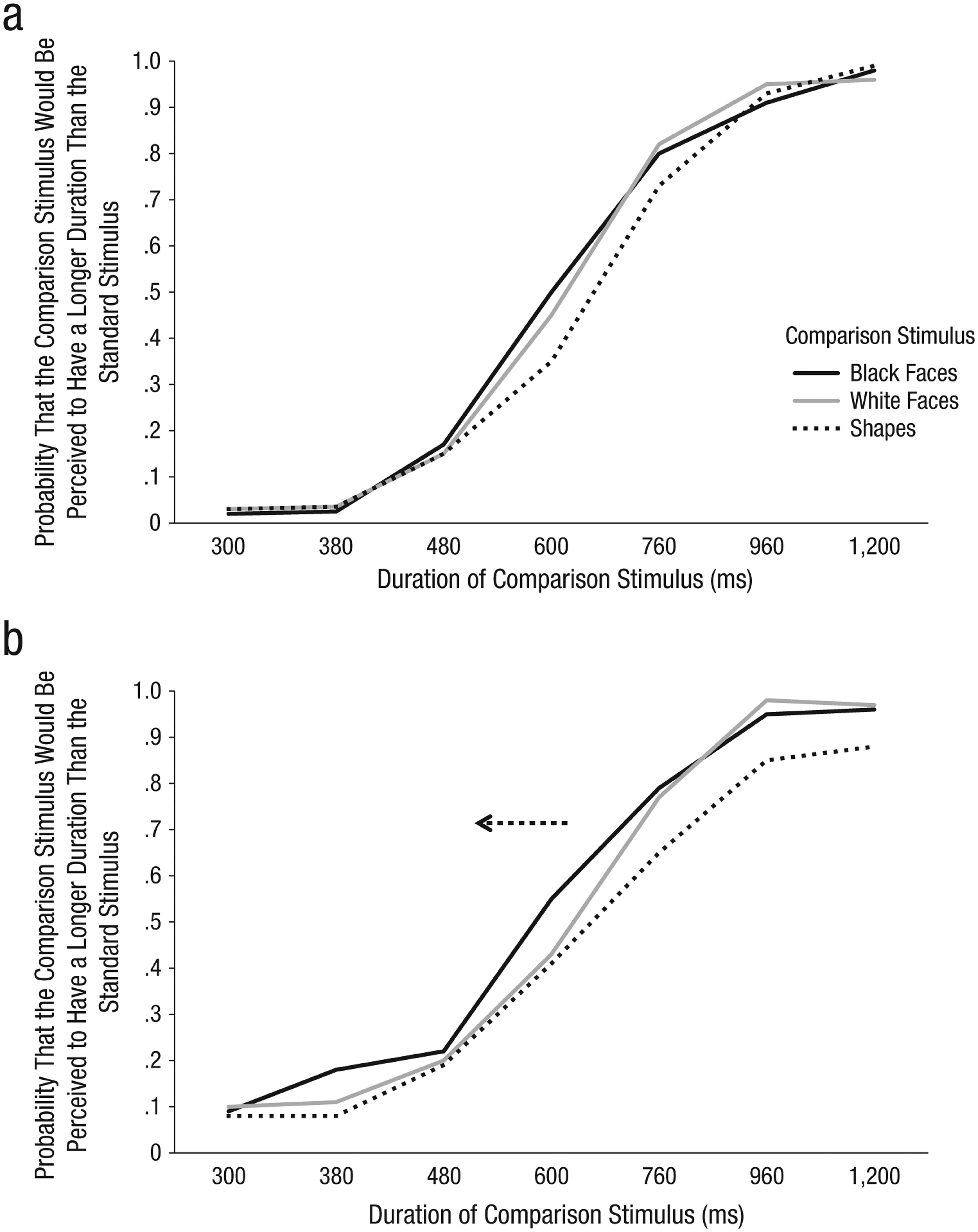
Results from Experiment 1. The probability that participants would judge a comparison stimulus to have appeared for longer than the standard duration is graphed as a function of duration of the comparison stimulus. Results for White faces, Black faces, and objects are graphed separately for (a) the group with low external motivation to control prejudice (EMCP) and (b) the group with high EMCP. The arrow in (b) highlights the direction of the leftward shift in the curve that occurs when participants perceive time to slow.
The second type of evidence of time slowing when participants perceived faces of Black men was provided by the analyses of PSE difference scores. We performed a regression analysis on PSE difference scores to examine race-based distortion of time perception as a result of EMCP. PSE difference scores between Black faces and objects and between White faces and objects were entered into the regression at the same step. EMCP scores were expressed as a continuous variable. A significant relationship emerged between EMCP and PSE difference scores between Black faces and objects, β = −0.60, t(37) = −2.4, p < .03. No relationship was found between EMCP and PSE difference scores between White faces and objects, β = 0.34, p > .18. Running the analyses as separate regressions similarly revealed that EMCP predicted PSE difference scores between Black faces and objects, β = −0.34, t(37) = −2.2, p < .04, but not PSE difference scores between White faces and objects, β = −0.13, p > .43. As hypothesized, we found that increases in EMCP reliably predicted a smaller PSE but only when participants were observing Black faces. That is, slowed time perception of faces relative to objects was seen only for faces of Black men and was contingent on EMCP. The greater a participant’s EMCP, the more he or she perceived time to slow when observing Black faces.
Next, we conducted an ANOVA with PSE difference score as the dependent variable and stimulus type and EMCP group as the independent variables. The predicted interaction emerged, F(1, 36) = 4.43, p < .05. When we performed the analyses using raw PSE scores (not difference scores) and controlled for object PSE by entering it as a covariate, we found the same pattern, F(1, 35) = 4.80, p < .05. The PSE was lower, as predicted, when the comparison stimulus was a Black face than when it was a White face but only for the high-EMCP group. This is illustrated in Figure 3, which shows a lowering of the PSE (71.46 ms) for responses to Black faces relative to objects, but only for the high-EMCP group. For this group, a smaller reduction in the PSE (33.93 ms) was found for White faces relative to objects. A comparison of these difference scores was reliable, t(15) = −2.37, p < .05. Indeed, for the high-EMCP group, the PSE for White faces (638 ms) did not reliably differ from the PSE for objects (672 ms), yet the PSE for Black faces was reliably smaller than each. No such differences emerged for the low-EMCP group: PSEs for Black and White faces were equally different from the PSE for objects (35 and 34 ms lower, respectively; Fig. 3).
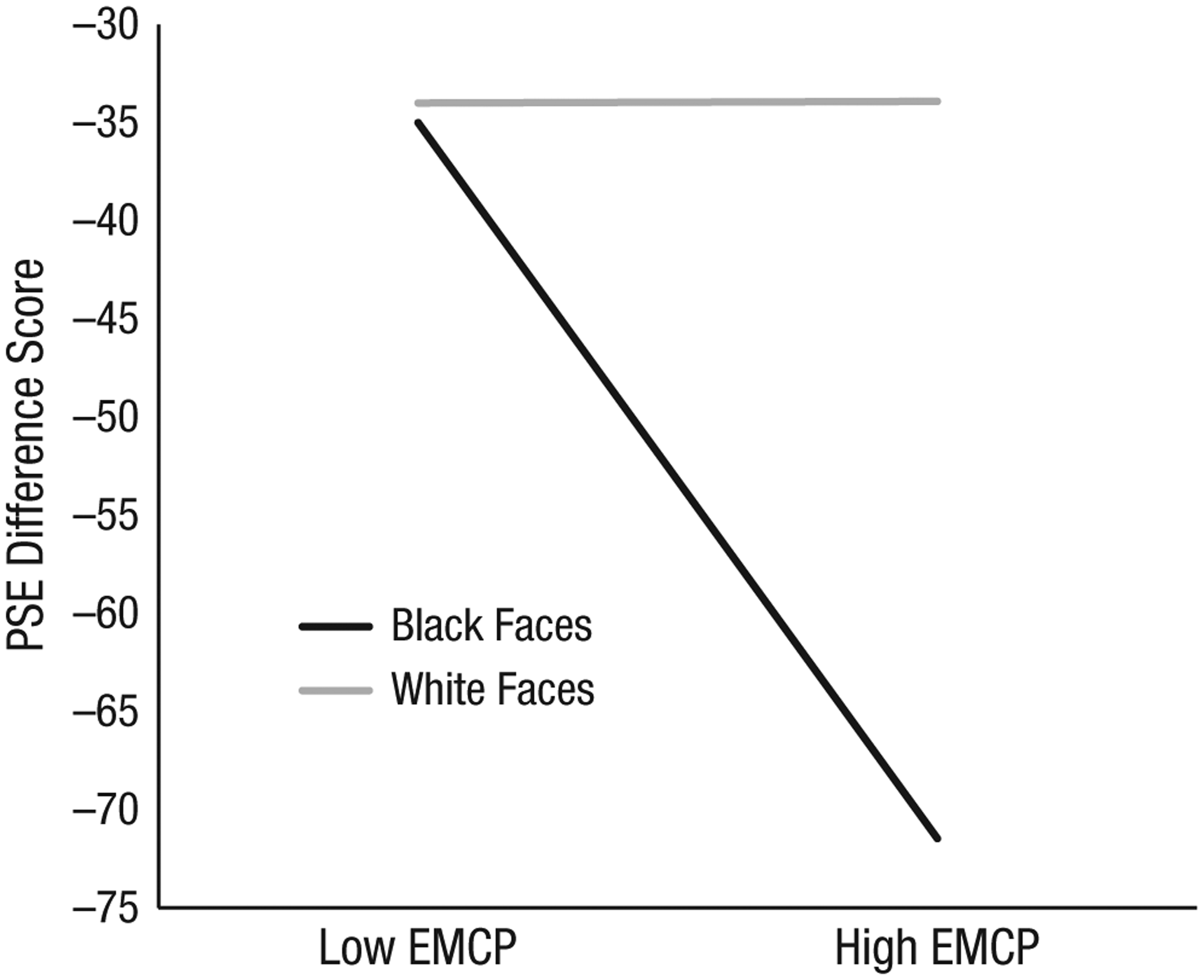
Results from Experiment 1: the difference score for point of subjective equality (PSE) for faces relative to objects. PSE difference scores were calculated as PSE for Black faces minus PSE for objects and PSE for White faces minus PSE for objects. Difference scores are graphed for the two external-motivation-to-control-prejudice (EMCP) groups, separately for Black faces and White faces.
The results show that for responses to faces of Black men relative to White men and objects, short amounts of time were mistaken for longer ones. Participants perceived a Black face to linger longer. What felt like the standard duration was in reality a significantly shorter period of time; therefore, time was perceived to slow. However, this effect is contingent on motivation. It emerged only among participants who were in the high-EMCP group.
The results supported our hypothesis that time perception slows when White Americans perceive Black faces. The greater one’s EMCP, the greater the bias in time perception. However, a temporal-discrimination task like that used in Experiment 1 is just one of several procedures used in the literature to assess time perception. Alternatively, many experiments also assess time perception using a generalization task that requires learning a standard duration through training and then judging whether the duration of comparison-stimulus presentation matches that of the standard stimulus. We used this procedure in Experiment 2 to examine the influence of race on time perception.
Experiment 2
Overview and design
A second experiment was conducted to provide convergent evidence (using a separate method of assessing time perception) for the finding from Experiment 1 that the slowing of time was associated with group-based arousal. In Experiment 2, we used a generalization task in which the participants learned a standard time during a training phase and then had to generalize it to a testing phase in which time perception was assessed. Time slowing would be manifest in the estimates of the duration for which the comparison stimuli were presented during the testing phase. We predicted that, when faces of Black men and faces of White men are presented for the same duration, faces of Black men will be perceived to have been presented longer than faces of White men. The race of faces and the duration for which they were presented was manipulated as a within-participants variable. In addition, although the results of Experiment 1 revealed no effect of gender (and this suggests that the arousal that caused time distortion was not based on gender), the participants were both men and women, which resulted in a lack of control over an important group membership—gender. That is, men were responding to faces of an in-group member, whereas women were responding to faces of an out-group member. The faces of men we used as comparison stimuli had been pretested to be of a perceived age similar to that of our participants and to have neutral emotional expression. We did this to minimize any factors that could affect responses to the images in an attempt to isolate race (as opposed to any arousal caused by thoughts of death if we presented elderly faces or anger if we presented emotional faces). Thus, to test our hypothesis more conservatively in Experiment 2, we eliminated the remaining group distinction—gender—to truly isolate race.
Method
Participants were 36 White male students (age range: 18–22 years) enrolled in the Introduction to Psychology course at Lehigh University. Participation was voluntary, and participants were compensated with a credit toward a course requirement. Two participants were dropped for failure to perform the task appropriately. The sample size was determined by a power analysis using G*power. The power analysis suggested that for a small to medium effect size, we would need between 24 and 40 participants. Thus, we decided to recruit at least 40 White male participants from the participant pool, and we included as many as we could recruit before the pool was emptied of available participants.
IMCP and EMCP were recorded as in Experiment 1, and participants were divided into high-EMCP and low-EMCP groups as in Experiment 1. To assess time perception, we used a generalization task. In Phase 1, participants had to learn to identify a standard amount of time using objects as stimuli. Objects (geometric shapes) appeared for durations ranging from 300 to 1,200 ms, and participants were asked to identify whether each object was presented for a “target time” (its duration was not specified in the instructions, but the target time was 600 ms). After each response, participants were given feedback regarding their accuracy. On 36 trials, objects were presented for 600 ms (i.e., the target duration); on another 36 trials, the duration was less than 600 ms; and on another 36 trials, the duration was greater than 600 ms. Over the course of these 108 trials, the participants learned to respond “yes” to the target duration of 600 ms with high accuracy.
The participants then began Phase 2 of the experiment. On each trial, they saw an image of either an object (geometric shape) or a face for a duration of 300, 380, 480, 600, 760, 960, or 1,200 ms. Their task was to judge whether its duration matched the previously learned target time (by pressing buttons marked “yes” and “no” on the keyboard). There were six blocks of trials and 36 trials in each block (27 faces and 9 objects). On 72 of the trials, items were presented for 600 ms; another 72 trials were divided equally among durations of 300, 380, and 480 ms; and a final 72 trials were divided equally among durations of 760, 960, and 1,200 ms. The race of the faces was manipulated as in Experiment 1. This task typically produces high accuracy at the extreme long and short durations (i.e., 300, 960, and 1,200 ms); among the remaining durations, for which the correct answer is more ambiguous, accuracy is variable. When duration is plotted on the x-axis and the percentage of “yes” responses on the y-axis, this task typically yields an inverted U-shaped curve (with most “yes” responses coming at the target duration). Slowed time perception is indicated by a leftward shift in this curve (more “yes” responses to stimuli with durations less than 600 ms and fewer “yes” responses to durations greater than 600 ms).
We analyzed whether the perception of stimuli during Phase 2 had slowed using a variable that represented the participants’ subjective perception of the duration of stimulus presentation that was equal to the target time learned in Phase 1 of the experiment. This perceived stimulus duration of 600 ms was calculated on the basis of participants’ “yes” responses to targets in Phase 2 (i.e., how they generalized the learned time from Phase 1 to new targets). This point was the peak of the inverted U-shaped curve and represented the point at which the person was most likely to say “yes, the target had the standard’s duration.” The peak score was calculated by plotting each person’s responses to each stimulus; duration of stimulus presentation was plotted on the x-axis, and the percentage of “yes” responses (i.e., the percentage of trials in which the duration of a stimulus was judged to be identical to the standard duration) was plotted on the y-axis. The data points approximated an inverted U-shaped curve, and each distribution was fit to a four-parameter Gaussian function:
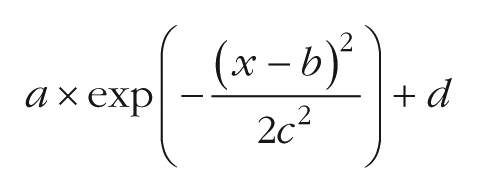
The parameter a relates to the amplitude of the curve; b represents the peak estimate of one participant’s personal curve for each stimulus type. The parameter c relates to the width of the curve, d accounts for overall rates of “yes” responding (similar to a y-intercept), and x is the duration plotted on the x-axis of the plot. Two participants produced reponses that could not be fit to the four-parameter Gaussian function, and their data was dropped from subsequent analyses.
The peak indicates which duration of target presentation is perceived to be the target time of 600 ms. If participants felt that time slowed when they perceived Black faces, the peak would be earlier (because a shorter time would feel like the target time of 600 ms) for responses to Black men than for responses to White men and objects. The time-slowing effect in this paradigm is most clearly illustrated when peaks for objects are subtracted from peaks for White faces and from peaks for Black faces. This approach treats responses to objects as a baseline. For each participant, we calculated these two types of peak difference scores. A peak for a class of stimuli (e.g., faces of Black men) lower than that found for control stimuli (geometric shapes) indicates that time has slowed for perceiving that class of stimuli. Thus, time slowing is indicated when peak difference scores between Black faces and control stimuli are reliably more negative than peak difference scores between White faces and control stimuli.
Results
The first evidence of time slowing when participants perceived faces of Black men was provided by the leftward shift of the inverted U-shaped curve that resulted when duration was plotted on the x-axis and the percentage of “yes” responses was plotted on the y-axis. The curve representing high-EMCP participants’ perception of duration of presentation of Black male faces was shifted leftward compared with their curves for White male faces and objects. However, participants low in EMCP responded to Black and White faces in an almost identical fashion. To address the statistical issue of a differential leftward shift for the three separate curves (two types of faces and geometric shapes), we conducted an ANOVA in which percentage of “yes” responses was the dependent variable, and stimulus type (Black face, White face, or object), duration (300, 380, 480, 600, 760, 960, or 1,200 ms), and EMCP (high or low) were the independent variables. The predicted three-way interaction emerged, F(12, 30) = 2.97, p < .02.
The second type of evidence of time slowing when participants perceived faces of Black men was provided by the analyses of peak scores. We performed a regression analysis on peak difference scores to examine race-based distortion of time perception as a result of EMCP. Peak difference scores between Black faces and objects and between White faces and objects were entered into the regression at the same step. EMCP scores were expressed as a continuous variable. A significant relationship emerged between EMCP and peak difference scores between Black faces and objects, β = −0.37, t(32) = −2.29, p < .05. No relationship was found between EMCP and the peak difference scores between White faces and objects, β = 0.24, p > .2. As predicted, the higher the EMCP, the lower the peak (i.e., time slowed), but this effect was reliable only when participants were responding to faces of Black men.
Next, we conducted an ANOVA with peak difference score as the dependent variable and stimulus type (a within-subjects variable) and EMCP group (a between-subjects variable) as the independent variables. The expected interaction emerged, F(1, 31) = 6.82, p < .02. When we performed the analyses using raw peak scores (rather than difference scores) and controlled for peak for objects by entering it as a covariate, we found the same pattern, F(1, 30) = 6.78, p < .02. The peak for Black faces was earlier than the peak for objects in the high-EMCP group but not in the low-EMCP group. The high- and low-EMCP groups did not have different peak scores when responding to White faces. Figure 4 illustrates that the earliest peak was for responses to Black faces in the high-EMCP group; this peak was 32.27 ms lower than the peak for objects. The corresponding peak in the low-EMCP group was 26 ms higher than the peak for objects. The PSE difference score between Black faces and objects was reliably lower for the high-EMCP group than for the low-EMCP group, t(31) = 2.71, p < .02. The peak for White faces was 17.4 ms lower than the peak for objects in the high-EMCP group and 15.7 ms lower than the peak for objects in the low-EMCP group; these peaks for White faces did not differ reliably (p > .9).
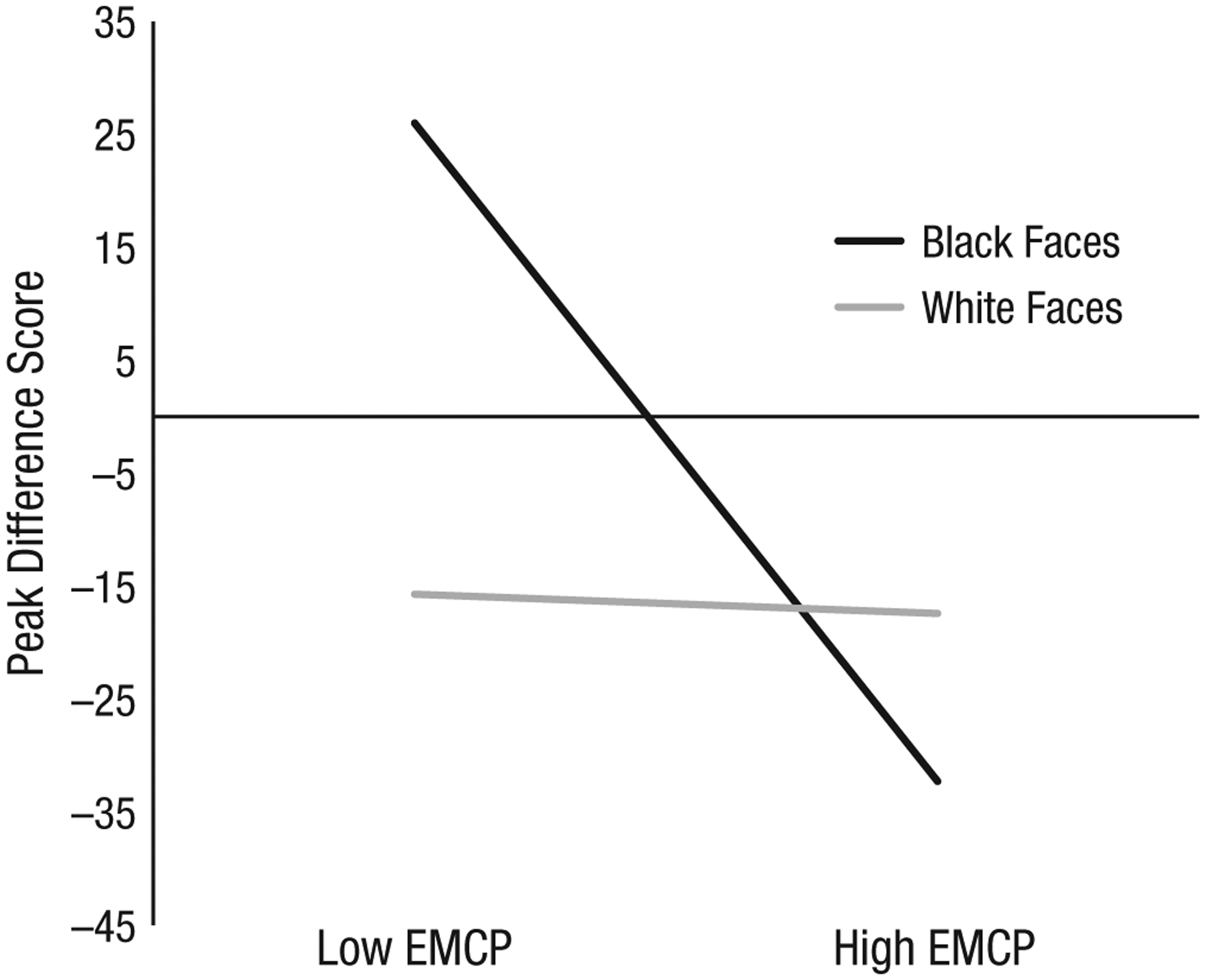
Results from Experiment 2: peak difference score for faces relative to objects (i.e., peak for faces minus peak for objects). Peak difference score is graphed for the two external-motivation-to-control-prejudice (EMCP) groups, separately for Black faces and White faces. A negative score means that the peak for a type of face was lower than the peak for objects.
As in Experiment 1, the perceptual experience of Black faces was shown to be different for people concerned with not appearing biased than for people who do not have this concern. For people in the high-EMCP group, the perception of the time a Black face was on the screen was slowed, so that a half second felt longer. No such bias in their perception of time emerged when they perceived faces of their own race or when they perceived shapes. No such bias emerged for the low-EMCP group. This finding suggests that trying to appear unbiased introduces a bias, documented for the first time in the current study: Time appears to slow for White people when they are perceiving Black people.
Conclusion
This is the first research on how and whether race affects time perception. However, complementary research on emotion-laden faces shows that faces with angry expressions are judged to be present for longer durations than faces with neutral expressions (Gil & Droit-Volet, 2011; Lee, Seelam, & O’Brien, 2011). The current research extends such work on social stimuli and time perception to the domain of racism. Together, these findings suggest that in addition to people’s ongoing concerns about appearing biased, conditions within the situation that heighten arousal—race, emotion, threat—bias time perception.
Time slowing is a particularly insidious bias because it is unintended, undetected, happens at a low level (perceptual distortion), and can affect how interactions unfold. For example, when examining patients, a doctor is trained to follow a series of steps, each of a duration tied to the doctor’s perception of when it is appropriate to shift phases. At each step, this period could arrive sooner because the perceptual experience is being slowed, and the medical visit would end sooner. It is already known that White doctors on average spend less time with Black patients than with White patients (Cooper et al., 2012). Is time perception a factor?
In many settings in which Whites are motivated to treat Blacks equitably, such as job interviews, cross-race interactions terminate sooner (e.g., Hebl, Foster, Mannix, & Dovidio, 2002). Perhaps in such interactions, it feels like one has dedicated appropriate time to the interaction when one has not because of a perceptual bias. Time slowing could also contribute to a feeling of awkwardness that often accompanies cross-race interactions because partners’ actions do not feel well coordinated. Rather than being a result of dislike or discomfort, awkwardness could merely reflect that the timing is off—the length of a conversational pause feels longer, so one ends up cutting off the partner by breaking the pause and consequently talking over them.
Perhaps most severe are the implications for time distortions in the domain of law enforcement. In 2014 alone, in Ohio (Cleveland), Missouri (Ferguson), and New York (Staten Island), officers killed unarmed Black civilians; public sentiment seemed to be that deadly force was used quicker than would be seen with White men in the same situation. Dire consequences surround an officer’s decision about when they should use deadly force. Disparities in the outcome of that decision that fall along racial lines could reflect overt racism. But such disparities could also emerge from attempts to be unbiased. The decision about when to shoot might be altered (i.e., shooting would happen sooner) if time perception slows. This is more likely to occur when goals to be unbiased exist but are motivated externally. This possibility raises questions about the logic of placing cameras on officers, which could heighten external concerns. When shootings are driven by unintended bias, then the good intent of introducing cameras might backfire if they heighten EMCP.
The bias we illustrate is subtle but not uncontrollable. We argue that its very existence arises from people attempting a specific type of control—pursuing EMCP. Thus, our research immediately points to ways in which the bias might be controlled. Goals that lower concerns about appearing biased should remove the time distortion.
Footnotes
Declaration of Conflicting Interests
The authors declared that they had no conflicts of interest with respect to their authorship or the publication of this article.