



Abstract
Distractor interference in the flanker task is commonly viewed as an outcome of unintentional, involuntary processing, a by-product of attention-controlled processing of the target. An important implication of this notion is that the distractors are not subjected to top-down processing of their own. We tested this idea in a modified version of the flanker task, in which letter targets (S or O) were sometimes flanked by ambiguous distractors (a character that could be S or 5 or one that could be O or 0). Distractor interference was dependent on participants’ expectations regarding the category of the distractors (i.e., letters or digits). For example, the O-0 distractor interfered with responding to S when it was perceived as a letter, but not when it was perceived as a digit. Hence, participants applied top-down processing to the peripheral distractors independently of the top-down processing applied to the targets. The fact that to-be-ignored peripheral distractors were processed to such a high level raises questions regarding the fundamental differences between target and distractor processing, and the quality of attentional filtering.
Keywords
The cause of flanker congruency effects and their implications for selective attention in general are still controversial despite more than 40 years of research (B. A. Eriksen & Eriksen, 1974; C. W. Eriksen & Hoffman, 1972). In the flanker task, participants make a two-choice response as to the identity of a central target letter (e.g., whether it is an S or an H). The target is flanked by two distractors. On some trials, the distractors are congruent with the target; that is, they would require the same response if they were targets (e.g., a target S flanked by Ss). On other trials, the distractors are incongruent with the target; that is, they would require the opposite response (e.g., an S flanked by Hs). On still other trials, the distractors are neutral (e.g., an S flanked by Ns). The results typically demonstrate unintentional processing of the distractors: Longer response times (RTs) when they are incongruent than when they are neutral or congruent. This congruency effect is assumed to be largely dictated by bottom-up processing, whereby features of the distractors automatically activate the representation of their associated response (e.g., B. A. Eriksen & Eriksen, 1974). Some investigators have attributed the failure to ignore the distractors to their leakage through the attentional filter, which results in their being further processed (e.g., Miller, 1991; Yantis & Johnston, 1990). More recently, a different explanation has become dominant: the possibility of a slippage of attention to the distractors as a result of imperfect attentional control (Gaspelin, Ruthruff, & Jung, 2014; Lachter, Forster, & Ruthruff, 2004).
In both accounts, distractor interference is viewed as an outcome of unintentional processing that is a by-product of target processing. Attention is directed to the central target, and the distractors are processed involuntarily. This can explain not only failure to ignore the distractors, but also the successful elimination of flanker effects in studies that have optimized attentional selection by creating conditions that enhance the distinction between the target and distractors (Lachter et al., 2004; Lavie, 1995; Miller, 1991; Paquet & Craig, 1997; Paquet & Lortie, 1990; Shiffrin, Diller, & Cohen, 1996; Yantis & Johnston, 1990; Yeh & Eriksen, 1984).
An important implication of the notion that distractor processing is involuntary and merely a “hitchhiker” of focused attentional processing is that the distractors are not subjected to top-down processing of their own. Note that in visual search, distractors may be subjected to top-down processing dictated by target processing when they capture attention because they share relevant features with the target (Folk, Remington, & Johnston, 1992; Wolfe, 1994). Indeed, researchers have eliminated (Cohen & Shoup, 1997) or reversed (Maruff, Danckert, Camplin, & Currie, 1999) flanker interference when incongruence of the distractors was defined on a task-irrelevant physical dimension. For example, in these studies, participants made one response to a specific letter and a specific color, and another response to another letter and another color. Thus, trials could be congruent in the color dimension (i.e., the target and distractors could be presented in the same color) but incongruent in the letter dimension, and vice versa. When participants knew in advance which dimension was the goal-relevant one (as in Maruff et al. and the second experiment of Cohen & Shoup), flanker interference was found only when the distractors were incongruent with the target in the relevant dimension, and not when they were incongruent with the target in the irrelevant dimension. When participants did not know the relevant dimension and thus could not apply top-down processing (as in Cohen & Shoup’s first experiment), the interference effect was not eliminated even when the target and distractors were incongruent in the irrelevant dimension.
From these studies, one might infer that the flanker effect arises because the distractors are subjected to secondary, passive, dependent processing that accompanies target processing; only the target receives top-down processing, and flanker effects are not due to active top-down processing assigned specifically to the flanking distractors. Here, we challenge this view, presenting the results of a study that was designed to test the possibility of independent, active top-down processing of distractors. We used a modified version of the flanker task in which the category of the distractors was manipulated. Participants reported whether the target, a centrally presented letter, was S or O. In one category condition, the distractors were always letters, and in the other, they were always digits. Ambiguous characters that could be read either as letters or as digits served as the critical distractors for measuring the interference effect in each category condition. By using critical displays that were visually identical in the two conditions, we were able to manipulate top-down factors while keeping bottom-up factors constant.
Experiment 1
Method
Participants
Eighteen undergraduates from Tel Aviv University participated in this experiment as part of a course requirement. All had normal or corrected-to-normal vision. Two additional participants did not complete the experiment, 1 because of a technical problem and 1 because of a personal problem.
Stimuli
A 17-in. CRT monitor was used to display the stimuli, which were presented in white on a black background. Each display contained one central target flanked by two identical distractors. The target was either the letter S or the letter O. The distractors were A, F, L, O, or S in the letters condition, and 3, 4, 5, 6, or 0 in the digits condition. Each character subtended 0.38° in width and 0.57° in height. The target and distractors were presented in a horizontal row; the target was always in the center of the display, and the center-to-center distance between the target and each distractor was 0.9°. Times New Roman font was used for the target, and two other fonts were randomly used for the distractors: Digital-7 Mono and SF Square Head Condensed. Figure 1 shows the distractor characters in these two fonts. Note that in these fonts, unlike in the font used for the targets, the letter S is exactly like the digit 5, and the letter O is exactly like the digit 0; we therefore refer to these as the S-5 and O-0 characters. This identical appearance enabled us to compare performance in different category conditions that used identical displays.

The distractor characters used in Experiments 1 and 2.
Procedure
Participants were seated in a dimly lit room, with their heads on a chin rest that was used to stabilize their viewing distance at 60 cm from the monitor. Figure 2 shows a sequence of two trials in each of the two category conditions. Each trial began with a 500-ms fixation display of a central white cross (0.2° × 0.2°) and then a 300-ms blank interval. Next, the stimulus display was presented until the participant responded. The intertrial interval was 500 ms. Participants were instructed to respond to the target letter as quickly and as accurately as possible, while ignoring the distractors. They were told to press the left “Ctrl” key with their left index finger when the target was the letter S and to press the right “Ctrl” key with their right index finger when the target was the letter O. The experiment consisted of four blocks of 288 trials each; two successive blocks were in the digits condition, and two successive blocks were in the letters condition. Each set of two blocks was preceded by 16 practice trials. Ten participants began with the letters condition, and 8 began with the digits condition. Stimulus presentation and data collection were controlled using Version 2008.1.11 of DirectRT (Empirisoft Corp., New York, NY), running on a Pentium PC.
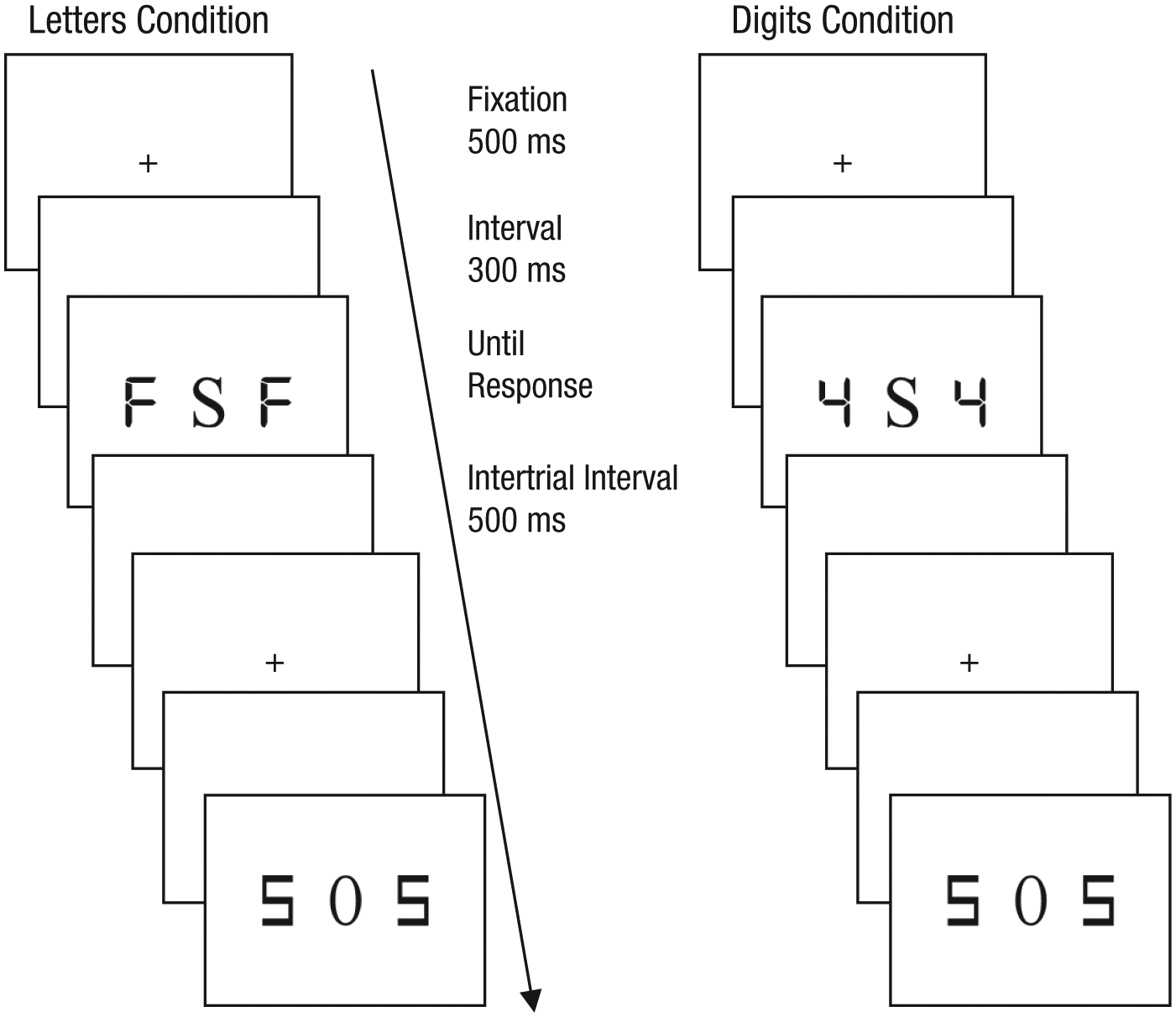
Sequences of two trials in the letters condition (left) and the digits condition (right) in Experiment 1. In each sequence, the first trial is a neutral trial, in which the flankers did not look like either of the potential targets, and the second is an incongruent trial, in which the flankers could be perceived as one of the potential targets.
Each block consisted of 216 (75%) neutral trials and 72 (25%) incongruent trials: In the neutral trials, the distractors were the unambiguous characters that were not associated with either response: the letters A, F, and L in the letters condition and the digits 3, 4, and 6 in the digits condition (e.g., the target S might be flanked by Fs in the letters condition and by 4s in the digits condition). In the incongruent trials, the distractors were the ambiguous characters: S-5 and O-0; in their interpretation as letters, these characters were always incongruent with the target (i.e., the target S was flanked by O-0 distractors, and the target O was flanked by S-5 distractors). Within each trial type in each block, the various display types were equally frequent; trials were randomly intermixed within each block. Overall, the experiment included four conditions resulting from the joint manipulation of category and congruency, both of which were manipulated within participants. The instructions preceding each block specified the category of the distractors; thus, the category condition—letters or digits—was quickly and effectively established. (This conclusion is supported by a pilot test of the procedure, which showed no differences in the pattern of results between the first and second sets of blocks.)
We did not include congruent trials but assessed distractor processing by comparing responses in incongruent trials and neutral trials. Numerous flanker studies over the years have found no consistent differences between performance in congruent trials and performance in neutral trials (e.g., C. W. Eriksen & St. James, 1986; Lavie, 1995; Lavie & de Fockert, 2003; Miller, 1991). Consequently, various studies have included either neutral trials or congruent trials for comparisons with incongruent trials. In the present study, we used neutral trials because we had to establish the categorical context of either letters or digits.
Results
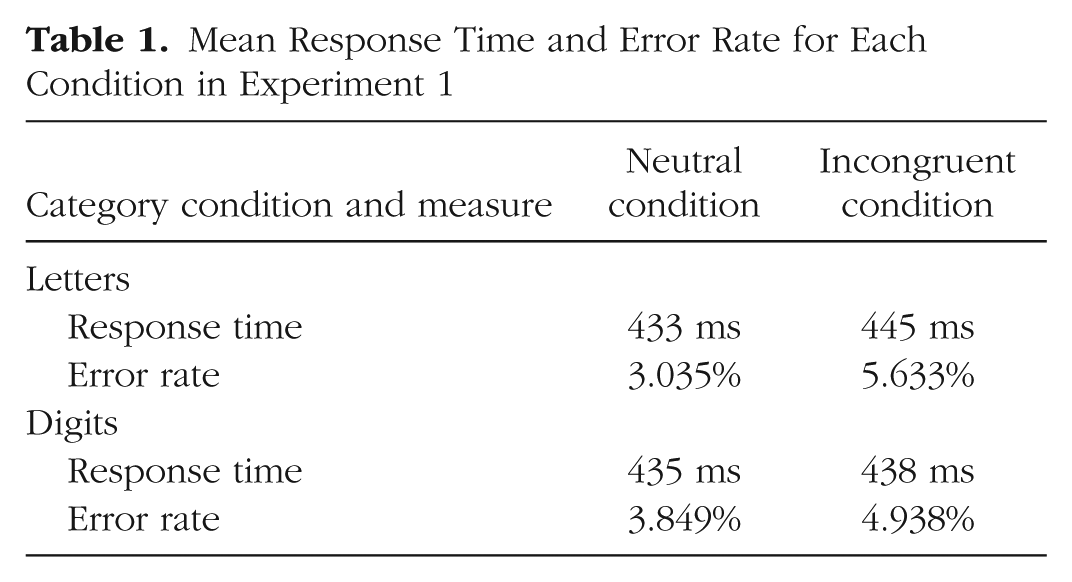
Table 1 presents the mean RTs and error rates for the four conditions. Trials with incorrect responses and those with RTs more than 2 standard deviations from the mean were removed from the RT analyses.
Mean Response Time and Error Rate for Each Condition in Experiment 1
Response times
A Category (letters vs. digits) × Incongruency (neutral vs. incongruent) repeated measures analysis of variance (ANOVA) performed on mean RTs revealed a significant main effect of incongruency, F(1, 17) = 15.646, p = .001; participants responded faster when the distractors were neutral than when they were incongruent with the target. The main effect of category did not reach significance, F(1, 17) = 0.268, p > .6. Of most interest is the significant interaction between category and incongruency, F(1, 17) = 9.305, p = .007, which was clarified by further analyses of the simple effects: Participants responded faster in neutral trials than in incongruent trials in the letters condition, F(1, 17) = 30.444, p < .00005, but not in the digits condition, F(1, 17) = 1.006, p > .3. These results suggest that in the letters condition, participants interpreted the ambiguous distractors S-5 and O-0 as letters (i.e., as the letters S and O), which made the distractors incongruent with the targets and consequently increased RTs. In the digits condition, on the other hand, participants interpreted the ambiguous S-5 as the digit 5 and the ambiguous O-0 as the digit 0, essentially treating these items as neutral distractors unrelated to the targets; therefore, there was no incongruency effect.
Note that only the displays in the incongruent trials were visually identical in the two category conditions; the displays in the neutral trials differed between the category conditions because they included unambiguous letter distractors in the letters condition and unambiguous digit distractors in the digits condition. Hence, the interference effects were based on identical items in the incongruent condition but different items in the neutral condition. The fact that no significant differences were found between RTs in the neutral trials in the letters condition and RTs in the neutral trials in the digits condition, F(1, 17) = 0.193, p > .6, rules out the possibility that the results reported in the previous paragraph were due to bottom-up differences between the displays in the letters and digits conditions. In addition, no significant differences were found between RTs in the incongruent trials in the letters condition and RTs in the incongruent trials in the digits condition, F(1, 17) = 1.652, p > .2. This result, together with the result for the neutral conditions, indicates that the letters and digits did not differ in processing difficulty.
Finally, it should be noted that the identity of the target letter (S vs. O) interacted neither with category, F(1, 17) = 0.003, p > .9, nor with incongruency, F(1, 17) = 0.143, p > .7.
Error rates
A Category (letters vs. digits) × Incongruency (neutral vs. incongruent) repeated measures ANOVA performed on the accuracy data revealed a significant main effect of incongruency, F(1, 17) = 23.314, p = .0002; the error rate was higher when the target and distractors were incongruent than when they were neutral. Neither the main effect of category, F(1, 17) = 0.018, p > .8, nor the interaction between category and incongruency, F(1, 17) = 2.448, p > .1, approached significance, so a speed-accuracy trade-off can be ruled out. As in the RT analyses, the simple effect of incongruency reached significance in the letters condition, F(1, 17) = 18.358, p = .0005, but not in the digits condition, F(1, 17) = 3.050, p = .099.
Finally, it should be noted that the identity of the target letter (S vs. O) interacted neither with category, F(1, 17) = 1.357, p > .2, nor with incongruency, F(1, 17) = 0.369, p > .5.
Experiment 2
Our second experiment was designed to ensure that the interaction obtained in the first experiment was indeed due to the ambiguity of the critical distractors rather than overall bias induced by the letter or digit category. Thus, the ambiguous distractors were replaced with unambiguous letters in both category conditions. If the interaction observed in the first experiment was produced by category-induced bias, then the same interaction would be expected in Experiment 2 because the overall bias was preserved. If, however, the pattern of results observed in the first experiment stemmed from the ambiguity of the distractors, then the interaction would be eliminated in the absence of ambiguous distractors.
Method
Participants
Twelve undergraduates from Tel Aviv University participated in this experiment as part of a course requirement. All had normal or corrected-to-normal vision.
Stimuli and procedure
The ambiguity of the critical distractors was eliminated by replacing the ambiguous characters with nonambiguous letters. In order to do so, we used two new fonts for the distractors: Calibri and Nyala. Both depict the letter S unambiguously, so it could not be read as the digit 5. The other target letter had to be replaced because it is not possible to easily distinguish between the letter O and the digit 0 in any font. We therefore replaced the target letter O (and the O-0 distractors) with the visually similar letter D. The bottom panel in Figure 1 shows the distractors used in this experiment. In all other respects, including the use of Times New Roman font for the targets, Experiment 2 was identical to Experiment 1. Thus, in the letters condition, the target letters S and D were flanked by unambiguous incongruent letters D and S, respectively, or by neutral letters, and in the digits condition, in this case more appropriately called the digits-plus-letters condition, the same target letters S and D were flanked by the same unambiguous incongruent letters or by neutral digits.
Results
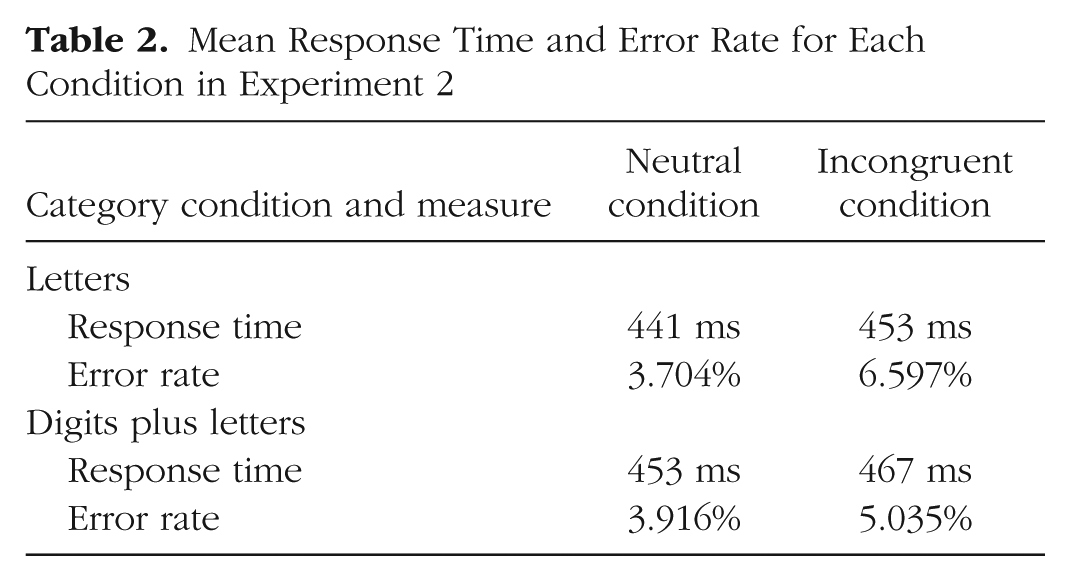
Table 2 presents the mean RTs and error rates for the four conditions. Trials with incorrect responses and those with RTs more than 2 standard deviations from the mean were removed from the RT analyses.
Mean Response Time and Error Rate for Each Condition in Experiment 2
Response times
A Category (letters vs. digits plus letters) × Incongruency (neutral vs. incongruent) repeated measures ANOVA performed on mean RTs revealed a significant main effect of incongruency, F(1, 11) = 17.961, p = .001; participants responded faster when the distractors were neutral than when they were incongruent with the target. The main effect of category also reached significance, F(1, 11) = 6.119, p = .031; participants responded faster in the letters condition than in the digits-plus-letters condition. Most important, unlike in Experiment 1, the interaction between category and incongruency was not significant, F(1, 11) = 0.076, p > .7. The simple effects of incongruency reached significance: Participants responded faster in neutral trials than in incongruent trials in both the letters condition, F(1, 11) = 15.869, p = .002, and the digits-plus-letters condition, F(1, 11) = 7.837, p = .017.
Error rates
A Category (letters vs. digits plus letters) × Incongruency (neutral vs. incongruent) repeated measures ANOVA performed on the accuracy data revealed a significant main effect of incongruency, F(1, 11) = 11.401, p = .006; the error rate was higher when the target and distractors were incongruent than when they were neutral. Neither the main effect of category, F(1, 11) = 0.813, p > .3, nor the interaction between category and incongruency, F(1, 11) = 3.370, p > .09, approached significance, so a speed-accuracy trade-off can be ruled out. The simple effect of incongruency reached significance in the letters condition, F(1, 11) = 10.907, p = .007, but not in the digits-plus-letters condition, F(1, 11) = 3.085, p > .1.
General Discussion
The results of Experiment 1 showed that when participants responded to target letters, the same ambiguous letter-digit flanking distractors produced interference when participants expected them to be letters, but not when they expected them to be digits. The reduction of flanker interference in the digits condition, obtained by manipulating only expectations regarding the distractors category without changing the physical features in the allegedly incongruent displays, indicates that participants applied top-down processing to the distractors independently of top-down processing pertaining to the target. Moreover, the observed interference effect in the digits-plus-letters condition of Experiment 2, in which the critical distractors were unambiguous letters, further substantiates our account that the results of Experiment 1 can be attributed to the ambiguity of the critical distractors.
The nature of the displays we used substantiates our interpretation that the distractors received active top-down processing. That is, their processing was not a by-product of attention-controlled processing of the target, nor some form of general passive priming induced by the letters or digits category. It should be emphasized that throughout Experiment 1, the targets were always letters—either S or O. Most important, this was the case not only in the letters condition, but also in the digits condition. Thus, in the digits condition, the processing of the targets as letters should have produced top-down resistance to processing the ambiguous distractors as digits. If something was primed, it was probably the set of the target letters more than anything else. The finding that perception of the ambiguous S-5 and O-0 distractors was not biased by the target set and these characters were not perceived as letters in the digits condition make it implausible that the flanker interference in the letters condition and its absence in the digits condition were due to passive category priming. If the distractors had been passively processed, the pattern of results most probably would have corresponded to priming of the target letters.
It should be further noted that unlike in experiments in which participants take advantage of a consistent target-distractor relationship (e.g., Miller, 1987; Paquet & Craig, 1997; Paquet & Lortie, 1990; Schmidt & Dark, 1998), in the present study there was no incentive to process the distractors, which had no informational value: The category of the targets was always letters, the category of the distractors was fixed within each block and known to participants, and there was no correlation between the identities of the targets and distractors.
Previous accounts of distractor processing would predict either no top-down effects on distractor processing or a top-down biasing of distractor processing toward the letters category in our experiments. That is, if the processing system attempted to ignore the distractors, there would be no top-down effects, and distractor processing would be driven only by bottom-up factors. Or if the target-related top-down processing spilled over to the distractors, there would be a top-down biasing of distractor processing toward the letters category because the targets were always letters. However, our findings confirm neither of these predictions. Instead, the results clearly show differential top-down effects in the letters and digits conditions, as a result of differential expectations regarding the distractor category.
The independent top-down processing of the distractors that we observed is inconsistent with the common belief that the processing system attempts to ignore distractors at all stages of processing. The results suggest that the distractors were processed to a higher level than expected, as the system attempted to identify the distractors as well as the targets. Our findings are neither expected from nor compatible with common views regarding perceptual and attentional processing in general, and distractors processing in the flanker task in particular. Although the notion of active allocation of attention to distractors seems inconsistent with the view that the system tends to inhibit interfering distractors, there are several studies that have shown that attention is actively allocated to expected locations of distractors (e.g., Tsal & Makovski, 2006) and that distractor items are initially attended at an early processing stage, before they can be actively inhibited (Humphreys, Stalmann, & Olivers, 2004; Moher & Egeth, 2012).
In a well-known study, Jonides and Gleitman (1972) also used the ambiguity of the letter O/digit 0 to study the effects of conceptual categories on visual processing. They showed that RTs in visual search were independent of display size when targets and distractors were from different categories (but not when they were from the same category). More important, this effect was also obtained when ambiguous O-0 characters were the targets and participants were simply informed either that the target was the letter O or that the target was the digit 0. Search for the expected target letter or digit was efficient when it was embedded in a display of items from a different category but not when it was embedded in a display of items from the same category. A major difference between this study and the present one should be noted, however. Jonides and Gleitman showed the effects of conceptual category on target processing, whereas our study demonstrated the effects of conceptual category on processing of to-be-ignored distractors.
As reviewed in the introduction, according to common views, flanker interference is the outcome of unintentional, involuntary processing, and any processing of distractors is passive in the sense that it is due to automatic data-driven processes or goal-driven processes that are based on information regarding the target’s attributes. According to these views, no distractor-based top-down processes ought to be involved in flanker effects (e.g., C. W. Eriksen, 1995; Pashler, 1998).
At first sight, the present pattern of results seems to be in accordance with current interactive theories of perception, which propose feedback mechanisms that enable higher-level processes to influence low-level visual representations (e.g., Di Lollo, Enns, & Rensink, 2000; Gilbert & Sigman, 2007; Kveraga, Ghuman, & Bar, 2007; Lupyan, Thompson-Schill, & Swingley, 2010). However, these theories postulate (although not always explicitly) that those feedback processes are aimed at facilitating target processing, whereas our findings strongly suggest that the same top-down processes applied to the targets were also applied to the flanking distractors. The fact that to-be-ignored peripheral distractors can receive deep and complex processing raises questions regarding the fundamental differences between target and distractor processing, the quality of attentional filtering, and its locus in the processing stream.
Future studies should investigate why active processing is applied to to-be-ignored distractors (e.g., Tsal & Makovski, 2006). One possibility is that the attentional system does not act fully in accordance with task instructions, as processing priorities may also be dictated by task-irrelevant phylogenetic evolution and ontogenetic history, which may bias the processing system to respond to stimuli that suggest a potential need for immediate action. Some processing priorities that were crucial for survival in ancient times may have become completely obsolete but may still continue to modulate behavior at all times (e.g., New, Cosmides, & Tooby, 2007; Öhman, Flykt, & Esteves, 2001). Keeping some resources available for monitoring the environment for expected objects in addition to performing the task at hand provides a far greater survival value than allocation of all resources to the target. Hence, some distractor processing during focused attention may reflect the default function of the attentional system rather than the failure of selective attention to ignore irrelevant distractors.
Footnotes
Action Editor
Philippe G. Schyns served as the action editor for this article.
Declaration of Conflicting Interests
The authors declared that they had no conflicts of interest with respect to their authorship or the publication of this article.